AUDIOGRAPHY
UNIT - 2
PREPARED BY
SANKARANARAYANAN K. B
ASST. PROFESSOR
DEPARTMENT OF VISUAL COMMUNICATION
NEHRU ARTS AND SCIENCE COLLEGE(Autonomous)
COIMBATORE
Expected outcomes
 Students will be able to understand about the
various microphones used in different media.
 Students will be able to remember the working
pattern and directionality of different microphone
types.
 Students will be able to choose the microphones
according to the purpose of recording.
 Students know about the basic types, and
characteristics of each microphone.
SYLLABUS – Unit 2
 Microphones-Type, Characteristics, design,
Applications, techniques, Patterns. Loudspeaker-
Types, designs, Application, Crossover, Amplifiers-
Amplifications, Preamplifier, VCA, DCA Concept,
Power Amplifiers, Impedance amplifier, Types, Uses,
Characteristics. Signal Processor-Dynamic Processor,
Time-dependent processor, multiple effect
processors, Concept of plug-in, Side chaining
analogue v/s digital processors. Cables and
Connectors-XLR, TRS, TRRS, TS, RCA, SPDIP, AES/EBU
and fiber optic Cables and Connectors.
Introduction
 Microphones are used in many applications
such as telephones, hearing aids, public
address systems for concert halls and public
events, motion picture production, live and
recorded audio engineering, sound recordings
etc. Its one of the most important part in the
audio chain. The different types of
microphones are used for different
applications. Lets us see one by one…..
Microphones
 A microphone, colloquially named mic is a device – a transducer – that
converts sound into an electrical signal. Microphones are used in many
applications such as telephones, hearing aids, public address systems for
concert halls and public events, motion picture production, live and
recorded audio engineering, sound recording, two-way
radios, megaphones, radio and television broadcasting, and in computers
for recording voice, speech recognition, VoIP, and for non-acoustic purposes
such as ultrasonic sensors.
 The first microphone that enabled proper voice telephony was the (loose-
contact) carbon microphone. This was independently developed by David
Edward Hughes in England and Emile Berliner and Thomas Edison in the US.
Inside a Microphone
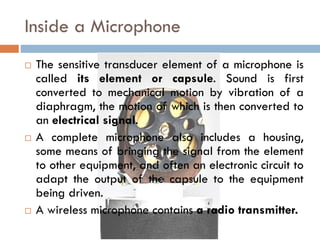
 The sensitive transducer element of a microphone is
called its element or capsule. Sound is first
converted to mechanical motion by vibration of a
diaphragm, the motion of which is then converted to
an electrical signal.
 A complete microphone also includes a housing,
some means of bringing the signal from the element
to other equipment, and often an electronic circuit to
adapt the output of the capsule to the equipment
being driven.
 A wireless microphone contains a radio transmitter.
Types of Microphones
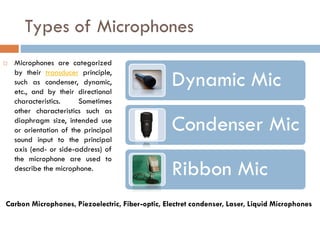
 Microphones are categorized
by their transducer principle,
such as condenser, dynamic,
etc., and by their directional
characteristics. Sometimes
other characteristics such as
diaphragm size, intended use
or orientation of the principal
sound input to the principal
axis (end- or side-address) of
the microphone are used to
describe the microphone.
Dynamic Mic
Condenser Mic
Ribbon Mic
Carbon Microphones, Piezoelectric, Fiber-optic, Electret condenser, Laser, Liquid Microphones
Dynamic Mic
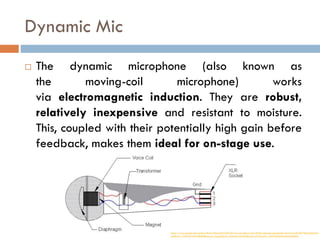
 The dynamic microphone (also known as
the moving-coil microphone) works
via electromagnetic induction. They are robust,
relatively inexpensive and resistant to moisture.
This, coupled with their potentially high gain before
feedback, makes them ideal for on-stage use.
https://www.google.com/url?sa=i&url=https%3A%2F%2Fwww.terralec.co.uk%2FMicrophones.aspx&psig=AOvVaw2KwRU7Pkiweyh56sHr
vdH&ust=1592047456108000&source=images&cd=vfe&ved=0CA0QjhxqFwoTCIDctpKV_OkCFQAAAAAdAAAAABA3
Dynamic Mic
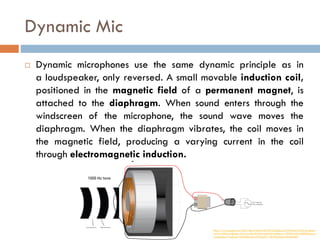
 Dynamic microphones use the same dynamic principle as in
a loudspeaker, only reversed. A small movable induction coil,
positioned in the magnetic field of a permanent magnet, is
attached to the diaphragm. When sound enters through the
windscreen of the microphone, the sound wave moves the
diaphragm. When the diaphragm vibrates, the coil moves in
the magnetic field, producing a varying current in the coil
through electromagnetic induction.
https://www.google.com/url?sa=i&url=https%3A%2F%2Fgiphy.com%2Fstickers%2Fmicrophone
UuW1l47hGuTo4&psig=AOvVaw2KwRU7Pkiweyh56sHrvdH&ust=1592047456108000&source
=images&cd=vfe&ved=0CA0QjhxqFwoTCIDctpKV_OkCFQAAAAAdAAAAABAt
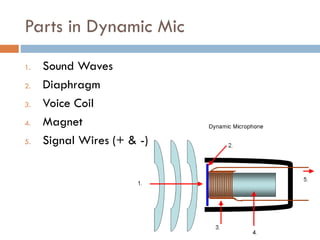
Parts in Dynamic Mic
1. Sound Waves
2. Diaphragm
3. Voice Coil
4. Magnet
5. Signal Wires (+ & -)
Condenser Mic
 The condenser microphone, invented at Western Electric
in 1916 by E. C. Wente is also called a capacitor
microphone or electrostatic microphone—capacitors
were historically called condensers.
 Here, the diaphragm acts as one plate of a capacitor,
and the vibrations produce changes in the distance
between the plates.
 There are two types, depending on the method of
extracting the audio signal from the transducer: DC-
biased microphones, and radio frequency (RF) or high
frequency (HF) condenser microphones.
Condenser Mic
 Condenser microphones span the range from telephone
transmitters through inexpensive karaoke microphones to
high-fidelity recording microphones. They generally produce
a high-quality audio signal and are now the popular choice
in laboratory and recording studio applications.
 They require a power source, provided either via
microphone inputs on equipment as phantom power or from
a small battery. Power is necessary for establishing the
capacitor plate voltage and is also needed to power the
microphone electronics
 A valve microphone is a condenser microphone that uses
a vacuum tube (valve) amplifier. They remain popular with
enthusiasts of tube sound.
https://www.google.com/url?sa=i&url=https%3A%2F%2Fpixabay.com%2Fphotos%2Faudio-condenser-
microphonemusic1844798%2F&psig=AOvVaw0G424TmxJGRsc_ZIayabXC&ust=1592049123048000&so
urce=images&cd=vfe&ved=0CAIQjRxqFwoTCPCKpLCb_OkCFQAAAAAdAAAAABAD
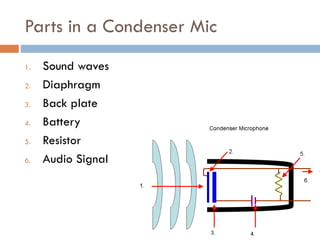
Parts in a Condenser Mic
1. Sound waves
2. Diaphragm
3. Back plate
4. Battery
5. Resistor
6. Audio Signal
Ribbon Mic
 Ribbon microphones use a thin, usually corrugated
metal ribbon suspended in a magnetic field. The
ribbon is electrically connected to the microphone's
output, and its vibration within the magnetic field
generates the electrical signal. Ribbon microphones
are similar to moving coil microphones in the sense
that both produce sound by means of magnetic
induction.
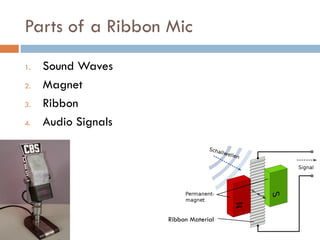
Parts of a Ribbon Mic
1. Sound Waves
2. Magnet
3. Ribbon
4. Audio Signals
Ribbon Material
Microphones
 Characteristics
 Design
 Applications
 Techniques
 Directional Patterns.
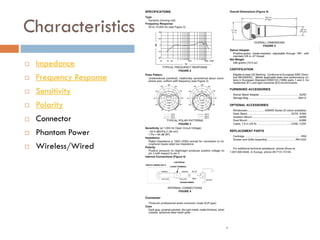
Characteristics
 Impedance
 Frequency Response
 Sensitivity
 Polarity
 Connector
 Phantom Power
 Wireless/Wired
Impedance
 Impedance measures the amount of opposition a
device has to an AC current. The Unit of Impedance
is ohms and is represented with the Greek omega
symbol Ω.
 All microphones will be rated with an impedance,
this may be written on the microphone itself or on
the specification sheet of microphone. The two
general classifications for microphone impedance.
 Low Impedance 200 - 1000 Ω
 High Impedance 10k – 50k Ω
Frequency Response
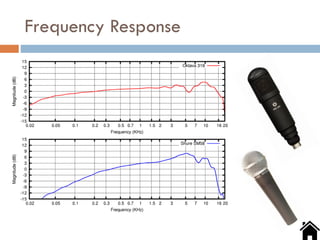
 The Frequency response refers to the way a
microphone act in response to different frequencies. It
is the feature of all microphones that some
frequencies are embellished and others are
attenuated. A frequency response which favor higher
frequencies means that the resulting audio output will
have more higher end frequencies (Treble) than the
original sound.
Frequency Response
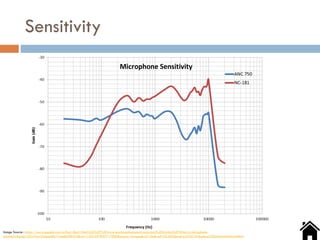
Sensitivity
 Microphone sensitivity is measured with a 1 kHz sine
wave at 94 dB (SPL).
 Sensitivity, the ratio of the analog output voltage or
digital output value to the input pressure.
 The amount of the analog or digital output signal
from the microphone with that input stimulus is a
measure of its sensitivity.
Sensitivity
Image Source : https://www.google.com/url?sa=i&url=http%3A%2F%2Fwww.learningaboutelectronics.com%2FArticles%2FWhat-is-microphone-
sensitivity&psig=AOvVaw3XsIjuadEbYYesh6HX8WN&ust=1592397859717000&source=images&cd=vfe&ved=0CA0QjhxqFwoTCKCWtbuuhuoCFQAAAAAdAAAAABAJ
Polarity
 Polarity, when it comes to recording, means having
the speaker move in the same direction that
the mic membrane originally moved. For example,
if you put a mic in front of a kick drum and the
drummer plays the kick, the head initially moves
toward the listener in front of the drum.
 For More Info Visit:
https://www.sweetwater.com/insync/polarity-does-it-really-
matter/#:~:text=Polarity%2C%20when%20it%20comes%20to,in%20front%20of%20the%20drum.
Polar Patterns (Directional response)
 A microphone's directionality or polar pattern
indicates how sensitive it is to sounds arriving at
different angles about its central axis. How the
physical body of the microphone is oriented relative
to the diagrams depends on the microphone design.
 Some microphone designs combine several
principles in creating the desired polar pattern. This
ranges from shielding (meaning
diffraction/dissipation/absorption) by the housing
itself to electronically combining dual membranes.
Video
Polar Patterns (Directional response)
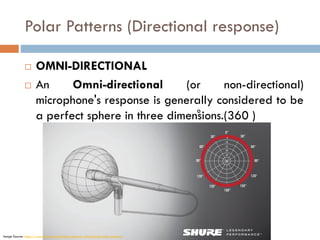
 OMNI-DIRECTIONAL
 An Omni-directional (or non-directional)
microphone's response is generally considered to be
a perfect sphere in three dimensions.(360 )
Image Source: https://www.shure.eu/musicians/discover/educational/polar-patterns
Polar Patterns (Directional response)
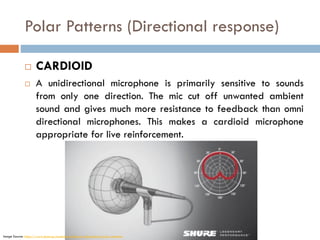
 CARDIOID
 A unidirectional microphone is primarily sensitive to sounds
from only one direction. The mic cut off unwanted ambient
sound and gives much more resistance to feedback than omni
directional microphones. This makes a cardioid microphone
appropriate for live reinforcement.
Image Source: https://www.shure.eu/musicians/discover/educational/polar-patterns
Polar Patterns (Directional response)
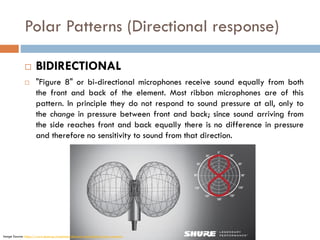
 BIDIRECTIONAL
 "Figure 8" or bi-directional microphones receive sound equally from both
the front and back of the element. Most ribbon microphones are of this
pattern. In principle they do not respond to sound pressure at all, only to
the change in pressure between front and back; since sound arriving from
the side reaches front and back equally there is no difference in pressure
and therefore no sensitivity to sound from that direction.
Image Source: https://www.shure.eu/musicians/discover/educational/polar-patterns
Other Polar Patterns (Directional
response)
 Hyper-cardioid
 Super-cardioid
 Sub-cardioid
Polar Patterns (Directional response)
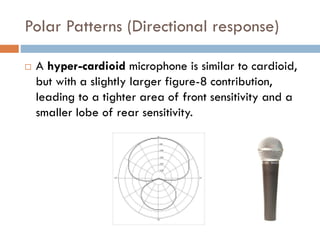
 A hyper-cardioid microphone is similar to cardioid,
but with a slightly larger figure-8 contribution,
leading to a tighter area of front sensitivity and a
smaller lobe of rear sensitivity.
Polar Patterns (Directional response)
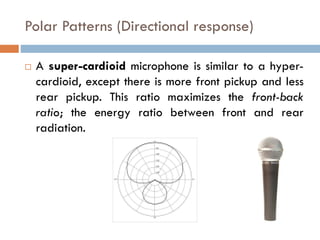
 A super-cardioid microphone is similar to a hyper-
cardioid, except there is more front pickup and less
rear pickup. This ratio maximizes the front-back
ratio; the energy ratio between front and rear
radiation.
Polar Patterns (Directional response)
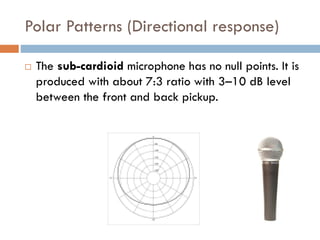
 The sub-cardioid microphone has no null points. It is
produced with about 7:3 ratio with 3–10 dB level
between the front and back pickup.
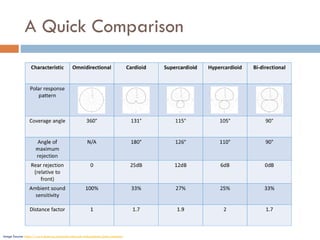
A Quick Comparison
Image Source: https://www.shure.eu/musicians/discover/educational/polar-patterns
Application-specific designs
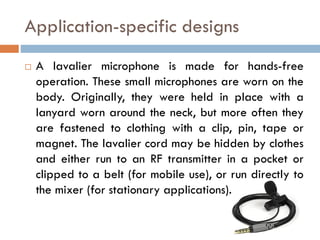
 A lavalier microphone is made for hands-free
operation. These small microphones are worn on the
body. Originally, they were held in place with a
lanyard worn around the neck, but more often they
are fastened to clothing with a clip, pin, tape or
magnet. The lavalier cord may be hidden by clothes
and either run to an RF transmitter in a pocket or
clipped to a belt (for mobile use), or run directly to
the mixer (for stationary applications).
Contact microphone
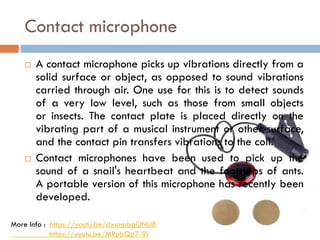
 A contact microphone picks up vibrations directly from a
solid surface or object, as opposed to sound vibrations
carried through air. One use for this is to detect sounds
of a very low level, such as those from small objects
or insects. The contact plate is placed directly on the
vibrating part of a musical instrument or other surface,
and the contact pin transfers vibrations to the coil.
 Contact microphones have been used to pick up the
sound of a snail's heartbeat and the footsteps of ants.
A portable version of this microphone has recently been
developed.
More Info : https://youtu.be/dxsmpbgONU8
https://youtu.be/MRpjsQp7-9I
Throat microphone
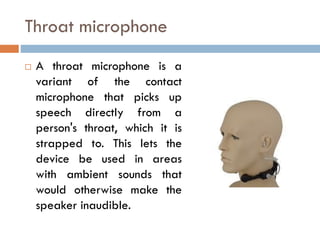
 A throat microphone is a
variant of the contact
microphone that picks up
speech directly from a
person's throat, which it is
strapped to. This lets the
device be used in areas
with ambient sounds that
would otherwise make the
speaker inaudible.
Parabolic microphone
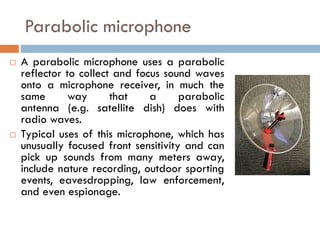
 A parabolic microphone uses a parabolic
reflector to collect and focus sound waves
onto a microphone receiver, in much the
same way that a parabolic
antenna (e.g. satellite dish) does with
radio waves.
 Typical uses of this microphone, which has
unusually focused front sensitivity and can
pick up sounds from many meters away,
include nature recording, outdoor sporting
events, eavesdropping, law enforcement,
and even espionage.
Wireless microphone
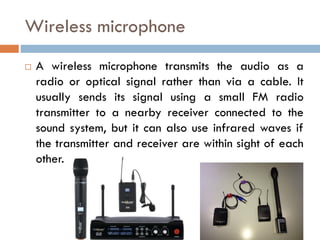
 A wireless microphone transmits the audio as a
radio or optical signal rather than via a cable. It
usually sends its signal using a small FM radio
transmitter to a nearby receiver connected to the
sound system, but it can also use infrared waves if
the transmitter and receiver are within sight of each
other.
Noise-canceling microphone
 A noise-canceling microphone is a highly directional
design intended for noisy environments. One such use
is in aircraft cockpits where they are normally
installed as boom microphones on headsets. Another
use is in live event support on loud concert stages for
vocalists involved with live performances.
 Many noise-canceling microphones combine signals
received from two diaphragms that are in opposite
electrical polarity or are processed electronically. A
few noise-canceling microphones are throat
microphones
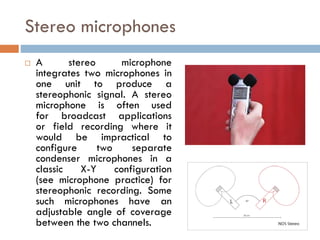
Stereo microphones
 A stereo microphone
integrates two microphones in
one unit to produce a
stereophonic signal. A stereo
microphone is often used
for broadcast applications
or field recording where it
would be impractical to
configure two separate
condenser microphones in a
classic X-Y configuration
(see microphone practice) for
stereophonic recording. Some
such microphones have an
adjustable angle of coverage
between the two channels.
MCQs / Assessment
 Multiple Choice Questions Link will be shared in
Quizziz.com
Model Question :
 What is the operating principle of a transducer in Moving Coil
Microphone?
a) Electromagnetic Induction b) Electrostatic Principle
c) None of the Above d) Both a & b
Summary
 Microphones are devices that are used for
recording sounds for various application. They are
mainly of 3 types, Dynamic, Ribbon and
Condenser. The main characteristics of microphones
are its impedance, frequency response, polarity,
sensitivity and directional response.
 Microphones are used for different kind of
applications according to their type, design, and
polar patterns.
Points to Remember
 Microphone is a transducer that converts acoustical
energy to electrical energy.
 Microphones are of different types: its
differentiated according to its design, polar
response, make and characteristics.
 There are three main type of polar patterns :
Unidirectional, bi directional and omni-directional.
 Application-specific microphones are used for
specific purposes of recording.
Source for Reference
 https://www.shure.eu/musicians/discover/education
al#!page-teaser-782efe2c#all
 https://www.shure.eu/musicians/discover/education
al/microphone-directionality-polar-pattern-basics
 https://www.shure.eu/videos/events/webinars/shur
e-webinar-microphone-techniques-for-mobile-
recording
Introduction of Next Session
 Loudspeakers
 Loudspeaker Types and Design
 Application
 Parts of Loudspeaker
 Crossover
Thank You
SANKARANARAYANAN K. B
ASST. PROFESSOR
DEPARTMENT OF VISUAL COMMUNICATION
NEHRU ARTS AND SCIENCE COLLEGE(Autonomous)
COIMBATORE
Mail Id: nascsankaranarayanan@nehrucolleges.com

Microphones-Type, Characteristics, design, Applications, techniques, Patterns

  • 1.
    AUDIOGRAPHY UNIT - 2 PREPAREDBY SANKARANARAYANAN K. B ASST. PROFESSOR DEPARTMENT OF VISUAL COMMUNICATION NEHRU ARTS AND SCIENCE COLLEGE(Autonomous) COIMBATORE
  • 2.
    Expected outcomes  Studentswill be able to understand about the various microphones used in different media.  Students will be able to remember the working pattern and directionality of different microphone types.  Students will be able to choose the microphones according to the purpose of recording.  Students know about the basic types, and characteristics of each microphone.
  • 3.
    SYLLABUS – Unit2  Microphones-Type, Characteristics, design, Applications, techniques, Patterns. Loudspeaker- Types, designs, Application, Crossover, Amplifiers- Amplifications, Preamplifier, VCA, DCA Concept, Power Amplifiers, Impedance amplifier, Types, Uses, Characteristics. Signal Processor-Dynamic Processor, Time-dependent processor, multiple effect processors, Concept of plug-in, Side chaining analogue v/s digital processors. Cables and Connectors-XLR, TRS, TRRS, TS, RCA, SPDIP, AES/EBU and fiber optic Cables and Connectors.
  • 4.
    Introduction  Microphones areused in many applications such as telephones, hearing aids, public address systems for concert halls and public events, motion picture production, live and recorded audio engineering, sound recordings etc. Its one of the most important part in the audio chain. The different types of microphones are used for different applications. Lets us see one by one…..
  • 5.
    Microphones  A microphone,colloquially named mic is a device – a transducer – that converts sound into an electrical signal. Microphones are used in many applications such as telephones, hearing aids, public address systems for concert halls and public events, motion picture production, live and recorded audio engineering, sound recording, two-way radios, megaphones, radio and television broadcasting, and in computers for recording voice, speech recognition, VoIP, and for non-acoustic purposes such as ultrasonic sensors.  The first microphone that enabled proper voice telephony was the (loose- contact) carbon microphone. This was independently developed by David Edward Hughes in England and Emile Berliner and Thomas Edison in the US.
  • 6.
    Inside a Microphone The sensitive transducer element of a microphone is called its element or capsule. Sound is first converted to mechanical motion by vibration of a diaphragm, the motion of which is then converted to an electrical signal.  A complete microphone also includes a housing, some means of bringing the signal from the element to other equipment, and often an electronic circuit to adapt the output of the capsule to the equipment being driven.  A wireless microphone contains a radio transmitter.
  • 7.
    Types of Microphones Microphones are categorized by their transducer principle, such as condenser, dynamic, etc., and by their directional characteristics. Sometimes other characteristics such as diaphragm size, intended use or orientation of the principal sound input to the principal axis (end- or side-address) of the microphone are used to describe the microphone. Dynamic Mic Condenser Mic Ribbon Mic Carbon Microphones, Piezoelectric, Fiber-optic, Electret condenser, Laser, Liquid Microphones
  • 8.
    Dynamic Mic  Thedynamic microphone (also known as the moving-coil microphone) works via electromagnetic induction. They are robust, relatively inexpensive and resistant to moisture. This, coupled with their potentially high gain before feedback, makes them ideal for on-stage use. https://www.google.com/url?sa=i&url=https%3A%2F%2Fwww.terralec.co.uk%2FMicrophones.aspx&psig=AOvVaw2KwRU7Pkiweyh56sHr vdH&ust=1592047456108000&source=images&cd=vfe&ved=0CA0QjhxqFwoTCIDctpKV_OkCFQAAAAAdAAAAABA3
  • 9.
    Dynamic Mic  Dynamicmicrophones use the same dynamic principle as in a loudspeaker, only reversed. A small movable induction coil, positioned in the magnetic field of a permanent magnet, is attached to the diaphragm. When sound enters through the windscreen of the microphone, the sound wave moves the diaphragm. When the diaphragm vibrates, the coil moves in the magnetic field, producing a varying current in the coil through electromagnetic induction. https://www.google.com/url?sa=i&url=https%3A%2F%2Fgiphy.com%2Fstickers%2Fmicrophone UuW1l47hGuTo4&psig=AOvVaw2KwRU7Pkiweyh56sHrvdH&ust=1592047456108000&source =images&cd=vfe&ved=0CA0QjhxqFwoTCIDctpKV_OkCFQAAAAAdAAAAABAt
  • 10.
    Parts in DynamicMic 1. Sound Waves 2. Diaphragm 3. Voice Coil 4. Magnet 5. Signal Wires (+ & -)
  • 11.
    Condenser Mic  Thecondenser microphone, invented at Western Electric in 1916 by E. C. Wente is also called a capacitor microphone or electrostatic microphone—capacitors were historically called condensers.  Here, the diaphragm acts as one plate of a capacitor, and the vibrations produce changes in the distance between the plates.  There are two types, depending on the method of extracting the audio signal from the transducer: DC- biased microphones, and radio frequency (RF) or high frequency (HF) condenser microphones.
  • 12.
    Condenser Mic  Condensermicrophones span the range from telephone transmitters through inexpensive karaoke microphones to high-fidelity recording microphones. They generally produce a high-quality audio signal and are now the popular choice in laboratory and recording studio applications.  They require a power source, provided either via microphone inputs on equipment as phantom power or from a small battery. Power is necessary for establishing the capacitor plate voltage and is also needed to power the microphone electronics  A valve microphone is a condenser microphone that uses a vacuum tube (valve) amplifier. They remain popular with enthusiasts of tube sound. https://www.google.com/url?sa=i&url=https%3A%2F%2Fpixabay.com%2Fphotos%2Faudio-condenser- microphonemusic1844798%2F&psig=AOvVaw0G424TmxJGRsc_ZIayabXC&ust=1592049123048000&so urce=images&cd=vfe&ved=0CAIQjRxqFwoTCPCKpLCb_OkCFQAAAAAdAAAAABAD
  • 13.
    Parts in aCondenser Mic 1. Sound waves 2. Diaphragm 3. Back plate 4. Battery 5. Resistor 6. Audio Signal
  • 14.
    Ribbon Mic  Ribbonmicrophones use a thin, usually corrugated metal ribbon suspended in a magnetic field. The ribbon is electrically connected to the microphone's output, and its vibration within the magnetic field generates the electrical signal. Ribbon microphones are similar to moving coil microphones in the sense that both produce sound by means of magnetic induction.
  • 15.
    Parts of aRibbon Mic 1. Sound Waves 2. Magnet 3. Ribbon 4. Audio Signals Ribbon Material
  • 16.
    Microphones  Characteristics  Design Applications  Techniques  Directional Patterns.
  • 17.
    Characteristics  Impedance  FrequencyResponse  Sensitivity  Polarity  Connector  Phantom Power  Wireless/Wired
  • 18.
    Impedance  Impedance measuresthe amount of opposition a device has to an AC current. The Unit of Impedance is ohms and is represented with the Greek omega symbol Ω.  All microphones will be rated with an impedance, this may be written on the microphone itself or on the specification sheet of microphone. The two general classifications for microphone impedance.  Low Impedance 200 - 1000 Ω  High Impedance 10k – 50k Ω
  • 19.
    Frequency Response  TheFrequency response refers to the way a microphone act in response to different frequencies. It is the feature of all microphones that some frequencies are embellished and others are attenuated. A frequency response which favor higher frequencies means that the resulting audio output will have more higher end frequencies (Treble) than the original sound.
  • 20.
  • 21.
    Sensitivity  Microphone sensitivityis measured with a 1 kHz sine wave at 94 dB (SPL).  Sensitivity, the ratio of the analog output voltage or digital output value to the input pressure.  The amount of the analog or digital output signal from the microphone with that input stimulus is a measure of its sensitivity.
  • 22.
    Sensitivity Image Source :https://www.google.com/url?sa=i&url=http%3A%2F%2Fwww.learningaboutelectronics.com%2FArticles%2FWhat-is-microphone- sensitivity&psig=AOvVaw3XsIjuadEbYYesh6HX8WN&ust=1592397859717000&source=images&cd=vfe&ved=0CA0QjhxqFwoTCKCWtbuuhuoCFQAAAAAdAAAAABAJ
  • 23.
    Polarity  Polarity, whenit comes to recording, means having the speaker move in the same direction that the mic membrane originally moved. For example, if you put a mic in front of a kick drum and the drummer plays the kick, the head initially moves toward the listener in front of the drum.  For More Info Visit: https://www.sweetwater.com/insync/polarity-does-it-really- matter/#:~:text=Polarity%2C%20when%20it%20comes%20to,in%20front%20of%20the%20drum.
  • 24.
    Polar Patterns (Directionalresponse)  A microphone's directionality or polar pattern indicates how sensitive it is to sounds arriving at different angles about its central axis. How the physical body of the microphone is oriented relative to the diagrams depends on the microphone design.  Some microphone designs combine several principles in creating the desired polar pattern. This ranges from shielding (meaning diffraction/dissipation/absorption) by the housing itself to electronically combining dual membranes. Video
  • 25.
    Polar Patterns (Directionalresponse)  OMNI-DIRECTIONAL  An Omni-directional (or non-directional) microphone's response is generally considered to be a perfect sphere in three dimensions.(360 ) Image Source: https://www.shure.eu/musicians/discover/educational/polar-patterns
  • 26.
    Polar Patterns (Directionalresponse)  CARDIOID  A unidirectional microphone is primarily sensitive to sounds from only one direction. The mic cut off unwanted ambient sound and gives much more resistance to feedback than omni directional microphones. This makes a cardioid microphone appropriate for live reinforcement. Image Source: https://www.shure.eu/musicians/discover/educational/polar-patterns
  • 27.
    Polar Patterns (Directionalresponse)  BIDIRECTIONAL  "Figure 8" or bi-directional microphones receive sound equally from both the front and back of the element. Most ribbon microphones are of this pattern. In principle they do not respond to sound pressure at all, only to the change in pressure between front and back; since sound arriving from the side reaches front and back equally there is no difference in pressure and therefore no sensitivity to sound from that direction. Image Source: https://www.shure.eu/musicians/discover/educational/polar-patterns
  • 28.
    Other Polar Patterns(Directional response)  Hyper-cardioid  Super-cardioid  Sub-cardioid
  • 29.
    Polar Patterns (Directionalresponse)  A hyper-cardioid microphone is similar to cardioid, but with a slightly larger figure-8 contribution, leading to a tighter area of front sensitivity and a smaller lobe of rear sensitivity.
  • 30.
    Polar Patterns (Directionalresponse)  A super-cardioid microphone is similar to a hyper- cardioid, except there is more front pickup and less rear pickup. This ratio maximizes the front-back ratio; the energy ratio between front and rear radiation.
  • 31.
    Polar Patterns (Directionalresponse)  The sub-cardioid microphone has no null points. It is produced with about 7:3 ratio with 3–10 dB level between the front and back pickup.
  • 32.
    A Quick Comparison ImageSource: https://www.shure.eu/musicians/discover/educational/polar-patterns
  • 33.
    Application-specific designs  Alavalier microphone is made for hands-free operation. These small microphones are worn on the body. Originally, they were held in place with a lanyard worn around the neck, but more often they are fastened to clothing with a clip, pin, tape or magnet. The lavalier cord may be hidden by clothes and either run to an RF transmitter in a pocket or clipped to a belt (for mobile use), or run directly to the mixer (for stationary applications).
  • 34.
    Contact microphone  Acontact microphone picks up vibrations directly from a solid surface or object, as opposed to sound vibrations carried through air. One use for this is to detect sounds of a very low level, such as those from small objects or insects. The contact plate is placed directly on the vibrating part of a musical instrument or other surface, and the contact pin transfers vibrations to the coil.  Contact microphones have been used to pick up the sound of a snail's heartbeat and the footsteps of ants. A portable version of this microphone has recently been developed. More Info : https://youtu.be/dxsmpbgONU8 https://youtu.be/MRpjsQp7-9I
  • 35.
    Throat microphone  Athroat microphone is a variant of the contact microphone that picks up speech directly from a person's throat, which it is strapped to. This lets the device be used in areas with ambient sounds that would otherwise make the speaker inaudible.
  • 36.
    Parabolic microphone  Aparabolic microphone uses a parabolic reflector to collect and focus sound waves onto a microphone receiver, in much the same way that a parabolic antenna (e.g. satellite dish) does with radio waves.  Typical uses of this microphone, which has unusually focused front sensitivity and can pick up sounds from many meters away, include nature recording, outdoor sporting events, eavesdropping, law enforcement, and even espionage.
  • 37.
    Wireless microphone  Awireless microphone transmits the audio as a radio or optical signal rather than via a cable. It usually sends its signal using a small FM radio transmitter to a nearby receiver connected to the sound system, but it can also use infrared waves if the transmitter and receiver are within sight of each other.
  • 38.
    Noise-canceling microphone  Anoise-canceling microphone is a highly directional design intended for noisy environments. One such use is in aircraft cockpits where they are normally installed as boom microphones on headsets. Another use is in live event support on loud concert stages for vocalists involved with live performances.  Many noise-canceling microphones combine signals received from two diaphragms that are in opposite electrical polarity or are processed electronically. A few noise-canceling microphones are throat microphones
  • 39.
    Stereo microphones  Astereo microphone integrates two microphones in one unit to produce a stereophonic signal. A stereo microphone is often used for broadcast applications or field recording where it would be impractical to configure two separate condenser microphones in a classic X-Y configuration (see microphone practice) for stereophonic recording. Some such microphones have an adjustable angle of coverage between the two channels.
  • 40.
    MCQs / Assessment Multiple Choice Questions Link will be shared in Quizziz.com Model Question :  What is the operating principle of a transducer in Moving Coil Microphone? a) Electromagnetic Induction b) Electrostatic Principle c) None of the Above d) Both a & b
  • 41.
    Summary  Microphones aredevices that are used for recording sounds for various application. They are mainly of 3 types, Dynamic, Ribbon and Condenser. The main characteristics of microphones are its impedance, frequency response, polarity, sensitivity and directional response.  Microphones are used for different kind of applications according to their type, design, and polar patterns.
  • 42.
    Points to Remember Microphone is a transducer that converts acoustical energy to electrical energy.  Microphones are of different types: its differentiated according to its design, polar response, make and characteristics.  There are three main type of polar patterns : Unidirectional, bi directional and omni-directional.  Application-specific microphones are used for specific purposes of recording.
  • 43.
    Source for Reference https://www.shure.eu/musicians/discover/education al#!page-teaser-782efe2c#all  https://www.shure.eu/musicians/discover/education al/microphone-directionality-polar-pattern-basics  https://www.shure.eu/videos/events/webinars/shur e-webinar-microphone-techniques-for-mobile- recording
  • 44.
    Introduction of NextSession  Loudspeakers  Loudspeaker Types and Design  Application  Parts of Loudspeaker  Crossover
  • 45.
    Thank You SANKARANARAYANAN K.B ASST. PROFESSOR DEPARTMENT OF VISUAL COMMUNICATION NEHRU ARTS AND SCIENCE COLLEGE(Autonomous) COIMBATORE Mail Id: nascsankaranarayanan@nehrucolleges.com