Consumer Electronics – EC E02
1
Loudspeakers and Microphones
Mr. Lenin. SB
Dept. of ECE
Associate Professor
SMVEC
2
Unit- 1
Content
Loudspeakers
• Crystal Loudspeaker,
• Dynamic Loudspeaker,
• Electrostatic loudspeaker,
• Permanent Magnet Loudspeaker,
• Woofers and
• Tweeters.
Microphones
• Microphone Characteristics,
• Crystal Microphone,
• Carbon Microphones,
• Dynamic Microphones and
• Wireless Microphones.
3
Text Books
1. S.P.Bali,―Consumer Electronics, Pearson
Education, 2005.
2. Jochen Schiller, Mobile Communications, 2nd
Edition, Addison-Wesley, 2001.
Introduction
• Consumer electronics or home electronics (i.e. analog or
digital) are equipment intended for everyday use, typically in
homes.
• Consumer electronics include devices such as
– Entertainment (flat screen TVs, DVD players, video games, remote
control cars, etc.),
– Communications (telephones, cell phones, e-mail-capable laptops,
etc.), and
– Home-office activities (e.g., desktop computers, printers etc.)
4
History
5
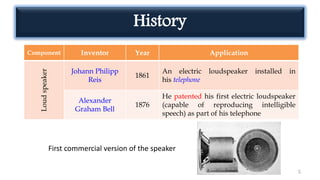
Component Inventor Year Application
Loudspeaker
Johann Philipp
Reis
1861
An electric loudspeaker installed in
his telephone
Alexander
Graham Bell
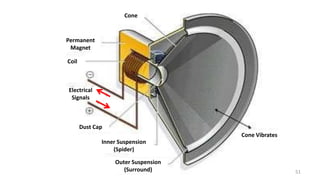
1876
He patented his first electric loudspeaker
(capable of reproducing intelligible
speech) as part of his telephone
First commercial version of the speaker
Loudspeaker
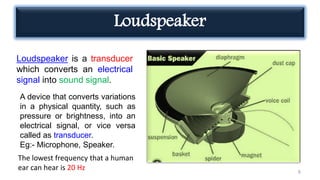
Loudspeaker is a transducer
which converts an electrical
signal into sound signal.
6
A device that converts variations
in a physical quantity, such as
pressure or brightness, into an
electrical signal, or vice versa
called as transducer.
Eg:- Microphone, Speaker.
The lowest frequency that a human
ear can hear is 20 Hz
7
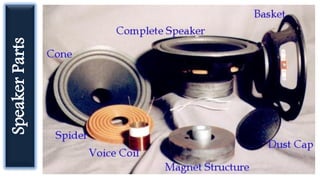
SpeakerParts
Characteristics
• There are a number of interrelated factors that must be considered in
designing transducer for converting electrical energy into acoustic
energy.
– sound travel fastest in Steel and cannot travel through a vacuum
• These include
• Electroacoustic efficiency,
• Uniformity of frequency response,
• Linearity of amplitude response,
• Transient response,
• Power handling capacity,
• Size,
• Durability and
• Cost. 8
IdealLoudspeaker
• Would have an electroacoustic efficiency approaching 100 per cent.
• Would have an acoustic output response that is independent of
frequency over the entire audible range.
• Would introduce neither harmonic nor intermodulation distortion
into its output.
• Would faithfully reproduce transients as well as steady input signals.
• Would be capable of producing a nondirectional radiation.
No single transducer has been designed that is capable of satisfying all the
above requirements.
9
Note
• A loudspeaker must be able to reproduce a wide range of audio frequencies
(i.e., 20 Hz to 20 kHz).
• Sound wave has two main characteristics, which are Pitch and loudness
10
11
CrossSectionView
12
Cont.
13
working
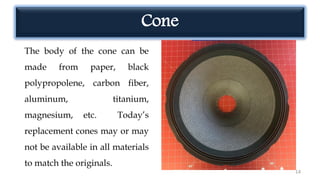
Cone
14
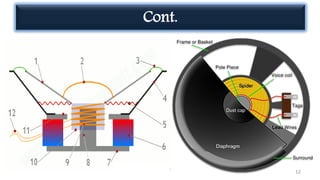
The body of the cone can be
made from paper, black
polypropolene, carbon fiber,
aluminum, titanium,
magnesium, etc. Today’s
replacement cones may or may
not be available in all materials
to match the originals.
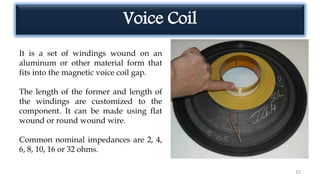
Voice Coil
15
It is a set of windings wound on an
aluminum or other material form that
fits into the magnetic voice coil gap.
The length of the former and length of
the windings are customized to the
component. It can be made using flat
wound or round wound wire.
Common nominal impedances are 2, 4,
6, 8, 10, 16 or 32 ohms.
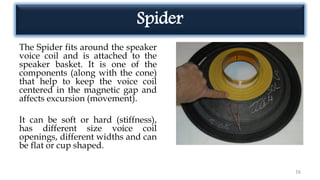
Spider
The Spider fits around the speaker
voice coil and is attached to the
speaker basket. It is one of the
components (along with the cone)
that help to keep the voice coil
centered in the magnetic gap and
affects excursion (movement).
It can be soft or hard (stiffness),
has different size voice coil
openings, different widths and can
be flat or cup shaped.
16
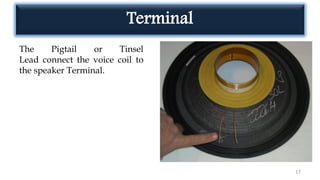
Terminal
The Pigtail or Tinsel
Lead connect the voice coil to
the speaker Terminal.
17
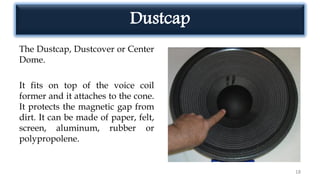
Dustcap
The Dustcap, Dustcover or Center
Dome.
It fits on top of the voice coil
former and it attaches to the cone.
It protects the magnetic gap from
dirt. It can be made of paper, felt,
screen, aluminum, rubber or
polypropolene.
18
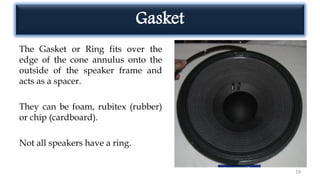
Gasket
The Gasket or Ring fits over the
edge of the cone annulus onto the
outside of the speaker frame and
acts as a spacer.
They can be foam, rubitex (rubber)
or chip (cardboard).
Not all speakers have a ring.
19
20
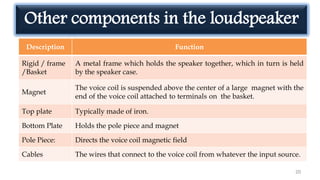
Description Function
Rigid / frame
/Basket
A metal frame which holds the speaker together, which in turn is held
by the speaker case.
Magnet
The voice coil is suspended above the center of a large magnet with the
end of the voice coil attached to terminals on the basket.
Top plate Typically made of iron.
Bottom Plate Holds the pole piece and magnet
Pole Piece: Directs the voice coil magnetic field
Cables The wires that connect to the voice coil from whatever the input source.
Other components in the loudspeaker
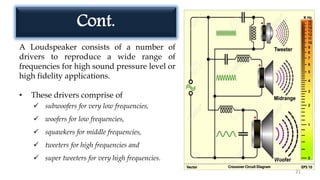
Cont.
A Loudspeaker consists of a number of
drivers to reproduce a wide range of
frequencies for high sound pressure level or
high fidelity applications.
• These drivers comprise of
 subwoofers for very low frequencies,
 woofers for low frequencies,
 squawkers for middle frequencies,
 tweeters for high frequencies and
 super tweeters for very high frequencies.
21
22
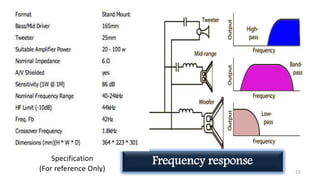
Frequency responseSpecification
(For reference Only)
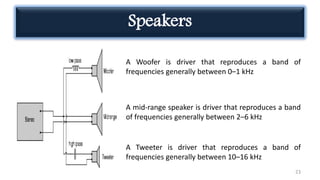
Speakers
23
A Woofer is driver that reproduces a band of
frequencies generally between 0–1 kHz
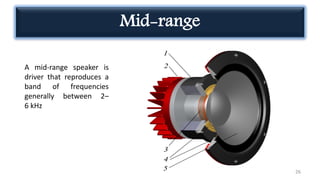
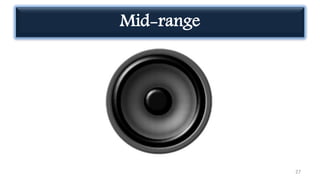
A mid-range speaker is driver that reproduces a band
of frequencies generally between 2–6 kHz
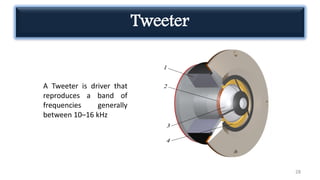
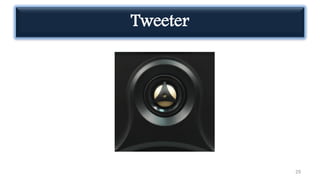
A Tweeter is driver that reproduces a band of
frequencies generally between 10–16 kHz
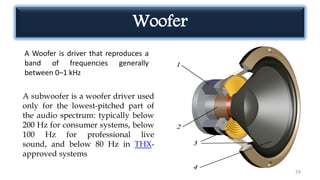
Woofer
24
A Woofer is driver that reproduces a
band of frequencies generally
between 0–1 kHz
A subwoofer is a woofer driver used
only for the lowest-pitched part of
the audio spectrum: typically below
200 Hz for consumer systems, below
100 Hz for professional live
sound, and below 80 Hz in THX-
approved systems
25
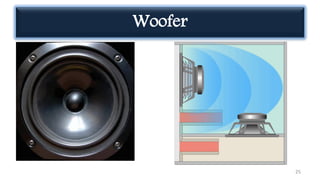
Woofer
Mid-range
26
A mid-range speaker is
driver that reproduces a
band of frequencies
generally between 2–
6 kHz
27
Mid-range
Tweeter
28
A Tweeter is driver that
reproduces a band of
frequencies generally
between 10–16 kHz
29
Tweeter
30
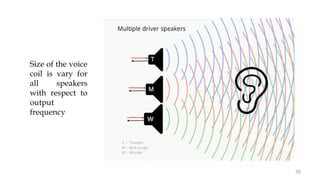
Size of the voice
coil is vary for
all speakers
with respect to
output
frequency
Cont.
• Two mostly used loud speaker is
– Dynamic
– Horn
• The speaker system itself can be divided into 3 functional parts
– Electromagnetic
– Mechanical
– Acoustic
31
Cont.
• The electromagnetic part consisting of the Voice coil and the field magnet.
Audio frequency electric current in the coil causes mechanical motion of the
cone or diaphragm on which it is mounted. This part is often referred to as
the driver or motor of the system.
32
Cont.
• The mechanical part, in which the driving coil is usually mounted and
which is set into mechanical motion by the audio frequency electrical
current in the driving coil.
• The acoustic part, which transmits the sound energy developed by the
mechanical part of the area served by the system in the most efficient and
faithful manner.
33
Note
• A low value of impedance tells us that the air moves easily in response to
an applied pressure (low pressure, high velocity), and a high value of
impedance tells us that it is hard to move (high pressure, low velocity).
• Manufacturers of loudspeakers give us a nominal impedance of 4, 6, 8
ohms as this is the dominant characteristic.
• Most loudspeakers have a power response that drops 10dB to 20dB from
low to high frequencies.
34
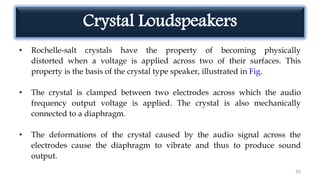
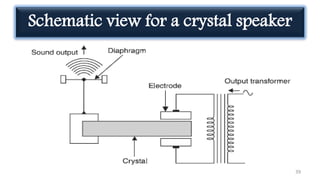
Crystal Loudspeakers
• Rochelle-salt crystals have the property of becoming physically
distorted when a voltage is applied across two of their surfaces. This
property is the basis of the crystal type speaker, illustrated in Fig.
• The crystal is clamped between two electrodes across which the audio
frequency output voltage is applied. The crystal is also mechanically
connected to a diaphragm.
• The deformations of the crystal caused by the audio signal across the
electrodes cause the diaphragm to vibrate and thus to produce sound
output.
35
Cont.
36
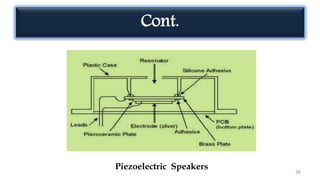
Piezoelectric Speakers
Cont.
• Piezoelectric speakers are frequently used as beepers in watches and other electronic
devices, and are sometimes used as tweeters in less-expensive speaker systems, such
as computer speakers and portable radios.
• Piezoelectric speakers have several advantages over conventional loudspeakers: they
are resistant to overloads that would normally destroy most high frequency drivers,
and they can be used without a crossover due to their electrical properties.
• There are also disadvantages: some amplifiers can oscillate when driving capacitive
loads like most piezoelectrics, which results in distortion or damage to the amplifier.
• This is why they are generally used in single frequency (beeper) or non-critical
applications.
37
38
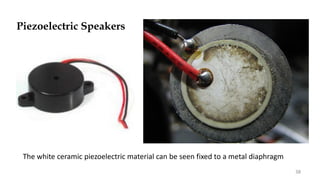
The white ceramic piezoelectric material can be seen fixed to a metal diaphragm
Piezoelectric Speakers
Schematic view for a crystal speaker
39
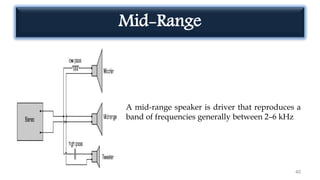
Mid-Range
40
A mid-range speaker is driver that reproduces a
band of frequencies generally between 2–6 kHz
41
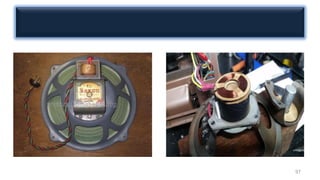
Permanent magnet Loud speaker
(Moving Coil)
• Function
• Working
• Advantages
• Disadvantages
• Applications
Permanent magnet Loud speaker
(Moving Coil)
Permanent magnet Loud speaker
(Moving Coil)
Function
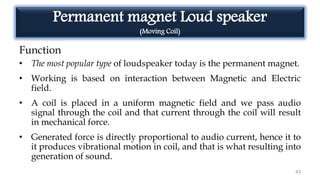
• The most popular type of loudspeaker today is the permanent magnet.
• Working is based on interaction between Magnetic and Electric
field.
• A coil is placed in a uniform magnetic field and we pass audio
signal through the coil and that current through the coil will result
in mechanical force.
• Generated force is directly proportional to audio current, hence it to
it produces vibrational motion in coil, and that is what resulting into
generation of sound.
43
Working
• Because of its comparative simplicity of construction and design, the
precision that may be built into it, and ease with which it is
interfaced with other equipment.
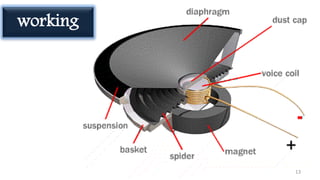
• An electromagnet called a voice coil attaches to the center of the
cone. A permanent magnet - a magnet that keeps its magnetic field
without electricity - sits behind the voice coil on the other side of the
cone.
• This means that a speaker uses two different types of magnets,
which is what gives speakers the power to push and pull against the
atmosphere rapidly.
44
Cont.
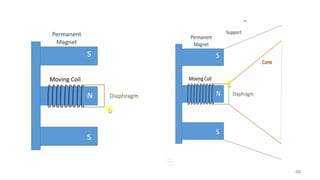
• The PM speaker contains a very light coil of wire affixed to the
diaphragm and located concentrically around or within the
permanent magnet.
• In operation, a steady current flows through the field coil,
magnetizing the field as shown in the next figure.
• The coil and the driver's magnetic system interact, generating a
mechanical force that causes the coil (attached with cone) to move
back and forth, accelerating and reproducing sound under the
control of the applied electrical signal coming from the amplifier.
45
46
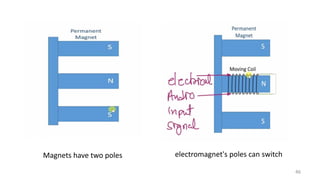
Magnets have two poles electromagnet's poles can switch
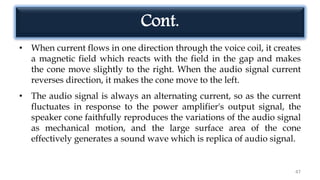
• When current flows in one direction through the voice coil, it creates
a magnetic field which reacts with the field in the gap and makes
the cone move slightly to the right. When the audio signal current
reverses direction, it makes the cone move to the left.
• The audio signal is always an alternating current, so as the current
fluctuates in response to the power amplifier's output signal, the
speaker cone faithfully reproduces the variations of the audio signal
as mechanical motion, and the large surface area of the cone
effectively generates a sound wave which is replica of audio signal.
47
Cont.
48
Cont.
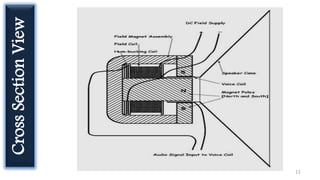
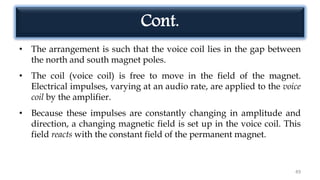
• The arrangement is such that the voice coil lies in the gap between
the north and south magnet poles.
• The coil (voice coil) is free to move in the field of the magnet.
Electrical impulses, varying at an audio rate, are applied to the voice
coil by the amplifier.
• Because these impulses are constantly changing in amplitude and
direction, a changing magnetic field is set up in the voice coil. This
field reacts with the constant field of the permanent magnet.
49
50
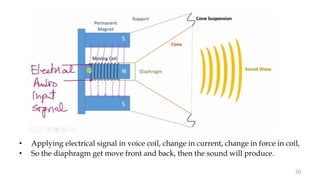
• Applying electrical signal in voice coil, change in current, change in force in coil,
• So the diaphragm get move front and back, then the sound will produce.
51
Cone
Coil
Dust Cap
Cone Vibrates
Outer Suspension
(Surround)
Inner Suspension
(Spider)
Permanent
Magnet
Electrical
Signals
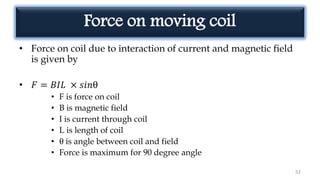
Force on moving coil
• Force on coil due to interaction of current and magnetic field
is given by
• 𝐹 = 𝐵𝐼𝐿 × 𝑠𝑖𝑛θ
• F is force on coil
• B is magnetic field
• I is current through coil
• L is length of coil
• θ is angle between coil and field
• Force is maximum for 90 degree angle
52
Cont.
• Audio current flows through voice coil
• Force = B*I*L
• Two types of transformation
– Electro mechanical
– Mechanical acoustic
53
54
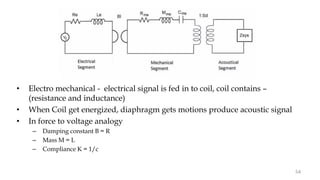
• Electro mechanical - electrical signal is fed in to coil, coil contains –
(resistance and inductance)
• When Coil get energized, diaphragm gets motions produce acoustic signal
• In force to voltage analogy
– Damping constant B = R
– Mass M = L
– Compliance K = 1/c
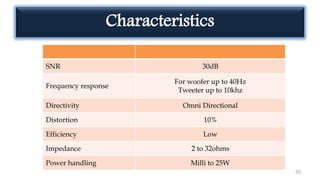
Characteristics
55
SNR 30dB
Frequency response
For woofer up to 40Hz
Tweeter up to 10khz
Directivity Omni Directional
Distortion 10%
Efficiency Low
Impedance 2 to 32ohms
Power handling Milli to 25W
Application
• You can find small permanent magnets in toys, handheld gadgets
such as electric razors, and clasps for bracelets and watches.
• It is found in the smallest pocket radios and is a major component of
the most elaborate theatre systems.
• Larger permanent magnets are useful in household appliance
motors and in stereo speakers.
• The electric motors in hybrid vehicles use very strong permanent
magnets.
57
Electrostatic loudspeaker
58
Introduction
• Electrostatic mean stationary charges where as speaker is a an
electro acoustic transducer; which converts an electrical audio
signal into a corresponding sound signal.
• An electrostatic Speaker (ESL) is design in which sound is generated
by the force exerted on a membrane suspended in an electrostatic
field.
59
60
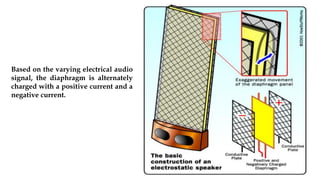
Based on the varying electrical audio
signal, the diaphragm is alternately
charged with a positive current and a
negative current.
Electrostatic
• The study of electric charges at rest is called electrostatics. Its other
name is ‘static electricity’.
• Electrically charged objects have several important characteristics:
– Like charges repel one another; that is, positive repels positive and
negative repels negative.
– Unlike charges attract each another; that is, positive attracts negative.
• Instead of using an electromagnet, electrostatic speakers vibrate air
using a large, thin, conductive diaphragm panel suspended between
two stationary conductive panels.
61
Cont.
• These conductive panels are charged with electrical current from a
wall outlet, creating an electrical field with a positive end and a
negative end.
• The audio signal runs a current through the suspended diaphragm
panel, rapidly switching between a positive charge and a negative
charge.
• When the charge is positive, the panel is drawn toward the negative
end of the field; when the charge is negative, it moves toward the
positive end of the field.
62
Coulomb's Law
• Electrostatics is the study of forces between charges, as described by
Coulomb's Law.
• Coulomb's law states that: The magnitude of the electrostatic force
of attraction between two point charges is directly proportional to
the product of the magnitudes of charges and inversely
proportional to the square of the distance between them.
63
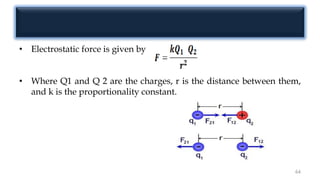
• Electrostatic force is given by
• Where Q1 and Q 2 are the charges, r is the distance between them,
and k is the proportionality constant.
64
Principle of ESL
• Electrostatic Speaker is purely based on electrostatic force.
• ESLs are simply (coulomb Law) a way to keep electric charges
separated but close together so they can do the work of moving a
plastic film to produce sound.
65
Cont.
• The usual construction technique is to place a tight plastic film (the
diaphragm) with an electric charge between two charged
conductors (called stators) on which the charges alternate.
• At one instant, the diaphragm is driven towards one of the stators,
then when the polarity of the charge on the conductors reverses, the
diaphragm is driven toward the other conductor this result is
sound.
66
67
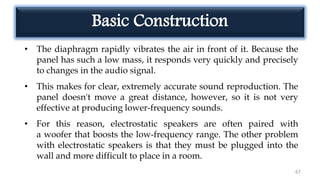
• The diaphragm rapidly vibrates the air in front of it. Because the
panel has such a low mass, it responds very quickly and precisely
to changes in the audio signal.
• This makes for clear, extremely accurate sound reproduction. The
panel doesn't move a great distance, however, so it is not very
effective at producing lower-frequency sounds.
• For this reason, electrostatic speakers are often paired with
a woofer that boosts the low-frequency range. The other problem
with electrostatic speakers is that they must be plugged into the
wall and more difficult to place in a room.
Basic Construction
Cont.
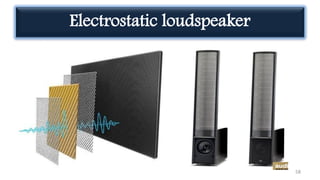
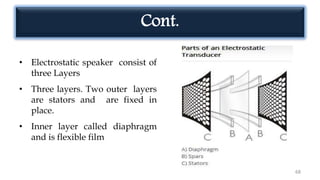
• Electrostatic speaker consist of
three Layers
• Three layers. Two outer layers
are stators and are fixed in
place.
• Inner layer called diaphragm
and is flexible film
68
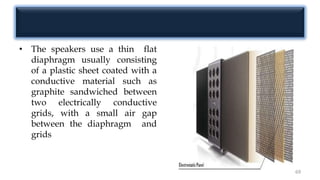
• The speakers use a thin flat
diaphragm usually consisting
of a plastic sheet coated with a
conductive material such as
graphite sandwiched between
two electrically conductive
grids, with a small air gap
between the diaphragm and
grids
69
Circuit Diagram
70
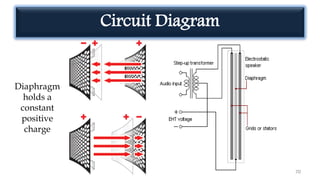
Diaphragm
holds a
constant
positive
charge
Working
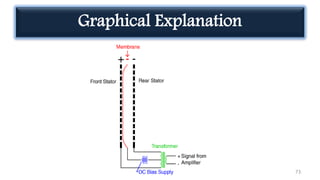
• When the speaker is operating, the diaphragm is charged to a fixed
positive voltage by a high-voltage power supply, creating a strong
electrostatic field around it
• The stators, meanwhile, are connected to the audio system's
amplifier through a step-up transformer.
• Step-up Transformer converts the amplifier's output to a pair of
high-voltage signals of equal strength but opposite polarity.
• So as the charge on one stator grows increasingly positive, the
charge on the other grows more negative by exactly the same
amount.
71
Cont.
• Because like charges repel and opposite charges attract, the
diaphragm's positive charge will force it to move forward or
backward depending on the stator charges.
• When the front stator's charge is negative and the back stator's
positive, the diaphragm will be pulled from the front and pushed
from the back and therefore move forward.
• The stronger the charges on the stators, the greater the diaphragm
displacement. In this way ESL Produce sound.
72
Graphical Explanation
73
Advantage of ESL
• Musical transparency can be better than in electrodynamics
speakers because the radiating surface has much less mass than
most other drivers and is therefore far less capable of storing
energy to be released later.
• For example, typical dynamic speaker drivers can have moving
masses of tens or hundreds of grams whereas an electrostatic
membrane only weighs a few milligrams, several times less than
the very lightest of electrodynamics speaker.
74
• Advantages of electrostatic loudspeakers include levels of
distortion one to two orders of magnitude lower than conventional
cone drivers in a box.
• The extremely light weight of the diaphragm which is driven across
its whole surface, and exemplary frequency response (both in
amplitude and phase) because the principle of generating force and
pressure is almost free from resonances unlike the more common
electrodynamics driver.
75
Disadvantage
• Cannot produce the lower frequency sounds
• Very, very sensitive to humidity changes and can lead to costly
repairs
• Arcing is very common, where a large amounts of electricity is
released at one point burning a hole in the stator
76
Conclusion
• Electrostatic speaker is work on the principle of Electrostatic Force
• It is very sample in construction other than conventional speaker
• Thin, late and smart and stylish design due to flat thin diaphragm.
• It required high step-up voltage and high bias voltage such as 4-6kv
DC, there it is very expensive.
77
78
Dynamic Loudspeaker
Dynamic Loudspeaker
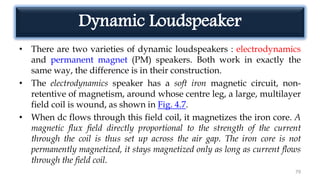
• There are two varieties of dynamic loudspeakers : electrodynamics
and permanent magnet (PM) speakers. Both work in exactly the
same way, the difference is in their construction.
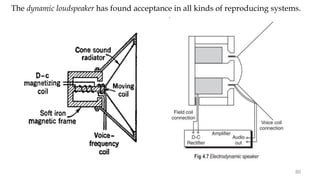
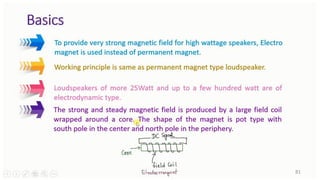
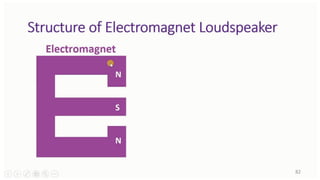
• The electrodynamics speaker has a soft iron magnetic circuit, non-
retentive of magnetism, around whose centre leg, a large, multilayer
field coil is wound, as shown in Fig. 4.7.
• When dc flows through this field coil, it magnetizes the iron core. A
magnetic flux field directly proportional to the strength of the current
through the coil is thus set up across the air gap. The iron core is not
permanently magnetized, it stays magnetized only as long as current flows
through the field coil.
79
80
The dynamic loudspeaker has found acceptance in all kinds of reproducing systems.
81
82
83
84
85
86
87
88
89
90
91
Permanent Magnets and Electromagnets:
What are the Differences?
• A permanent magnet is an object made from a material that is
magnetized and creates its own persistent magnetic field. As the
name suggests, a permanent magnet is 'permanent'. This means that
it always has a magnetic field and will display a magnetic behavior
at all times.
• An electromagnet is made from a coil of wire which acts as a
magnet when an electric current passes through it. Often an
electromagnet is wrapped around a core of ferromagnetic material
like steel, which enhances the magnetic field produced by the coil.
92
Permanent Magnet v. Electromagnet:
Magnetic Properties
• A permanent magnet’s magnetic properties exist when the magnet
is (magnetized). An electromagnetic magnet only displays magnetic
properties when an electric current is applied to it.
• That is how you can differentiate between the two. The magnets
that you have affixed to your refrigerator are permanent magnets,
while electromagnets are the principle behind AC motors.
93
Permanent Magnet v. Electromagnet:
Magnetic Strength
• Permanent magnet strength depends upon the material used in its
creation. The strength of an electromagnet can be adjusted by the amount
of electric current allowed to flow into it.
• As a result, the same electromagnet can be adjusted for different strength
levels.
94
Permanent Magnet v. Electromagnet:
Loss of Magnetic Properties
• If a permanent magnet loses its magnetic properties, as it does by
heating to a (maximum) temperature, it will be rendered useless
and its magnetic properties can be only recovered by re-
magnetizing.
• Contrarily, an electromagnet loses its magnetic power every time an
electric current is removed and becomes magnetic once again when
the electric field is introduced.
95
Permanent Magnet v. Electromagnet:
Advantages
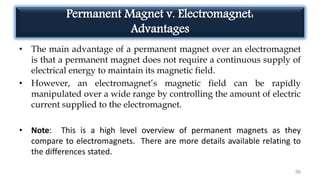
• The main advantage of a permanent magnet over an electromagnet
is that a permanent magnet does not require a continuous supply of
electrical energy to maintain its magnetic field.
• However, an electromagnet’s magnetic field can be rapidly
manipulated over a wide range by controlling the amount of electric
current supplied to the electromagnet.
• Note: This is a high level overview of permanent magnets as they
compare to electromagnets. There are more details available relating to
the differences stated.
96
97
98
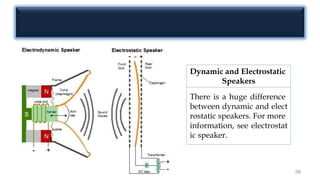
Dynamic and Electrostatic
Speakers
There is a huge difference
between dynamic and elect
rostatic speakers. For more
information, see electrostat
ic speaker.
Woofers
99
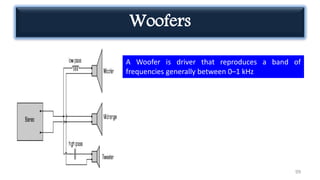
A Woofer is driver that reproduces a band of
frequencies generally between 0–1 kHz
Woofer
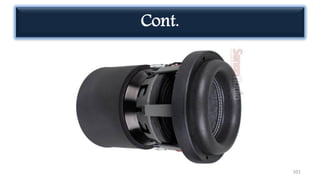
• A woofer is a driver that reproduces low frequencies. The driver works
with the characteristics of the enclosure to produce suitable low
frequencies.
• Some loudspeaker systems use a woofer for the lowest frequencies,
sometimes well enough that a subwoofer is not needed.
• Additionally, some loudspeakers use the woofer to handle middle
frequencies, eliminating the mid-range driver.
• This can be accomplished with the selection of a tweeter that can work low enough
that, combined with a woofer that responds high enough, the two drivers add
coherently in the middle frequencies.
100
101
Cont.
Cont.
• Woofer is the term commonly used for a loudspeaker driver
designed to produce low frequency sounds, typically from around
40 Hz up to about a KHz or higher.
• There are two types of low frequency speaker, the commonly
known woofer, and the more recent addition the subwoofer.
• The latter is used for the reproduction of frequencies below those
produced by the woofer and it is generally purchased as an add-on
to an existing system.
102
Cont.
• The low frequencies speaker provides the bass of any hi-fi system. The
prime requisite for low frequency reproduction is a large diaphragm the
larger the better.
• In addition to large size, the diaphragm must be of fairly heavy construction
Light diaphragms just can't hold up under the vibrations encountered
under the lower audio ranges.
• A woofer must be able to vibrate back and forth very easily i.e have high
compliance. One way to accomplish this is to have the diaphragm loosely
connected to the frame. The gasket that holds the edge of diaphragm to the
frame basket is fastened, so that it barely keeps the diaphragm from
slipping loose.
103
Cont.
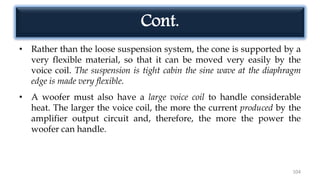
• Rather than the loose suspension system, the cone is supported by a
very flexible material, so that it can be moved very easily by the
voice coil. The suspension is tight cabin the sine wave at the diaphragm
edge is made very flexible.
• A woofer must also have a large voice coil to handle considerable
heat. The larger the voice coil, the more the current produced by the
amplifier output circuit and, therefore, the more the power the
woofer can handle.
104
Cont.
• Finally, a strong magnet can be of great help to move the heavy voice
coil and cone assembly too well. The better the woofer, the heavier
the magnet assembly (unless it's ceramic).
105
Tweeter
106
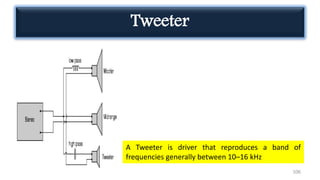
A Tweeter is driver that reproduces a band of
frequencies generally between 10–16 kHz
Tweeters
• A tweeter is a loudspeaker designed to produce high audio
frequencies, typically from around 2,000 Hz to 20,000 Hz.
• Some tweeters can manage response up to 65 kHz.
• Nearly all tweeters are electro-dynamic drivers, using a voice coil
suspended within a fixed magnetic field.
• There are two main types of high frequency speakers; the well-
known tweeter and the more recent super tweeter.
107
Six basic high-frequency tweeters
i. The cone is a physically disincentive version of the woofer.
ii. The dome, so called because of its dome-shaped diaphragm.
iii. The horn, so named because it is a horn.
iv. The Heil air-motion transformer which uses the principle of lever in
its operation, named after its inventor, Dr. Oskar Heil.
v. High polymer molecular-film tweeter, uses the piezoelectric effect
for its principle of operation (used exclusively by Pioneer).
vi. The electrostatic tweeter works on the principle of attraction or
repulsion between two metal plates.
108
Types
• Types of tweeters
– Cone tweeter
– Dome tweeters
– Horn tweeters
109
Cont.
• Cone tweeters have the same basic design and form as a woofer
with optimizations to operate at higher frequencies. The
optimizations usually are:
• A very small and light cone so it can move rapidly;
• Cone materials chosen for stiffness (e.g., ceramic cones in one
manufacturer's line), or good damping properties (e.g., silk or
coated fabric) or both.
110
Cont.
• The suspension (or spider) is stiffer than for other drivers—less flexibility is
needed for high frequency reproduction;
• Small voice coils (3/4 inch is typical) and light (thin) wire, which also helps
the tweeter cone move rapidly.
• Cone tweeters are relatively cheap, but do not have the dispersion
characteristics of domes. Thus they are routinely seen in low cost
applications such as factory car speakers, shelf stereo systems, and boom
boxes. Cone tweeters can also be found in older stereo hi-fi system speakers
designed and manufactured before the advent of the dome tweeter. They
are now a rare sight in modern hi-fi usage.
111
112
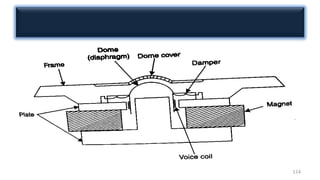
Dome tweeters
• A dome tweeter is constructed by attaching a voice coil to a dome,
which is attached to the magnet or the top plate via a low
compliance suspension. These tweeters typically do not have a
frame or basket, but a simple front plate attached to the magnet
assembly.
• Dome tweeters are categorized by their voice coil diameter. The
majority of dome tweeters presently used in hi-fi speakers are 25
mm (1 in) in diameter. A variation is the ring radiator in which the
'suspension' of the cone or dome becomes the major radiating
element. These tweeters have different directivity characteristics
when compared to standard dome tweeters.
113
114
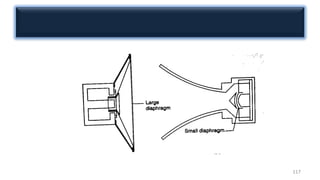
Horn tweeters
• A horn tweeter is any of the above tweeters coupled to a flared or
horn structure. Horns are used for two purposes — to control
dispersion, and to couple the tweeter diaphragm to the air for
higher efficiency.
• The tweeter in either case is usually termed a compression driver
and is quite different from more common types of tweeters (see
above). Properly used, a horn improves the off-axis response of the
tweeter by controlling (i.e., reducing) the directivity of the tweeter.
It can also improve the efficiency of the tweeter by coupling the
relatively high acoustic impedance of the driver to the lower
impedance of the air.
115
• The larger the horn, the lower the frequencies at which it can work, since
large horns provide coupling to the air at lower frequencies. There are
different types of horns, including radial and constant directivity (CD).
Horn tweeters may have a somewhat 'different' sonic signature than simple
dome tweeters.
• Poorly designed horns, or improperly crossed-over horns, have predictable
problems in the accuracy of their output, and the load that they present to
the amplifier. Perhaps concerned about the image of poorly designed horns,
some manufacturers use horn loaded tweeters, but avoid using the term.
Their euphemisms include "elliptical aperture" "Semi-horn" and "Directivity
controlled". These are, nonetheless, a form of horn loading.
116
117
118
Microphones
History
119
Component Inventor Year Application
Microphone
first microphone was
invented by Alexander
Graham Bell
1876
It was a liquid device and that was not
very practical.
Thomas Alva
Edison invented the
first practical carbon
microphone.
1886
The carbon microphone was used for
radio transmissions and extensively in
telephone transmitters until the 1970s
when they were replaced by
piezoelectric ceramic elements.
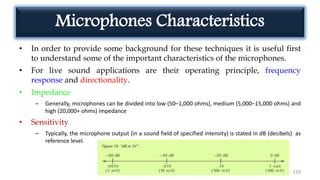
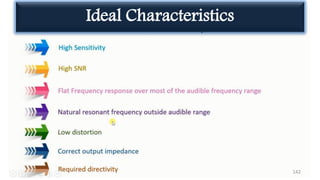
Microphones Characteristics
• In order to provide some background for these techniques it is useful first
to understand some of the important characteristics of the microphones.
• For live sound applications are their operating principle, frequency
response and directionality.
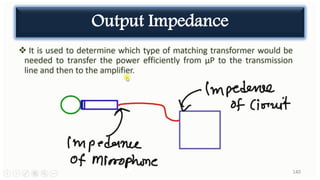
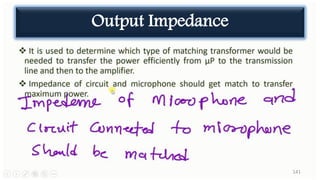
• Impedance
– Generally, microphones can be divided into low (50–1,000 ohms), medium (5,000–15,000 ohms) and
high (20,000+ ohms) impedance
• Sensitivity
– Typically, the microphone output (in a sound field of specified intensity) is stated in dB (decibels) as
reference level.
120
Microphones
• Microphones are a type of transducer - a device which converts acoustical
energy (sound waves) into electrical energy (the audio signal). Different
types of microphone have different ways of converting energy but they all
share one thing in common.
• Diaphragm. This is a thin piece of material (such as paper, plastic or
aluminium) which vibrates when it is struck by sound waves. In a typical
hand-held mic, the diaphragm is located in the head of the microphone.
When the diaphragm vibrates, it causes other components to vibrate. These
vibrations are converted into an electrical current which becomes the audio
signal.
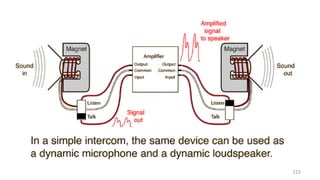
121
122
123
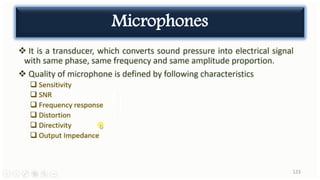
Microphones
124
Pa = Pascal Pressure
Sensitivity
125
SNR
126
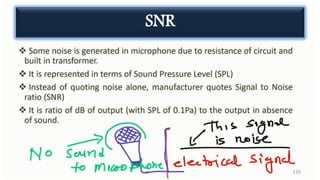
SNR
127
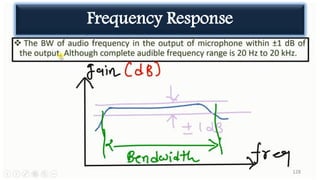
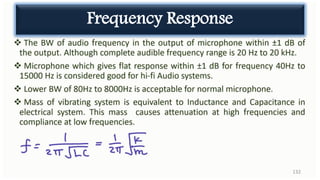
Frequency Response
128
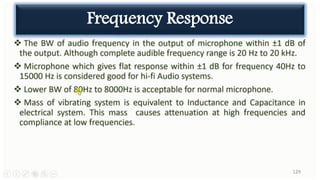
Frequency Response
129
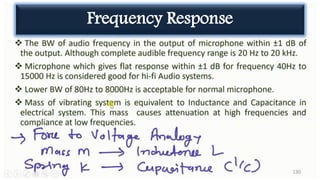
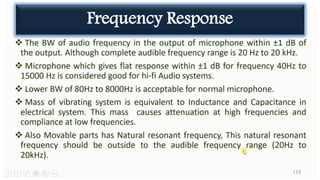
Frequency Response
130
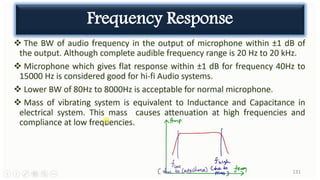
Frequency Response
131
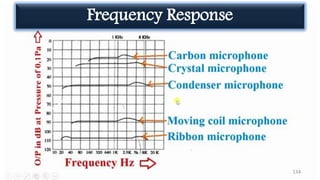
Frequency Response
132
Frequency Response
133
Frequency Response
134
Frequency Response
135
Distortion
136
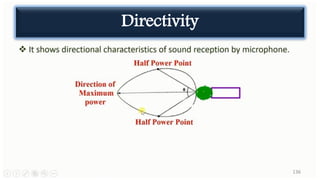
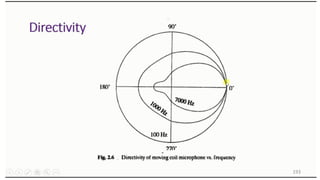
Directivity
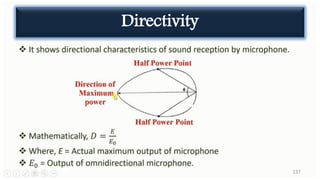
137
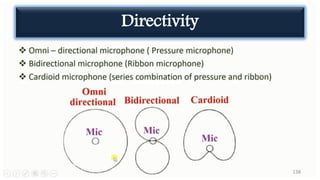
Directivity
138
Directivity
139
Output Impedance
140
Output Impedance
141
Output Impedance
142
Ideal Characteristics
143
Crystal Microphone
144
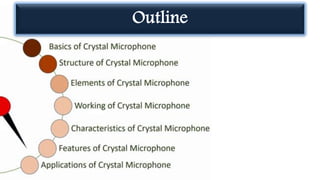
Outline
145
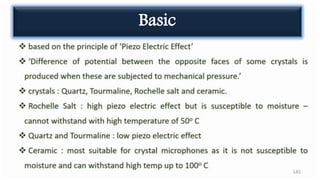
Basic
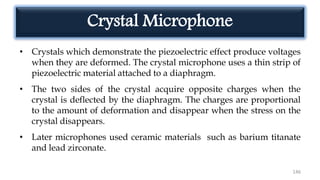
Crystal Microphone
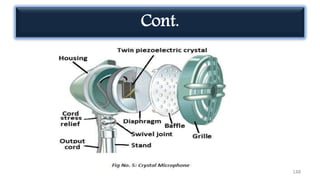
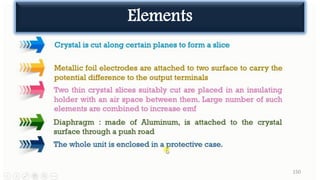
• Crystals which demonstrate the piezoelectric effect produce voltages
when they are deformed. The crystal microphone uses a thin strip of
piezoelectric material attached to a diaphragm.
• The two sides of the crystal acquire opposite charges when the
crystal is deflected by the diaphragm. The charges are proportional
to the amount of deformation and disappear when the stress on the
crystal disappears.
• Later microphones used ceramic materials such as barium titanate
and lead zirconate.
146
• The electric output of crystal microphones is comparatively large,
but the frequency response is not comparable to good as dynamic
microphone, so they are not serious contenders for the music
market.
147
Cont.
Cont.
148
149
Structure
150
Elements
151
Structure
152
Structure
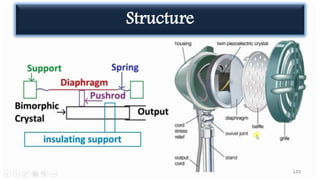
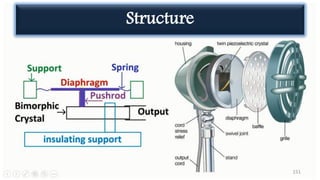
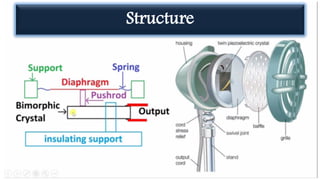
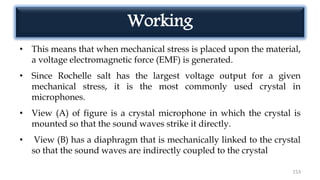
• This means that when mechanical stress is placed upon the material,
a voltage electromagnetic force (EMF) is generated.
• Since Rochelle salt has the largest voltage output for a given
mechanical stress, it is the most commonly used crystal in
microphones.
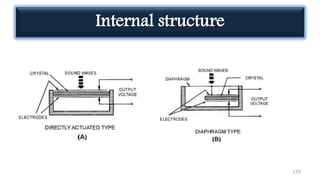
• View (A) of figure is a crystal microphone in which the crystal is
mounted so that the sound waves strike it directly.
• View (B) has a diaphragm that is mechanically linked to the crystal
so that the sound waves are indirectly coupled to the crystal
153
Working
154
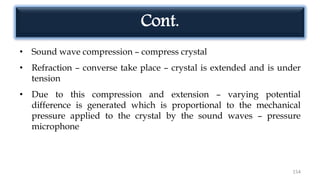
• Sound wave compression – compress crystal
• Refraction – converse take place – crystal is extended and is under
tension
• Due to this compression and extension – varying potential
difference is generated which is proportional to the mechanical
pressure applied to the crystal by the sound waves – pressure
microphone
Cont.
Internal structure
155
156
157
158
159
Carbon Microphone
160
Outline
Carbon Microphone
• The carbon microphone was widely used for many years being one
of the earliest reliable microphones. But it was not widely used now
a days.
161
Construction
• The basic concept behind the carbon microphone is the fact that
when carbon granules are compressed their resistance decreases.
This occurs because the granules come into better contact with each
other when they are pushed together by the higher pressure.
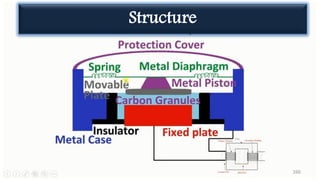
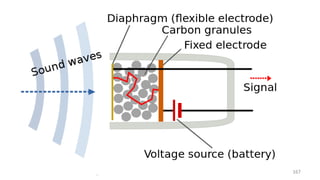
• The carbon microphone comprises carbon granules that are
contained within a small contained that is covered with a thin metal
diaphragm. A battery is also required to cause a current to flow
through the microphone.
162
Cont.
• The carbon microphone is consisting of two metal plates separated
by granules of carbon.
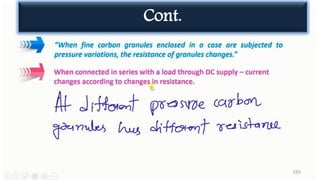
• One plate faces outward and acts as a diaphragm.
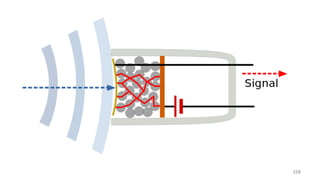
• When sound waves strike this plate, the pressure on the granules
changes, which in turn changes the electrical resistance between the
plates. (Higher pressure lowers the resistance as the granules are
pushed closer together.)
163
164
Operation
165
Cont.
166
Structure
167
168
169
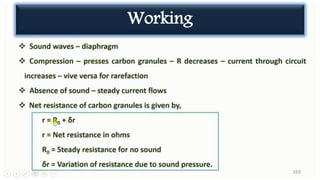
Working
Working
• The varying current can be passed through a transformer or a
capacitor to enable it to be used within a telephone, or by some form
of amplifier.
• The frequency response of the carbon microphone, however, is
limited to a narrow range, and the device produces significant
electrical noise.
• Often the microphone would produce a form of crackling noise
which could be eliminated by shaking it or giving it a small sharp
knock. This would shake the carbon granules and enable them to
produce a more steady current.
170
Cont.
• The change in contact resistance causes a current from a battery
connected in series with the carbon button and the primary of a
transformer to vary in amplitude, resulting in a current waveform
similar to the acoustic waveform striking the diaphragm.
• One of the main disadvantages of the carbon microphone is that it
has continuous high frequency hiss caused by the changing contact
resistance between the carbon granules.
171
172
173
Application
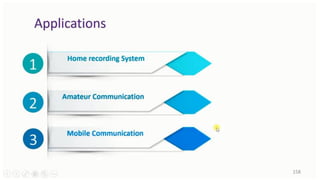
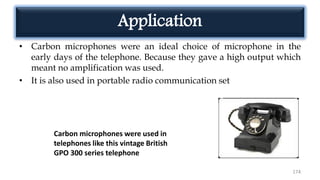
• Carbon microphones were an ideal choice of microphone in the
early days of the telephone. Because they gave a high output which
meant no amplification was used.
• It is also used in portable radio communication set
174
Carbon microphones were used in
telephones like this vintage British
GPO 300 series telephone
advantages
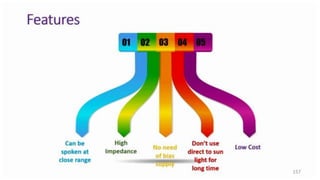
• High output
• Simple principle & construction
• Cheap and simple to manufacture
175
disadvantages
• Very noisy - high background noise and on occasions it would
crackle. (Constant BACKGROUND HISS (hissing noise)which
results from random changes in the resistance between individual
carbon granules).
• Poor sensitivity and frequency response.
• Requires battery or other supply for operation
• The disadvantages, however, are offset by advantages that make its
use in military applications widespread. It is lightweight, rugged,
and can produce an extremely high output.
176
177
Dynamic Microphone
178
Outline
179
Basics
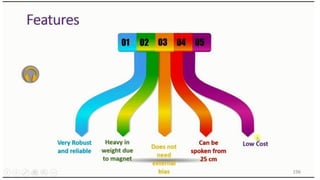
• Dynamic microphones are versatile and ideal for general-purpose
use. They use a simple design with few moving parts.
• They are relatively strong and flexible to rough handling. They are
also better suited to handling high volume levels, for examples they
will deal better with certain instruments are amplifiers.
• They have no internal amplifier and do not require batteries or
external power. When a magnet is moved near a coil of wire, an
electrical current is generated in the wire.
• Using this electromagnet principle, the dynamic microphone uses a
wire coil and magnet to create the audio signal.
180
Cont.
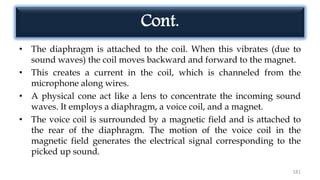
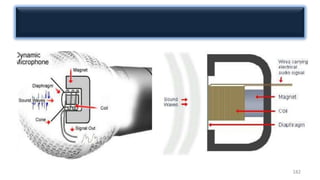
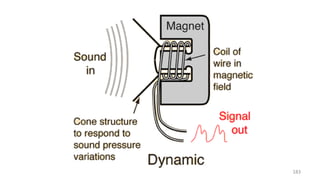
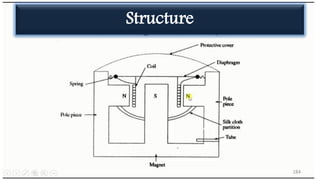
• The diaphragm is attached to the coil. When this vibrates (due to
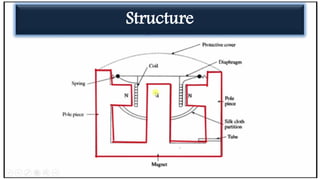
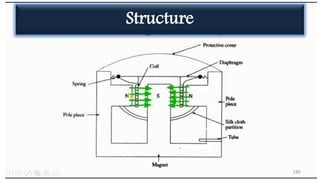
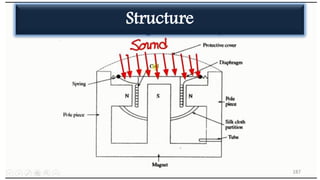
sound waves) the coil moves backward and forward to the magnet.
• This creates a current in the coil, which is channeled from the
microphone along wires.
• A physical cone act like a lens to concentrate the incoming sound
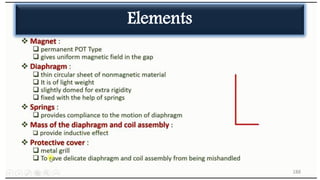
waves. It employs a diaphragm, a voice coil, and a magnet.
• The voice coil is surrounded by a magnetic field and is attached to
the rear of the diaphragm. The motion of the voice coil in the
magnetic field generates the electrical signal corresponding to the
picked up sound.
181
182
183
184
Structure
185
Structure
186
Structure
187
Structure
188
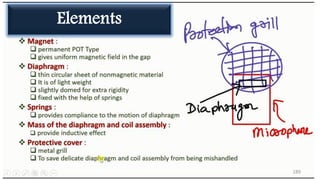
Elements
189
Elements
190
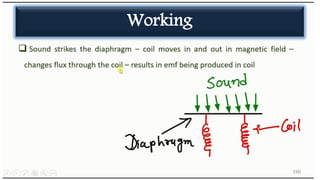
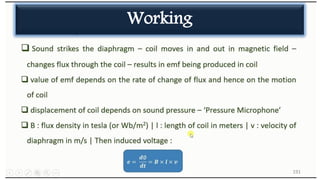
Working
191
Working
192
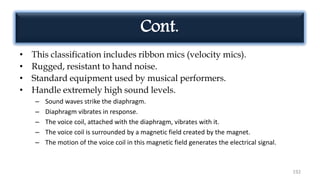
Cont.
• This classification includes ribbon mics (velocity mics).
• Rugged, resistant to hand noise.
• Standard equipment used by musical performers.
• Handle extremely high sound levels.
– Sound waves strike the diaphragm.
– Diaphragm vibrates in response.
– The voice coil, attached with the diaphragm, vibrates with it.
– The voice coil is surrounded by a magnetic field created by the magnet.
– The motion of the voice coil in this magnetic field generates the electrical signal.
193
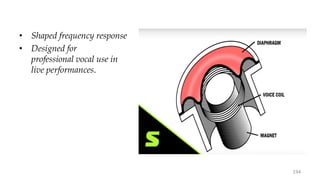
• Shaped frequency response
• Designed for
professional vocal use in
live performances.
194
195
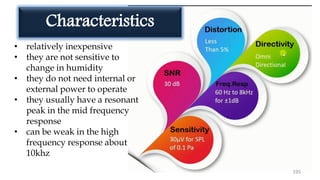
• relatively inexpensive
• they are not sensitive to
change in humidity
• they do not need internal or
external power to operate
• they usually have a resonant
peak in the mid frequency
response
• can be weak in the high
frequency response about
10khz
Characteristics
196
197
Wireless or Cordless Microphone
• A wireless microphone is a microphone without a physical cable
connecting it directly to the sound recording or amplifying
equipment with which it is associated.
• It has a small, battery‐powered radio transmitter in the microphone
body, which transmits the audio signal from the microphone by
radio waves to a nearby receiver unit, which recovers the audio.
198
• The other audio equipment is connected to the receiver unit by
cable.
• Wireless microphones are widely used in the entertainment
industry, television broadcasting, and public speaking to allow
public speakers, interviewers, performers, and entertainers to move
about freely while using a microphone to amplify their voices.
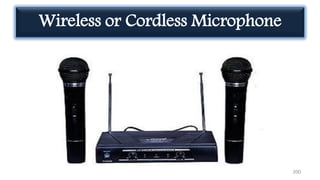
• These are Hand held and collar type as shown in figure
199
Wireless or Cordless Microphone
200
Advantages
• Greater freedom of movement for the artist or speaker.
• Avoidance of cabling stressing problems common with wired
microphones.
• Reduction of cable "trip hazards" in the performance space
201
Disadvantages
• Some wireless systems have a shorter range, while more expensive
models can exceed that distance.
• Possible interference with or, more often, from other radio
equipment or other radio microphones.
• Operation time is limited relative to battery life.
202

Loudspeakers and microphones

  • 1.
  • 2.
    Loudspeakers and Microphones Mr.Lenin. SB Dept. of ECE Associate Professor SMVEC 2 Unit- 1
  • 3.
    Content Loudspeakers • Crystal Loudspeaker, •Dynamic Loudspeaker, • Electrostatic loudspeaker, • Permanent Magnet Loudspeaker, • Woofers and • Tweeters. Microphones • Microphone Characteristics, • Crystal Microphone, • Carbon Microphones, • Dynamic Microphones and • Wireless Microphones. 3 Text Books 1. S.P.Bali,―Consumer Electronics, Pearson Education, 2005. 2. Jochen Schiller, Mobile Communications, 2nd Edition, Addison-Wesley, 2001.
  • 4.
    Introduction • Consumer electronicsor home electronics (i.e. analog or digital) are equipment intended for everyday use, typically in homes. • Consumer electronics include devices such as – Entertainment (flat screen TVs, DVD players, video games, remote control cars, etc.), – Communications (telephones, cell phones, e-mail-capable laptops, etc.), and – Home-office activities (e.g., desktop computers, printers etc.) 4
  • 5.
    History 5 Component Inventor YearApplication Loudspeaker Johann Philipp Reis 1861 An electric loudspeaker installed in his telephone Alexander Graham Bell 1876 He patented his first electric loudspeaker (capable of reproducing intelligible speech) as part of his telephone First commercial version of the speaker
  • 6.
    Loudspeaker Loudspeaker is atransducer which converts an electrical signal into sound signal. 6 A device that converts variations in a physical quantity, such as pressure or brightness, into an electrical signal, or vice versa called as transducer. Eg:- Microphone, Speaker. The lowest frequency that a human ear can hear is 20 Hz
  • 7.
  • 8.
    Characteristics • There area number of interrelated factors that must be considered in designing transducer for converting electrical energy into acoustic energy. – sound travel fastest in Steel and cannot travel through a vacuum • These include • Electroacoustic efficiency, • Uniformity of frequency response, • Linearity of amplitude response, • Transient response, • Power handling capacity, • Size, • Durability and • Cost. 8
  • 9.
    IdealLoudspeaker • Would havean electroacoustic efficiency approaching 100 per cent. • Would have an acoustic output response that is independent of frequency over the entire audible range. • Would introduce neither harmonic nor intermodulation distortion into its output. • Would faithfully reproduce transients as well as steady input signals. • Would be capable of producing a nondirectional radiation. No single transducer has been designed that is capable of satisfying all the above requirements. 9
  • 10.
    Note • A loudspeakermust be able to reproduce a wide range of audio frequencies (i.e., 20 Hz to 20 kHz). • Sound wave has two main characteristics, which are Pitch and loudness 10
  • 11.
  • 12.
  • 13.
  • 14.
    Cone 14 The body ofthe cone can be made from paper, black polypropolene, carbon fiber, aluminum, titanium, magnesium, etc. Today’s replacement cones may or may not be available in all materials to match the originals.
  • 15.
    Voice Coil 15 It isa set of windings wound on an aluminum or other material form that fits into the magnetic voice coil gap. The length of the former and length of the windings are customized to the component. It can be made using flat wound or round wound wire. Common nominal impedances are 2, 4, 6, 8, 10, 16 or 32 ohms.
  • 16.
    Spider The Spider fitsaround the speaker voice coil and is attached to the speaker basket. It is one of the components (along with the cone) that help to keep the voice coil centered in the magnetic gap and affects excursion (movement). It can be soft or hard (stiffness), has different size voice coil openings, different widths and can be flat or cup shaped. 16
  • 17.
    Terminal The Pigtail orTinsel Lead connect the voice coil to the speaker Terminal. 17
  • 18.
    Dustcap The Dustcap, Dustcoveror Center Dome. It fits on top of the voice coil former and it attaches to the cone. It protects the magnetic gap from dirt. It can be made of paper, felt, screen, aluminum, rubber or polypropolene. 18
  • 19.
    Gasket The Gasket orRing fits over the edge of the cone annulus onto the outside of the speaker frame and acts as a spacer. They can be foam, rubitex (rubber) or chip (cardboard). Not all speakers have a ring. 19
  • 20.
    20 Description Function Rigid /frame /Basket A metal frame which holds the speaker together, which in turn is held by the speaker case. Magnet The voice coil is suspended above the center of a large magnet with the end of the voice coil attached to terminals on the basket. Top plate Typically made of iron. Bottom Plate Holds the pole piece and magnet Pole Piece: Directs the voice coil magnetic field Cables The wires that connect to the voice coil from whatever the input source. Other components in the loudspeaker
  • 21.
    Cont. A Loudspeaker consistsof a number of drivers to reproduce a wide range of frequencies for high sound pressure level or high fidelity applications. • These drivers comprise of  subwoofers for very low frequencies,  woofers for low frequencies,  squawkers for middle frequencies,  tweeters for high frequencies and  super tweeters for very high frequencies. 21
  • 22.
  • 23.
    Speakers 23 A Woofer isdriver that reproduces a band of frequencies generally between 0–1 kHz A mid-range speaker is driver that reproduces a band of frequencies generally between 2–6 kHz A Tweeter is driver that reproduces a band of frequencies generally between 10–16 kHz
  • 24.
    Woofer 24 A Woofer isdriver that reproduces a band of frequencies generally between 0–1 kHz A subwoofer is a woofer driver used only for the lowest-pitched part of the audio spectrum: typically below 200 Hz for consumer systems, below 100 Hz for professional live sound, and below 80 Hz in THX- approved systems
  • 25.
  • 26.
    Mid-range 26 A mid-range speakeris driver that reproduces a band of frequencies generally between 2– 6 kHz
  • 27.
  • 28.
    Tweeter 28 A Tweeter isdriver that reproduces a band of frequencies generally between 10–16 kHz
  • 29.
  • 30.
    30 Size of thevoice coil is vary for all speakers with respect to output frequency
  • 31.
    Cont. • Two mostlyused loud speaker is – Dynamic – Horn • The speaker system itself can be divided into 3 functional parts – Electromagnetic – Mechanical – Acoustic 31
  • 32.
    Cont. • The electromagneticpart consisting of the Voice coil and the field magnet. Audio frequency electric current in the coil causes mechanical motion of the cone or diaphragm on which it is mounted. This part is often referred to as the driver or motor of the system. 32
  • 33.
    Cont. • The mechanicalpart, in which the driving coil is usually mounted and which is set into mechanical motion by the audio frequency electrical current in the driving coil. • The acoustic part, which transmits the sound energy developed by the mechanical part of the area served by the system in the most efficient and faithful manner. 33
  • 34.
    Note • A lowvalue of impedance tells us that the air moves easily in response to an applied pressure (low pressure, high velocity), and a high value of impedance tells us that it is hard to move (high pressure, low velocity). • Manufacturers of loudspeakers give us a nominal impedance of 4, 6, 8 ohms as this is the dominant characteristic. • Most loudspeakers have a power response that drops 10dB to 20dB from low to high frequencies. 34
  • 35.
    Crystal Loudspeakers • Rochelle-saltcrystals have the property of becoming physically distorted when a voltage is applied across two of their surfaces. This property is the basis of the crystal type speaker, illustrated in Fig. • The crystal is clamped between two electrodes across which the audio frequency output voltage is applied. The crystal is also mechanically connected to a diaphragm. • The deformations of the crystal caused by the audio signal across the electrodes cause the diaphragm to vibrate and thus to produce sound output. 35
  • 36.
  • 37.
    Cont. • Piezoelectric speakersare frequently used as beepers in watches and other electronic devices, and are sometimes used as tweeters in less-expensive speaker systems, such as computer speakers and portable radios. • Piezoelectric speakers have several advantages over conventional loudspeakers: they are resistant to overloads that would normally destroy most high frequency drivers, and they can be used without a crossover due to their electrical properties. • There are also disadvantages: some amplifiers can oscillate when driving capacitive loads like most piezoelectrics, which results in distortion or damage to the amplifier. • This is why they are generally used in single frequency (beeper) or non-critical applications. 37
  • 38.
    38 The white ceramicpiezoelectric material can be seen fixed to a metal diaphragm Piezoelectric Speakers
  • 39.
    Schematic view fora crystal speaker 39
  • 40.
    Mid-Range 40 A mid-range speakeris driver that reproduces a band of frequencies generally between 2–6 kHz
  • 41.
    41 Permanent magnet Loudspeaker (Moving Coil)
  • 42.
    • Function • Working •Advantages • Disadvantages • Applications Permanent magnet Loud speaker (Moving Coil)
  • 43.
    Permanent magnet Loudspeaker (Moving Coil) Function • The most popular type of loudspeaker today is the permanent magnet. • Working is based on interaction between Magnetic and Electric field. • A coil is placed in a uniform magnetic field and we pass audio signal through the coil and that current through the coil will result in mechanical force. • Generated force is directly proportional to audio current, hence it to it produces vibrational motion in coil, and that is what resulting into generation of sound. 43
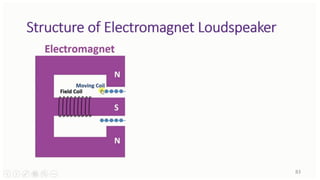
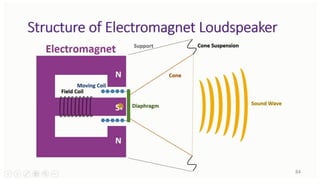
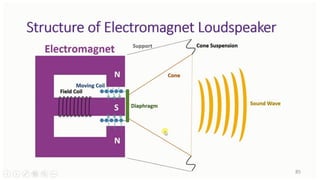
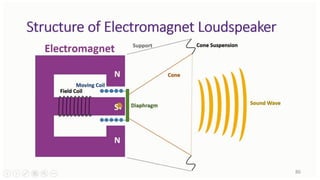
  • 44.
    Working • Because ofits comparative simplicity of construction and design, the precision that may be built into it, and ease with which it is interfaced with other equipment. • An electromagnet called a voice coil attaches to the center of the cone. A permanent magnet - a magnet that keeps its magnetic field without electricity - sits behind the voice coil on the other side of the cone. • This means that a speaker uses two different types of magnets, which is what gives speakers the power to push and pull against the atmosphere rapidly. 44
  • 45.
    Cont. • The PMspeaker contains a very light coil of wire affixed to the diaphragm and located concentrically around or within the permanent magnet. • In operation, a steady current flows through the field coil, magnetizing the field as shown in the next figure. • The coil and the driver's magnetic system interact, generating a mechanical force that causes the coil (attached with cone) to move back and forth, accelerating and reproducing sound under the control of the applied electrical signal coming from the amplifier. 45
  • 46.
    46 Magnets have twopoles electromagnet's poles can switch
  • 47.
    • When currentflows in one direction through the voice coil, it creates a magnetic field which reacts with the field in the gap and makes the cone move slightly to the right. When the audio signal current reverses direction, it makes the cone move to the left. • The audio signal is always an alternating current, so as the current fluctuates in response to the power amplifier's output signal, the speaker cone faithfully reproduces the variations of the audio signal as mechanical motion, and the large surface area of the cone effectively generates a sound wave which is replica of audio signal. 47 Cont.
  • 48.
  • 49.
    Cont. • The arrangementis such that the voice coil lies in the gap between the north and south magnet poles. • The coil (voice coil) is free to move in the field of the magnet. Electrical impulses, varying at an audio rate, are applied to the voice coil by the amplifier. • Because these impulses are constantly changing in amplitude and direction, a changing magnetic field is set up in the voice coil. This field reacts with the constant field of the permanent magnet. 49
  • 50.
    50 • Applying electricalsignal in voice coil, change in current, change in force in coil, • So the diaphragm get move front and back, then the sound will produce.
  • 51.
    51 Cone Coil Dust Cap Cone Vibrates OuterSuspension (Surround) Inner Suspension (Spider) Permanent Magnet Electrical Signals
  • 52.
    Force on movingcoil • Force on coil due to interaction of current and magnetic field is given by • 𝐹 = 𝐵𝐼𝐿 × 𝑠𝑖𝑛θ • F is force on coil • B is magnetic field • I is current through coil • L is length of coil • θ is angle between coil and field • Force is maximum for 90 degree angle 52
  • 53.
    Cont. • Audio currentflows through voice coil • Force = B*I*L • Two types of transformation – Electro mechanical – Mechanical acoustic 53
  • 54.
    54 • Electro mechanical- electrical signal is fed in to coil, coil contains – (resistance and inductance) • When Coil get energized, diaphragm gets motions produce acoustic signal • In force to voltage analogy – Damping constant B = R – Mass M = L – Compliance K = 1/c
  • 55.
    Characteristics 55 SNR 30dB Frequency response Forwoofer up to 40Hz Tweeter up to 10khz Directivity Omni Directional Distortion 10% Efficiency Low Impedance 2 to 32ohms Power handling Milli to 25W
  • 56.
    Application • You canfind small permanent magnets in toys, handheld gadgets such as electric razors, and clasps for bracelets and watches. • It is found in the smallest pocket radios and is a major component of the most elaborate theatre systems. • Larger permanent magnets are useful in household appliance motors and in stereo speakers. • The electric motors in hybrid vehicles use very strong permanent magnets.
  • 57.
  • 58.
  • 59.
    Introduction • Electrostatic meanstationary charges where as speaker is a an electro acoustic transducer; which converts an electrical audio signal into a corresponding sound signal. • An electrostatic Speaker (ESL) is design in which sound is generated by the force exerted on a membrane suspended in an electrostatic field. 59
  • 60.
    60 Based on thevarying electrical audio signal, the diaphragm is alternately charged with a positive current and a negative current.
  • 61.
    Electrostatic • The studyof electric charges at rest is called electrostatics. Its other name is ‘static electricity’. • Electrically charged objects have several important characteristics: – Like charges repel one another; that is, positive repels positive and negative repels negative. – Unlike charges attract each another; that is, positive attracts negative. • Instead of using an electromagnet, electrostatic speakers vibrate air using a large, thin, conductive diaphragm panel suspended between two stationary conductive panels. 61
  • 62.
    Cont. • These conductivepanels are charged with electrical current from a wall outlet, creating an electrical field with a positive end and a negative end. • The audio signal runs a current through the suspended diaphragm panel, rapidly switching between a positive charge and a negative charge. • When the charge is positive, the panel is drawn toward the negative end of the field; when the charge is negative, it moves toward the positive end of the field. 62
  • 63.
    Coulomb's Law • Electrostaticsis the study of forces between charges, as described by Coulomb's Law. • Coulomb's law states that: The magnitude of the electrostatic force of attraction between two point charges is directly proportional to the product of the magnitudes of charges and inversely proportional to the square of the distance between them. 63
  • 64.
    • Electrostatic forceis given by • Where Q1 and Q 2 are the charges, r is the distance between them, and k is the proportionality constant. 64
  • 65.
    Principle of ESL •Electrostatic Speaker is purely based on electrostatic force. • ESLs are simply (coulomb Law) a way to keep electric charges separated but close together so they can do the work of moving a plastic film to produce sound. 65
  • 66.
    Cont. • The usualconstruction technique is to place a tight plastic film (the diaphragm) with an electric charge between two charged conductors (called stators) on which the charges alternate. • At one instant, the diaphragm is driven towards one of the stators, then when the polarity of the charge on the conductors reverses, the diaphragm is driven toward the other conductor this result is sound. 66
  • 67.
    67 • The diaphragmrapidly vibrates the air in front of it. Because the panel has such a low mass, it responds very quickly and precisely to changes in the audio signal. • This makes for clear, extremely accurate sound reproduction. The panel doesn't move a great distance, however, so it is not very effective at producing lower-frequency sounds. • For this reason, electrostatic speakers are often paired with a woofer that boosts the low-frequency range. The other problem with electrostatic speakers is that they must be plugged into the wall and more difficult to place in a room. Basic Construction
  • 68.
    Cont. • Electrostatic speakerconsist of three Layers • Three layers. Two outer layers are stators and are fixed in place. • Inner layer called diaphragm and is flexible film 68
  • 69.
    • The speakersuse a thin flat diaphragm usually consisting of a plastic sheet coated with a conductive material such as graphite sandwiched between two electrically conductive grids, with a small air gap between the diaphragm and grids 69
  • 70.
  • 71.
    Working • When thespeaker is operating, the diaphragm is charged to a fixed positive voltage by a high-voltage power supply, creating a strong electrostatic field around it • The stators, meanwhile, are connected to the audio system's amplifier through a step-up transformer. • Step-up Transformer converts the amplifier's output to a pair of high-voltage signals of equal strength but opposite polarity. • So as the charge on one stator grows increasingly positive, the charge on the other grows more negative by exactly the same amount. 71
  • 72.
    Cont. • Because likecharges repel and opposite charges attract, the diaphragm's positive charge will force it to move forward or backward depending on the stator charges. • When the front stator's charge is negative and the back stator's positive, the diaphragm will be pulled from the front and pushed from the back and therefore move forward. • The stronger the charges on the stators, the greater the diaphragm displacement. In this way ESL Produce sound. 72
  • 73.
  • 74.
    Advantage of ESL •Musical transparency can be better than in electrodynamics speakers because the radiating surface has much less mass than most other drivers and is therefore far less capable of storing energy to be released later. • For example, typical dynamic speaker drivers can have moving masses of tens or hundreds of grams whereas an electrostatic membrane only weighs a few milligrams, several times less than the very lightest of electrodynamics speaker. 74
  • 75.
    • Advantages ofelectrostatic loudspeakers include levels of distortion one to two orders of magnitude lower than conventional cone drivers in a box. • The extremely light weight of the diaphragm which is driven across its whole surface, and exemplary frequency response (both in amplitude and phase) because the principle of generating force and pressure is almost free from resonances unlike the more common electrodynamics driver. 75
  • 76.
    Disadvantage • Cannot producethe lower frequency sounds • Very, very sensitive to humidity changes and can lead to costly repairs • Arcing is very common, where a large amounts of electricity is released at one point burning a hole in the stator 76
  • 77.
    Conclusion • Electrostatic speakeris work on the principle of Electrostatic Force • It is very sample in construction other than conventional speaker • Thin, late and smart and stylish design due to flat thin diaphragm. • It required high step-up voltage and high bias voltage such as 4-6kv DC, there it is very expensive. 77
  • 78.
  • 79.
    Dynamic Loudspeaker • Thereare two varieties of dynamic loudspeakers : electrodynamics and permanent magnet (PM) speakers. Both work in exactly the same way, the difference is in their construction. • The electrodynamics speaker has a soft iron magnetic circuit, non- retentive of magnetism, around whose centre leg, a large, multilayer field coil is wound, as shown in Fig. 4.7. • When dc flows through this field coil, it magnetizes the iron core. A magnetic flux field directly proportional to the strength of the current through the coil is thus set up across the air gap. The iron core is not permanently magnetized, it stays magnetized only as long as current flows through the field coil. 79
  • 80.
    80 The dynamic loudspeakerhas found acceptance in all kinds of reproducing systems.
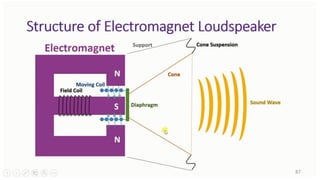
  • 81.
  • 82.
  • 83.
  • 84.
  • 85.
  • 86.
  • 87.
  • 88.
  • 89.
  • 90.
  • 91.
  • 92.
    Permanent Magnets andElectromagnets: What are the Differences? • A permanent magnet is an object made from a material that is magnetized and creates its own persistent magnetic field. As the name suggests, a permanent magnet is 'permanent'. This means that it always has a magnetic field and will display a magnetic behavior at all times. • An electromagnet is made from a coil of wire which acts as a magnet when an electric current passes through it. Often an electromagnet is wrapped around a core of ferromagnetic material like steel, which enhances the magnetic field produced by the coil. 92
  • 93.
    Permanent Magnet v.Electromagnet: Magnetic Properties • A permanent magnet’s magnetic properties exist when the magnet is (magnetized). An electromagnetic magnet only displays magnetic properties when an electric current is applied to it. • That is how you can differentiate between the two. The magnets that you have affixed to your refrigerator are permanent magnets, while electromagnets are the principle behind AC motors. 93
  • 94.
    Permanent Magnet v.Electromagnet: Magnetic Strength • Permanent magnet strength depends upon the material used in its creation. The strength of an electromagnet can be adjusted by the amount of electric current allowed to flow into it. • As a result, the same electromagnet can be adjusted for different strength levels. 94
  • 95.
    Permanent Magnet v.Electromagnet: Loss of Magnetic Properties • If a permanent magnet loses its magnetic properties, as it does by heating to a (maximum) temperature, it will be rendered useless and its magnetic properties can be only recovered by re- magnetizing. • Contrarily, an electromagnet loses its magnetic power every time an electric current is removed and becomes magnetic once again when the electric field is introduced. 95
  • 96.
    Permanent Magnet v.Electromagnet: Advantages • The main advantage of a permanent magnet over an electromagnet is that a permanent magnet does not require a continuous supply of electrical energy to maintain its magnetic field. • However, an electromagnet’s magnetic field can be rapidly manipulated over a wide range by controlling the amount of electric current supplied to the electromagnet. • Note: This is a high level overview of permanent magnets as they compare to electromagnets. There are more details available relating to the differences stated. 96
  • 97.
  • 98.
    98 Dynamic and Electrostatic Speakers Thereis a huge difference between dynamic and elect rostatic speakers. For more information, see electrostat ic speaker.
  • 99.
    Woofers 99 A Woofer isdriver that reproduces a band of frequencies generally between 0–1 kHz
  • 100.
    Woofer • A wooferis a driver that reproduces low frequencies. The driver works with the characteristics of the enclosure to produce suitable low frequencies. • Some loudspeaker systems use a woofer for the lowest frequencies, sometimes well enough that a subwoofer is not needed. • Additionally, some loudspeakers use the woofer to handle middle frequencies, eliminating the mid-range driver. • This can be accomplished with the selection of a tweeter that can work low enough that, combined with a woofer that responds high enough, the two drivers add coherently in the middle frequencies. 100
  • 101.
  • 102.
    Cont. • Woofer isthe term commonly used for a loudspeaker driver designed to produce low frequency sounds, typically from around 40 Hz up to about a KHz or higher. • There are two types of low frequency speaker, the commonly known woofer, and the more recent addition the subwoofer. • The latter is used for the reproduction of frequencies below those produced by the woofer and it is generally purchased as an add-on to an existing system. 102
  • 103.
    Cont. • The lowfrequencies speaker provides the bass of any hi-fi system. The prime requisite for low frequency reproduction is a large diaphragm the larger the better. • In addition to large size, the diaphragm must be of fairly heavy construction Light diaphragms just can't hold up under the vibrations encountered under the lower audio ranges. • A woofer must be able to vibrate back and forth very easily i.e have high compliance. One way to accomplish this is to have the diaphragm loosely connected to the frame. The gasket that holds the edge of diaphragm to the frame basket is fastened, so that it barely keeps the diaphragm from slipping loose. 103
  • 104.
    Cont. • Rather thanthe loose suspension system, the cone is supported by a very flexible material, so that it can be moved very easily by the voice coil. The suspension is tight cabin the sine wave at the diaphragm edge is made very flexible. • A woofer must also have a large voice coil to handle considerable heat. The larger the voice coil, the more the current produced by the amplifier output circuit and, therefore, the more the power the woofer can handle. 104
  • 105.
    Cont. • Finally, astrong magnet can be of great help to move the heavy voice coil and cone assembly too well. The better the woofer, the heavier the magnet assembly (unless it's ceramic). 105
  • 106.
    Tweeter 106 A Tweeter isdriver that reproduces a band of frequencies generally between 10–16 kHz
  • 107.
    Tweeters • A tweeteris a loudspeaker designed to produce high audio frequencies, typically from around 2,000 Hz to 20,000 Hz. • Some tweeters can manage response up to 65 kHz. • Nearly all tweeters are electro-dynamic drivers, using a voice coil suspended within a fixed magnetic field. • There are two main types of high frequency speakers; the well- known tweeter and the more recent super tweeter. 107
  • 108.
    Six basic high-frequencytweeters i. The cone is a physically disincentive version of the woofer. ii. The dome, so called because of its dome-shaped diaphragm. iii. The horn, so named because it is a horn. iv. The Heil air-motion transformer which uses the principle of lever in its operation, named after its inventor, Dr. Oskar Heil. v. High polymer molecular-film tweeter, uses the piezoelectric effect for its principle of operation (used exclusively by Pioneer). vi. The electrostatic tweeter works on the principle of attraction or repulsion between two metal plates. 108
  • 109.
    Types • Types oftweeters – Cone tweeter – Dome tweeters – Horn tweeters 109
  • 110.
    Cont. • Cone tweetershave the same basic design and form as a woofer with optimizations to operate at higher frequencies. The optimizations usually are: • A very small and light cone so it can move rapidly; • Cone materials chosen for stiffness (e.g., ceramic cones in one manufacturer's line), or good damping properties (e.g., silk or coated fabric) or both. 110
  • 111.
    Cont. • The suspension(or spider) is stiffer than for other drivers—less flexibility is needed for high frequency reproduction; • Small voice coils (3/4 inch is typical) and light (thin) wire, which also helps the tweeter cone move rapidly. • Cone tweeters are relatively cheap, but do not have the dispersion characteristics of domes. Thus they are routinely seen in low cost applications such as factory car speakers, shelf stereo systems, and boom boxes. Cone tweeters can also be found in older stereo hi-fi system speakers designed and manufactured before the advent of the dome tweeter. They are now a rare sight in modern hi-fi usage. 111
  • 112.
  • 113.
    Dome tweeters • Adome tweeter is constructed by attaching a voice coil to a dome, which is attached to the magnet or the top plate via a low compliance suspension. These tweeters typically do not have a frame or basket, but a simple front plate attached to the magnet assembly. • Dome tweeters are categorized by their voice coil diameter. The majority of dome tweeters presently used in hi-fi speakers are 25 mm (1 in) in diameter. A variation is the ring radiator in which the 'suspension' of the cone or dome becomes the major radiating element. These tweeters have different directivity characteristics when compared to standard dome tweeters. 113
  • 114.
  • 115.
    Horn tweeters • Ahorn tweeter is any of the above tweeters coupled to a flared or horn structure. Horns are used for two purposes — to control dispersion, and to couple the tweeter diaphragm to the air for higher efficiency. • The tweeter in either case is usually termed a compression driver and is quite different from more common types of tweeters (see above). Properly used, a horn improves the off-axis response of the tweeter by controlling (i.e., reducing) the directivity of the tweeter. It can also improve the efficiency of the tweeter by coupling the relatively high acoustic impedance of the driver to the lower impedance of the air. 115
  • 116.
    • The largerthe horn, the lower the frequencies at which it can work, since large horns provide coupling to the air at lower frequencies. There are different types of horns, including radial and constant directivity (CD). Horn tweeters may have a somewhat 'different' sonic signature than simple dome tweeters. • Poorly designed horns, or improperly crossed-over horns, have predictable problems in the accuracy of their output, and the load that they present to the amplifier. Perhaps concerned about the image of poorly designed horns, some manufacturers use horn loaded tweeters, but avoid using the term. Their euphemisms include "elliptical aperture" "Semi-horn" and "Directivity controlled". These are, nonetheless, a form of horn loading. 116
  • 117.
  • 118.
  • 119.
    History 119 Component Inventor YearApplication Microphone first microphone was invented by Alexander Graham Bell 1876 It was a liquid device and that was not very practical. Thomas Alva Edison invented the first practical carbon microphone. 1886 The carbon microphone was used for radio transmissions and extensively in telephone transmitters until the 1970s when they were replaced by piezoelectric ceramic elements.
  • 120.
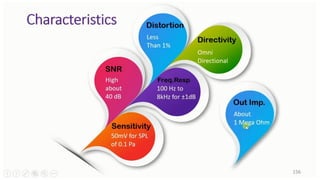
    Microphones Characteristics • Inorder to provide some background for these techniques it is useful first to understand some of the important characteristics of the microphones. • For live sound applications are their operating principle, frequency response and directionality. • Impedance – Generally, microphones can be divided into low (50–1,000 ohms), medium (5,000–15,000 ohms) and high (20,000+ ohms) impedance • Sensitivity – Typically, the microphone output (in a sound field of specified intensity) is stated in dB (decibels) as reference level. 120
  • 121.
    Microphones • Microphones area type of transducer - a device which converts acoustical energy (sound waves) into electrical energy (the audio signal). Different types of microphone have different ways of converting energy but they all share one thing in common. • Diaphragm. This is a thin piece of material (such as paper, plastic or aluminium) which vibrates when it is struck by sound waves. In a typical hand-held mic, the diaphragm is located in the head of the microphone. When the diaphragm vibrates, it causes other components to vibrate. These vibrations are converted into an electrical current which becomes the audio signal. 121
  • 122.
  • 123.
  • 124.
    124 Pa = PascalPressure Sensitivity
  • 125.
  • 126.
  • 127.
  • 128.
  • 129.
  • 130.
  • 131.
  • 132.
  • 133.
  • 134.
  • 135.
  • 136.
  • 137.
  • 138.
  • 139.
  • 140.
  • 141.
  • 142.
  • 143.
  • 144.
  • 145.
  • 146.
    Crystal Microphone • Crystalswhich demonstrate the piezoelectric effect produce voltages when they are deformed. The crystal microphone uses a thin strip of piezoelectric material attached to a diaphragm. • The two sides of the crystal acquire opposite charges when the crystal is deflected by the diaphragm. The charges are proportional to the amount of deformation and disappear when the stress on the crystal disappears. • Later microphones used ceramic materials such as barium titanate and lead zirconate. 146
  • 147.
    • The electricoutput of crystal microphones is comparatively large, but the frequency response is not comparable to good as dynamic microphone, so they are not serious contenders for the music market. 147 Cont.
  • 148.
  • 149.
  • 150.
  • 151.
  • 152.
  • 153.
    • This meansthat when mechanical stress is placed upon the material, a voltage electromagnetic force (EMF) is generated. • Since Rochelle salt has the largest voltage output for a given mechanical stress, it is the most commonly used crystal in microphones. • View (A) of figure is a crystal microphone in which the crystal is mounted so that the sound waves strike it directly. • View (B) has a diaphragm that is mechanically linked to the crystal so that the sound waves are indirectly coupled to the crystal 153 Working
  • 154.
    154 • Sound wavecompression – compress crystal • Refraction – converse take place – crystal is extended and is under tension • Due to this compression and extension – varying potential difference is generated which is proportional to the mechanical pressure applied to the crystal by the sound waves – pressure microphone Cont.
  • 155.
  • 156.
  • 157.
  • 158.
  • 159.
  • 160.
  • 161.
    Carbon Microphone • Thecarbon microphone was widely used for many years being one of the earliest reliable microphones. But it was not widely used now a days. 161
  • 162.
    Construction • The basicconcept behind the carbon microphone is the fact that when carbon granules are compressed their resistance decreases. This occurs because the granules come into better contact with each other when they are pushed together by the higher pressure. • The carbon microphone comprises carbon granules that are contained within a small contained that is covered with a thin metal diaphragm. A battery is also required to cause a current to flow through the microphone. 162
  • 163.
    Cont. • The carbonmicrophone is consisting of two metal plates separated by granules of carbon. • One plate faces outward and acts as a diaphragm. • When sound waves strike this plate, the pressure on the granules changes, which in turn changes the electrical resistance between the plates. (Higher pressure lowers the resistance as the granules are pushed closer together.) 163
  • 164.
  • 165.
  • 166.
  • 167.
  • 168.
  • 169.
  • 170.
    Working • The varyingcurrent can be passed through a transformer or a capacitor to enable it to be used within a telephone, or by some form of amplifier. • The frequency response of the carbon microphone, however, is limited to a narrow range, and the device produces significant electrical noise. • Often the microphone would produce a form of crackling noise which could be eliminated by shaking it or giving it a small sharp knock. This would shake the carbon granules and enable them to produce a more steady current. 170
  • 171.
    Cont. • The changein contact resistance causes a current from a battery connected in series with the carbon button and the primary of a transformer to vary in amplitude, resulting in a current waveform similar to the acoustic waveform striking the diaphragm. • One of the main disadvantages of the carbon microphone is that it has continuous high frequency hiss caused by the changing contact resistance between the carbon granules. 171
  • 172.
  • 173.
  • 174.
    Application • Carbon microphoneswere an ideal choice of microphone in the early days of the telephone. Because they gave a high output which meant no amplification was used. • It is also used in portable radio communication set 174 Carbon microphones were used in telephones like this vintage British GPO 300 series telephone
  • 175.
    advantages • High output •Simple principle & construction • Cheap and simple to manufacture 175
  • 176.
    disadvantages • Very noisy- high background noise and on occasions it would crackle. (Constant BACKGROUND HISS (hissing noise)which results from random changes in the resistance between individual carbon granules). • Poor sensitivity and frequency response. • Requires battery or other supply for operation • The disadvantages, however, are offset by advantages that make its use in military applications widespread. It is lightweight, rugged, and can produce an extremely high output. 176
  • 177.
  • 178.
  • 179.
  • 180.
    Basics • Dynamic microphonesare versatile and ideal for general-purpose use. They use a simple design with few moving parts. • They are relatively strong and flexible to rough handling. They are also better suited to handling high volume levels, for examples they will deal better with certain instruments are amplifiers. • They have no internal amplifier and do not require batteries or external power. When a magnet is moved near a coil of wire, an electrical current is generated in the wire. • Using this electromagnet principle, the dynamic microphone uses a wire coil and magnet to create the audio signal. 180
  • 181.
    Cont. • The diaphragmis attached to the coil. When this vibrates (due to sound waves) the coil moves backward and forward to the magnet. • This creates a current in the coil, which is channeled from the microphone along wires. • A physical cone act like a lens to concentrate the incoming sound waves. It employs a diaphragm, a voice coil, and a magnet. • The voice coil is surrounded by a magnetic field and is attached to the rear of the diaphragm. The motion of the voice coil in the magnetic field generates the electrical signal corresponding to the picked up sound. 181
  • 182.
  • 183.
  • 184.
  • 185.
  • 186.
  • 187.
  • 188.
  • 189.
  • 190.
  • 191.
  • 192.
    192 Cont. • This classificationincludes ribbon mics (velocity mics). • Rugged, resistant to hand noise. • Standard equipment used by musical performers. • Handle extremely high sound levels. – Sound waves strike the diaphragm. – Diaphragm vibrates in response. – The voice coil, attached with the diaphragm, vibrates with it. – The voice coil is surrounded by a magnetic field created by the magnet. – The motion of the voice coil in this magnetic field generates the electrical signal.
  • 193.
  • 194.
    • Shaped frequencyresponse • Designed for professional vocal use in live performances. 194
  • 195.
    195 • relatively inexpensive •they are not sensitive to change in humidity • they do not need internal or external power to operate • they usually have a resonant peak in the mid frequency response • can be weak in the high frequency response about 10khz Characteristics
  • 196.
  • 197.
  • 198.
    Wireless or CordlessMicrophone • A wireless microphone is a microphone without a physical cable connecting it directly to the sound recording or amplifying equipment with which it is associated. • It has a small, battery‐powered radio transmitter in the microphone body, which transmits the audio signal from the microphone by radio waves to a nearby receiver unit, which recovers the audio. 198
  • 199.
    • The otheraudio equipment is connected to the receiver unit by cable. • Wireless microphones are widely used in the entertainment industry, television broadcasting, and public speaking to allow public speakers, interviewers, performers, and entertainers to move about freely while using a microphone to amplify their voices. • These are Hand held and collar type as shown in figure 199
  • 200.
    Wireless or CordlessMicrophone 200
  • 201.
    Advantages • Greater freedomof movement for the artist or speaker. • Avoidance of cabling stressing problems common with wired microphones. • Reduction of cable "trip hazards" in the performance space 201
  • 202.
    Disadvantages • Some wirelesssystems have a shorter range, while more expensive models can exceed that distance. • Possible interference with or, more often, from other radio equipment or other radio microphones. • Operation time is limited relative to battery life. 202