

Made by Muhammad Yaman 
X-W
How Do Microphones Work? 
The Basics Microphones just convert a real sound wave into an 
electrical audio signal. In order to do so, they have a small, light 
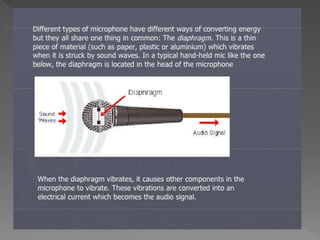
material in them called the diaphragm. When the sound vibrations 
through the air reach the diaphragm, they cause the diaphragm to 
vibrate. This in turns will somehow cause an electrical current in the 
microphone to vary, whereupon it is sent out to a mixer, preamplifier or 
amplifier for use.
Types of Microphone: 
There are a number of different types of microphone in common use. The 
differences can be divided into two areas: 
The type of conversion technology they use 
This refers to the technical method the mike uses to convert sound into 
electricity. The most common technologies are dynamic , condenser, 
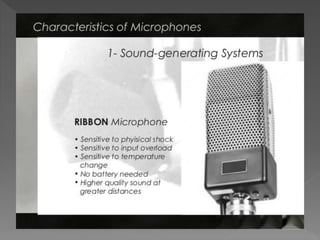
ribbon and crystal . Each has advantages and disadvantages, and each 
is generally more suited to certain types of application. The following 
pages will provide details. 
The type of application they are designed for 
Some mikes are designed for general use and can be used effectively in 
many different situations. Others are very specialised and are only really 
useful for their intended purpose. Characteristics to look for include 
directional properties, frequency response and impedance (more on 
these later).
Dynamic Microphones 
Dynamic Microphones are typically classified according to how the 
diaphragms produce sound. Dynamic Microphones Dynamic 
microphones are versatile and ideal for general-purpose use. They 
use a simple design with few moving parts. They are relatively sturdy 
and resilient to rough handling. They are also better suited to 
handling high volume levels, such as from certain musical 
instruments or amplifiers. They have no internal amplifier and do not 
require batteries or external power.
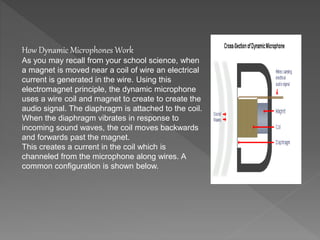
How Dynamic Microphones Work 
As you may recall from your school science, when 
a magnet is moved near a coil of wire an electrical 
current is generated in the wire. Using this 
electromagnet principle, the dynamic microphone 
uses a wire coil and magnet to create to create the 
audio signal. The diaphragm is attached to the coil. 
When the diaphragm vibrates in response to 
incoming sound waves, the coil moves backwards 
and forwards past the magnet. 
This creates a current in the coil which is 
channeled from the microphone along wires. A 
common configuration is shown below.
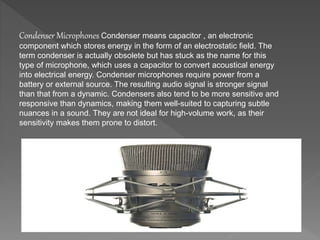
Condenser Microphones Condenser means capacitor , an electronic 
component which stores energy in the form of an electrostatic field. The 
term condenser is actually obsolete but has stuck as the name for this 
type of microphone, which uses a capacitor to convert acoustical energy 
into electrical energy. Condenser microphones require power from a 
battery or external source. The resulting audio signal is stronger signal 
than that from a dynamic. Condensers also tend to be more sensitive and 
responsive than dynamics, making them well-suited to capturing subtle 
nuances in a sound. They are not ideal for high-volume work, as their 
sensitivity makes them prone to distort.
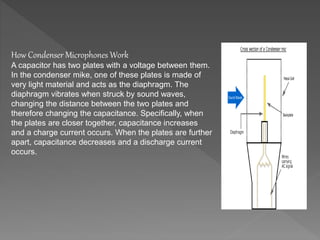
How Condenser Microphones Work 
A capacitor has two plates with a voltage between them. 
In the condenser mike, one of these plates is made of 
very light material and acts as the diaphragm. The 
diaphragm vibrates when struck by sound waves, 
changing the distance between the two plates and 
therefore changing the capacitance. Specifically, when 
the plates are closer together, capacitance increases 
and a charge current occurs. When the plates are further 
apart, capacitance decreases and a discharge current 
occurs.
Phantom Power Condenser 
microphones need a source of power to impress the charge on the 
capacitor. One of three methods is used. Either a battery will be inserted 
inside the microphone, a permanent charge is retained on the diaphragm 
or back plate thanks to some clever material scientist, or phantom power 
is used. Phantom power is the supply of power through the ground cable 
of an XLR cable. Ranging from 9 volts to 52 volts, typically 48 volts, this 
power can be put into the cable either from a mixer, a phantom power 
box or a battery pack. A mixer might have a button that allows phantom 
power through the ground cable. A phantom power box is like an 
intermediate component between a mixer and a mike. It is a box (duh) 
connected to the mains that essentially just puts a charge on the ground 
cable. A battery pack does exactly the same thing, but works only with 
batteries
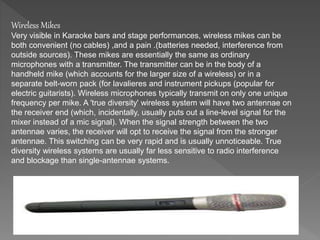
Wireless Mikes 
Very visible in Karaoke bars and stage performances, wireless mikes can be 
both convenient (no cables) ,and a pain .(batteries needed, interference from 
outside sources). These mikes are essentially the same as ordinary 
microphones with a transmitter. The transmitter can be in the body of a 
handheld mike (which accounts for the larger size of a wireless) or in a 
separate belt-worn pack (for lavalieres and instrument pickups (popular for 
electric guitarists). Wireless microphones typically transmit on only one unique 
frequency per mike. A 'true diversity' wireless system will have two antennae on 
the receiver end (which, incidentally, usually puts out a line-level signal for the 
mixer instead of a mic signal). When the signal strength between the two 
antennae varies, the receiver will opt to receive the signal from the stronger 
antennae. This switching can be very rapid and is usually unnoticeable. True 
diversity wireless systems are usually far less sensitive to radio interference 
and blockage than single-antennae systems.
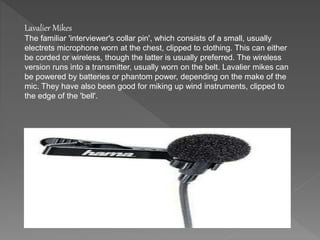
Lavalier Mikes 
The familiar 'interviewer's collar pin', which consists of a small, usually 
electrets microphone worn at the chest, clipped to clothing. This can either 
be corded or wireless, though the latter is usually preferred. The wireless 
version runs into a transmitter, usually worn on the belt. Lavalier mikes can 
be powered by batteries or phantom power, depending on the make of the 
mic. They have also been good for miking up wind instruments, clipped to 
the edge of the 'bell'.
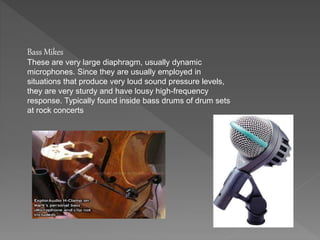
Bass Mikes 
These are very large diaphragm, usually dynamic 
microphones. Since they are usually employed in 
situations that produce very loud sound pressure levels, 
they are very sturdy and have lousy high-frequency 
response. Typically found inside bass drums of drum sets 
at rock concerts
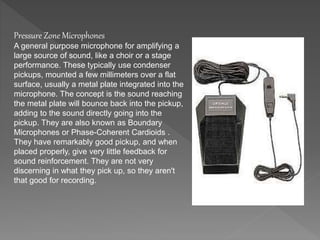
Pressure Zone Microphones 
A general purpose microphone for amplifying a 
large source of sound, like a choir or a stage 
performance. These typically use condenser 
pickups, mounted a few millimeters over a flat 
surface, usually a metal plate integrated into the 
microphone. The concept is the sound reaching 
the metal plate will bounce back into the pickup, 
adding to the sound directly going into the 
pickup. They are also known as Boundary 
Microphones or Phase-Coherent Cardioids . 
They have remarkably good pickup, and when 
placed properly, give very little feedback for 
sound reinforcement. They are not very 
discerning in what they pick up, so they aren't 
that good for recording.
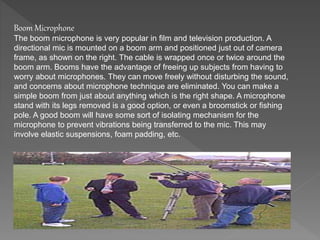
Boom Microphone 
The boom microphone is very popular in film and television production. A 
directional mic is mounted on a boom arm and positioned just out of camera 
frame, as shown on the right. The cable is wrapped once or twice around the 
boom arm. Booms have the advantage of freeing up subjects from having to 
worry about microphones. They can move freely without disturbing the sound, 
and concerns about microphone technique are eliminated. You can make a 
simple boom from just about anything which is the right shape. A microphone 
stand with its legs removed is a good option, or even a broomstick or fishing 
pole. A good boom will have some sort of isolating mechanism for the 
microphone to prevent vibrations being transferred to the mic. This may 
involve elastic suspensions, foam padding, etc.
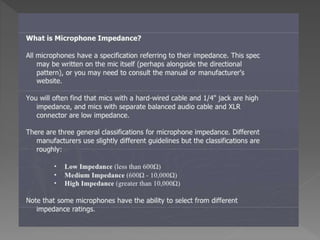
Microphone Impedance 
When dealing with microphones, one consideration which is often 
misunderstood or overlooked is the microphone's impedance rating. Perhaps 
this is because impedance isn't a "critical" factor; that is, 
microphones will still continue to operate whether or not the best impedance 
rating is used. However, in order to ensure the best quality and most reliable 
audio, attention should be paid to getting this factor right. If you want the short 
answer, here it is: Low impedance is better than high impedance. 
What is Impedance? 
Impedance is an electronics term which measures the amount of opposition a 
device has to an AC current (such as an audio signal). Technically speaking, it 
is the combined effect of capacitance, inductance, and resistance on a signal. 
Impedance is measured in ohms, shown with the Greek Omega symbol Ω or 
the letter Z . A microphone with the specification 600Ω has an impedance of 
600 ohms.
Microphone Frequency Response 
Frequency response refers to the way a microphone responds to different 
frequencies. It is a characteristic of all microphones that some frequencies are 
exaggerated and others are attenuated (reduced). For example, a frequency 
response which favors high frequencies means that the resulting audio output 
will sound more trebly than the original sound.
Frequency Response Charts 
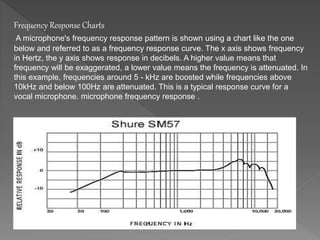
A microphone's frequency response pattern is shown using a chart like the one 
below and referred to as a frequency response curve. The x axis shows frequency 
in Hertz, the y axis shows response in decibels. A higher value means that 
frequency will be exaggerated, a lower value means the frequency is attenuated. In 
this example, frequencies around 5 - kHz are boosted while frequencies above 
10kHz and below 100Hz are attenuated. This is a typical response curve for a 
vocal microphone. microphone frequency response .
Frequency Response Ranges 
You will often see frequency response quoted as a range 
between two figures. This is a simple (or perhaps 
"simplistic") way to see which frequencies a 
microphone is capable of capturing effectively. For 
example, a microphone which is said to have a 
frequency response of 20 Hz to 20 kHz can reproduce 
all frequencies within this range. Frequencies outside 
this range will be reproduced to a much lesser extent or 
not at all. This specification makes no mention of the 
response curve, or how successfully the various 
frequencies will be reproduced. Like many 
specifications, it should be taken as a guide only. 
Condenser vs Dynamic 
Condenser microphones generally have flatter frequency 
responses than dynamic. All other things being equal, 
this would usually mean that a condenser is more 
desirable if accurate sound is a prime consideration
Working Principals of Microphones

Working Principals of Microphones

  • 1.
  • 2.
    How Do MicrophonesWork? The Basics Microphones just convert a real sound wave into an electrical audio signal. In order to do so, they have a small, light material in them called the diaphragm. When the sound vibrations through the air reach the diaphragm, they cause the diaphragm to vibrate. This in turns will somehow cause an electrical current in the microphone to vary, whereupon it is sent out to a mixer, preamplifier or amplifier for use.
  • 4.
    Types of Microphone: There are a number of different types of microphone in common use. The differences can be divided into two areas: The type of conversion technology they use This refers to the technical method the mike uses to convert sound into electricity. The most common technologies are dynamic , condenser, ribbon and crystal . Each has advantages and disadvantages, and each is generally more suited to certain types of application. The following pages will provide details. The type of application they are designed for Some mikes are designed for general use and can be used effectively in many different situations. Others are very specialised and are only really useful for their intended purpose. Characteristics to look for include directional properties, frequency response and impedance (more on these later).
  • 5.
    Dynamic Microphones DynamicMicrophones are typically classified according to how the diaphragms produce sound. Dynamic Microphones Dynamic microphones are versatile and ideal for general-purpose use. They use a simple design with few moving parts. They are relatively sturdy and resilient to rough handling. They are also better suited to handling high volume levels, such as from certain musical instruments or amplifiers. They have no internal amplifier and do not require batteries or external power.
  • 6.
    How Dynamic MicrophonesWork As you may recall from your school science, when a magnet is moved near a coil of wire an electrical current is generated in the wire. Using this electromagnet principle, the dynamic microphone uses a wire coil and magnet to create to create the audio signal. The diaphragm is attached to the coil. When the diaphragm vibrates in response to incoming sound waves, the coil moves backwards and forwards past the magnet. This creates a current in the coil which is channeled from the microphone along wires. A common configuration is shown below.
  • 7.
    Condenser Microphones Condensermeans capacitor , an electronic component which stores energy in the form of an electrostatic field. The term condenser is actually obsolete but has stuck as the name for this type of microphone, which uses a capacitor to convert acoustical energy into electrical energy. Condenser microphones require power from a battery or external source. The resulting audio signal is stronger signal than that from a dynamic. Condensers also tend to be more sensitive and responsive than dynamics, making them well-suited to capturing subtle nuances in a sound. They are not ideal for high-volume work, as their sensitivity makes them prone to distort.
  • 8.
    How Condenser MicrophonesWork A capacitor has two plates with a voltage between them. In the condenser mike, one of these plates is made of very light material and acts as the diaphragm. The diaphragm vibrates when struck by sound waves, changing the distance between the two plates and therefore changing the capacitance. Specifically, when the plates are closer together, capacitance increases and a charge current occurs. When the plates are further apart, capacitance decreases and a discharge current occurs.
  • 9.
    Phantom Power Condenser microphones need a source of power to impress the charge on the capacitor. One of three methods is used. Either a battery will be inserted inside the microphone, a permanent charge is retained on the diaphragm or back plate thanks to some clever material scientist, or phantom power is used. Phantom power is the supply of power through the ground cable of an XLR cable. Ranging from 9 volts to 52 volts, typically 48 volts, this power can be put into the cable either from a mixer, a phantom power box or a battery pack. A mixer might have a button that allows phantom power through the ground cable. A phantom power box is like an intermediate component between a mixer and a mike. It is a box (duh) connected to the mains that essentially just puts a charge on the ground cable. A battery pack does exactly the same thing, but works only with batteries
  • 13.
    Wireless Mikes Veryvisible in Karaoke bars and stage performances, wireless mikes can be both convenient (no cables) ,and a pain .(batteries needed, interference from outside sources). These mikes are essentially the same as ordinary microphones with a transmitter. The transmitter can be in the body of a handheld mike (which accounts for the larger size of a wireless) or in a separate belt-worn pack (for lavalieres and instrument pickups (popular for electric guitarists). Wireless microphones typically transmit on only one unique frequency per mike. A 'true diversity' wireless system will have two antennae on the receiver end (which, incidentally, usually puts out a line-level signal for the mixer instead of a mic signal). When the signal strength between the two antennae varies, the receiver will opt to receive the signal from the stronger antennae. This switching can be very rapid and is usually unnoticeable. True diversity wireless systems are usually far less sensitive to radio interference and blockage than single-antennae systems.
  • 14.
    Lavalier Mikes Thefamiliar 'interviewer's collar pin', which consists of a small, usually electrets microphone worn at the chest, clipped to clothing. This can either be corded or wireless, though the latter is usually preferred. The wireless version runs into a transmitter, usually worn on the belt. Lavalier mikes can be powered by batteries or phantom power, depending on the make of the mic. They have also been good for miking up wind instruments, clipped to the edge of the 'bell'.
  • 15.
    Bass Mikes Theseare very large diaphragm, usually dynamic microphones. Since they are usually employed in situations that produce very loud sound pressure levels, they are very sturdy and have lousy high-frequency response. Typically found inside bass drums of drum sets at rock concerts
  • 16.
    Pressure Zone Microphones A general purpose microphone for amplifying a large source of sound, like a choir or a stage performance. These typically use condenser pickups, mounted a few millimeters over a flat surface, usually a metal plate integrated into the microphone. The concept is the sound reaching the metal plate will bounce back into the pickup, adding to the sound directly going into the pickup. They are also known as Boundary Microphones or Phase-Coherent Cardioids . They have remarkably good pickup, and when placed properly, give very little feedback for sound reinforcement. They are not very discerning in what they pick up, so they aren't that good for recording.
  • 17.
    Boom Microphone Theboom microphone is very popular in film and television production. A directional mic is mounted on a boom arm and positioned just out of camera frame, as shown on the right. The cable is wrapped once or twice around the boom arm. Booms have the advantage of freeing up subjects from having to worry about microphones. They can move freely without disturbing the sound, and concerns about microphone technique are eliminated. You can make a simple boom from just about anything which is the right shape. A microphone stand with its legs removed is a good option, or even a broomstick or fishing pole. A good boom will have some sort of isolating mechanism for the microphone to prevent vibrations being transferred to the mic. This may involve elastic suspensions, foam padding, etc.
  • 20.
    Microphone Impedance Whendealing with microphones, one consideration which is often misunderstood or overlooked is the microphone's impedance rating. Perhaps this is because impedance isn't a "critical" factor; that is, microphones will still continue to operate whether or not the best impedance rating is used. However, in order to ensure the best quality and most reliable audio, attention should be paid to getting this factor right. If you want the short answer, here it is: Low impedance is better than high impedance. What is Impedance? Impedance is an electronics term which measures the amount of opposition a device has to an AC current (such as an audio signal). Technically speaking, it is the combined effect of capacitance, inductance, and resistance on a signal. Impedance is measured in ohms, shown with the Greek Omega symbol Ω or the letter Z . A microphone with the specification 600Ω has an impedance of 600 ohms.
  • 22.
    Microphone Frequency Response Frequency response refers to the way a microphone responds to different frequencies. It is a characteristic of all microphones that some frequencies are exaggerated and others are attenuated (reduced). For example, a frequency response which favors high frequencies means that the resulting audio output will sound more trebly than the original sound.
  • 23.
    Frequency Response Charts A microphone's frequency response pattern is shown using a chart like the one below and referred to as a frequency response curve. The x axis shows frequency in Hertz, the y axis shows response in decibels. A higher value means that frequency will be exaggerated, a lower value means the frequency is attenuated. In this example, frequencies around 5 - kHz are boosted while frequencies above 10kHz and below 100Hz are attenuated. This is a typical response curve for a vocal microphone. microphone frequency response .
  • 24.
    Frequency Response Ranges You will often see frequency response quoted as a range between two figures. This is a simple (or perhaps "simplistic") way to see which frequencies a microphone is capable of capturing effectively. For example, a microphone which is said to have a frequency response of 20 Hz to 20 kHz can reproduce all frequencies within this range. Frequencies outside this range will be reproduced to a much lesser extent or not at all. This specification makes no mention of the response curve, or how successfully the various frequencies will be reproduced. Like many specifications, it should be taken as a guide only. Condenser vs Dynamic Condenser microphones generally have flatter frequency responses than dynamic. All other things being equal, this would usually mean that a condenser is more desirable if accurate sound is a prime consideration