MICROFINANCE:  Enabling The Power  of Ideas & Entrepreneurial Energy for the Other Half Vinod Khosla May 2004
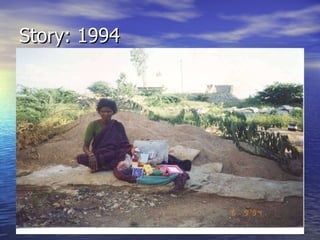
Story: 1994
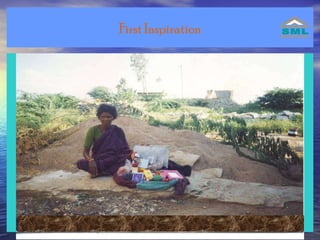
First Inspiration SML
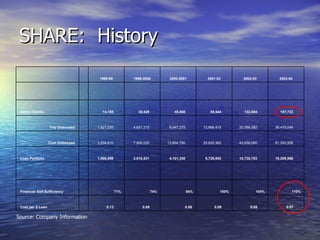
SHARE:  History Source: Company Information 0.07  0.08  0.09  0.09  0.09  0.13    Cost per $ Loan  110% 104% 100% 84% 74% 71%   Financial Self Sufficiency                  18,209,566  10,738,703  6,728,653  4,101,330  2,616,531  1,098,896    Loan Portfolio  81,393,506  43,938,060  25,825,362  13,604,790  7,906,020  3,254,810    Cum Disbursed  36,479,044  20,358,382  12,868,419  6,047,275  4,651,210  1,921,035    Yrly Disbursed  197,722  132,084  85,644  48,868  30,629  14,155    Active Clients                  2003-04 2002-03 2001-02 2000-2001 1999-2000 1998-99    
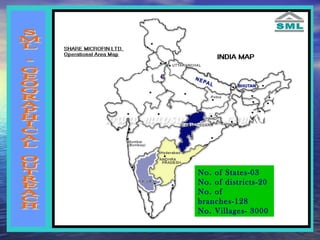
No. of States-03 No. of districts-20 No. of branches-128 No. Villages- 3000 SML - GEOGRAPHICAL OUTREACH No of  States :  3 No of  Districts : 20 No of  Branches:  108 SML
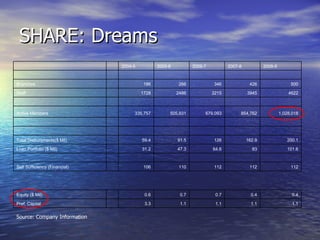
SHARE: Dreams Source: Company Information 1.1 1.1 1.1 1.1 3.3   Pref. Capital 0.4 0.4 0.7 0.7 0.6   Equity ($ Mil) 112 112 112 110 106   Self Sufficiency (Financial)               101.6 83 64.6 47.3 31.2   Loan Portfolio ($ Mil) 200.1 162.9 126 91.5 59.4   Total Disbursments($ Mil)                             1,028,018 854,762 679,093 505,931 335,757   Active Members               4622 3945 3215 2486 1728   Staff 500 426 346 266 186   Branches               2008-9 2007-8 2006-7 2005-6 2004-5    
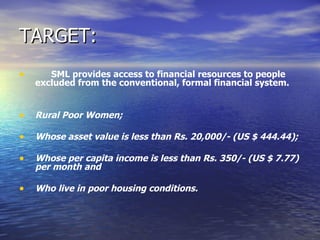
TARGET: SML provides access to financial resources to people excluded from the conventional, formal financial system. Rural Poor Women; Whose asset value is less than Rs. 20,000/- (US $ 444.44); Whose per capita income is less than Rs. 350/- (US $ 7.77) per month and Who live in poor housing conditions.
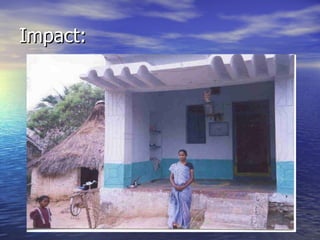
Impact:
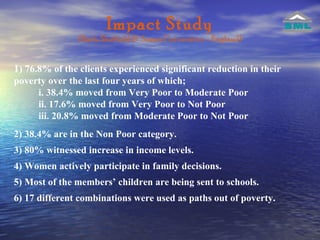
Impact Study (Bath, Sheffield & Sussex Universities – England) 1 ) 76.8% of the clients experienced significant reduction in their  poverty over the last four years of which; i. 38.4% moved from Very Poor to Moderate Poor ii. 17.6% moved from Very Poor to Not Poor iii. 20.8% moved from Moderate Poor to Not Poor 2) 38.4% are in the Non Poor category. 3) 80% witnessed increase in income levels. 4) Women actively participate in family decisions. 5) Most of the members’ children are being sent to schools. 6) 17 different combinations were used as paths out of poverty. SML
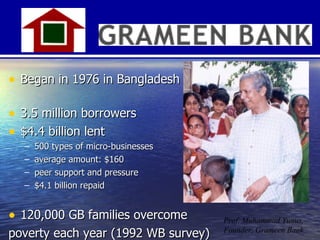
Began in 1976 in Bangladesh 3.5 million borrowers $4.4 billion lent  500 types of micro-businesses average amount: $160 peer support and pressure $4.1 billion repaid 120,000 GB families overcome poverty each year (1992 WB survey) Prof. Muhammad Yunus, Founder, Grameen Bank
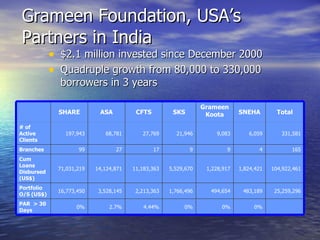
Grameen Foundation, USA’s Partners in India $2.1 million invested since December 2000 Quadruple growth from 80,000 to 330,000 borrowers in 3 years 0% 0% 0% 4.44% 2.7% 0% PAR  > 30 Days 25,259,296 483,189 494,654 1,766,496 2,213,363 3,528,145 16,773,450 Portfolio O/S (US$) 104,922,461 1,824,421 1,228,917 5,529,670 11,183,363 14,124,871 71,031,219 Cum Loans Disbursed (US$) 165 4 9 9 17 27 99 Branches 331,581 6,059 9,083 21,946 27,769 68,781 197,943 # of  Active Clients Total SNEHA Grameen Koota SKS CFTS ASA SHARE
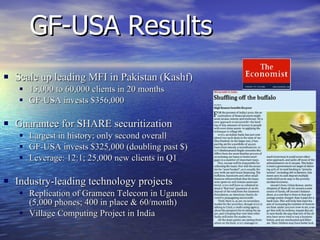
GF-USA Results Scale up leading MFI in Pakistan (Kashf) 15,000 to 60,000 clients in 20 months GF-USA invests $356,000 Guarantee for SHARE securitization Largest in history; only second overall GF-USA invests $325,000 (doubling past $) Leverage: 12:1; 25,000 new clients in Q1 Industry-leading technology projects Replication of Grameen Telecom in Uganda (5,000 phones; 400 in place & 60/month) Village Computing Project in India
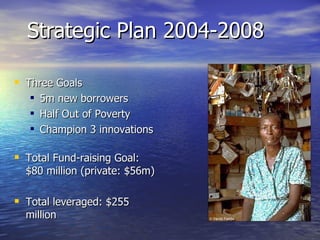
Strategic Plan 2004-2008 Three Goals 5m new borrowers Half Out of Poverty Champion 3 innovations Total Fund-raising Goal: $80 million (private: $56m) Total leveraged: $255 million
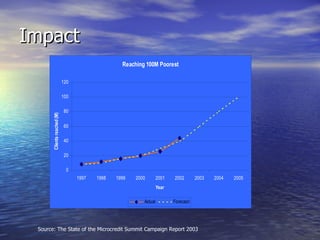
DREAM the DREAMS! Microcredit Summit 1997 Reach the Poorest Empower Women Build Financially Self-Sufficient Institutions Positive Measurable Impact 100m by 2005 (x5) Source: The State of the Microcredit Summit Campaign Report 2003
Remove The Myths The poorest are too costly to reach & motivate Institutions for the poor cannot be financially self-sufficient Such institutions will only add a debt burden to the poor Source: The State of the Microcredit Summit Campaign Report 2003
Impact Source: The State of the Microcredit Summit Campaign Report 2003
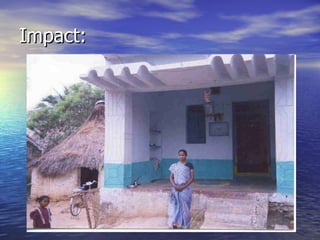
Impact:
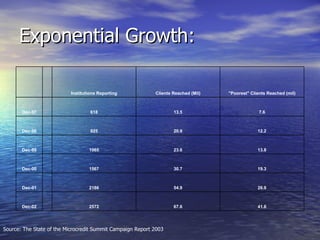
Exponential Growth: Source: The State of the Microcredit Summit Campaign Report 2003 41.6 67.6 2572   Dec-02 26.9 54.9 2186   Dec-01 19.3 30.7 1567   Dec-00 13.8 23.6 1065   Dec-99 12.2 20.9 925   Dec-98 7.6 13.5 618   Dec-97 "Poorest" Clients Reached (mil) Clients Reached (Mil) Institutions Reporting    
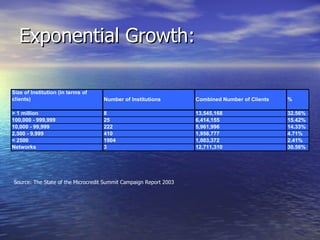
Exponential Growth: Source: The State of the Microcredit Summit Campaign Report 2003
Economic Basis Source: The State of the Microcredit Summit Campaign Report 2003 Ratings Professional Boards Audit  Functions Market Cost of Funds Incentive Compensation … .and much more
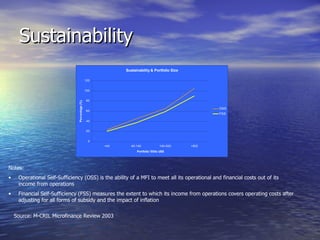
Sustainability Notes: Operational Self-Sufficiency (OSS) is the ability of a MFI to meet all its operational and financial costs out of its income from operations Financial Self-Sufficiency (FSS) measures the extent to which its income from operations covers operating costs after adjusting for all forms of subsidy and the impact of inflation Source: M-CRIL Microfinance Review 2003
Capitalism Scaled? Virtuous Pyramid Scheme Sustainable “Better NOT Best Alternative” Methodology Incentive Schemes for Workforce Scalability: Commercial basis at ALL levels Economic Efficiency from Darwinian Model
Powers of… Entrepreneurship Power of Ideas Self preservation, Survival & Betterment Appropriate Capital Appropriate Assistance
Regulation
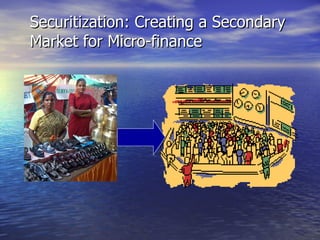
Securitization: Creating a Secondary Market for Micro-finance
Example: SHARE Securitization SHARE sold $4.3 million of its portfolio to ICICI Bank in Jan 04 42,000 loans from 26 branches as of 10.31.03 Continues to act as collection agent ICICI discounted the FV of principal and interest of these receivables at 8.75% Repayments will all be made by Jan 05 All future loans originated in these branches will be thru Partnership Model Boosts SHARE’s ROA and ROE
Investors and lenders demand increased efficiency and transparency  New efficiencies can mean lower costs to  borrowers Increased transparency and professionalism leading to lower risk of error and fraud Tapping into virtually unlimited sources of capital for expansion Reduction of time management spends “fund-raising” Benefits of Commercialization
Do Good , Do Well
Technology’s Role: ICT for cost management ICT as “products” ………? MIT Media Labs UC Berkeley
Debates? Sustainability vs MFI+ Definition of BPL Impact Assessment Issues Usurious Interest? NGO or “For Profit” Role of Government Role of Big Institutions
Lessons From Silicon Valley David or Goliath? Process or Passion? Help vs Enablement vs “Get out of the Way” Entrepreneurial Innovation Entrepreneurial Persistence Entrepreneurial Capital Efficiency Entrepreneurial Energy Venture Capital & Venture Assistance
Mix of $ Research “Programs” Impact Assessment Equity Loans
Comments? [email_address]
Exclusion of poorest people and areas  to reduce perceived portfolio risk among MFI lenders/owners Phasing out of complementary services (BDS, credit with education) and social impact experimentation  to reduce costs and increase profits “ Mission Drift”: Overarching poverty reduction objective slowly diluted/lost Ownership is increasingly foreign and from traditional banking sector Risks of Commercialization
Right mix of incentives for MFI loan officers Grameen Bank Five Star System 2 for social impact 3 stars for financial performance Apex organizations choice of MFIs Case of SHARE & GF-USA MFI choices for key management and governance posts (case of Fonkoze) Donors/Investors attention and valuing of: Poverty targeting, poverty impact (monitoring & results), experimentation & complementary services  Ensuring that ownership is predominantly local and ideally includes clients themselves Risk Mitigation
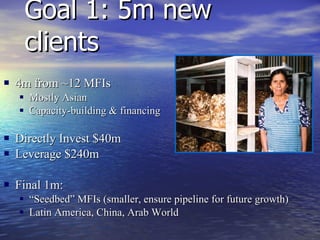
Goal 1: 5m new clients 4m from ~12 MFIs Mostly Asian Capacity-building & financing Directly Invest $40m Leverage $240m Final 1m: “ Seedbed” MFIs (smaller, ensure pipeline for future growth) Latin America, China, Arab World

Microfinance may2004

  • 1.
    MICROFINANCE: EnablingThe Power of Ideas & Entrepreneurial Energy for the Other Half Vinod Khosla May 2004
  • 2.
  • 3.
  • 4.
    SHARE: HistorySource: Company Information 0.07 0.08 0.09 0.09 0.09 0.13   Cost per $ Loan 110% 104% 100% 84% 74% 71%   Financial Self Sufficiency                 18,209,566 10,738,703 6,728,653 4,101,330 2,616,531 1,098,896   Loan Portfolio 81,393,506 43,938,060 25,825,362 13,604,790 7,906,020 3,254,810   Cum Disbursed 36,479,044 20,358,382 12,868,419 6,047,275 4,651,210 1,921,035   Yrly Disbursed 197,722 132,084 85,644 48,868 30,629 14,155   Active Clients                 2003-04 2002-03 2001-02 2000-2001 1999-2000 1998-99    
  • 5.
    No. of States-03No. of districts-20 No. of branches-128 No. Villages- 3000 SML - GEOGRAPHICAL OUTREACH No of States : 3 No of Districts : 20 No of Branches: 108 SML
  • 6.
    SHARE: Dreams Source:Company Information 1.1 1.1 1.1 1.1 3.3   Pref. Capital 0.4 0.4 0.7 0.7 0.6   Equity ($ Mil) 112 112 112 110 106   Self Sufficiency (Financial)               101.6 83 64.6 47.3 31.2   Loan Portfolio ($ Mil) 200.1 162.9 126 91.5 59.4   Total Disbursments($ Mil)                             1,028,018 854,762 679,093 505,931 335,757   Active Members               4622 3945 3215 2486 1728   Staff 500 426 346 266 186   Branches               2008-9 2007-8 2006-7 2005-6 2004-5    
  • 7.
    TARGET: SML providesaccess to financial resources to people excluded from the conventional, formal financial system. Rural Poor Women; Whose asset value is less than Rs. 20,000/- (US $ 444.44); Whose per capita income is less than Rs. 350/- (US $ 7.77) per month and Who live in poor housing conditions.
  • 8.
  • 9.
    Impact Study (Bath,Sheffield & Sussex Universities – England) 1 ) 76.8% of the clients experienced significant reduction in their poverty over the last four years of which; i. 38.4% moved from Very Poor to Moderate Poor ii. 17.6% moved from Very Poor to Not Poor iii. 20.8% moved from Moderate Poor to Not Poor 2) 38.4% are in the Non Poor category. 3) 80% witnessed increase in income levels. 4) Women actively participate in family decisions. 5) Most of the members’ children are being sent to schools. 6) 17 different combinations were used as paths out of poverty. SML
  • 10.
    Began in 1976in Bangladesh 3.5 million borrowers $4.4 billion lent 500 types of micro-businesses average amount: $160 peer support and pressure $4.1 billion repaid 120,000 GB families overcome poverty each year (1992 WB survey) Prof. Muhammad Yunus, Founder, Grameen Bank
  • 11.
    Grameen Foundation, USA’sPartners in India $2.1 million invested since December 2000 Quadruple growth from 80,000 to 330,000 borrowers in 3 years 0% 0% 0% 4.44% 2.7% 0% PAR > 30 Days 25,259,296 483,189 494,654 1,766,496 2,213,363 3,528,145 16,773,450 Portfolio O/S (US$) 104,922,461 1,824,421 1,228,917 5,529,670 11,183,363 14,124,871 71,031,219 Cum Loans Disbursed (US$) 165 4 9 9 17 27 99 Branches 331,581 6,059 9,083 21,946 27,769 68,781 197,943 # of Active Clients Total SNEHA Grameen Koota SKS CFTS ASA SHARE
  • 12.
    GF-USA Results Scaleup leading MFI in Pakistan (Kashf) 15,000 to 60,000 clients in 20 months GF-USA invests $356,000 Guarantee for SHARE securitization Largest in history; only second overall GF-USA invests $325,000 (doubling past $) Leverage: 12:1; 25,000 new clients in Q1 Industry-leading technology projects Replication of Grameen Telecom in Uganda (5,000 phones; 400 in place & 60/month) Village Computing Project in India
  • 13.
    Strategic Plan 2004-2008Three Goals 5m new borrowers Half Out of Poverty Champion 3 innovations Total Fund-raising Goal: $80 million (private: $56m) Total leveraged: $255 million
  • 14.
    DREAM the DREAMS!Microcredit Summit 1997 Reach the Poorest Empower Women Build Financially Self-Sufficient Institutions Positive Measurable Impact 100m by 2005 (x5) Source: The State of the Microcredit Summit Campaign Report 2003
  • 15.
    Remove The MythsThe poorest are too costly to reach & motivate Institutions for the poor cannot be financially self-sufficient Such institutions will only add a debt burden to the poor Source: The State of the Microcredit Summit Campaign Report 2003
  • 16.
    Impact Source: TheState of the Microcredit Summit Campaign Report 2003
  • 17.
  • 18.
    Exponential Growth: Source:The State of the Microcredit Summit Campaign Report 2003 41.6 67.6 2572   Dec-02 26.9 54.9 2186   Dec-01 19.3 30.7 1567   Dec-00 13.8 23.6 1065   Dec-99 12.2 20.9 925   Dec-98 7.6 13.5 618   Dec-97 "Poorest" Clients Reached (mil) Clients Reached (Mil) Institutions Reporting    
  • 19.
    Exponential Growth: Source:The State of the Microcredit Summit Campaign Report 2003
  • 20.
    Economic Basis Source:The State of the Microcredit Summit Campaign Report 2003 Ratings Professional Boards Audit Functions Market Cost of Funds Incentive Compensation … .and much more
  • 21.
    Sustainability Notes: OperationalSelf-Sufficiency (OSS) is the ability of a MFI to meet all its operational and financial costs out of its income from operations Financial Self-Sufficiency (FSS) measures the extent to which its income from operations covers operating costs after adjusting for all forms of subsidy and the impact of inflation Source: M-CRIL Microfinance Review 2003
  • 22.
    Capitalism Scaled? VirtuousPyramid Scheme Sustainable “Better NOT Best Alternative” Methodology Incentive Schemes for Workforce Scalability: Commercial basis at ALL levels Economic Efficiency from Darwinian Model
  • 23.
    Powers of… EntrepreneurshipPower of Ideas Self preservation, Survival & Betterment Appropriate Capital Appropriate Assistance
  • 24.
  • 25.
    Securitization: Creating aSecondary Market for Micro-finance
  • 26.
    Example: SHARE SecuritizationSHARE sold $4.3 million of its portfolio to ICICI Bank in Jan 04 42,000 loans from 26 branches as of 10.31.03 Continues to act as collection agent ICICI discounted the FV of principal and interest of these receivables at 8.75% Repayments will all be made by Jan 05 All future loans originated in these branches will be thru Partnership Model Boosts SHARE’s ROA and ROE
  • 27.
    Investors and lendersdemand increased efficiency and transparency New efficiencies can mean lower costs to borrowers Increased transparency and professionalism leading to lower risk of error and fraud Tapping into virtually unlimited sources of capital for expansion Reduction of time management spends “fund-raising” Benefits of Commercialization
  • 28.
    Do Good ,Do Well
  • 29.
    Technology’s Role: ICTfor cost management ICT as “products” ………? MIT Media Labs UC Berkeley
  • 30.
    Debates? Sustainability vsMFI+ Definition of BPL Impact Assessment Issues Usurious Interest? NGO or “For Profit” Role of Government Role of Big Institutions
  • 31.
    Lessons From SiliconValley David or Goliath? Process or Passion? Help vs Enablement vs “Get out of the Way” Entrepreneurial Innovation Entrepreneurial Persistence Entrepreneurial Capital Efficiency Entrepreneurial Energy Venture Capital & Venture Assistance
  • 32.
    Mix of $Research “Programs” Impact Assessment Equity Loans
  • 33.
  • 34.
    Exclusion of poorestpeople and areas to reduce perceived portfolio risk among MFI lenders/owners Phasing out of complementary services (BDS, credit with education) and social impact experimentation to reduce costs and increase profits “ Mission Drift”: Overarching poverty reduction objective slowly diluted/lost Ownership is increasingly foreign and from traditional banking sector Risks of Commercialization
  • 35.
    Right mix ofincentives for MFI loan officers Grameen Bank Five Star System 2 for social impact 3 stars for financial performance Apex organizations choice of MFIs Case of SHARE & GF-USA MFI choices for key management and governance posts (case of Fonkoze) Donors/Investors attention and valuing of: Poverty targeting, poverty impact (monitoring & results), experimentation & complementary services Ensuring that ownership is predominantly local and ideally includes clients themselves Risk Mitigation
  • 36.
    Goal 1: 5mnew clients 4m from ~12 MFIs Mostly Asian Capacity-building & financing Directly Invest $40m Leverage $240m Final 1m: “ Seedbed” MFIs (smaller, ensure pipeline for future growth) Latin America, China, Arab World