Group name:
Black and white
Welcome to our presentation
Our topic is
 micro-credit system
What is Microcredit?

A programme that extend small loans to very
poor people for self-employment projects
that generate income, allowing them to care
for themselves and their families.
 Part of microfinance which provides
numerous financial services to the poor
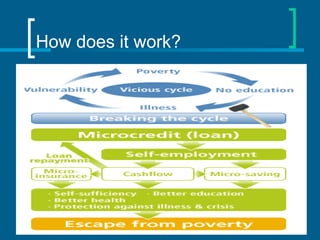
How does it work?
Why is Microcredit important?
 Why is Microcredit important?
 Four billion poor people need access to financial services
 Social justice
 Only philanthropy is not enough
 Women suffering the most
 Development of informal sector  farmers, tailors…
 Need to remove poverty in society
 ↑ Demand  $50 billion per year for Microcredit
 ↑ 15-30% growth annually
 Moral responsibility of businesses
How Microcredit
Different from Conventional Banks
 5 features
 Loan size is small  b/w $100-$500  average $100
 Customers are rural poor, particularly women
 Income activities  Self-employment, non-formal sector
 No collateral required
 Must have saving account linked to Microcredit
History of Microcredit:
Muhammad Yunus
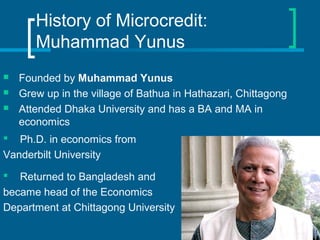
 Founded by Muhammad Yunus
 Grew up in the village of Bathua in Hathazari, Chittagong
 Attended Dhaka University and has a BA and MA in
economics
 Ph.D. in economics from
Vanderbilt University
 Returned to Bangladesh and
became head of the Economics
Department at Chittagong University
History of Microcredit:
Women of Jobra
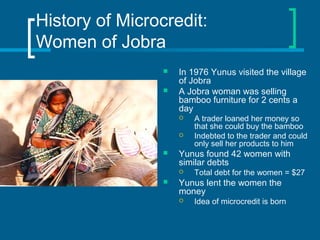
 In 1976 Yunus visited the village
of Jobra
 A Jobra woman was selling
bamboo furniture for 2 cents a
day
 A trader loaned her money so
that she could buy the bamboo
 Indebted to the trader and could
only sell her products to him
 Yunus found 42 women with
similar debts
 Total debt for the women = $27
 Yunus lent the women the
money
 Idea of microcredit is born
History of Microcredit:
Struggle for Support
 Yunus attempted to convince the banks of
Bangladesh to loan to the poor people
 Every bank denied his request
 Tried different banks for over 6 months
 “poor people are not credit worthy”
 Became a guarantor for a bank
 Successful lending in 5 different villages
 But banks continued to deny his requests
 Yunus realized he had to form his own bank
to lend to the poor
History of Microcredit:
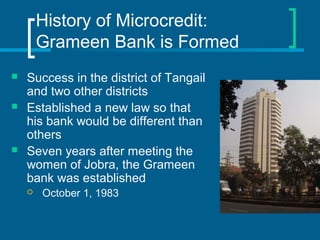
Grameen Bank is Formed
 Success in the district of Tangail
and two other districts
 Established a new law so that
his bank would be different than
others
 Seven years after meeting the
women of Jobra, the Grameen
bank was established
 October 1, 1983
History of Microcredit:
Grameen Bank Today
 As of July 2007 Grameen Bank has loaned
$6.38 billion to 7.4 million people
 More than 94% of loans have gone to
women
 More likely to devote money to their family
 In 2006 Yunus received the Nobel Peace
Prize
 $1.4 million prize
 Company to make low-cost, high-nutrition food for
poor
 Eye hospital for the poor in Bangladesh
History of Microcredit:
Microcredit Today
 Today there are more than 7,000
microfinance institutions
 Microcredit is offered in more than 100
countries
 More than 13 million people have been
given microcredit loans
 Loan repayment is at 97%
 Microcredit banks are now finding more
ways to help borrowers through agriculture,
health, and other programs
Assumptions of Microcredit
 Credit is a human right
 Need a dollar to get a dollar
 Most banks create poverty
 Governments must enable people
 Lending to women empowers communities
 Credit creates self-employment
 Credit makes other human rights attainable
How Microcredit Works
 Major players: All of these groups must work
together to enable microcredit programs to
exist and eliminate fraudulent practices
which may harm the poor.
 Borrowers
 Government
 Banks
 Donors
 Wholesale Funds
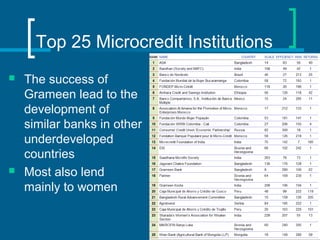
Top 25 Microcredit Institutions
 The success of
Grameen lead to the
development of
similar banks in other
underdeveloped
countries
 Most also lend
mainly to women
Requirements to Borrow
 Willing to take part in a “solidarity group”
 Money used only for improvements of
village life
 Agree to the codes of conduct for members
of microcredit programs
 Grameen Bank’s16 Decisions
 BRAC’s 17 Promises
 RD-12’s 21 Oaths
Requirements to Borrow
(cont…)

Land ownership of the household: For example, landless and marginal
farmers owning or cultivating less than 1.50 acre (0.6ha) of land on
share-cropping including homestead can become members of ADIP
credit program.
 Age of the individuals : For example, in case of BRAC, individuals
applying for credit must be aged between 18-54 years.
 Income of the households: For example, household having a maximum
monthly income of up to 3000 taka (equivalent to 44.44 USD) can become
members of marginal and landless group of ADIP.
 Residence of the individuals: The individual should be a permanent
resident of the village.
Requirements to Borrow
(cont…)
 Marital Status of the individuals. For example, married people were
encouraged in ADIP rather than singles.
 Affiliation: The individual cannot be affiliated with other NGOs or any
other microcredit program at the same time.
 Health status of the individuals: Individuals must be physically active
having no serious diseases like cancer or disabled.
 Focus on poor and destitute women. For instance, BRAC gives priority
 on widowed or divorced women with children
Qualifications for Traditional
Credit
 Assets
 Income
 Debts
 Repayment History
Qualifications for Microcredit
 Activity will generate employment
 Little or no collateral
 Part of a support group
 Women preferred
 Agree to Codes of Conduct
 Previous borrowers can get a loan as
long as previous loans are paid off
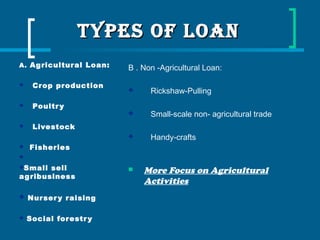
B . Non -Agricultural Loan:
 Rickshaw-Pulling
 Small-scale non- agricultural trade
 Handy-crafts
 More Focus on Agricultural
Activities
A. Agricultural Loan:
 Crop production
 Poultry
 Livestock
 Fisheries

Small sell
agribusiness
 Nursery raising
 Social forestry
Types of LoanTypes of Loan
Impact of micro-credit program on
poverty reduction
 Impact of micro-credit program on
poverty reduction was measured by
considering four dimensions.
 those area are change in income,
change in farm and household assets,
change in living standard and change
in poverty situations.
 Resent study shows the number of
new businesses increased by one
third.
 microcredit in Bangladesh had a
"positive impact on enterprise and
household income and asset
accumulation
Impact of micro-credit program
on poverty reduction (cont…)
Impact of micro-credit program on
poverty reduction (cont…)
 Microloans in the US have allowed
small business owners to make their
businesses their primary source of
income with 67% of the borrowers
showing a significant increase in their
income as a result of their participation
in certain micro-loan programs
Impact of micro-credit program on
poverty reduction (cont…)
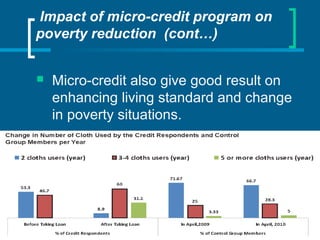
 Micro-credit also give good result on
enhancing living standard and change
in poverty situations.
Critiques of Microcredit
 Grameen Bank's high repayment rate does not
reflect the number of women who are repeat
borrowers
 Women become dependent on loans
 Women act as collection agents for their husbands
 Men spend the money
 Women fall into debt
 Over dependence on external capital
 Too much power given to field officers
 Sometimes violence is used to collect repayments
 Loan recipients could get into a cycle of debt
 Loans from other microcredit institutions to repay previous
microcredit loans
 High interest rates
Any question ?
thAnk you

Presentation on-microcredit

  • 1.
    Group name: Black andwhite Welcome to our presentation
  • 2.
    Our topic is micro-credit system
  • 3.
    What is Microcredit?  Aprogramme that extend small loans to very poor people for self-employment projects that generate income, allowing them to care for themselves and their families.  Part of microfinance which provides numerous financial services to the poor
  • 4.
  • 5.
    Why is Microcreditimportant?  Why is Microcredit important?  Four billion poor people need access to financial services  Social justice  Only philanthropy is not enough  Women suffering the most  Development of informal sector  farmers, tailors…  Need to remove poverty in society  ↑ Demand  $50 billion per year for Microcredit  ↑ 15-30% growth annually  Moral responsibility of businesses
  • 6.
    How Microcredit Different fromConventional Banks  5 features  Loan size is small  b/w $100-$500  average $100  Customers are rural poor, particularly women  Income activities  Self-employment, non-formal sector  No collateral required  Must have saving account linked to Microcredit
  • 7.
    History of Microcredit: MuhammadYunus  Founded by Muhammad Yunus  Grew up in the village of Bathua in Hathazari, Chittagong  Attended Dhaka University and has a BA and MA in economics  Ph.D. in economics from Vanderbilt University  Returned to Bangladesh and became head of the Economics Department at Chittagong University
  • 8.
    History of Microcredit: Womenof Jobra  In 1976 Yunus visited the village of Jobra  A Jobra woman was selling bamboo furniture for 2 cents a day  A trader loaned her money so that she could buy the bamboo  Indebted to the trader and could only sell her products to him  Yunus found 42 women with similar debts  Total debt for the women = $27  Yunus lent the women the money  Idea of microcredit is born
  • 9.
    History of Microcredit: Strugglefor Support  Yunus attempted to convince the banks of Bangladesh to loan to the poor people  Every bank denied his request  Tried different banks for over 6 months  “poor people are not credit worthy”  Became a guarantor for a bank  Successful lending in 5 different villages  But banks continued to deny his requests  Yunus realized he had to form his own bank to lend to the poor
  • 10.
    History of Microcredit: GrameenBank is Formed  Success in the district of Tangail and two other districts  Established a new law so that his bank would be different than others  Seven years after meeting the women of Jobra, the Grameen bank was established  October 1, 1983
  • 11.
    History of Microcredit: GrameenBank Today  As of July 2007 Grameen Bank has loaned $6.38 billion to 7.4 million people  More than 94% of loans have gone to women  More likely to devote money to their family  In 2006 Yunus received the Nobel Peace Prize  $1.4 million prize  Company to make low-cost, high-nutrition food for poor  Eye hospital for the poor in Bangladesh
  • 12.
    History of Microcredit: MicrocreditToday  Today there are more than 7,000 microfinance institutions  Microcredit is offered in more than 100 countries  More than 13 million people have been given microcredit loans  Loan repayment is at 97%  Microcredit banks are now finding more ways to help borrowers through agriculture, health, and other programs
  • 13.
    Assumptions of Microcredit Credit is a human right  Need a dollar to get a dollar  Most banks create poverty  Governments must enable people  Lending to women empowers communities  Credit creates self-employment  Credit makes other human rights attainable
  • 14.
    How Microcredit Works Major players: All of these groups must work together to enable microcredit programs to exist and eliminate fraudulent practices which may harm the poor.  Borrowers  Government  Banks  Donors  Wholesale Funds
  • 15.
    Top 25 MicrocreditInstitutions  The success of Grameen lead to the development of similar banks in other underdeveloped countries  Most also lend mainly to women
  • 16.
    Requirements to Borrow Willing to take part in a “solidarity group”  Money used only for improvements of village life  Agree to the codes of conduct for members of microcredit programs  Grameen Bank’s16 Decisions  BRAC’s 17 Promises  RD-12’s 21 Oaths
  • 17.
    Requirements to Borrow (cont…)  Landownership of the household: For example, landless and marginal farmers owning or cultivating less than 1.50 acre (0.6ha) of land on share-cropping including homestead can become members of ADIP credit program.  Age of the individuals : For example, in case of BRAC, individuals applying for credit must be aged between 18-54 years.  Income of the households: For example, household having a maximum monthly income of up to 3000 taka (equivalent to 44.44 USD) can become members of marginal and landless group of ADIP.  Residence of the individuals: The individual should be a permanent resident of the village.
  • 18.
    Requirements to Borrow (cont…) Marital Status of the individuals. For example, married people were encouraged in ADIP rather than singles.  Affiliation: The individual cannot be affiliated with other NGOs or any other microcredit program at the same time.  Health status of the individuals: Individuals must be physically active having no serious diseases like cancer or disabled.  Focus on poor and destitute women. For instance, BRAC gives priority  on widowed or divorced women with children
  • 19.
    Qualifications for Traditional Credit Assets  Income  Debts  Repayment History
  • 20.
    Qualifications for Microcredit Activity will generate employment  Little or no collateral  Part of a support group  Women preferred  Agree to Codes of Conduct  Previous borrowers can get a loan as long as previous loans are paid off
  • 21.
    B . Non-Agricultural Loan:  Rickshaw-Pulling  Small-scale non- agricultural trade  Handy-crafts  More Focus on Agricultural Activities A. Agricultural Loan:  Crop production  Poultry  Livestock  Fisheries  Small sell agribusiness  Nursery raising  Social forestry Types of LoanTypes of Loan
  • 22.
    Impact of micro-creditprogram on poverty reduction  Impact of micro-credit program on poverty reduction was measured by considering four dimensions.  those area are change in income, change in farm and household assets, change in living standard and change in poverty situations.
  • 23.
     Resent studyshows the number of new businesses increased by one third.  microcredit in Bangladesh had a "positive impact on enterprise and household income and asset accumulation Impact of micro-credit program on poverty reduction (cont…)
  • 24.
    Impact of micro-creditprogram on poverty reduction (cont…)  Microloans in the US have allowed small business owners to make their businesses their primary source of income with 67% of the borrowers showing a significant increase in their income as a result of their participation in certain micro-loan programs
  • 25.
    Impact of micro-creditprogram on poverty reduction (cont…)  Micro-credit also give good result on enhancing living standard and change in poverty situations.
  • 26.
    Critiques of Microcredit Grameen Bank's high repayment rate does not reflect the number of women who are repeat borrowers  Women become dependent on loans  Women act as collection agents for their husbands  Men spend the money  Women fall into debt  Over dependence on external capital  Too much power given to field officers  Sometimes violence is used to collect repayments  Loan recipients could get into a cycle of debt  Loans from other microcredit institutions to repay previous microcredit loans  High interest rates
  • 27.
  • 28.