THE PATHWAY OF MICROFINANCE What’s it should be: Inclusive Financial System for low income households and the poor By Mohamad Nazirwan, Head of BRI - IVP Asian Banker Summit 2007: Microfinance Forum for Commercial Bankers Jakarta March 25 th  2006
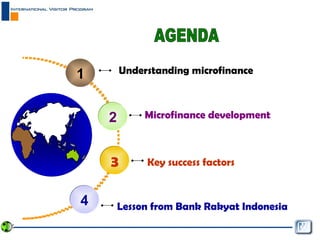
Microfinance development 1 2 Understanding microfinance 3 Key success factors AGENDA 4 Lesson from Bank Rakyat Indonesia
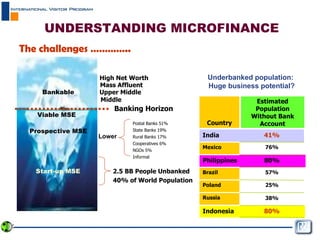
Indonesia Russia Country Poland Brazil Philippines Mexico India Estimated Population Without Bank Account 38% 25% 57% 80% 76% 41% 80% Lower 2.5 BB People Unbanked 40% of World Population Postal Banks 51% State Banks 19% Rural Banks 17% Cooperatives 6% NGOs 5% Informal Underbanked population:  Huge business potential? Iceberg Phenomena  Bankable Banking Horizon Viable MSE Prospective MSE Start-up MSE UNDERSTANDING MICROFINANCE The challenges ………….. Upper Middle  Middle Mass Affluent High Net Worth
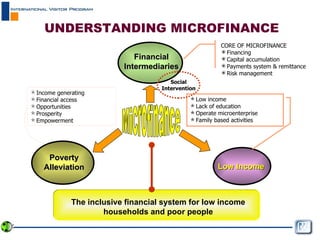
Microfinance Poverty Alleviation Low Income  Low income Lack of education Operate microenterprise Family based activities CORE OF MICROFINANCE Financing Capital accumulation Payments system & remittance Risk management Income generating Financial access Opportunities Prosperity  Empowerment Financial Intermediaries UNDERSTANDING MICROFINANCE Social Intervention The inclusive financial system for low income households and poor people
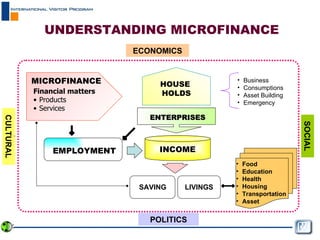
M ICROFINANCE HOUSE   HOLDS Business Consumptions Asset Building Emergency INCOME EMPLOYMENT ENTERPRISES ECONOMICS SOCIAL CULTURAL P OLITICS LIVINGS SAVING Financial matters  Products Services UNDERSTANDING MICROFINANCE Food Education Health Housing Transportation Asset
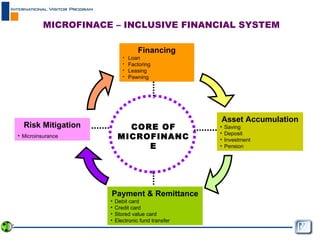
MICROFINACE – INCLUSIVE FINANCIAL SYSTEM  CORE OF MICROFINANCE Financing Loan  Factoring Leasing Pawning Asset Accumulation Saving Deposit Investment Pension  Payment & Remittance Debit card Credit card Stored value card Electronic fund transfer Risk Mitigation Microinsurance
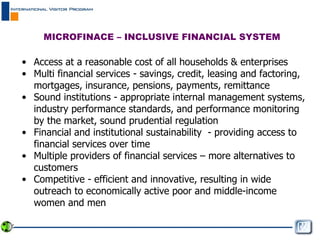
Access at a reasonable cost of all households & enterprises Multi financial services - savings, credit, leasing and factoring, mortgages, insurance, pensions, payments, remittance  Sound institutions - appropriate internal management systems, industry performance standards, and performance monitoring by the market, sound prudential regulation  Financial and institutional sustainability  - providing access to financial services over time  Multiple providers of financial services – more alternatives to customers Competitive - efficient and innovative, resulting in wide outreach to economically active poor and middle-income women and men MICROFINACE – INCLUSIVE FINANCIAL SYSTEM
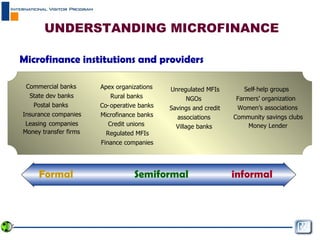
Commercial banks State dev banks Postal banks Insurance companies Leasing companies Money transfer firms  Apex organizations Rural banks Co - operative banks Microfinance banks Credit unions Regulated MFIs Finance companies Unregulated MFIs NGOs Savings and credit  associations Village banks Self - help groups Farmers’ organization Women’s associations Community savings clubs Formal Semiformal informal Money Lender UNDERSTANDING MICROFINANCE Microfinance institutions and providers
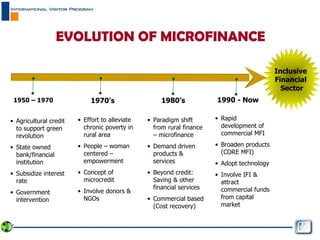
EVOLUTION OF MICROFINANCE Inclusive  Financial  Sector 1950 – 1970 Agricultural credit to support green revolution State owned bank/financial institution Subsidize interest rate Government intervention 1970’s Effort to alleviate chronic poverty in rural area People – woman centered – empowerment Concept of microcredit  Involve donors & NGOs Paradigm shift from rural finance – microfinance Demand driven products & services Beyond credit: Saving & other financial services Commercial based (Cost recovery)  1980’s 1990 - Now Rapid development of commercial MFI Broaden products (CORE MFI) Adopt technology  Involve IFI & attract commercial funds from capital market
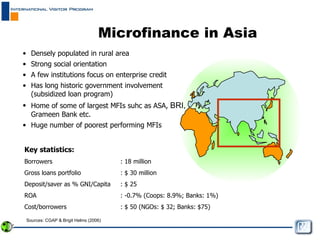
Microfinance in Asia Densely populated in rural area Strong social orientation A few institutions focus on enterprise credit Has long historic government involvement (subsidized loan program) Home of some of largest MFIs suhc as ASA,  BRI,  Grameen Bank etc. Huge number of poorest performing MFIs  Key statistics: Borrowers : 18 million Gross loans portfolio : $ 30 million Deposit/saver as % GNI/Capita : $ 25  ROA : -0.7% (Coops: 8.9%; Banks: 1%) Cost/borrowers  : $ 50 (NGOs: $ 32; Banks: $75) Sources: CGAP & Brigit Helms (2006)
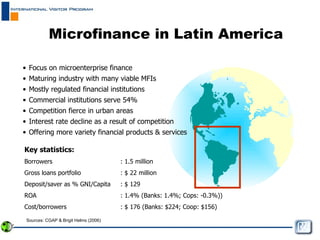
Microfinance in Latin America Focus on microenterprise finance  Maturing industry with many viable MFIs Mostly regulated financial institutions Commercial institutions serve 54% Competition fierce in urban areas Interest rate decline as a result of competition Offering more variety financial products & services  Key statistics: Borrowers : 1.5 million Gross loans portfolio : $ 22 million Deposit/saver as % GNI/Capita : $ 129  ROA : 1.4% (Banks: 1.4%; Cops: -0.3%)) Cost/borrowers  : $ 176 (Banks: $224; Coop: $156) Sources: CGAP & Brigit Helms (2006)
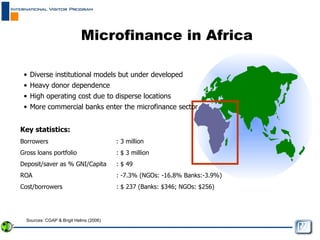
Microfinance in Africa Diverse institutional models but under developed Heavy donor dependence High operating cost due to disperse locations  More commercial banks enter the microfinance sector Key statistics: Borrowers : 3 million Gross loans portfolio : $ 3 million Deposit/saver as % GNI/Capita : $ 49  ROA : -7.3% (NGOs: -16.8% Banks:-3.9%) Cost/borrowers  : $ 237 (Banks: $346; NGOs: $256) Sources: CGAP & Brigit Helms (2006)
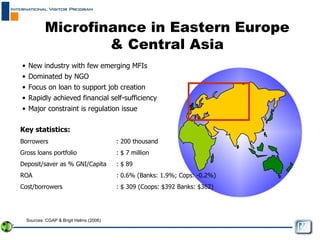
Microfinance in Eastern Europe & Central Asia New industry with few emerging MFIs  Dominated by NGO Focus on loan to support job creation  Rapidly achieved financial self-sufficiency  Major constraint is regulation issue Key statistics: Borrowers : 200 thousand  Gross loans portfolio : $ 7 million Deposit/saver as % GNI/Capita : $ 89  ROA : 0.6% (Banks: 1.9%; Cops: -0.2%) Cost/borrowers  : $ 309 (Coops: $392 Banks: $362) Sources: CGAP & Brigit Helms (2006)
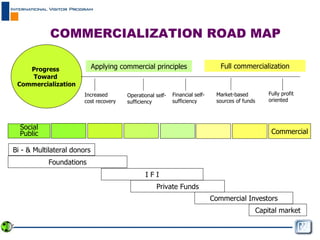
COMMERCIALIZATION ROAD MAP Progress  Toward  Commercialization Applying commercial principles Full commercialization Increased cost recovery Operational self-sufficiency Financial self-sufficiency Market-based sources of funds Fully profit oriented Social Public Commercial Bi - & Multilateral donors Foundations I F I Private Funds Commercial Investors Capital market
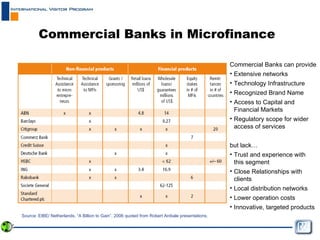
Commercial Banks in Microfinance Source: EIBE/ Netherlands, “A Billion to Gain”, 2006 quoted from Robert Anibale presentations. Commercial Banks can provide Extensive networks Technology Infrastructure Recognized Brand Name Access to Capital and Financial Markets Regulatory scope for wider access of services but lack… Trust and experience with this segment Close Relationships with clients Local distribution networks  Lower operation costs Innovative, targeted products
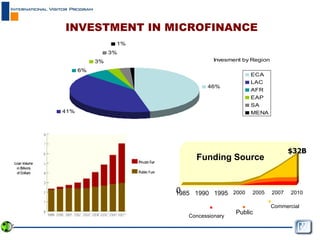
INVESTMENT IN MICROFINANCE 0 1985 1990 1995 2000 2005 2007 2010 Funding Source  Concessionary Public Commercial $32B
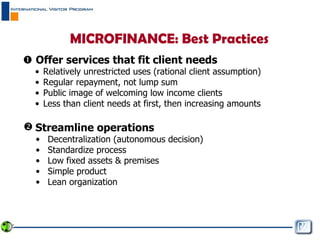
MICROFINANCE: Best Practices    Offer services that fit client needs Relatively unrestricted uses (rational client assumption) Regular repayment, not lump sum Public image of welcoming low income clients Less than client needs at first, then increasing amounts Streamline operations   Decentralization (autonomous decision) Standardize process  Low fixed assets & premises Simple product Lean organization
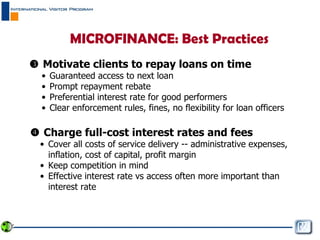
   Motivate clients to repay loans on time Guaranteed access to next loan Prompt repayment rebate Preferential interest rate for good performers Clear enforcement rules, fines, no flexibility for loan officers    Charge full-cost interest rates and fees Cover all costs of service delivery -- administrative expenses, inflation, cost of capital, profit margin  Keep competition in mind Effective interest rate vs access often more important than interest rate MICROFINANCE: Best Practices
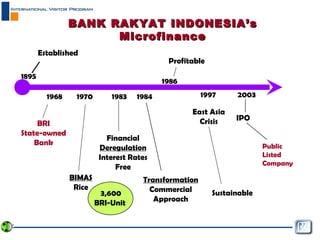
BANK RAKYAT INDONESIA’s Microfinance 1968 BRI State-owned Bank BIMAS Rice 2003 1983 Financial Deregulation Interest Rates Free 1984 Transformation Commercial Approach 1986 Profitable 1997 East Asia Crisis IPO 3,600 BRI-Unit  Public Listed Company 1895 Established 1970 Sustainable
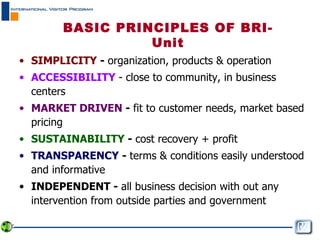
BASIC PRINCIPLES OF  BR I- Unit SIMPLICITY  -  organization, products & operation ACCESSIBILITY   - close to community, in business centers MARKET DRIVEN  -  fit to customer needs, market based pricing  SUSTAINABILITY  -  cost recovery + profit TRANSPARENCY  -  terms & conditions easily understood and informative   INDEPENDENT  -  all business decision with out any intervention from outside parties and government

Asian Banker Prsenstation

  • 1.
    THE PATHWAY OFMICROFINANCE What’s it should be: Inclusive Financial System for low income households and the poor By Mohamad Nazirwan, Head of BRI - IVP Asian Banker Summit 2007: Microfinance Forum for Commercial Bankers Jakarta March 25 th 2006
  • 2.
    Microfinance development 12 Understanding microfinance 3 Key success factors AGENDA 4 Lesson from Bank Rakyat Indonesia
  • 3.
    Indonesia Russia CountryPoland Brazil Philippines Mexico India Estimated Population Without Bank Account 38% 25% 57% 80% 76% 41% 80% Lower 2.5 BB People Unbanked 40% of World Population Postal Banks 51% State Banks 19% Rural Banks 17% Cooperatives 6% NGOs 5% Informal Underbanked population: Huge business potential? Iceberg Phenomena Bankable Banking Horizon Viable MSE Prospective MSE Start-up MSE UNDERSTANDING MICROFINANCE The challenges ………….. Upper Middle Middle Mass Affluent High Net Worth
  • 4.
    Microfinance Poverty AlleviationLow Income Low income Lack of education Operate microenterprise Family based activities CORE OF MICROFINANCE Financing Capital accumulation Payments system & remittance Risk management Income generating Financial access Opportunities Prosperity Empowerment Financial Intermediaries UNDERSTANDING MICROFINANCE Social Intervention The inclusive financial system for low income households and poor people
  • 5.
    M ICROFINANCE HOUSE HOLDS Business Consumptions Asset Building Emergency INCOME EMPLOYMENT ENTERPRISES ECONOMICS SOCIAL CULTURAL P OLITICS LIVINGS SAVING Financial matters Products Services UNDERSTANDING MICROFINANCE Food Education Health Housing Transportation Asset
  • 6.
    MICROFINACE – INCLUSIVEFINANCIAL SYSTEM CORE OF MICROFINANCE Financing Loan Factoring Leasing Pawning Asset Accumulation Saving Deposit Investment Pension Payment & Remittance Debit card Credit card Stored value card Electronic fund transfer Risk Mitigation Microinsurance
  • 7.
    Access at areasonable cost of all households & enterprises Multi financial services - savings, credit, leasing and factoring, mortgages, insurance, pensions, payments, remittance Sound institutions - appropriate internal management systems, industry performance standards, and performance monitoring by the market, sound prudential regulation Financial and institutional sustainability - providing access to financial services over time Multiple providers of financial services – more alternatives to customers Competitive - efficient and innovative, resulting in wide outreach to economically active poor and middle-income women and men MICROFINACE – INCLUSIVE FINANCIAL SYSTEM
  • 8.
    Commercial banks Statedev banks Postal banks Insurance companies Leasing companies Money transfer firms Apex organizations Rural banks Co - operative banks Microfinance banks Credit unions Regulated MFIs Finance companies Unregulated MFIs NGOs Savings and credit associations Village banks Self - help groups Farmers’ organization Women’s associations Community savings clubs Formal Semiformal informal Money Lender UNDERSTANDING MICROFINANCE Microfinance institutions and providers
  • 9.
    EVOLUTION OF MICROFINANCEInclusive Financial Sector 1950 – 1970 Agricultural credit to support green revolution State owned bank/financial institution Subsidize interest rate Government intervention 1970’s Effort to alleviate chronic poverty in rural area People – woman centered – empowerment Concept of microcredit Involve donors & NGOs Paradigm shift from rural finance – microfinance Demand driven products & services Beyond credit: Saving & other financial services Commercial based (Cost recovery) 1980’s 1990 - Now Rapid development of commercial MFI Broaden products (CORE MFI) Adopt technology Involve IFI & attract commercial funds from capital market
  • 10.
    Microfinance in AsiaDensely populated in rural area Strong social orientation A few institutions focus on enterprise credit Has long historic government involvement (subsidized loan program) Home of some of largest MFIs suhc as ASA, BRI, Grameen Bank etc. Huge number of poorest performing MFIs Key statistics: Borrowers : 18 million Gross loans portfolio : $ 30 million Deposit/saver as % GNI/Capita : $ 25 ROA : -0.7% (Coops: 8.9%; Banks: 1%) Cost/borrowers : $ 50 (NGOs: $ 32; Banks: $75) Sources: CGAP & Brigit Helms (2006)
  • 11.
    Microfinance in LatinAmerica Focus on microenterprise finance Maturing industry with many viable MFIs Mostly regulated financial institutions Commercial institutions serve 54% Competition fierce in urban areas Interest rate decline as a result of competition Offering more variety financial products & services Key statistics: Borrowers : 1.5 million Gross loans portfolio : $ 22 million Deposit/saver as % GNI/Capita : $ 129 ROA : 1.4% (Banks: 1.4%; Cops: -0.3%)) Cost/borrowers : $ 176 (Banks: $224; Coop: $156) Sources: CGAP & Brigit Helms (2006)
  • 12.
    Microfinance in AfricaDiverse institutional models but under developed Heavy donor dependence High operating cost due to disperse locations More commercial banks enter the microfinance sector Key statistics: Borrowers : 3 million Gross loans portfolio : $ 3 million Deposit/saver as % GNI/Capita : $ 49 ROA : -7.3% (NGOs: -16.8% Banks:-3.9%) Cost/borrowers : $ 237 (Banks: $346; NGOs: $256) Sources: CGAP & Brigit Helms (2006)
  • 13.
    Microfinance in EasternEurope & Central Asia New industry with few emerging MFIs Dominated by NGO Focus on loan to support job creation Rapidly achieved financial self-sufficiency Major constraint is regulation issue Key statistics: Borrowers : 200 thousand Gross loans portfolio : $ 7 million Deposit/saver as % GNI/Capita : $ 89 ROA : 0.6% (Banks: 1.9%; Cops: -0.2%) Cost/borrowers : $ 309 (Coops: $392 Banks: $362) Sources: CGAP & Brigit Helms (2006)
  • 14.
    COMMERCIALIZATION ROAD MAPProgress Toward Commercialization Applying commercial principles Full commercialization Increased cost recovery Operational self-sufficiency Financial self-sufficiency Market-based sources of funds Fully profit oriented Social Public Commercial Bi - & Multilateral donors Foundations I F I Private Funds Commercial Investors Capital market
  • 15.
    Commercial Banks inMicrofinance Source: EIBE/ Netherlands, “A Billion to Gain”, 2006 quoted from Robert Anibale presentations. Commercial Banks can provide Extensive networks Technology Infrastructure Recognized Brand Name Access to Capital and Financial Markets Regulatory scope for wider access of services but lack… Trust and experience with this segment Close Relationships with clients Local distribution networks Lower operation costs Innovative, targeted products
  • 16.
    INVESTMENT IN MICROFINANCE0 1985 1990 1995 2000 2005 2007 2010 Funding Source Concessionary Public Commercial $32B
  • 17.
    MICROFINANCE: Best Practices Offer services that fit client needs Relatively unrestricted uses (rational client assumption) Regular repayment, not lump sum Public image of welcoming low income clients Less than client needs at first, then increasing amounts Streamline operations Decentralization (autonomous decision) Standardize process Low fixed assets & premises Simple product Lean organization
  • 18.
    Motivate clients to repay loans on time Guaranteed access to next loan Prompt repayment rebate Preferential interest rate for good performers Clear enforcement rules, fines, no flexibility for loan officers  Charge full-cost interest rates and fees Cover all costs of service delivery -- administrative expenses, inflation, cost of capital, profit margin Keep competition in mind Effective interest rate vs access often more important than interest rate MICROFINANCE: Best Practices
  • 19.
    BANK RAKYAT INDONESIA’sMicrofinance 1968 BRI State-owned Bank BIMAS Rice 2003 1983 Financial Deregulation Interest Rates Free 1984 Transformation Commercial Approach 1986 Profitable 1997 East Asia Crisis IPO 3,600 BRI-Unit Public Listed Company 1895 Established 1970 Sustainable
  • 20.
    BASIC PRINCIPLES OF BR I- Unit SIMPLICITY - organization, products & operation ACCESSIBILITY - close to community, in business centers MARKET DRIVEN - fit to customer needs, market based pricing SUSTAINABILITY - cost recovery + profit TRANSPARENCY - terms & conditions easily understood and informative INDEPENDENT - all business decision with out any intervention from outside parties and government