11/01/16 1
Microfinance
Meaning &
Scope
Presentation By-
V.N.Kulkarni
11/01/16 2
Outline of presentation
• What is microfinance?
• Providing financial services to the poor:
challenges
• Providing financial services to the poor
in India: Overview
• Microfinance: Challenges ahead and
potential solutions/initiatives
11/01/16 3
Microfinance: what is it?
What are the words that come to your
mind when you hear the word
microfinance?
11/01/16 4
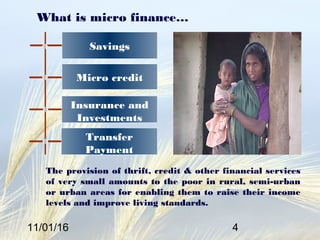
What is micro finance…
The provision of thrift, credit & other financial services
of very small amounts to the poor in rural, semi-urban
or urban areas for enabling them to raise their income
levels and improve living standards.
Micro credit
Insurance and
Investments
Savings
Transfer
Payment
11/01/16 5
• Indian banking system has achieved a formidable
outreach in rural areas
– 49% (32,538) of all scheduled commercial bank
branches are rural
– 31% (131.1 million) of the total deposit accounts are in
rural India
– 43% (22.4 million) of total credit accounts are in rural
India
– Number of people per branch has reduced from
64,000 in June 1969 to 15,000 in June 1997 (all India
average)
Source:
BSR, March 31, 2001, Table 1.3, RBI
Deolalkar, G.H., “The Indian Banking Sector: On the road to progress”, A Study of Financial Markets
Rural banking in India:
progress made
11/01/16 6
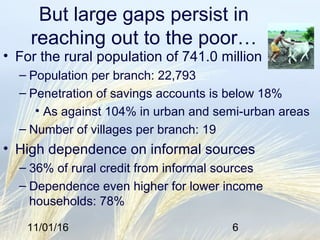
But large gaps persist in
reaching out to the poor…
• For the rural population of 741.0 million
– Population per branch: 22,793
– Penetration of savings accounts is below 18%
• As against 104% in urban and semi-urban areas
– Number of villages per branch: 19
• High dependence on informal sources
– 36% of rural credit from informal sources
– Dependence even higher for lower income
households: 78%
11/01/16 7
• Credit on reasonable terms to
the poor can bring about a
significant reduction in poverty.
• It is with this hypothesis, micro
credit assumes significance in
the Indian context.
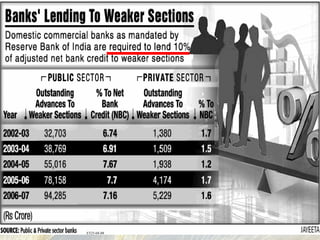
11/01/16 8ET25-04-08
11/01/16 9
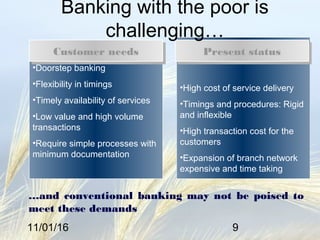
•Doorstep banking
•Flexibility in timings
•Timely availability of services
•Low value and high volume
transactions
•Require simple processes with
minimum documentation
•High cost of service delivery
•Timings and procedures: Rigid
and inflexible
•High transaction cost for the
customers
•Expansion of branch network
expensive and time taking
Customer needsCustomer needs Present statusPresent status
Banking with the poor is
challenging…
…and conventional banking may not be poised to
meet these demands
11/01/16 10
Profitable business
opportunities exist…
…setting the path for scale up
Market size and
potential of low income
clients
Market size and
potential of low income
clients
Low delinquency in pilot
phase
Low delinquency in pilot
phase
Creating bigger
customers for future
Creating bigger
customers for future
Stepping stone to the
entire rural market
Stepping stone to the
entire rural market
11/01/16 11
How help can be extended?
• Helping poor people can be in three
ways.
• Direct lending by Banks
• Lending through NGOs
• Lending through MFIs
11/01/16 12
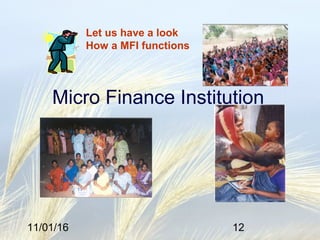
Micro Finance Institution
Let us have a look
How a MFI functions
11/01/16 13
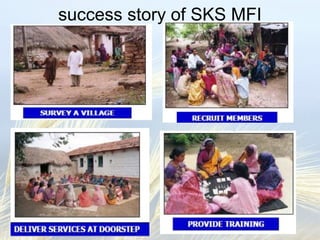
SKS- delivers microfinance through a
Grameen (village) banking
• Village selection
• SKS staff members conduct a comprehensive
survey
• Projection Meeting
• With the entire village to introduce SKS, its
mission, methodology and services.
• Mini-Projection Meeting
• to further explain SKS to interested parties
and appeal directly to those who may not
have attended the meeting because of
religious, class, caste or gender barriers.
11/01/16 14
success story of SKS MFI
11/01/16 15
Methodology
• Group Formation.
• Compulsory Group Training (CGT).
CGT is a five day program consisting of
hour-long sessions designed to educate
clients on the processes & procedures
• Group Recognition Test
• Financial Transactions
11/01/16 16
Formation of SHG
(Self Help Groups)
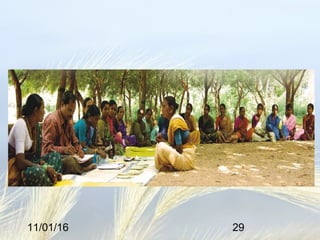
• Group consisting of 10-15 members are
formed.
• Generally women come together
• They decide min contribution of amount
p.m towards corpus.
• Internal lending starts at ROI decided
by group
• Group opens account with a Bank.
11/01/16 17
SHG functioning
• The account with the bank is operated jointly
by two/three elected members
• After successful operation of the account the
gives loan to the group generally three times
of funds the group holds as loan for business
expansion of its members.
• Loan obtained through Bank is utilized for
internal lending.
• Proper books of accounts are maintained and
explained to members in monthly meetings.
11/01/16 18
11/01/16 19
Advantages of Microfinance
•  Continued access to funding to low income
• clients
•  Fast and easy procedure for the poor to get the
• loan
•  Accompanying non financial services for the poor
•  Helps in women empowerment
•  Promotes entrepreneurship
•  Direct contact with clients, which gives less
• chances of default.
•  It helps in the alleviating the poverty
•  Help in the creation of demand as a whole
•  Helps in the development of the country
•  Contribute in the prosperity of the nation
•  Product tailored to clients needs
11/01/16 20
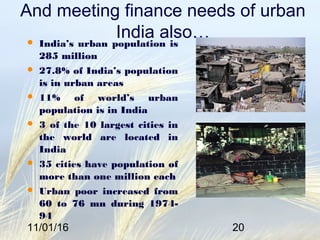
And meeting finance needs of urban
India also… India’s urban population is
285 million
 27.8% of India’s population
is in urban areas
 11% of world’s urban
population is in India
 3 of the 10 largest cities in
the world are located in
India
 35 cities have population of
more than one million each
 Urban poor increased from
60 to 76 mn during 1974-
94
11/01/16 21
Providing financial services to
the poor: challenges
• Risk management challenges
due to information asymmetry
problems
• Accessibility (geographic
accessibility and easiness to
deal with)
• No collateral, Low value and
cash intensive nature of the
business
• Staff training and motivation
High transaction
costs
11/01/16 22
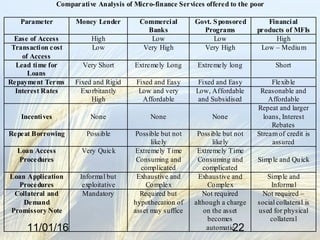
Comparative Analysis of Micro-finance Services offered to the poor
Parameter Money Lender Commercial
Banks
Govt. Sponsored
Programs
Financial
products of MFIs
Ease of Access High Low Low High
Transaction cost
of Access
Low Very High Very High Low – Medium
Lead time for
Loans
Very Short Extremely Long Extremely long Short
Repayment Terms Fixed and Rigid Fixed and Easy Fixed and Easy Flexible
Interest Rates Exorbitantly
High
Low and very
Affordable
Low, Affordable
and Subsidised
Reasonable and
Affordable
Incentives None None None
Repeat and larger
loans, Interest
Rebates
Repeat Borrowing Possible Possible but not
likely
Possible but not
likely
Streamof credit is
assured
Loan Access
Procedures
Very Quick Extremely Time
Consuming and
complicated
Extremely Time
Consuming and
complicated
Simple and Quick
Loan Application
Procedures
Informal but
exploitative
Exhaustive and
Complex
Exhaustive and
Complex
Simple and
Informal
Collateral and
Demand
Promissory Note
Mandatory Required but
hypothecation of
asset may suffice
Not required
although a charge
on the asset
becomes
automatic
Not required –
social collateral is
used for physical
collateral
11/01/16 23
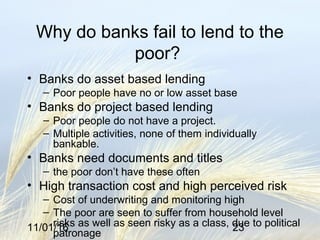
Why do banks fail to lend to the
poor?
• Banks do asset based lending
– Poor people have no or low asset base
• Banks do project based lending
– Poor people do not have a project.
– Multiple activities, none of them individually
bankable.
• Banks need documents and titles
– the poor don’t have these often
• High transaction cost and high perceived risk
– Cost of underwriting and monitoring high
– The poor are seen to suffer from household level
risks as well as seen risky as a class, due to political
patronage
11/01/16 24
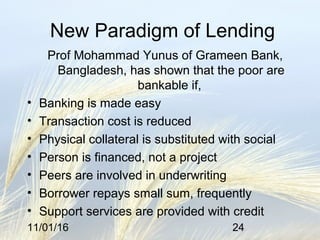
New Paradigm of Lending
Prof Mohammad Yunus of Grameen Bank,
Bangladesh, has shown that the poor are
bankable if,
• Banking is made easy
• Transaction cost is reduced
• Physical collateral is substituted with social
• Person is financed, not a project
• Peers are involved in underwriting
• Borrower repays small sum, frequently
• Support services are provided with credit
11/01/16 25
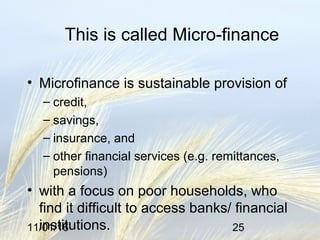
This is called Micro-finance
• Microfinance is sustainable provision of
– credit,
– savings,
– insurance, and
– other financial services (e.g. remittances,
pensions)
• with a focus on poor households, who
find it difficult to access banks/ financial
institutions.
11/01/16 26
Self-Employed Women’s
Association (SEWA)
Ahmedabad
• SEWA is a group of inter-related institutions.
• SEWA, the mother institution is a registered
trade union, whose members work informally
in construction, transport, tea-shops, hawking,
rag-picking, garment making etc.
• SEWA Bank is an urban cooperative bank
providing savings, credit and insurance
services.
• Over 100 occupational cooperatives provide
training, technical assistance and collective
buying and selling
11/01/16 27
India – Microfinance Overview
• 24.25 million poor families access
microfinance
• Over 22 lakh Self Help Groups (SHGs)
• Cumulative assistance so far Rs. 11,400crore
• Over 35,000 branches of 560 banks
(commercial, regional rural and cooperative)
• Over 3,000 partners working in 563 districts
11/01/16 28
Why would the money come
back?
• Group lending- each individual responsible for
recovery; future loans linked to group’s credit
history
• Recovery of loans through peer pressure/social
collateral
• Other members to make good the losses
• Regular repayments of the loan by the borrower
in small amounts.
• Short tenor loans (typically 12 months)
• Very close supervision & monitoring of clients by
field staff
11/01/16 29
11/01/16 30
Thank you

Micro Fin & SHG-sies

  • 1.
  • 2.
    11/01/16 2 Outline ofpresentation • What is microfinance? • Providing financial services to the poor: challenges • Providing financial services to the poor in India: Overview • Microfinance: Challenges ahead and potential solutions/initiatives
  • 3.
    11/01/16 3 Microfinance: whatis it? What are the words that come to your mind when you hear the word microfinance?
  • 4.
    11/01/16 4 What ismicro finance… The provision of thrift, credit & other financial services of very small amounts to the poor in rural, semi-urban or urban areas for enabling them to raise their income levels and improve living standards. Micro credit Insurance and Investments Savings Transfer Payment
  • 5.
    11/01/16 5 • Indianbanking system has achieved a formidable outreach in rural areas – 49% (32,538) of all scheduled commercial bank branches are rural – 31% (131.1 million) of the total deposit accounts are in rural India – 43% (22.4 million) of total credit accounts are in rural India – Number of people per branch has reduced from 64,000 in June 1969 to 15,000 in June 1997 (all India average) Source: BSR, March 31, 2001, Table 1.3, RBI Deolalkar, G.H., “The Indian Banking Sector: On the road to progress”, A Study of Financial Markets Rural banking in India: progress made
  • 6.
    11/01/16 6 But largegaps persist in reaching out to the poor… • For the rural population of 741.0 million – Population per branch: 22,793 – Penetration of savings accounts is below 18% • As against 104% in urban and semi-urban areas – Number of villages per branch: 19 • High dependence on informal sources – 36% of rural credit from informal sources – Dependence even higher for lower income households: 78%
  • 7.
    11/01/16 7 • Crediton reasonable terms to the poor can bring about a significant reduction in poverty. • It is with this hypothesis, micro credit assumes significance in the Indian context.
  • 8.
  • 9.
    11/01/16 9 •Doorstep banking •Flexibilityin timings •Timely availability of services •Low value and high volume transactions •Require simple processes with minimum documentation •High cost of service delivery •Timings and procedures: Rigid and inflexible •High transaction cost for the customers •Expansion of branch network expensive and time taking Customer needsCustomer needs Present statusPresent status Banking with the poor is challenging… …and conventional banking may not be poised to meet these demands
  • 10.
    11/01/16 10 Profitable business opportunitiesexist… …setting the path for scale up Market size and potential of low income clients Market size and potential of low income clients Low delinquency in pilot phase Low delinquency in pilot phase Creating bigger customers for future Creating bigger customers for future Stepping stone to the entire rural market Stepping stone to the entire rural market
  • 11.
    11/01/16 11 How helpcan be extended? • Helping poor people can be in three ways. • Direct lending by Banks • Lending through NGOs • Lending through MFIs
  • 12.
    11/01/16 12 Micro FinanceInstitution Let us have a look How a MFI functions
  • 13.
    11/01/16 13 SKS- deliversmicrofinance through a Grameen (village) banking • Village selection • SKS staff members conduct a comprehensive survey • Projection Meeting • With the entire village to introduce SKS, its mission, methodology and services. • Mini-Projection Meeting • to further explain SKS to interested parties and appeal directly to those who may not have attended the meeting because of religious, class, caste or gender barriers.
  • 14.
  • 15.
    11/01/16 15 Methodology • GroupFormation. • Compulsory Group Training (CGT). CGT is a five day program consisting of hour-long sessions designed to educate clients on the processes & procedures • Group Recognition Test • Financial Transactions
  • 16.
    11/01/16 16 Formation ofSHG (Self Help Groups) • Group consisting of 10-15 members are formed. • Generally women come together • They decide min contribution of amount p.m towards corpus. • Internal lending starts at ROI decided by group • Group opens account with a Bank.
  • 17.
    11/01/16 17 SHG functioning •The account with the bank is operated jointly by two/three elected members • After successful operation of the account the gives loan to the group generally three times of funds the group holds as loan for business expansion of its members. • Loan obtained through Bank is utilized for internal lending. • Proper books of accounts are maintained and explained to members in monthly meetings.
  • 18.
  • 19.
    11/01/16 19 Advantages ofMicrofinance •  Continued access to funding to low income • clients •  Fast and easy procedure for the poor to get the • loan •  Accompanying non financial services for the poor •  Helps in women empowerment •  Promotes entrepreneurship •  Direct contact with clients, which gives less • chances of default. •  It helps in the alleviating the poverty •  Help in the creation of demand as a whole •  Helps in the development of the country •  Contribute in the prosperity of the nation •  Product tailored to clients needs
  • 20.
    11/01/16 20 And meetingfinance needs of urban India also… India’s urban population is 285 million  27.8% of India’s population is in urban areas  11% of world’s urban population is in India  3 of the 10 largest cities in the world are located in India  35 cities have population of more than one million each  Urban poor increased from 60 to 76 mn during 1974- 94
  • 21.
    11/01/16 21 Providing financialservices to the poor: challenges • Risk management challenges due to information asymmetry problems • Accessibility (geographic accessibility and easiness to deal with) • No collateral, Low value and cash intensive nature of the business • Staff training and motivation High transaction costs
  • 22.
    11/01/16 22 Comparative Analysisof Micro-finance Services offered to the poor Parameter Money Lender Commercial Banks Govt. Sponsored Programs Financial products of MFIs Ease of Access High Low Low High Transaction cost of Access Low Very High Very High Low – Medium Lead time for Loans Very Short Extremely Long Extremely long Short Repayment Terms Fixed and Rigid Fixed and Easy Fixed and Easy Flexible Interest Rates Exorbitantly High Low and very Affordable Low, Affordable and Subsidised Reasonable and Affordable Incentives None None None Repeat and larger loans, Interest Rebates Repeat Borrowing Possible Possible but not likely Possible but not likely Streamof credit is assured Loan Access Procedures Very Quick Extremely Time Consuming and complicated Extremely Time Consuming and complicated Simple and Quick Loan Application Procedures Informal but exploitative Exhaustive and Complex Exhaustive and Complex Simple and Informal Collateral and Demand Promissory Note Mandatory Required but hypothecation of asset may suffice Not required although a charge on the asset becomes automatic Not required – social collateral is used for physical collateral
  • 23.
    11/01/16 23 Why dobanks fail to lend to the poor? • Banks do asset based lending – Poor people have no or low asset base • Banks do project based lending – Poor people do not have a project. – Multiple activities, none of them individually bankable. • Banks need documents and titles – the poor don’t have these often • High transaction cost and high perceived risk – Cost of underwriting and monitoring high – The poor are seen to suffer from household level risks as well as seen risky as a class, due to political patronage
  • 24.
    11/01/16 24 New Paradigmof Lending Prof Mohammad Yunus of Grameen Bank, Bangladesh, has shown that the poor are bankable if, • Banking is made easy • Transaction cost is reduced • Physical collateral is substituted with social • Person is financed, not a project • Peers are involved in underwriting • Borrower repays small sum, frequently • Support services are provided with credit
  • 25.
    11/01/16 25 This iscalled Micro-finance • Microfinance is sustainable provision of – credit, – savings, – insurance, and – other financial services (e.g. remittances, pensions) • with a focus on poor households, who find it difficult to access banks/ financial institutions.
  • 26.
    11/01/16 26 Self-Employed Women’s Association(SEWA) Ahmedabad • SEWA is a group of inter-related institutions. • SEWA, the mother institution is a registered trade union, whose members work informally in construction, transport, tea-shops, hawking, rag-picking, garment making etc. • SEWA Bank is an urban cooperative bank providing savings, credit and insurance services. • Over 100 occupational cooperatives provide training, technical assistance and collective buying and selling
  • 27.
    11/01/16 27 India –Microfinance Overview • 24.25 million poor families access microfinance • Over 22 lakh Self Help Groups (SHGs) • Cumulative assistance so far Rs. 11,400crore • Over 35,000 branches of 560 banks (commercial, regional rural and cooperative) • Over 3,000 partners working in 563 districts
  • 28.
    11/01/16 28 Why wouldthe money come back? • Group lending- each individual responsible for recovery; future loans linked to group’s credit history • Recovery of loans through peer pressure/social collateral • Other members to make good the losses • Regular repayments of the loan by the borrower in small amounts. • Short tenor loans (typically 12 months) • Very close supervision & monitoring of clients by field staff
  • 29.
  • 30.