Promoting Transparent Pricing in the Microfinance Industry


                                                                  Pricing
                                                              Transparency,
                                                             Profits, IPOs and
                                                               Responsible
                                                               Microfinance
                                                                San Deigo| April 2011
The Good News in October 2006
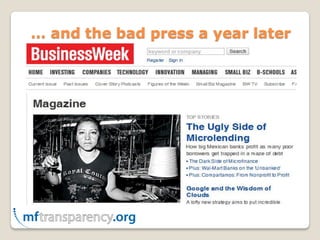
… and the bad press a year later
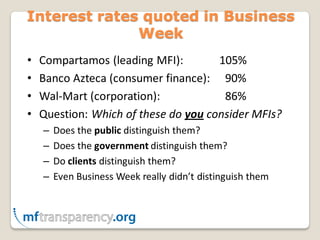
Interest rates quoted in Business
              Week
•   Compartamos (leading MFI):        105%
•   Banco Azteca (consumer finance): 90%
•   Wal-Mart (corporation):            86%
•   Question: Which of these do you consider MFIs?
    –   Does the public distinguish them?
    –   Does the government distinguish them?
    –   Do clients distinguish them?
    –   Even Business Week really didn’t distinguish them
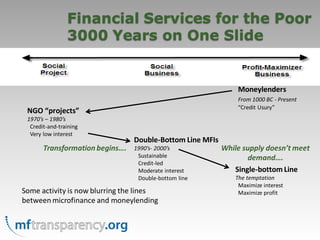
Financial Services for the Poor
                3000 Years on One Slide


                                                                Moneylenders
                                                                From 1000 BC - Present
                                                                “Credit Usury”
 NGO “projects”
 1970’s – 1980’s
  Credit-and-training
  Very low interest
                                 Double-Bottom Line MFIs
       Transformation begins….   1990’s- 2000’s            While supply doesn’t meet
                                  Sustainable                      demand….
                                  Credit-led
                                  Moderate interest           Single-bottom Line
                                  Double-bottom line           The temptation
                                                                Maximize interest
Some activity is now blurring the lines                         Maximize profit
between microfinance and moneylending
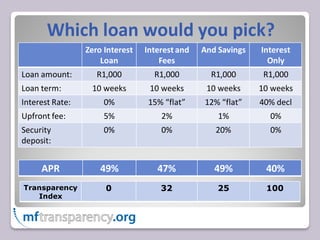
Which loan would you pick?
                 Zero Interest   Interest and   And Savings   Interest
                     Loan            Fees                       Only
Loan amount:        R1,000         R1,000         R1,000       R1,000
Loan term:        10 weeks        10 weeks       10 weeks     10 weeks
Interest Rate:        0%         15% “flat”     12% “flat”    40% decl
Upfront fee:          5%             2%             1%          0%
Security              0%             0%            20%          0%
deposit:


     APR             49%            47%            49%         40%
Transparency          0              32             25         100
   Index
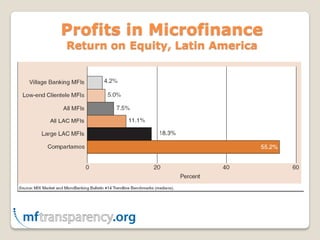
Profits in Microfinance
Return on Equity, Latin America
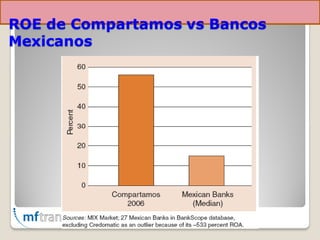
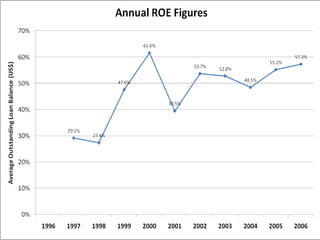
ROE de Compartamos vs Bancos
Mexicanos
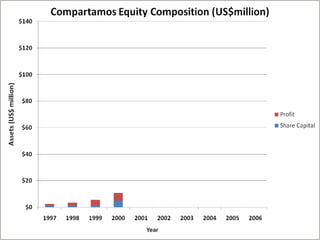
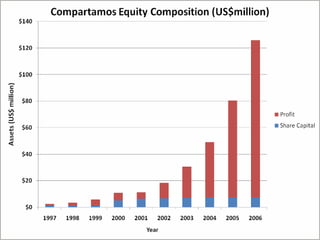
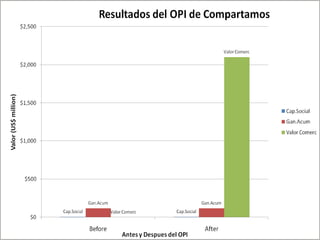
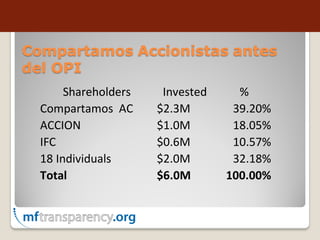
Compartamos Accionistas antes
del OPI
       Shareholders    Invested     %
  Compartamos AC      $2.3M        39.20%
  ACCION              $1.0M        18.05%
  IFC                 $0.6M        10.57%
  18 Individuals      $2.0M        32.18%
  Total               $6.0M       100.00%
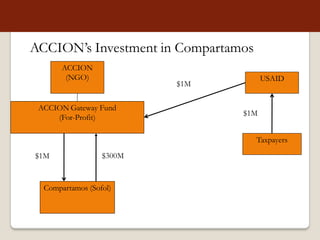
ACCION’s Investment in Compartamos
       ACCION
        (NGO)                         USAID
                          $1M

 ACCION Gateway Fund
                                $1M
     (For-Profit)

                                     Taxpayers
$1M               $300M


  Compartamos (Sofol)
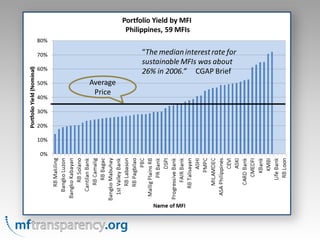
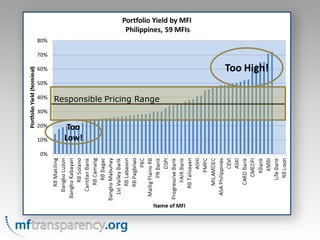
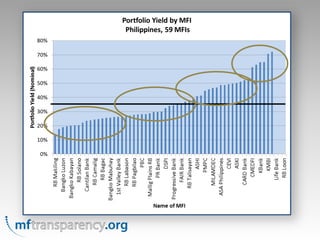
“The median interest rate for
          sustainable MFIs was about
          26% in 2006.” CGAP Brief
Average
 Price
Too High!

Responsible Pricing Range


   Too
  Low!
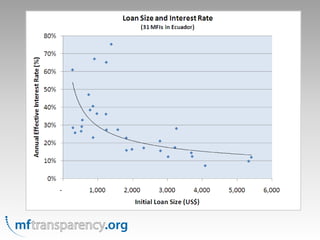
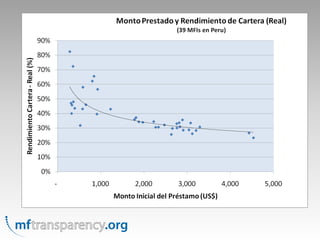
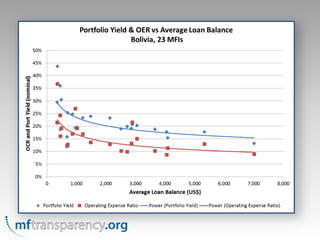
Is there a curve in other
       countries?
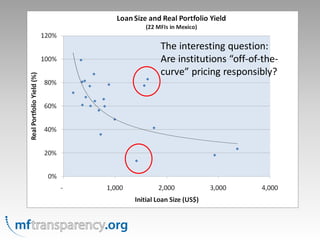
The interesting question:
Are institutions “off-of-the-
curve” pricing responsibly?
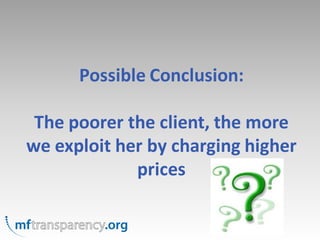
Possible Conclusion:

 The poorer the client, the more
we exploit her by charging higher
             prices
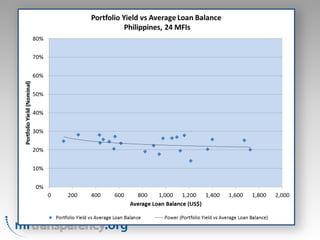
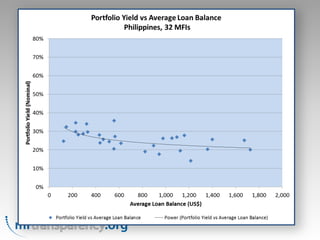
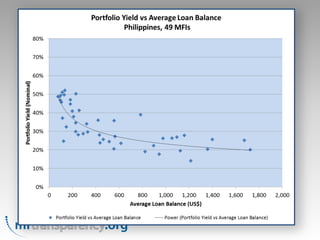
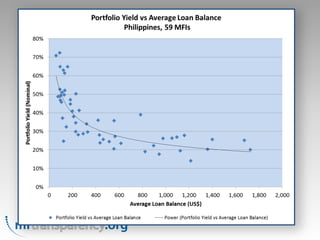
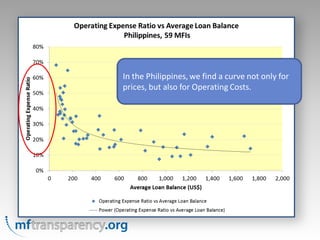
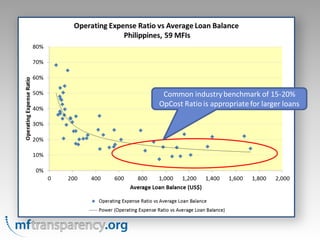
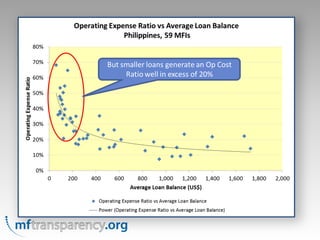
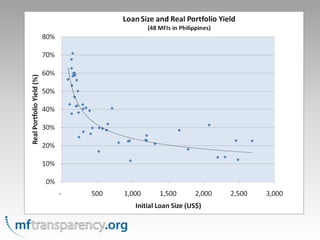
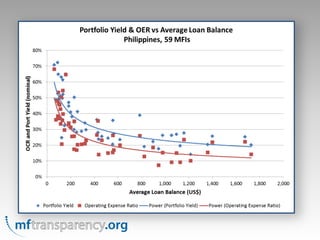
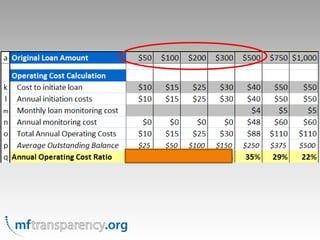
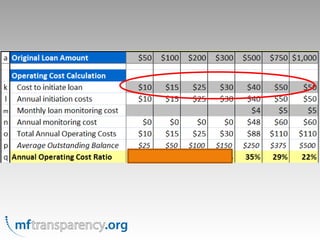
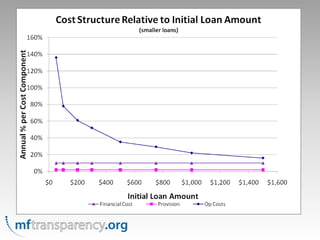
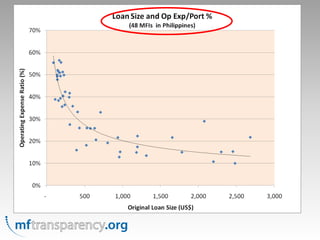
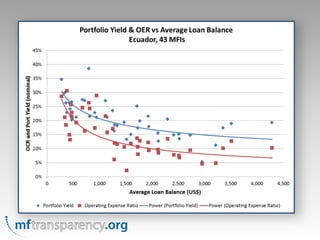
In the Philippines, we find a curve not only for
prices, but also for Operating Costs.
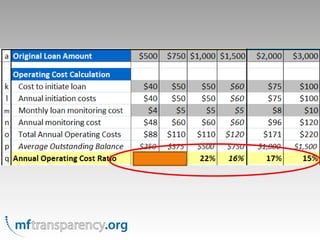
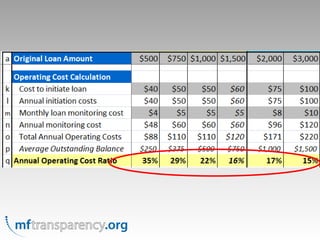
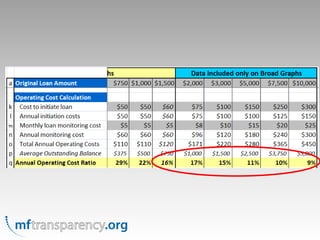
Common industry benchmark of 15-20%
OpCost Ratio is appropriate for larger loans
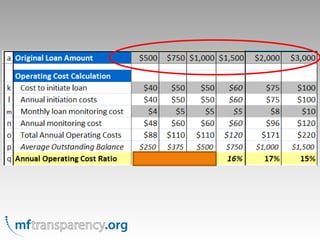
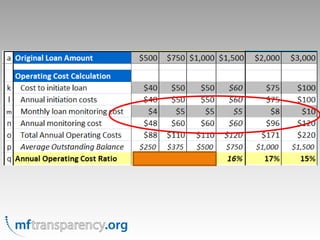
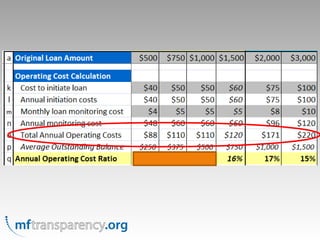
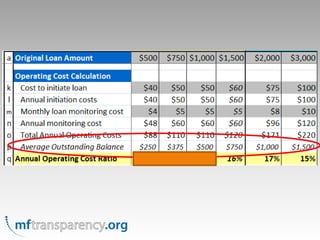
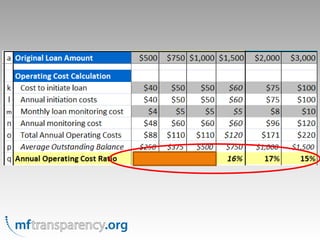
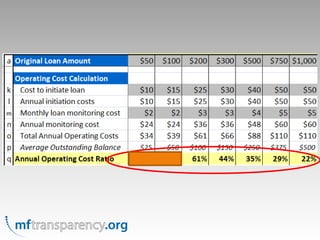
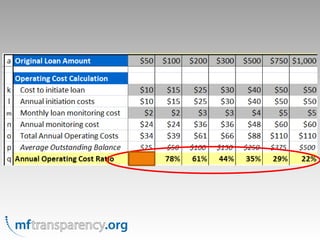
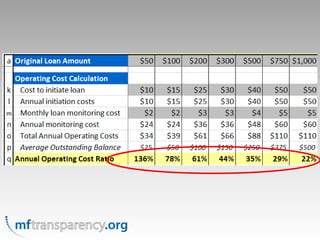
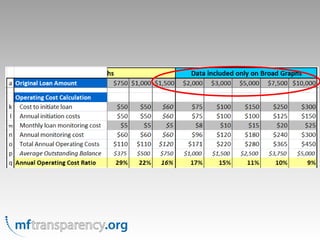
But smaller loans generate an Op Cost
     Ratio well in excess of 20%
Comparison of the Cost Curve and
        the Price Curve
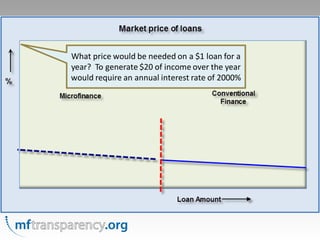
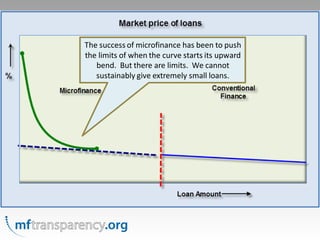
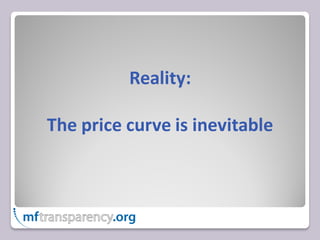
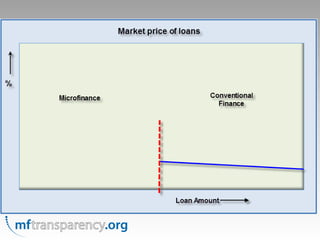
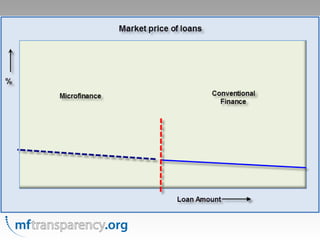
Reality:

The price curve is inevitable
What price would be needed on a $1 loan for a
year? To generate $20 of income over the year
would require an annual interest rate of 2000%
The success of microfinance has been to push
the limits of when the curve starts its upward
   bend. But there are limits. We cannot
   sustainably give extremely small loans.
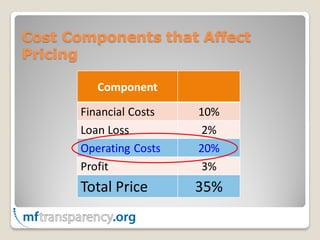
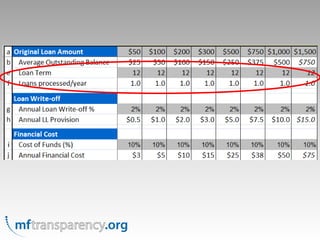
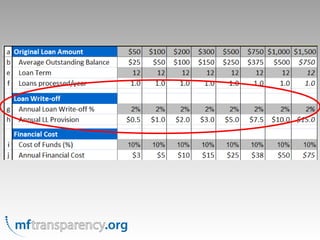
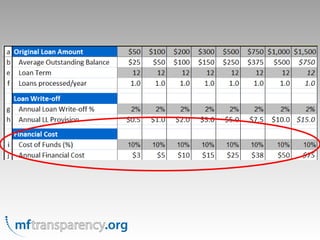
Cost Components that Affect
Pricing

         Component
      Financial Costs   10%
      Loan Loss          2%
      Operating Costs   20%
      Profit             3%
      Total Price       35%
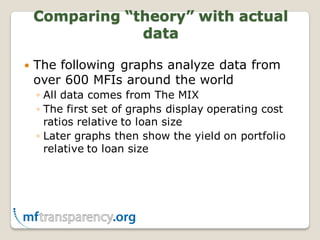
Comparing “theory” with actual
                data

   The following graphs analyze data from
    over 600 MFIs around the world
    ◦ All data comes from The MIX
    ◦ The first set of graphs display operating cost
      ratios relative to loan size
    ◦ Later graphs then show the yield on portfolio
      relative to loan size
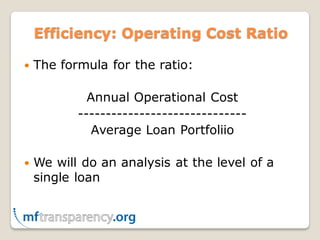
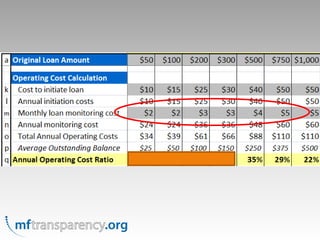
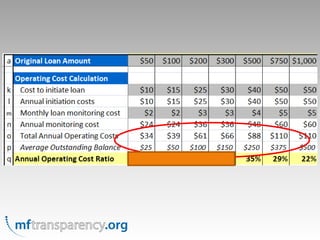
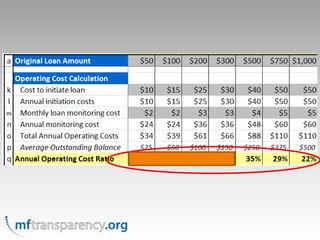
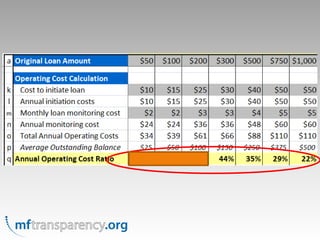
Efficiency: Operating Cost Ratio

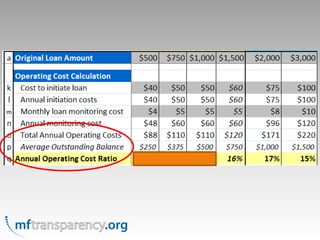
   The formula for the ratio:

             Annual Operational Cost
           ------------------------------
              Average Loan Portfoliio

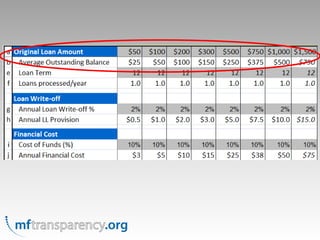
   We will do an analysis at the level of a
    single loan
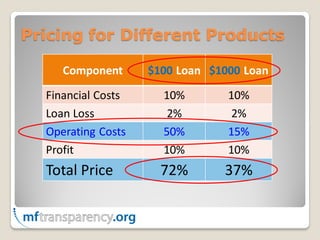
Pricing for Different Products

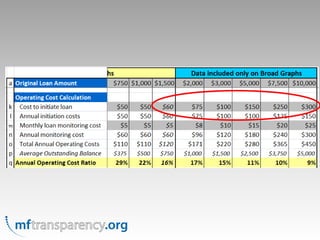
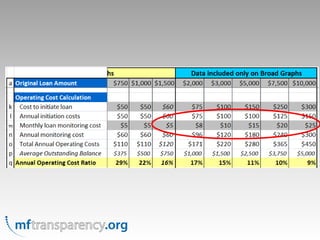
     Component      $100 Loan $1000 Loan

  Financial Costs     10%        10%
  Loan Loss            2%         2%
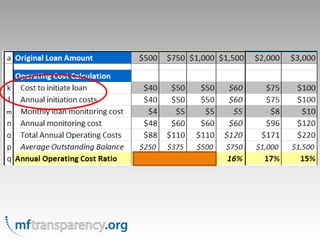
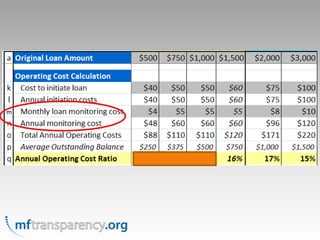
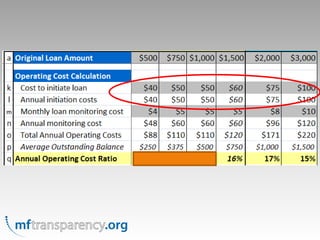
  Operating Costs     50%        15%
  Profit              10%        10%
  Total Price         72%       37%
Lack of Transparent Pricing

The way we communicate prices
    to our clients is far from
          transparent
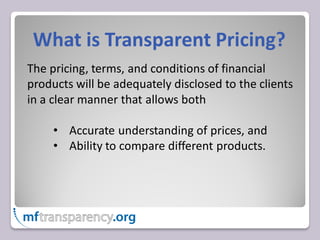
What is Transparent Pricing?
The pricing, terms, and conditions of financial
products will be adequately disclosed to the clients
in a clear manner that allows both

     • Accurate understanding of prices, and
     • Ability to compare different products.
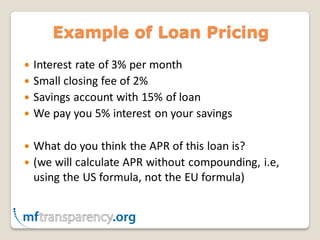
Example of Loan Pricing
 Interest rate of 3% per month
 Small closing fee of 2%
 Savings account with 15% of loan
 We pay you 5% interest on your savings


 What do you think the APR of this loan is?
 (we will calculate APR without compounding, i.e,
  using the US formula, not the EU formula)
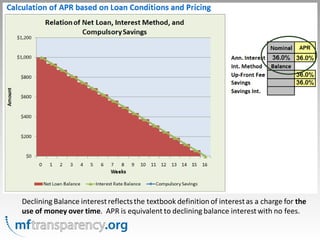
Declining Balance interest reflects the textbook definition of interest as a charge for the
use of money over time. APR is equivalent to declining balance interest with no fees.
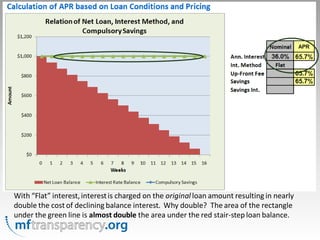
With “Flat” interest, interest is charged on the original loan amount resulting in nearly
double the cost of declining balance interest. Why double? The area of the rectangle
under the green line is almost double the area under the red stair-step loan balance.
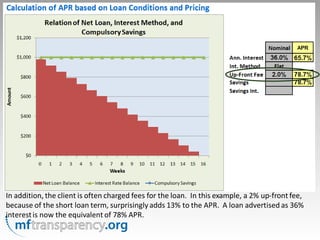
In addition, the client is often charged fees for the loan. In this example, a 2% up-front fee,
because of the short loan term, surprisingly adds 13% to the APR. A loan advertised as 36%
interest is now the equivalent of 78% APR.
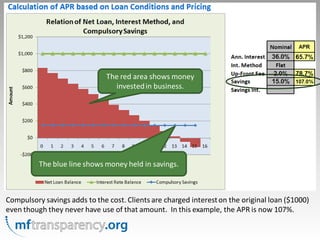
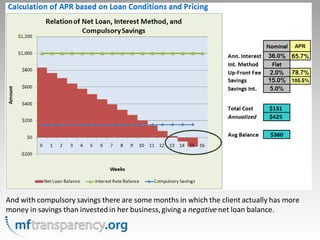
The red area shows money
                                 invested in business.


          The blue line shows money held in savings.


Compulsory savings adds to the cost. Clients are charged interest on the original loan ($1000)
even though they never have use of that amount. In this example, the APR is now 107%.
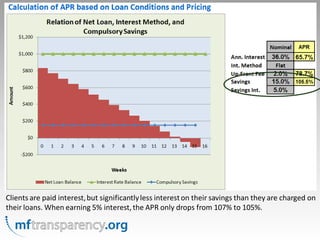
Clients are paid interest, but significantly less interest on their savings than they are charged on
their loans. When earning 5% interest, the APR only drops from 107% to 105%.
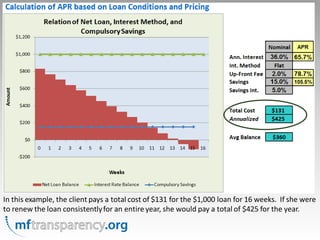
In this example, the client pays a total cost of $131 for the $1,000 loan for 16 weeks. If she were
to renew the loan consistently for an entire year, she would pay a total of $425 for the year.
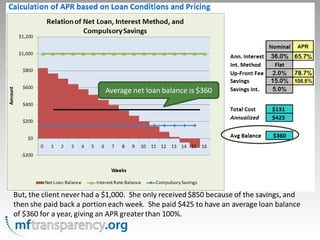
Average net loan balance is $360


But, the client never had a $1,000. She only received $850 because of the savings, and
then she paid back a portion each week. She paid $425 to have an average loan balance
of $360 for a year, giving an APR greater than 100%.
And with compulsory savings there are some months in which the client actually has more
money in savings than invested in her business, giving a negative net loan balance.
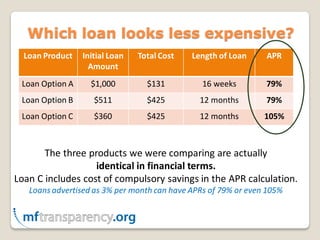
Which loan looks less expensive?
  Loan Product   Initial Loan   Total Cost   Length of Loan     APR
                   Amount
 Loan Option A     $1,000         $131          16 weeks        79%
 Loan Option B      $511          $425         12 months        79%
 Loan Option C      $360          $425         12 months        105%


       The three products we were comparing are actually
                   identical in financial terms.
Loan C includes cost of compulsory savings in the APR calculation.
   Loans advertised as 3% per month can have APRs of 79% or even 105%
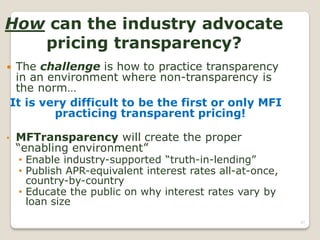
How can the industry advocate
   pricing transparency?
    The challenge is how to practice transparency
     in an environment where non-transparency is
     the norm…
    It is very difficult to be the first or only MFI
            practicing transparent pricing!

•    MFTransparency will create the proper
     “enabling environment”
     • Enable industry-supported “truth-in-lending”
     • Publish APR-equivalent interest rates all-at-once,
       country-by-country
     • Educate the public on why interest rates vary by
       loan size
                                                            87
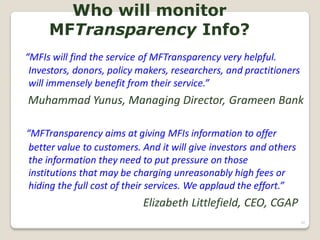
Who will monitor
     MFTransparency Info?
“MFIs will find the service of MFTransparency very helpful.
 Investors, donors, policy makers, researchers, and practitioners
 will immensely benefit from their service.”
Muhammad Yunus, Managing Director, Grameen Bank

“MFTransparency aims at giving MFIs information to offer
 better value to customers. And it will give investors and others
 the information they need to put pressure on those
 institutions that may be charging unreasonably high fees or
 hiding the full cost of their services. We applaud the effort.”
                            Elizabeth Littlefield, CEO, CGAP
                                                                    88
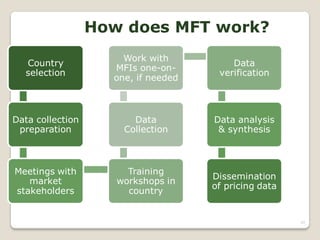
How does MFT work?
                      Work with
  Country                                Data
                    MFIs one-on-
  selection                           verification
                    one, if needed


Data collection         Data         Data analysis
 preparation          Collection      & synthesis


Meetings with          Training
                                     Dissemination
   market            workshops in
                                     of pricing data
stakeholders           country


                                                       89
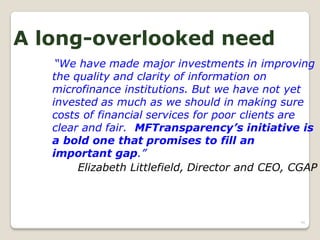
A long-overlooked need
    “We have made major investments in improving
   the quality and clarity of information on
   microfinance institutions. But we have not yet
   invested as much as we should in making sure
   costs of financial services for poor clients are
   clear and fair. MFTransparency’s initiative is
   a bold one that promises to fill an
   important gap.”
        Elizabeth Littlefield, Director and CEO, CGAP


                                                 90

Mf transparency presentation slides

  • 1.
    Promoting Transparent Pricingin the Microfinance Industry Pricing Transparency, Profits, IPOs and Responsible Microfinance San Deigo| April 2011
  • 2.
    The Good Newsin October 2006
  • 3.
    … and thebad press a year later
  • 4.
    Interest rates quotedin Business Week • Compartamos (leading MFI): 105% • Banco Azteca (consumer finance): 90% • Wal-Mart (corporation): 86% • Question: Which of these do you consider MFIs? – Does the public distinguish them? – Does the government distinguish them? – Do clients distinguish them? – Even Business Week really didn’t distinguish them
  • 5.
    Financial Services forthe Poor 3000 Years on One Slide Moneylenders From 1000 BC - Present “Credit Usury” NGO “projects” 1970’s – 1980’s Credit-and-training Very low interest Double-Bottom Line MFIs Transformation begins…. 1990’s- 2000’s While supply doesn’t meet Sustainable demand…. Credit-led Moderate interest Single-bottom Line Double-bottom line The temptation Maximize interest Some activity is now blurring the lines Maximize profit between microfinance and moneylending
  • 6.
    Which loan wouldyou pick? Zero Interest Interest and And Savings Interest Loan Fees Only Loan amount: R1,000 R1,000 R1,000 R1,000 Loan term: 10 weeks 10 weeks 10 weeks 10 weeks Interest Rate: 0% 15% “flat” 12% “flat” 40% decl Upfront fee: 5% 2% 1% 0% Security 0% 0% 20% 0% deposit: APR 49% 47% 49% 40% Transparency 0 32 25 100 Index
  • 7.
    Profits in Microfinance Returnon Equity, Latin America
  • 8.
    ROE de Compartamosvs Bancos Mexicanos
  • 13.
    Compartamos Accionistas antes delOPI Shareholders Invested % Compartamos AC $2.3M 39.20% ACCION $1.0M 18.05% IFC $0.6M 10.57% 18 Individuals $2.0M 32.18% Total $6.0M 100.00%
  • 14.
    ACCION’s Investment inCompartamos ACCION (NGO) USAID $1M ACCION Gateway Fund $1M (For-Profit) Taxpayers $1M $300M Compartamos (Sofol)
  • 16.
    “The median interestrate for sustainable MFIs was about 26% in 2006.” CGAP Brief Average Price
  • 17.
  • 23.
    Is there acurve in other countries?
  • 26.
    The interesting question: Areinstitutions “off-of-the- curve” pricing responsibly?
  • 27.
    Possible Conclusion: Thepoorer the client, the more we exploit her by charging higher prices
  • 28.
    In the Philippines,we find a curve not only for prices, but also for Operating Costs.
  • 29.
    Common industry benchmarkof 15-20% OpCost Ratio is appropriate for larger loans
  • 30.
    But smaller loansgenerate an Op Cost Ratio well in excess of 20%
  • 32.
    Comparison of theCost Curve and the Price Curve
  • 36.
  • 39.
    What price wouldbe needed on a $1 loan for a year? To generate $20 of income over the year would require an annual interest rate of 2000%
  • 40.
    The success ofmicrofinance has been to push the limits of when the curve starts its upward bend. But there are limits. We cannot sustainably give extremely small loans.
  • 41.
    Cost Components thatAffect Pricing Component Financial Costs 10% Loan Loss 2% Operating Costs 20% Profit 3% Total Price 35%
  • 42.
    Comparing “theory” withactual data  The following graphs analyze data from over 600 MFIs around the world ◦ All data comes from The MIX ◦ The first set of graphs display operating cost ratios relative to loan size ◦ Later graphs then show the yield on portfolio relative to loan size
  • 43.
    Efficiency: Operating CostRatio  The formula for the ratio: Annual Operational Cost ------------------------------ Average Loan Portfoliio  We will do an analysis at the level of a single loan
  • 74.
    Pricing for DifferentProducts Component $100 Loan $1000 Loan Financial Costs 10% 10% Loan Loss 2% 2% Operating Costs 50% 15% Profit 10% 10% Total Price 72% 37%
  • 75.
    Lack of TransparentPricing The way we communicate prices to our clients is far from transparent
  • 76.
    What is TransparentPricing? The pricing, terms, and conditions of financial products will be adequately disclosed to the clients in a clear manner that allows both • Accurate understanding of prices, and • Ability to compare different products.
  • 77.
    Example of LoanPricing  Interest rate of 3% per month  Small closing fee of 2%  Savings account with 15% of loan  We pay you 5% interest on your savings  What do you think the APR of this loan is?  (we will calculate APR without compounding, i.e, using the US formula, not the EU formula)
  • 78.
    Declining Balance interestreflects the textbook definition of interest as a charge for the use of money over time. APR is equivalent to declining balance interest with no fees.
  • 79.
    With “Flat” interest,interest is charged on the original loan amount resulting in nearly double the cost of declining balance interest. Why double? The area of the rectangle under the green line is almost double the area under the red stair-step loan balance.
  • 80.
    In addition, theclient is often charged fees for the loan. In this example, a 2% up-front fee, because of the short loan term, surprisingly adds 13% to the APR. A loan advertised as 36% interest is now the equivalent of 78% APR.
  • 81.
    The red areashows money invested in business. The blue line shows money held in savings. Compulsory savings adds to the cost. Clients are charged interest on the original loan ($1000) even though they never have use of that amount. In this example, the APR is now 107%.
  • 82.
    Clients are paidinterest, but significantly less interest on their savings than they are charged on their loans. When earning 5% interest, the APR only drops from 107% to 105%.
  • 83.
    In this example,the client pays a total cost of $131 for the $1,000 loan for 16 weeks. If she were to renew the loan consistently for an entire year, she would pay a total of $425 for the year.
  • 84.
    Average net loanbalance is $360 But, the client never had a $1,000. She only received $850 because of the savings, and then she paid back a portion each week. She paid $425 to have an average loan balance of $360 for a year, giving an APR greater than 100%.
  • 85.
    And with compulsorysavings there are some months in which the client actually has more money in savings than invested in her business, giving a negative net loan balance.
  • 86.
    Which loan looksless expensive? Loan Product Initial Loan Total Cost Length of Loan APR Amount Loan Option A $1,000 $131 16 weeks 79% Loan Option B $511 $425 12 months 79% Loan Option C $360 $425 12 months 105% The three products we were comparing are actually identical in financial terms. Loan C includes cost of compulsory savings in the APR calculation. Loans advertised as 3% per month can have APRs of 79% or even 105%
  • 87.
    How can theindustry advocate pricing transparency?  The challenge is how to practice transparency in an environment where non-transparency is the norm… It is very difficult to be the first or only MFI practicing transparent pricing! • MFTransparency will create the proper “enabling environment” • Enable industry-supported “truth-in-lending” • Publish APR-equivalent interest rates all-at-once, country-by-country • Educate the public on why interest rates vary by loan size 87
  • 88.
    Who will monitor MFTransparency Info? “MFIs will find the service of MFTransparency very helpful. Investors, donors, policy makers, researchers, and practitioners will immensely benefit from their service.” Muhammad Yunus, Managing Director, Grameen Bank “MFTransparency aims at giving MFIs information to offer better value to customers. And it will give investors and others the information they need to put pressure on those institutions that may be charging unreasonably high fees or hiding the full cost of their services. We applaud the effort.” Elizabeth Littlefield, CEO, CGAP 88
  • 89.
    How does MFTwork? Work with Country Data MFIs one-on- selection verification one, if needed Data collection Data Data analysis preparation Collection & synthesis Meetings with Training Dissemination market workshops in of pricing data stakeholders country 89
  • 90.
    A long-overlooked need “We have made major investments in improving the quality and clarity of information on microfinance institutions. But we have not yet invested as much as we should in making sure costs of financial services for poor clients are clear and fair. MFTransparency’s initiative is a bold one that promises to fill an important gap.” Elizabeth Littlefield, Director and CEO, CGAP 90