Dr. Mabel Merlen Jacob
Assistant Professor
Department of Microbiology
St. Mary’s College,Thrissur
MICROBES IN THE ENVIRONMENT
Microbes in the environment, Dr. Mabel Merlen Jacob, St. Mary's College
 Obsessed with eliminating bacteria and
the microbes causing infection, illness and death??
 Not all microorganisms are harmful
 Some are essential for life to exist
 Many are helpful in
 fighting global warming
 cleaning up pollution
 breaking down plastic
 developing a cure for cancer
Microbes in the environment, Dr. Mabel Merlen Jacob, St. Mary's College
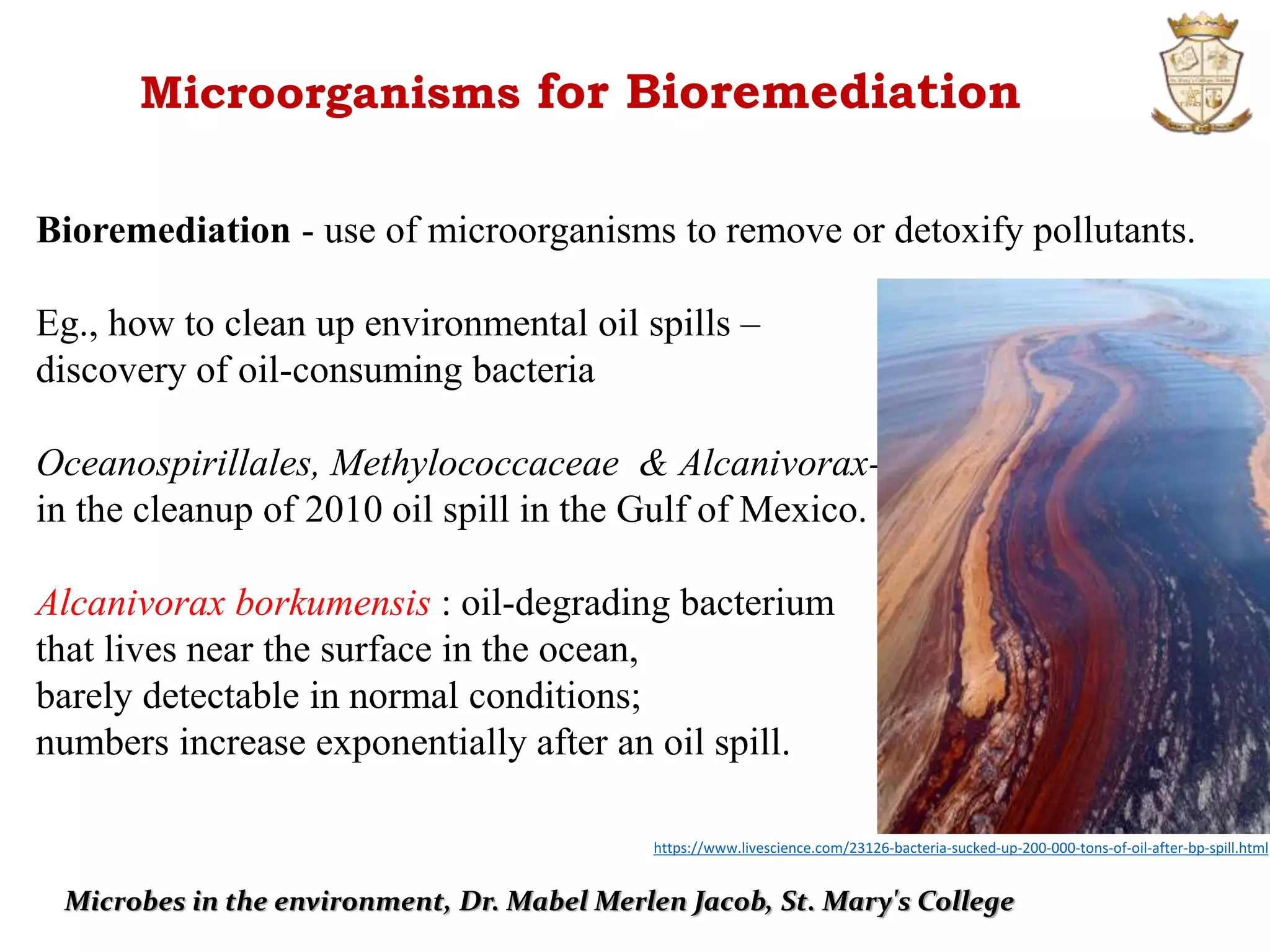
Bioremediation - use of microorganisms to remove or detoxify pollutants.
Eg., how to clean up environmental oil spills –
discovery of oil-consuming bacteria
Oceanospirillales, Methylococcaceae & Alcanivorax-
in the cleanup of 2010 oil spill in the Gulf of Mexico.
Alcanivorax borkumensis : oil-degrading bacterium
that lives near the surface in the ocean,
barely detectable in normal conditions;
numbers increase exponentially after an oil spill.
Microorganisms for Bioremediation
https://www.livescience.com/23126-bacteria-sucked-up-200-000-tons-of-oil-after-bp-spill.html
Microbes in the environment, Dr. Mabel Merlen Jacob, St. Mary's College
• A. borkumensis generates a biofilm to help emulsify, or break up
the oil into small droplets, so that bacteria can utilize the oil.
https://www.coursehero.com/sg/microbiology/environmental-applications/
Bacteria Generate Electricity from
Pollution
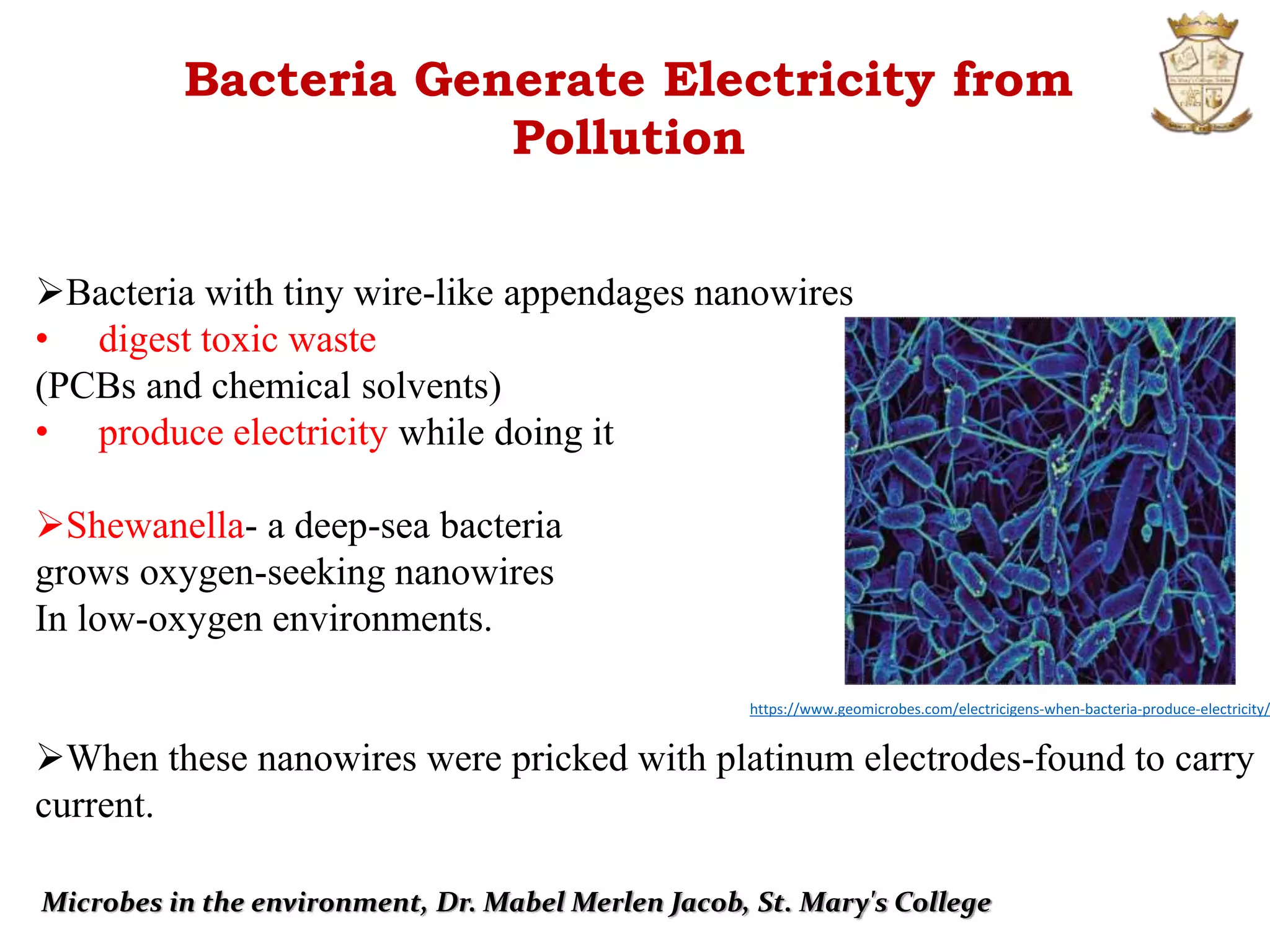
Bacteria with tiny wire-like appendages nanowires
• digest toxic waste
(PCBs and chemical solvents)
• produce electricity while doing it
Shewanella- a deep-sea bacteria
grows oxygen-seeking nanowires
In low-oxygen environments.
When these nanowires were pricked with platinum electrodes-found to carry
current.
Microbes in the environment, Dr. Mabel Merlen Jacob, St. Mary's College
https://www.geomicrobes.com/electricigens-when-bacteria-produce-electricity/
If harnessed effectively, could be used in sewage treatment plants
• to digest waste & to power the plant.
Microbes in the environment, Dr. Mabel Merlen Jacob, St. Mary's College
https://www.sciencenews.org/article/bacteria-go-electric
 Nanowires grown by certain types of bacteria used to immobilize
harmful materials – like uranium
 Geobacter (found naturally in soil), electroplates uranium, making it
insoluble - so it can’t dissolve and contaminate groundwater
 Potential in uranium contamination sites like mines and nuclear plants
 to contain the radiation & reduce
consequences of spills
Geobacter Consume
Radioactive Contamination
Microbes in the environment, Dr. Mabel Merlen Jacob, St. Mary's College
Geobacter metallireducens munching uranium (Credit: Eye of Science/Science Photo Library)
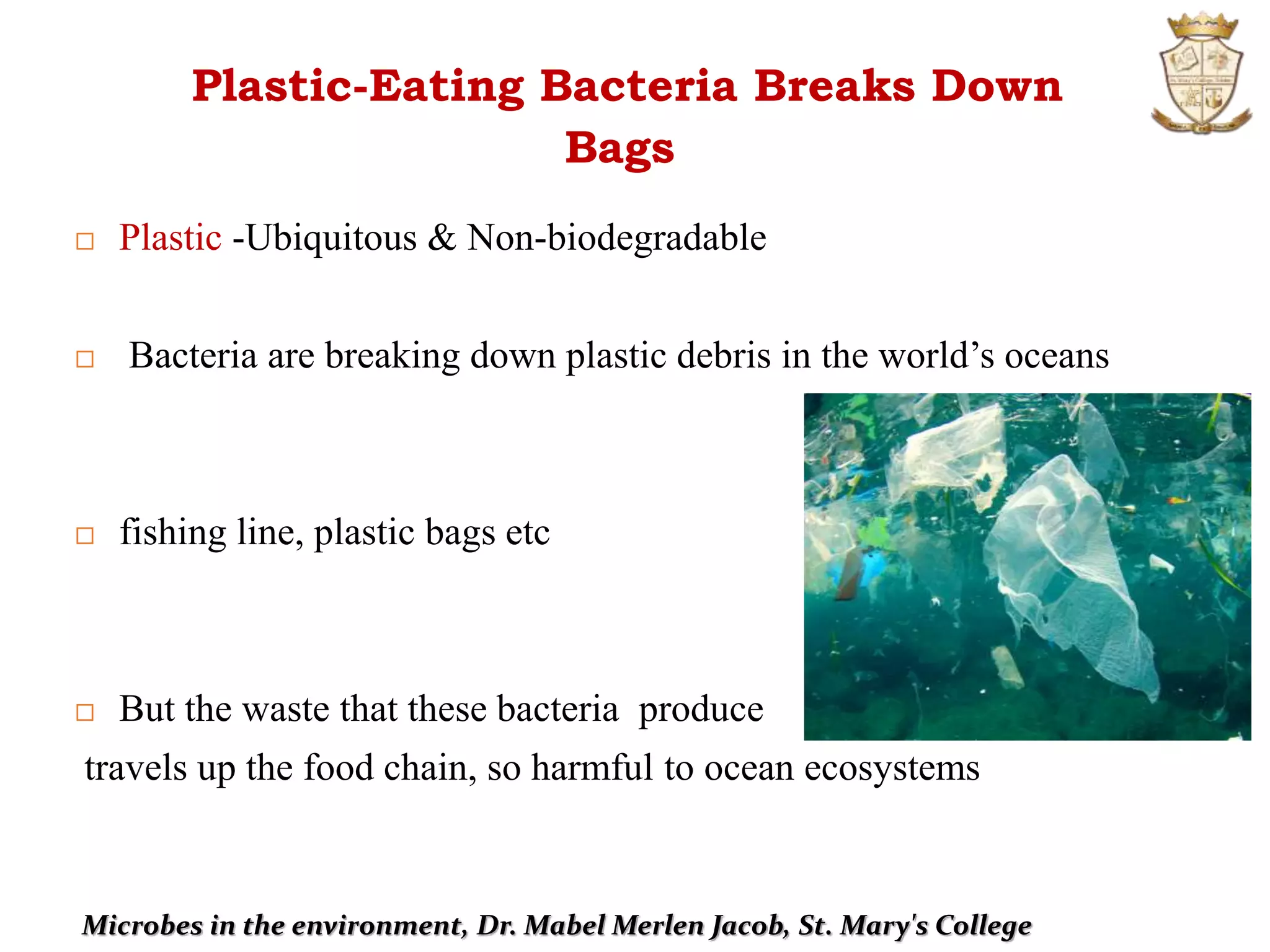
 Plastic -Ubiquitous & Non-biodegradable
 Bacteria are breaking down plastic debris in the world’s oceans
 fishing line, plastic bags etc
 But the waste that these bacteria produce
travels up the food chain, so harmful to ocean ecosystems
Plastic-Eating Bacteria Breaks Down
Bags
Microbes in the environment, Dr. Mabel Merlen Jacob, St. Mary's College
http://www.earthdecks.net/plastic-eating-enzyme/
Microbes in the environment, Dr. Mabel Merlen Jacob, St. Mary's College
 Nylon 6 - polymer ; used in toothbrushes, surgical sutures, ropes, hosiery
and violin strings.
 Manufacture of Nylon 6 produces toxic byproducts that get carried out in
waste water
 Flavobacterium produces special enzymes to digest these byproducts
 They didn’t have these enzymes previously, and those enzymes aren’t seen
in similar bacterial strains.
 The ability to produce these enzymes in order to consume a material that
didn’t even exist prior to the invention of nylon in 1935!
Nylon-Eating Bacteria Clean Up
Factory Waste
Microbes in the environment, Dr. Mabel Merlen Jacob, St. Mary's College
http://blog.drwile.com/nylon-digesting-bacteria-are-almost-certainly-not-a-modern-strain/
Microbes in the environment, Dr. Mabel Merlen Jacob, St. Mary's College
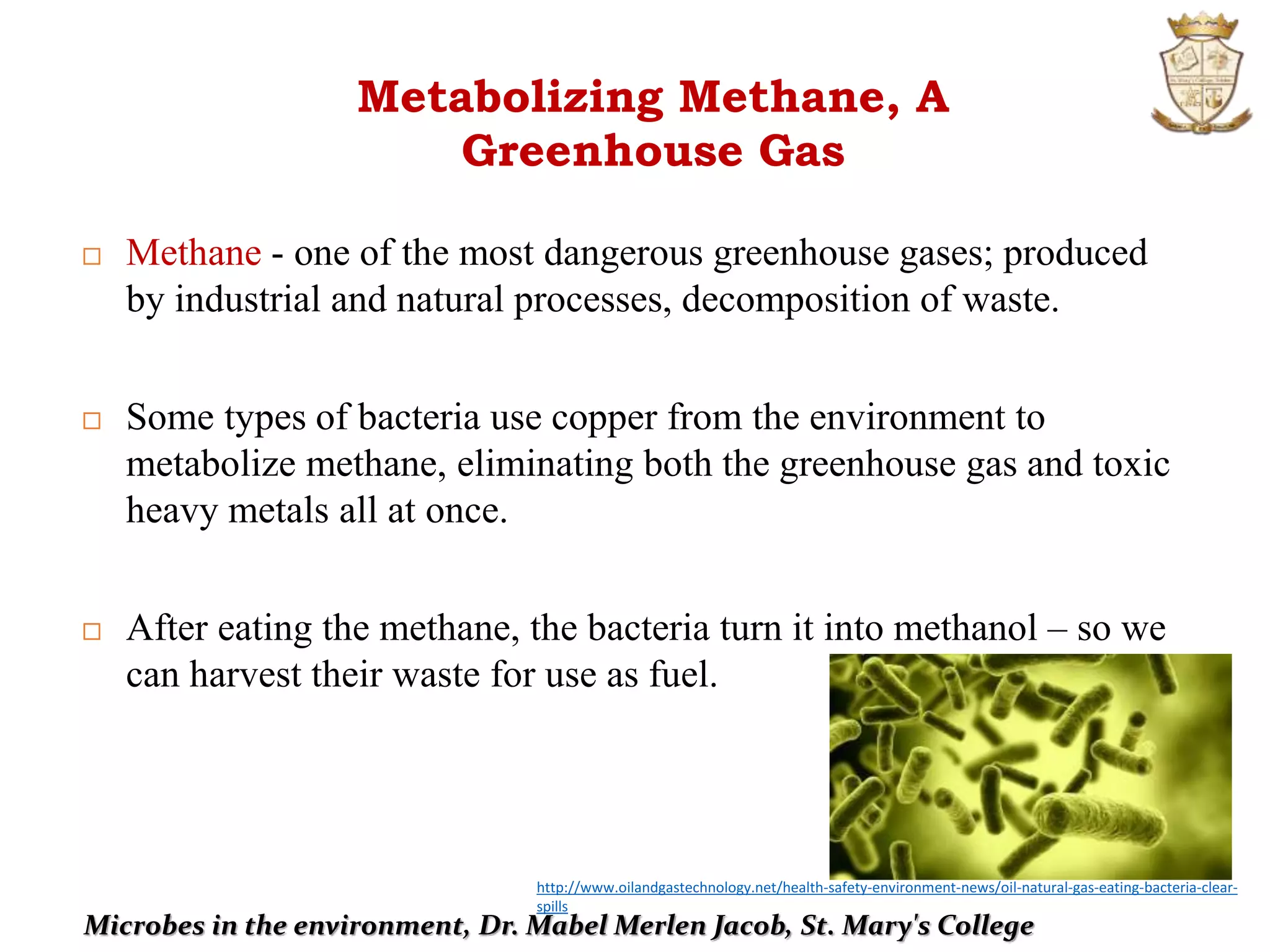
 Methane - one of the most dangerous greenhouse gases; produced
by industrial and natural processes, decomposition of waste.
 Some types of bacteria use copper from the environment to
metabolize methane, eliminating both the greenhouse gas and toxic
heavy metals all at once.
 After eating the methane, the bacteria turn it into methanol – so we
can harvest their waste for use as fuel.
Metabolizing Methane, A
Greenhouse Gas
Microbes in the environment, Dr. Mabel Merlen Jacob, St. Mary's College
http://www.oilandgastechnology.net/health-safety-environment-news/oil-natural-gas-eating-bacteria-clear-
spills
Turning Newspapers into Car Fuel
 Microbes named T-103, found in animal waste eat paper and
produce butanol
 Tulane University developed a method for growing the cellulose-
consuming microbes so they can produce fuel in the presence of
oxygen, which is lethal to other butanol-producing bacteria.
 This could make the whole fuel production process far less
expensive and more potentially applicable in the real world.
 Butanol produces more energy than ethanol and doesn’t require
engine modifications. It can also be carried through existing fuel
pipelines.
Microbes in the environment, Dr. Mabel Merlen Jacob, St. Mary's College
Soil-Dwelling Bacteria Kills Cancer
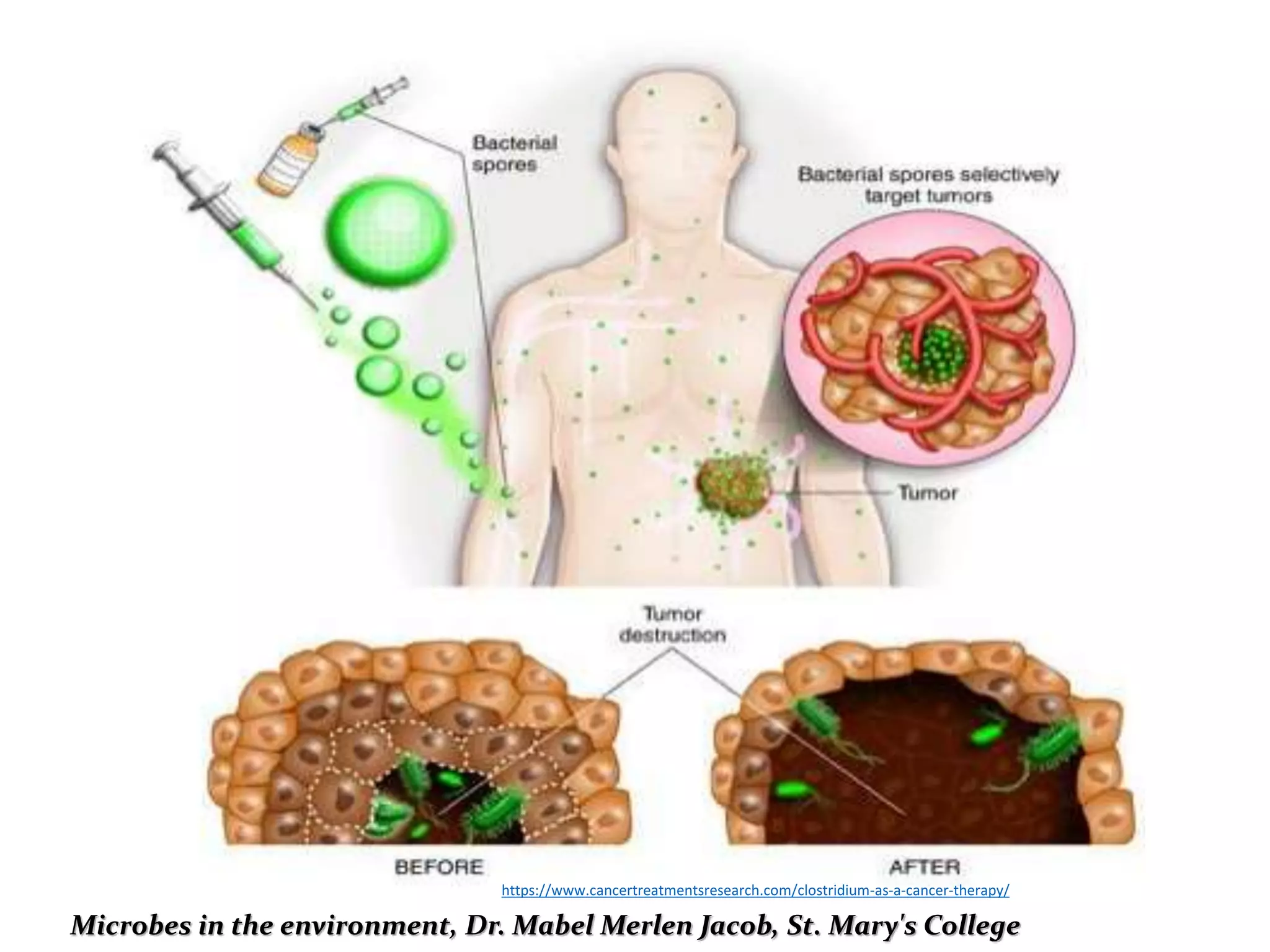
 Clostridium sporogenes -used to deliver drugs in cancer therapy by
exploitingto its ability to target tumors.
 C. sporogenes will only grow in oxygen-depleted environments –
like the center of solid tumors, says Professor Nigel Minton of the
University of Nottingham
 When injected into a tumor log with cancer drugs, the bacteria help
the drugs kill the tumor cells without affecting healthy tissue.
Microbes in the environment, Dr. Mabel Merlen Jacob, St. Mary's College
https://www.cancertreatmentsresearch.com/clostridium-as-a-cancer-therapy/
Microbes in the environment, Dr. Mabel Merlen Jacob, St. Mary's College
Panda Poop Bacteria Makes Biofuel
 “Who would have guessed that ‘panda poop’ might help solve one of
the major hurdles to producing biofuels, which is optimizing the
breakdown of the raw plant materials used to make the fuels?” says
Ashli Brown, Ph.D., co-author of a study on how bacteria in panda
feces can break down the tough plant material known as lignocellulose.
 This discovery could speed up development of plant-based biofuels
 Several types of digestive bacteria found in the panda feces are similar
to those found in termites, which are good at digesting wood.
 The bacteria that have been identified for their cellulose-processing
abilities can be isolated and grown on a commercial scale.
 Just proves how important biodiversity is, and that many species around
the world may have more to offer than we realize.
Microbes in the environment, Dr. Mabel Merlen Jacob, St. Mary's College
Turning Human Waste into Rocket Fuel
 Human sewage is no less - with the help of the bacteria Brocadia
anammoxidans, it could be transformed into hydrazine or the rocket
fuel https://www.sciencedaily.com/releases/2015/10/151021083529.htm
 The bacteria naturally consume ammonia and produce hydrazine in
the process.
 Until their discovery, scientists thought that hydrazine was only a
man-made substance.
Microbes in the environment, Dr. Mabel Merlen Jacob, St. Mary's College
Sulphur-Eating Bacteria Reduce Acid
Run-Off
 Sulphur in mine tailings from mining operations react with water
and oxygen & produce toxic sulphuric acid- a major
environmental problem which also contribute to climate change
 Researchers at McMaster University identified two species of
bacteria isolated from a mine tailings pond in northern Ontario
 They grow using sulphur as an energy source – produce and
consume each other’s sulphur-containing waste; reduces the
amount of toxic runoff Acid Mine Drainage (AMD).
 This runoff dissolves carbonate rocks and releases CO2,
worsening climate change, so the more it is reduced, the less
carbon dioxide gas is released into the atmosphere https://phys.org/news/2010-01-
sulphur-eating-bacteria-limit-acid-run-off.html
Microbes in the environment, Dr. Mabel Merlen Jacob, St. Mary's College
References
• https://www.momtastic.com/webecoist/2011/09/26/beneficial-
bacteria-12-ways-microbes-help-the-environment/
Microbes in the environment, Dr. Mabel Merlen Jacob, St. Mary's College

Microbiology:Microbes In The Environment

  • 1.
    Dr. Mabel MerlenJacob Assistant Professor Department of Microbiology St. Mary’s College,Thrissur MICROBES IN THE ENVIRONMENT
  • 2.
    Microbes in theenvironment, Dr. Mabel Merlen Jacob, St. Mary's College  Obsessed with eliminating bacteria and the microbes causing infection, illness and death??  Not all microorganisms are harmful  Some are essential for life to exist  Many are helpful in  fighting global warming  cleaning up pollution  breaking down plastic  developing a cure for cancer
  • 3.
    Microbes in theenvironment, Dr. Mabel Merlen Jacob, St. Mary's College Bioremediation - use of microorganisms to remove or detoxify pollutants. Eg., how to clean up environmental oil spills – discovery of oil-consuming bacteria Oceanospirillales, Methylococcaceae & Alcanivorax- in the cleanup of 2010 oil spill in the Gulf of Mexico. Alcanivorax borkumensis : oil-degrading bacterium that lives near the surface in the ocean, barely detectable in normal conditions; numbers increase exponentially after an oil spill. Microorganisms for Bioremediation https://www.livescience.com/23126-bacteria-sucked-up-200-000-tons-of-oil-after-bp-spill.html
  • 4.
    Microbes in theenvironment, Dr. Mabel Merlen Jacob, St. Mary's College • A. borkumensis generates a biofilm to help emulsify, or break up the oil into small droplets, so that bacteria can utilize the oil. https://www.coursehero.com/sg/microbiology/environmental-applications/
  • 5.
    Bacteria Generate Electricityfrom Pollution Bacteria with tiny wire-like appendages nanowires • digest toxic waste (PCBs and chemical solvents) • produce electricity while doing it Shewanella- a deep-sea bacteria grows oxygen-seeking nanowires In low-oxygen environments. When these nanowires were pricked with platinum electrodes-found to carry current. Microbes in the environment, Dr. Mabel Merlen Jacob, St. Mary's College https://www.geomicrobes.com/electricigens-when-bacteria-produce-electricity/
  • 6.
    If harnessed effectively,could be used in sewage treatment plants • to digest waste & to power the plant. Microbes in the environment, Dr. Mabel Merlen Jacob, St. Mary's College https://www.sciencenews.org/article/bacteria-go-electric
  • 7.
     Nanowires grownby certain types of bacteria used to immobilize harmful materials – like uranium  Geobacter (found naturally in soil), electroplates uranium, making it insoluble - so it can’t dissolve and contaminate groundwater  Potential in uranium contamination sites like mines and nuclear plants  to contain the radiation & reduce consequences of spills Geobacter Consume Radioactive Contamination Microbes in the environment, Dr. Mabel Merlen Jacob, St. Mary's College Geobacter metallireducens munching uranium (Credit: Eye of Science/Science Photo Library)
  • 8.
     Plastic -Ubiquitous& Non-biodegradable  Bacteria are breaking down plastic debris in the world’s oceans  fishing line, plastic bags etc  But the waste that these bacteria produce travels up the food chain, so harmful to ocean ecosystems Plastic-Eating Bacteria Breaks Down Bags Microbes in the environment, Dr. Mabel Merlen Jacob, St. Mary's College
  • 9.
    http://www.earthdecks.net/plastic-eating-enzyme/ Microbes in theenvironment, Dr. Mabel Merlen Jacob, St. Mary's College
  • 10.
     Nylon 6- polymer ; used in toothbrushes, surgical sutures, ropes, hosiery and violin strings.  Manufacture of Nylon 6 produces toxic byproducts that get carried out in waste water  Flavobacterium produces special enzymes to digest these byproducts  They didn’t have these enzymes previously, and those enzymes aren’t seen in similar bacterial strains.  The ability to produce these enzymes in order to consume a material that didn’t even exist prior to the invention of nylon in 1935! Nylon-Eating Bacteria Clean Up Factory Waste Microbes in the environment, Dr. Mabel Merlen Jacob, St. Mary's College
  • 11.
  • 12.
     Methane -one of the most dangerous greenhouse gases; produced by industrial and natural processes, decomposition of waste.  Some types of bacteria use copper from the environment to metabolize methane, eliminating both the greenhouse gas and toxic heavy metals all at once.  After eating the methane, the bacteria turn it into methanol – so we can harvest their waste for use as fuel. Metabolizing Methane, A Greenhouse Gas Microbes in the environment, Dr. Mabel Merlen Jacob, St. Mary's College http://www.oilandgastechnology.net/health-safety-environment-news/oil-natural-gas-eating-bacteria-clear- spills
  • 13.
    Turning Newspapers intoCar Fuel  Microbes named T-103, found in animal waste eat paper and produce butanol  Tulane University developed a method for growing the cellulose- consuming microbes so they can produce fuel in the presence of oxygen, which is lethal to other butanol-producing bacteria.  This could make the whole fuel production process far less expensive and more potentially applicable in the real world.  Butanol produces more energy than ethanol and doesn’t require engine modifications. It can also be carried through existing fuel pipelines. Microbes in the environment, Dr. Mabel Merlen Jacob, St. Mary's College
  • 14.
    Soil-Dwelling Bacteria KillsCancer  Clostridium sporogenes -used to deliver drugs in cancer therapy by exploitingto its ability to target tumors.  C. sporogenes will only grow in oxygen-depleted environments – like the center of solid tumors, says Professor Nigel Minton of the University of Nottingham  When injected into a tumor log with cancer drugs, the bacteria help the drugs kill the tumor cells without affecting healthy tissue. Microbes in the environment, Dr. Mabel Merlen Jacob, St. Mary's College
  • 15.
  • 16.
    Panda Poop BacteriaMakes Biofuel  “Who would have guessed that ‘panda poop’ might help solve one of the major hurdles to producing biofuels, which is optimizing the breakdown of the raw plant materials used to make the fuels?” says Ashli Brown, Ph.D., co-author of a study on how bacteria in panda feces can break down the tough plant material known as lignocellulose.  This discovery could speed up development of plant-based biofuels  Several types of digestive bacteria found in the panda feces are similar to those found in termites, which are good at digesting wood.  The bacteria that have been identified for their cellulose-processing abilities can be isolated and grown on a commercial scale.  Just proves how important biodiversity is, and that many species around the world may have more to offer than we realize. Microbes in the environment, Dr. Mabel Merlen Jacob, St. Mary's College
  • 17.
    Turning Human Wasteinto Rocket Fuel  Human sewage is no less - with the help of the bacteria Brocadia anammoxidans, it could be transformed into hydrazine or the rocket fuel https://www.sciencedaily.com/releases/2015/10/151021083529.htm  The bacteria naturally consume ammonia and produce hydrazine in the process.  Until their discovery, scientists thought that hydrazine was only a man-made substance. Microbes in the environment, Dr. Mabel Merlen Jacob, St. Mary's College
  • 18.
    Sulphur-Eating Bacteria ReduceAcid Run-Off  Sulphur in mine tailings from mining operations react with water and oxygen & produce toxic sulphuric acid- a major environmental problem which also contribute to climate change  Researchers at McMaster University identified two species of bacteria isolated from a mine tailings pond in northern Ontario  They grow using sulphur as an energy source – produce and consume each other’s sulphur-containing waste; reduces the amount of toxic runoff Acid Mine Drainage (AMD).  This runoff dissolves carbonate rocks and releases CO2, worsening climate change, so the more it is reduced, the less carbon dioxide gas is released into the atmosphere https://phys.org/news/2010-01- sulphur-eating-bacteria-limit-acid-run-off.html Microbes in the environment, Dr. Mabel Merlen Jacob, St. Mary's College
  • 19.
    Microbes in theenvironment, Dr. Mabel Merlen Jacob, St. Mary's College
  • 20.