Microbial Technology in
Food Industry
 Foods, microorganisms, and humans have had a long and interesting
association that developed long before recorded history.
 Foods are not only of nutritional value to those who consume them but often
are ideal culture media for microbial growth.
 Microorganisms can be used to transform raw foods into gastronomic
delights, including chocolate, cheeses, pickles, sausages, and soy sauce.
Wines, beers, and other alcoholic products also are produced through
microbial activity.
 On the other hand, microorganisms can degrade food quality and lead to
spoilage.
 Importantly, foods also can serve as vehicles for disease transmission.
 The detection and control of pathogens and food spoilage microorganisms
are important parts of food microbiology.
Food as a Substrate for Microorganisms
Factors Influencing Growth of
Microorganisms in Food
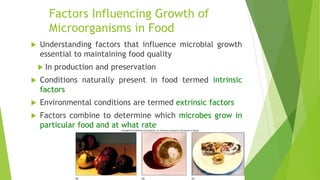
 Understanding factors that influence microbial growth
essential to maintaining food quality
 In production and preservation
 Conditions naturally present in food termed intrinsic
factors
 Environmental conditions are termed extrinsic factors
 Factors combine to determine which microbes grow in
particular food and at what rate
Factors Influencing Growth of
Microorganisms in Food
 Intrinsic factors
 Multiplication of microbes is greatly influenced by
inherent characteristics of food
Microbes multiply most rapidly in moist, nutritionally
rich, pH neutral foods
 Intrinsic factors include
Water availability
pH
Nutrients
Biological barriers
Antimicrobial chemicals
Factors Influencing Growth of
Microorganisms in Food
 Intrinsic factors
 Water availability
Foods vary dramatically in terms of water availability
Fresh meats and milk have high water content
Supports microbial growth
Breads, nuts and dried foods have low water
availability
Defined populations can grow in these specific
environments
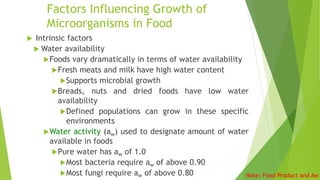
Water activity (aw) used to designate amount of water
available in foods
Pure water has aw of 1.0
Most bacteria require aw of above 0.90
Most fungi require aw of above 0.80 Note: Food Product and Aw
Factors Influencing Growth of
Microorganisms in Food
 Intrinsic factors
 pH
 Important in determining which organisms can survive and thrive on
specific foods
 Many microorganisms inhibited by acid conditions
 Exception include lactic acid bacteria
 Lactic acid bacteria used in fermentation process of food production
 Also prime cause of spoilage of unpasteurized milk and other foods
 Fungi are able to survive at relatively low pH
 Most acid foods spoil from fungal contamination as opposed to
bacteria
 pH can determine bacteria’s ability to produce toxin
 Toxin production of many organisms is inhibited by acid pH
Factors Influencing Growth of Microorganisms
in Food
 Intrinsic factors
 Nutrients
Nutrients present in food determine organisms that can
grow in foods
 Biological barriers
Rinds, shells and other outer coverings help protect
foods from microbial invasion
 Antimicrobial chemicals
Some foods contain natural antimicrobial chemicals
that inhibit growth of organisms responsible for
spoilage
 Some foods intrinsically contain naturally-occurring antimicrobial
compounds that convey some level of microbiological stability to
them. Specific examples include eugenol in cloves, allicin in
garlic, cinnamic aldehyde and eugenol in cinnamon, allyl
isothiocyanate in mustard, eugenol and thymol in sage, and
carvacrol (isothymol) and thymol in oregano.
 Some animal-based foods also contain antimicrobial constituents.
Examples include lactoferrin, conglutinin and the lactoperoxidase
system in cow's milk, lysozyme in eggs and milk.
 It is also known that some types of food processing result in the formation
of antimicrobial compounds in the food. The smoking of fish and meat can
result in the deposition of antimicrobial substances onto the product
surface.
 Some types of fermentations can result in the natural production of
antimicrobial substances, including bacteriocins, antibiotics, and other
related inhibitors.
(Bacteriocins are proteins or peptides that are produced by certain strains
of bacteria that inactivate other, usually closely-related, bacteria)
Factors Influencing Growth of
Microorganisms in Food
 Extrinsic factors
 Extent of microbial growth largely dependent on storage
of food
 Microbes multiply rapidly in warm, oxygen-rich
environments
 Extrinsic factors include
Storage temperature
Atmosphere
Factors Influencing Growth of
Microorganisms in Food
 Extrinsic factors
 Storage temperature
Storage temperature affects rate of microbial growth
Below freezing water availability is significantly
decreased
Water crystallizes and is unavailable halting
microbial growth
At low temperature (above freezing) enzymatic
action is very slow or non-existent
Results in inability of microbe to grow
Factors Influencing Growth of
Microorganisms in Food
 Extrinsic factors
 Atmosphere
Presence or absence of oxygen affects type of
microbial population
Obligate aerobes (needs O2) cannot grow under
anaerobic conditions
Obligate anaerobes (are killed by normal O2 conc. In
atm.) will grow in anaerobic conditions
Including certain foodborne pathogens
Sources of Microorganisms in Foods
 fruits and vegetables
 animals (meat)
 natural (including internal) sources
 external sources
 Natural sources -surfaces of fruits, vegetables, and grains, and the pores in
some tubers (e.g., radish and onion); animal skin, hair, feathers,
gastrointestinal tract, urinogenital tract, respiratory tract, and milk ducts
(teat canal) in udders of milk animals.
 outside sources- air, soil, sewage, water, feeds, humans, food ingredients,
equipment, packages, and insects.
 during the handling of foods.
PREDOMINANT MICROORGANISMS IN DIFFERENT
SOURCES
A. Plants (Fruits and Vegetables)
 The inside tissue of foods from plant sources are essentially sterile, except for a
few porous vegetables (e.g., radishes and onions) and leafy vegetables (e.g.,
cabbage and Brussels sprouts)
 Molds, yeasts, lactic acid bacteria, and bacteria from genera Pseudomonas,
Alcaligenes, Micrococcus, Erwinia, Bacillus, Clostridium, and Enterobacter can be
expected from this source.
 Pathogens, especially of enteric types, can be present if the soil is contaminated
with untreated sewage.
 Diseases of the plants, damage of the surface (before, during, and after harvest),
long delay between harvesting and washing, and unfavorable storage and transport
conditions after harvesting and before processing can greatly increase microbial
numbers as well as predominant types. Improper storage conditions following
processing can also increase their numbers.
B. Animals, Birds, Fish, and Shellfish
 Food animals and birds normally carry many types of indigenous
microorganisms in the digestive, respiratory, and urinogenital tracts, the
teat canal in the udder, as well as in the skin, hooves, hair, and feathers.
 Many, as carriers, can harbor pathogens such as Salmonella serovars,
pathogenic Escherichia coli, Campylobacter jejuni, Yersinia enterocolitica,
and Listeria monocytogenes without showing symptoms.
 Laying birds have been suspected of asymptomatically carrying Salmonella
enteritidis in the ovaries and contaminating the yolk during ovulation.
 Fish and shellfish also carry normal microflora in the scales, skin, and
digestive tracts. Water quality, feeding habits, and diseases can change the
normal microbial types and level. Pathogens such as Vibrio
parahaemolyticus, Vib. vulnificus, and Vib. cholerae are of major concern
from these sources.
 Many spoilage and pathogenic microorganisms can get into foods of animal
origin (milk, egg, meat, and fishery products) during production and
processing. Milk can be contaminated with fecal materials on the udder
surface, egg shells with fecal material during laying, meat with the
intestinal contents during slaughtering, and fish with intestinal contents
during processing.
C. Air
 Microorganisms are present in dust and moisture droplets in the air.
 They do not grow in dust, but are transient and variable, depending on the
environment.
 Their level is controlled by the degree of humidity, size and level of dust
particles, temperature and air velocity, and resistance of microorganisms
to drying.
 Generally, dry air with low dust content and higher temperature has a low
microbial level.
 Spores of Bacillus spp., Clostridium spp., and molds, and cells of some
Grampositive bacteria (e.g., Micrococcus spp. and Sarcina spp.), as well as
yeasts, can be predominantly present in air.
D. Soil
 Soil, especially the type used to grow agricultural produce and raise
animals and birds, contains several varieties of microorganisms.
 Because microorganisms can multiply in soil, their numbers can be very
high (billions/g).
 Many types of molds, yeasts, and bacterial genera (e.g., Enterobacter,
Pseudomonas, Proteus, Micrococcus, Enterococcus, Bacillus, and
Clostridium) can enter foods from the soil.
 Soil contaminated with fecal materials can be the source of enteric
pathogenic bacteria and viruses in food.
E. Sewage
 Sewage, especially when used as fertilizer in crops, can contaminate food
with microorganisms, the most significant of which are different
enteropathogenic bacteria and viruses.
 This can be a major concern with organically grown food and many
imported fruits and vegetables, in which untreated sewage and manure
might be used as fertilizer.
 Pathogenic parasites can also get in food from sewage.
F. Water
 Water is used to produce, process, and, under certain conditions, store foods.
 It is used for irrigation of crops, drinking by food animals and birds, raising fishery
and marine products, washing foods, processing (pasteurization, canning, and
cooling of heated foods) and storage of foods (e.g., fish on ice), washing and
sanitation of equipment, and processing and transportation facilities.
 Water is also used as an ingredient in many processed foods.
 Thus, water quality can greatly influence microbial quality of foods.
 Contamination of foods with pathogenic bacteria, viruses, and parasites from water
has been recorded.
 Although potable water does not contain coliforms and pathogens, it can contain
other bacteria capable of causing food spoilage, such as Pseudomonas, Alcaligenes,
and Flavobacterium.
G. Humans
 Between production and consumption, foods come in contact with different
people handling the foods.
 They include not only people working in farms and food processing plants, but
also those handling foods at restaurants, catering services, retail stores, and at
home.
 Human carriers have been the source of pathogenic microorganisms in foods that
later caused foodborne diseases, especially with ready to eat foods.
 Improperly cleaned hands, lack of aesthetic sense and personal hygiene, and dirty
clothes and hair can be major sources of microbial contamination in foods.
 The presence of minor cuts and infection in hands and face and mild generalized
diseases (e.g., flu, strep throat, or hepatitis A in an early stage) can amplify the
situation.
 In addition to spoilage bacteria, pathogens such as Sta. aureus, Salmonella
serovars, Shigella spp., pathogenic Esc. coli, and hepatitis A can be introduced
into foods from human sources.
H. Food Ingredients
 In prepared or fabricated foods, many ingredients or additives are included
in different quantities.
 Many of these ingredients can be the source of both spoilage and
pathogenic microorganisms.
 Various spices generally have very high populations of mold and bacterial
spores.
 Starch, sugar, and flour might have spores of thermophilic bacteria.
 Pathogens have been isolated from dried coconut, egg, and chocolate.
I. Equipment
 A wide variety of equipment is used in harvesting, slaughtering,
transporting, processing, and storing foods.
 Many types of microorganisms from air, raw foods, water, and personnel
can get into the equipment and contaminate foods.
 Also, when processing equipment is used continuously for a long period of
time, microorganisms initially present can multiply and act as a continuous
source of contamination in the product produced subsequently.
 Salmonella, Listeria, Escherichia, Enterococcus, Micrococcus,
Pseudomonas, Lactobacillus, Leuconostoc, Clostridium, Bacillus spp., and
yeasts and molds can get in food from equipment
J. Miscellaneous
 Foods might be contaminated with microorganisms from several other
sources, namely packaging and wrapping materials, containers, flies,
vermins, birds, house pets, and rodents.
 House pets can also harbor pathogens; proper care should be taken not to
contaminate food from this source.

Microbial technology in food industry

  • 1.
  • 2.
     Foods, microorganisms,and humans have had a long and interesting association that developed long before recorded history.  Foods are not only of nutritional value to those who consume them but often are ideal culture media for microbial growth.  Microorganisms can be used to transform raw foods into gastronomic delights, including chocolate, cheeses, pickles, sausages, and soy sauce. Wines, beers, and other alcoholic products also are produced through microbial activity.  On the other hand, microorganisms can degrade food quality and lead to spoilage.  Importantly, foods also can serve as vehicles for disease transmission.  The detection and control of pathogens and food spoilage microorganisms are important parts of food microbiology.
  • 3.
    Food as aSubstrate for Microorganisms
  • 4.
    Factors Influencing Growthof Microorganisms in Food  Understanding factors that influence microbial growth essential to maintaining food quality  In production and preservation  Conditions naturally present in food termed intrinsic factors  Environmental conditions are termed extrinsic factors  Factors combine to determine which microbes grow in particular food and at what rate
  • 5.
    Factors Influencing Growthof Microorganisms in Food  Intrinsic factors  Multiplication of microbes is greatly influenced by inherent characteristics of food Microbes multiply most rapidly in moist, nutritionally rich, pH neutral foods  Intrinsic factors include Water availability pH Nutrients Biological barriers Antimicrobial chemicals
  • 6.
    Factors Influencing Growthof Microorganisms in Food  Intrinsic factors  Water availability Foods vary dramatically in terms of water availability Fresh meats and milk have high water content Supports microbial growth Breads, nuts and dried foods have low water availability Defined populations can grow in these specific environments Water activity (aw) used to designate amount of water available in foods Pure water has aw of 1.0 Most bacteria require aw of above 0.90 Most fungi require aw of above 0.80 Note: Food Product and Aw
  • 8.
    Factors Influencing Growthof Microorganisms in Food  Intrinsic factors  pH  Important in determining which organisms can survive and thrive on specific foods  Many microorganisms inhibited by acid conditions  Exception include lactic acid bacteria  Lactic acid bacteria used in fermentation process of food production  Also prime cause of spoilage of unpasteurized milk and other foods  Fungi are able to survive at relatively low pH  Most acid foods spoil from fungal contamination as opposed to bacteria  pH can determine bacteria’s ability to produce toxin  Toxin production of many organisms is inhibited by acid pH
  • 9.
    Factors Influencing Growthof Microorganisms in Food  Intrinsic factors  Nutrients Nutrients present in food determine organisms that can grow in foods  Biological barriers Rinds, shells and other outer coverings help protect foods from microbial invasion  Antimicrobial chemicals Some foods contain natural antimicrobial chemicals that inhibit growth of organisms responsible for spoilage
  • 10.
     Some foodsintrinsically contain naturally-occurring antimicrobial compounds that convey some level of microbiological stability to them. Specific examples include eugenol in cloves, allicin in garlic, cinnamic aldehyde and eugenol in cinnamon, allyl isothiocyanate in mustard, eugenol and thymol in sage, and carvacrol (isothymol) and thymol in oregano.  Some animal-based foods also contain antimicrobial constituents. Examples include lactoferrin, conglutinin and the lactoperoxidase system in cow's milk, lysozyme in eggs and milk.
  • 11.
     It isalso known that some types of food processing result in the formation of antimicrobial compounds in the food. The smoking of fish and meat can result in the deposition of antimicrobial substances onto the product surface.  Some types of fermentations can result in the natural production of antimicrobial substances, including bacteriocins, antibiotics, and other related inhibitors. (Bacteriocins are proteins or peptides that are produced by certain strains of bacteria that inactivate other, usually closely-related, bacteria)
  • 12.
    Factors Influencing Growthof Microorganisms in Food  Extrinsic factors  Extent of microbial growth largely dependent on storage of food  Microbes multiply rapidly in warm, oxygen-rich environments  Extrinsic factors include Storage temperature Atmosphere
  • 13.
    Factors Influencing Growthof Microorganisms in Food  Extrinsic factors  Storage temperature Storage temperature affects rate of microbial growth Below freezing water availability is significantly decreased Water crystallizes and is unavailable halting microbial growth At low temperature (above freezing) enzymatic action is very slow or non-existent Results in inability of microbe to grow
  • 14.
    Factors Influencing Growthof Microorganisms in Food  Extrinsic factors  Atmosphere Presence or absence of oxygen affects type of microbial population Obligate aerobes (needs O2) cannot grow under anaerobic conditions Obligate anaerobes (are killed by normal O2 conc. In atm.) will grow in anaerobic conditions Including certain foodborne pathogens
  • 16.
  • 17.
    Sources of Microorganismsin Foods  fruits and vegetables  animals (meat)  natural (including internal) sources  external sources  Natural sources -surfaces of fruits, vegetables, and grains, and the pores in some tubers (e.g., radish and onion); animal skin, hair, feathers, gastrointestinal tract, urinogenital tract, respiratory tract, and milk ducts (teat canal) in udders of milk animals.  outside sources- air, soil, sewage, water, feeds, humans, food ingredients, equipment, packages, and insects.  during the handling of foods.
  • 18.
    PREDOMINANT MICROORGANISMS INDIFFERENT SOURCES A. Plants (Fruits and Vegetables)  The inside tissue of foods from plant sources are essentially sterile, except for a few porous vegetables (e.g., radishes and onions) and leafy vegetables (e.g., cabbage and Brussels sprouts)  Molds, yeasts, lactic acid bacteria, and bacteria from genera Pseudomonas, Alcaligenes, Micrococcus, Erwinia, Bacillus, Clostridium, and Enterobacter can be expected from this source.  Pathogens, especially of enteric types, can be present if the soil is contaminated with untreated sewage.  Diseases of the plants, damage of the surface (before, during, and after harvest), long delay between harvesting and washing, and unfavorable storage and transport conditions after harvesting and before processing can greatly increase microbial numbers as well as predominant types. Improper storage conditions following processing can also increase their numbers.
  • 19.
    B. Animals, Birds,Fish, and Shellfish  Food animals and birds normally carry many types of indigenous microorganisms in the digestive, respiratory, and urinogenital tracts, the teat canal in the udder, as well as in the skin, hooves, hair, and feathers.  Many, as carriers, can harbor pathogens such as Salmonella serovars, pathogenic Escherichia coli, Campylobacter jejuni, Yersinia enterocolitica, and Listeria monocytogenes without showing symptoms.  Laying birds have been suspected of asymptomatically carrying Salmonella enteritidis in the ovaries and contaminating the yolk during ovulation.
  • 20.
     Fish andshellfish also carry normal microflora in the scales, skin, and digestive tracts. Water quality, feeding habits, and diseases can change the normal microbial types and level. Pathogens such as Vibrio parahaemolyticus, Vib. vulnificus, and Vib. cholerae are of major concern from these sources.  Many spoilage and pathogenic microorganisms can get into foods of animal origin (milk, egg, meat, and fishery products) during production and processing. Milk can be contaminated with fecal materials on the udder surface, egg shells with fecal material during laying, meat with the intestinal contents during slaughtering, and fish with intestinal contents during processing.
  • 21.
    C. Air  Microorganismsare present in dust and moisture droplets in the air.  They do not grow in dust, but are transient and variable, depending on the environment.  Their level is controlled by the degree of humidity, size and level of dust particles, temperature and air velocity, and resistance of microorganisms to drying.  Generally, dry air with low dust content and higher temperature has a low microbial level.  Spores of Bacillus spp., Clostridium spp., and molds, and cells of some Grampositive bacteria (e.g., Micrococcus spp. and Sarcina spp.), as well as yeasts, can be predominantly present in air.
  • 22.
    D. Soil  Soil,especially the type used to grow agricultural produce and raise animals and birds, contains several varieties of microorganisms.  Because microorganisms can multiply in soil, their numbers can be very high (billions/g).  Many types of molds, yeasts, and bacterial genera (e.g., Enterobacter, Pseudomonas, Proteus, Micrococcus, Enterococcus, Bacillus, and Clostridium) can enter foods from the soil.  Soil contaminated with fecal materials can be the source of enteric pathogenic bacteria and viruses in food.
  • 23.
    E. Sewage  Sewage,especially when used as fertilizer in crops, can contaminate food with microorganisms, the most significant of which are different enteropathogenic bacteria and viruses.  This can be a major concern with organically grown food and many imported fruits and vegetables, in which untreated sewage and manure might be used as fertilizer.  Pathogenic parasites can also get in food from sewage.
  • 24.
    F. Water  Wateris used to produce, process, and, under certain conditions, store foods.  It is used for irrigation of crops, drinking by food animals and birds, raising fishery and marine products, washing foods, processing (pasteurization, canning, and cooling of heated foods) and storage of foods (e.g., fish on ice), washing and sanitation of equipment, and processing and transportation facilities.  Water is also used as an ingredient in many processed foods.  Thus, water quality can greatly influence microbial quality of foods.  Contamination of foods with pathogenic bacteria, viruses, and parasites from water has been recorded.  Although potable water does not contain coliforms and pathogens, it can contain other bacteria capable of causing food spoilage, such as Pseudomonas, Alcaligenes, and Flavobacterium.
  • 25.
    G. Humans  Betweenproduction and consumption, foods come in contact with different people handling the foods.  They include not only people working in farms and food processing plants, but also those handling foods at restaurants, catering services, retail stores, and at home.  Human carriers have been the source of pathogenic microorganisms in foods that later caused foodborne diseases, especially with ready to eat foods.  Improperly cleaned hands, lack of aesthetic sense and personal hygiene, and dirty clothes and hair can be major sources of microbial contamination in foods.  The presence of minor cuts and infection in hands and face and mild generalized diseases (e.g., flu, strep throat, or hepatitis A in an early stage) can amplify the situation.  In addition to spoilage bacteria, pathogens such as Sta. aureus, Salmonella serovars, Shigella spp., pathogenic Esc. coli, and hepatitis A can be introduced into foods from human sources.
  • 26.
    H. Food Ingredients In prepared or fabricated foods, many ingredients or additives are included in different quantities.  Many of these ingredients can be the source of both spoilage and pathogenic microorganisms.  Various spices generally have very high populations of mold and bacterial spores.  Starch, sugar, and flour might have spores of thermophilic bacteria.  Pathogens have been isolated from dried coconut, egg, and chocolate.
  • 27.
    I. Equipment  Awide variety of equipment is used in harvesting, slaughtering, transporting, processing, and storing foods.  Many types of microorganisms from air, raw foods, water, and personnel can get into the equipment and contaminate foods.  Also, when processing equipment is used continuously for a long period of time, microorganisms initially present can multiply and act as a continuous source of contamination in the product produced subsequently.  Salmonella, Listeria, Escherichia, Enterococcus, Micrococcus, Pseudomonas, Lactobacillus, Leuconostoc, Clostridium, Bacillus spp., and yeasts and molds can get in food from equipment
  • 28.
    J. Miscellaneous  Foodsmight be contaminated with microorganisms from several other sources, namely packaging and wrapping materials, containers, flies, vermins, birds, house pets, and rodents.  House pets can also harbor pathogens; proper care should be taken not to contaminate food from this source.

Editor's Notes

  • #3 The Chinese, Greeks and Egyptians were using salted fish in their diet as early as 3000BC. Fermented sausages –ancient Babylonian and ancient china -1500BC. The Romans used snow to preserve their meat. 8000 year old wine jars found in Republic of Georgia. Fermentation is a metabolic process that converts sugar to organic acids, CO2 or alcohol. It occurs in yeast and bacteria, but also in oxygen-starved muscle cells, as in the case of lactic acid fermentation.
  • #7 The aw of sugar varies from 0.575 to 0.825 Food product design Food safety Mycotoxins are compounds produced by moulds under specific environmental conditions. These toxins are harmful to human and animal health.
  • #9 Increasing the acidity of foods, either through fermentation or the addition of weak acids, has been used as a preservation method since ancient times. In their natural state, most foods such as meat, fish, and vegetables are slightly acidic while most fruits are moderately acidic. A few foods such as egg white are alkaline.
  • #11 These nutrients include water, a source of energy, nitrogen, vitamins, and minerals. Meats have abundant protein, lipids, minerals, and vitamins. Foods such as milk and milk products and eggs are rich in nutrients. Amino acids serve as a source of nitrogen and energy and are utilized by most microorganisms Examples of minerals required for microbial growth include phosphorus, iron, magnesium, sulfur, manganese, calcium, and potassium. In general, small amounts of these minerals are required; thus a wide range of foods can serve as good sources of minerals. Biological barriers- Examples of such physical barriers include testa of seeds, skin of fruits and vegetables, shell of nuts, animal hide, egg cuticle, shell, and membranes. The egg is another good example of an effective biological structure that, when intact, will prevent external microbial contamination of the perishable yolk; contamination is possible, however, through transovarian infection. (Salmonella.)
  • #12 a protein present in milk and other secretions, with bactericidal and iron-binding properties. Conglutinin-a nonimmunoglobulin bovine serum protein that aggregates immune complexes with conglutinogen activity (inactivated C3b) in the presence of divalent cations.. Lactoperoxidase is an enzyme, which is naturally present in fresh raw milk. ability to oxidise the thiocyanate ion (SCN-) in the presence of hydrogen peroxide (H2O2) (these components also exist naturally in tears, saliva, and gastric juices). The resulting chemical compound has an antibacterial effect in fresh raw milk. Lysozyme protects us from the ever-present danger of bacterial infection. It is a small enzyme that attacks the protective cell walls of bacteria.
  • #13 There are two mechanisms for this preservation: dehydration and the antibacterial properties of phenols and other chemicals in the absorbed smoke.
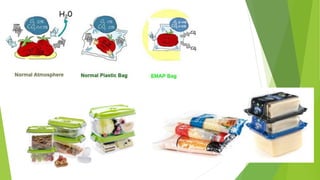
  • #16 Controlled atmosphere and modified atmosphere packaging of certain foods can dramatically extend their shelf life. The use of CO2, N2 , and ethanol are examples of MAP (modified atmosphere packing) applications. In general, the inhibitory effects of CO2 increase with decreasing temperature due to the increased solubility of CO2 at lower temperatures Examples of obligately anaerobic bacterial genera include: Actinomyces, Bacteroides, Clostridium, Fusobacterium, Peptostreptococcus, Porphyromonas, Prevotella, Propionibacterium, and Veillonella.
  • #17 Equilibrium modified atmosphere packing