THE MICROBIAL
WORLD
Module 2
Learning Outcomes
■ Explain the importance of microorganisms
■ Differentiate the different types of microorganisms
■ Discuss the different factors that promote microbial growth food
■ Explain how temperature in the danger zone affects bacterial growth
■ Recognize the importance of preventing the growth of these microorganisms in food
Words to Remember
■ Binary Fission – is an asexual reproduction commonly observed in
bacteria by a separation of the body into two new bodies. In the
process of binary fission, an organism duplicates its genetic material,
or deoxyribonucleic acid (DNA), and the divides into two parts
(cytokinesis), with each new organism receiving one copy of DNA.
■ Microorganisms or microbes – this are microscopic organisms that
exist in unicellular, multicellular, or cell clusters. They are widespread
in nature and are beneficial to life, but some can cause serious harm.
■ Pathogens – are disease-causing microorganisms.
MICROORGANISMS
■ Are said to be ubiquitous – they can thrive in almost all places on earth from land to
seas, oceans, and rivers.
■ They can provide food and shelter
■ They decompose all kinds of substances from decaying plants and animals to plastics.
■ Microbes can cause diseases including pandemics like Spanish flu, the Great Plague,
the Cholera, and the Asian Flu.
■ Microorganisms brought so much gifts to us. Wine will not be wine without fermenting
microbes.
■ Microorganisms have also gained importance as tools in the scientific world-from
antibiotic production to gene therapy.
MICROORGANISMS AS APPLIED TO
FOOD INDUSTRY
■ The control of microbiological spoilage and poisoning starts with the understanding
of possible food safety hazards.
■ Majority of organisms occur naturally in the environment where food are grown. Most
of them can be killed by adequate cooking temperature and numbers are kept to a
minimum by distribution and storage temperature.
■ Microorganism
– Bacteria
– Viruses
– Fungi
– Parasites
BACTERIA
■ Bacteria are very ubiquitous and can be found anywhere. Some examples where
they can live and multiply:
– Air, soil, water
– In gastro-intestinal tract of animals and humans
– On fruits, nuts, and vegetables
– On raw meat, poultry, and seafood
– On insects and rodents; and
– On hands, skin, hair, and clothing of people.
BACTERIA
■ The food safety concern with bacteria is that they are single-celled organisms that
can live independently.
■ The cells are prokaryotic because they lack a nucleus.
■ They can be classified in four major shapes; bacillus (rod shape), coccus (spherical
shape), spirilla (spiral shape), and vibrio (curved shape). They divide by binary
fission; and they may possess flagella for motility.
BACTERIA
■ The bacterial growth curve represents
the number of live cells in a bacterial
population over a period of time.
4 Distinct Phases
■ Lag phase – where bacteria are
metabolically active but not dividing.
■ Exponential phase – time for
exponential growth
■ Stationary phase – growth reaches a
plateau as the number of dying cells
equals the number of dividing cells; and
■ Death phase – exponential decrease in
the number of living cells
■ Bacteria can cause great number of
deaths due to foodborne illnesses. It
needs appropriate laboratory tools and
equipment to see them.
VIRUSES
■ They can contaminate food, water, and beverages. Unlike bacteria, they need a host
cell to multiply and they are not considered to be complete cells. Thus, they do not
multiply in food by can be transferred to food and food-contact surfaces.
■ Once inside a human host, they can reproduce and cause foodborne illness.
■ Poor person hygiene and contaminated water supply are the leading causes of viral
outbreak.
■ Raw or undercooked shellfish like clams, mussels, and oysters particularly if these
shellfish were harvested where harvested from polluted water.
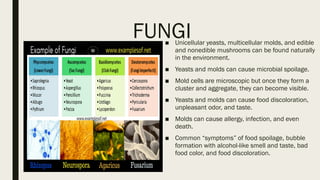
FUNGI
■ Unicellular yeasts, multicellular molds, and edible
and nonedible mushrooms can be found naturally
in the environment.
■ Yeasts and molds can cause microbial spoilage.
■ Mold cells are microscopic but once they form a
cluster and aggregate, they can become visible.
■ Yeasts and molds can cause food discoloration,
unpleasant odor, and taste.
■ Molds can cause allergy, infection, and even
death.
■ Common “symptoms” of food spoilage, bubble
formation with alcohol-like smell and taste, bad
food color, and food discoloration.
PARASITES
■ Living organisms that depend on other living
organisms or technically called hosts for
nutrition and survival.
■ It may range as single-cell organism to a
mature form like worms which can either be
segmented or non-segmented.
■ Animals such as pigs, cows, poultry, and fish
can serve as a secondary host.
■ Once ingested in the form of eggs and
capsules, it can mature in the human’s
intestinal tract causing abnominal pain, body
malaise, diarrhea, vomiting, weakness and to
extreme conditions and complications and
also death.
FACTORS AFFECTING MICROBIAL
GROWTH IN FOOD
■ FAT TOM
■ FOOD
■ ACIDITY
■ TEMPERATURE
■ TIME
■ OXYGEN
■ MOISTURE
FOOD
■ Bacteria nourish themselves primarily on protein and carbohydrates. Food that are high in protein
and carbohydrates. Food that are high in protein and carbohydrates supports rapid bacterial growth.
Potentially Hazardous Foods
■ Raw and cooked meat
■ Milk and dairy products
■ Fish and seafoods( excluding live seafood) such as shrimps, crabs, fish;
■ Semi-processed or cut fruits and vegetables including salads, watermelon, soy beans, and sprouts.
■ Cooked rice and pasta
■ Eggs; and
■ nuts
ACIDITY
■ Highly acidic foods and organic
acids can inhibit bacterial growth.
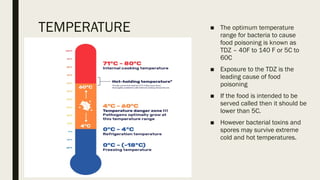
TEMPERATURE ■ The optimum temperature
range for bacteria to cause
food poisoning is known as
TDZ – 40F to 140 F or 5C to
60C
■ Exposure to the TDZ is the
leading cause of food
poisoning
■ If the food is intended to be
served called then it should be
lower than 5C.
■ However bacterial toxins and
spores may survive extreme
cold and hot temperatures.
TIME
■ Clock is ticking once the food is on the TDZ
■ Some bacteria can double in number every 10-30 minutes
■ Thus bacterium can grow by millions in 4 hours-enough to cause food poisoning and
produce toxins.
OXYGEN
■ Bacterial groups can be categorized generally as aerobic, anerobic, and facultative
anaerobic.
■ Aerobic – need oxygen to grow
■ Anaerobic – need total absence of oxygen to grow
■ Facultative Anaerobic – live and survive in the presence or absence of oxygen, most
food poisoning causes
MOISTURE
■ Like most living organisms, bacteria needs water to grow.
■ Potentially hazardous foods mostly contain high amount of water that is readily
available for bacteria to use.
■ Food technology advancements make the water bind to food structure thus
prolonging the shelf life
– Sugar, salt, drying, dehydrating

The Microbial World Module 2 - Risk Management

  • 1.
  • 2.
    Learning Outcomes ■ Explainthe importance of microorganisms ■ Differentiate the different types of microorganisms ■ Discuss the different factors that promote microbial growth food ■ Explain how temperature in the danger zone affects bacterial growth ■ Recognize the importance of preventing the growth of these microorganisms in food
  • 3.
    Words to Remember ■Binary Fission – is an asexual reproduction commonly observed in bacteria by a separation of the body into two new bodies. In the process of binary fission, an organism duplicates its genetic material, or deoxyribonucleic acid (DNA), and the divides into two parts (cytokinesis), with each new organism receiving one copy of DNA. ■ Microorganisms or microbes – this are microscopic organisms that exist in unicellular, multicellular, or cell clusters. They are widespread in nature and are beneficial to life, but some can cause serious harm. ■ Pathogens – are disease-causing microorganisms.
  • 4.
    MICROORGANISMS ■ Are saidto be ubiquitous – they can thrive in almost all places on earth from land to seas, oceans, and rivers. ■ They can provide food and shelter ■ They decompose all kinds of substances from decaying plants and animals to plastics. ■ Microbes can cause diseases including pandemics like Spanish flu, the Great Plague, the Cholera, and the Asian Flu. ■ Microorganisms brought so much gifts to us. Wine will not be wine without fermenting microbes. ■ Microorganisms have also gained importance as tools in the scientific world-from antibiotic production to gene therapy.
  • 5.
    MICROORGANISMS AS APPLIEDTO FOOD INDUSTRY ■ The control of microbiological spoilage and poisoning starts with the understanding of possible food safety hazards. ■ Majority of organisms occur naturally in the environment where food are grown. Most of them can be killed by adequate cooking temperature and numbers are kept to a minimum by distribution and storage temperature. ■ Microorganism – Bacteria – Viruses – Fungi – Parasites
  • 6.
    BACTERIA ■ Bacteria arevery ubiquitous and can be found anywhere. Some examples where they can live and multiply: – Air, soil, water – In gastro-intestinal tract of animals and humans – On fruits, nuts, and vegetables – On raw meat, poultry, and seafood – On insects and rodents; and – On hands, skin, hair, and clothing of people.
  • 7.
    BACTERIA ■ The foodsafety concern with bacteria is that they are single-celled organisms that can live independently. ■ The cells are prokaryotic because they lack a nucleus. ■ They can be classified in four major shapes; bacillus (rod shape), coccus (spherical shape), spirilla (spiral shape), and vibrio (curved shape). They divide by binary fission; and they may possess flagella for motility.
  • 8.
    BACTERIA ■ The bacterialgrowth curve represents the number of live cells in a bacterial population over a period of time. 4 Distinct Phases ■ Lag phase – where bacteria are metabolically active but not dividing. ■ Exponential phase – time for exponential growth ■ Stationary phase – growth reaches a plateau as the number of dying cells equals the number of dividing cells; and ■ Death phase – exponential decrease in the number of living cells ■ Bacteria can cause great number of deaths due to foodborne illnesses. It needs appropriate laboratory tools and equipment to see them.
  • 9.
    VIRUSES ■ They cancontaminate food, water, and beverages. Unlike bacteria, they need a host cell to multiply and they are not considered to be complete cells. Thus, they do not multiply in food by can be transferred to food and food-contact surfaces. ■ Once inside a human host, they can reproduce and cause foodborne illness. ■ Poor person hygiene and contaminated water supply are the leading causes of viral outbreak. ■ Raw or undercooked shellfish like clams, mussels, and oysters particularly if these shellfish were harvested where harvested from polluted water.
  • 10.
    FUNGI ■ Unicellular yeasts,multicellular molds, and edible and nonedible mushrooms can be found naturally in the environment. ■ Yeasts and molds can cause microbial spoilage. ■ Mold cells are microscopic but once they form a cluster and aggregate, they can become visible. ■ Yeasts and molds can cause food discoloration, unpleasant odor, and taste. ■ Molds can cause allergy, infection, and even death. ■ Common “symptoms” of food spoilage, bubble formation with alcohol-like smell and taste, bad food color, and food discoloration.
  • 11.
    PARASITES ■ Living organismsthat depend on other living organisms or technically called hosts for nutrition and survival. ■ It may range as single-cell organism to a mature form like worms which can either be segmented or non-segmented. ■ Animals such as pigs, cows, poultry, and fish can serve as a secondary host. ■ Once ingested in the form of eggs and capsules, it can mature in the human’s intestinal tract causing abnominal pain, body malaise, diarrhea, vomiting, weakness and to extreme conditions and complications and also death.
  • 12.
    FACTORS AFFECTING MICROBIAL GROWTHIN FOOD ■ FAT TOM ■ FOOD ■ ACIDITY ■ TEMPERATURE ■ TIME ■ OXYGEN ■ MOISTURE
  • 13.
    FOOD ■ Bacteria nourishthemselves primarily on protein and carbohydrates. Food that are high in protein and carbohydrates. Food that are high in protein and carbohydrates supports rapid bacterial growth. Potentially Hazardous Foods ■ Raw and cooked meat ■ Milk and dairy products ■ Fish and seafoods( excluding live seafood) such as shrimps, crabs, fish; ■ Semi-processed or cut fruits and vegetables including salads, watermelon, soy beans, and sprouts. ■ Cooked rice and pasta ■ Eggs; and ■ nuts
  • 14.
    ACIDITY ■ Highly acidicfoods and organic acids can inhibit bacterial growth.
  • 15.
    TEMPERATURE ■ Theoptimum temperature range for bacteria to cause food poisoning is known as TDZ – 40F to 140 F or 5C to 60C ■ Exposure to the TDZ is the leading cause of food poisoning ■ If the food is intended to be served called then it should be lower than 5C. ■ However bacterial toxins and spores may survive extreme cold and hot temperatures.
  • 16.
    TIME ■ Clock isticking once the food is on the TDZ ■ Some bacteria can double in number every 10-30 minutes ■ Thus bacterium can grow by millions in 4 hours-enough to cause food poisoning and produce toxins.
  • 17.
    OXYGEN ■ Bacterial groupscan be categorized generally as aerobic, anerobic, and facultative anaerobic. ■ Aerobic – need oxygen to grow ■ Anaerobic – need total absence of oxygen to grow ■ Facultative Anaerobic – live and survive in the presence or absence of oxygen, most food poisoning causes
  • 18.
    MOISTURE ■ Like mostliving organisms, bacteria needs water to grow. ■ Potentially hazardous foods mostly contain high amount of water that is readily available for bacteria to use. ■ Food technology advancements make the water bind to food structure thus prolonging the shelf life – Sugar, salt, drying, dehydrating