P R E S E N T E D B Y :
M O U S A M I J A R I A
S T . G E O R G E C O L L E G E O F M A N A G E M E N T A N D S C I E N C E
M S C M I C R O B I O L O G Y
S E M E S T E R 2
CONVENTIONAL ANDMODERN METHODS FOR
DETECTION OF SPOILAGE AND
CHARACTERIZATION
CONVENTIONAL METHODS
 The examination of foods for the presence , types
and numbers of microorganisms and/or their
products is basic to food microbiology.
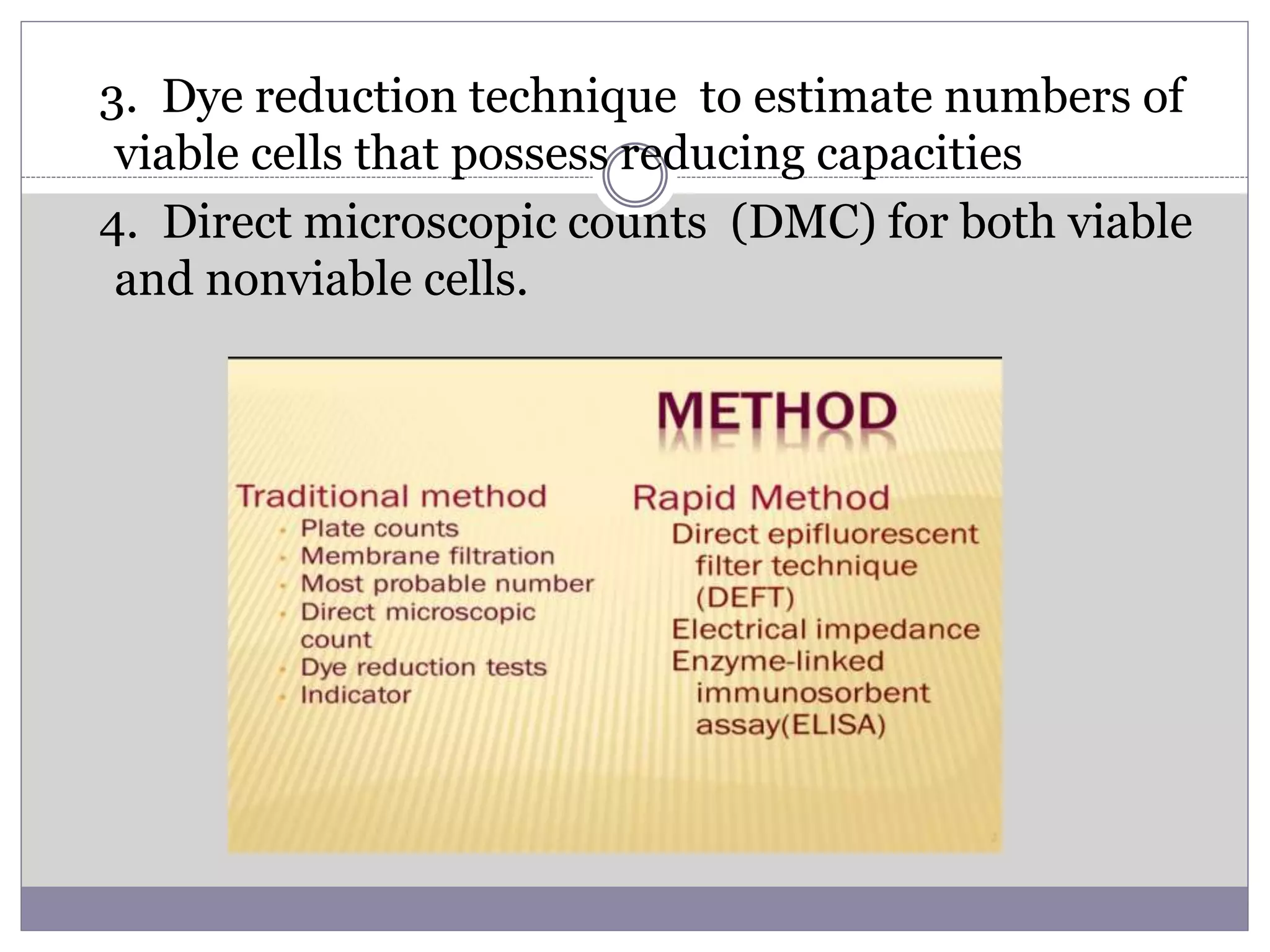
 The four basic methods employed for ‘’total’’
numbers are as follows:
1. Standard plate counts (SPC) or aerobic plate
counts(APC) for viable cells or colony forming units
(cfu).
2. Most probable numbers (MPN) method as a
statistical determination of viable cells.
3. Dye reduction technique to estimate numbers of
viable cells that possess reducing capacities
4. Direct microscopic counts (DMC) for both viable
and nonviable cells.
STANDARD PLATE COUNT (SPC)
 Portions of food samples are blended or
homogenized
 Diluted in a proper diluent.
 Plated in or onto a suitable agar medium
 Incubated at a appropriate temperature for given
time
 Visible colonies are counted by Quebec or electronic
counter
MOST PROBABLE NUMBERS
 Dilution of food samples are prepared
 3 serial aliquots or dilution are then planted into 9-
15 test tubes
 Numbers of organisms in original sample are
determined by standard MPN tables.
ADVANTAGES:
 Relatively simple
 Method of choice for determining fecal coliform
densities.
 Organisms can be determined by use of
appropriate selective and differential media.
DISADVANTAGES:
 Uses large volume of glasswares
 Lack of precision
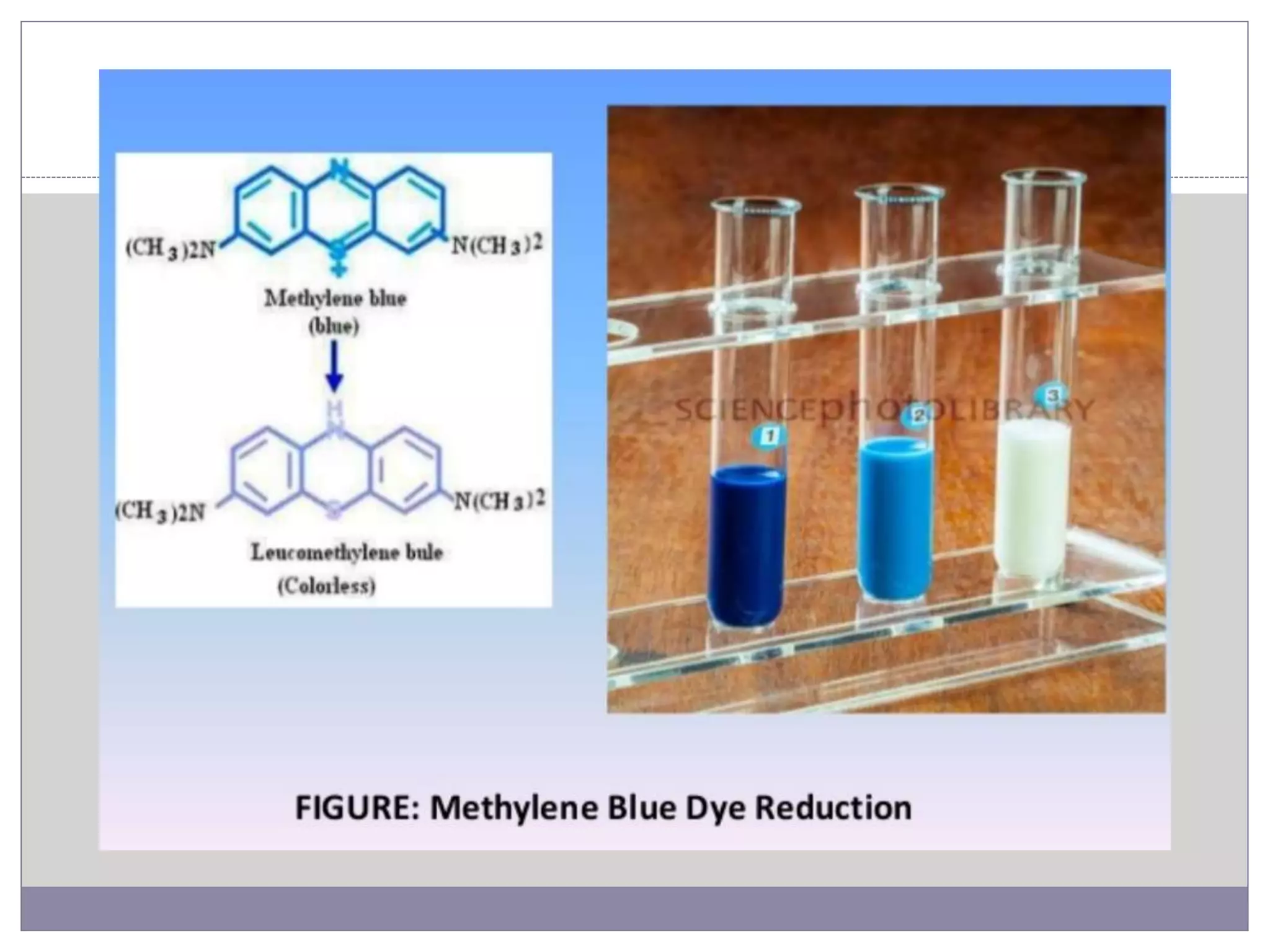
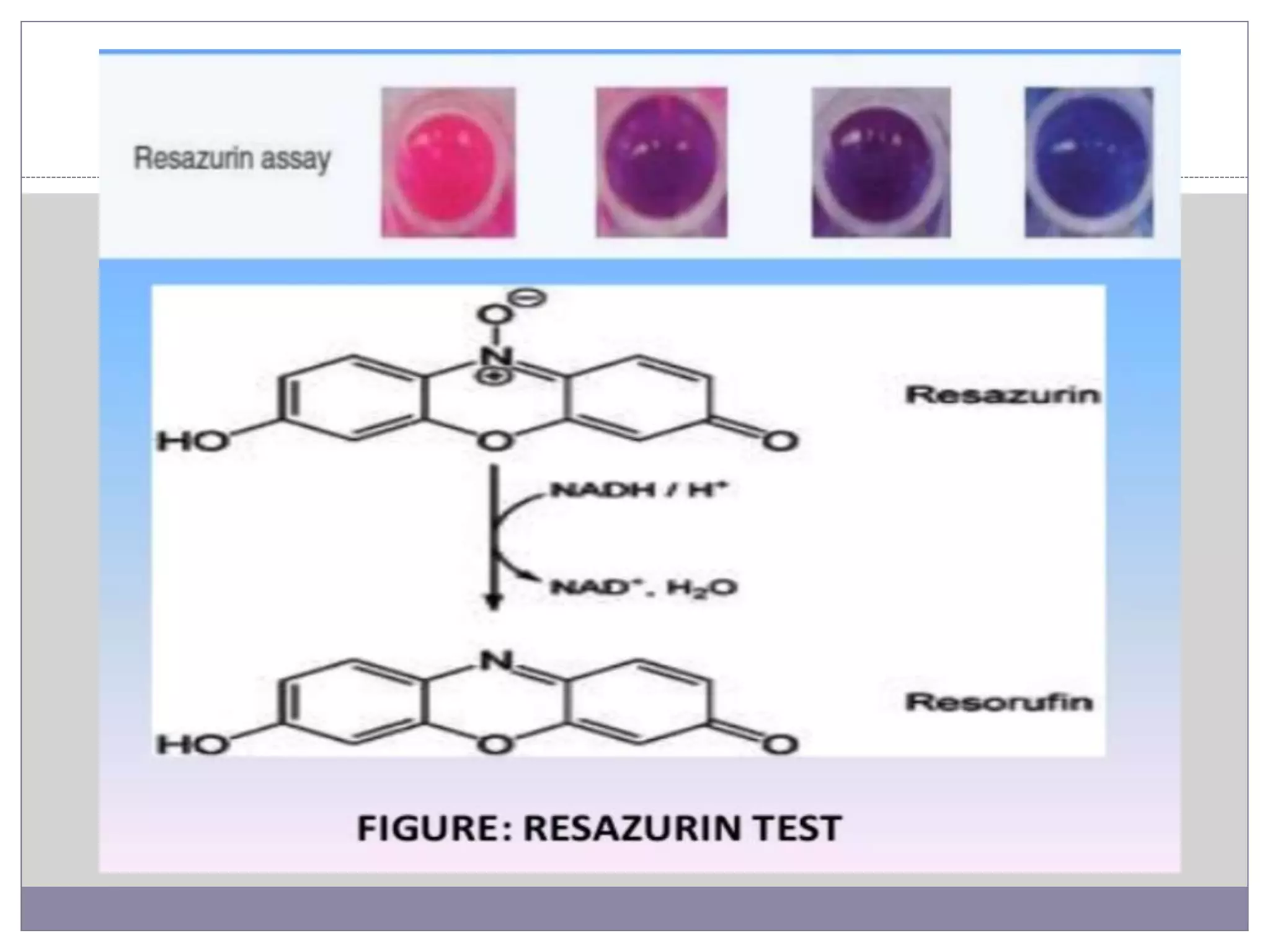
DYE REDUCTION
 Properly prepared supernatants of foods are added
to standard solutions of either dye for reduction
from blue to white for methylene blue and from slate
blue to pink or white for resazurin.
 Time for dye reduction is inversely proportional to
the number of organisms in sample.
ADVANTAGES:
 Simple rapid and inexpensive
 Only viable cells actively reduce dyes.
DISADVANTAGES:
 Not all organisms reduce dyes equally
 Not applicable to food specimens that contain
reductive enzymes.
DIRECT MICROSCOPIC COUNT (DMC)
 Most widely used in dairy industry for assessing
microbial quality of raw milk and other dairy
products.
 Method consists of adding 0.01 ml of a sample to 1
cm square area on microscopic slide, following
fixing, defatting of sample, staining the organisms
 The latter involves use of calibrated microscope.
 The method lends itself to the rapid
microbiological examination of food products such
as dried and frozen foods.
ADVANTAGES:
 Rapid and simple
 Cell morphology can be assessed and it lends to
fluorescent probes for improved efficiency.
DISADVANTAGES:
 Microscopic method hence fatiguing to analyst.
 Both viable and non viable cells are enumerated.
 Food particles are not always distinguishable from
microorganisms
 Some cells do not take the stain.
 DMC counts are invariably higher than counts of
SPC.
MODERN METHODS
Modern methods can be divided into three types:
 CHEMICAL
 BIOLOGICAL
 PHYSICAL
CHEMICAL METHODS:
 Used to detect, enumerate, or identify food borne
organisms.
 Thermostable nuclease
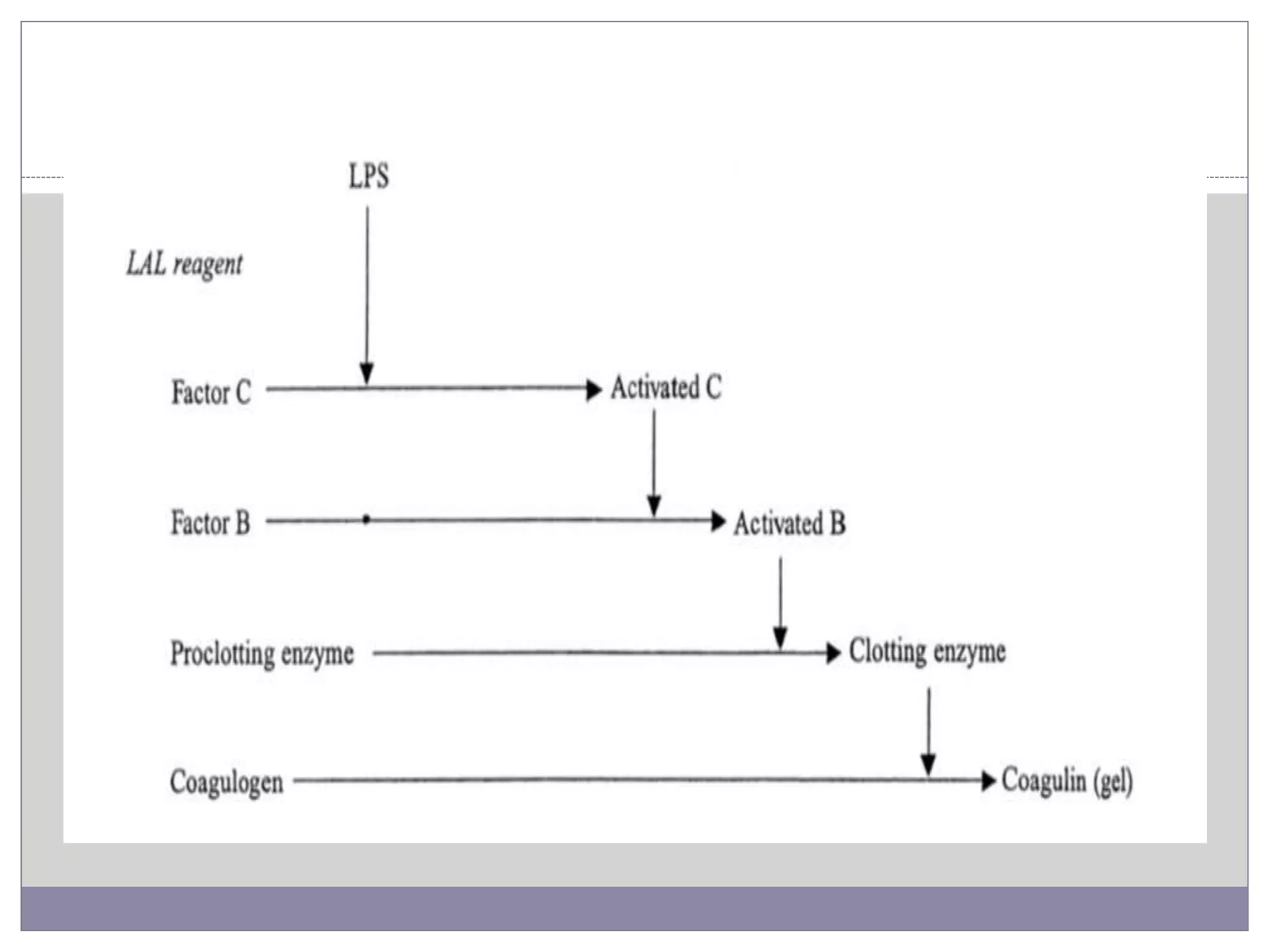
 Limulus amoebocyte lysate assay (LAL).
 ATP assay
 Radiometry
 Fluorogenic/ chromogenic substrates
THERMOSTABLE NUCLEASE:
 For identifying Staphylococcus aureus
 Their is high correlation between the production of
coagulase and thermostable nuclease by S. aureus
especially enterotoxin producers.
ADVANTAGES:
 Heat stable nature the enzyme will persist even if
the bacterial cells are destroyed by heat ,
chemicals.
 Heat stable nuclease can be detected faster than
enterotoxin.
 Nuclease of concern is stable to heat as are the
enterotoxins.
Limulus LYSATE FOR
ENDOTOXINS:
 Gram negative bacteria are characterized which
consists of lipopolysaccharide.
 Test employs lysate protein obtained from blood cellsof
horseshoe crab ( Limulus polyphemous).
 Lysate protein is the most sensitive substance known
for endotoxins.
 Endotoxins causes gel formation of the lysate material.
 Endotoxin titers increase in proportion of viable counts
of gram negative bacteria.
ADENOSINE TRIPHOSPHATE
MEASUREMENT:
 ATP is measured by firefly luciferin luciferase
system
 In presence of ATP , luciferase emits light , which is
measured by luminometer.
 Amount of light produced by firefly luciferase is
directly proportional to the amount of ATP added
 Also used in clinical microbiology to screen urine
specimens.
RADIOMETRY:
 C- labeled metabolite is incorporated in growth
medium so that when organism utilize this
metabolite CO2 is released and measured by
radioactivity counter.
 Procedure contains capped vials to which
metabolites are added, also with appropriate gases
and then inoculated.
 The presence of CO2 is checked.
 The time required to detect the labeled CO2 is
inversely related to the number of organisms in a
product.
BIOLOGICAL METHODS
 ELISA:
 An enzyme is coupled to either an antigen or an antibody.
 A solid phase (polystyrene) is coated with antigen and
incubated with anti serum.
 Following incubation and washing, an enzyme labeled
preparation of anti immunoglobulin is added.
 Enzyme in tube is assayed to determine the antibodies.
 Enzyme used is horseradish peroxidase .
 Amount of enz. present is acertained by coloimetric
determination of enz. Substrate.
 POLYMERASE CHAIN REACTION:
 When starting material is dsDNA , it is heated to
separate the strands.
 When the starting material is RNA it is converted to
dsDNA by reverse transcriptase.
 After heating they are cooled in presence of
oligonucleotide primers
 DNA polymerase plus dATP , dCTP, dTTP, and dGTP
are added resulting in the synthesis of complementry
strands.
 When this process is repeated 2 strands become 4 , 4
becomes 8 and so on resulting in several million copies
of the original.
 NUCLEIC ACID (DNA) PROBES:
 DNA fragments of unknown organisms are
prepared by restriction endonucleases
 After separating fragment strands by
electrophoresis, they are transferred to cellulose
nitrate filters and hybridized to labeled probes.
 After washing to remove unreacted probe DNA ,
the presence of hybridized product is assessed by
radiography.
PHYSICAL METHODS
 BIOSENSORS:
 Procedure that can be used to detect the presence
or activity of an organism living or dead.
 Some biosensors are based on principle of physics (
eg: fiber optics) while others are based on
biological principles(eg: lux gene luminesence)
 Eg: Accoustical biosensors, Fiber optics.
 MICROCALORIMETRY:
 It is study of small heat changes, the measurement
of enthalpy change involved in the breakdown of
growth substances.
 Two types : batch and flow.
 Used to study spoilage in canned foods .
 To differentiate between Enterobacteriaceae.
 To detect the presence of S. aureus.
 To estimate bacteria in ground meat.
 FLOW CYTOMETRY:
 Science of measuring components(cells) and properties
of individual cells in liquid suspension.
 Suspended cells are brought to the detector by means
of flow channel.
 Fluidic devices under laminar flow define the
trajectories and velocities that cells traverse the
detector.
 Individual cells can be sorted on the basis of their
measured properties like fluoresence, absorbance, and
light scatter.
 BIOSYS INSTRUMENT:
 It makes automatic and computer analysed changes in
the color of reaction vials as organisms grow in
specified culture media that contain a substrate that
changes color in proportion to incresase in number of
cells.
 Used to detect Salmonella and Listeria spp.
 Used to measure amino acid decarboxylation in enteric
bacteria
 To measure the effects of citrate and lactate in raw
meat biota.
THANK YOU

Conventional and modern methods for detection of spoilage

  • 1.
    P R ES E N T E D B Y : M O U S A M I J A R I A S T . G E O R G E C O L L E G E O F M A N A G E M E N T A N D S C I E N C E M S C M I C R O B I O L O G Y S E M E S T E R 2 CONVENTIONAL ANDMODERN METHODS FOR DETECTION OF SPOILAGE AND CHARACTERIZATION
  • 2.
    CONVENTIONAL METHODS  Theexamination of foods for the presence , types and numbers of microorganisms and/or their products is basic to food microbiology.  The four basic methods employed for ‘’total’’ numbers are as follows: 1. Standard plate counts (SPC) or aerobic plate counts(APC) for viable cells or colony forming units (cfu). 2. Most probable numbers (MPN) method as a statistical determination of viable cells.
  • 3.
    3. Dye reductiontechnique to estimate numbers of viable cells that possess reducing capacities 4. Direct microscopic counts (DMC) for both viable and nonviable cells.
  • 4.
    STANDARD PLATE COUNT(SPC)  Portions of food samples are blended or homogenized  Diluted in a proper diluent.  Plated in or onto a suitable agar medium  Incubated at a appropriate temperature for given time  Visible colonies are counted by Quebec or electronic counter
  • 5.
    MOST PROBABLE NUMBERS Dilution of food samples are prepared  3 serial aliquots or dilution are then planted into 9- 15 test tubes  Numbers of organisms in original sample are determined by standard MPN tables. ADVANTAGES:  Relatively simple  Method of choice for determining fecal coliform densities.
  • 6.
     Organisms canbe determined by use of appropriate selective and differential media. DISADVANTAGES:  Uses large volume of glasswares  Lack of precision
  • 7.
    DYE REDUCTION  Properlyprepared supernatants of foods are added to standard solutions of either dye for reduction from blue to white for methylene blue and from slate blue to pink or white for resazurin.  Time for dye reduction is inversely proportional to the number of organisms in sample.
  • 10.
    ADVANTAGES:  Simple rapidand inexpensive  Only viable cells actively reduce dyes. DISADVANTAGES:  Not all organisms reduce dyes equally  Not applicable to food specimens that contain reductive enzymes.
  • 11.
    DIRECT MICROSCOPIC COUNT(DMC)  Most widely used in dairy industry for assessing microbial quality of raw milk and other dairy products.  Method consists of adding 0.01 ml of a sample to 1 cm square area on microscopic slide, following fixing, defatting of sample, staining the organisms  The latter involves use of calibrated microscope.
  • 12.
     The methodlends itself to the rapid microbiological examination of food products such as dried and frozen foods. ADVANTAGES:  Rapid and simple  Cell morphology can be assessed and it lends to fluorescent probes for improved efficiency. DISADVANTAGES:  Microscopic method hence fatiguing to analyst.
  • 13.
     Both viableand non viable cells are enumerated.  Food particles are not always distinguishable from microorganisms  Some cells do not take the stain.  DMC counts are invariably higher than counts of SPC.
  • 14.
    MODERN METHODS Modern methodscan be divided into three types:  CHEMICAL  BIOLOGICAL  PHYSICAL CHEMICAL METHODS:  Used to detect, enumerate, or identify food borne organisms.
  • 15.
     Thermostable nuclease Limulus amoebocyte lysate assay (LAL).  ATP assay  Radiometry  Fluorogenic/ chromogenic substrates THERMOSTABLE NUCLEASE:  For identifying Staphylococcus aureus  Their is high correlation between the production of coagulase and thermostable nuclease by S. aureus especially enterotoxin producers.
  • 16.
    ADVANTAGES:  Heat stablenature the enzyme will persist even if the bacterial cells are destroyed by heat , chemicals.  Heat stable nuclease can be detected faster than enterotoxin.  Nuclease of concern is stable to heat as are the enterotoxins.
  • 17.
    Limulus LYSATE FOR ENDOTOXINS: Gram negative bacteria are characterized which consists of lipopolysaccharide.  Test employs lysate protein obtained from blood cellsof horseshoe crab ( Limulus polyphemous).  Lysate protein is the most sensitive substance known for endotoxins.  Endotoxins causes gel formation of the lysate material.  Endotoxin titers increase in proportion of viable counts of gram negative bacteria.
  • 19.
    ADENOSINE TRIPHOSPHATE MEASUREMENT:  ATPis measured by firefly luciferin luciferase system  In presence of ATP , luciferase emits light , which is measured by luminometer.  Amount of light produced by firefly luciferase is directly proportional to the amount of ATP added  Also used in clinical microbiology to screen urine specimens.
  • 20.
    RADIOMETRY:  C- labeledmetabolite is incorporated in growth medium so that when organism utilize this metabolite CO2 is released and measured by radioactivity counter.  Procedure contains capped vials to which metabolites are added, also with appropriate gases and then inoculated.  The presence of CO2 is checked.  The time required to detect the labeled CO2 is inversely related to the number of organisms in a product.
  • 21.
    BIOLOGICAL METHODS  ELISA: An enzyme is coupled to either an antigen or an antibody.  A solid phase (polystyrene) is coated with antigen and incubated with anti serum.  Following incubation and washing, an enzyme labeled preparation of anti immunoglobulin is added.  Enzyme in tube is assayed to determine the antibodies.  Enzyme used is horseradish peroxidase .  Amount of enz. present is acertained by coloimetric determination of enz. Substrate.
  • 22.
     POLYMERASE CHAINREACTION:  When starting material is dsDNA , it is heated to separate the strands.  When the starting material is RNA it is converted to dsDNA by reverse transcriptase.  After heating they are cooled in presence of oligonucleotide primers  DNA polymerase plus dATP , dCTP, dTTP, and dGTP are added resulting in the synthesis of complementry strands.  When this process is repeated 2 strands become 4 , 4 becomes 8 and so on resulting in several million copies of the original.
  • 23.
     NUCLEIC ACID(DNA) PROBES:  DNA fragments of unknown organisms are prepared by restriction endonucleases  After separating fragment strands by electrophoresis, they are transferred to cellulose nitrate filters and hybridized to labeled probes.  After washing to remove unreacted probe DNA , the presence of hybridized product is assessed by radiography.
  • 24.
    PHYSICAL METHODS  BIOSENSORS: Procedure that can be used to detect the presence or activity of an organism living or dead.  Some biosensors are based on principle of physics ( eg: fiber optics) while others are based on biological principles(eg: lux gene luminesence)  Eg: Accoustical biosensors, Fiber optics.
  • 25.
     MICROCALORIMETRY:  Itis study of small heat changes, the measurement of enthalpy change involved in the breakdown of growth substances.  Two types : batch and flow.  Used to study spoilage in canned foods .  To differentiate between Enterobacteriaceae.  To detect the presence of S. aureus.  To estimate bacteria in ground meat.
  • 26.
     FLOW CYTOMETRY: Science of measuring components(cells) and properties of individual cells in liquid suspension.  Suspended cells are brought to the detector by means of flow channel.  Fluidic devices under laminar flow define the trajectories and velocities that cells traverse the detector.  Individual cells can be sorted on the basis of their measured properties like fluoresence, absorbance, and light scatter.
  • 27.
     BIOSYS INSTRUMENT: It makes automatic and computer analysed changes in the color of reaction vials as organisms grow in specified culture media that contain a substrate that changes color in proportion to incresase in number of cells.  Used to detect Salmonella and Listeria spp.  Used to measure amino acid decarboxylation in enteric bacteria  To measure the effects of citrate and lactate in raw meat biota.
  • 28.