GUNJAN SHARMA
Assistant Professor
MEANING AND DEFINITION
Academic writing is the official writing manner used in colleges and
universities. It’s what students are projected to produce for classes and
what professors and academic researchers use to write scholarly materials.
It is the process of writing analytically – the breaking down of ideas with
the purpose of presenting information that depicts a clear understanding of
a certain subject.
Academic writing is the process of presenting idea in a rational,
organized, systematic, sensible and logical way.
Uses deductive reasoning, third person voice and is more formal than
some other types of writing.
Characteristics of academic writing
While specific requirements may vary based on the particular form of academic writing or
the class or publication for which a work is produced, some characteristics are common to
all academic writing.
Formal tone - a formal tone is always used in academic writing. It is not lighthearted or
conversational in tone. Slang and clichés do not belong in this type of writing.
Precise language - in keeping with the formal tone, it’s important to choose precise
language that very clearly conveys the author’s meaning.
Point-of-view (pov) - academic writing is usually written in third person pov because its
focus is to educate on the facts rather than to support an opinion or give advice.
Research focus - because most academic writing involves reporting research results, it
tends to focus on the specific research question(s) being studied.
Organization - academic writing should be organized logically in a linear, matter-of-fact
fashion. Use headings to delineate each major section.
Source citations - most academic writing includes at least some secondary research
sources. Be sure to properly cite all sources and include a bibliography.
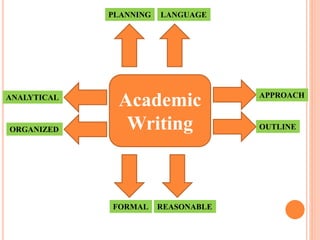
Academic
Writing
PLANNING LANGUAGE
APPROACH
OUTLINE
REASONABLE
FORMAL
ANALYTICAL
ORGANIZED
Abstract
Annotated bibliography
Academic journal article
Book report
Conference paper
Dissertation
Essay
Explication
Literary criticism
Research paper
Research proposal
Textbook
Thesis
Different types of academic writing include:
INTRODUCTION BODY CONCLUSION
In the introduction, you must grab the reader's attention and identify the thesis of the paper.
Depending on the type of paper you are writing, there are several appropriate hook approaches to
consider for the introduction.
Consider beginning your introduction with one of the following options:
statement of the research question
declaration of the work’s primary focus
relevant quote from a famous work or person
some interesting facts or statistics
operational definition of important terms related to the work
Example introduction for an academic paper:
“The purpose of this paper is to explore the themes discussed in The Metamorphosis (Kafka, 1915).
An example of surrealist literature, this book is much more than a classic story about a man who
transitions into an insect. The primary theme of this work relates to the dehumanization of man in a
capitalistic society. This paper will provide specific examples from the text that relate to the notion
that, in a capitalist system, the value of an individual is inextricably linked to the person’s ability to
bring in an income.
This is the main part of the work. The paragraphs must be clearly written and arranged
in a logical order. For example, it could be arranged chronologically or in order of
importance.
•The first sentence in each paragraph should link to the preceding paragraph so the
whole section flows smoothly.
•Within each paragraph, the sentences need to flow and refer back to the topic.
•Achieve cohesion by repeating important words, using synonyms for the main subject,
and using transitional words (like however, such as, therefore, and for example).
Example excerpt from the body of an academic paper:
“While the terms diversity and inclusion are sometimes used interchangeably, they do
not have the same meaning. Diversity is about the state of being different, while
inclusion addresses the extent to which people are truly included. Diversity and
inclusion are certainly closely associated with one another, but they are different
constructs that have different implications in the workplace.”
The purpose of the conclusion is to cleanly bring the paper to a close for
readers. It should reiterate the thesis and summarize the main points or
findings. If the paper is summarizing the results of a research study, it is
generally best to suggest an area for further research or study, based on the
conclusions presented.
Conclusion example appropriate for an academic paper:
“With regards to the question of whether or not fear appeals are effective in
advertising focused on preventing substance, the results of this study seem
to indicate that such messages may actually have no impact on behavior.
The results indicate that, while viewers do find such messages to be
frightening, they tend to tune out the messages rather than attending to
them. These findings suggest that such messages may create cognitive
dissonance that keeps them from being effective. More study is needed to
explore this possibility.”
Nine Basic Ways to Improve
our Style in Academic
Writing….
1. Use ACTIVE VOICE
Don't say: "The stepmother's house was cleaned by Cinderella." (Passive.)
Say instead: "Cinderella cleaned the stepmother's house." (Active voice.)
Passive voice construction ("was cleaned") is reserved for those occasions where
the "do-er" of the action is unknown.
Example: "Prince Charming saw the glass slipper that was left behind."
2. Mix it up in terms of PUNCTUATION
Here are a few commonly misused punctuation marks that a lot of people aren't sure about:
The semi-colon (;) separates two complete sentences that are complementary.
Example: "She was always covered in cinders from cleaning the fireplace; they called her
Cinderella."
The colon (:) is used...
a. preceding a list.
Example: "Before her stepmother awoke, Cinderella had three chores to complete: feeding
the chickens, cooking breakfast, and doing the wash."
b. as a sort of "drum roll," preceding some big revelation.
Example: "One thing fueled the wicked stepmother's hatred for Cinderella: jealousy."
The dash (--) is made by typing two hyphens (-). No spaces go in between the dash and the
text. It is used...
a. to bracket off some explanatory information.
Example: "Even Cinderella's stepsisters-who were not nearly as lovely or virtuous as
Cinderella--were allowed to go to the ball."
b. in the "drum roll" sense of the colon.
Example: "Prince Charming would find this mystery lady--even if he had to put the slipper
on every other girl in the kingdom."
3. Vary your SENTENCE STRUCTURE
Don't say: "Cinderella saw her fairy godmother appear. She was dressed in blue. She
held a wand. The wand had a star on it. She was covered in sparkles. Cinderella was
amazed. She asked who the woman was. The woman said, 'I am your fairy godmother.'
She said she would get Cinderella a dress and a coach. She said she would help
Cinderella go to the ball."
Instead say: (there are multiple correct ways to rewrite this, but here's one) "Amazed,
Cinderella watched as her fairy godmother appeared. The woman dressed in blue was
covered in sparkles and carried a star-shaped wand. Cinderella asked the woman who
she was, to which the woman replied, 'I am your fairy godmother." The fairy
godmother would get Cinderella a dress and a coach; she would help Cinderella get to
the ball."
4. Closely related to this, avoid CHOPPINESS
Don't say: "She scrubbed the floors. They were dirty. She used a mop. She sighed sadly.
It was as if she were a servant ."
Instead say : (again, there are multiple ways to do this) "She scrubbed the dirty floors
using a mop, as if she were a servant. She sighed sadly."
5. Avoid REPETITION.
Don't say: "The stepsisters were jealous and envious ."
Instead say : "The stepsisters were jealous ." (...or envious. Pick one.)
6. Be CONCISE
Don't say: "The mystery lady was one who every eligible man at the ball
admired."
Instead say : "Every eligible man at the ball admired the mystery lady."
7. Use the VOCABULARY that you know.
Don't always feel you have to use big words. It is always better to be clear and
use simple language rather than showing off flashy words you aren't sure about
and potentially misusing them. This is not to say, however, that you should settle
for very weak vocabulary choices (like "bad" or "big" or "mad").
8. But also work on expanding your VOCABULARY.
When reading, look up words you don't know. See how they're used. Start a
list. Incorporate them into your writing as you feel comfortable and as they are
appropriate.
9. Keep language FORMAL and avoid language of everyday speech.
Don't say: "Cinderella was mellow and good. She never let her stepmother
get to her ."
Say instead: "Cinderella was mild-mannered and kind. She never let her
stepmother affect her high spirits ."
PLAGIARISM
Plagiarism is a form of cheating and is not a acceptable in HE.
A students writing contains plagiarism if they have done any of the following:
1. Copied script from someone else’s effort.
2. Used ideas from someone else.
3. Made mistake with their paraphrasing or referencing.
4. Buying a finished project from someone else.
Avoiding plagiarism follow these contour:
Take notes when reading : always take note of where information has come from.
Developed skills: study how to quote, paraphrase and reference properly.
Protect yourself: never give your work to another person.
Use quotation mark.
Include an in-text citation to tell readers the author of the quote.
BASIS FOR COMPARISON REFERENCE BIBLIOGRAPHY
Meaning Reference implies the list of sources, that has
been referred in the research work.
Bibliography is about listing out all the materials
which has been consulted during the research
work.
Based on Primary Sources Both Primary and Secondary Sources
Arrangement Alphabetically and numerically Numerically
Includes Only in-text citations, that have been used in the
assignment or project.
Both in-text citations and other sources, that are
used to generate the idea.
Supporting argument A reference can be used to support an argument. A bibliography cannot be used to support an
argument.
Used for Thesis and Dissertation Journal Papers and Research work
BIBLIOGRAPHY AND REFERENCES
How do I write a bibliography?
Author name.
Title of the publication (and the title of the article if it's a
magazine or encyclopedia)
Date of publication.
The place of publication of a book.
The publishing company of a book.
The volume number of a magazine or printed encyclopedia.
The page number(s)
What to Include on a Reference List:
Author/Editor (if it is an editor always put (ed.) ...
Title (this should be in italics)
Series title and number (if part of a series)
Edition (if not the first edition)
Place of publication (if there is more than one place listed, use the first
named)
Publisher.
Year of publication.
Example of how references should be written:
Petrie KJ, Mueller JT, Schirmbeck F, Donkin L, Broadbent E, Ellis CJ et al.
Effect of providing information about normal test results on patients’
reassurance: randomised controlled trial. British Medical Journal [Online]
2007;334(7589): 352-354. Available from: doi:
10.1136/bmj.39093.464190.55 [Accessed 26th August 2011].
APA [ American Psychological Association
Academic Writing {Aw}

Academic Writing {Aw}

  • 1.
  • 2.
    MEANING AND DEFINITION Academicwriting is the official writing manner used in colleges and universities. It’s what students are projected to produce for classes and what professors and academic researchers use to write scholarly materials. It is the process of writing analytically – the breaking down of ideas with the purpose of presenting information that depicts a clear understanding of a certain subject. Academic writing is the process of presenting idea in a rational, organized, systematic, sensible and logical way. Uses deductive reasoning, third person voice and is more formal than some other types of writing.
  • 3.
    Characteristics of academicwriting While specific requirements may vary based on the particular form of academic writing or the class or publication for which a work is produced, some characteristics are common to all academic writing. Formal tone - a formal tone is always used in academic writing. It is not lighthearted or conversational in tone. Slang and clichés do not belong in this type of writing. Precise language - in keeping with the formal tone, it’s important to choose precise language that very clearly conveys the author’s meaning. Point-of-view (pov) - academic writing is usually written in third person pov because its focus is to educate on the facts rather than to support an opinion or give advice. Research focus - because most academic writing involves reporting research results, it tends to focus on the specific research question(s) being studied. Organization - academic writing should be organized logically in a linear, matter-of-fact fashion. Use headings to delineate each major section. Source citations - most academic writing includes at least some secondary research sources. Be sure to properly cite all sources and include a bibliography.
  • 4.
  • 6.
    Abstract Annotated bibliography Academic journalarticle Book report Conference paper Dissertation Essay Explication Literary criticism Research paper Research proposal Textbook Thesis Different types of academic writing include:
  • 9.
  • 11.
    In the introduction,you must grab the reader's attention and identify the thesis of the paper. Depending on the type of paper you are writing, there are several appropriate hook approaches to consider for the introduction. Consider beginning your introduction with one of the following options: statement of the research question declaration of the work’s primary focus relevant quote from a famous work or person some interesting facts or statistics operational definition of important terms related to the work Example introduction for an academic paper: “The purpose of this paper is to explore the themes discussed in The Metamorphosis (Kafka, 1915). An example of surrealist literature, this book is much more than a classic story about a man who transitions into an insect. The primary theme of this work relates to the dehumanization of man in a capitalistic society. This paper will provide specific examples from the text that relate to the notion that, in a capitalist system, the value of an individual is inextricably linked to the person’s ability to bring in an income.
  • 13.
    This is themain part of the work. The paragraphs must be clearly written and arranged in a logical order. For example, it could be arranged chronologically or in order of importance. •The first sentence in each paragraph should link to the preceding paragraph so the whole section flows smoothly. •Within each paragraph, the sentences need to flow and refer back to the topic. •Achieve cohesion by repeating important words, using synonyms for the main subject, and using transitional words (like however, such as, therefore, and for example). Example excerpt from the body of an academic paper: “While the terms diversity and inclusion are sometimes used interchangeably, they do not have the same meaning. Diversity is about the state of being different, while inclusion addresses the extent to which people are truly included. Diversity and inclusion are certainly closely associated with one another, but they are different constructs that have different implications in the workplace.”
  • 15.
    The purpose ofthe conclusion is to cleanly bring the paper to a close for readers. It should reiterate the thesis and summarize the main points or findings. If the paper is summarizing the results of a research study, it is generally best to suggest an area for further research or study, based on the conclusions presented. Conclusion example appropriate for an academic paper: “With regards to the question of whether or not fear appeals are effective in advertising focused on preventing substance, the results of this study seem to indicate that such messages may actually have no impact on behavior. The results indicate that, while viewers do find such messages to be frightening, they tend to tune out the messages rather than attending to them. These findings suggest that such messages may create cognitive dissonance that keeps them from being effective. More study is needed to explore this possibility.”
  • 18.
    Nine Basic Waysto Improve our Style in Academic Writing….
  • 19.
    1. Use ACTIVEVOICE Don't say: "The stepmother's house was cleaned by Cinderella." (Passive.) Say instead: "Cinderella cleaned the stepmother's house." (Active voice.) Passive voice construction ("was cleaned") is reserved for those occasions where the "do-er" of the action is unknown. Example: "Prince Charming saw the glass slipper that was left behind."
  • 20.
    2. Mix itup in terms of PUNCTUATION Here are a few commonly misused punctuation marks that a lot of people aren't sure about: The semi-colon (;) separates two complete sentences that are complementary. Example: "She was always covered in cinders from cleaning the fireplace; they called her Cinderella." The colon (:) is used... a. preceding a list. Example: "Before her stepmother awoke, Cinderella had three chores to complete: feeding the chickens, cooking breakfast, and doing the wash." b. as a sort of "drum roll," preceding some big revelation. Example: "One thing fueled the wicked stepmother's hatred for Cinderella: jealousy." The dash (--) is made by typing two hyphens (-). No spaces go in between the dash and the text. It is used... a. to bracket off some explanatory information. Example: "Even Cinderella's stepsisters-who were not nearly as lovely or virtuous as Cinderella--were allowed to go to the ball." b. in the "drum roll" sense of the colon. Example: "Prince Charming would find this mystery lady--even if he had to put the slipper on every other girl in the kingdom."
  • 21.
    3. Vary yourSENTENCE STRUCTURE Don't say: "Cinderella saw her fairy godmother appear. She was dressed in blue. She held a wand. The wand had a star on it. She was covered in sparkles. Cinderella was amazed. She asked who the woman was. The woman said, 'I am your fairy godmother.' She said she would get Cinderella a dress and a coach. She said she would help Cinderella go to the ball." Instead say: (there are multiple correct ways to rewrite this, but here's one) "Amazed, Cinderella watched as her fairy godmother appeared. The woman dressed in blue was covered in sparkles and carried a star-shaped wand. Cinderella asked the woman who she was, to which the woman replied, 'I am your fairy godmother." The fairy godmother would get Cinderella a dress and a coach; she would help Cinderella get to the ball." 4. Closely related to this, avoid CHOPPINESS Don't say: "She scrubbed the floors. They were dirty. She used a mop. She sighed sadly. It was as if she were a servant ." Instead say : (again, there are multiple ways to do this) "She scrubbed the dirty floors using a mop, as if she were a servant. She sighed sadly."
  • 22.
    5. Avoid REPETITION. Don'tsay: "The stepsisters were jealous and envious ." Instead say : "The stepsisters were jealous ." (...or envious. Pick one.) 6. Be CONCISE Don't say: "The mystery lady was one who every eligible man at the ball admired." Instead say : "Every eligible man at the ball admired the mystery lady." 7. Use the VOCABULARY that you know. Don't always feel you have to use big words. It is always better to be clear and use simple language rather than showing off flashy words you aren't sure about and potentially misusing them. This is not to say, however, that you should settle for very weak vocabulary choices (like "bad" or "big" or "mad").
  • 23.
    8. But alsowork on expanding your VOCABULARY. When reading, look up words you don't know. See how they're used. Start a list. Incorporate them into your writing as you feel comfortable and as they are appropriate. 9. Keep language FORMAL and avoid language of everyday speech. Don't say: "Cinderella was mellow and good. She never let her stepmother get to her ." Say instead: "Cinderella was mild-mannered and kind. She never let her stepmother affect her high spirits ."
  • 24.
    PLAGIARISM Plagiarism is aform of cheating and is not a acceptable in HE. A students writing contains plagiarism if they have done any of the following: 1. Copied script from someone else’s effort. 2. Used ideas from someone else. 3. Made mistake with their paraphrasing or referencing. 4. Buying a finished project from someone else. Avoiding plagiarism follow these contour: Take notes when reading : always take note of where information has come from. Developed skills: study how to quote, paraphrase and reference properly. Protect yourself: never give your work to another person. Use quotation mark. Include an in-text citation to tell readers the author of the quote.
  • 25.
    BASIS FOR COMPARISONREFERENCE BIBLIOGRAPHY Meaning Reference implies the list of sources, that has been referred in the research work. Bibliography is about listing out all the materials which has been consulted during the research work. Based on Primary Sources Both Primary and Secondary Sources Arrangement Alphabetically and numerically Numerically Includes Only in-text citations, that have been used in the assignment or project. Both in-text citations and other sources, that are used to generate the idea. Supporting argument A reference can be used to support an argument. A bibliography cannot be used to support an argument. Used for Thesis and Dissertation Journal Papers and Research work BIBLIOGRAPHY AND REFERENCES
  • 26.
    How do Iwrite a bibliography? Author name. Title of the publication (and the title of the article if it's a magazine or encyclopedia) Date of publication. The place of publication of a book. The publishing company of a book. The volume number of a magazine or printed encyclopedia. The page number(s)
  • 27.
    What to Includeon a Reference List: Author/Editor (if it is an editor always put (ed.) ... Title (this should be in italics) Series title and number (if part of a series) Edition (if not the first edition) Place of publication (if there is more than one place listed, use the first named) Publisher. Year of publication. Example of how references should be written: Petrie KJ, Mueller JT, Schirmbeck F, Donkin L, Broadbent E, Ellis CJ et al. Effect of providing information about normal test results on patients’ reassurance: randomised controlled trial. British Medical Journal [Online] 2007;334(7589): 352-354. Available from: doi: 10.1136/bmj.39093.464190.55 [Accessed 26th August 2011]. APA [ American Psychological Association