Prepared By:
GUNJAN SHARMA
Assistant Professor
Pragati College, Raipur.
Job satisfaction cannot be quantified by a numerical
value, but it is a metric that works well to determine
an individual’s positive emotional response towards
their job. Organizations around the world are devising
ways to measure this, and one of the most effective
means is to get feedback from employees themselves.
An individual’s response to his/her job cannot be the
same as another’s. Job satisfaction varies from person
to person, even if they happen to be at the same
workplace and under identical working conditions.
Due to the ambiguous nature of this metric, there
needs to be a multi-dimensional approach to
understanding employees’ work satisfaction.
Job satisfaction refers to a person’s feeling of satisfaction on the
job, which acts as a motivation to work. It is not the self-
satisfaction, happiness or self-contentment but the satisfaction on
the job.
Job satisfaction relates to the total relationship between an
individual and the employer for which he is paid. Satisfaction
means the simple feeling of attainment of any goal or objective.
Job dissatisfaction brings an absence of motivation at work.
Siegal and Lance (1987) stated that ‘job satisfaction is an emotional response
defining the degree to which people like their job.’
Vroom (1982) defined job satisfaction as workers’ emotional orientation
toward their current job roles. Similarly, Schultz (1982) stated that job
satisfaction is essentially the psychological disposition of people toward their
work.
Lofquist and Davis (1991), defined job satisfaction as “an individual’s
positive affective reaction of the target environment as a result of the
individual’s appraisal of the extent to which his or her needs are fulfilled by
the environment”.
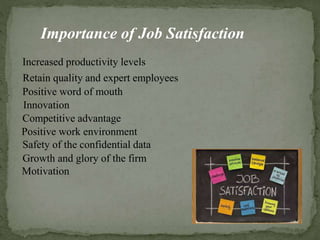
Increased productivity levels
Retain quality and expert employees
Positive word of mouth
Innovation
Positive work environment
Competitive advantage
Safety of the confidential data
Growth and glory of the firm
Motivation
Importance of Job Satisfaction
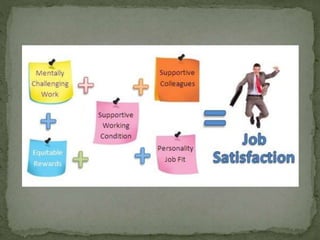
There are different factors on which job satisfaction depends.
(i) Personal Factors:
They include workers’ sex, education, age, marital status and their personal
characteristics, family background, socio-economic background and the like.
(ii) Factors Inherent in the Job:
These factors have recently been studied and found to be important in the selection of
employees. Instead of being guided by their co-workers and supervisors, the skilled
workers would rather like to be guided by their own inclination to choose jobs in
consideration of ‘what they have to do’. These factors include- the work itself,
conditions, influence of internal and external environment on the job which are
uncontrolled by the management, etc.
(iii) Factors Controlled by the Management:
The nature of supervision, job security, kind of work group, and wage rate, promotional
opportunities, and transfer policy, duration of work and sense of responsibilities are
factors controlled by management. All these factors greatly influence the workers. These
factors motivate the workers and provide a sense of job satisfaction.
Satisfaction and Productivity:
Based on research carried out in Hawthorne studies, further research to prove that “happy workers
are productive” was carried out, which has been proved negative. Based on the conclusion of
Hawthorne studies, managers began their efforts to make their employees happier by improving
work conditions, providing Laissez-faire type of leadership, expanding various facilities to the
workers, but it has been found that there is no direct relationship between happiness and
productivity.
Robins concluded that productive workers are likely to be happy workers. Further research on the
subject suggests that organization having happy workers might have increased productivity. On
individual level it may not be true due to complexity of environment, work processes, various
systems and sub systems having impact on the individual employee.
But it can be said from organizational point of view that organization that are able to evolve such
policies that make employees happy bound to have improved productivity. V.H. Vroom.
Productivity is considered as reward for hard work which is due to high level of satisfaction.
However globalisation, speed of machines and knowledge explosion, impact of media on workers,
social awareness and high expectations of employees to meet social obligations are important
factors to ensure high satisfaction level of employees. While evolving industrial practices, above
factors should be considered favourably and employee growth achieved so that organizations
grow automatically.
Satisfaction and Absenteeism:
There is an inverse relationship between satisfaction and absenteeism. When
workers are more satisfied the absenteeism is low. When satisfaction level is low
absenteeism tends to be high. There are certain moderating variables like sick
leave and degree to which people feel that their jobs are important.
Where there is a provision for sick leave, employees would take the benefit and
absent themselves. As far as the importance of work is concerned, it has been
observed that people attend to their work when it is important to accomplish.
Employees having high satisfaction would not necessarily result in to low
absenteeism but those having low satisfaction level would definitely have high
absenteeism.
Satisfaction and Turnover:
It has been found that employees who are not satisfied with their jobs will
have high turnover. Employees who are satisfied will not have high turnover.
Satisfaction is also negatively related to turnover but the co-relation is
stronger than what we found in absenteeism. Employee performance is a
moderating factor of the satisfaction—Turnover relationship.
In recent times a phenomenon amongst the software engineers whose
performance is high, their turnover has been noticed as high because of
competition for personal growth. Organization lures the competent person
for their organizational growth. Organization cares for such high performers
and their retention. Poor performers do not leave the organization for fear of
lack of job opportunity outside.
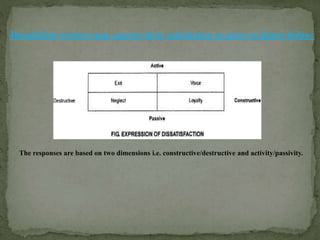
Dissatisfied workers may express their satisfaction as given in figure below:
The responses are based on two dimensions i.e. constructive/destructive and activity/passivity.
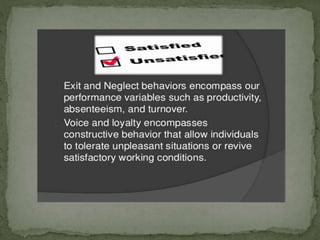
Individual starts searching a new job and resign from the current job.
Employees tries to improve working conditions. In the process suggestion to
management are submitted, increased union activates and communication is
important.
Voice
Workers behave passively in situation like external criticism. They wait for things to
improve on their own.
Deliberately and consciously allow conditions to worsen by long absenteeism, lack of
interest for quality control, targets, quota, etc. They put in reduced efforts and display lack
of interest
Job Satisfaction – Measurement
There are many methods for measuring job satisfaction. By far,
the most common method for collecting data regarding job
satisfaction is the Likert scale (named after Rensis Likert). Other
less common methods of for gauging job satisfaction include-
Yes/No questions, True/False questions, point systems,
checklists and forced choice answers. This data is typically
collected using an Enterprise Feedback Management (EFM)
system.
The Job Descriptive Index (JDI), created by Smith, Kendall, &
Hulin (1969), is a specific questionnaire of job satisfaction that
has been widely used. It measures one’s satisfaction in five
facets- pay, promotions and promotion opportunities, co-
workers, supervision and the work itself. The scale is simple,
participants answer either yes, no, or cannot decide (indicated
by’?’) in response to whether given statements accurately
describe one’s job.
The Job in General Index is an overall measurement of job
satisfaction. It is an improvement to the Job Descriptive Index
because the JDI focuses too much on individual facets and not
enough on work satisfaction in general.
Cont…
Other job satisfaction questionnaires include- the Minnesota
Satisfaction Questionnaire (MSQ), the Job Satisfaction Survey (JSS)
and the Faces Scale. The MSQ measures job satisfaction in 20 facets
and has a long form with 100 questions (five items from each facet)
and a short form with 20 questions (one item from each facet).
The JSS is a 36 item questionnaire that measures nine facets of job
satisfaction. Finally, the Faces Scale of job satisfaction, one of the
first scales used widely, measured overall job satisfaction with just
one item which participants respond to by choosing a face.
How to Increase Job Satisfaction?
1. Grievance-Handling Procedure
2. Satisfactory Future
3. Testing the Worker’s Ability and Progress
4. Respect for Creative Suggestions
5. Cordial Analysis or Evaluation of Work Performance
6. Increase in Wages
7. Praise for Good Performance
8. Promotion According to Ability
9. Proper Quantum of Work
10. Equal Wages for Equal Work
11. Freedom to Seek Help in Solving Problems
12. Absence of Unnecessary Intervention and Criticism
13. Satisfactory Hours of Work
14. Availability of Leaves and Rest
Variables Of Job Satisfaction
I. Organizational Variables
(1) Occupational Level
(2) Job Content
(3) Considerate Leadership
(4) Pay and Promotional Opportunities
(5) Interaction in the Work Group
II. Personal Variables
(1) Age
(2) Educational Level
(3) Gender/Sex
(4) Career Development
(5) Role Perception
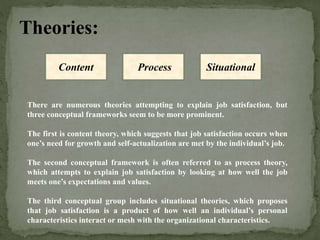
Theories:
There are numerous theories attempting to explain job satisfaction, but
three conceptual frameworks seem to be more prominent.
The first is content theory, which suggests that job satisfaction occurs when
one’s need for growth and self-actualization are met by the individual’s job.
The second conceptual framework is often referred to as process theory,
which attempts to explain job satisfaction by looking at how well the job
meets one’s expectations and values.
The third conceptual group includes situational theories, which proposes
that job satisfaction is a product of how well an individual’s personal
characteristics interact or mesh with the organizational characteristics.
Content Process Situational
Job satisfaction

Job satisfaction

  • 1.
    Prepared By: GUNJAN SHARMA AssistantProfessor Pragati College, Raipur.
  • 2.
    Job satisfaction cannotbe quantified by a numerical value, but it is a metric that works well to determine an individual’s positive emotional response towards their job. Organizations around the world are devising ways to measure this, and one of the most effective means is to get feedback from employees themselves. An individual’s response to his/her job cannot be the same as another’s. Job satisfaction varies from person to person, even if they happen to be at the same workplace and under identical working conditions. Due to the ambiguous nature of this metric, there needs to be a multi-dimensional approach to understanding employees’ work satisfaction.
  • 3.
    Job satisfaction refersto a person’s feeling of satisfaction on the job, which acts as a motivation to work. It is not the self- satisfaction, happiness or self-contentment but the satisfaction on the job. Job satisfaction relates to the total relationship between an individual and the employer for which he is paid. Satisfaction means the simple feeling of attainment of any goal or objective. Job dissatisfaction brings an absence of motivation at work.
  • 5.
    Siegal and Lance(1987) stated that ‘job satisfaction is an emotional response defining the degree to which people like their job.’ Vroom (1982) defined job satisfaction as workers’ emotional orientation toward their current job roles. Similarly, Schultz (1982) stated that job satisfaction is essentially the psychological disposition of people toward their work. Lofquist and Davis (1991), defined job satisfaction as “an individual’s positive affective reaction of the target environment as a result of the individual’s appraisal of the extent to which his or her needs are fulfilled by the environment”.
  • 6.
    Increased productivity levels Retainquality and expert employees Positive word of mouth Innovation Positive work environment Competitive advantage Safety of the confidential data Growth and glory of the firm Motivation Importance of Job Satisfaction
  • 7.
    There are differentfactors on which job satisfaction depends. (i) Personal Factors: They include workers’ sex, education, age, marital status and their personal characteristics, family background, socio-economic background and the like. (ii) Factors Inherent in the Job: These factors have recently been studied and found to be important in the selection of employees. Instead of being guided by their co-workers and supervisors, the skilled workers would rather like to be guided by their own inclination to choose jobs in consideration of ‘what they have to do’. These factors include- the work itself, conditions, influence of internal and external environment on the job which are uncontrolled by the management, etc. (iii) Factors Controlled by the Management: The nature of supervision, job security, kind of work group, and wage rate, promotional opportunities, and transfer policy, duration of work and sense of responsibilities are factors controlled by management. All these factors greatly influence the workers. These factors motivate the workers and provide a sense of job satisfaction.
  • 8.
    Satisfaction and Productivity: Basedon research carried out in Hawthorne studies, further research to prove that “happy workers are productive” was carried out, which has been proved negative. Based on the conclusion of Hawthorne studies, managers began their efforts to make their employees happier by improving work conditions, providing Laissez-faire type of leadership, expanding various facilities to the workers, but it has been found that there is no direct relationship between happiness and productivity. Robins concluded that productive workers are likely to be happy workers. Further research on the subject suggests that organization having happy workers might have increased productivity. On individual level it may not be true due to complexity of environment, work processes, various systems and sub systems having impact on the individual employee. But it can be said from organizational point of view that organization that are able to evolve such policies that make employees happy bound to have improved productivity. V.H. Vroom. Productivity is considered as reward for hard work which is due to high level of satisfaction. However globalisation, speed of machines and knowledge explosion, impact of media on workers, social awareness and high expectations of employees to meet social obligations are important factors to ensure high satisfaction level of employees. While evolving industrial practices, above factors should be considered favourably and employee growth achieved so that organizations grow automatically.
  • 9.
    Satisfaction and Absenteeism: Thereis an inverse relationship between satisfaction and absenteeism. When workers are more satisfied the absenteeism is low. When satisfaction level is low absenteeism tends to be high. There are certain moderating variables like sick leave and degree to which people feel that their jobs are important. Where there is a provision for sick leave, employees would take the benefit and absent themselves. As far as the importance of work is concerned, it has been observed that people attend to their work when it is important to accomplish. Employees having high satisfaction would not necessarily result in to low absenteeism but those having low satisfaction level would definitely have high absenteeism.
  • 10.
    Satisfaction and Turnover: Ithas been found that employees who are not satisfied with their jobs will have high turnover. Employees who are satisfied will not have high turnover. Satisfaction is also negatively related to turnover but the co-relation is stronger than what we found in absenteeism. Employee performance is a moderating factor of the satisfaction—Turnover relationship. In recent times a phenomenon amongst the software engineers whose performance is high, their turnover has been noticed as high because of competition for personal growth. Organization lures the competent person for their organizational growth. Organization cares for such high performers and their retention. Poor performers do not leave the organization for fear of lack of job opportunity outside.
  • 11.
    Dissatisfied workers mayexpress their satisfaction as given in figure below: The responses are based on two dimensions i.e. constructive/destructive and activity/passivity.
  • 12.
    Individual starts searchinga new job and resign from the current job. Employees tries to improve working conditions. In the process suggestion to management are submitted, increased union activates and communication is important. Voice
  • 13.
    Workers behave passivelyin situation like external criticism. They wait for things to improve on their own. Deliberately and consciously allow conditions to worsen by long absenteeism, lack of interest for quality control, targets, quota, etc. They put in reduced efforts and display lack of interest
  • 15.
    Job Satisfaction –Measurement There are many methods for measuring job satisfaction. By far, the most common method for collecting data regarding job satisfaction is the Likert scale (named after Rensis Likert). Other less common methods of for gauging job satisfaction include- Yes/No questions, True/False questions, point systems, checklists and forced choice answers. This data is typically collected using an Enterprise Feedback Management (EFM) system. The Job Descriptive Index (JDI), created by Smith, Kendall, & Hulin (1969), is a specific questionnaire of job satisfaction that has been widely used. It measures one’s satisfaction in five facets- pay, promotions and promotion opportunities, co- workers, supervision and the work itself. The scale is simple, participants answer either yes, no, or cannot decide (indicated by’?’) in response to whether given statements accurately describe one’s job. The Job in General Index is an overall measurement of job satisfaction. It is an improvement to the Job Descriptive Index because the JDI focuses too much on individual facets and not enough on work satisfaction in general.
  • 16.
    Cont… Other job satisfactionquestionnaires include- the Minnesota Satisfaction Questionnaire (MSQ), the Job Satisfaction Survey (JSS) and the Faces Scale. The MSQ measures job satisfaction in 20 facets and has a long form with 100 questions (five items from each facet) and a short form with 20 questions (one item from each facet). The JSS is a 36 item questionnaire that measures nine facets of job satisfaction. Finally, the Faces Scale of job satisfaction, one of the first scales used widely, measured overall job satisfaction with just one item which participants respond to by choosing a face.
  • 17.
    How to IncreaseJob Satisfaction? 1. Grievance-Handling Procedure 2. Satisfactory Future 3. Testing the Worker’s Ability and Progress 4. Respect for Creative Suggestions 5. Cordial Analysis or Evaluation of Work Performance 6. Increase in Wages 7. Praise for Good Performance 8. Promotion According to Ability 9. Proper Quantum of Work 10. Equal Wages for Equal Work 11. Freedom to Seek Help in Solving Problems 12. Absence of Unnecessary Intervention and Criticism 13. Satisfactory Hours of Work 14. Availability of Leaves and Rest
  • 18.
    Variables Of JobSatisfaction I. Organizational Variables (1) Occupational Level (2) Job Content (3) Considerate Leadership (4) Pay and Promotional Opportunities (5) Interaction in the Work Group II. Personal Variables (1) Age (2) Educational Level (3) Gender/Sex (4) Career Development (5) Role Perception
  • 19.
    Theories: There are numeroustheories attempting to explain job satisfaction, but three conceptual frameworks seem to be more prominent. The first is content theory, which suggests that job satisfaction occurs when one’s need for growth and self-actualization are met by the individual’s job. The second conceptual framework is often referred to as process theory, which attempts to explain job satisfaction by looking at how well the job meets one’s expectations and values. The third conceptual group includes situational theories, which proposes that job satisfaction is a product of how well an individual’s personal characteristics interact or mesh with the organizational characteristics. Content Process Situational