
Improving cold storage and
processing traits in potato
through targeted gene knockout
(Clasen et al., 2015)
Plant Biotechnology Journal
Published on 7 April 2015
Journal Club Meeting
Presented by:
Sarbesh D. Dangol
January 7, 2016.
Nigde, Turkey.
Introduction
• Solanum tuberosum: Third most important food
crop.
• Used by processors for potato chips, french fries
and other processed products.
• Harvested once a year, it’s necessary to cold store
tubers.
Cons of Cold storage of potatoes
• Cold storage causes cold-induced sweetening
(CIS).
• Processing at high temperatures form
unacceptable dark-pigmented products.
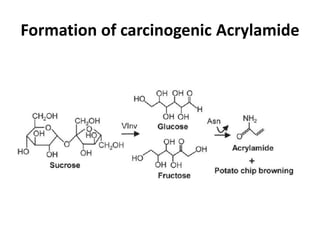
• Formation of carcinogenic acrylamide during
processing.
• Methods that reduce CIS and acrylamide??
How?? Reduce reducing sugar content.
Target Invertase enzymes??
Formation of carcinogenic Acrylamide
Invertase enzymes accumulate
reducing sugars
• CWIN (Cell-wall Invertase)
• VIN (Vacuolar invertase)
• CIN (Cytoplasmic invertase)
But why target VInv?
• VInv produce reducing sugars in cold-stored
tubers (Kumar et al., 2004; Matsuura-Endo et
al., 2006; Sowokinos, 2001).
• VInv knockdown lowers reducing sugars and
dark-pigmented non-enzymatic browning
(Bhaskar et al., 2010; Wu et al., 2011; Ye et al.,
2010).
TALEN generated gene knockout is the
approach of this research
• Knockout mutations in all alleles of the VInv
gene.
• Use of transcription activator-like effector
nucleases (TALENs).
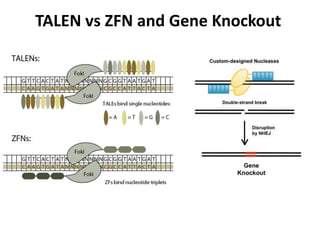
TALEN vs ZFN and Gene Knockout
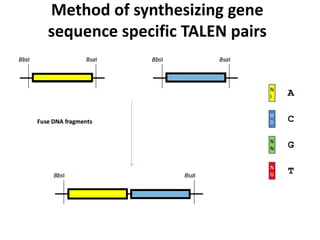
Method of synthesizing gene
sequence specific TALEN pairs
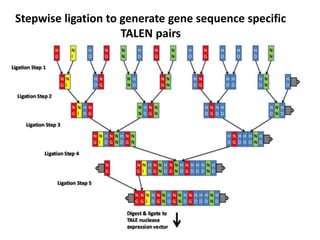
Stepwise ligation to generate gene sequence specific
TALEN pairs
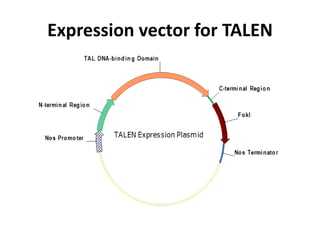
Expression vector for TALEN
Why Solanum tuberosum cv Ranger
Russet?
• Widely used for frying.
• Processing is hindered due to cold-induced
sweetening.
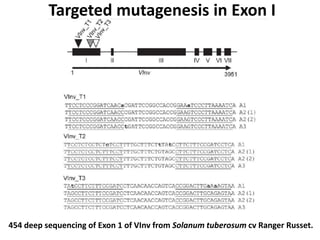
Targeted mutagenesis in Exon I
454 deep sequencing of Exon 1 of VInv from Solanum tuberosum cv Ranger Russet.
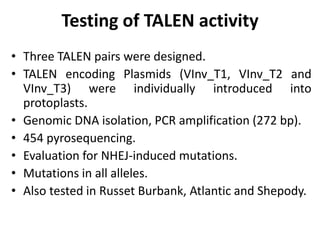
Testing of TALEN activity
• Three TALEN pairs were designed.
• TALEN encoding Plasmids (VInv_T1, VInv_T2 and
VInv_T3) were individually introduced into
protoplasts.
• Genomic DNA isolation, PCR amplification (272 bp).
• 454 pyrosequencing.
• Evaluation for NHEJ-induced mutations.
• Mutations in all alleles.
• Also tested in Russet Burbank, Atlantic and Shepody.
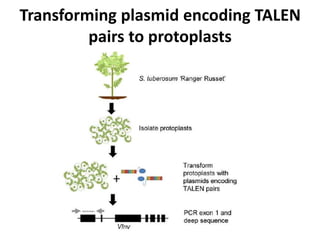
Transforming plasmid encoding TALEN
pairs to protoplasts
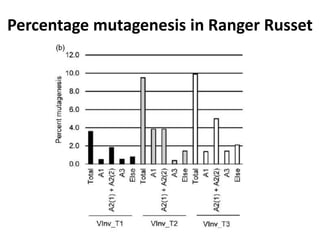
Percentage mutagenesis in Ranger Russet
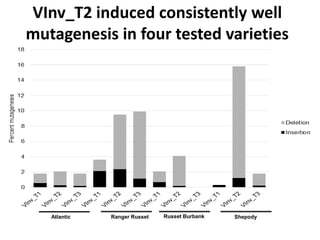
VInv_T2 induced consistently well
mutagenesis in four tested varieties
Atlantic Ranger Russet Russet Burbank Shepody
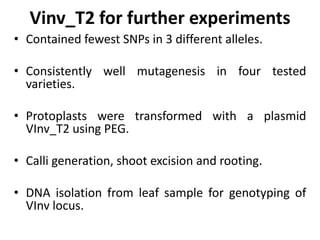
Vinv_T2 for further experiments
• Contained fewest SNPs in 3 different alleles.
• Consistently well mutagenesis in four tested
varieties.
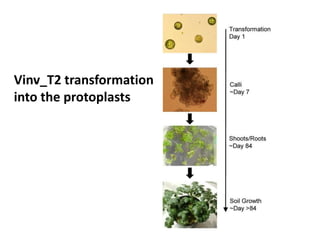
• Protoplasts were transformed with a plasmid
VInv_T2 using PEG.
• Calli generation, shoot excision and rooting.
• DNA isolation from leaf sample for genotyping of
VInv locus.
Vinv_T2 transformation
into the protoplasts
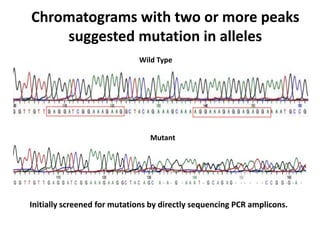
Chromatograms with two or more peaks
suggested mutation in alleles
Wild Type
Mutant
Initially screened for mutations by directly sequencing PCR amplicons.
Characterization of vacuolar invertase
mutant plants
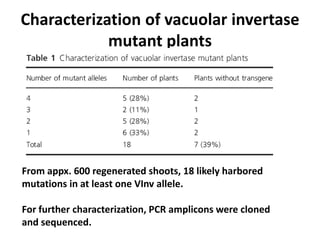
From appx. 600 regenerated shoots, 18 likely harbored
mutations in at least one VInv allele.
For further characterization, PCR amplicons were cloned
and sequenced.
Mutations in various transformation groups
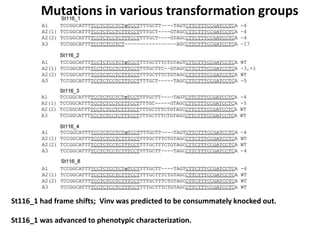
St116_1 had frame shifts; Vinv was predicted to be consummately knocked out.
St116_1 was advanced to phenotypic characterization.
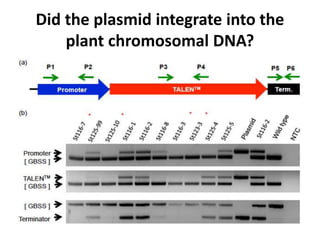
Did the plasmid integrate into the
plant chromosomal DNA?
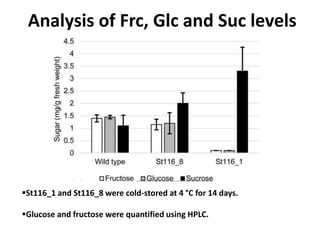
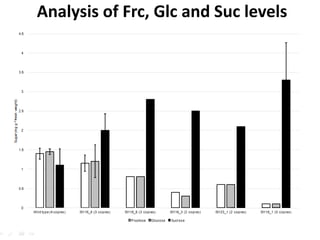
Analysis of Frc, Glc and Suc levels
St116_1 and St116_8 were cold-stored at 4 °C for 14 days.
Glucose and fructose were quantified using HPLC.
Analysis of Frc, Glc and Suc levels
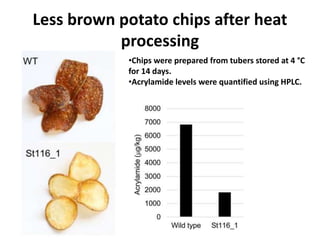
Less brown potato chips after heat
processing
•Chips were prepared from tubers stored at 4 °C
for 14 days.
•Acrylamide levels were quantified using HPLC.
Discussion
• Complexity of the autotetraploid genome.
• High degree of heterozygosity.
• Classic improvement require long breeding
cycles and screening large populations.
• Transgenesis/cisgenesis, RNAi and TILLING, labor
intensive and integrate transgenes in a random
fashion.
• Desired expression of the transgene required.
• Targeted gene modification needs to be highly
efficient: Such as TALEN gene editing.
Discussion
• TALENs cleaved multiple alleles with delivery to
potato protoplasts with over 80% efficiency.
• About 3% of the plants were found to contain
mutations in one to four VInv alleles.
• TALENs were highly efficient mutagens in
protoplasts from other commercial varieties.
• Targeted mutations into a gene-of-interest in a
single generation in elite potato varieties.
Discussion
• Off-target mutagenesis can occur when using
TALENs for genome modification (Frock et al., 2015;
Mali et al., 2013).
• TALEN pairs could tolerate up to 3–4 mismatches
(Juillerat et al., 2014).
• Searched publicly available potato genome
sequences for potential TALEN-binding sites.
• No potential target sequences were found with four
or less mismatches.
• To completely rule out the possibility, perform
whole-genome sequencing.
Discussion
• Previous studies with RNAi with partial suppression
did not control CIS effectively (Bhaskar et al., 2010;
Wu et al., 2011).
• When all four VInv alleles were mutated, reducing
sugars were undetectable.
• Low level of acrylamide generated within complete
knockout lines.
• Low acrylamide suggests presence of reducing sugars,
albeit at undetectable levels.
• Reducing sugars are most likely due to CWIN and CIN
(Bhaskar et al., 2010; Roitsch and Gonzalez, 2004).
Future prospects
• Further reduce acrylamide content by
targeting additional, nonessential invertases.
• Whole genome sequencing to elucidate
whether there are mutations elsewhere.
• No foreign DNA and thus are not different
from naturally occurring varieties.
• Non-GMO? Non-transgenic? Acceptance by
regulators? Acceptance by anti-GMO activists/
consumers?
Critical Analysis
1. It’s global VInv silencing, and not tuber-specific.
2. Phenotypic disturbances? Wild type phenotype?
Stunted growth? Tuber sizes? Tubers per plant?
3. There is stable integration in plant genome of
St116-1 and St116-8???
4. Incorporation of promoter gene in plant
chromosome can also be called transgenic, isn’t
it?
5. Cold storage experiment should have been done
for 0th hour.
Critical Analysis
6. If Ranger Russet is used as potato chips by
industries, and if it gives that dark chips as shown
in wild type, how is that possible for consumers
to consume such chips, or industry to process
such a type? I think the wild type dark chips are
merely exaggerated.
7. What if tubers are kept for months for cold
storage?
8. Is it agronomically useful?
Critical Analysis
9. Is acrylamide really a carcinogen in humans?
In rodents, yes. In humans? Possibly!
Nevertheless, neurotoxic in humans.
10. The choice of the adjective “nonessential
invertases” is a bit too extreme to use. CWIN
and CIN aren’t non-essential invertases in
tubers.
11. Efficiency of this experiment is too low to be
reliable.
Research Article Details
Improving cold storage and processing traits
in potato through targeted gene knockout
Benjamin M. Clasen, Thomas J. Stoddard, Song Luo, Zachary L. Demorest,
Jin Li, Frederic Cedrone, Redeat Tibebu, Shawn Davison, Erin E. Ray,
Aurelie Daulhac, Andrew Coffman, Ann Yabandith, Adam Retterath,
William Haun, Nicholas J. Baltes, Luc Mathis, Daniel F. Voytas and Feng
Zhang.
Cellectis plant sciences Inc., New Brighton, MN, USA
Cellectis SA, Paris, France
Plant Biotechnology Journal (2016) 14, pp. 169–176
doi: 10.1111/pbi.12370
Thank You. 

Improving cold storage and processing traits in potato

  • 1.
    Improving cold storageand processing traits in potato through targeted gene knockout (Clasen et al., 2015) Plant Biotechnology Journal Published on 7 April 2015 Journal Club Meeting Presented by: Sarbesh D. Dangol January 7, 2016. Nigde, Turkey.
  • 2.
    Introduction • Solanum tuberosum:Third most important food crop. • Used by processors for potato chips, french fries and other processed products. • Harvested once a year, it’s necessary to cold store tubers.
  • 3.
    Cons of Coldstorage of potatoes • Cold storage causes cold-induced sweetening (CIS). • Processing at high temperatures form unacceptable dark-pigmented products. • Formation of carcinogenic acrylamide during processing. • Methods that reduce CIS and acrylamide?? How?? Reduce reducing sugar content. Target Invertase enzymes??
  • 4.
  • 5.
    Invertase enzymes accumulate reducingsugars • CWIN (Cell-wall Invertase) • VIN (Vacuolar invertase) • CIN (Cytoplasmic invertase)
  • 6.
    But why targetVInv? • VInv produce reducing sugars in cold-stored tubers (Kumar et al., 2004; Matsuura-Endo et al., 2006; Sowokinos, 2001). • VInv knockdown lowers reducing sugars and dark-pigmented non-enzymatic browning (Bhaskar et al., 2010; Wu et al., 2011; Ye et al., 2010).
  • 7.
    TALEN generated geneknockout is the approach of this research • Knockout mutations in all alleles of the VInv gene. • Use of transcription activator-like effector nucleases (TALENs).
  • 8.
    TALEN vs ZFNand Gene Knockout
  • 9.
    Method of synthesizinggene sequence specific TALEN pairs
  • 10.
    Stepwise ligation togenerate gene sequence specific TALEN pairs
  • 11.
  • 12.
    Why Solanum tuberosumcv Ranger Russet? • Widely used for frying. • Processing is hindered due to cold-induced sweetening.
  • 13.
    Targeted mutagenesis inExon I 454 deep sequencing of Exon 1 of VInv from Solanum tuberosum cv Ranger Russet.
  • 14.
    Testing of TALENactivity • Three TALEN pairs were designed. • TALEN encoding Plasmids (VInv_T1, VInv_T2 and VInv_T3) were individually introduced into protoplasts. • Genomic DNA isolation, PCR amplification (272 bp). • 454 pyrosequencing. • Evaluation for NHEJ-induced mutations. • Mutations in all alleles. • Also tested in Russet Burbank, Atlantic and Shepody.
  • 15.
    Transforming plasmid encodingTALEN pairs to protoplasts
  • 16.
  • 17.
    VInv_T2 induced consistentlywell mutagenesis in four tested varieties Atlantic Ranger Russet Russet Burbank Shepody
  • 18.
    Vinv_T2 for furtherexperiments • Contained fewest SNPs in 3 different alleles. • Consistently well mutagenesis in four tested varieties. • Protoplasts were transformed with a plasmid VInv_T2 using PEG. • Calli generation, shoot excision and rooting. • DNA isolation from leaf sample for genotyping of VInv locus.
  • 19.
  • 20.
    Chromatograms with twoor more peaks suggested mutation in alleles Wild Type Mutant Initially screened for mutations by directly sequencing PCR amplicons.
  • 21.
    Characterization of vacuolarinvertase mutant plants From appx. 600 regenerated shoots, 18 likely harbored mutations in at least one VInv allele. For further characterization, PCR amplicons were cloned and sequenced.
  • 22.
    Mutations in varioustransformation groups St116_1 had frame shifts; Vinv was predicted to be consummately knocked out. St116_1 was advanced to phenotypic characterization.
  • 23.
    Did the plasmidintegrate into the plant chromosomal DNA?
  • 24.
    Analysis of Frc,Glc and Suc levels St116_1 and St116_8 were cold-stored at 4 °C for 14 days. Glucose and fructose were quantified using HPLC.
  • 25.
    Analysis of Frc,Glc and Suc levels
  • 26.
    Less brown potatochips after heat processing •Chips were prepared from tubers stored at 4 °C for 14 days. •Acrylamide levels were quantified using HPLC.
  • 27.
    Discussion • Complexity ofthe autotetraploid genome. • High degree of heterozygosity. • Classic improvement require long breeding cycles and screening large populations. • Transgenesis/cisgenesis, RNAi and TILLING, labor intensive and integrate transgenes in a random fashion. • Desired expression of the transgene required. • Targeted gene modification needs to be highly efficient: Such as TALEN gene editing.
  • 28.
    Discussion • TALENs cleavedmultiple alleles with delivery to potato protoplasts with over 80% efficiency. • About 3% of the plants were found to contain mutations in one to four VInv alleles. • TALENs were highly efficient mutagens in protoplasts from other commercial varieties. • Targeted mutations into a gene-of-interest in a single generation in elite potato varieties.
  • 29.
    Discussion • Off-target mutagenesiscan occur when using TALENs for genome modification (Frock et al., 2015; Mali et al., 2013). • TALEN pairs could tolerate up to 3–4 mismatches (Juillerat et al., 2014). • Searched publicly available potato genome sequences for potential TALEN-binding sites. • No potential target sequences were found with four or less mismatches. • To completely rule out the possibility, perform whole-genome sequencing.
  • 30.
    Discussion • Previous studieswith RNAi with partial suppression did not control CIS effectively (Bhaskar et al., 2010; Wu et al., 2011). • When all four VInv alleles were mutated, reducing sugars were undetectable. • Low level of acrylamide generated within complete knockout lines. • Low acrylamide suggests presence of reducing sugars, albeit at undetectable levels. • Reducing sugars are most likely due to CWIN and CIN (Bhaskar et al., 2010; Roitsch and Gonzalez, 2004).
  • 31.
    Future prospects • Furtherreduce acrylamide content by targeting additional, nonessential invertases. • Whole genome sequencing to elucidate whether there are mutations elsewhere. • No foreign DNA and thus are not different from naturally occurring varieties. • Non-GMO? Non-transgenic? Acceptance by regulators? Acceptance by anti-GMO activists/ consumers?
  • 32.
    Critical Analysis 1. It’sglobal VInv silencing, and not tuber-specific. 2. Phenotypic disturbances? Wild type phenotype? Stunted growth? Tuber sizes? Tubers per plant? 3. There is stable integration in plant genome of St116-1 and St116-8??? 4. Incorporation of promoter gene in plant chromosome can also be called transgenic, isn’t it? 5. Cold storage experiment should have been done for 0th hour.
  • 33.
    Critical Analysis 6. IfRanger Russet is used as potato chips by industries, and if it gives that dark chips as shown in wild type, how is that possible for consumers to consume such chips, or industry to process such a type? I think the wild type dark chips are merely exaggerated. 7. What if tubers are kept for months for cold storage? 8. Is it agronomically useful?
  • 34.
    Critical Analysis 9. Isacrylamide really a carcinogen in humans? In rodents, yes. In humans? Possibly! Nevertheless, neurotoxic in humans. 10. The choice of the adjective “nonessential invertases” is a bit too extreme to use. CWIN and CIN aren’t non-essential invertases in tubers. 11. Efficiency of this experiment is too low to be reliable.
  • 35.
    Research Article Details Improvingcold storage and processing traits in potato through targeted gene knockout Benjamin M. Clasen, Thomas J. Stoddard, Song Luo, Zachary L. Demorest, Jin Li, Frederic Cedrone, Redeat Tibebu, Shawn Davison, Erin E. Ray, Aurelie Daulhac, Andrew Coffman, Ann Yabandith, Adam Retterath, William Haun, Nicholas J. Baltes, Luc Mathis, Daniel F. Voytas and Feng Zhang. Cellectis plant sciences Inc., New Brighton, MN, USA Cellectis SA, Paris, France Plant Biotechnology Journal (2016) 14, pp. 169–176 doi: 10.1111/pbi.12370
  • 36.