Submitted to: Dr. Nayyar Parvez sir
Submitted by: Pratiksha Srivastava
M.Pharm 1st year
Galgotias university
 Pharmacokinetic modeling is a
mathematical modeling technique for
predicting the absorption, distribution,
metabolism and excretion (ADME) of
synthetic or natural chemical substances in
humans and other animal species.
• Drug movement within the body is the
complex process to describe and for analysis.
• So two major approaches in the quantitative
study of various kinetic processes of drug
disposition in the body are:
1. Model approach, and
2. Model-independent approach (non-
compartmental analysis)
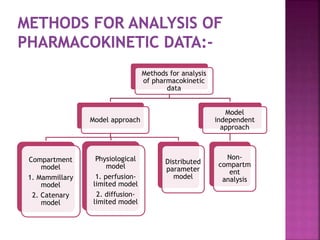
Methods for analysis
of pharmacokinetic
data
Model approach
Compartment
model
1. Mammillary
model
2. Catenary
model
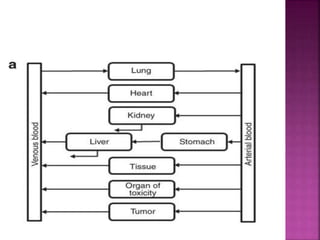
Physiological
model
1. perfusion-
limited model
2. diffusion-
limited model
Distributed
parameter
model
Model
independent
approach
Non-
compartm
ent
analysis
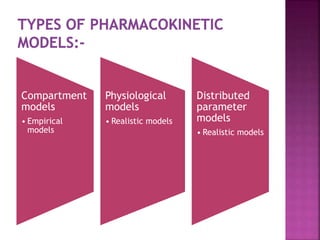
 In this approach, models are used to describe
changes in drug concentration in the body with
time.
PHARMACOKINETIC MODEL:
Pharmacokinetic model provides mathematical
expression for the time course of drugs
throughout the body and compute meaningful
pharmacokinetic parameters.
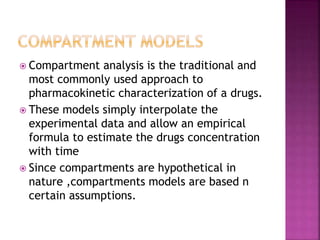
Compartment
models
• Empirical
models
Physiological
models
• Realistic models
Distributed
parameter
models
• Realistic models
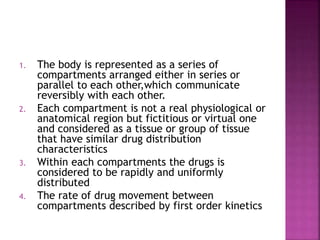
 Compartment analysis is the traditional and
most commonly used approach to
pharmacokinetic characterization of a drugs.
 These models simply interpolate the
experimental data and allow an empirical
formula to estimate the drugs concentration
with time
 Since compartments are hypothetical in
nature ,compartments models are based n
certain assumptions.
1. The body is represented as a series of
compartments arranged either in series or
parallel to each other,which communicate
reversibly with each other.
2. Each compartment is not a real physiological or
anatomical region but fictitious or virtual one
and considered as a tissue or group of tissue
that have similar drug distribution
characteristics
3. Within each compartments the drugs is
considered to be rapidly and uniformly
distributed
4. The rate of drug movement between
compartments described by first order kinetics
 Depending upon whether the compartment
are arranged parallel or in series
,compartments models are divided into two
categories –
 Mammillary model
 Catenary model
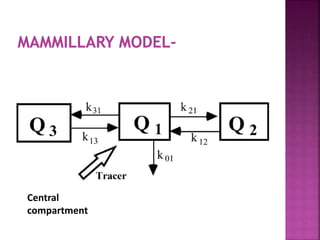
 It consists of one or more peripheral
compartments connected to the central
compartment in a manner similar to
connection of satellites to a planet
 They are joined parallel to the central
compartment
 The central compartment comprises of
plasma and highly perfused tissues such as
lungs, liver, kidney etc. which rapidly
equilibrate with drugs.
Central
compartment
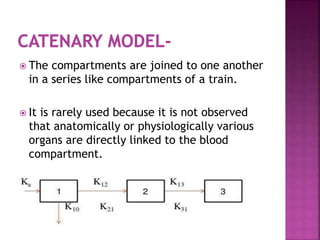
 The compartments are joined to one another
in a series like compartments of a train.
 It is rarely used because it is not observed
that anatomically or physiologically various
organs are directly linked to the blood
compartment.
 They are drawn on the basis of known
anatomical and physiological data
 So it present more realistic picture of
drug disposition in various organs and
tissues.
 Tissues with similar perfusion properties
are grouped into a single compartment
 e.g. lungs, liver, brain and kidney are
grouped as rapidly equilibrating tissues
 While muscles and adipose as slowly
equilibrating tissues.
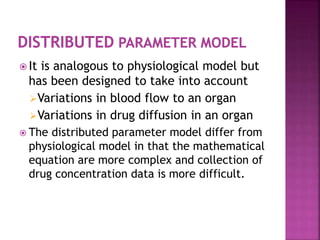
 It is analogous to physiological model but
has been designed to take into account
Variations in blood flow to an organ
Variations in drug diffusion in an organ
 The distributed parameter model differ from
physiological model in that the mathematical
equation are more complex and collection of
drug concentration data is more difficult.
 k/as model independent methods
 Because it does not require the assumption
of specific compartment model.
 This method is based on the assumption that
the drugs or metabolites follow linear
kinetics,
 So this technique can be applied to any
compartment model.
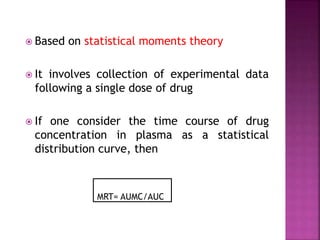
 Based on statistical moments theory
 It involves collection of experimental data
following a single dose of drug
 If one consider the time course of drug
concentration in plasma as a statistical
distribution curve, then
MRT= AUMC/AUC
 Where
MRT= mean residence time
AUMC= area under the first moment
curve
AUC= Area under the zero moment curve
MRT= is defined as the average amount of time
spent by the drug in the body before being
eliminated.
AUMC and AUC can be calculated from the use
of trapezoidal rule.
 Characterizing the behavior of drugs in
patients.
 Correlating plasma drug concentration with
pharmacological response.
 Evaluating the bioequivalence
bioinequivalence between different
formulations of the same drugs.
 Determining the influence of altered
physiologydisease state on drugs ADME
 Explaining drugs interaction.

Pharmacokinetic models

  • 1.
    Submitted to: Dr.Nayyar Parvez sir Submitted by: Pratiksha Srivastava M.Pharm 1st year Galgotias university
  • 2.
     Pharmacokinetic modelingis a mathematical modeling technique for predicting the absorption, distribution, metabolism and excretion (ADME) of synthetic or natural chemical substances in humans and other animal species.
  • 3.
    • Drug movementwithin the body is the complex process to describe and for analysis. • So two major approaches in the quantitative study of various kinetic processes of drug disposition in the body are: 1. Model approach, and 2. Model-independent approach (non- compartmental analysis)
  • 4.
    Methods for analysis ofpharmacokinetic data Model approach Compartment model 1. Mammillary model 2. Catenary model Physiological model 1. perfusion- limited model 2. diffusion- limited model Distributed parameter model Model independent approach Non- compartm ent analysis
  • 5.
     In thisapproach, models are used to describe changes in drug concentration in the body with time. PHARMACOKINETIC MODEL: Pharmacokinetic model provides mathematical expression for the time course of drugs throughout the body and compute meaningful pharmacokinetic parameters.
  • 6.
    Compartment models • Empirical models Physiological models • Realisticmodels Distributed parameter models • Realistic models
  • 7.
     Compartment analysisis the traditional and most commonly used approach to pharmacokinetic characterization of a drugs.  These models simply interpolate the experimental data and allow an empirical formula to estimate the drugs concentration with time  Since compartments are hypothetical in nature ,compartments models are based n certain assumptions.
  • 8.
    1. The bodyis represented as a series of compartments arranged either in series or parallel to each other,which communicate reversibly with each other. 2. Each compartment is not a real physiological or anatomical region but fictitious or virtual one and considered as a tissue or group of tissue that have similar drug distribution characteristics 3. Within each compartments the drugs is considered to be rapidly and uniformly distributed 4. The rate of drug movement between compartments described by first order kinetics
  • 9.
     Depending uponwhether the compartment are arranged parallel or in series ,compartments models are divided into two categories –  Mammillary model  Catenary model
  • 10.
     It consistsof one or more peripheral compartments connected to the central compartment in a manner similar to connection of satellites to a planet  They are joined parallel to the central compartment  The central compartment comprises of plasma and highly perfused tissues such as lungs, liver, kidney etc. which rapidly equilibrate with drugs.
  • 11.
  • 12.
     The compartmentsare joined to one another in a series like compartments of a train.  It is rarely used because it is not observed that anatomically or physiologically various organs are directly linked to the blood compartment.
  • 13.
     They aredrawn on the basis of known anatomical and physiological data  So it present more realistic picture of drug disposition in various organs and tissues.  Tissues with similar perfusion properties are grouped into a single compartment  e.g. lungs, liver, brain and kidney are grouped as rapidly equilibrating tissues  While muscles and adipose as slowly equilibrating tissues.
  • 15.
     It isanalogous to physiological model but has been designed to take into account Variations in blood flow to an organ Variations in drug diffusion in an organ  The distributed parameter model differ from physiological model in that the mathematical equation are more complex and collection of drug concentration data is more difficult.
  • 16.
     k/as modelindependent methods  Because it does not require the assumption of specific compartment model.  This method is based on the assumption that the drugs or metabolites follow linear kinetics,  So this technique can be applied to any compartment model.
  • 17.
     Based onstatistical moments theory  It involves collection of experimental data following a single dose of drug  If one consider the time course of drug concentration in plasma as a statistical distribution curve, then MRT= AUMC/AUC
  • 18.
     Where MRT= meanresidence time AUMC= area under the first moment curve AUC= Area under the zero moment curve MRT= is defined as the average amount of time spent by the drug in the body before being eliminated. AUMC and AUC can be calculated from the use of trapezoidal rule.
  • 19.
     Characterizing thebehavior of drugs in patients.  Correlating plasma drug concentration with pharmacological response.  Evaluating the bioequivalence bioinequivalence between different formulations of the same drugs.  Determining the influence of altered physiologydisease state on drugs ADME  Explaining drugs interaction.