Software Development Best Practices for
       Human-Rated Spacecraft


          Project Management Challenge 2008
                Daytona Beach, Florida
                 February 26 - 27, 2008


                   Michael Aguilar
           NASA Engineering and Safety Center


                 Engineering Excellence         1
Background


• In late 2005, the NASA Engineering and Safety Center
  (NESC) was asked by the Astronaut Office to answer
  the basic question:


          "How do you know you have a safe
               and reliable system?"


     Full report available on-line at: nesc.nasa.gov


                    Engineering Excellence               2
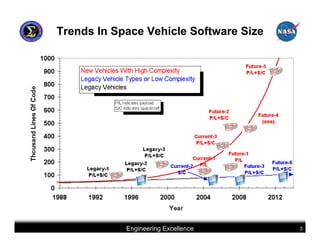
Trends In Space Vehicle Software Size


            Engineering Excellence      3
Software Reliability

There are two major approaches to increasing the reliability of
  software:
• Software defect prevention (fault avoidance): using a
  disciplined development approach that minimizes the
  likelihood that defects will be introduced or will remain
  undetected in the software product
• Software fault tolerance: designing and implementing the
  software under an assumption that a limited number of
  residual defects will remain despite the best efforts to
  eliminate them


                        Engineering Excellence                    4
Software Defect Prevention


Using a disciplined development approach that
minimizes the likelihood that defects will be
introduced or will remain undetected in the
software product.


               Engineering Excellence           5
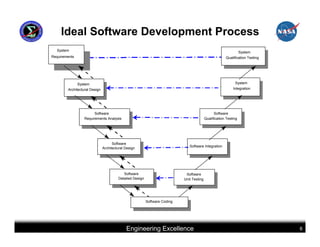
Ideal Software Development Process
  System                                                                                                        System
Requirements                                                                                            Qualification Testing


              System                                                                                          System
        Architectural Design                                                                                 Integration


                       Software                                                                  Software
                 Requirements Analysis                                                     Qualification Testing


                                     Software
                                                                               Software Integration
                               Architectural Design


                                           Software                          Software
                                        Detailed Design                     Unit Testing


                                                          Software Coding


                                             Engineering Excellence                                                             6
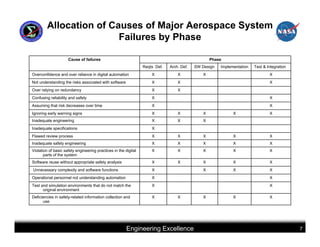
Allocation of Causes of Major Aerospace System
                         Failures by Phase

                     Cause of failures                                                             Phase
                                                                 Reqts Def.   Arch. Def.   SW Design   Implementation   Test & Integration
Overconfidence and over reliance in digital automation               X            X            X                                X
Not understanding the risks associated with software                 X            X                                             X
Over relying on redundancy                                           X            X
Confusing reliability and safety                                     X                                                          X
Assuming that risk decreases over time                               X                                                          X
Ignoring early warning signs                                         X            X            X             X                  X
Inadequate engineering                                               X            X            X
Inadequate specifications                                            X
Flawed review process                                                X            X            X             X                  X
Inadequate safety engineering                                        X            X            X             X                  X
Violation of basic safety engineering practices in the digital       X            X            X             X                  X
       parts of the system
Software reuse without appropriate safety analysis                   X            X            X             X                  X
Unnecessary complexity and software functions                        X                         X             X                  X
Operational personnel not understanding automation                   X                                                          X
Test and simulation environments that do not match the               X                                                          X
      original environment
Deficiencies in safety-related information collection and            X            X            X             X                  X
      use


                                                        Engineering Excellence                                                               7
Requirements Validation
•   Modeling and simulation: Modeling and simulation should be
    used to set and evaluate performance parameters requirements
    affecting software performance, quality of communication services in
    the data transport layers, requirements for responses to failures and
    anomalous conditions, and human/software or system interactions.
•   Non-advocate software and system requirements reviews:
    Reviews by knowledgeable third parties can uncover problems or
    issues that may have been overlooked by the primary requirements
    developers.
•   Use of relevant “golden rules” and “lessons learned”: Golden
    rules or lessons learned are excellent sources of requirements and
    should be reviewed as part of the requirements validation process.
•   Hazards and Safety analyses: Hazards analyses, such as Failure
    Modes and Effects Analyses and Fault Trees.


                           Engineering Excellence                           8
Requirements Verification

•   Early planning: Assure adequate planning for simulation test beds,
    communications equipment, test tools and data collection devices.
•   Verification methods for low observable parameters:
    Instrumentation methods development for throughput, response
    time, or reliability.
•   Anticipating ephemeral failure behaviors: The verification
    strategy should anticipate failure behaviors and plan for how this
    information can be captured – particular if they are ephemeral and
    non-reproducible.
•   Testing of diagnostics and failure isolation capabilities:
    Diagnostic and fault isolation capabilities for off-nominal behavior.
•   Capturing of unanticipated failures or behaviors: Ensure that
    test plans and procedures have provisions for recording of
    unanticipated behaviors.


                            Engineering Excellence                          9
Requirements Management

•   Gathering resources for software test and verification:
    Assembling modeling and simulation capabilities, domain expertise,
    identifying areas of uncertainty
•   Scheduling of software test and verification: The software test
    and verification program commonly includes managing critical path
    scheduling pressures.
•   Tracking and maintaining requirements throughout the
    development process: Newly discovered software requirements
    should be propagated back into the higher level software and
    systems requirements documentation, and changes in existing
    requirements should be documented and tracked.
•   Configuration Management of software requirements: Ensure
    that changes to software requirements are controlled and that when
    changes are made, they are propagated to all entities and
    stakeholders involved in the project.


                          Engineering Excellence                         10
Software Architecture Trades

• Distributed vs. centralized architectures: Distributed single point
  transmission failures such as undetected or unregulated message
  delays, or loss of synchronization in replicas of common data.
  Centralized architectures are vulnerable to failures in the central
  node of a centralized system.
• Extent of modularity: Uncoupled development, integration of
  revised components, and utilization of previously developed (or
  commercial off the shelf) components traded against increases the
  number of interfaces.
• Point-to-point vs. common communications infrastructure: The
  reduction of interdependencies among software elements and use of
  common inter-process communications constructs traded against
  vulnerabilities in terms of lost or delayed messages, message
  integrity, and message validity.


                         Engineering Excellence                         11
Software Architecture Trades

• COTS or reused vs. reused/modified vs. developed
  software: Reliability benefits are the ability to begin early test
  and integration of such software.
   •   An understanding of the operational condition differences,
       constraints and tradeoffs are necessary. In safety critical
       applications, uncertainties about undocumented design
       decisions and tradeoffs embodied in the code may necessitate
       redevelopment.
        •   Ariane 5 booster loss (inertial reference software re-use)
        •   Magellan spacecraft (GNC software re-use from a DSCS satellite).
   •   Verification of the suitability of the re-used software components
       by means of assessment of operational service history, the
       applicability of the allocated requirements to the published
       capabilities of the software, compatibility with other runtime
       elements, and proper version numbers.


                             Engineering Excellence                            12
Software Design

• Traceability: Requirements should be traceable to the
  functional elements or classes defined in the design.
• Exception handling and other failure behaviors: Exception
  handlers should consider all failure conditions defined in the
  requirements and in safety analyses. Where possible,
  exceptions should be handled as close to the locations in the
  code where they are generated.
• Diagnostics capabilities: Special attention should be paid
  to response time anomalies, priority inversion, and resource
  contention. The diagnostic capability of the system as a
  whole will largely depend on the diagnostic capabilities in all
  of the constituent software components.


                        Engineering Excellence                      13
Software Design

•   Implementation language: The implementation language and
    runtime environment (including virtual machines) should be capable
    of realizing the design.
•   Interfaces: Interfaces among software modules should be
    completely defined and include not only arguments for the inputs
    and outputs of the function or object itself but also additional
    parameters for status, error handling, and recovery. Interfaces
    should be designed “defensively”.
• Class library definition and inheritance: For object oriented
  architectures the definition of base and derived classes should
  be consistent and traceable to both the requirements and the
  architecture.


                           Engineering Excellence                        14
Software Design

• Compatibility with hardware and resource constraints: The
  software allocated to each hardware element should conform to
  memory, processor capacity, and interface constraints
• COTS and Non-developmental runtime elements: Existing
  software components and runtime elements should be
  configuration controlled, well characterized with respect to the
  intended use, and fully documented
• Automated Coding Tools: Newer techniques based on object
  oriented design or model-based development have resulted in
  tools that can go directly from design to executable code.
   –   Among the advantages are the ability to generate an executable
       design that can be evaluated prior to detailed coding.
   –   Among the concerns is the quality of the automatically generated
       code, particularly with respect to off-nominal conditions or inputs.


                            Engineering Excellence                            15
Code Implementation

•   Use of “safe” subsets for safety or mission critical functions:
    Modern languages such as Ada, C, C++ and Java have safe
    subsets defined (or in the process of being defined) for their use in
    safety critical applications.
     –   Disadvantages of such subsets is implementation in the language
         requires more source code which both reduces productivity (thereby
         adding to development cost), complicates software maintenance, and
         discourages reusability.
•   Routine or class libraries, and runtime environments: The
    runtime libraries and other environmental components that support
    the developed software should conform to the constraints of the
    architecture and design and should provide the necessary
    capabilities to support desired failure behavior – including
     –   Reliability, performance, throughput
     –   Failure response, detection and recovery
     –   Diagnostics requirements


                              Engineering Excellence                          16
Code Implementation

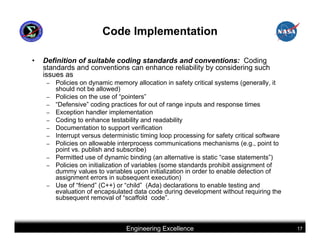
•   Definition of suitable coding standards and conventions: Coding
    standards and conventions can enhance reliability by considering such
    issues as
     –   Policies on dynamic memory allocation in safety critical systems (generally, it
         should not be allowed)
     –   Policies on the use of “pointers”
     –   “Defensive” coding practices for out of range inputs and response times
     –   Exception handler implementation
     –   Coding to enhance testability and readability
     –   Documentation to support verification
     –   Interrupt versus deterministic timing loop processing for safety critical software
     –   Policies on allowable interprocess communications mechanisms (e.g., point to
         point vs. publish and subscribe)
     –   Permitted use of dynamic binding (an alternative is static “case statements”)
     –   Policies on initialization of variables (some standards prohibit assignment of
         dummy values to variables upon initialization in order to enable detection of
         assignment errors in subsequent execution)
     –   Use of “friend” (C++) or “child” (Ada) declarations to enable testing and
         evaluation of encapsulated data code during development without requiring the
         subsequent removal of “scaffold code”.


                                  Engineering Excellence                                      17
Code Implementation

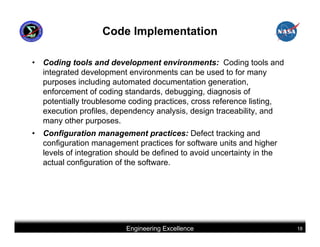
•   Coding tools and development environments: Coding tools and
    integrated development environments can be used to for many
    purposes including automated documentation generation,
    enforcement of coding standards, debugging, diagnosis of
    potentially troublesome coding practices, cross reference listing,
    execution profiles, dependency analysis, design traceability, and
    many other purposes.
•   Configuration management practices: Defect tracking and
    configuration management practices for software units and higher
    levels of integration should be defined to avoid uncertainty in the
    actual configuration of the software.


                           Engineering Excellence                         18
Test and Inspection of Code

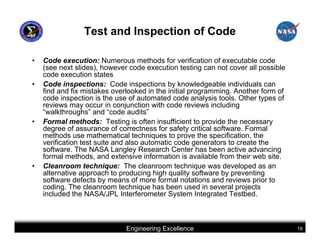
•   Code execution: Numerous methods for verification of executable code
    (see next slides), however code execution testing can not cover all possible
    code execution states
•   Code inspections: Code inspections by knowledgeable individuals can
    find and fix mistakes overlooked in the initial programming. Another form of
    code inspection is the use of automated code analysis tools. Other types of
    reviews may occur in conjunction with code reviews including
    “walkthroughs” and “code audits”
•   Formal methods: Testing is often insufficient to provide the necessary
    degree of assurance of correctness for safety critical software. Formal
    methods use mathematical techniques to prove the specification, the
    verification test suite and also automatic code generators to create the
    software. The NASA Langley Research Center has been active advancing
    formal methods, and extensive information is available from their web site.
•   Cleanroom technique: The cleanroom technique was developed as an
    alternative approach to producing high quality software by preventing
    software defects by means of more formal notations and reviews prior to
    coding. The cleanroom technique has been used in several projects
    included the NASA/JPL Interferometer System Integrated Testbed.


                              Engineering Excellence                               19
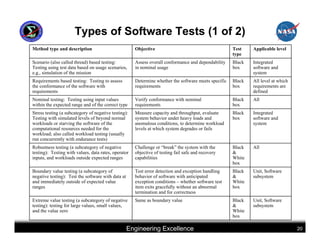
Types of Software Tests (1 of 2)
Method type and description                           Objective                                       Test    Applicable level
                                                                                                      type
Scenario (also called thread) based testing:          Assess overall conformance and dependability    Black   Integrated
Testing using test data based on usage scenarios,     in nominal usage                                box     software and
e.g., simulation of the mission                                                                               system
Requirements based testing: Testing to assess         Determine whether the software meets specific   Black   All level at which
the conformance of the software with                  requirements                                    box     requirements are
requirements                                                                                                  defined
Nominal testing: Testing using input values           Verify conformance with nominal                 Black   All
within the expected range and of the correct type     requirements                                    box
Stress testing (a subcategory of negative testing):   Measure capacity and throughput, evaluate       Black   Integrated
Testing with simulated levels of beyond normal        system behavior under heavy loads and           box     software and
workloads or starving the software of the             anomalous conditions, to determine workload             system
computational resources needed for the                levels at which system degrades or fails
workload; also called workload testing (usually
run concurrently with endurance tests)
Robustness testing (a subcategory of negative         Challenge or “break” the system with the        Black   All
testing): Testing with values, data rates, operator   objective of testing fail safe and recovery     &
inputs, and workloads outside expected ranges         capabilities                                    White
                                                                                                      box
Boundary value testing (a subcategory of              Test error detection and exception handling     Black   Unit, Software
negative testing): Test the software with data at     behavior of software with anticipated           &       subsystem
and immediately outside of expected value             exception conditions – whether software test    White
ranges                                                item exits gracefully without an abnormal       box
                                                      termination and for correctness
Extreme value testing (a subcategory of negative      Same as boundary value                          Black   Unit, Software
testing): testing for large values, small values,                                                     &       subsystem
and the value zero                                                                                    White
                                                                                                      box

                                                    Engineering Excellence                                                         20
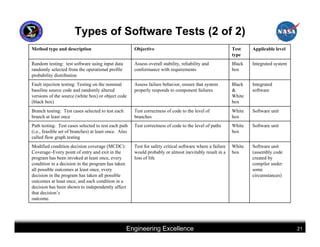
Types of Software Tests (2 of 2)
Method type and description                            Objective                                           Test    Applicable level
                                                                                                           type
Random testing: test software using input data         Assess overall stability, reliability and           Black   Integrated system
randomly selected from the operational profile         conformance with requirements                       box
probability distribution
Fault injection testing: Testing on the nominal        Assess failure behavior, ensure that system         Black   Integrated
baseline source code and randomly altered              properly responds to component failures             &       software
versions of the source (white box) or object code                                                          White
(black box)                                                                                                box
Branch testing: Test cases selected to test each       Test correctness of code to the level of            White   Software unit
branch at least once                                   branches                                            box
Path testing: Test cases selected to test each path    Test correctness of code to the level of paths      White   Software unit
(i.e., feasible set of branches) at least once. Also                                                       box
called flow graph testing
Modified condition decision coverage (MCDC):           Test for safety critical software where a failure   White   Software unit
Coverage–Every point of entry and exit in the          would probably or almost inevitably result in a     box     (assembly code
program has been invoked at least once, every          loss of life                                                created by
condition in a decision in the program has taken                                                                   compiler under
all possible outcomes at least once, every                                                                         some
decision in the program has taken all possible                                                                     circumstances)
outcomes at least once, and each condition in a
decision has been shown to independently affect
that decision’s
outcome.


                                                   Engineering Excellence                                                              21
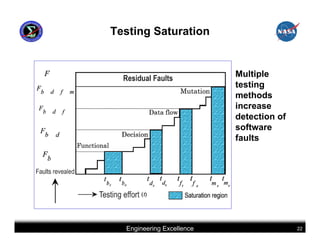
Testing Saturation


                           Multiple
                           testing
                           methods
                           increase
                           detection of
                           software
                           faults


  Engineering Excellence                  22
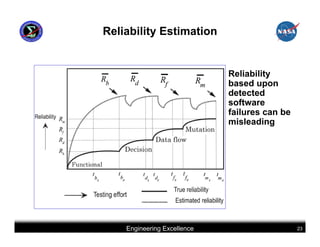
Reliability Estimation


                             Reliability
                             based upon
                             detected
                             software
                             failures can be
                             misleading


    Engineering Excellence                     23
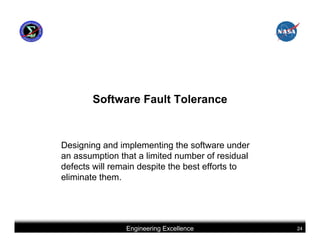
Software Fault Tolerance


Designing and implementing the software under
an assumption that a limited number of residual
defects will remain despite the best efforts to
eliminate them.


                Engineering Excellence            24
Replication

• Replication: The executing redundant copies of software
  as an architecture level concept.
   – static redundancy: all copies of the executing program are
     provided with the same input and produce the same output.
     The output is chosen by a default selection of one of the
     channels or by comparing or voting on the output. The
     primary challenge for this form of replication is
     synchronization of the input or the output.
   – dynamic redundancy: one of the copies is assigned the
     active or “hot” role and other copies are in a standby role.
     The designation of “dynamic” is related to the fact that
     changing roles requires a change in the state of the
     software.


                       Engineering Excellence                       25
Exception Handling

• Exception handling: The ability of the software to detect
  (exception “raised” or “thrown”) and handle (exception
  handled or “caught) abnormal conditions in a controlled
  manner which allows for continued operation or a safe
  shutdown and is an architectural or design-level
  concept.
   –   Examples of responses include rollback and retry,
       substituting a default value, using a previous value,
       proceeding with processing without the input value,
       stopping processing, raising an alarm condition, sending a
       message to a user (or another software process) requesting
       an instruction on further action, or safe shutdown.


                        Engineering Excellence                      26
Multiversion Software

• Multiversion software: The independent generation of
  functionally equivalent programs, called versions, from
  the same initial specification. Independent generation of
  programs means that the programming efforts are carried
  out by different individuals or groups, using different
  programming languages and algorithms wherever
  possible. If three or more versions are developed, then
  voting logic can be implemented.
   – Even if the versions are developed independently, they
     suffer from correlated failures
   – Maintenance of multiple versions must be managed for all
     defect corrections and upgrades


                      Engineering Excellence                    27
Recovery Blocks

• Recovery blocks: Structures that consist of three
  elements: a primary routine, an alternate routine, and a
  runtime acceptance test. If a primary routine is not
  capable of completing the task correctly, then an
  alternate routine can be invoked to mitigate the effects of
  the failure. The acceptance test determines whether the
  primary routine failed.
   – The primary and alternative routines can run sequentially or
     concurrently.
   – Recovery blocks are resource intensive not only in
     development, but also in subsequent maintenance and
     runtime resources.


                       Engineering Excellence                       28
Computer Aided Software Engineering
             (CASE)

    GSFC James Web Space Telescope
           CASE experience


            Engineering Excellence    29
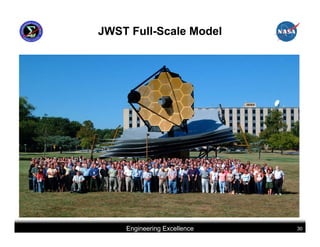
JWST Full-Scale Model


    Engineering Excellence   30
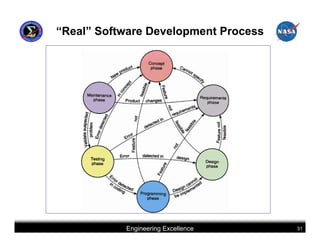
“Real” Software Development Process


           Engineering Excellence     31
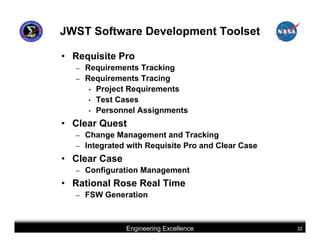
JWST Software Development Toolset

• Requisite Pro
  – Requirements Tracking
  – Requirements Tracing
     • Project Requirements
     • Test Cases
     • Personnel Assignments

• Clear Quest
  – Change Management and Tracking
  – Integrated with Requisite Pro and Clear Case

• Clear Case
  –   Configuration Management
• Rational Rose Real Time
  –   FSW Generation


               Engineering Excellence              32
JWST Experience
            Unified Modeling Language (UML)
•   Scientists and Operators presented their requirements to JWST
    software developers in UML Use Case and Sequence Diagrams
•   Review diagrams consistent within peer reviews
    –   Review material consisted of minimal meeting package
    –   Design was reviewed, projected directly out of the development
        environment
•   Statechart Diagrams, Sequence Diagrams, and Timing
    Diagrams presented to Instrument developers to define
    software/hardware interface
•   Design document described each and every software build
    exactly


                           Engineering Excellence                        33
JWST Software Integration Experience
•   External software developers supplied with identical tool suite and
    hardware development environment
     –   Rational ROSE tool suite, COTS C&DH hardware, Ground system, Database
•   Complete C&DH model is supplied to NASA developers
•   Library of C&DH model is supplied to ITAR restricted developers
•   Integration of the C&DH model and instrument application specific
    model occurs for all development teams at the model level
•   Training, lessons learned, support and guidance shared across all
    development teams due to identical environments and
    development tools
•   Review presentation material was similar in content across all
    external and internal reviews


                              Engineering Excellence                             34
JWST Code Generation Experience
• Generated code is at interface between drivers, board-
  support package, OS, and state machine framework
   –   Drivers, board-support package, OS configuration, and application
       specific functions are all hand coded
   –   State machine diagrams provide structure to the reactive system
   –   Source code for entire system is generated and available for
       analysis
• Minor and major alterations to system statemachine can be
  accomplished with little effort producing a robust
  statemachine after modification
• Minor defects and changes to functionality are
  accomplished with similar effort to hand coded
  implementation
• Static code analysis was performed on JWST source code
  (250K LOC) uncovering 60 defects
   –   far below industry metrics for code defect density


                           Engineering Excellence                          35

Michael.aguilar

  • 1.
    Software Development BestPractices for Human-Rated Spacecraft Project Management Challenge 2008 Daytona Beach, Florida February 26 - 27, 2008 Michael Aguilar NASA Engineering and Safety Center Engineering Excellence 1
  • 2.
    Background • In late2005, the NASA Engineering and Safety Center (NESC) was asked by the Astronaut Office to answer the basic question: "How do you know you have a safe and reliable system?" Full report available on-line at: nesc.nasa.gov Engineering Excellence 2
  • 3.
    Trends In SpaceVehicle Software Size Engineering Excellence 3
  • 4.
    Software Reliability There aretwo major approaches to increasing the reliability of software: • Software defect prevention (fault avoidance): using a disciplined development approach that minimizes the likelihood that defects will be introduced or will remain undetected in the software product • Software fault tolerance: designing and implementing the software under an assumption that a limited number of residual defects will remain despite the best efforts to eliminate them Engineering Excellence 4
  • 5.
    Software Defect Prevention Usinga disciplined development approach that minimizes the likelihood that defects will be introduced or will remain undetected in the software product. Engineering Excellence 5
  • 6.
    Ideal Software DevelopmentProcess System System Requirements Qualification Testing System System Architectural Design Integration Software Software Requirements Analysis Qualification Testing Software Software Integration Architectural Design Software Software Detailed Design Unit Testing Software Coding Engineering Excellence 6
  • 7.
    Allocation of Causesof Major Aerospace System Failures by Phase Cause of failures Phase Reqts Def. Arch. Def. SW Design Implementation Test & Integration Overconfidence and over reliance in digital automation X X X X Not understanding the risks associated with software X X X Over relying on redundancy X X Confusing reliability and safety X X Assuming that risk decreases over time X X Ignoring early warning signs X X X X X Inadequate engineering X X X Inadequate specifications X Flawed review process X X X X X Inadequate safety engineering X X X X X Violation of basic safety engineering practices in the digital X X X X X parts of the system Software reuse without appropriate safety analysis X X X X X Unnecessary complexity and software functions X X X X Operational personnel not understanding automation X X Test and simulation environments that do not match the X X original environment Deficiencies in safety-related information collection and X X X X X use Engineering Excellence 7
  • 8.
    Requirements Validation • Modeling and simulation: Modeling and simulation should be used to set and evaluate performance parameters requirements affecting software performance, quality of communication services in the data transport layers, requirements for responses to failures and anomalous conditions, and human/software or system interactions. • Non-advocate software and system requirements reviews: Reviews by knowledgeable third parties can uncover problems or issues that may have been overlooked by the primary requirements developers. • Use of relevant “golden rules” and “lessons learned”: Golden rules or lessons learned are excellent sources of requirements and should be reviewed as part of the requirements validation process. • Hazards and Safety analyses: Hazards analyses, such as Failure Modes and Effects Analyses and Fault Trees. Engineering Excellence 8
  • 9.
    Requirements Verification • Early planning: Assure adequate planning for simulation test beds, communications equipment, test tools and data collection devices. • Verification methods for low observable parameters: Instrumentation methods development for throughput, response time, or reliability. • Anticipating ephemeral failure behaviors: The verification strategy should anticipate failure behaviors and plan for how this information can be captured – particular if they are ephemeral and non-reproducible. • Testing of diagnostics and failure isolation capabilities: Diagnostic and fault isolation capabilities for off-nominal behavior. • Capturing of unanticipated failures or behaviors: Ensure that test plans and procedures have provisions for recording of unanticipated behaviors. Engineering Excellence 9
  • 10.
    Requirements Management • Gathering resources for software test and verification: Assembling modeling and simulation capabilities, domain expertise, identifying areas of uncertainty • Scheduling of software test and verification: The software test and verification program commonly includes managing critical path scheduling pressures. • Tracking and maintaining requirements throughout the development process: Newly discovered software requirements should be propagated back into the higher level software and systems requirements documentation, and changes in existing requirements should be documented and tracked. • Configuration Management of software requirements: Ensure that changes to software requirements are controlled and that when changes are made, they are propagated to all entities and stakeholders involved in the project. Engineering Excellence 10
  • 11.
    Software Architecture Trades •Distributed vs. centralized architectures: Distributed single point transmission failures such as undetected or unregulated message delays, or loss of synchronization in replicas of common data. Centralized architectures are vulnerable to failures in the central node of a centralized system. • Extent of modularity: Uncoupled development, integration of revised components, and utilization of previously developed (or commercial off the shelf) components traded against increases the number of interfaces. • Point-to-point vs. common communications infrastructure: The reduction of interdependencies among software elements and use of common inter-process communications constructs traded against vulnerabilities in terms of lost or delayed messages, message integrity, and message validity. Engineering Excellence 11
  • 12.
    Software Architecture Trades •COTS or reused vs. reused/modified vs. developed software: Reliability benefits are the ability to begin early test and integration of such software. • An understanding of the operational condition differences, constraints and tradeoffs are necessary. In safety critical applications, uncertainties about undocumented design decisions and tradeoffs embodied in the code may necessitate redevelopment. • Ariane 5 booster loss (inertial reference software re-use) • Magellan spacecraft (GNC software re-use from a DSCS satellite). • Verification of the suitability of the re-used software components by means of assessment of operational service history, the applicability of the allocated requirements to the published capabilities of the software, compatibility with other runtime elements, and proper version numbers. Engineering Excellence 12
  • 13.
    Software Design • Traceability:Requirements should be traceable to the functional elements or classes defined in the design. • Exception handling and other failure behaviors: Exception handlers should consider all failure conditions defined in the requirements and in safety analyses. Where possible, exceptions should be handled as close to the locations in the code where they are generated. • Diagnostics capabilities: Special attention should be paid to response time anomalies, priority inversion, and resource contention. The diagnostic capability of the system as a whole will largely depend on the diagnostic capabilities in all of the constituent software components. Engineering Excellence 13
  • 14.
    Software Design • Implementation language: The implementation language and runtime environment (including virtual machines) should be capable of realizing the design. • Interfaces: Interfaces among software modules should be completely defined and include not only arguments for the inputs and outputs of the function or object itself but also additional parameters for status, error handling, and recovery. Interfaces should be designed “defensively”. • Class library definition and inheritance: For object oriented architectures the definition of base and derived classes should be consistent and traceable to both the requirements and the architecture. Engineering Excellence 14
  • 15.
    Software Design • Compatibilitywith hardware and resource constraints: The software allocated to each hardware element should conform to memory, processor capacity, and interface constraints • COTS and Non-developmental runtime elements: Existing software components and runtime elements should be configuration controlled, well characterized with respect to the intended use, and fully documented • Automated Coding Tools: Newer techniques based on object oriented design or model-based development have resulted in tools that can go directly from design to executable code. – Among the advantages are the ability to generate an executable design that can be evaluated prior to detailed coding. – Among the concerns is the quality of the automatically generated code, particularly with respect to off-nominal conditions or inputs. Engineering Excellence 15
  • 16.
    Code Implementation • Use of “safe” subsets for safety or mission critical functions: Modern languages such as Ada, C, C++ and Java have safe subsets defined (or in the process of being defined) for their use in safety critical applications. – Disadvantages of such subsets is implementation in the language requires more source code which both reduces productivity (thereby adding to development cost), complicates software maintenance, and discourages reusability. • Routine or class libraries, and runtime environments: The runtime libraries and other environmental components that support the developed software should conform to the constraints of the architecture and design and should provide the necessary capabilities to support desired failure behavior – including – Reliability, performance, throughput – Failure response, detection and recovery – Diagnostics requirements Engineering Excellence 16
  • 17.
    Code Implementation • Definition of suitable coding standards and conventions: Coding standards and conventions can enhance reliability by considering such issues as – Policies on dynamic memory allocation in safety critical systems (generally, it should not be allowed) – Policies on the use of “pointers” – “Defensive” coding practices for out of range inputs and response times – Exception handler implementation – Coding to enhance testability and readability – Documentation to support verification – Interrupt versus deterministic timing loop processing for safety critical software – Policies on allowable interprocess communications mechanisms (e.g., point to point vs. publish and subscribe) – Permitted use of dynamic binding (an alternative is static “case statements”) – Policies on initialization of variables (some standards prohibit assignment of dummy values to variables upon initialization in order to enable detection of assignment errors in subsequent execution) – Use of “friend” (C++) or “child” (Ada) declarations to enable testing and evaluation of encapsulated data code during development without requiring the subsequent removal of “scaffold code”. Engineering Excellence 17
  • 18.
    Code Implementation • Coding tools and development environments: Coding tools and integrated development environments can be used to for many purposes including automated documentation generation, enforcement of coding standards, debugging, diagnosis of potentially troublesome coding practices, cross reference listing, execution profiles, dependency analysis, design traceability, and many other purposes. • Configuration management practices: Defect tracking and configuration management practices for software units and higher levels of integration should be defined to avoid uncertainty in the actual configuration of the software. Engineering Excellence 18
  • 19.
    Test and Inspectionof Code • Code execution: Numerous methods for verification of executable code (see next slides), however code execution testing can not cover all possible code execution states • Code inspections: Code inspections by knowledgeable individuals can find and fix mistakes overlooked in the initial programming. Another form of code inspection is the use of automated code analysis tools. Other types of reviews may occur in conjunction with code reviews including “walkthroughs” and “code audits” • Formal methods: Testing is often insufficient to provide the necessary degree of assurance of correctness for safety critical software. Formal methods use mathematical techniques to prove the specification, the verification test suite and also automatic code generators to create the software. The NASA Langley Research Center has been active advancing formal methods, and extensive information is available from their web site. • Cleanroom technique: The cleanroom technique was developed as an alternative approach to producing high quality software by preventing software defects by means of more formal notations and reviews prior to coding. The cleanroom technique has been used in several projects included the NASA/JPL Interferometer System Integrated Testbed. Engineering Excellence 19
  • 20.
    Types of SoftwareTests (1 of 2) Method type and description Objective Test Applicable level type Scenario (also called thread) based testing: Assess overall conformance and dependability Black Integrated Testing using test data based on usage scenarios, in nominal usage box software and e.g., simulation of the mission system Requirements based testing: Testing to assess Determine whether the software meets specific Black All level at which the conformance of the software with requirements box requirements are requirements defined Nominal testing: Testing using input values Verify conformance with nominal Black All within the expected range and of the correct type requirements box Stress testing (a subcategory of negative testing): Measure capacity and throughput, evaluate Black Integrated Testing with simulated levels of beyond normal system behavior under heavy loads and box software and workloads or starving the software of the anomalous conditions, to determine workload system computational resources needed for the levels at which system degrades or fails workload; also called workload testing (usually run concurrently with endurance tests) Robustness testing (a subcategory of negative Challenge or “break” the system with the Black All testing): Testing with values, data rates, operator objective of testing fail safe and recovery & inputs, and workloads outside expected ranges capabilities White box Boundary value testing (a subcategory of Test error detection and exception handling Black Unit, Software negative testing): Test the software with data at behavior of software with anticipated & subsystem and immediately outside of expected value exception conditions – whether software test White ranges item exits gracefully without an abnormal box termination and for correctness Extreme value testing (a subcategory of negative Same as boundary value Black Unit, Software testing): testing for large values, small values, & subsystem and the value zero White box Engineering Excellence 20
  • 21.
    Types of SoftwareTests (2 of 2) Method type and description Objective Test Applicable level type Random testing: test software using input data Assess overall stability, reliability and Black Integrated system randomly selected from the operational profile conformance with requirements box probability distribution Fault injection testing: Testing on the nominal Assess failure behavior, ensure that system Black Integrated baseline source code and randomly altered properly responds to component failures & software versions of the source (white box) or object code White (black box) box Branch testing: Test cases selected to test each Test correctness of code to the level of White Software unit branch at least once branches box Path testing: Test cases selected to test each path Test correctness of code to the level of paths White Software unit (i.e., feasible set of branches) at least once. Also box called flow graph testing Modified condition decision coverage (MCDC): Test for safety critical software where a failure White Software unit Coverage–Every point of entry and exit in the would probably or almost inevitably result in a box (assembly code program has been invoked at least once, every loss of life created by condition in a decision in the program has taken compiler under all possible outcomes at least once, every some decision in the program has taken all possible circumstances) outcomes at least once, and each condition in a decision has been shown to independently affect that decision’s outcome. Engineering Excellence 21
  • 22.
    Testing Saturation Multiple testing methods increase detection of software faults Engineering Excellence 22
  • 23.
    Reliability Estimation Reliability based upon detected software failures can be misleading Engineering Excellence 23
  • 24.
    Software Fault Tolerance Designingand implementing the software under an assumption that a limited number of residual defects will remain despite the best efforts to eliminate them. Engineering Excellence 24
  • 25.
    Replication • Replication: Theexecuting redundant copies of software as an architecture level concept. – static redundancy: all copies of the executing program are provided with the same input and produce the same output. The output is chosen by a default selection of one of the channels or by comparing or voting on the output. The primary challenge for this form of replication is synchronization of the input or the output. – dynamic redundancy: one of the copies is assigned the active or “hot” role and other copies are in a standby role. The designation of “dynamic” is related to the fact that changing roles requires a change in the state of the software. Engineering Excellence 25
  • 26.
    Exception Handling • Exceptionhandling: The ability of the software to detect (exception “raised” or “thrown”) and handle (exception handled or “caught) abnormal conditions in a controlled manner which allows for continued operation or a safe shutdown and is an architectural or design-level concept. – Examples of responses include rollback and retry, substituting a default value, using a previous value, proceeding with processing without the input value, stopping processing, raising an alarm condition, sending a message to a user (or another software process) requesting an instruction on further action, or safe shutdown. Engineering Excellence 26
  • 27.
    Multiversion Software • Multiversionsoftware: The independent generation of functionally equivalent programs, called versions, from the same initial specification. Independent generation of programs means that the programming efforts are carried out by different individuals or groups, using different programming languages and algorithms wherever possible. If three or more versions are developed, then voting logic can be implemented. – Even if the versions are developed independently, they suffer from correlated failures – Maintenance of multiple versions must be managed for all defect corrections and upgrades Engineering Excellence 27
  • 28.
    Recovery Blocks • Recoveryblocks: Structures that consist of three elements: a primary routine, an alternate routine, and a runtime acceptance test. If a primary routine is not capable of completing the task correctly, then an alternate routine can be invoked to mitigate the effects of the failure. The acceptance test determines whether the primary routine failed. – The primary and alternative routines can run sequentially or concurrently. – Recovery blocks are resource intensive not only in development, but also in subsequent maintenance and runtime resources. Engineering Excellence 28
  • 29.
    Computer Aided SoftwareEngineering (CASE) GSFC James Web Space Telescope CASE experience Engineering Excellence 29
  • 30.
    JWST Full-Scale Model Engineering Excellence 30
  • 31.
    “Real” Software DevelopmentProcess Engineering Excellence 31
  • 32.
    JWST Software DevelopmentToolset • Requisite Pro – Requirements Tracking – Requirements Tracing • Project Requirements • Test Cases • Personnel Assignments • Clear Quest – Change Management and Tracking – Integrated with Requisite Pro and Clear Case • Clear Case – Configuration Management • Rational Rose Real Time – FSW Generation Engineering Excellence 32
  • 33.
    JWST Experience Unified Modeling Language (UML) • Scientists and Operators presented their requirements to JWST software developers in UML Use Case and Sequence Diagrams • Review diagrams consistent within peer reviews – Review material consisted of minimal meeting package – Design was reviewed, projected directly out of the development environment • Statechart Diagrams, Sequence Diagrams, and Timing Diagrams presented to Instrument developers to define software/hardware interface • Design document described each and every software build exactly Engineering Excellence 33
  • 34.
    JWST Software IntegrationExperience • External software developers supplied with identical tool suite and hardware development environment – Rational ROSE tool suite, COTS C&DH hardware, Ground system, Database • Complete C&DH model is supplied to NASA developers • Library of C&DH model is supplied to ITAR restricted developers • Integration of the C&DH model and instrument application specific model occurs for all development teams at the model level • Training, lessons learned, support and guidance shared across all development teams due to identical environments and development tools • Review presentation material was similar in content across all external and internal reviews Engineering Excellence 34
  • 35.
    JWST Code GenerationExperience • Generated code is at interface between drivers, board- support package, OS, and state machine framework – Drivers, board-support package, OS configuration, and application specific functions are all hand coded – State machine diagrams provide structure to the reactive system – Source code for entire system is generated and available for analysis • Minor and major alterations to system statemachine can be accomplished with little effort producing a robust statemachine after modification • Minor defects and changes to functionality are accomplished with similar effort to hand coded implementation • Static code analysis was performed on JWST source code (250K LOC) uncovering 60 defects – far below industry metrics for code defect density Engineering Excellence 35