Software Reliability
Software Validation
Defensive Programming
Software Analysis Tools
Conclusion
Software Reliability
Journ´ee des Technologies de l’Information et de la
Communication
Baptiste Wicht
EIA-FR
June 3, 2014
Baptiste Wicht EIA-FR Software Reliability
Software Reliability
Software Validation
Defensive Programming
Software Analysis Tools
Conclusion
EIA-FR
Baptiste Wicht EIA-FR Software Reliability
Software Reliability
Software Validation
Defensive Programming
Software Analysis Tools
Conclusion
Table of Contents
1 Software Reliability
2 Software Validation
3 Defensive Programming
4 Software Analysis Tools
5 Conclusion
Baptiste Wicht EIA-FR Software Reliability
Software Reliability
Software Validation
Defensive Programming
Software Analysis Tools
Conclusion
Definitions
Examples
Facts
Solutions
Contents
1 Software Reliability
Definitions
Examples
Facts
Solutions
2 Software Validation
3 Defensive Programming
4 Software Analysis Tools
5 Conclusion
Baptiste Wicht EIA-FR Software Reliability
Software Reliability
Software Validation
Defensive Programming
Software Analysis Tools
Conclusion
Definitions
Examples
Facts
Solutions
Definitions
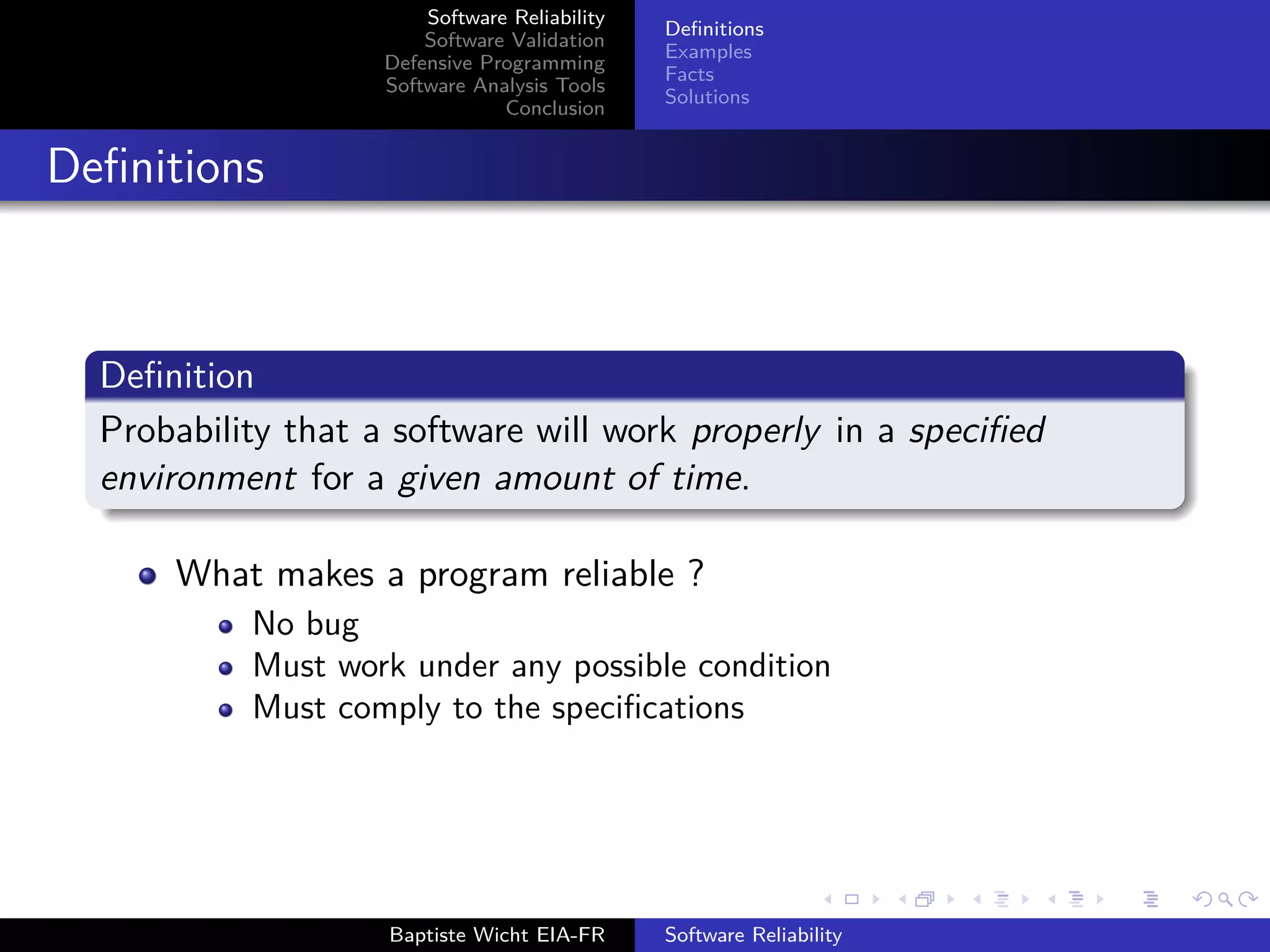
Definition
Probability that a software will work properly in a specified
environment for a given amount of time.
What makes a program reliable ?
No bug
Must work under any possible condition
Must comply to the specifications
Baptiste Wicht EIA-FR Software Reliability
Software Reliability
Software Validation
Defensive Programming
Software Analysis Tools
Conclusion
Definitions
Examples
Facts
Solutions
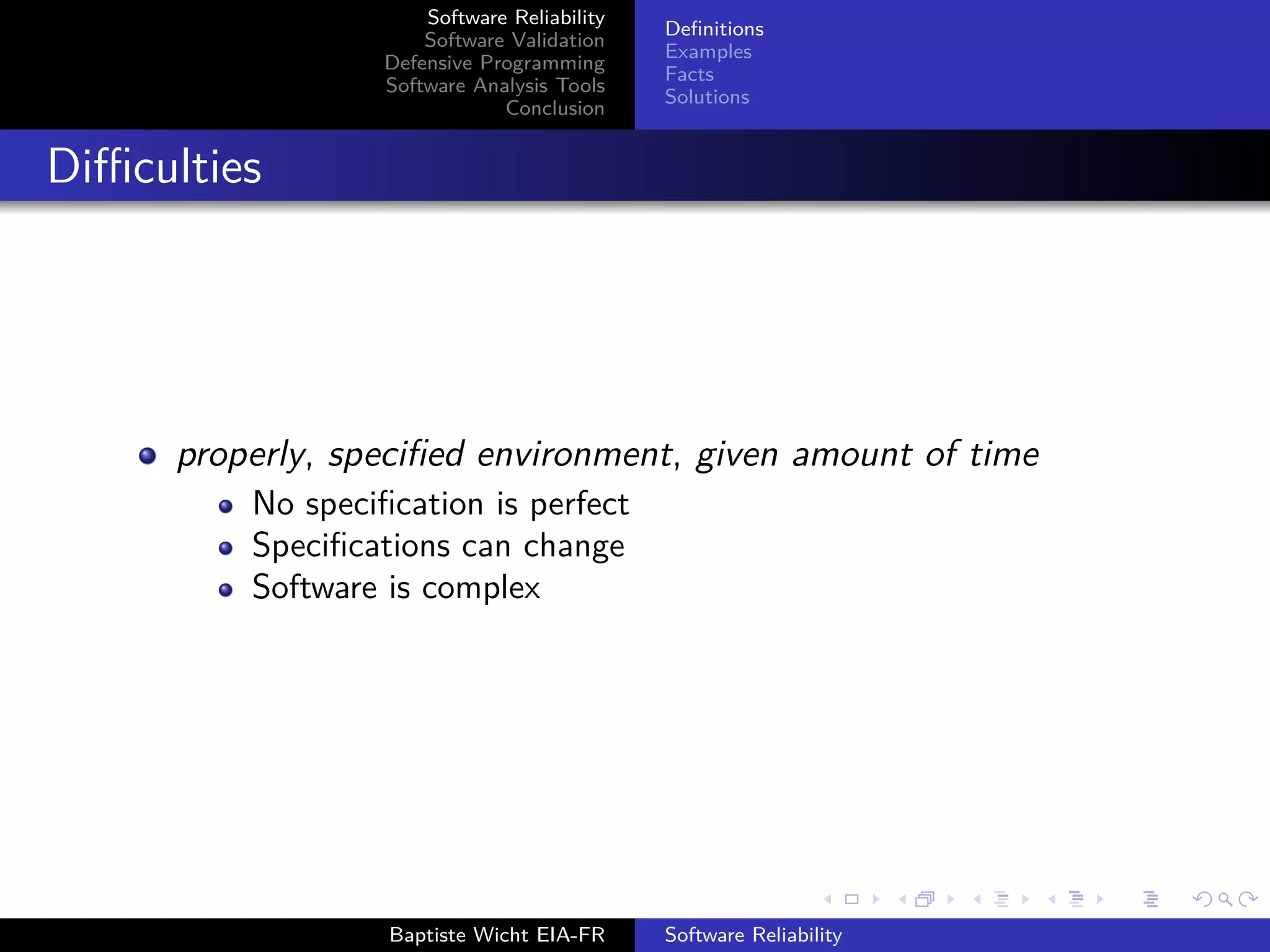
Difficulties
properly, specified environment, given amount of time
No specification is perfect
Specifications can change
Software is complex
Baptiste Wicht EIA-FR Software Reliability
Software Reliability
Software Validation
Defensive Programming
Software Analysis Tools
Conclusion
Definitions
Examples
Facts
Solutions
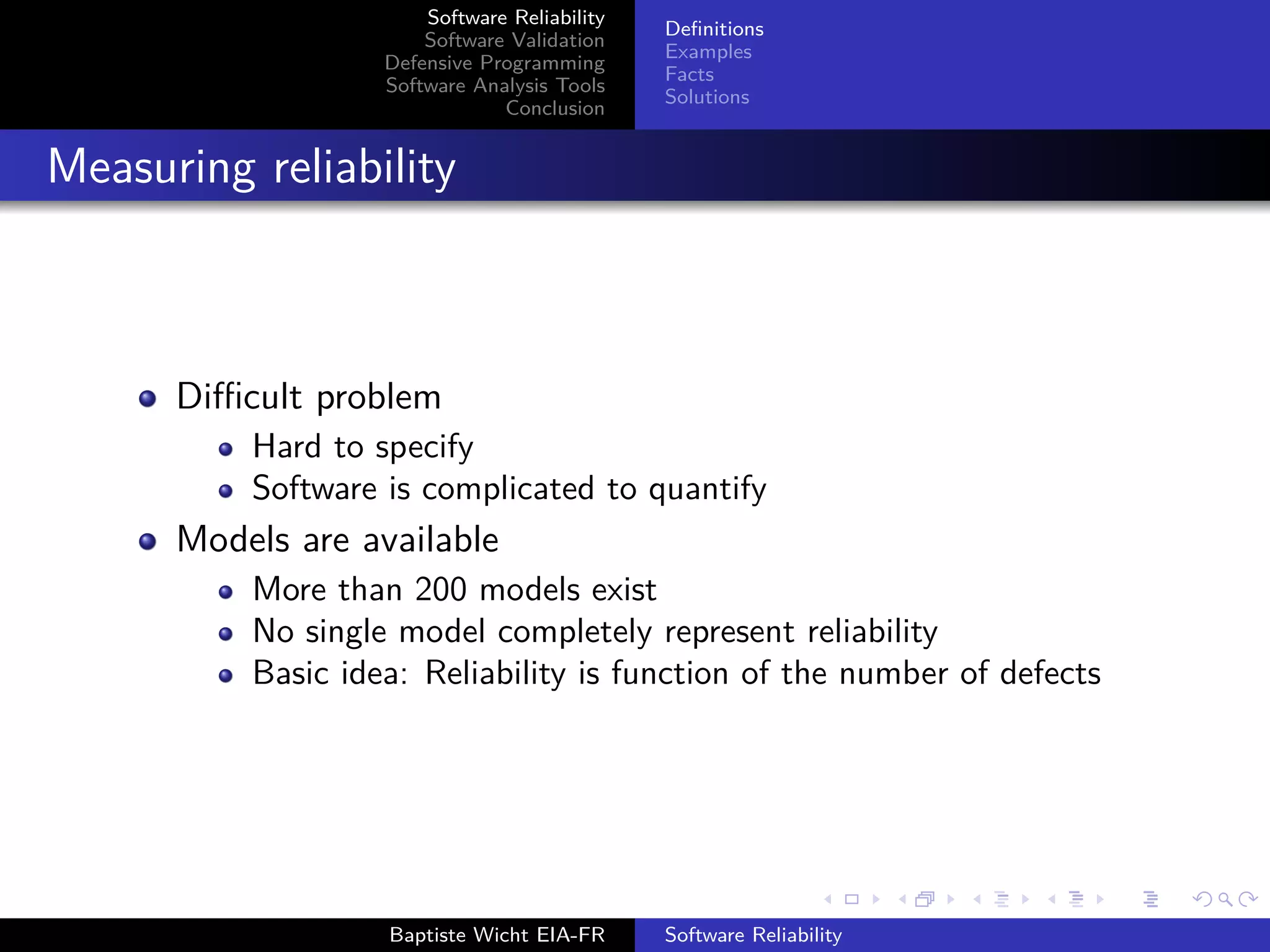
Measuring reliability
Difficult problem
Hard to specify
Software is complicated to quantify
Models are available
More than 200 models exist
No single model completely represent reliability
Basic idea: Reliability is function of the number of defects
Baptiste Wicht EIA-FR Software Reliability
Software Reliability
Software Validation
Defensive Programming
Software Analysis Tools
Conclusion
Definitions
Examples
Facts
Solutions
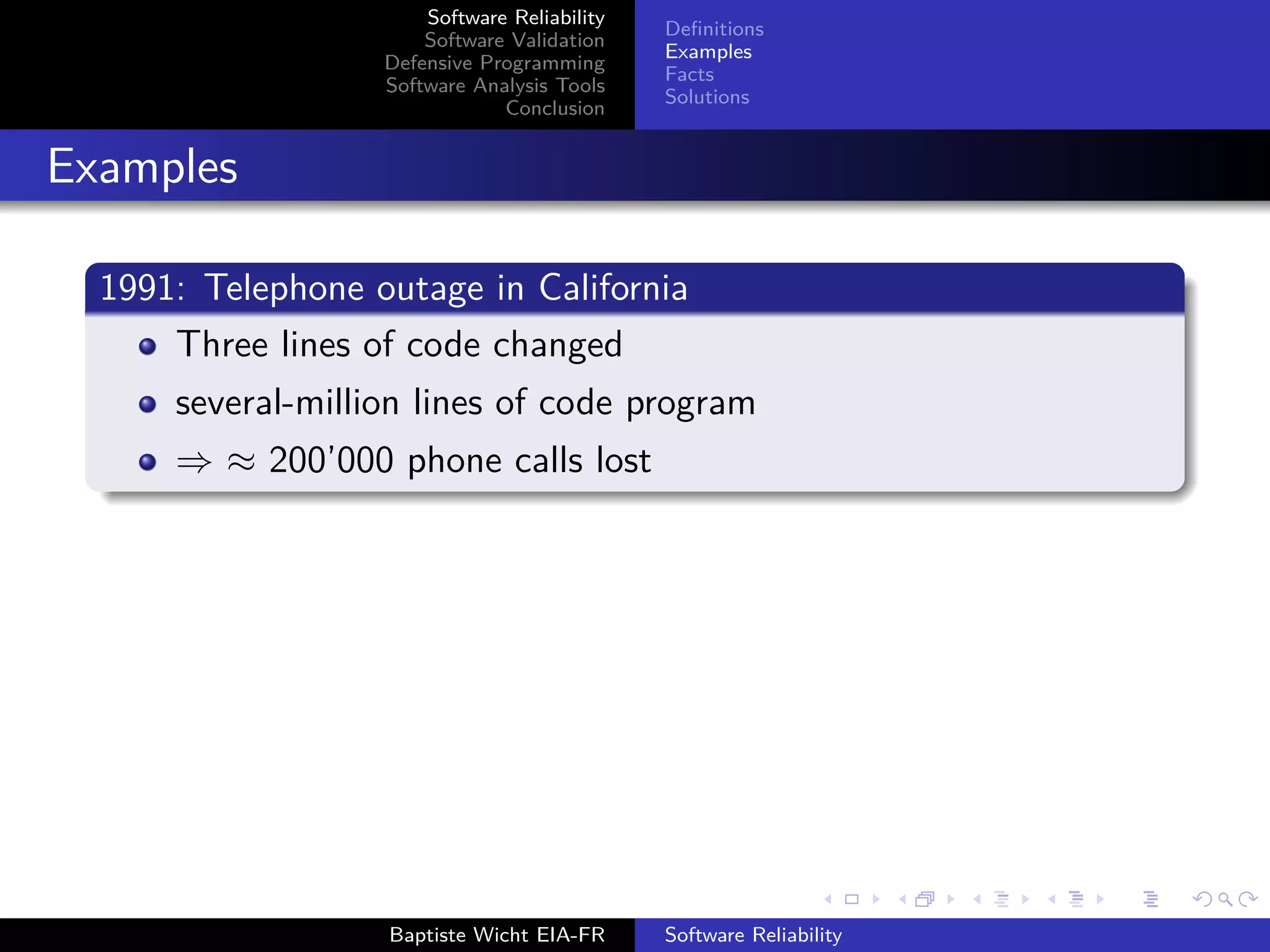
Examples
1991: Telephone outage in California
Three lines of code changed
several-million lines of code program
⇒ ≈ 200’000 phone calls lost
Baptiste Wicht EIA-FR Software Reliability
Software Reliability
Software Validation
Defensive Programming
Software Analysis Tools
Conclusion
Definitions
Examples
Facts
Solutions
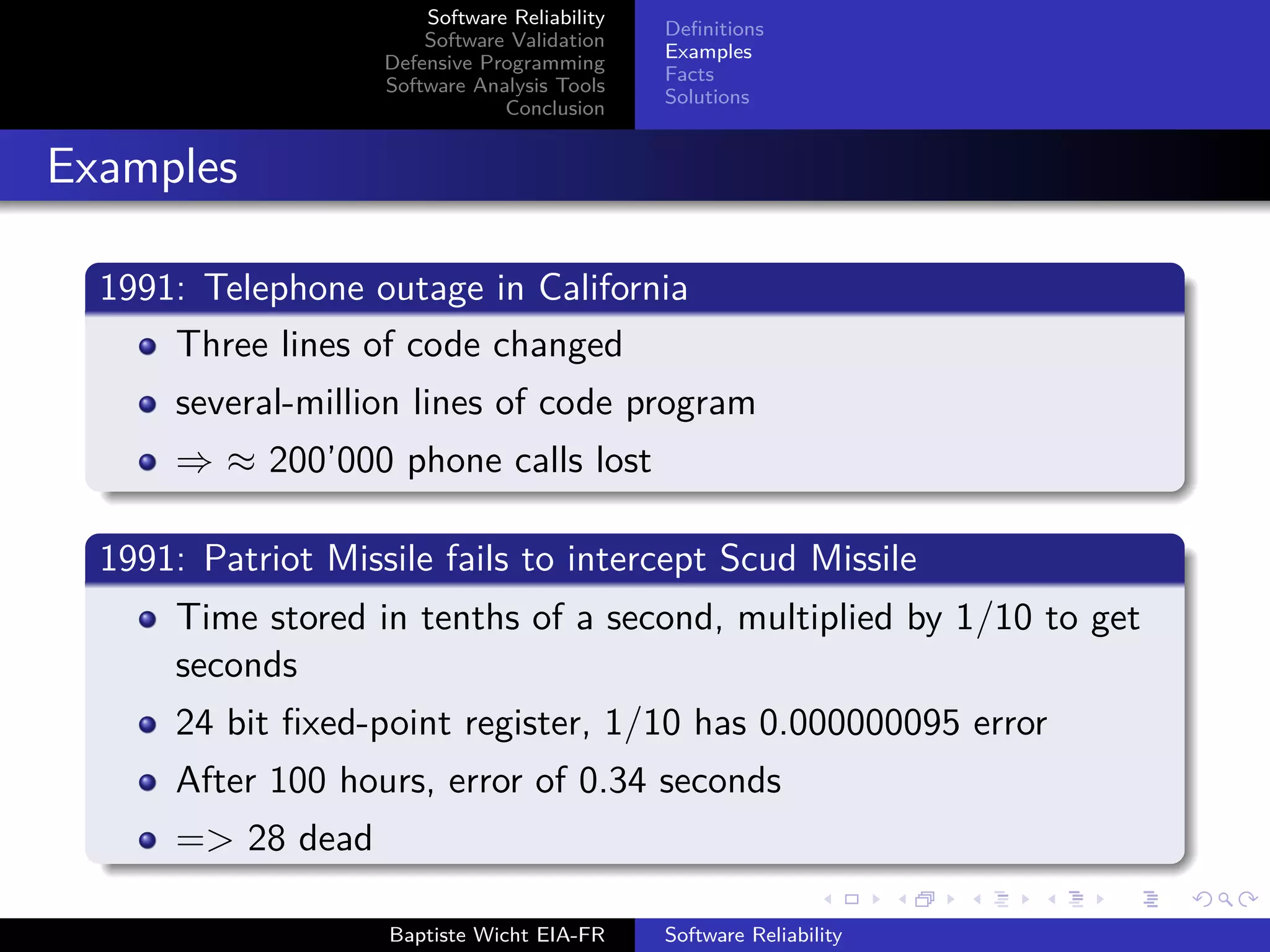
Examples
1991: Telephone outage in California
Three lines of code changed
several-million lines of code program
⇒ ≈ 200’000 phone calls lost
1991: Patriot Missile fails to intercept Scud Missile
Time stored in tenths of a second, multiplied by 1/10 to get
seconds
24 bit fixed-point register, 1/10 has 0.000000095 error
After 100 hours, error of 0.34 seconds
=> 28 dead
Baptiste Wicht EIA-FR Software Reliability
Software Reliability
Software Validation
Defensive Programming
Software Analysis Tools
Conclusion
Definitions
Examples
Facts
Solutions
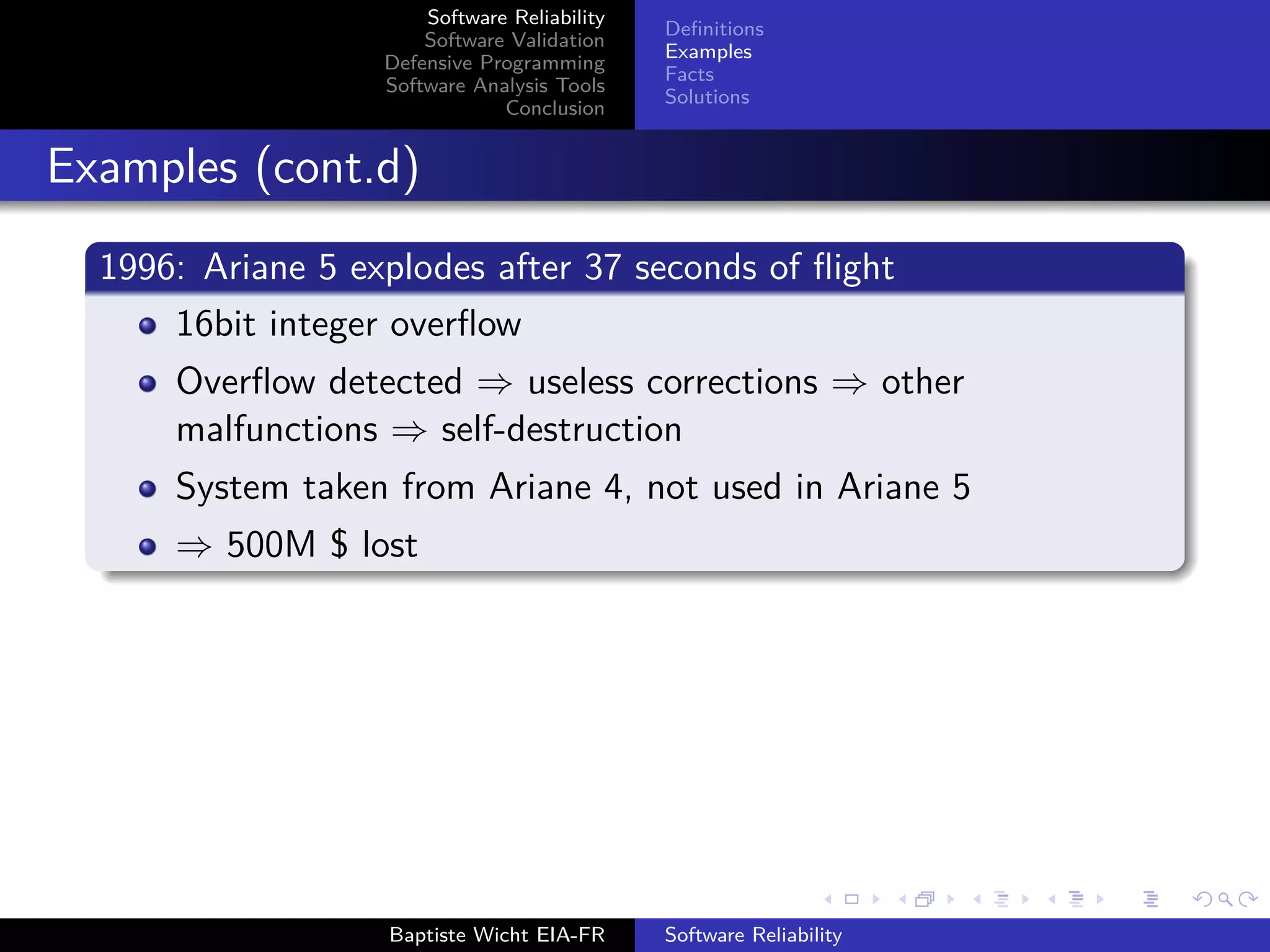
Examples (cont.d)
1996: Ariane 5 explodes after 37 seconds of flight
16bit integer overflow
Overflow detected ⇒ useless corrections ⇒ other
malfunctions ⇒ self-destruction
System taken from Ariane 4, not used in Ariane 5
⇒ 500M $ lost
Baptiste Wicht EIA-FR Software Reliability
Software Reliability
Software Validation
Defensive Programming
Software Analysis Tools
Conclusion
Definitions
Examples
Facts
Solutions
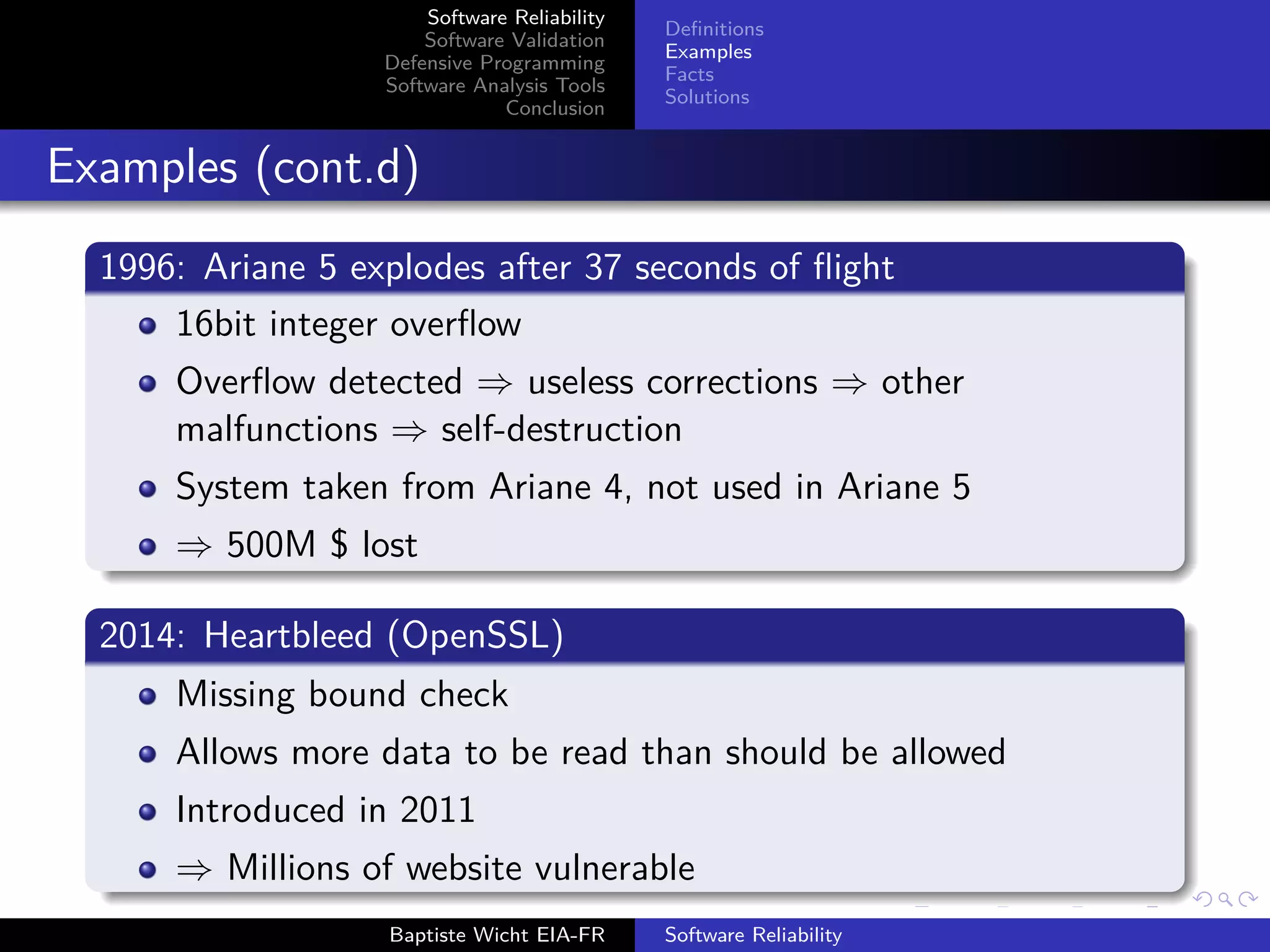
Examples (cont.d)
1996: Ariane 5 explodes after 37 seconds of flight
16bit integer overflow
Overflow detected ⇒ useless corrections ⇒ other
malfunctions ⇒ self-destruction
System taken from Ariane 4, not used in Ariane 5
⇒ 500M $ lost
2014: Heartbleed (OpenSSL)
Missing bound check
Allows more data to be read than should be allowed
Introduced in 2011
⇒ Millions of website vulnerable
Baptiste Wicht EIA-FR Software Reliability
Software Reliability
Software Validation
Defensive Programming
Software Analysis Tools
Conclusion
Definitions
Examples
Facts
Solutions
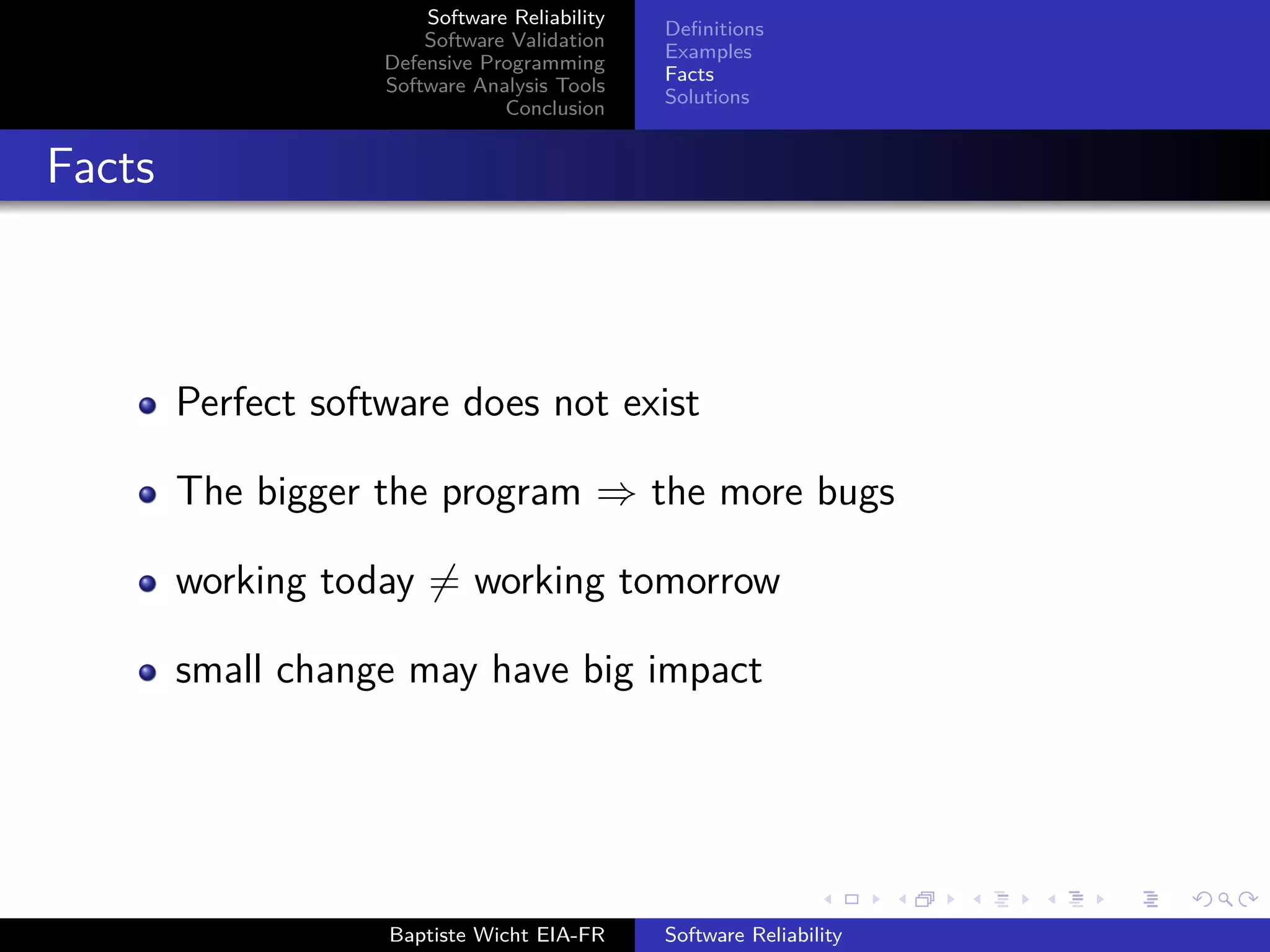
Facts
Perfect software does not exist
The bigger the program ⇒ the more bugs
working today = working tomorrow
small change may have big impact
Baptiste Wicht EIA-FR Software Reliability
Software Reliability
Software Validation
Defensive Programming
Software Analysis Tools
Conclusion
Definitions
Examples
Facts
Solutions
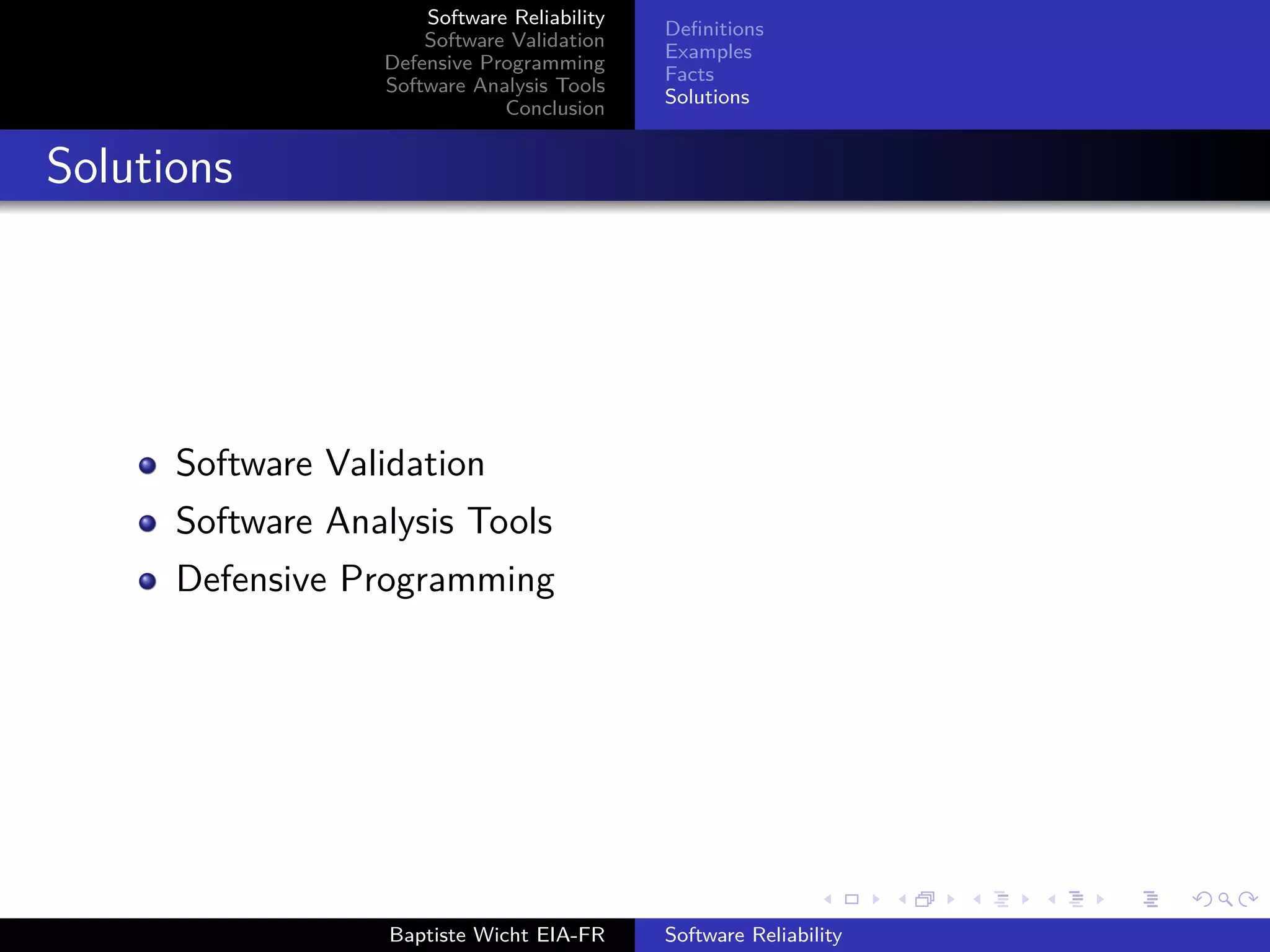
Solutions
Software Validation
Software Analysis Tools
Defensive Programming
Baptiste Wicht EIA-FR Software Reliability
Software Reliability
Software Validation
Defensive Programming
Software Analysis Tools
Conclusion
Unit Testing
Integration Testing
Software Validation
Conclusion
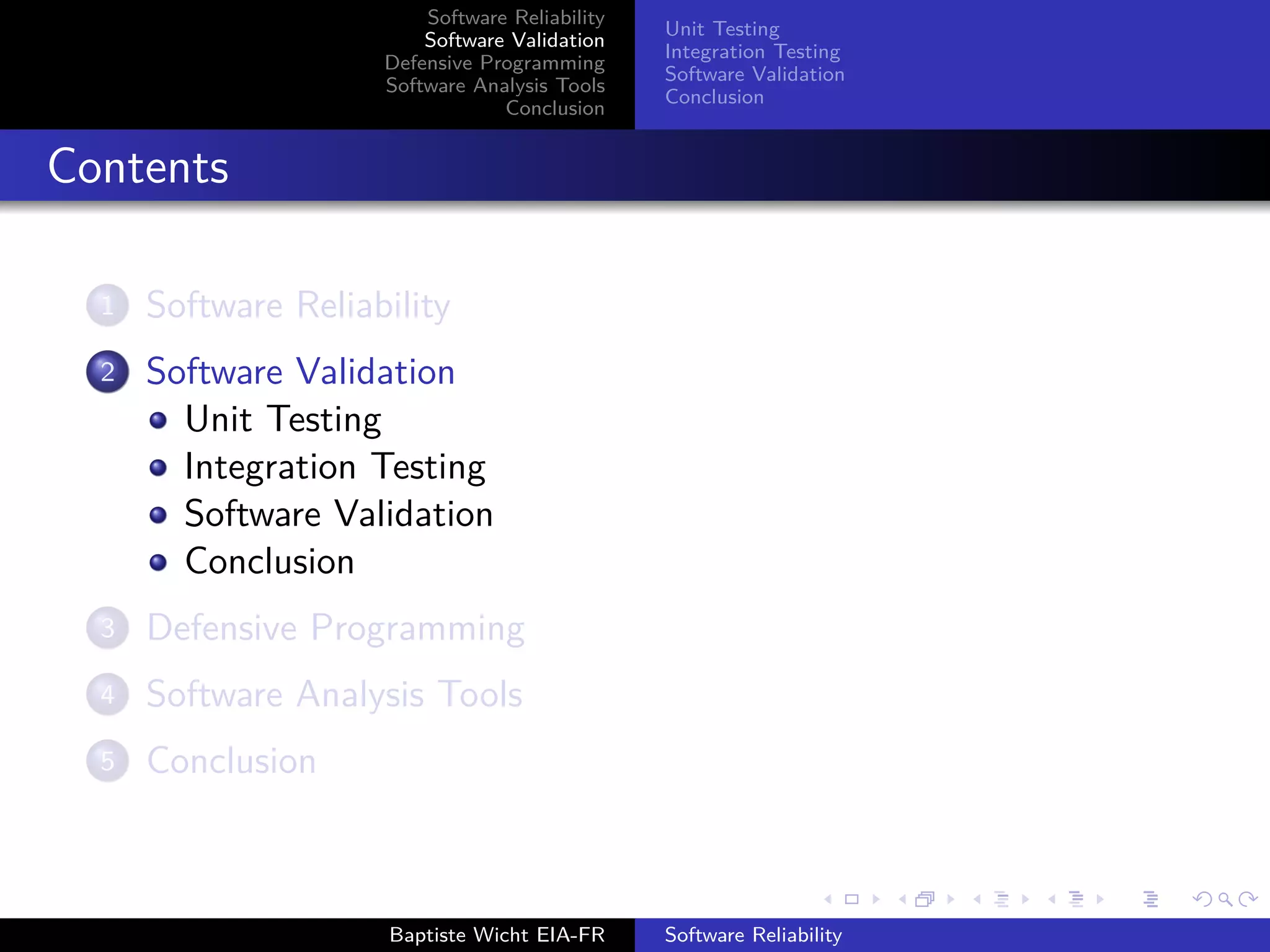
Contents
1 Software Reliability
2 Software Validation
Unit Testing
Integration Testing
Software Validation
Conclusion
3 Defensive Programming
4 Software Analysis Tools
5 Conclusion
Baptiste Wicht EIA-FR Software Reliability
Software Reliability
Software Validation
Defensive Programming
Software Analysis Tools
Conclusion
Unit Testing
Integration Testing
Software Validation
Conclusion
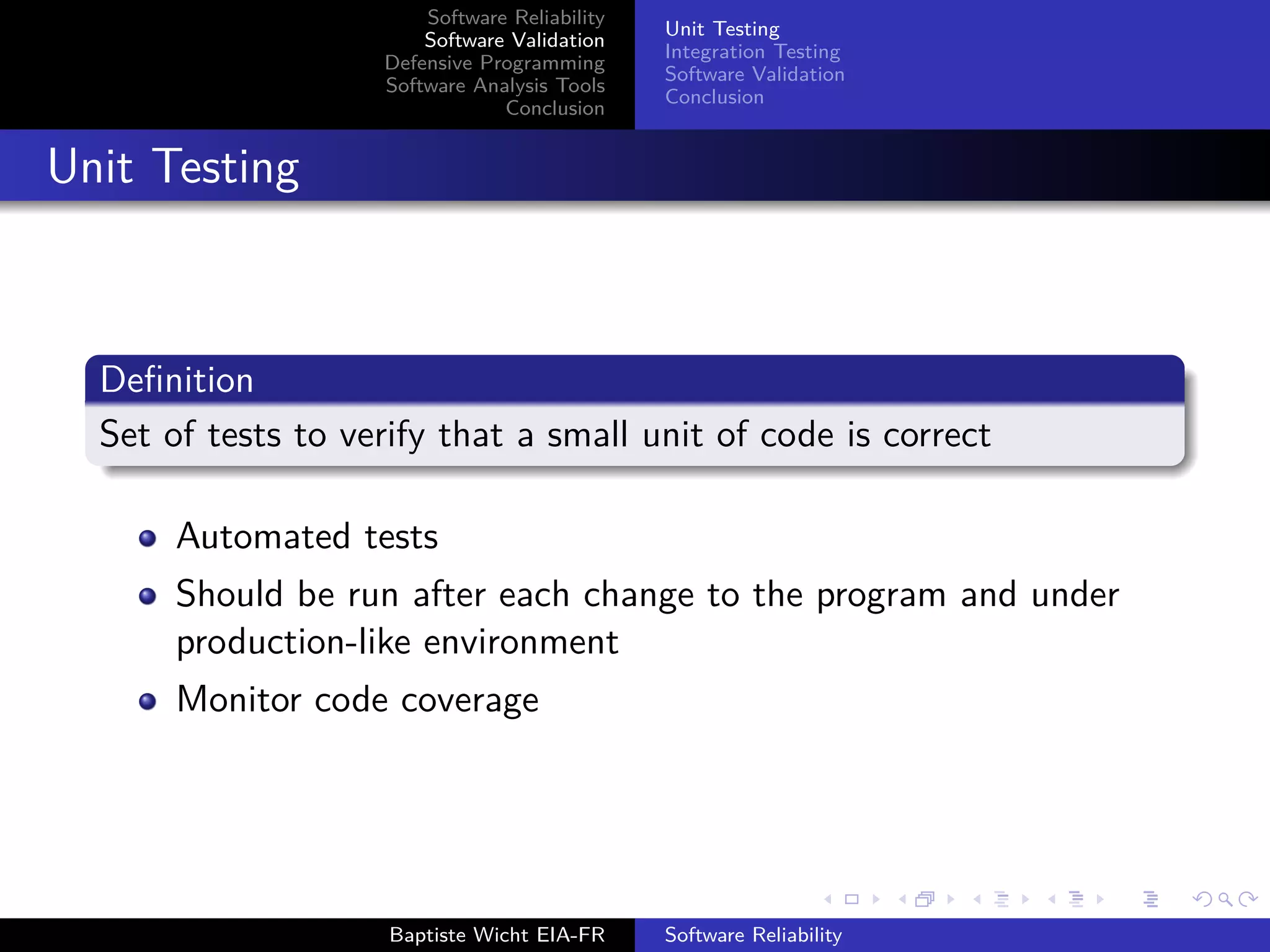
Unit Testing
Definition
Set of tests to verify that a small unit of code is correct
Automated tests
Should be run after each change to the program and under
production-like environment
Monitor code coverage
Baptiste Wicht EIA-FR Software Reliability
Software Reliability
Software Validation
Defensive Programming
Software Analysis Tools
Conclusion
Unit Testing
Integration Testing
Software Validation
Conclusion
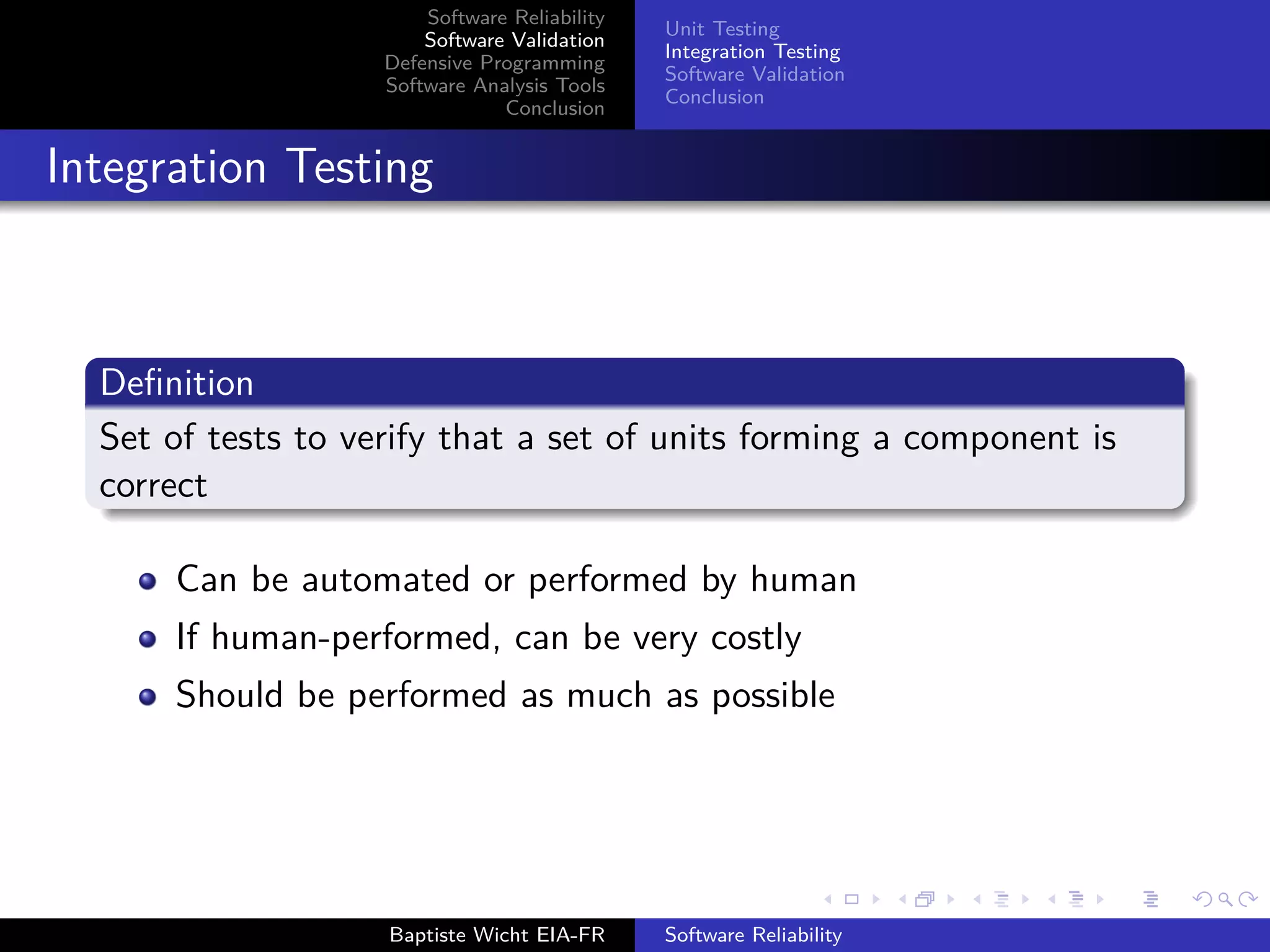
Integration Testing
Definition
Set of tests to verify that a set of units forming a component is
correct
Can be automated or performed by human
If human-performed, can be very costly
Should be performed as much as possible
Baptiste Wicht EIA-FR Software Reliability
Software Reliability
Software Validation
Defensive Programming
Software Analysis Tools
Conclusion
Unit Testing
Integration Testing
Software Validation
Conclusion
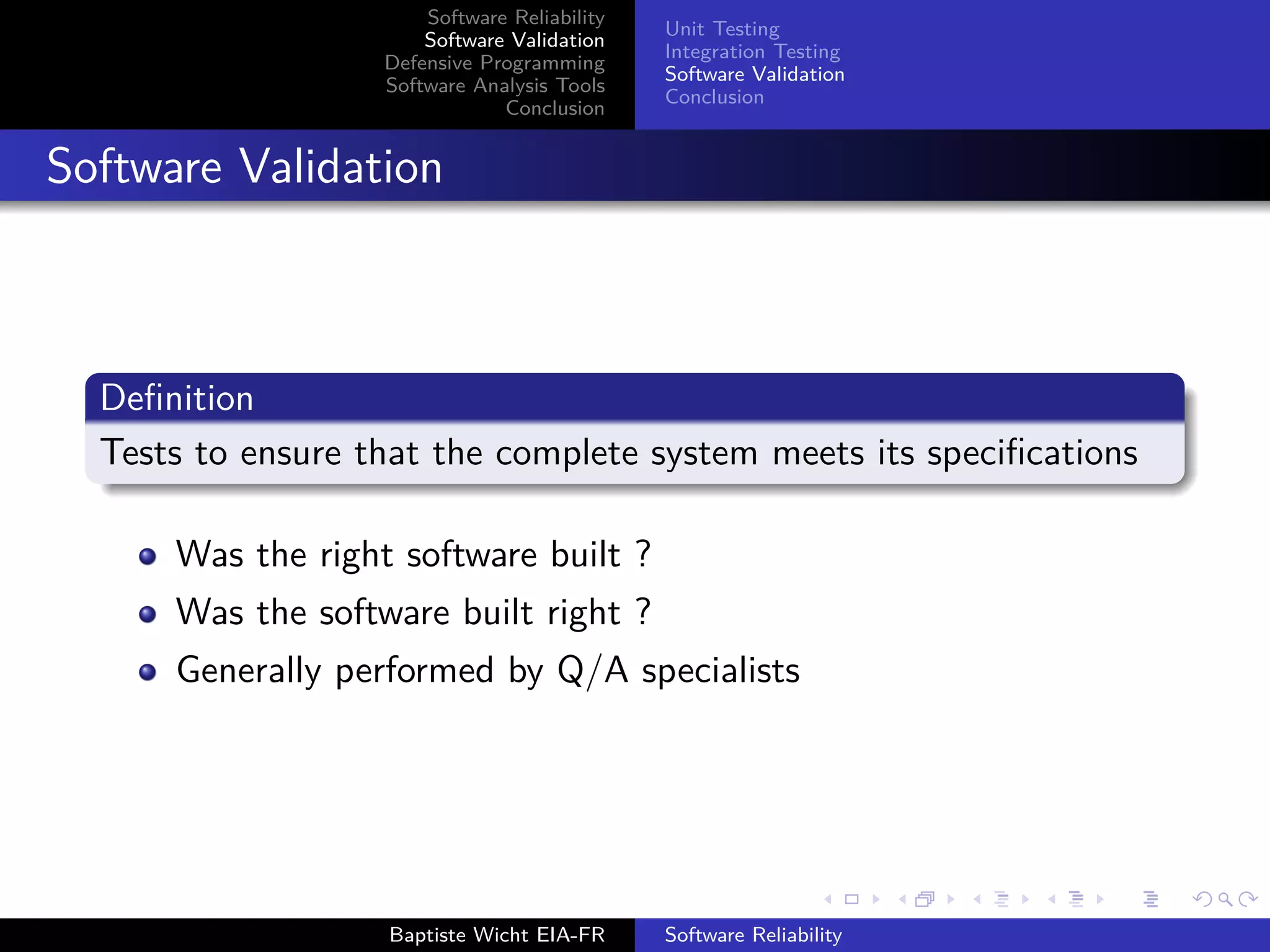
Software Validation
Definition
Tests to ensure that the complete system meets its specifications
Was the right software built ?
Was the software built right ?
Generally performed by Q/A specialists
Baptiste Wicht EIA-FR Software Reliability
Software Reliability
Software Validation
Defensive Programming
Software Analysis Tools
Conclusion
Unit Testing
Integration Testing
Software Validation
Conclusion
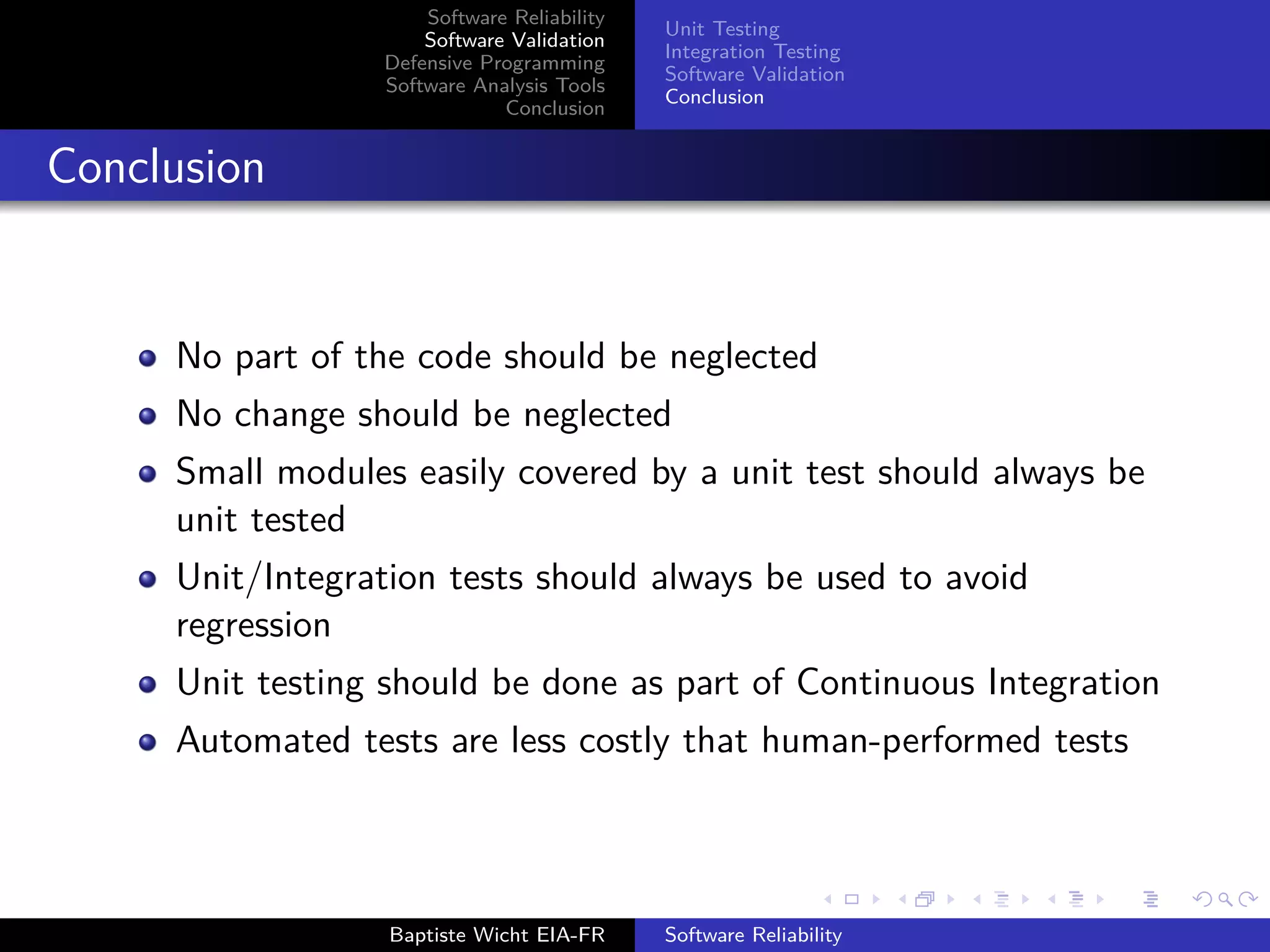
Conclusion
No part of the code should be neglected
No change should be neglected
Small modules easily covered by a unit test should always be
unit tested
Unit/Integration tests should always be used to avoid
regression
Unit testing should be done as part of Continuous Integration
Automated tests are less costly that human-performed tests
Baptiste Wicht EIA-FR Software Reliability
Software Reliability
Software Validation
Defensive Programming
Software Analysis Tools
Conclusion
Language Features
Contract Programming
Conclusion
Contents
1 Software Reliability
2 Software Validation
3 Defensive Programming
Language Features
Contract Programming
Conclusion
4 Software Analysis Tools
5 Conclusion
Baptiste Wicht EIA-FR Software Reliability
Software Reliability
Software Validation
Defensive Programming
Software Analysis Tools
Conclusion
Language Features
Contract Programming
Conclusion
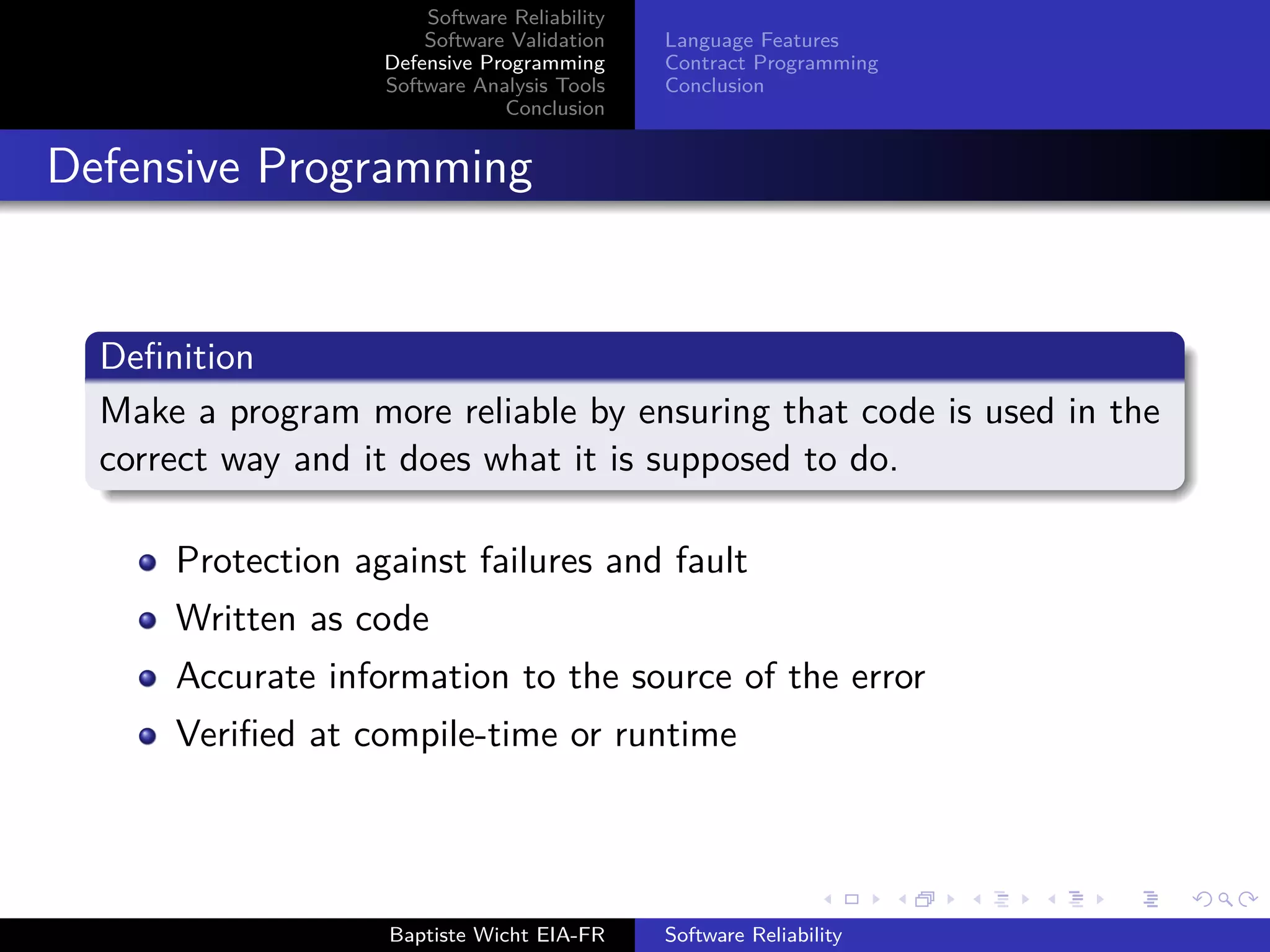
Defensive Programming
Definition
Make a program more reliable by ensuring that code is used in the
correct way and it does what it is supposed to do.
Protection against failures and fault
Written as code
Accurate information to the source of the error
Verified at compile-time or runtime
Baptiste Wicht EIA-FR Software Reliability
Software Reliability
Software Validation
Defensive Programming
Software Analysis Tools
Conclusion
Language Features
Contract Programming
Conclusion
Language Features
Different languages provide different level of security
int array [100];
int b = array [100]; // What should happen ?
Baptiste Wicht EIA-FR Software Reliability
Software Reliability
Software Validation
Defensive Programming
Software Analysis Tools
Conclusion
Language Features
Contract Programming
Conclusion
Language Features
Different languages provide different level of security
int array [100];
int b = array [100]; // What should happen ?
C/C++: Undefined
Java/Python: Runtime error
Generally: lower level ⇒ harder to debug
Baptiste Wicht EIA-FR Software Reliability
Software Reliability
Software Validation
Defensive Programming
Software Analysis Tools
Conclusion
Language Features
Contract Programming
Conclusion
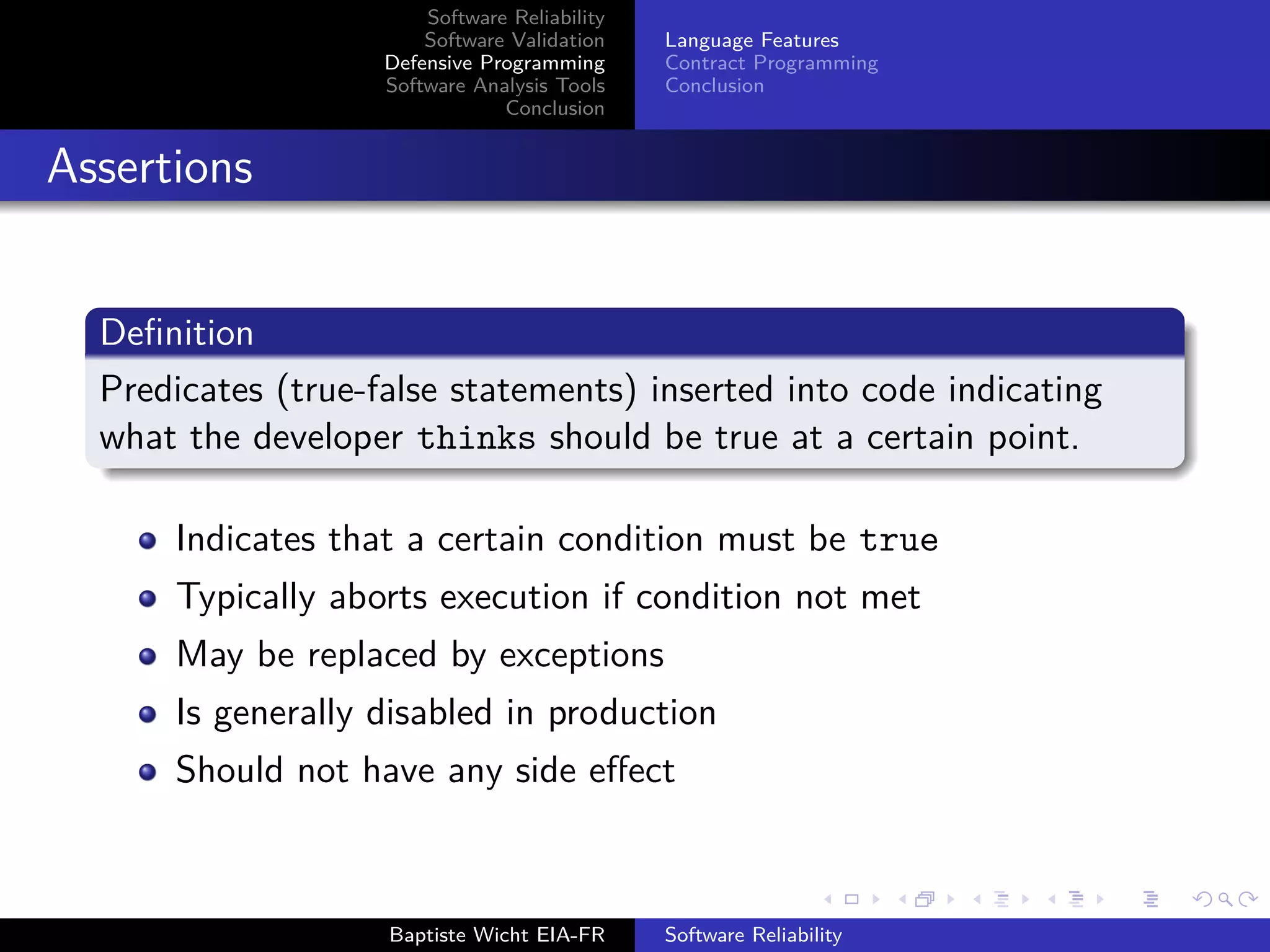
Assertions
Definition
Predicates (true-false statements) inserted into code indicating
what the developer thinks should be true at a certain point.
Indicates that a certain condition must be true
Typically aborts execution if condition not met
May be replaced by exceptions
Is generally disabled in production
Should not have any side effect
Baptiste Wicht EIA-FR Software Reliability
Software Reliability
Software Validation
Defensive Programming
Software Analysis Tools
Conclusion
Language Features
Contract Programming
Conclusion
Assertions (cont.d)
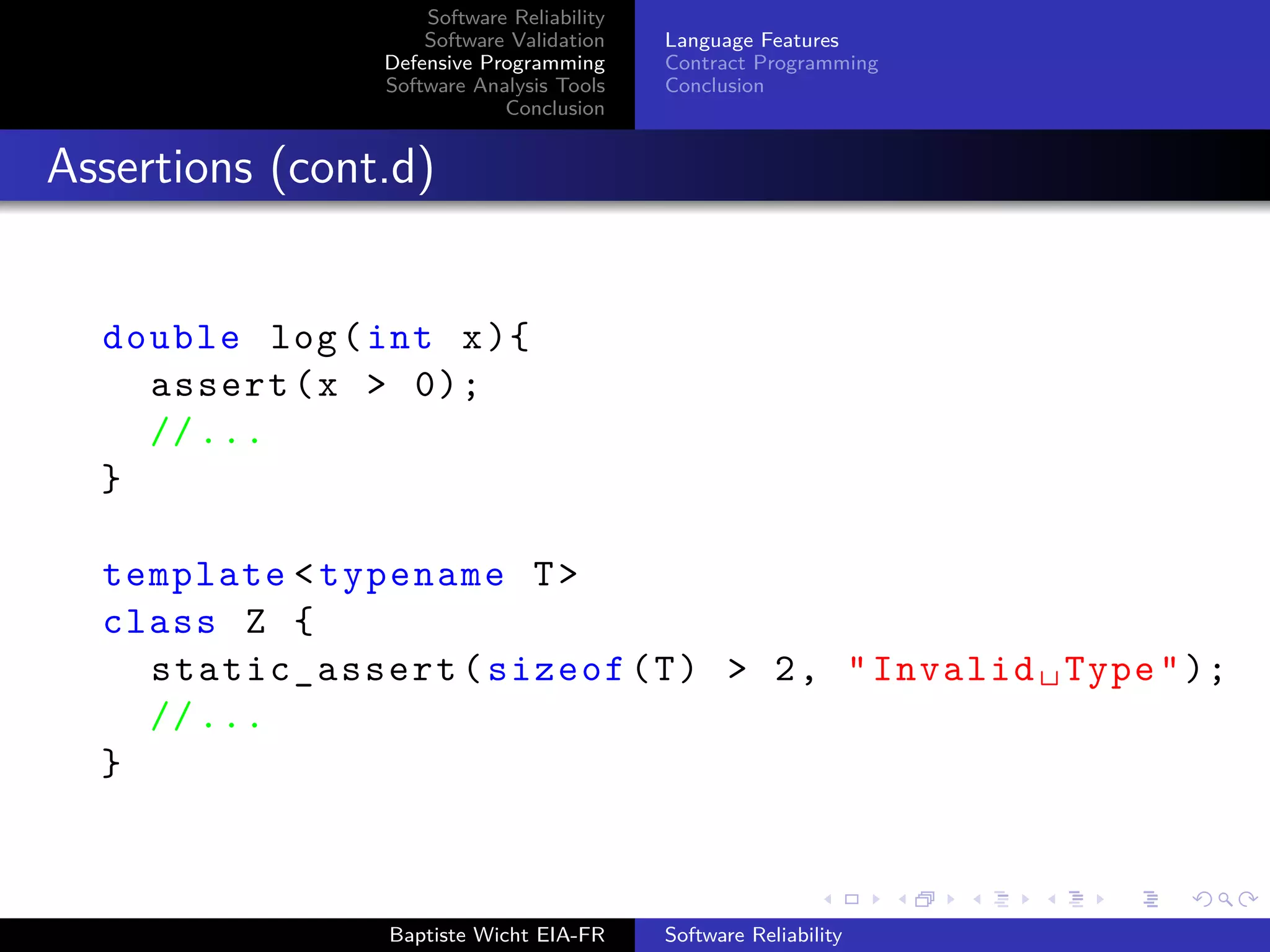
double log(int x){
assert(x > 0);
//...
}
template <typename T>
class Z {
static_assert(sizeof(T) > 2, "Invalid␣Type");
//...
}
Baptiste Wicht EIA-FR Software Reliability
Software Reliability
Software Validation
Defensive Programming
Software Analysis Tools
Conclusion
Language Features
Contract Programming
Conclusion
Assertions (cont.d)
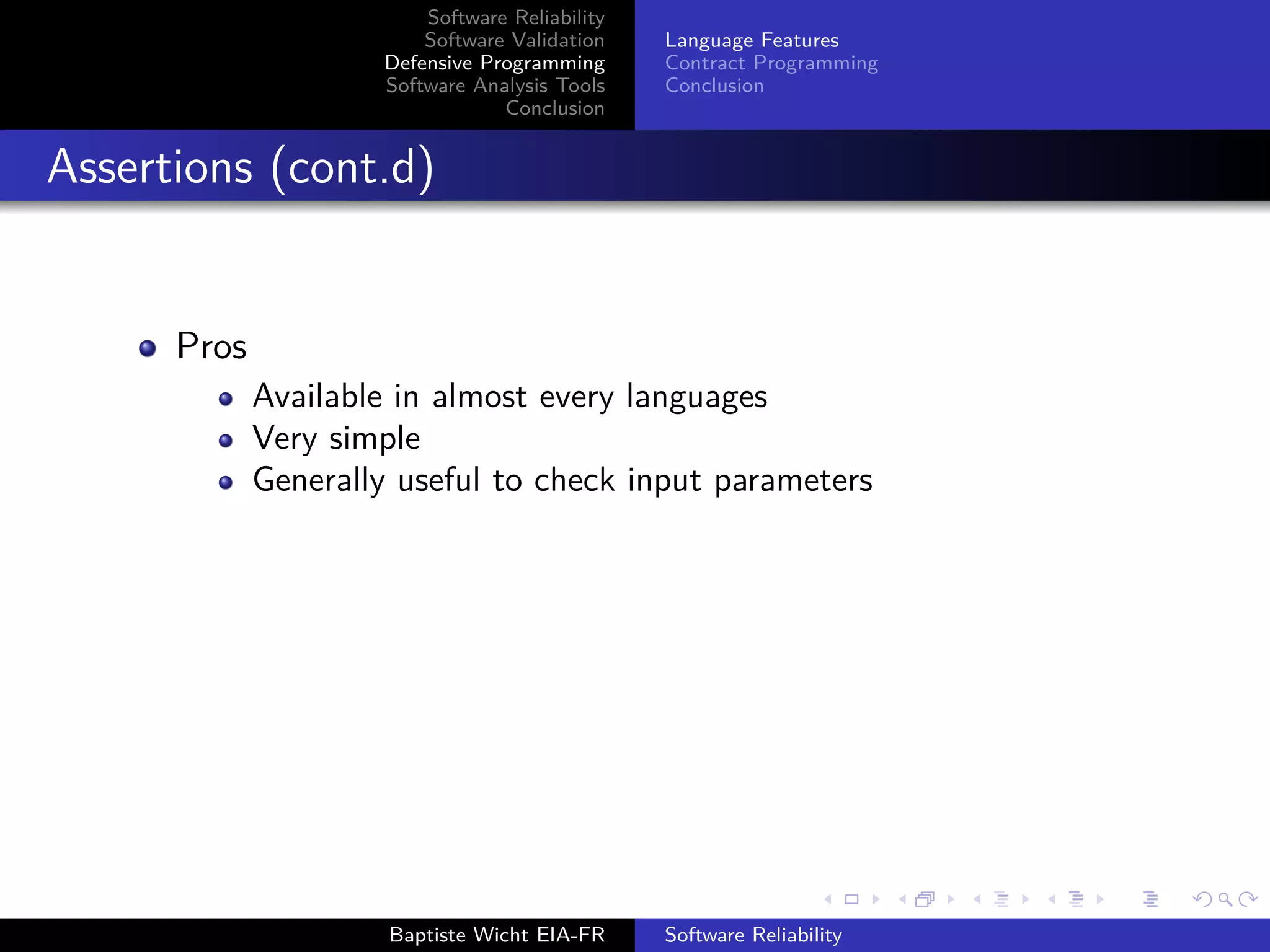
Pros
Available in almost every languages
Very simple
Generally useful to check input parameters
Baptiste Wicht EIA-FR Software Reliability
Software Reliability
Software Validation
Defensive Programming
Software Analysis Tools
Conclusion
Language Features
Contract Programming
Conclusion
Assertions (cont.d)
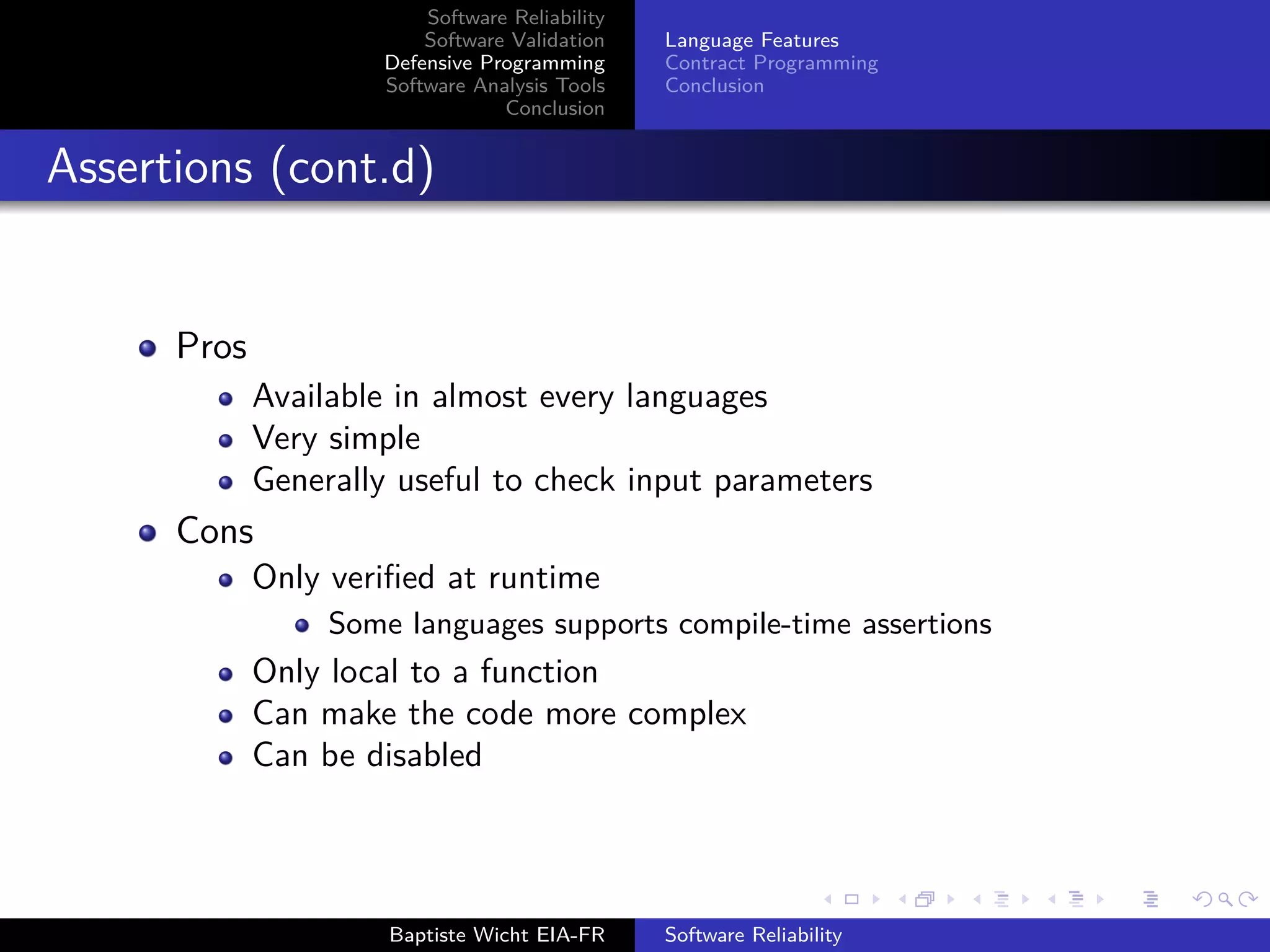
Pros
Available in almost every languages
Very simple
Generally useful to check input parameters
Cons
Only verified at runtime
Some languages supports compile-time assertions
Only local to a function
Can make the code more complex
Can be disabled
Baptiste Wicht EIA-FR Software Reliability
Software Reliability
Software Validation
Defensive Programming
Software Analysis Tools
Conclusion
Language Features
Contract Programming
Conclusion
Contract Programming
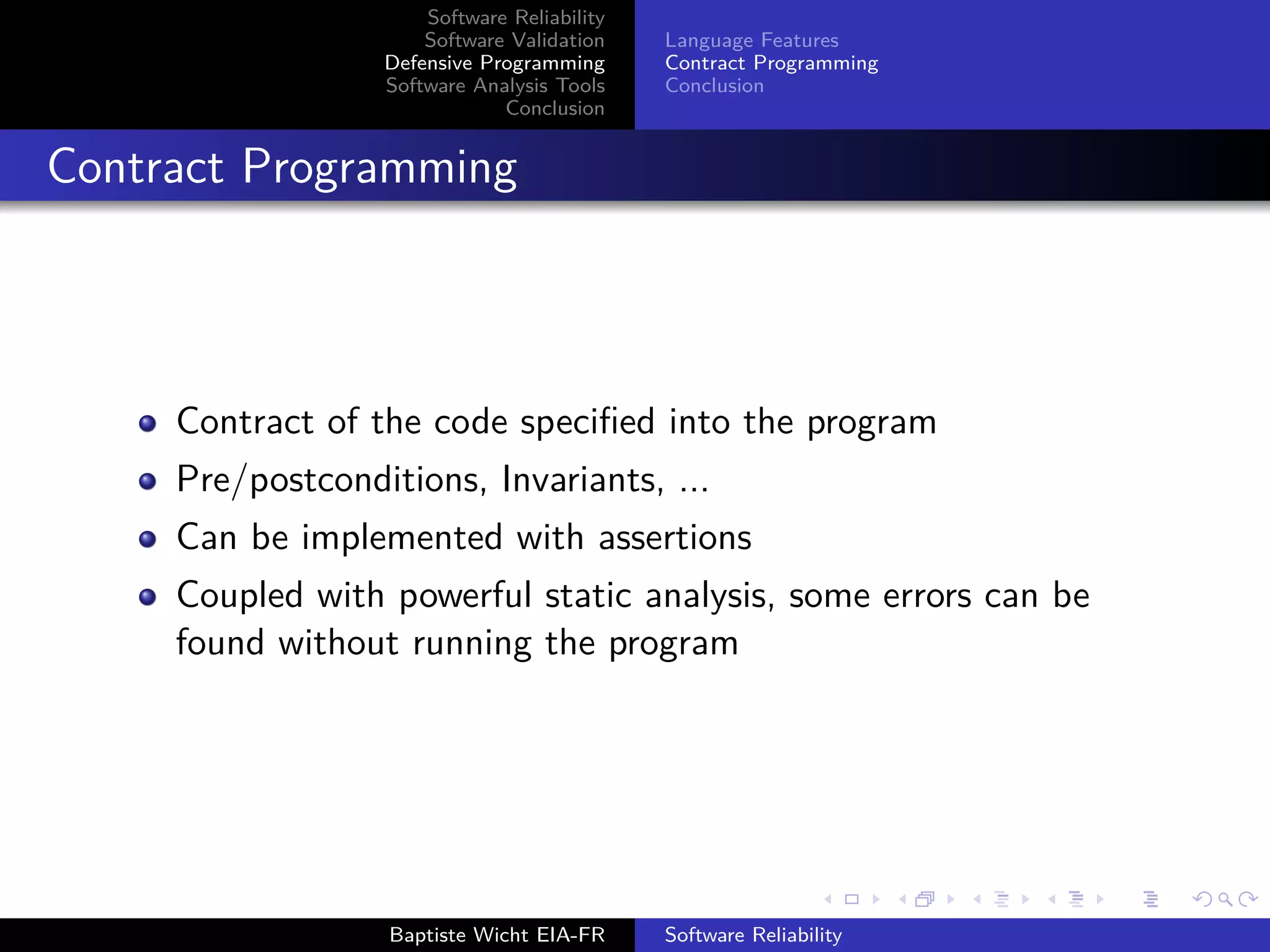
Contract of the code specified into the program
Pre/postconditions, Invariants, ...
Can be implemented with assertions
Coupled with powerful static analysis, some errors can be
found without running the program
Baptiste Wicht EIA-FR Software Reliability
Software Reliability
Software Validation
Defensive Programming
Software Analysis Tools
Conclusion
Language Features
Contract Programming
Conclusion
Conclusion
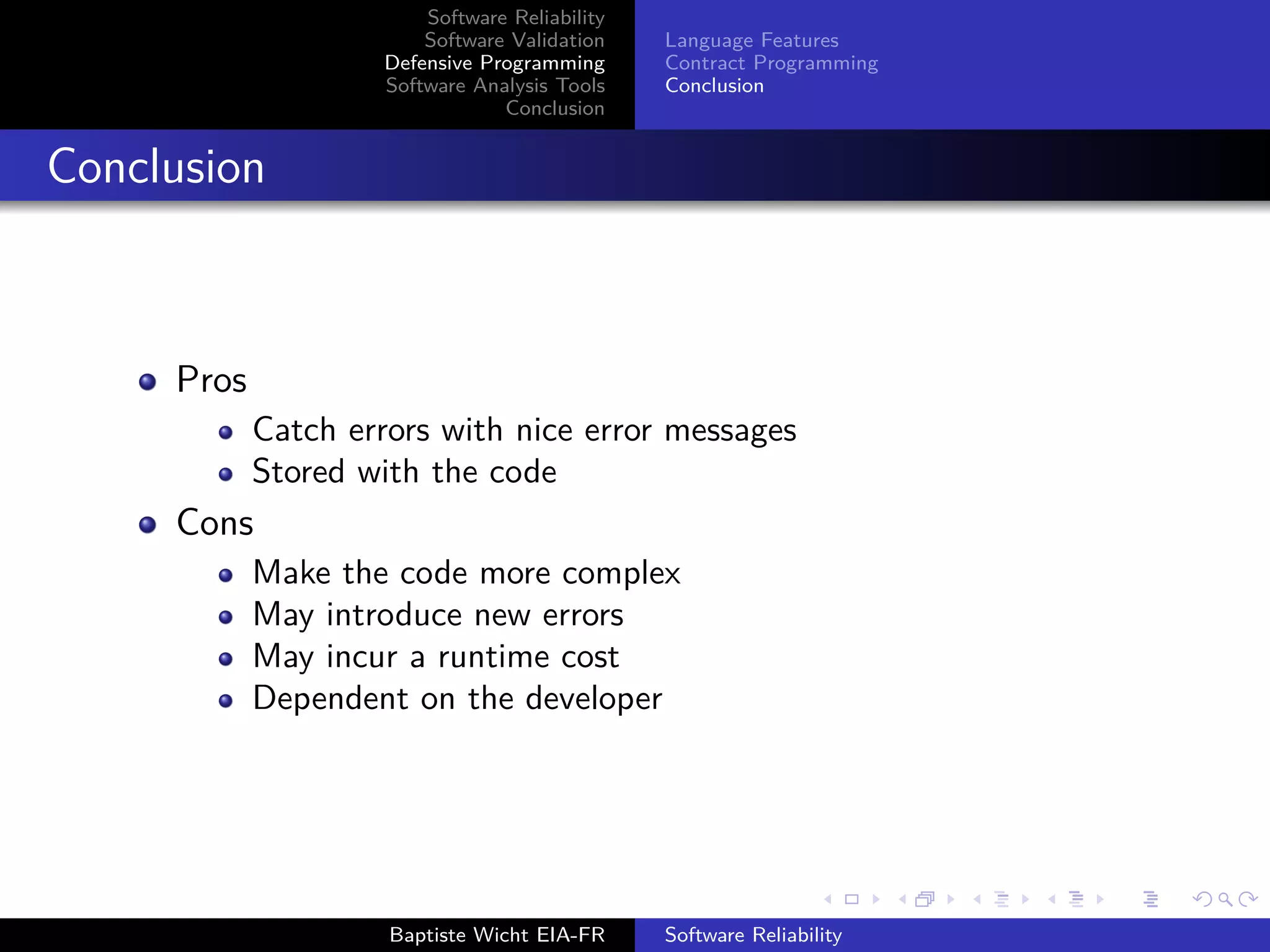
Pros
Catch errors with nice error messages
Stored with the code
Cons
Make the code more complex
May introduce new errors
May incur a runtime cost
Dependent on the developer
Baptiste Wicht EIA-FR Software Reliability
Software Reliability
Software Validation
Defensive Programming
Software Analysis Tools
Conclusion
Compilers
Tools
Exercises
SonarQube
Conclusion
Contents
1 Software Reliability
2 Software Validation
3 Defensive Programming
4 Software Analysis Tools
Compilers
Tools
Exercises
SonarQube
Conclusion
5 Conclusion
Baptiste Wicht EIA-FR Software Reliability
Software Reliability
Software Validation
Defensive Programming
Software Analysis Tools
Conclusion
Compilers
Tools
Exercises
SonarQube
Conclusion
Software Analysis Tools
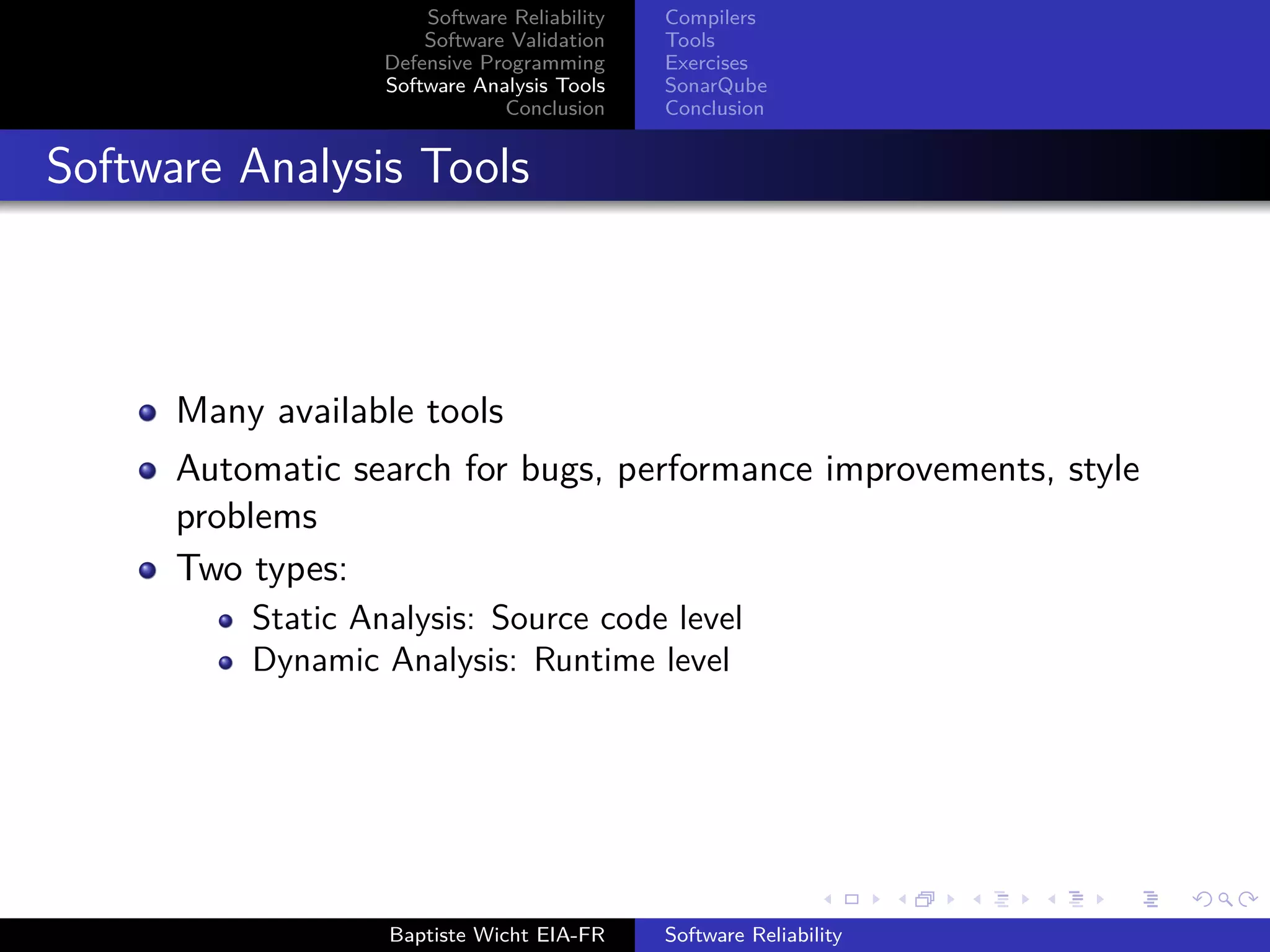
Many available tools
Automatic search for bugs, performance improvements, style
problems
Two types:
Static Analysis: Source code level
Dynamic Analysis: Runtime level
Baptiste Wicht EIA-FR Software Reliability
Software Reliability
Software Validation
Defensive Programming
Software Analysis Tools
Conclusion
Compilers
Tools
Exercises
SonarQube
Conclusion
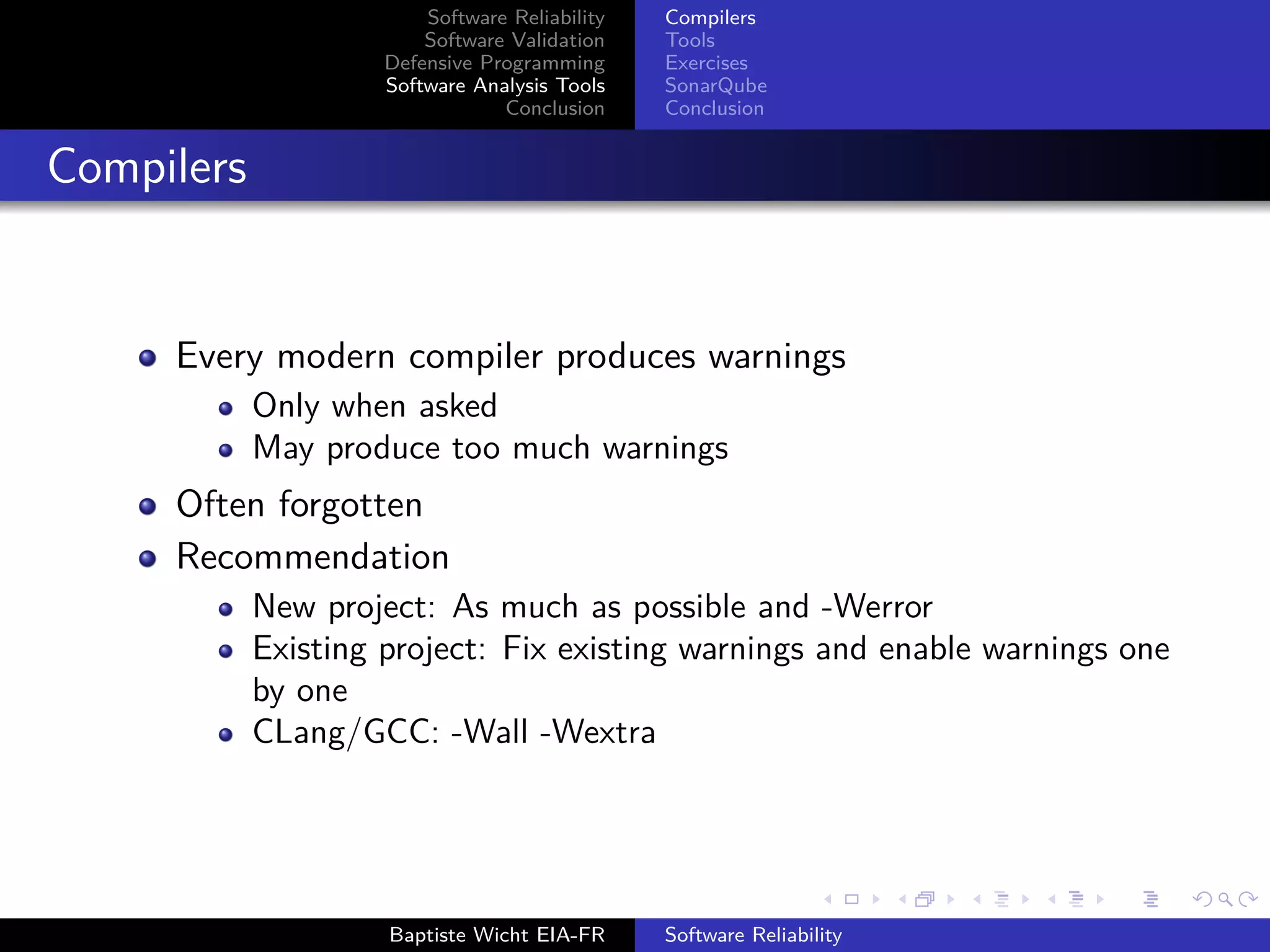
Compilers
Every modern compiler produces warnings
Only when asked
May produce too much warnings
Often forgotten
Recommendation
New project: As much as possible and -Werror
Existing project: Fix existing warnings and enable warnings one
by one
CLang/GCC: -Wall -Wextra
Baptiste Wicht EIA-FR Software Reliability
Software Reliability
Software Validation
Defensive Programming
Software Analysis Tools
Conclusion
Compilers
Tools
Exercises
SonarQube
Conclusion
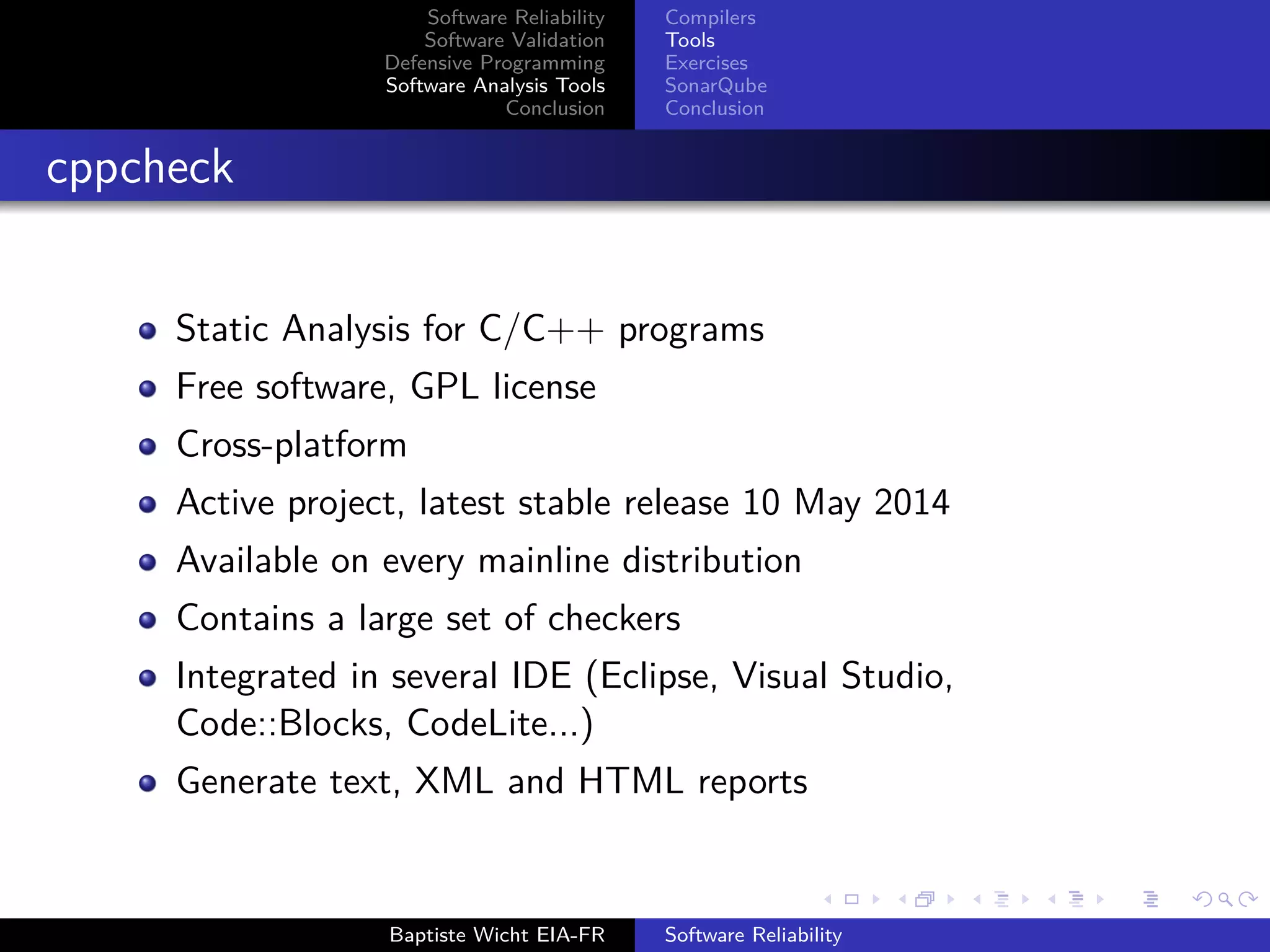
cppcheck
Static Analysis for C/C++ programs
Free software, GPL license
Cross-platform
Active project, latest stable release 10 May 2014
Available on every mainline distribution
Contains a large set of checkers
Integrated in several IDE (Eclipse, Visual Studio,
Code::Blocks, CodeLite...)
Generate text, XML and HTML reports
Baptiste Wicht EIA-FR Software Reliability
Software Reliability
Software Validation
Defensive Programming
Software Analysis Tools
Conclusion
Compilers
Tools
Exercises
SonarQube
Conclusion
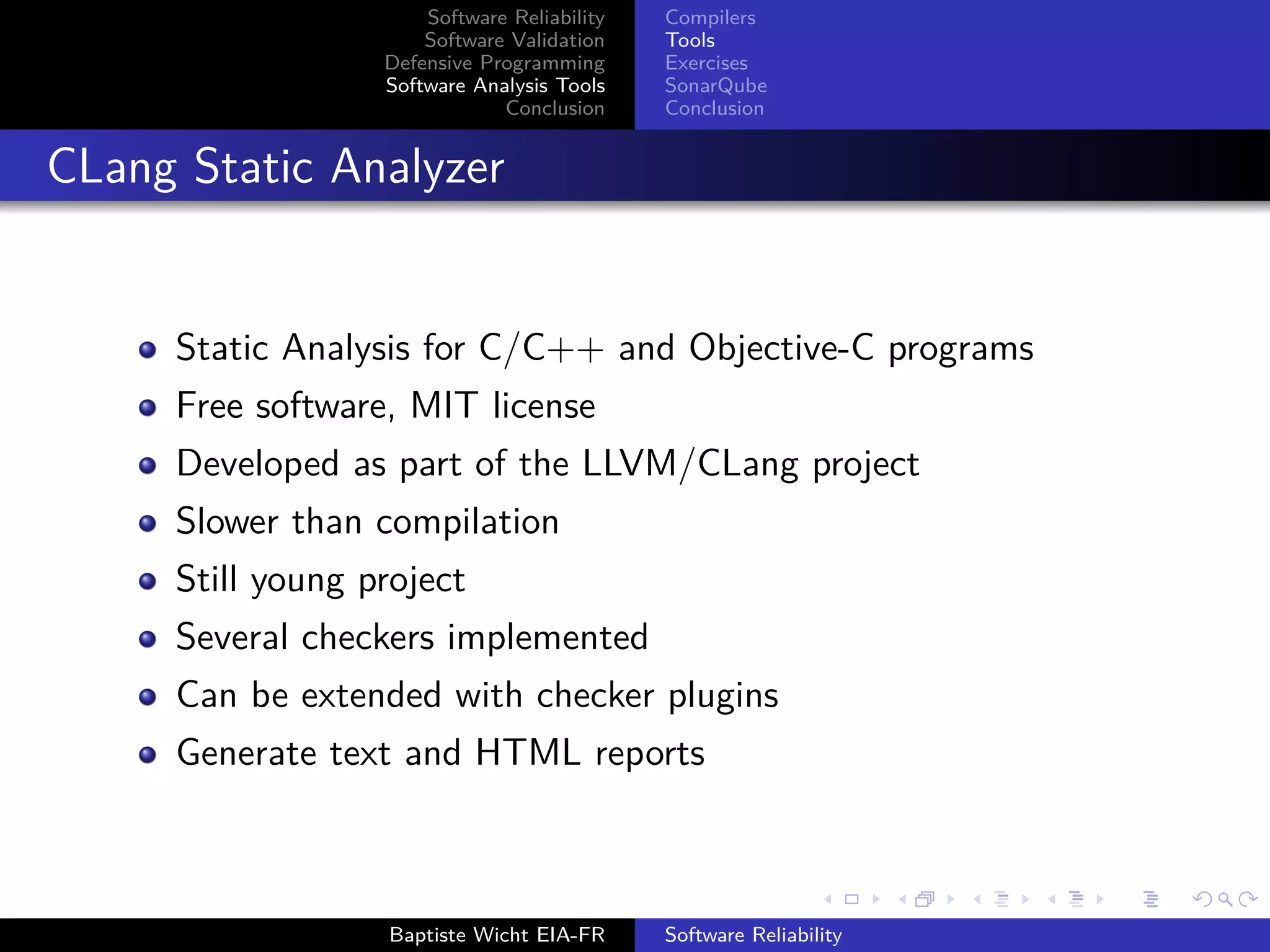
CLang Static Analyzer
Static Analysis for C/C++ and Objective-C programs
Free software, MIT license
Developed as part of the LLVM/CLang project
Slower than compilation
Still young project
Several checkers implemented
Can be extended with checker plugins
Generate text and HTML reports
Baptiste Wicht EIA-FR Software Reliability
Software Reliability
Software Validation
Defensive Programming
Software Analysis Tools
Conclusion
Compilers
Tools
Exercises
SonarQube
Conclusion
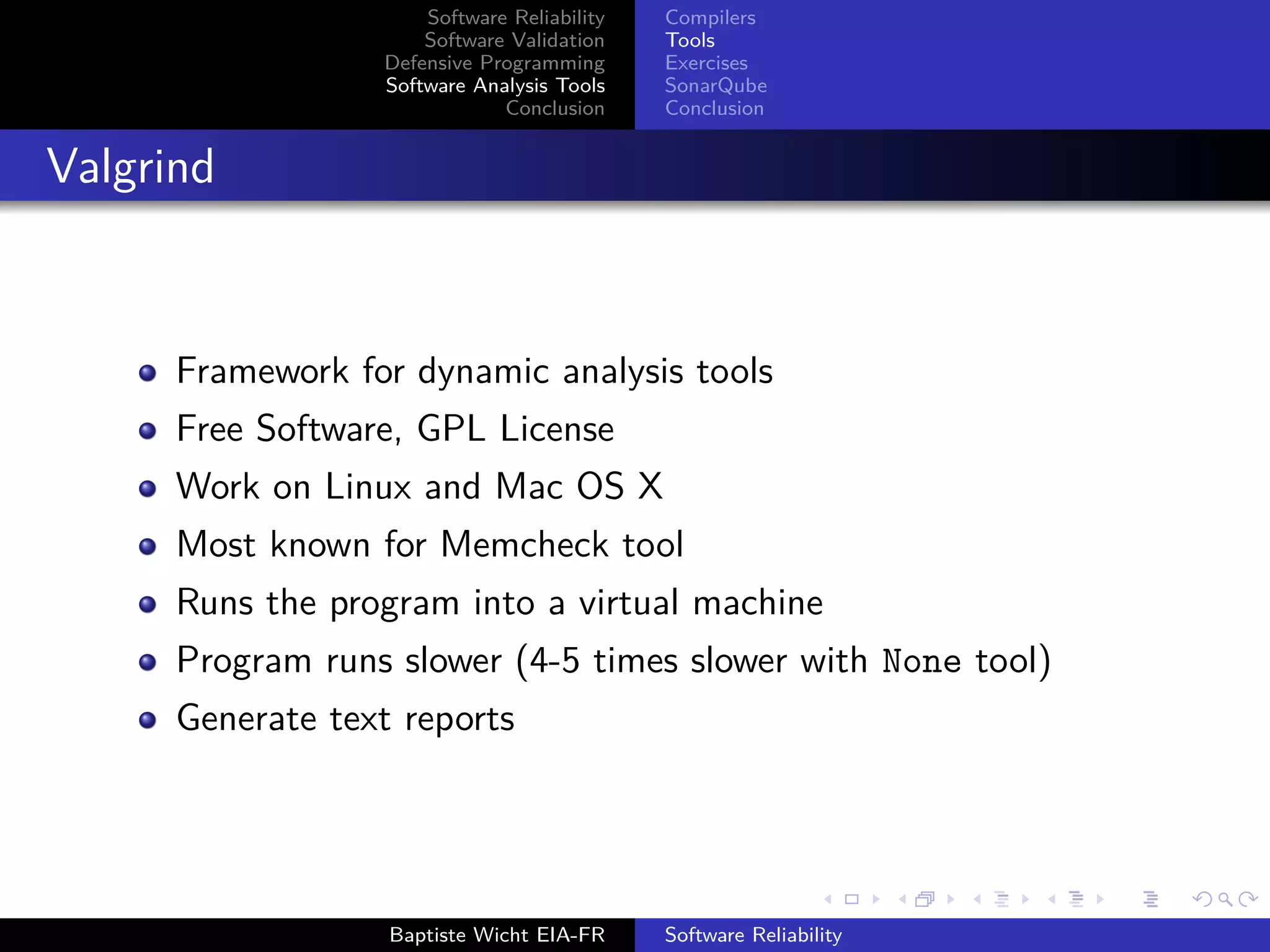
Valgrind
Framework for dynamic analysis tools
Free Software, GPL License
Work on Linux and Mac OS X
Most known for Memcheck tool
Runs the program into a virtual machine
Program runs slower (4-5 times slower with None tool)
Generate text reports
Baptiste Wicht EIA-FR Software Reliability
Software Reliability
Software Validation
Defensive Programming
Software Analysis Tools
Conclusion
Compilers
Tools
Exercises
SonarQube
Conclusion
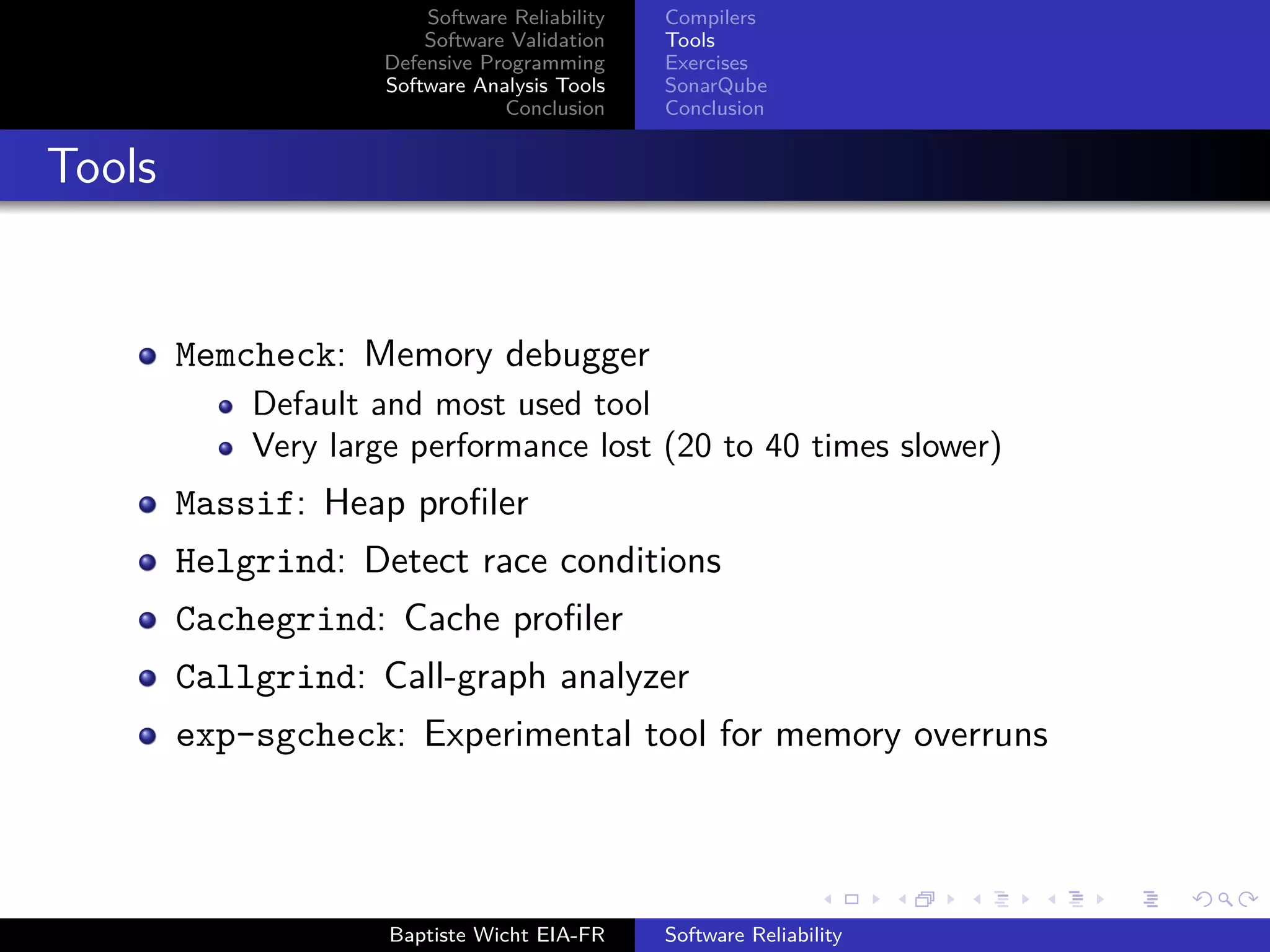
Tools
Memcheck: Memory debugger
Default and most used tool
Very large performance lost (20 to 40 times slower)
Massif: Heap profiler
Helgrind: Detect race conditions
Cachegrind: Cache profiler
Callgrind: Call-graph analyzer
exp-sgcheck: Experimental tool for memory overruns
Baptiste Wicht EIA-FR Software Reliability
Software Reliability
Software Validation
Defensive Programming
Software Analysis Tools
Conclusion
Compilers
Tools
Exercises
SonarQube
Conclusion
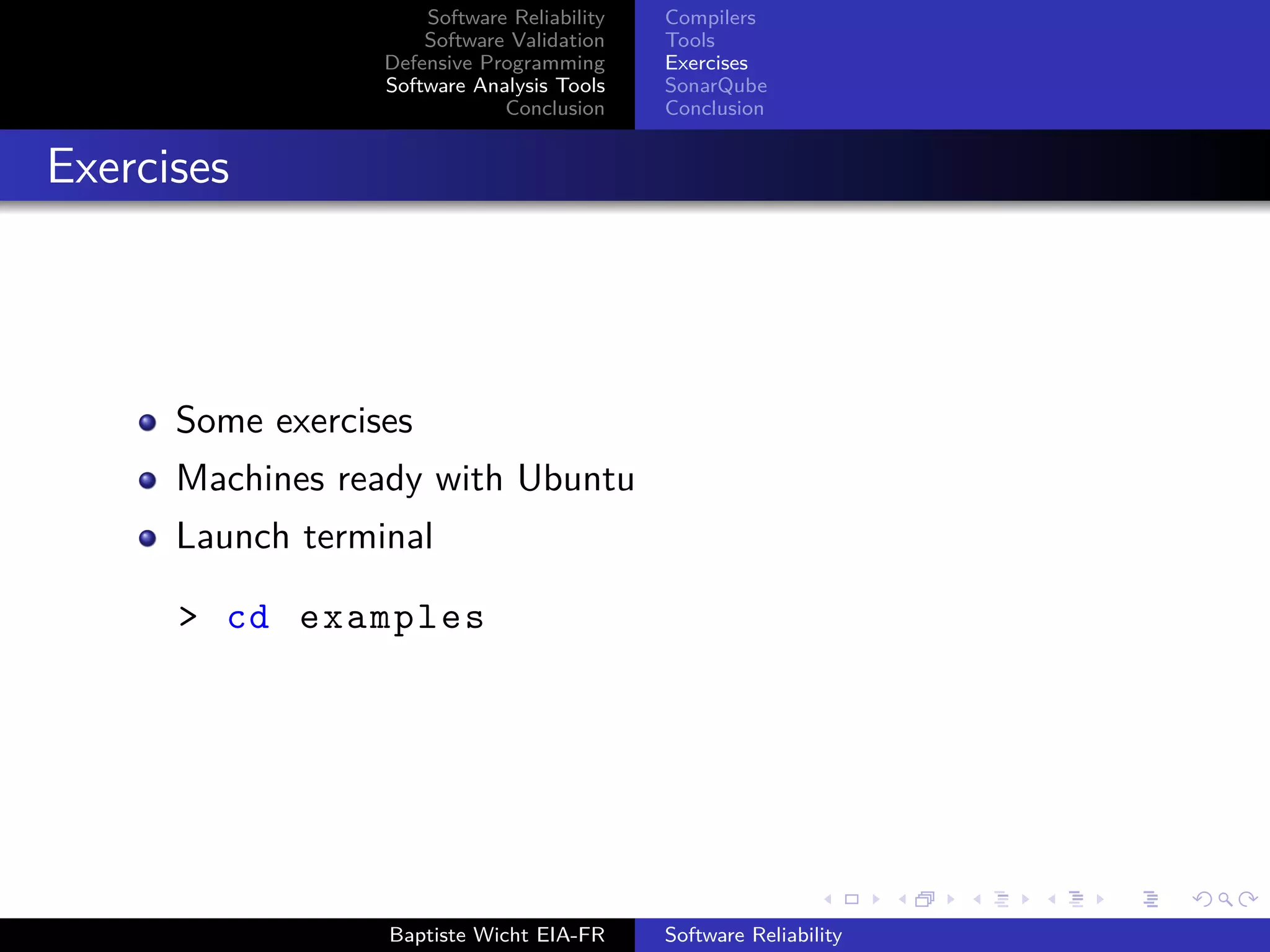
Exercises
Some exercises
Machines ready with Ubuntu
Launch terminal
> cd examples
Baptiste Wicht EIA-FR Software Reliability
Software Reliability
Software Validation
Defensive Programming
Software Analysis Tools
Conclusion
Compilers
Tools
Exercises
SonarQube
Conclusion
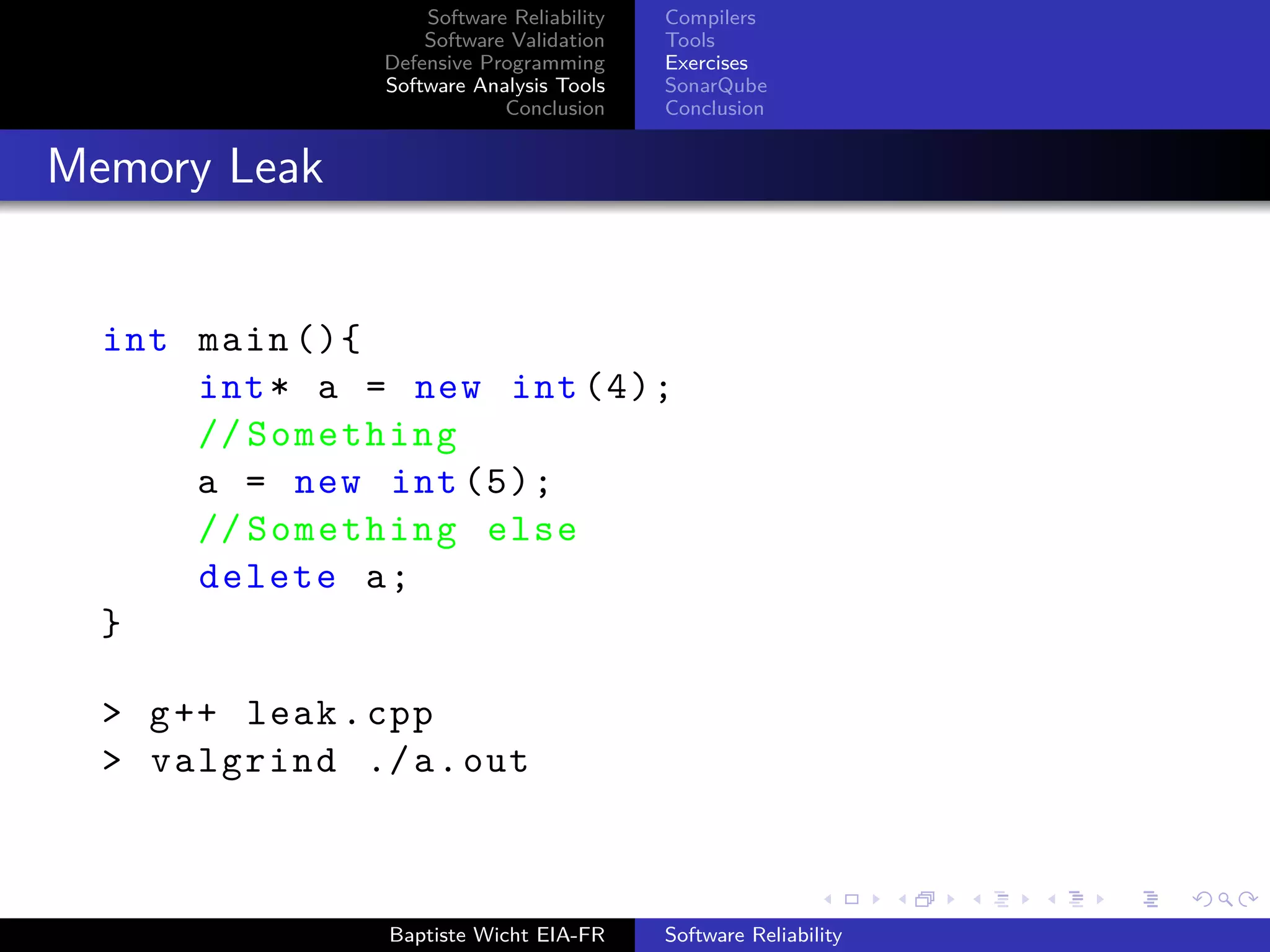
Memory Leak
int main (){
int* a = new int (4);
// Something
a = new int (5);
// Something else
delete a;
}
> g++ leak.cpp
> valgrind ./a.out
Baptiste Wicht EIA-FR Software Reliability
Software Reliability
Software Validation
Defensive Programming
Software Analysis Tools
Conclusion
Compilers
Tools
Exercises
SonarQube
Conclusion
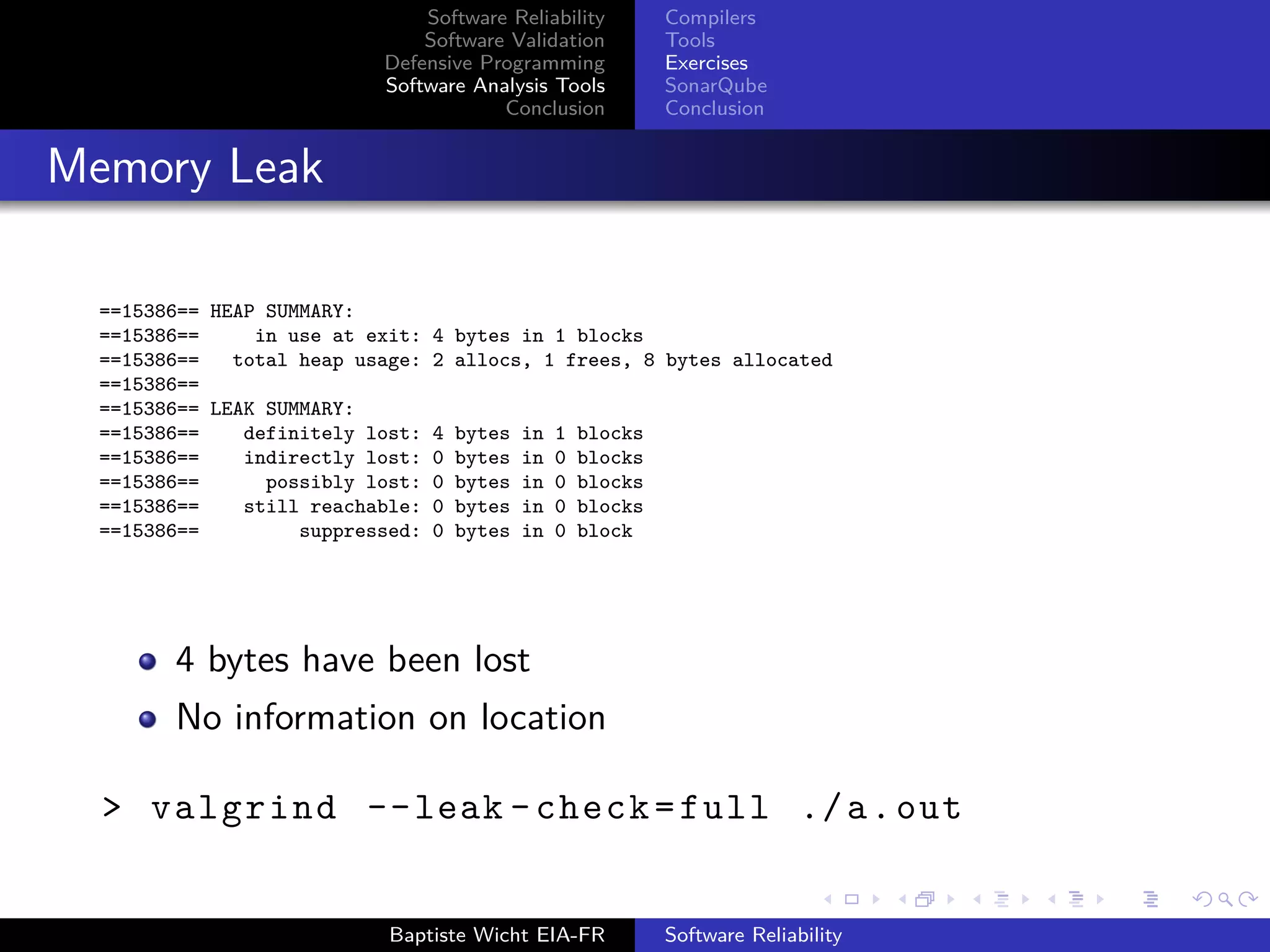
Memory Leak
==15386== HEAP SUMMARY:
==15386== in use at exit: 4 bytes in 1 blocks
==15386== total heap usage: 2 allocs, 1 frees, 8 bytes allocated
==15386==
==15386== LEAK SUMMARY:
==15386== definitely lost: 4 bytes in 1 blocks
==15386== indirectly lost: 0 bytes in 0 blocks
==15386== possibly lost: 0 bytes in 0 blocks
==15386== still reachable: 0 bytes in 0 blocks
==15386== suppressed: 0 bytes in 0 block
4 bytes have been lost
No information on location
> valgrind --leak -check=full ./a.out
Baptiste Wicht EIA-FR Software Reliability
Software Reliability
Software Validation
Defensive Programming
Software Analysis Tools
Conclusion
Compilers
Tools
Exercises
SonarQube
Conclusion
Memory Leak
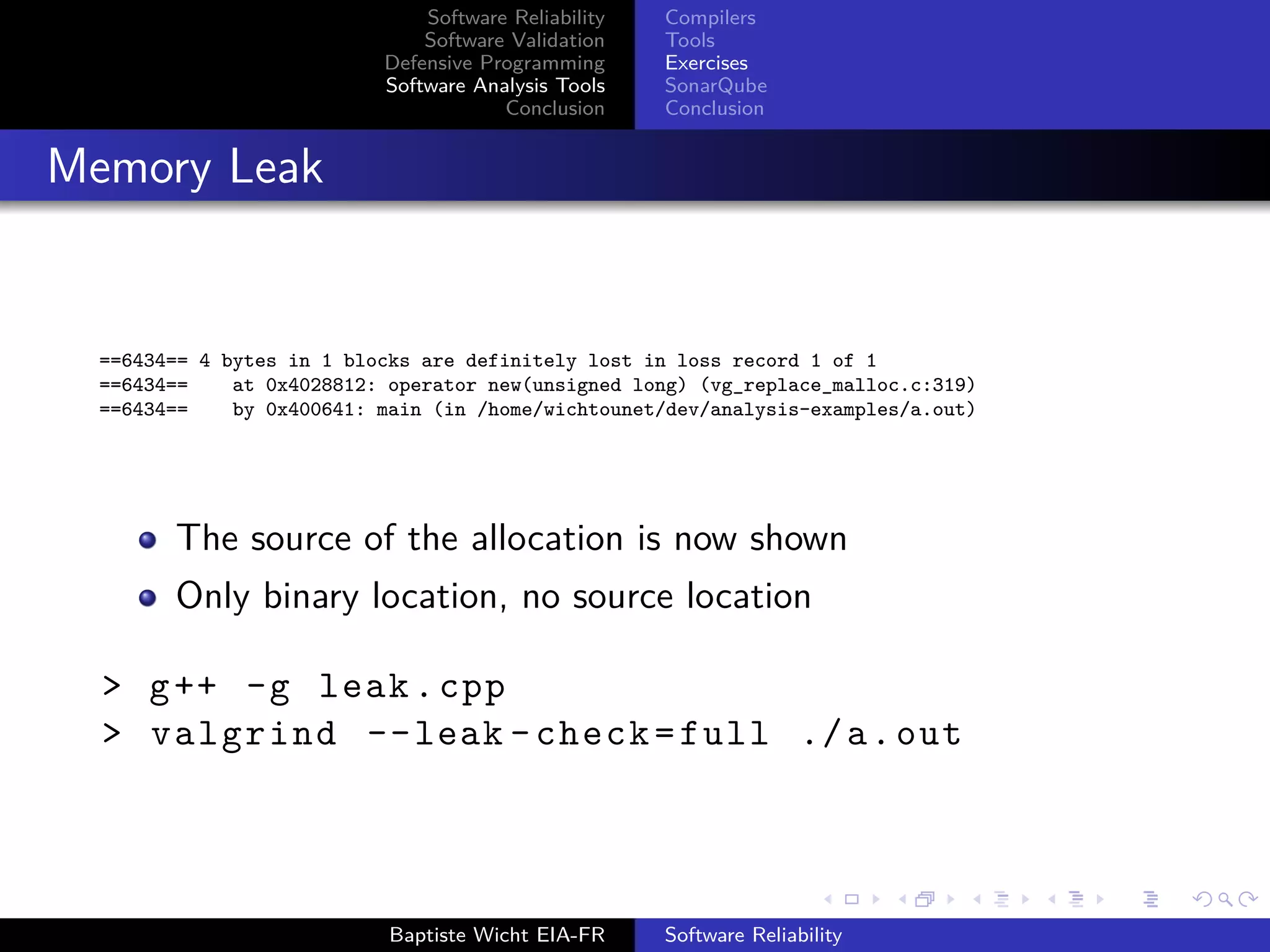
==6434== 4 bytes in 1 blocks are definitely lost in loss record 1 of 1
==6434== at 0x4028812: operator new(unsigned long) (vg_replace_malloc.c:319)
==6434== by 0x400641: main (in /home/wichtounet/dev/analysis-examples/a.out)
The source of the allocation is now shown
Only binary location, no source location
> g++ -g leak.cpp
> valgrind --leak -check=full ./a.out
Baptiste Wicht EIA-FR Software Reliability
Software Reliability
Software Validation
Defensive Programming
Software Analysis Tools
Conclusion
Compilers
Tools
Exercises
SonarQube
Conclusion
Memory Leak
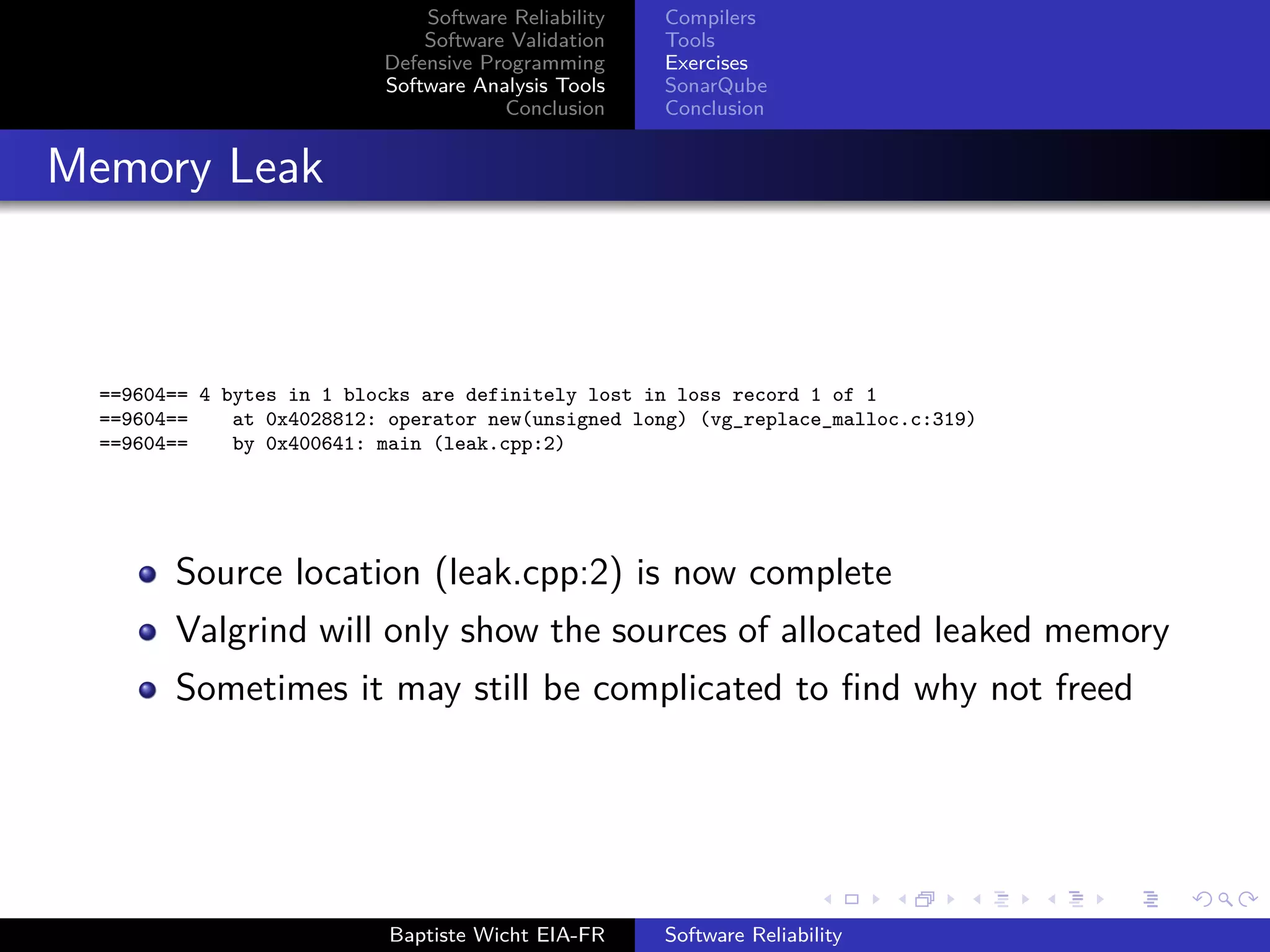
==9604== 4 bytes in 1 blocks are definitely lost in loss record 1 of 1
==9604== at 0x4028812: operator new(unsigned long) (vg_replace_malloc.c:319)
==9604== by 0x400641: main (leak.cpp:2)
Source location (leak.cpp:2) is now complete
Valgrind will only show the sources of allocated leaked memory
Sometimes it may still be complicated to find why not freed
Baptiste Wicht EIA-FR Software Reliability
Software Reliability
Software Validation
Defensive Programming
Software Analysis Tools
Conclusion
Compilers
Tools
Exercises
SonarQube
Conclusion
Heap Overrun
int main (){
int* heap = new int [5];
heap [5] = 42;
delete [] heap;
return 0;
}
> g++ -g heap_overrun.cpp
> valgrind ./a.out
Baptiste Wicht EIA-FR Software Reliability
Software Reliability
Software Validation
Defensive Programming
Software Analysis Tools
Conclusion
Compilers
Tools
Exercises
SonarQube
Conclusion
Heap Overrun
==16922== Invalid write of size 4
==16922== at 0x40064E: main (heap_overrun.cpp:4)
==16922== Address 0x50c4054 is 0 bytes after a block of size 20 alloc’d
==16922== at 0x4028F40: operator new[](unsigned long) (vg_replace_malloc.c:384)
==16922== by 0x400641: main (heap_overrun.cpp:2)
Source location of the invalid write (heap overrun.cpp:4)
Source location of the allocation (heap overrun.cpp:2)
> valgrind --leak -check=full ./a.out
Baptiste Wicht EIA-FR Software Reliability
Software Reliability
Software Validation
Defensive Programming
Software Analysis Tools
Conclusion
Compilers
Tools
Exercises
SonarQube
Conclusion
Stack Overrun
int main (){
int i, a[10];
for (i = 0; i <= 10; i++)
a[i] = 42;
return 0;
}
> g++ -g stack_overrun.cpp
> valgrind ./a.out
Baptiste Wicht EIA-FR Software Reliability
Software Reliability
Software Validation
Defensive Programming
Software Analysis Tools
Conclusion
Compilers
Tools
Exercises
SonarQube
Conclusion
Stack Overrun
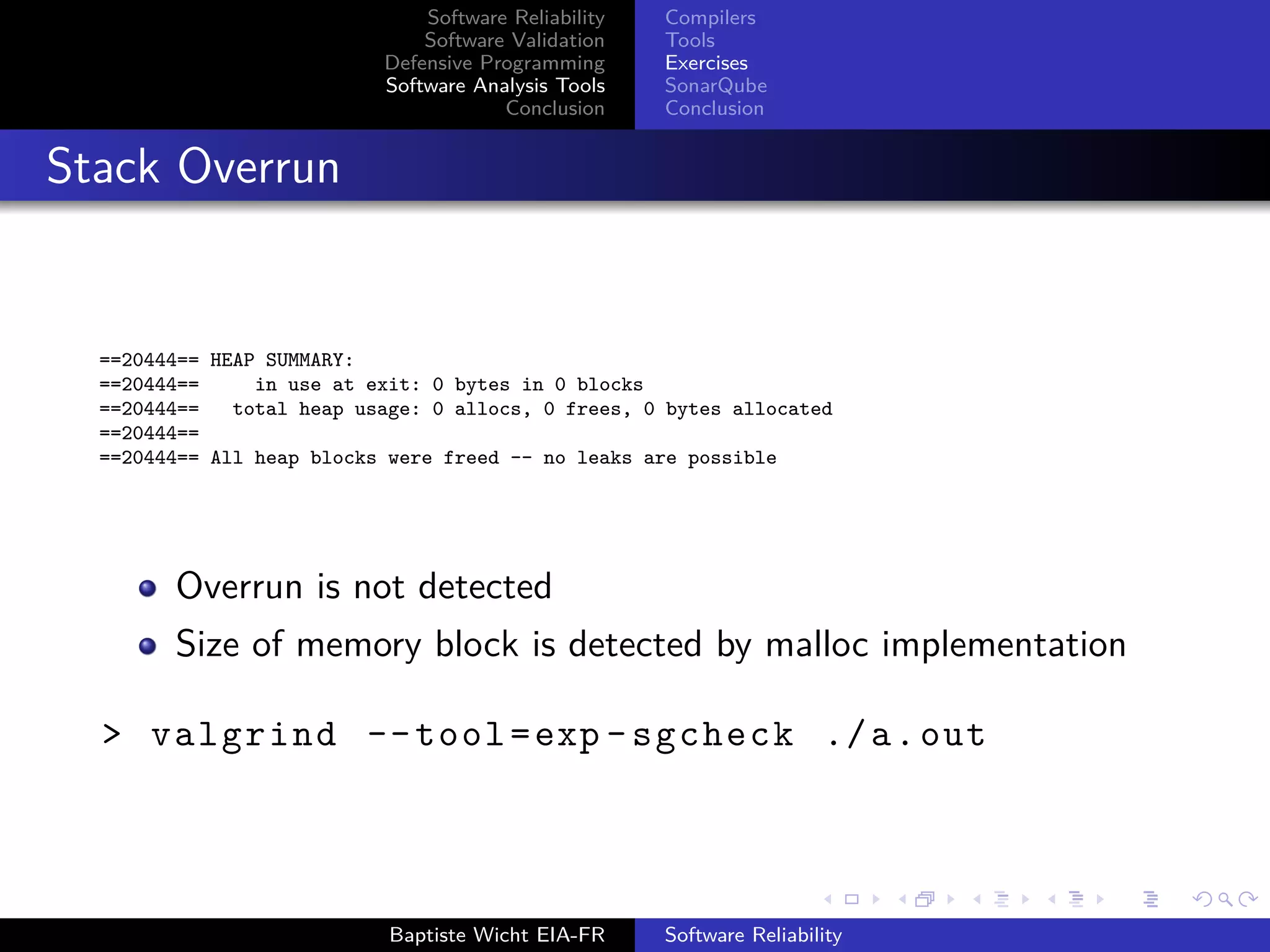
==20444== HEAP SUMMARY:
==20444== in use at exit: 0 bytes in 0 blocks
==20444== total heap usage: 0 allocs, 0 frees, 0 bytes allocated
==20444==
==20444== All heap blocks were freed -- no leaks are possible
Overrun is not detected
Size of memory block is detected by malloc implementation
> valgrind --tool=exp -sgcheck ./a.out
Baptiste Wicht EIA-FR Software Reliability
Software Reliability
Software Validation
Defensive Programming
Software Analysis Tools
Conclusion
Compilers
Tools
Exercises
SonarQube
Conclusion
Stack Overrun
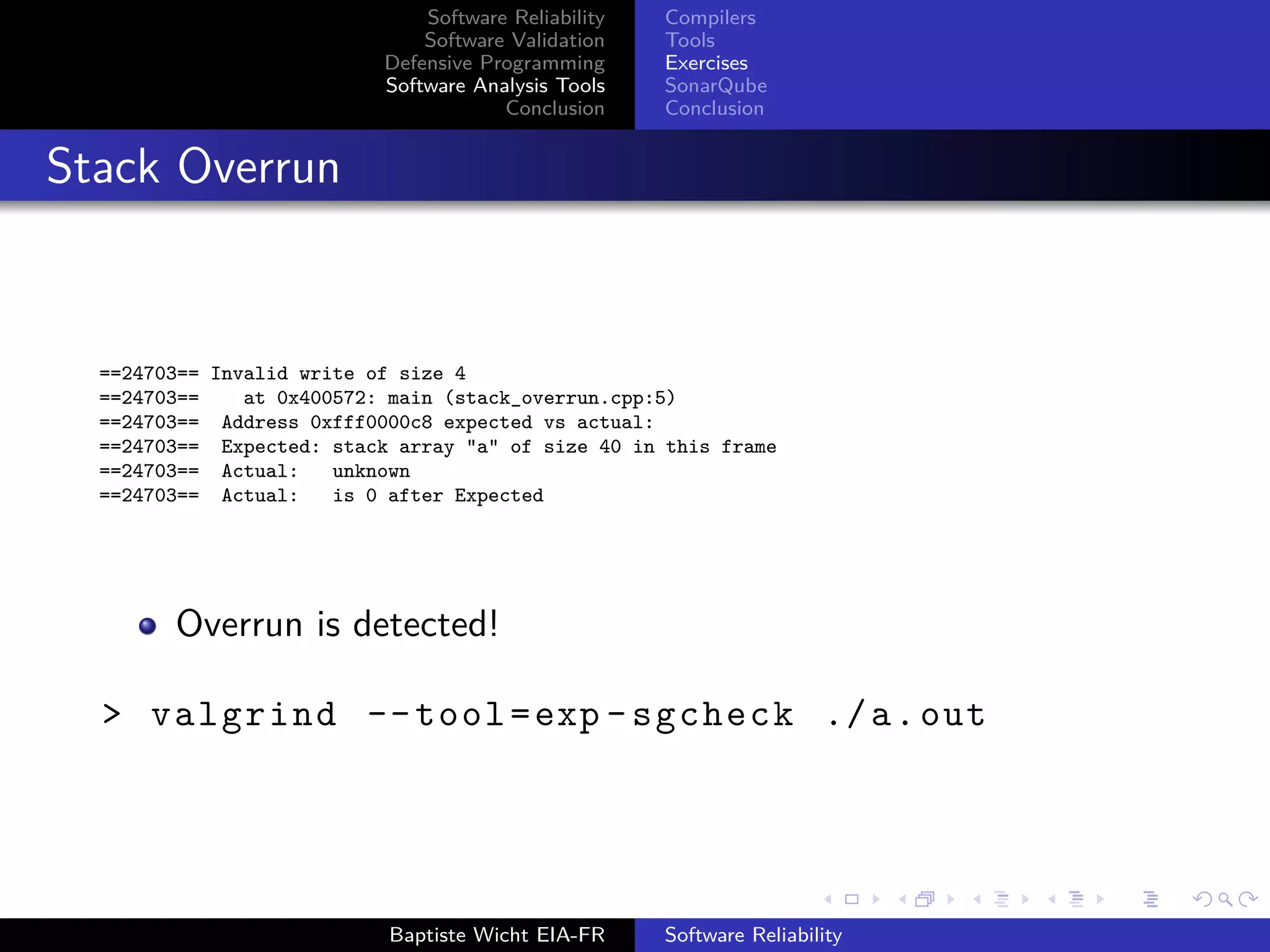
==24703== Invalid write of size 4
==24703== at 0x400572: main (stack_overrun.cpp:5)
==24703== Address 0xfff0000c8 expected vs actual:
==24703== Expected: stack array "a" of size 40 in this frame
==24703== Actual: unknown
==24703== Actual: is 0 after Expected
Overrun is detected!
> valgrind --tool=exp -sgcheck ./a.out
Baptiste Wicht EIA-FR Software Reliability
Software Reliability
Software Validation
Defensive Programming
Software Analysis Tools
Conclusion
Compilers
Tools
Exercises
SonarQube
Conclusion
Stack Overrun 2
int main (){
int stack [5];
stack [5] = 0;
return 0;
}
> g++ -g stack_overrun_2 .cpp
> valgrind --tool=exp -sgcheck ./a.out
Baptiste Wicht EIA-FR Software Reliability
Software Reliability
Software Validation
Defensive Programming
Software Analysis Tools
Conclusion
Compilers
Tools
Exercises
SonarQube
Conclusion
Stack Overrun 2
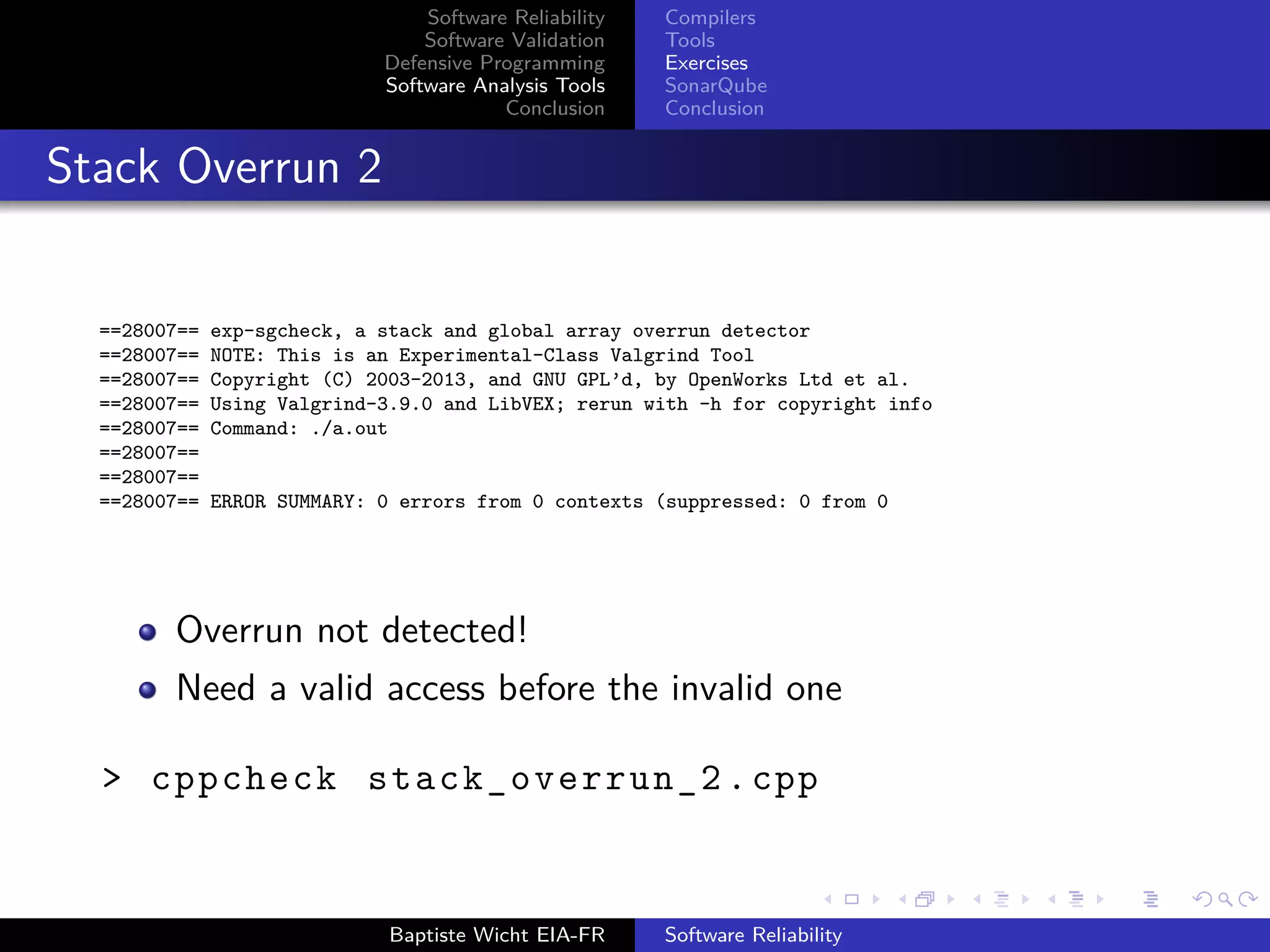
==28007== exp-sgcheck, a stack and global array overrun detector
==28007== NOTE: This is an Experimental-Class Valgrind Tool
==28007== Copyright (C) 2003-2013, and GNU GPL’d, by OpenWorks Ltd et al.
==28007== Using Valgrind-3.9.0 and LibVEX; rerun with -h for copyright info
==28007== Command: ./a.out
==28007==
==28007==
==28007== ERROR SUMMARY: 0 errors from 0 contexts (suppressed: 0 from 0
Overrun not detected!
Need a valid access before the invalid one
> cppcheck stack_overrun_2 .cpp
Baptiste Wicht EIA-FR Software Reliability
Software Reliability
Software Validation
Defensive Programming
Software Analysis Tools
Conclusion
Compilers
Tools
Exercises
SonarQube
Conclusion
Stack Overrun 2
Checking stack_overrun_2.cpp...
[stack_overrun_2.cpp:4]: (error) Array ’stack[5]’ accessed at index 5, which is out of bounds.
Overrun detected!
Tools put together are very powerful
Baptiste Wicht EIA-FR Software Reliability
Software Reliability
Software Validation
Defensive Programming
Software Analysis Tools
Conclusion
Compilers
Tools
Exercises
SonarQube
Conclusion
Complex Memory Leak
int main (){
int* array [42];
for(int i = 0; i < 42; ++i){
array[i] = new int;
}
// Something
for(int i = 0; i < 41; ++i){
delete array[i];
}
}
> cppcheck --enable=all leak_2.cpp
Baptiste Wicht EIA-FR Software Reliability
Software Reliability
Software Validation
Defensive Programming
Software Analysis Tools
Conclusion
Compilers
Tools
Exercises
SonarQube
Conclusion
Complex Memory Leak
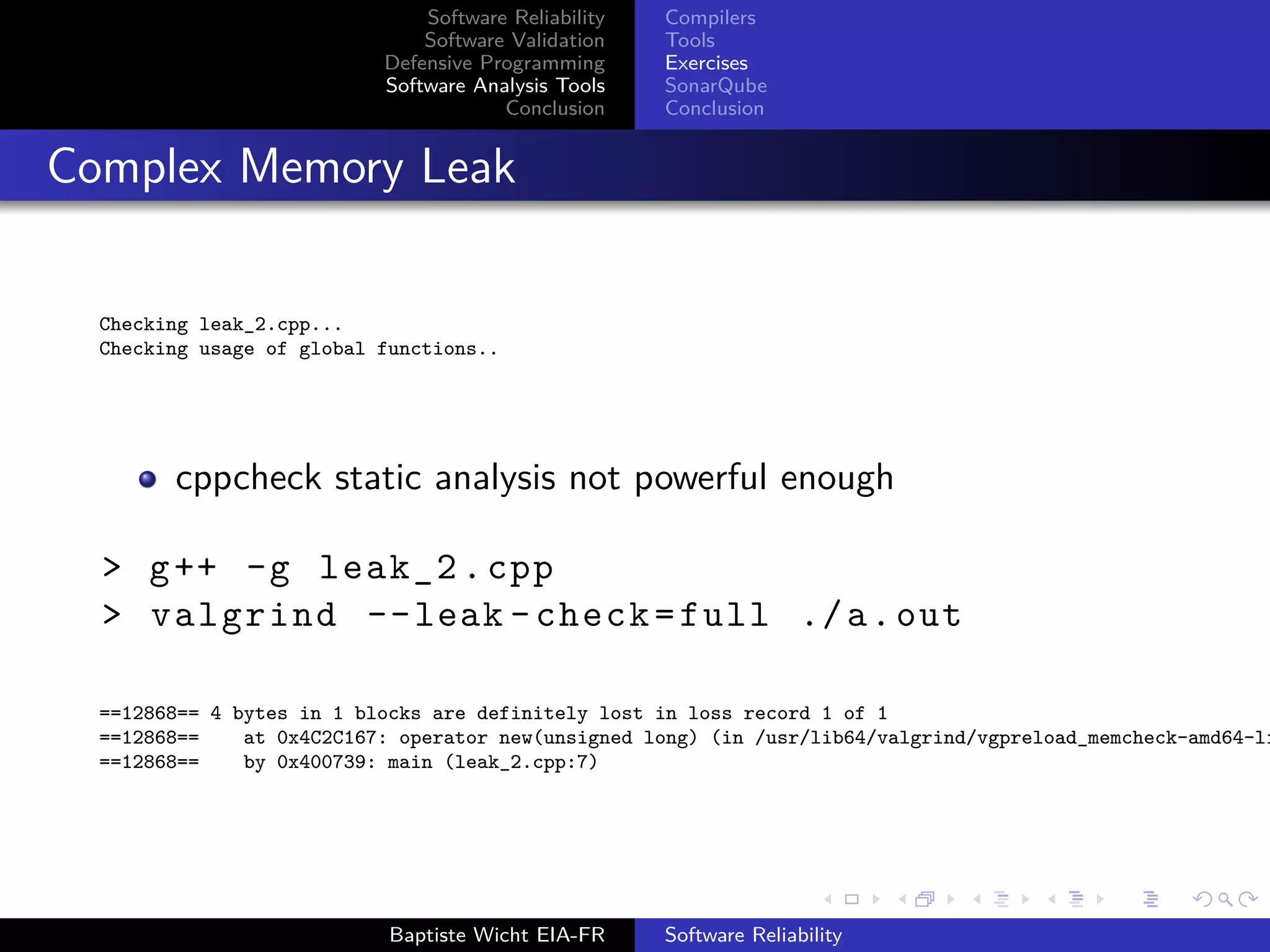
Checking leak_2.cpp...
Checking usage of global functions..
cppcheck static analysis not powerful enough
> g++ -g leak_2.cpp
> valgrind --leak -check=full ./a.out
==12868== 4 bytes in 1 blocks are definitely lost in loss record 1 of 1
==12868== at 0x4C2C167: operator new(unsigned long) (in /usr/lib64/valgrind/vgpreload_memcheck-amd64-li
==12868== by 0x400739: main (leak_2.cpp:7)
Baptiste Wicht EIA-FR Software Reliability
Software Reliability
Software Validation
Defensive Programming
Software Analysis Tools
Conclusion
Compilers
Tools
Exercises
SonarQube
Conclusion
Yet Another Leak
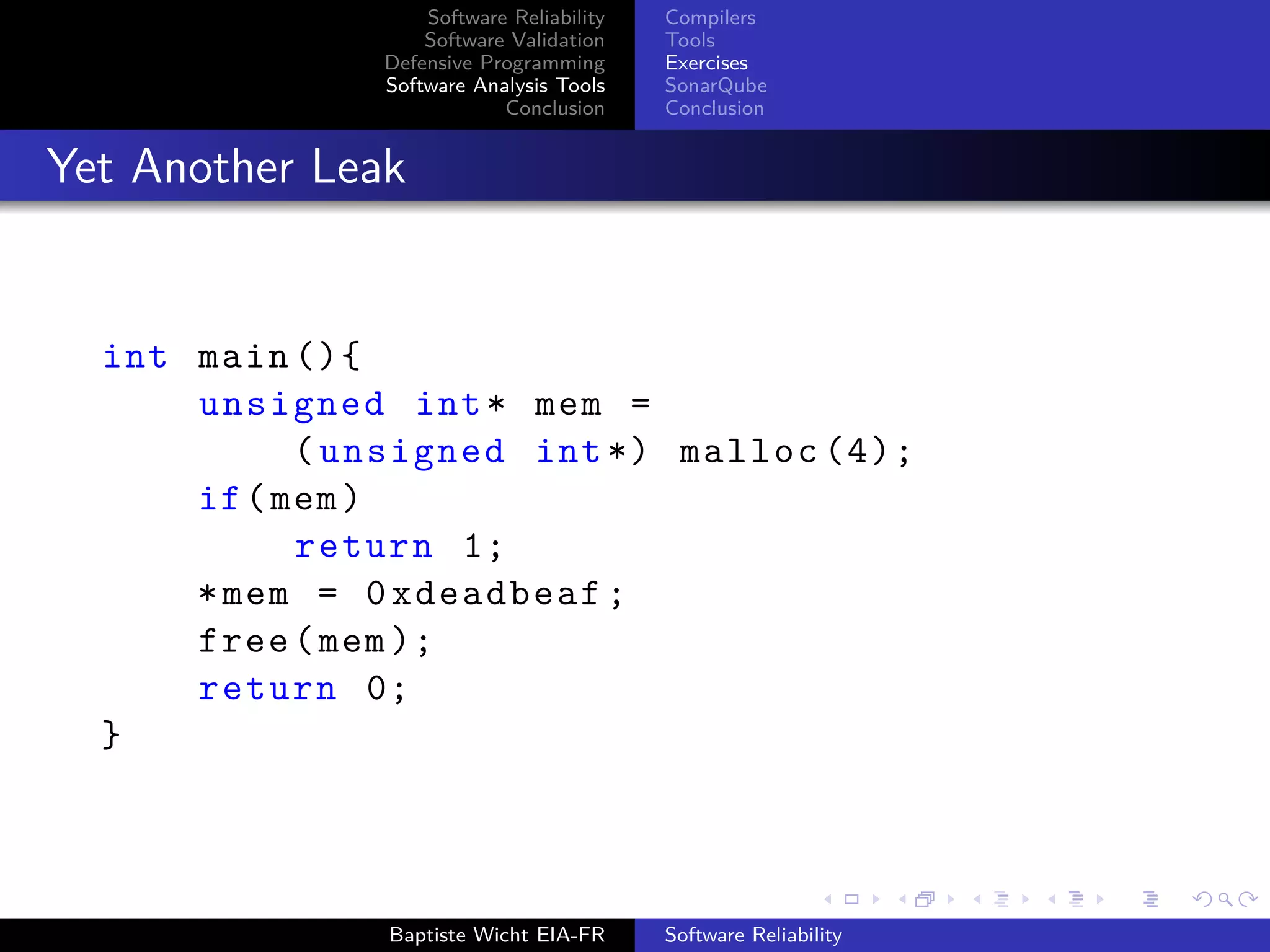
int main (){
unsigned int* mem =
(unsigned int*) malloc (4);
if(mem)
return 1;
*mem = 0xdeadbeaf;
free(mem);
return 0;
}
Baptiste Wicht EIA-FR Software Reliability
Software Reliability
Software Validation
Defensive Programming
Software Analysis Tools
Conclusion
Compilers
Tools
Exercises
SonarQube
Conclusion
Yet Another Leak
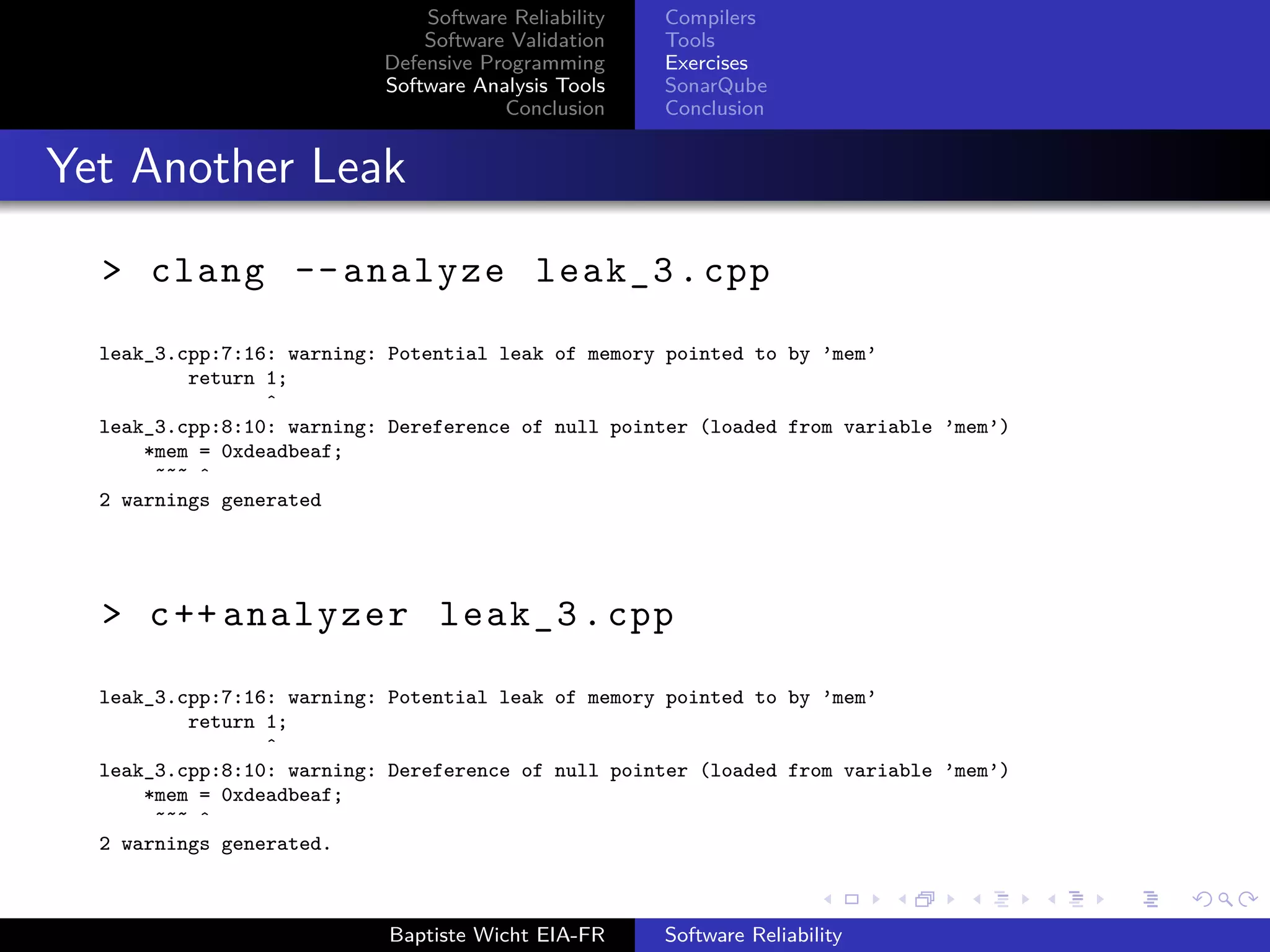
> clang --analyze leak_3.cpp
leak_3.cpp:7:16: warning: Potential leak of memory pointed to by ’mem’
return 1;
ˆ
leak_3.cpp:8:10: warning: Dereference of null pointer (loaded from variable ’mem’)
*mem = 0xdeadbeaf;
˜˜˜ ˆ
2 warnings generated
> c++ analyzer leak_3.cpp
leak_3.cpp:7:16: warning: Potential leak of memory pointed to by ’mem’
return 1;
ˆ
leak_3.cpp:8:10: warning: Dereference of null pointer (loaded from variable ’mem’)
*mem = 0xdeadbeaf;
˜˜˜ ˆ
2 warnings generated.
Baptiste Wicht EIA-FR Software Reliability
Software Reliability
Software Validation
Defensive Programming
Software Analysis Tools
Conclusion
Compilers
Tools
Exercises
SonarQube
Conclusion
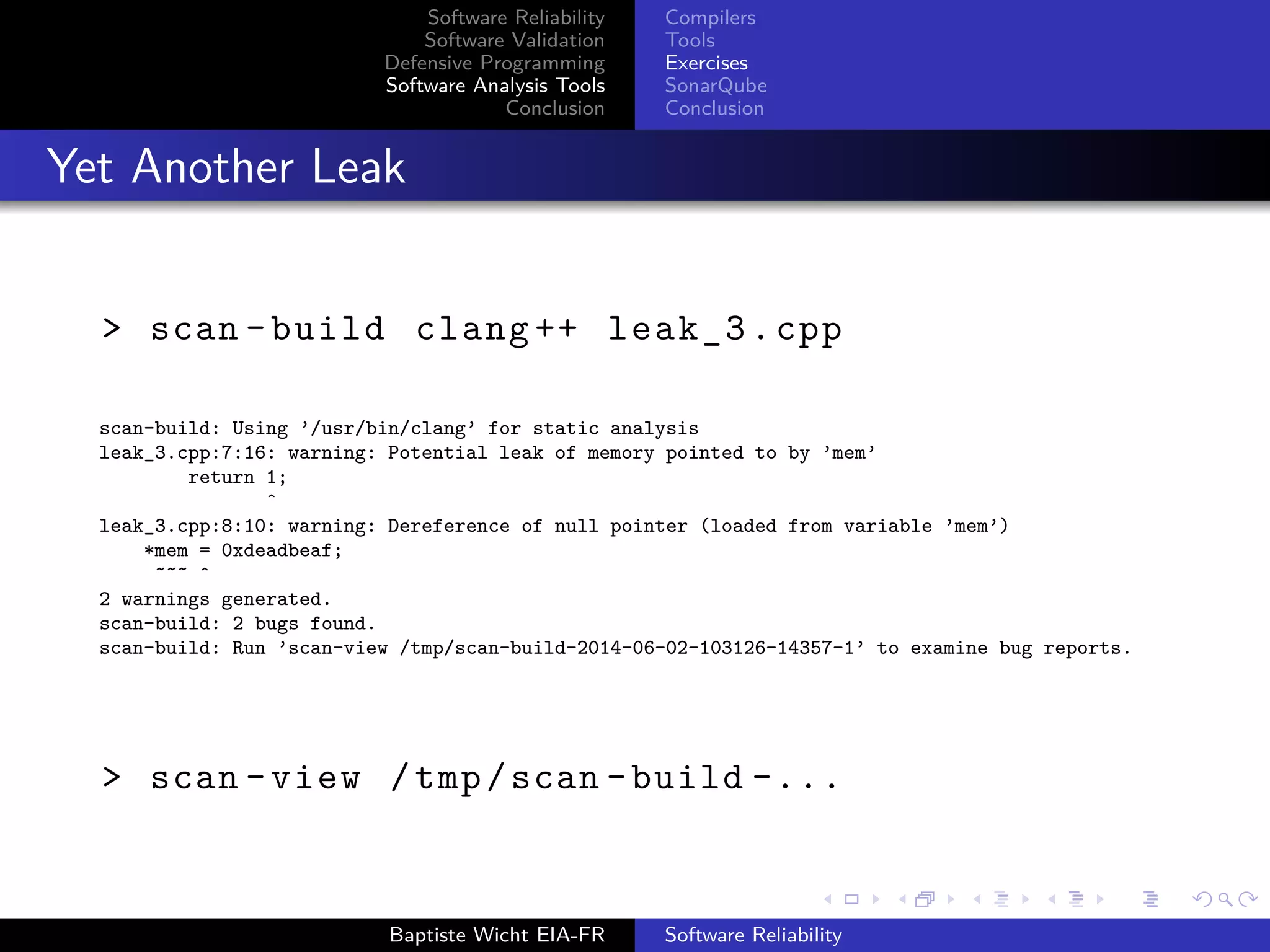
Yet Another Leak
> scan -build clang ++ leak_3.cpp
scan-build: Using ’/usr/bin/clang’ for static analysis
leak_3.cpp:7:16: warning: Potential leak of memory pointed to by ’mem’
return 1;
ˆ
leak_3.cpp:8:10: warning: Dereference of null pointer (loaded from variable ’mem’)
*mem = 0xdeadbeaf;
˜˜˜ ˆ
2 warnings generated.
scan-build: 2 bugs found.
scan-build: Run ’scan-view /tmp/scan-build-2014-06-02-103126-14357-1’ to examine bug reports.
> scan -view /tmp/scan -build -...
Baptiste Wicht EIA-FR Software Reliability
Software Reliability
Software Validation
Defensive Programming
Software Analysis Tools
Conclusion
Compilers
Tools
Exercises
SonarQube
Conclusion
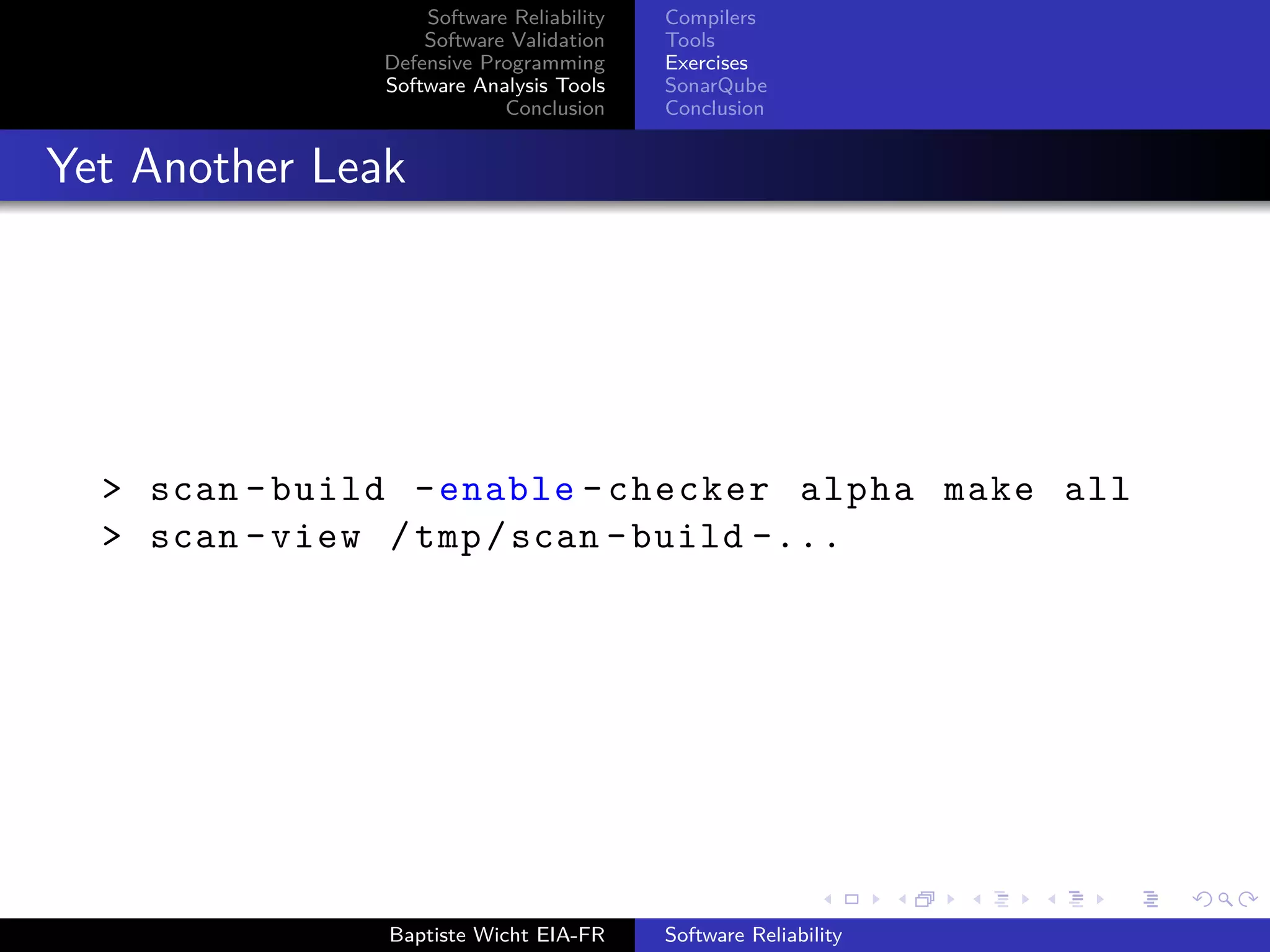
Yet Another Leak
> scan -build -enable -checker alpha make all
> scan -view /tmp/scan -build -...
Baptiste Wicht EIA-FR Software Reliability
Software Reliability
Software Validation
Defensive Programming
Software Analysis Tools
Conclusion
Compilers
Tools
Exercises
SonarQube
Conclusion
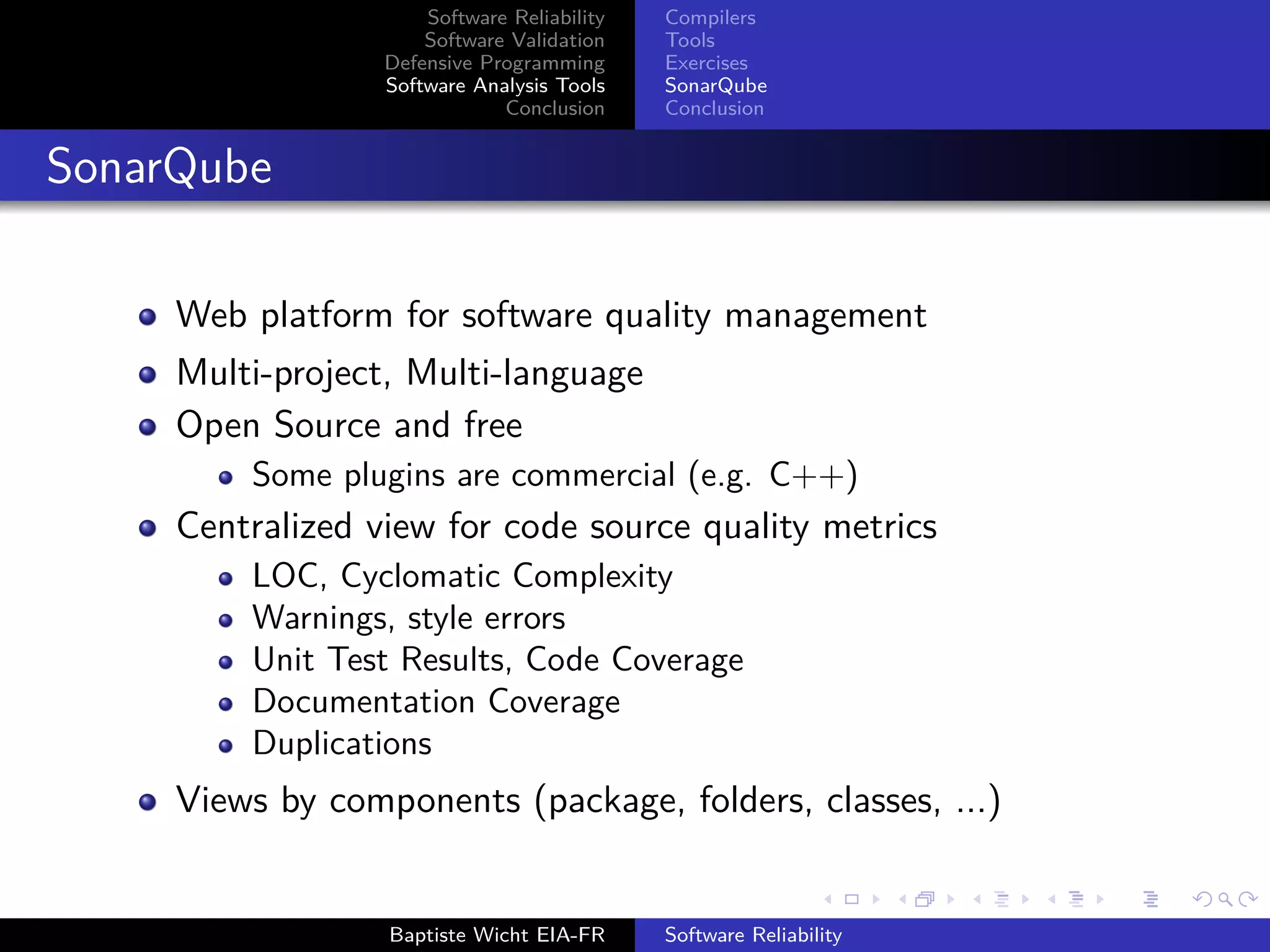
SonarQube
Web platform for software quality management
Multi-project, Multi-language
Open Source and free
Some plugins are commercial (e.g. C++)
Centralized view for code source quality metrics
LOC, Cyclomatic Complexity
Warnings, style errors
Unit Test Results, Code Coverage
Documentation Coverage
Duplications
Views by components (package, folders, classes, ...)
Baptiste Wicht EIA-FR Software Reliability
Software Reliability
Software Validation
Defensive Programming
Software Analysis Tools
Conclusion
Compilers
Tools
Exercises
SonarQube
Conclusion
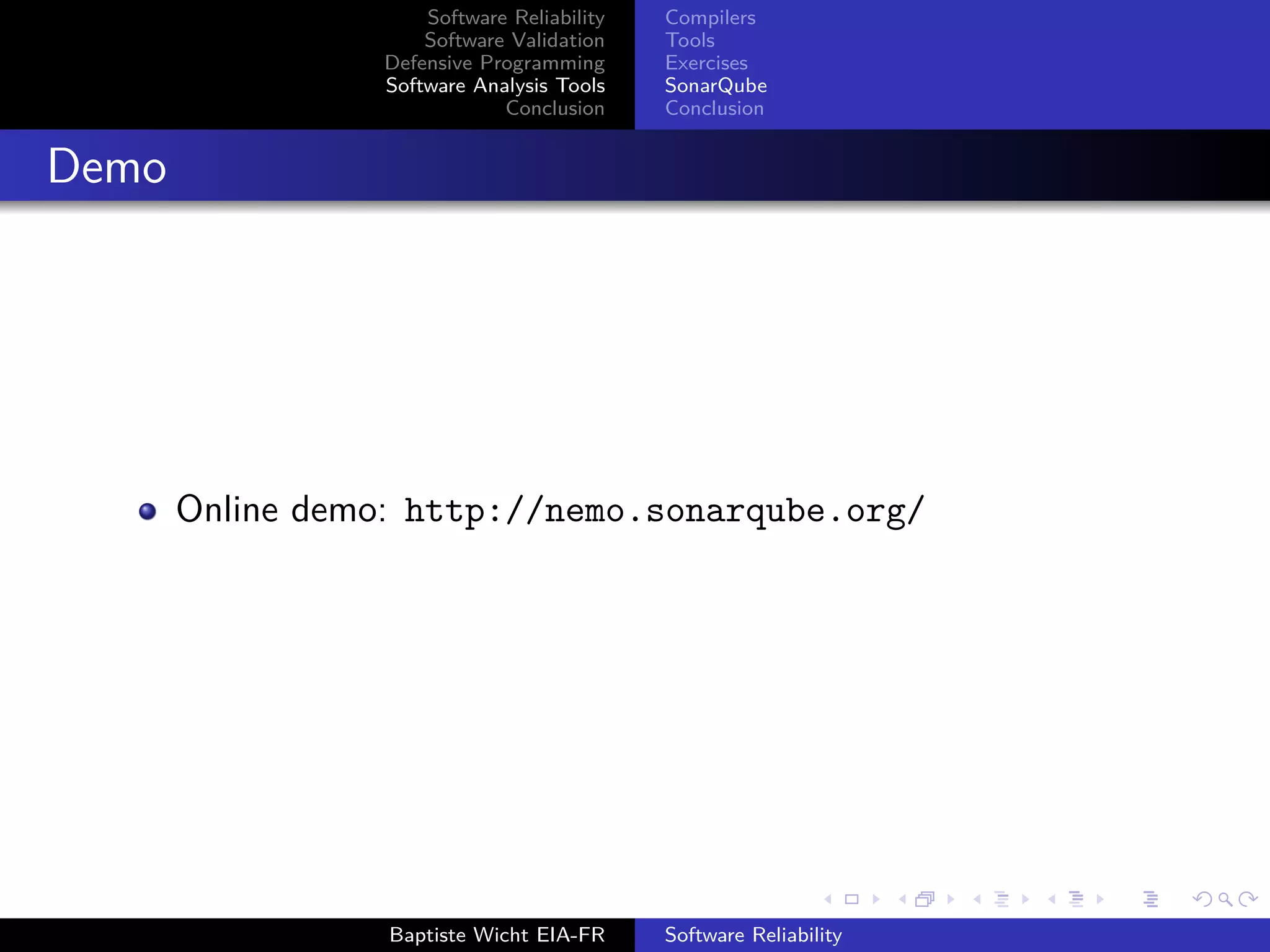
Demo
Online demo: http://nemo.sonarqube.org/
Baptiste Wicht EIA-FR Software Reliability
Software Reliability
Software Validation
Defensive Programming
Software Analysis Tools
Conclusion
Compilers
Tools
Exercises
SonarQube
Conclusion
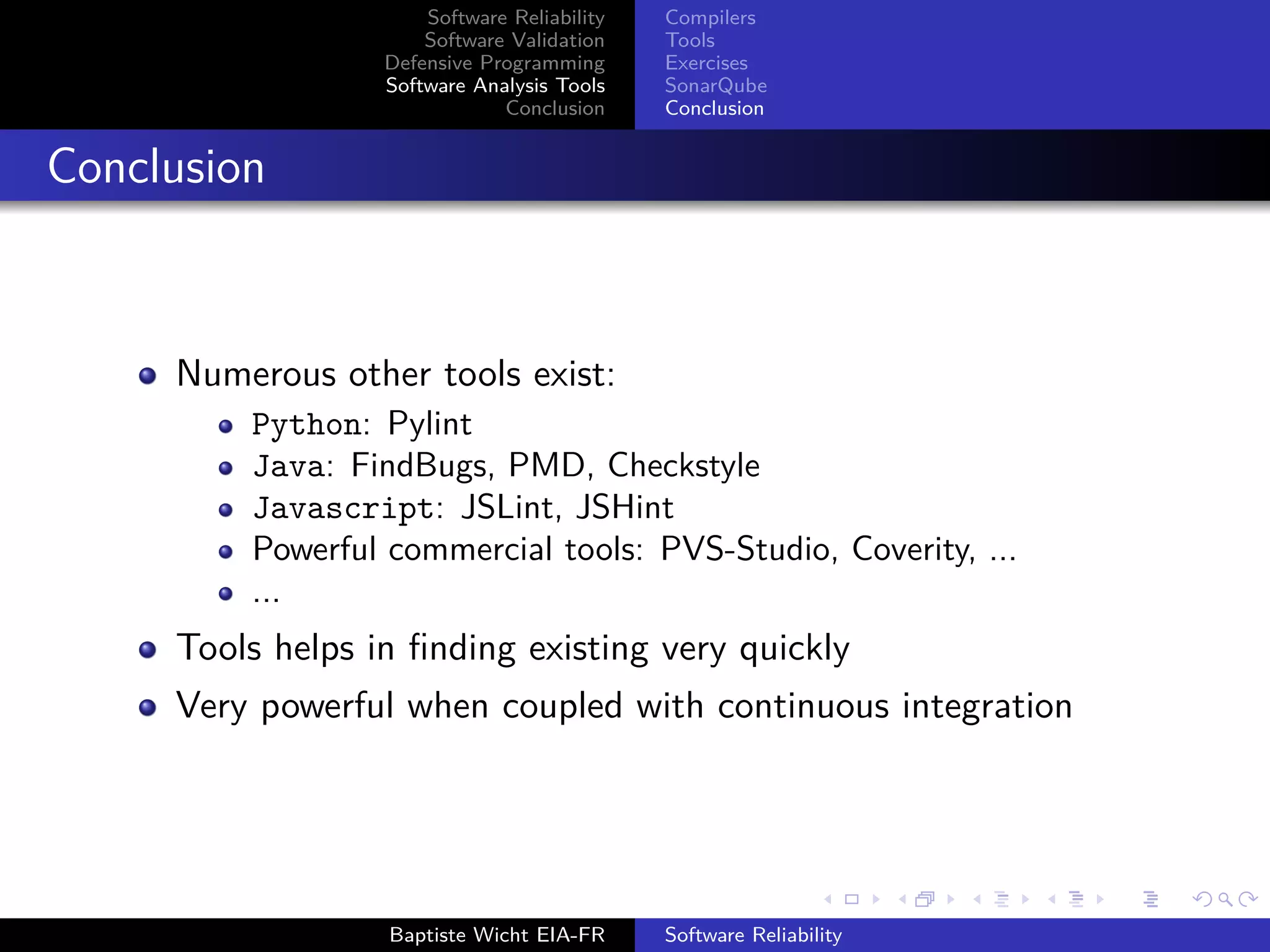
Conclusion
Numerous other tools exist:
Python: Pylint
Java: FindBugs, PMD, Checkstyle
Javascript: JSLint, JSHint
Powerful commercial tools: PVS-Studio, Coverity, ...
...
Tools helps in finding existing very quickly
Very powerful when coupled with continuous integration
Baptiste Wicht EIA-FR Software Reliability
Software Reliability
Software Validation
Defensive Programming
Software Analysis Tools
Conclusion
Contents
1 Software Reliability
2 Software Validation
3 Defensive Programming
4 Software Analysis Tools
5 Conclusion
Baptiste Wicht EIA-FR Software Reliability
Software Reliability
Software Validation
Defensive Programming
Software Analysis Tools
Conclusion
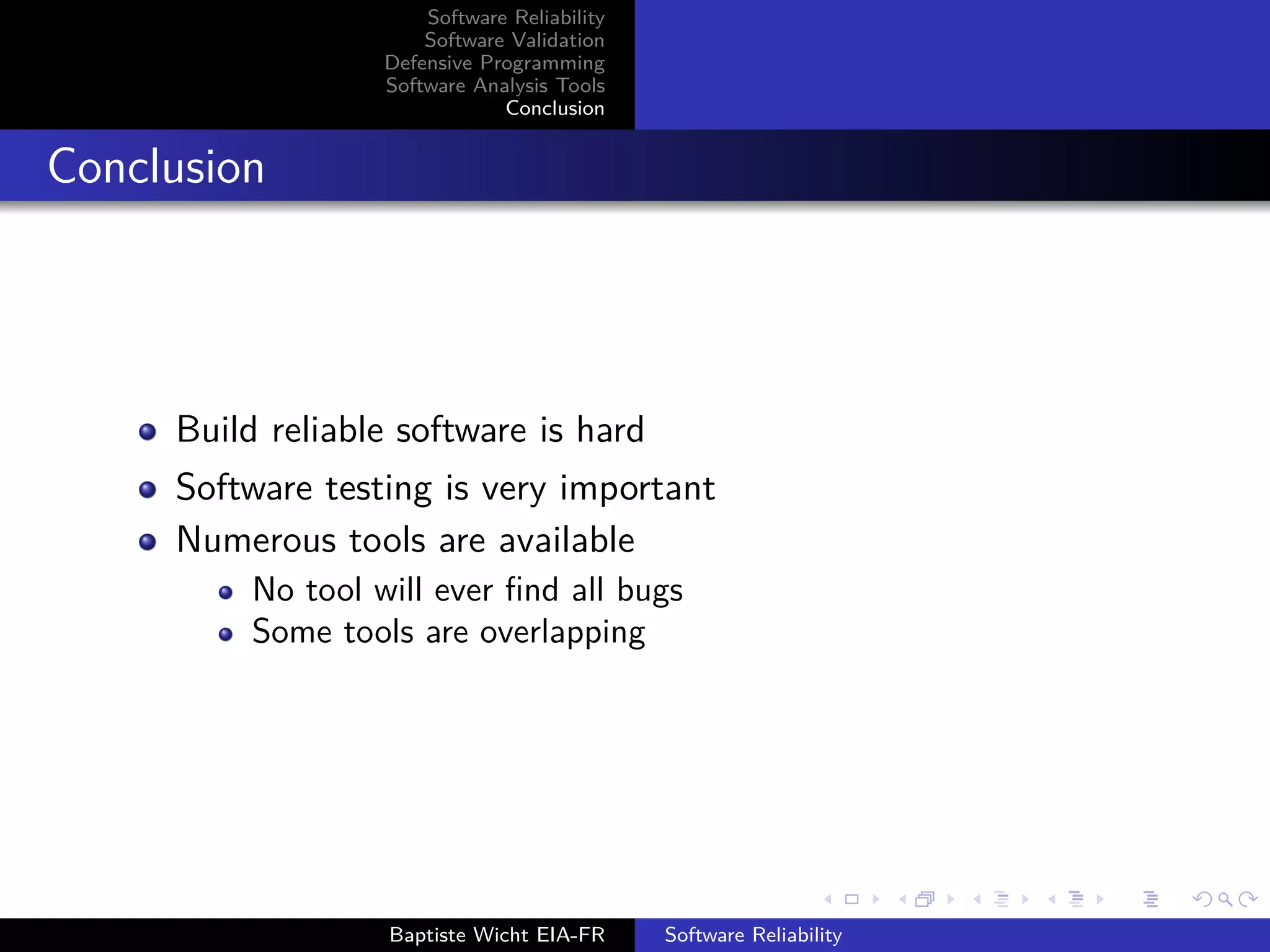
Conclusion
Build reliable software is hard
Software testing is very important
Numerous tools are available
No tool will ever find all bugs
Some tools are overlapping
Baptiste Wicht EIA-FR Software Reliability
Software Reliability
Software Validation
Defensive Programming
Software Analysis Tools
Conclusion
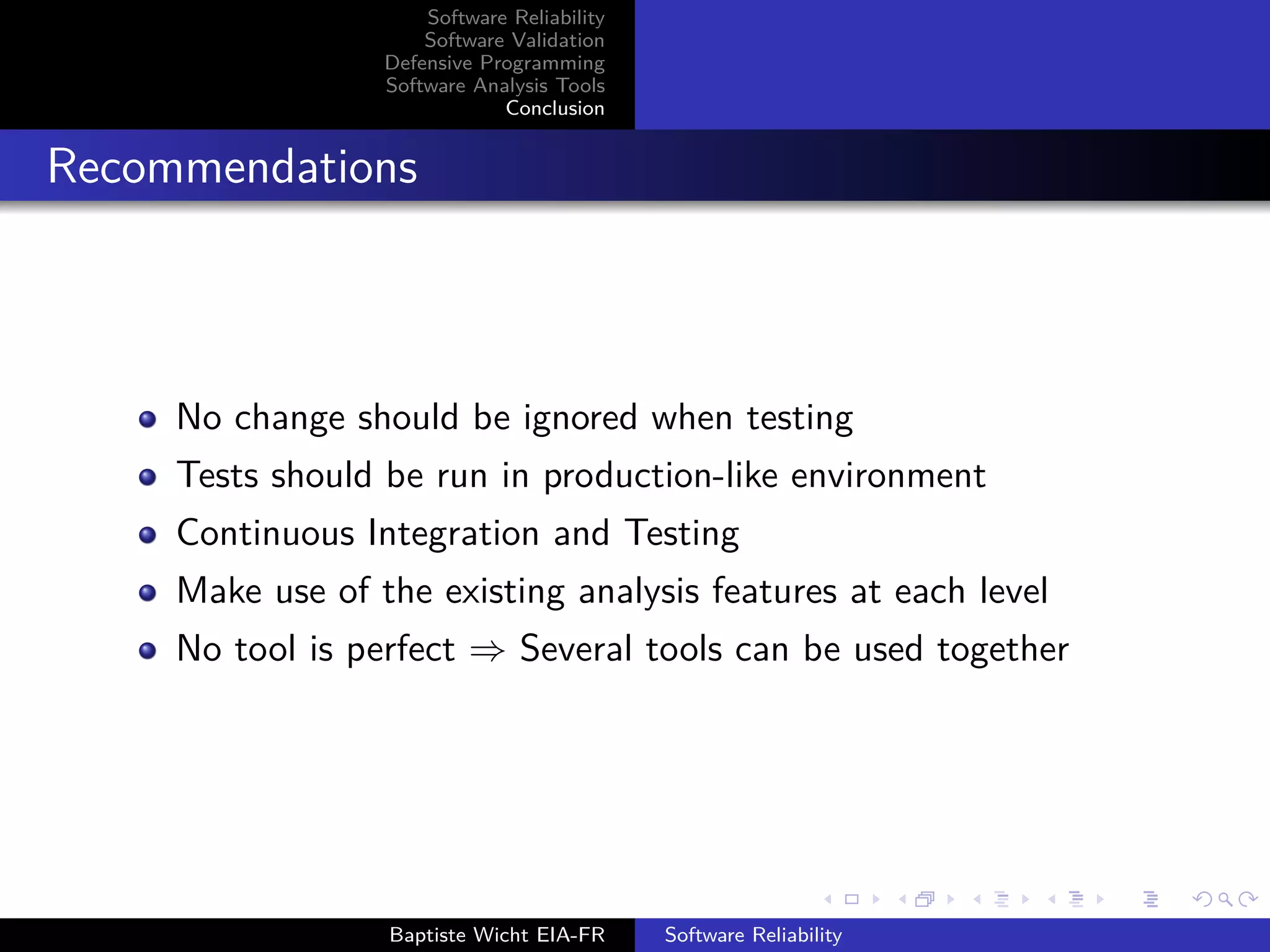
Recommendations
No change should be ignored when testing
Tests should be run in production-like environment
Continuous Integration and Testing
Make use of the existing analysis features at each level
No tool is perfect ⇒ Several tools can be used together
Baptiste Wicht EIA-FR Software Reliability
Software Reliability
Software Validation
Defensive Programming
Software Analysis Tools
Conclusion
Questions
Questions ?
Baptiste Wicht EIA-FR Software Reliability

Software reliability

  • 1.
    Software Reliability Software Validation DefensiveProgramming Software Analysis Tools Conclusion Software Reliability Journ´ee des Technologies de l’Information et de la Communication Baptiste Wicht EIA-FR June 3, 2014 Baptiste Wicht EIA-FR Software Reliability
  • 2.
    Software Reliability Software Validation DefensiveProgramming Software Analysis Tools Conclusion EIA-FR Baptiste Wicht EIA-FR Software Reliability
  • 3.
    Software Reliability Software Validation DefensiveProgramming Software Analysis Tools Conclusion Table of Contents 1 Software Reliability 2 Software Validation 3 Defensive Programming 4 Software Analysis Tools 5 Conclusion Baptiste Wicht EIA-FR Software Reliability
  • 4.
    Software Reliability Software Validation DefensiveProgramming Software Analysis Tools Conclusion Definitions Examples Facts Solutions Contents 1 Software Reliability Definitions Examples Facts Solutions 2 Software Validation 3 Defensive Programming 4 Software Analysis Tools 5 Conclusion Baptiste Wicht EIA-FR Software Reliability
  • 5.
    Software Reliability Software Validation DefensiveProgramming Software Analysis Tools Conclusion Definitions Examples Facts Solutions Definitions Definition Probability that a software will work properly in a specified environment for a given amount of time. What makes a program reliable ? No bug Must work under any possible condition Must comply to the specifications Baptiste Wicht EIA-FR Software Reliability
  • 6.
    Software Reliability Software Validation DefensiveProgramming Software Analysis Tools Conclusion Definitions Examples Facts Solutions Difficulties properly, specified environment, given amount of time No specification is perfect Specifications can change Software is complex Baptiste Wicht EIA-FR Software Reliability
  • 7.
    Software Reliability Software Validation DefensiveProgramming Software Analysis Tools Conclusion Definitions Examples Facts Solutions Measuring reliability Difficult problem Hard to specify Software is complicated to quantify Models are available More than 200 models exist No single model completely represent reliability Basic idea: Reliability is function of the number of defects Baptiste Wicht EIA-FR Software Reliability
  • 8.
    Software Reliability Software Validation DefensiveProgramming Software Analysis Tools Conclusion Definitions Examples Facts Solutions Examples 1991: Telephone outage in California Three lines of code changed several-million lines of code program ⇒ ≈ 200’000 phone calls lost Baptiste Wicht EIA-FR Software Reliability
  • 9.
    Software Reliability Software Validation DefensiveProgramming Software Analysis Tools Conclusion Definitions Examples Facts Solutions Examples 1991: Telephone outage in California Three lines of code changed several-million lines of code program ⇒ ≈ 200’000 phone calls lost 1991: Patriot Missile fails to intercept Scud Missile Time stored in tenths of a second, multiplied by 1/10 to get seconds 24 bit fixed-point register, 1/10 has 0.000000095 error After 100 hours, error of 0.34 seconds => 28 dead Baptiste Wicht EIA-FR Software Reliability
  • 10.
    Software Reliability Software Validation DefensiveProgramming Software Analysis Tools Conclusion Definitions Examples Facts Solutions Examples (cont.d) 1996: Ariane 5 explodes after 37 seconds of flight 16bit integer overflow Overflow detected ⇒ useless corrections ⇒ other malfunctions ⇒ self-destruction System taken from Ariane 4, not used in Ariane 5 ⇒ 500M $ lost Baptiste Wicht EIA-FR Software Reliability
  • 11.
    Software Reliability Software Validation DefensiveProgramming Software Analysis Tools Conclusion Definitions Examples Facts Solutions Examples (cont.d) 1996: Ariane 5 explodes after 37 seconds of flight 16bit integer overflow Overflow detected ⇒ useless corrections ⇒ other malfunctions ⇒ self-destruction System taken from Ariane 4, not used in Ariane 5 ⇒ 500M $ lost 2014: Heartbleed (OpenSSL) Missing bound check Allows more data to be read than should be allowed Introduced in 2011 ⇒ Millions of website vulnerable Baptiste Wicht EIA-FR Software Reliability
  • 12.
    Software Reliability Software Validation DefensiveProgramming Software Analysis Tools Conclusion Definitions Examples Facts Solutions Facts Perfect software does not exist The bigger the program ⇒ the more bugs working today = working tomorrow small change may have big impact Baptiste Wicht EIA-FR Software Reliability
  • 13.
    Software Reliability Software Validation DefensiveProgramming Software Analysis Tools Conclusion Definitions Examples Facts Solutions Solutions Software Validation Software Analysis Tools Defensive Programming Baptiste Wicht EIA-FR Software Reliability
  • 14.
    Software Reliability Software Validation DefensiveProgramming Software Analysis Tools Conclusion Unit Testing Integration Testing Software Validation Conclusion Contents 1 Software Reliability 2 Software Validation Unit Testing Integration Testing Software Validation Conclusion 3 Defensive Programming 4 Software Analysis Tools 5 Conclusion Baptiste Wicht EIA-FR Software Reliability
  • 15.
    Software Reliability Software Validation DefensiveProgramming Software Analysis Tools Conclusion Unit Testing Integration Testing Software Validation Conclusion Unit Testing Definition Set of tests to verify that a small unit of code is correct Automated tests Should be run after each change to the program and under production-like environment Monitor code coverage Baptiste Wicht EIA-FR Software Reliability
  • 16.
    Software Reliability Software Validation DefensiveProgramming Software Analysis Tools Conclusion Unit Testing Integration Testing Software Validation Conclusion Integration Testing Definition Set of tests to verify that a set of units forming a component is correct Can be automated or performed by human If human-performed, can be very costly Should be performed as much as possible Baptiste Wicht EIA-FR Software Reliability
  • 17.
    Software Reliability Software Validation DefensiveProgramming Software Analysis Tools Conclusion Unit Testing Integration Testing Software Validation Conclusion Software Validation Definition Tests to ensure that the complete system meets its specifications Was the right software built ? Was the software built right ? Generally performed by Q/A specialists Baptiste Wicht EIA-FR Software Reliability
  • 18.
    Software Reliability Software Validation DefensiveProgramming Software Analysis Tools Conclusion Unit Testing Integration Testing Software Validation Conclusion Conclusion No part of the code should be neglected No change should be neglected Small modules easily covered by a unit test should always be unit tested Unit/Integration tests should always be used to avoid regression Unit testing should be done as part of Continuous Integration Automated tests are less costly that human-performed tests Baptiste Wicht EIA-FR Software Reliability
  • 19.
    Software Reliability Software Validation DefensiveProgramming Software Analysis Tools Conclusion Language Features Contract Programming Conclusion Contents 1 Software Reliability 2 Software Validation 3 Defensive Programming Language Features Contract Programming Conclusion 4 Software Analysis Tools 5 Conclusion Baptiste Wicht EIA-FR Software Reliability
  • 20.
    Software Reliability Software Validation DefensiveProgramming Software Analysis Tools Conclusion Language Features Contract Programming Conclusion Defensive Programming Definition Make a program more reliable by ensuring that code is used in the correct way and it does what it is supposed to do. Protection against failures and fault Written as code Accurate information to the source of the error Verified at compile-time or runtime Baptiste Wicht EIA-FR Software Reliability
  • 21.
    Software Reliability Software Validation DefensiveProgramming Software Analysis Tools Conclusion Language Features Contract Programming Conclusion Language Features Different languages provide different level of security int array [100]; int b = array [100]; // What should happen ? Baptiste Wicht EIA-FR Software Reliability
  • 22.
    Software Reliability Software Validation DefensiveProgramming Software Analysis Tools Conclusion Language Features Contract Programming Conclusion Language Features Different languages provide different level of security int array [100]; int b = array [100]; // What should happen ? C/C++: Undefined Java/Python: Runtime error Generally: lower level ⇒ harder to debug Baptiste Wicht EIA-FR Software Reliability
  • 23.
    Software Reliability Software Validation DefensiveProgramming Software Analysis Tools Conclusion Language Features Contract Programming Conclusion Assertions Definition Predicates (true-false statements) inserted into code indicating what the developer thinks should be true at a certain point. Indicates that a certain condition must be true Typically aborts execution if condition not met May be replaced by exceptions Is generally disabled in production Should not have any side effect Baptiste Wicht EIA-FR Software Reliability
  • 24.
    Software Reliability Software Validation DefensiveProgramming Software Analysis Tools Conclusion Language Features Contract Programming Conclusion Assertions (cont.d) double log(int x){ assert(x > 0); //... } template <typename T> class Z { static_assert(sizeof(T) > 2, "Invalid␣Type"); //... } Baptiste Wicht EIA-FR Software Reliability
  • 25.
    Software Reliability Software Validation DefensiveProgramming Software Analysis Tools Conclusion Language Features Contract Programming Conclusion Assertions (cont.d) Pros Available in almost every languages Very simple Generally useful to check input parameters Baptiste Wicht EIA-FR Software Reliability
  • 26.
    Software Reliability Software Validation DefensiveProgramming Software Analysis Tools Conclusion Language Features Contract Programming Conclusion Assertions (cont.d) Pros Available in almost every languages Very simple Generally useful to check input parameters Cons Only verified at runtime Some languages supports compile-time assertions Only local to a function Can make the code more complex Can be disabled Baptiste Wicht EIA-FR Software Reliability
  • 27.
    Software Reliability Software Validation DefensiveProgramming Software Analysis Tools Conclusion Language Features Contract Programming Conclusion Contract Programming Contract of the code specified into the program Pre/postconditions, Invariants, ... Can be implemented with assertions Coupled with powerful static analysis, some errors can be found without running the program Baptiste Wicht EIA-FR Software Reliability
  • 28.
    Software Reliability Software Validation DefensiveProgramming Software Analysis Tools Conclusion Language Features Contract Programming Conclusion Conclusion Pros Catch errors with nice error messages Stored with the code Cons Make the code more complex May introduce new errors May incur a runtime cost Dependent on the developer Baptiste Wicht EIA-FR Software Reliability
  • 29.
    Software Reliability Software Validation DefensiveProgramming Software Analysis Tools Conclusion Compilers Tools Exercises SonarQube Conclusion Contents 1 Software Reliability 2 Software Validation 3 Defensive Programming 4 Software Analysis Tools Compilers Tools Exercises SonarQube Conclusion 5 Conclusion Baptiste Wicht EIA-FR Software Reliability
  • 30.
    Software Reliability Software Validation DefensiveProgramming Software Analysis Tools Conclusion Compilers Tools Exercises SonarQube Conclusion Software Analysis Tools Many available tools Automatic search for bugs, performance improvements, style problems Two types: Static Analysis: Source code level Dynamic Analysis: Runtime level Baptiste Wicht EIA-FR Software Reliability
  • 31.
    Software Reliability Software Validation DefensiveProgramming Software Analysis Tools Conclusion Compilers Tools Exercises SonarQube Conclusion Compilers Every modern compiler produces warnings Only when asked May produce too much warnings Often forgotten Recommendation New project: As much as possible and -Werror Existing project: Fix existing warnings and enable warnings one by one CLang/GCC: -Wall -Wextra Baptiste Wicht EIA-FR Software Reliability
  • 32.
    Software Reliability Software Validation DefensiveProgramming Software Analysis Tools Conclusion Compilers Tools Exercises SonarQube Conclusion cppcheck Static Analysis for C/C++ programs Free software, GPL license Cross-platform Active project, latest stable release 10 May 2014 Available on every mainline distribution Contains a large set of checkers Integrated in several IDE (Eclipse, Visual Studio, Code::Blocks, CodeLite...) Generate text, XML and HTML reports Baptiste Wicht EIA-FR Software Reliability
  • 33.
    Software Reliability Software Validation DefensiveProgramming Software Analysis Tools Conclusion Compilers Tools Exercises SonarQube Conclusion CLang Static Analyzer Static Analysis for C/C++ and Objective-C programs Free software, MIT license Developed as part of the LLVM/CLang project Slower than compilation Still young project Several checkers implemented Can be extended with checker plugins Generate text and HTML reports Baptiste Wicht EIA-FR Software Reliability
  • 34.
    Software Reliability Software Validation DefensiveProgramming Software Analysis Tools Conclusion Compilers Tools Exercises SonarQube Conclusion Valgrind Framework for dynamic analysis tools Free Software, GPL License Work on Linux and Mac OS X Most known for Memcheck tool Runs the program into a virtual machine Program runs slower (4-5 times slower with None tool) Generate text reports Baptiste Wicht EIA-FR Software Reliability
  • 35.
    Software Reliability Software Validation DefensiveProgramming Software Analysis Tools Conclusion Compilers Tools Exercises SonarQube Conclusion Tools Memcheck: Memory debugger Default and most used tool Very large performance lost (20 to 40 times slower) Massif: Heap profiler Helgrind: Detect race conditions Cachegrind: Cache profiler Callgrind: Call-graph analyzer exp-sgcheck: Experimental tool for memory overruns Baptiste Wicht EIA-FR Software Reliability
  • 36.
    Software Reliability Software Validation DefensiveProgramming Software Analysis Tools Conclusion Compilers Tools Exercises SonarQube Conclusion Exercises Some exercises Machines ready with Ubuntu Launch terminal > cd examples Baptiste Wicht EIA-FR Software Reliability
  • 37.
    Software Reliability Software Validation DefensiveProgramming Software Analysis Tools Conclusion Compilers Tools Exercises SonarQube Conclusion Memory Leak int main (){ int* a = new int (4); // Something a = new int (5); // Something else delete a; } > g++ leak.cpp > valgrind ./a.out Baptiste Wicht EIA-FR Software Reliability
  • 38.
    Software Reliability Software Validation DefensiveProgramming Software Analysis Tools Conclusion Compilers Tools Exercises SonarQube Conclusion Memory Leak ==15386== HEAP SUMMARY: ==15386== in use at exit: 4 bytes in 1 blocks ==15386== total heap usage: 2 allocs, 1 frees, 8 bytes allocated ==15386== ==15386== LEAK SUMMARY: ==15386== definitely lost: 4 bytes in 1 blocks ==15386== indirectly lost: 0 bytes in 0 blocks ==15386== possibly lost: 0 bytes in 0 blocks ==15386== still reachable: 0 bytes in 0 blocks ==15386== suppressed: 0 bytes in 0 block 4 bytes have been lost No information on location > valgrind --leak -check=full ./a.out Baptiste Wicht EIA-FR Software Reliability
  • 39.
    Software Reliability Software Validation DefensiveProgramming Software Analysis Tools Conclusion Compilers Tools Exercises SonarQube Conclusion Memory Leak ==6434== 4 bytes in 1 blocks are definitely lost in loss record 1 of 1 ==6434== at 0x4028812: operator new(unsigned long) (vg_replace_malloc.c:319) ==6434== by 0x400641: main (in /home/wichtounet/dev/analysis-examples/a.out) The source of the allocation is now shown Only binary location, no source location > g++ -g leak.cpp > valgrind --leak -check=full ./a.out Baptiste Wicht EIA-FR Software Reliability
  • 40.
    Software Reliability Software Validation DefensiveProgramming Software Analysis Tools Conclusion Compilers Tools Exercises SonarQube Conclusion Memory Leak ==9604== 4 bytes in 1 blocks are definitely lost in loss record 1 of 1 ==9604== at 0x4028812: operator new(unsigned long) (vg_replace_malloc.c:319) ==9604== by 0x400641: main (leak.cpp:2) Source location (leak.cpp:2) is now complete Valgrind will only show the sources of allocated leaked memory Sometimes it may still be complicated to find why not freed Baptiste Wicht EIA-FR Software Reliability
  • 41.
    Software Reliability Software Validation DefensiveProgramming Software Analysis Tools Conclusion Compilers Tools Exercises SonarQube Conclusion Heap Overrun int main (){ int* heap = new int [5]; heap [5] = 42; delete [] heap; return 0; } > g++ -g heap_overrun.cpp > valgrind ./a.out Baptiste Wicht EIA-FR Software Reliability
  • 42.
    Software Reliability Software Validation DefensiveProgramming Software Analysis Tools Conclusion Compilers Tools Exercises SonarQube Conclusion Heap Overrun ==16922== Invalid write of size 4 ==16922== at 0x40064E: main (heap_overrun.cpp:4) ==16922== Address 0x50c4054 is 0 bytes after a block of size 20 alloc’d ==16922== at 0x4028F40: operator new[](unsigned long) (vg_replace_malloc.c:384) ==16922== by 0x400641: main (heap_overrun.cpp:2) Source location of the invalid write (heap overrun.cpp:4) Source location of the allocation (heap overrun.cpp:2) > valgrind --leak -check=full ./a.out Baptiste Wicht EIA-FR Software Reliability
  • 43.
    Software Reliability Software Validation DefensiveProgramming Software Analysis Tools Conclusion Compilers Tools Exercises SonarQube Conclusion Stack Overrun int main (){ int i, a[10]; for (i = 0; i <= 10; i++) a[i] = 42; return 0; } > g++ -g stack_overrun.cpp > valgrind ./a.out Baptiste Wicht EIA-FR Software Reliability
  • 44.
    Software Reliability Software Validation DefensiveProgramming Software Analysis Tools Conclusion Compilers Tools Exercises SonarQube Conclusion Stack Overrun ==20444== HEAP SUMMARY: ==20444== in use at exit: 0 bytes in 0 blocks ==20444== total heap usage: 0 allocs, 0 frees, 0 bytes allocated ==20444== ==20444== All heap blocks were freed -- no leaks are possible Overrun is not detected Size of memory block is detected by malloc implementation > valgrind --tool=exp -sgcheck ./a.out Baptiste Wicht EIA-FR Software Reliability
  • 45.
    Software Reliability Software Validation DefensiveProgramming Software Analysis Tools Conclusion Compilers Tools Exercises SonarQube Conclusion Stack Overrun ==24703== Invalid write of size 4 ==24703== at 0x400572: main (stack_overrun.cpp:5) ==24703== Address 0xfff0000c8 expected vs actual: ==24703== Expected: stack array "a" of size 40 in this frame ==24703== Actual: unknown ==24703== Actual: is 0 after Expected Overrun is detected! > valgrind --tool=exp -sgcheck ./a.out Baptiste Wicht EIA-FR Software Reliability
  • 46.
    Software Reliability Software Validation DefensiveProgramming Software Analysis Tools Conclusion Compilers Tools Exercises SonarQube Conclusion Stack Overrun 2 int main (){ int stack [5]; stack [5] = 0; return 0; } > g++ -g stack_overrun_2 .cpp > valgrind --tool=exp -sgcheck ./a.out Baptiste Wicht EIA-FR Software Reliability
  • 47.
    Software Reliability Software Validation DefensiveProgramming Software Analysis Tools Conclusion Compilers Tools Exercises SonarQube Conclusion Stack Overrun 2 ==28007== exp-sgcheck, a stack and global array overrun detector ==28007== NOTE: This is an Experimental-Class Valgrind Tool ==28007== Copyright (C) 2003-2013, and GNU GPL’d, by OpenWorks Ltd et al. ==28007== Using Valgrind-3.9.0 and LibVEX; rerun with -h for copyright info ==28007== Command: ./a.out ==28007== ==28007== ==28007== ERROR SUMMARY: 0 errors from 0 contexts (suppressed: 0 from 0 Overrun not detected! Need a valid access before the invalid one > cppcheck stack_overrun_2 .cpp Baptiste Wicht EIA-FR Software Reliability
  • 48.
    Software Reliability Software Validation DefensiveProgramming Software Analysis Tools Conclusion Compilers Tools Exercises SonarQube Conclusion Stack Overrun 2 Checking stack_overrun_2.cpp... [stack_overrun_2.cpp:4]: (error) Array ’stack[5]’ accessed at index 5, which is out of bounds. Overrun detected! Tools put together are very powerful Baptiste Wicht EIA-FR Software Reliability
  • 49.
    Software Reliability Software Validation DefensiveProgramming Software Analysis Tools Conclusion Compilers Tools Exercises SonarQube Conclusion Complex Memory Leak int main (){ int* array [42]; for(int i = 0; i < 42; ++i){ array[i] = new int; } // Something for(int i = 0; i < 41; ++i){ delete array[i]; } } > cppcheck --enable=all leak_2.cpp Baptiste Wicht EIA-FR Software Reliability
  • 50.
    Software Reliability Software Validation DefensiveProgramming Software Analysis Tools Conclusion Compilers Tools Exercises SonarQube Conclusion Complex Memory Leak Checking leak_2.cpp... Checking usage of global functions.. cppcheck static analysis not powerful enough > g++ -g leak_2.cpp > valgrind --leak -check=full ./a.out ==12868== 4 bytes in 1 blocks are definitely lost in loss record 1 of 1 ==12868== at 0x4C2C167: operator new(unsigned long) (in /usr/lib64/valgrind/vgpreload_memcheck-amd64-li ==12868== by 0x400739: main (leak_2.cpp:7) Baptiste Wicht EIA-FR Software Reliability
  • 51.
    Software Reliability Software Validation DefensiveProgramming Software Analysis Tools Conclusion Compilers Tools Exercises SonarQube Conclusion Yet Another Leak int main (){ unsigned int* mem = (unsigned int*) malloc (4); if(mem) return 1; *mem = 0xdeadbeaf; free(mem); return 0; } Baptiste Wicht EIA-FR Software Reliability
  • 52.
    Software Reliability Software Validation DefensiveProgramming Software Analysis Tools Conclusion Compilers Tools Exercises SonarQube Conclusion Yet Another Leak > clang --analyze leak_3.cpp leak_3.cpp:7:16: warning: Potential leak of memory pointed to by ’mem’ return 1; ˆ leak_3.cpp:8:10: warning: Dereference of null pointer (loaded from variable ’mem’) *mem = 0xdeadbeaf; ˜˜˜ ˆ 2 warnings generated > c++ analyzer leak_3.cpp leak_3.cpp:7:16: warning: Potential leak of memory pointed to by ’mem’ return 1; ˆ leak_3.cpp:8:10: warning: Dereference of null pointer (loaded from variable ’mem’) *mem = 0xdeadbeaf; ˜˜˜ ˆ 2 warnings generated. Baptiste Wicht EIA-FR Software Reliability
  • 53.
    Software Reliability Software Validation DefensiveProgramming Software Analysis Tools Conclusion Compilers Tools Exercises SonarQube Conclusion Yet Another Leak > scan -build clang ++ leak_3.cpp scan-build: Using ’/usr/bin/clang’ for static analysis leak_3.cpp:7:16: warning: Potential leak of memory pointed to by ’mem’ return 1; ˆ leak_3.cpp:8:10: warning: Dereference of null pointer (loaded from variable ’mem’) *mem = 0xdeadbeaf; ˜˜˜ ˆ 2 warnings generated. scan-build: 2 bugs found. scan-build: Run ’scan-view /tmp/scan-build-2014-06-02-103126-14357-1’ to examine bug reports. > scan -view /tmp/scan -build -... Baptiste Wicht EIA-FR Software Reliability
  • 54.
    Software Reliability Software Validation DefensiveProgramming Software Analysis Tools Conclusion Compilers Tools Exercises SonarQube Conclusion Yet Another Leak > scan -build -enable -checker alpha make all > scan -view /tmp/scan -build -... Baptiste Wicht EIA-FR Software Reliability
  • 55.
    Software Reliability Software Validation DefensiveProgramming Software Analysis Tools Conclusion Compilers Tools Exercises SonarQube Conclusion SonarQube Web platform for software quality management Multi-project, Multi-language Open Source and free Some plugins are commercial (e.g. C++) Centralized view for code source quality metrics LOC, Cyclomatic Complexity Warnings, style errors Unit Test Results, Code Coverage Documentation Coverage Duplications Views by components (package, folders, classes, ...) Baptiste Wicht EIA-FR Software Reliability
  • 56.
    Software Reliability Software Validation DefensiveProgramming Software Analysis Tools Conclusion Compilers Tools Exercises SonarQube Conclusion Demo Online demo: http://nemo.sonarqube.org/ Baptiste Wicht EIA-FR Software Reliability
  • 57.
    Software Reliability Software Validation DefensiveProgramming Software Analysis Tools Conclusion Compilers Tools Exercises SonarQube Conclusion Conclusion Numerous other tools exist: Python: Pylint Java: FindBugs, PMD, Checkstyle Javascript: JSLint, JSHint Powerful commercial tools: PVS-Studio, Coverity, ... ... Tools helps in finding existing very quickly Very powerful when coupled with continuous integration Baptiste Wicht EIA-FR Software Reliability
  • 58.
    Software Reliability Software Validation DefensiveProgramming Software Analysis Tools Conclusion Contents 1 Software Reliability 2 Software Validation 3 Defensive Programming 4 Software Analysis Tools 5 Conclusion Baptiste Wicht EIA-FR Software Reliability
  • 59.
    Software Reliability Software Validation DefensiveProgramming Software Analysis Tools Conclusion Conclusion Build reliable software is hard Software testing is very important Numerous tools are available No tool will ever find all bugs Some tools are overlapping Baptiste Wicht EIA-FR Software Reliability
  • 60.
    Software Reliability Software Validation DefensiveProgramming Software Analysis Tools Conclusion Recommendations No change should be ignored when testing Tests should be run in production-like environment Continuous Integration and Testing Make use of the existing analysis features at each level No tool is perfect ⇒ Several tools can be used together Baptiste Wicht EIA-FR Software Reliability
  • 61.
    Software Reliability Software Validation DefensiveProgramming Software Analysis Tools Conclusion Questions Questions ? Baptiste Wicht EIA-FR Software Reliability