Importance of software

 Software can have a huge
 impact in any aspect of
 society.
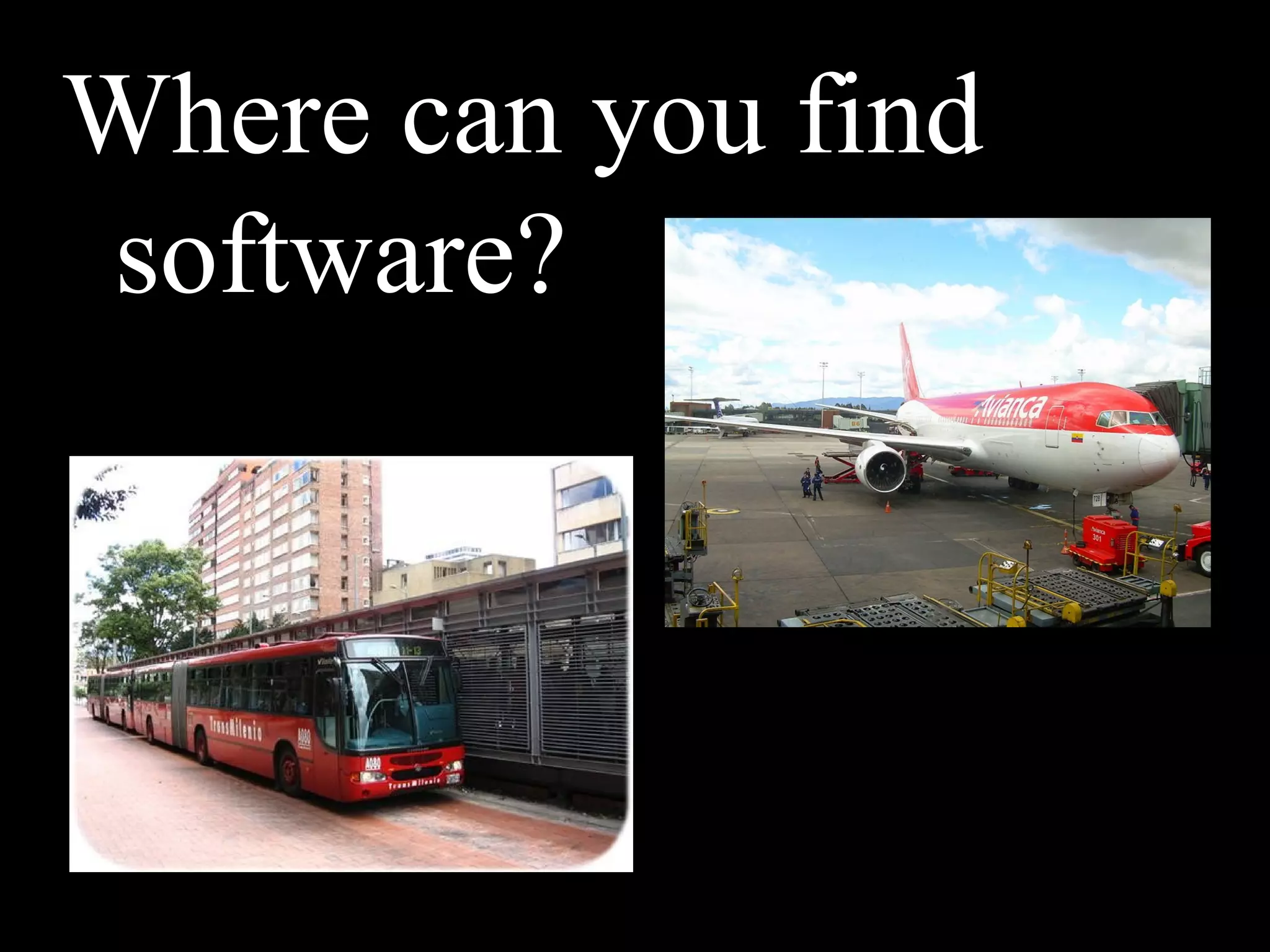
Where can you find
software?
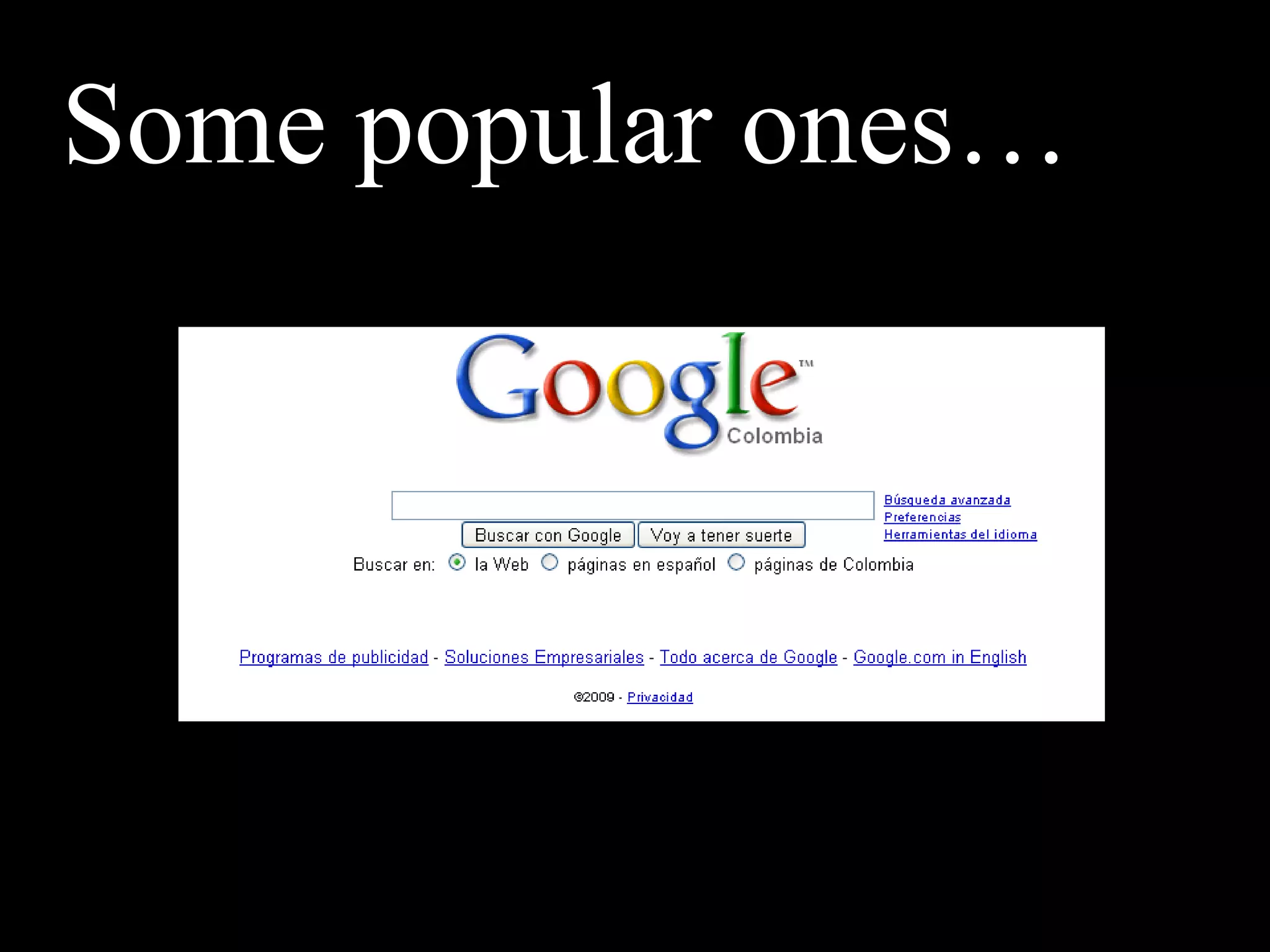
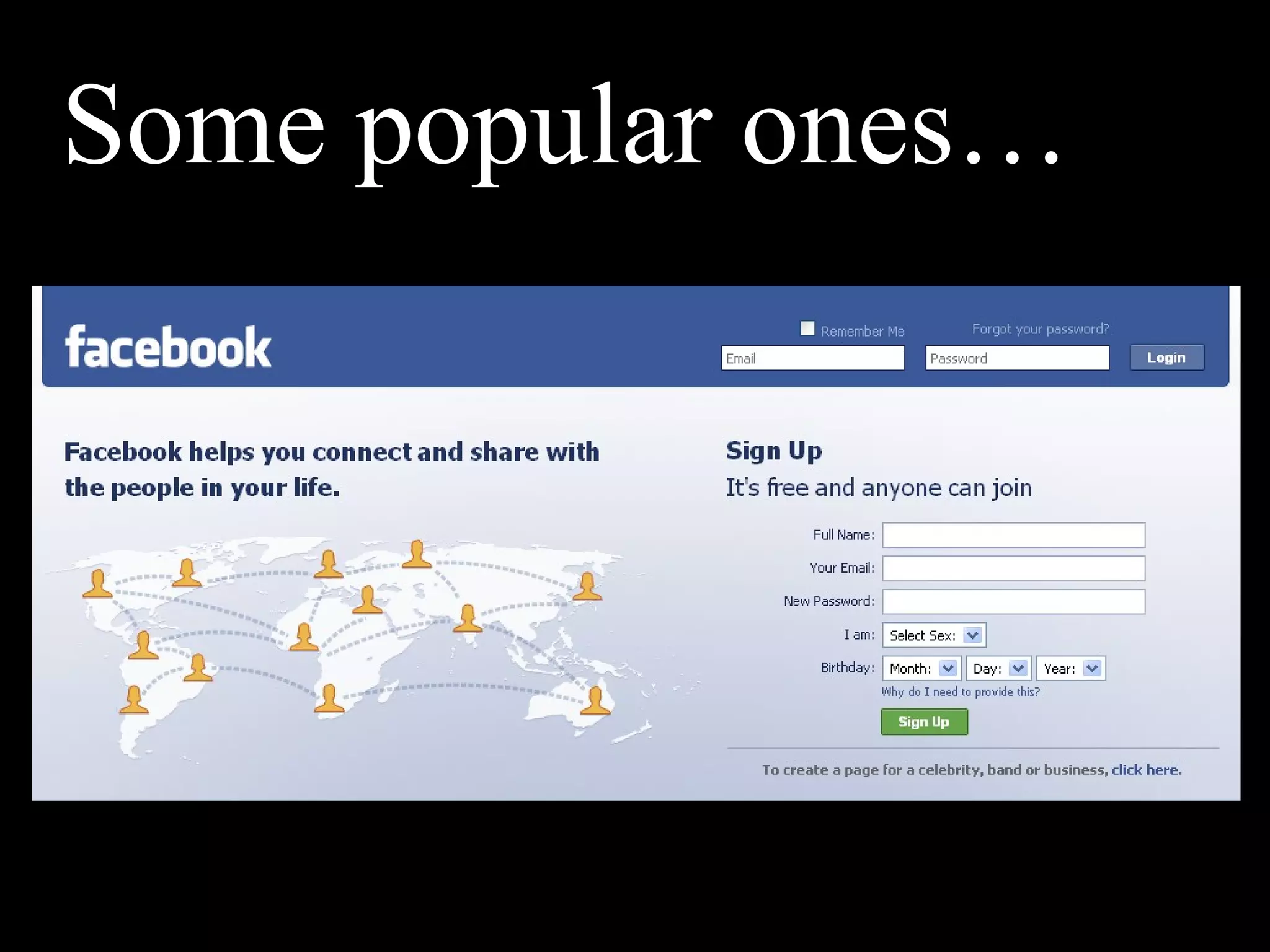
Some popular ones…
Some popular ones…
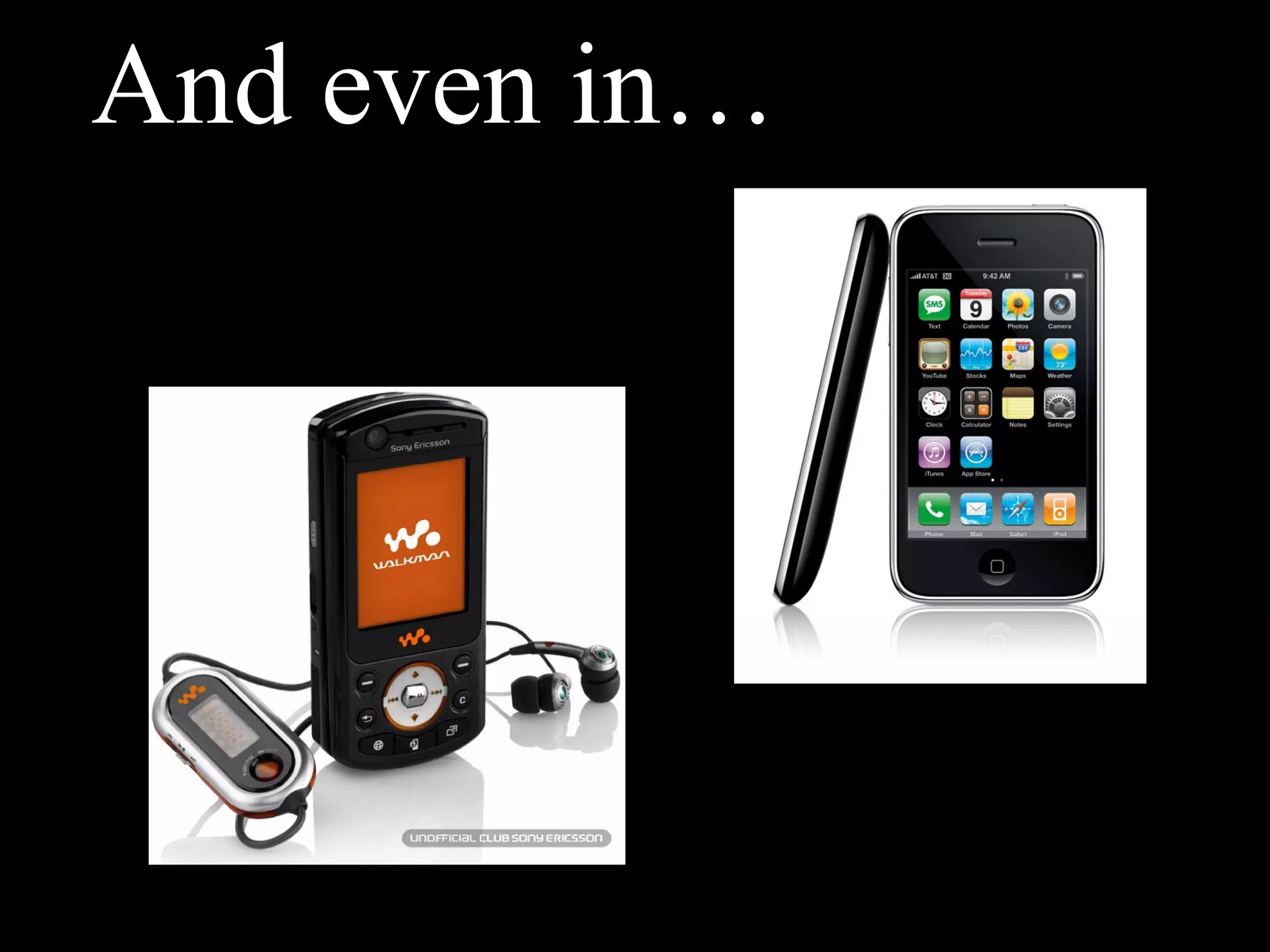
And even in…
Conclusion

   Software is Almost
   Everywhere.
Problems in software
    development
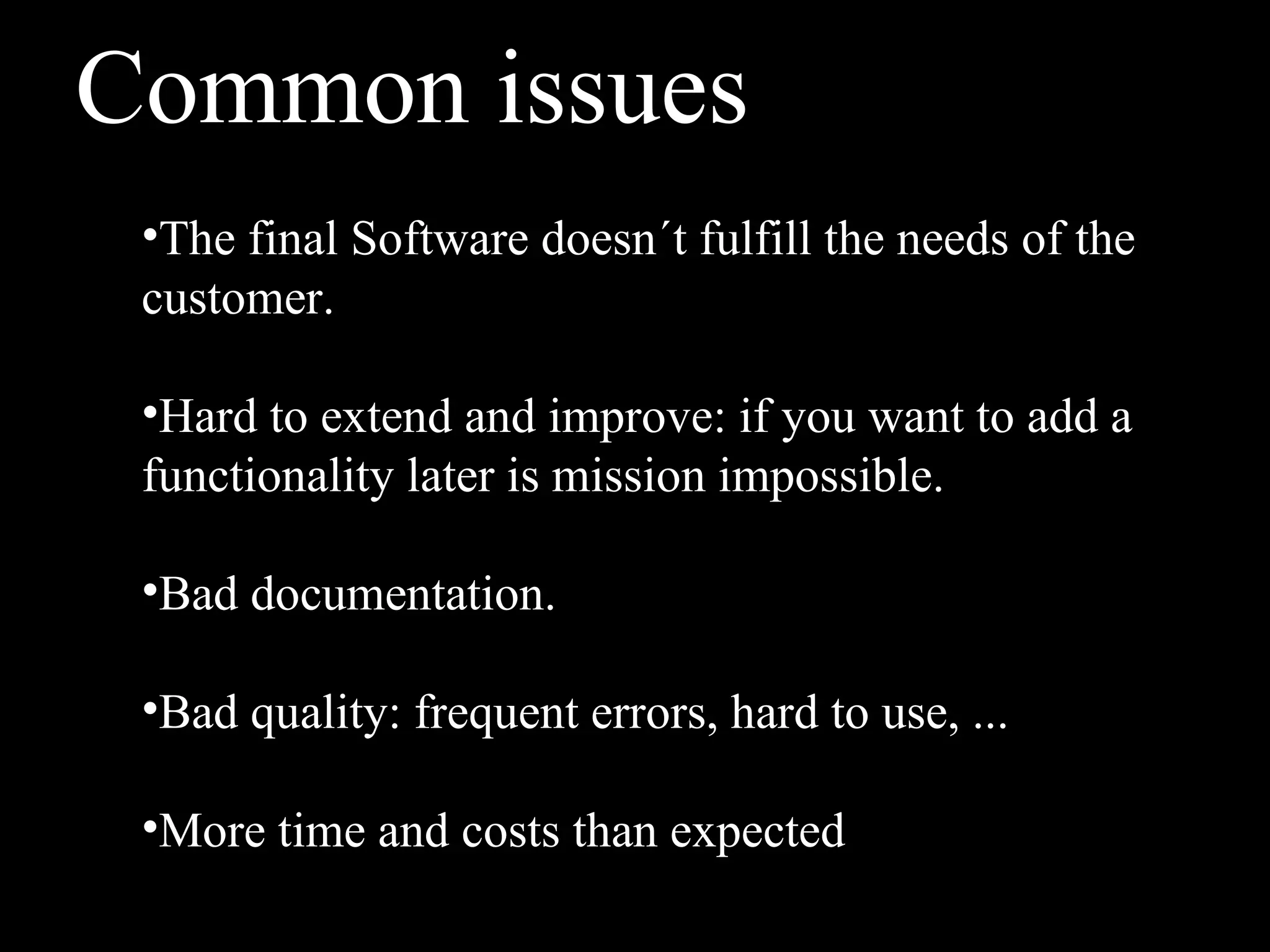
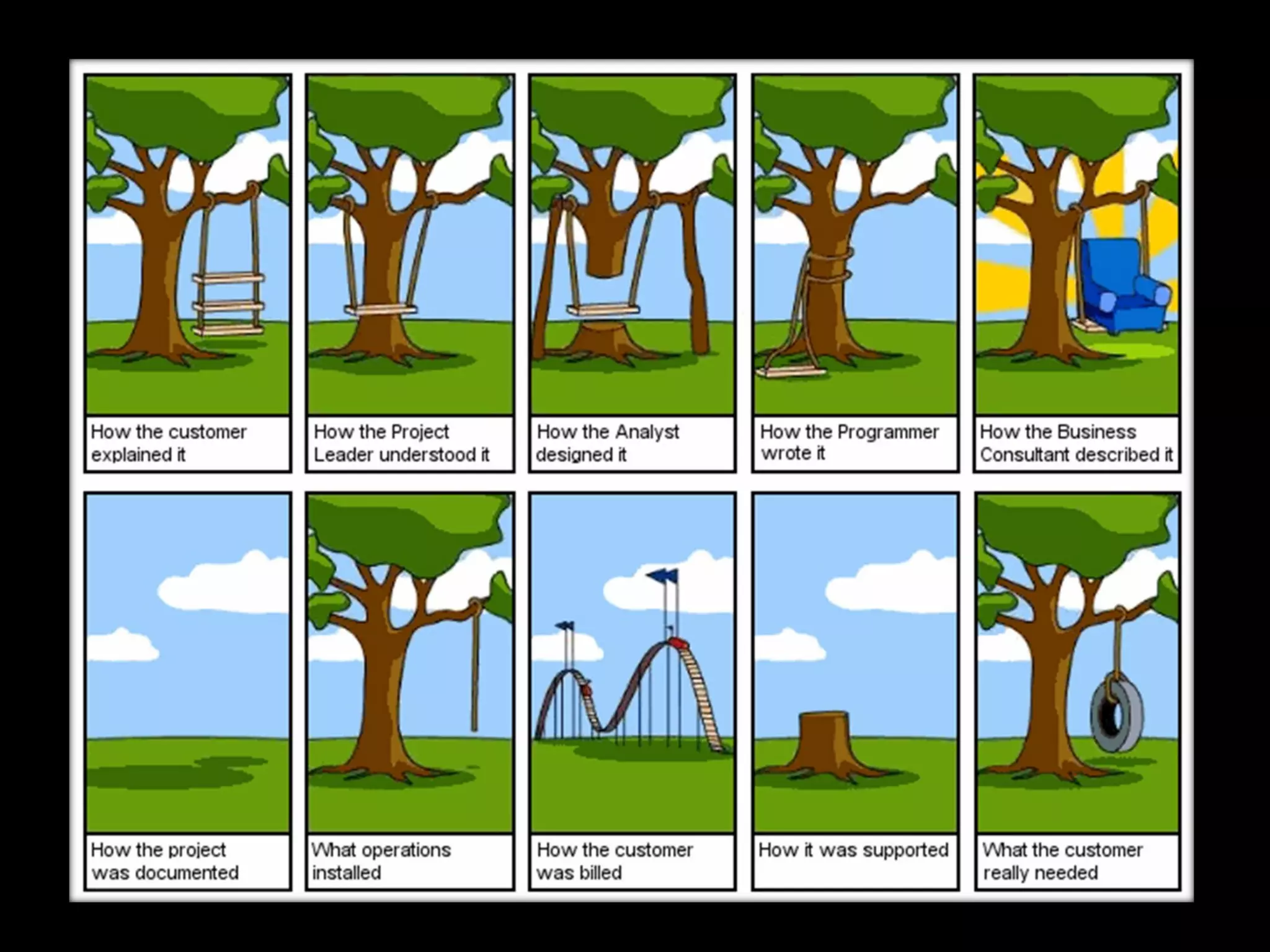
Common issues
 •The final Software doesn´t fulfill the needs of the
 customer.

 •Hard to extend and improve: if you want to add a
 functionality later is mission impossible.

 •Bad documentation.

 •Bad quality: frequent errors, hard to use, ...

 •More time and costs than expected
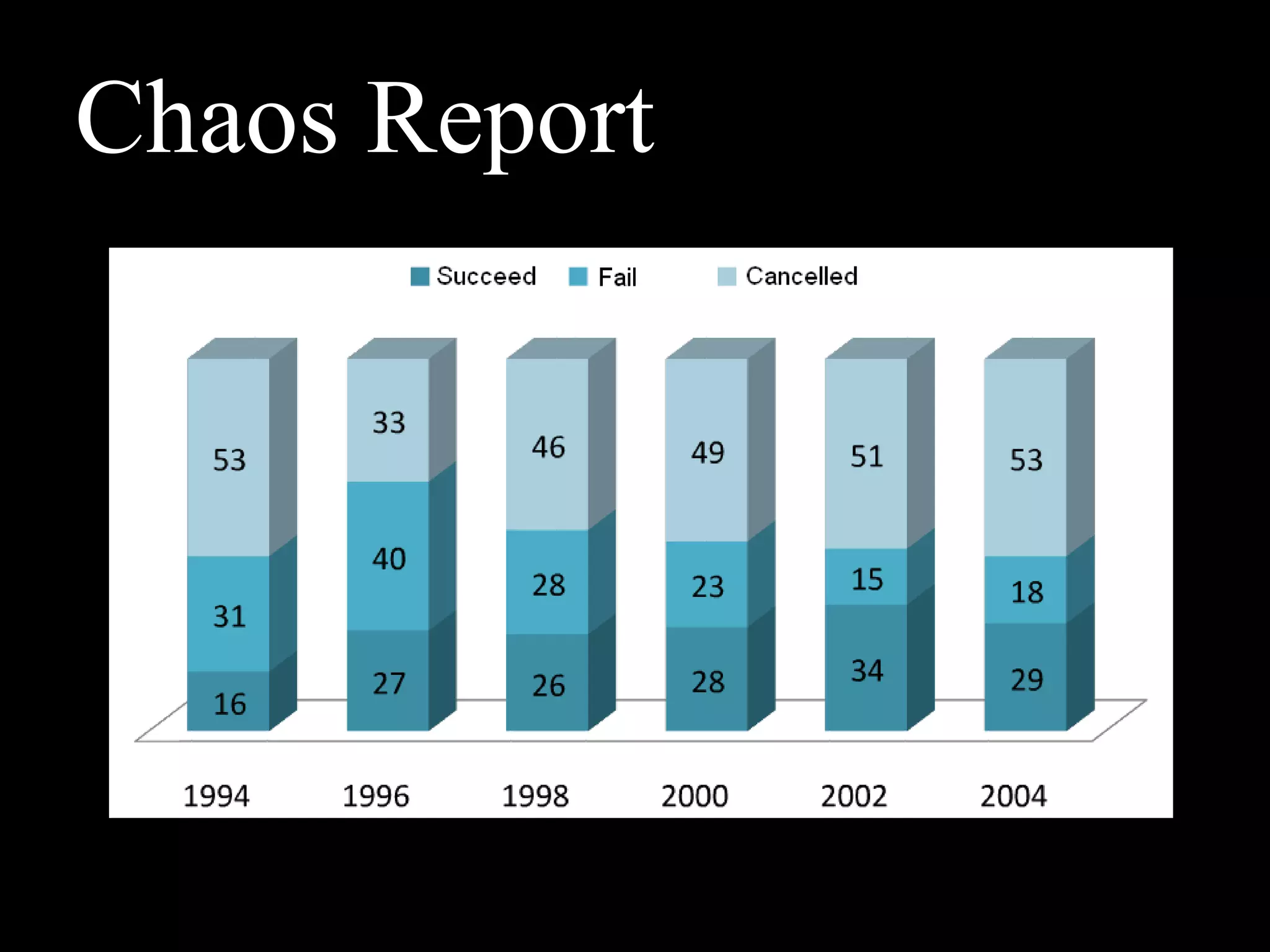
Chaos Report
Conclusion
Programming is NOT enough!
   It is not enough to do your best: you must
   Know what to do, and THEN do your best.
   -- W. Edwards Deming
Solution
Software Engineering
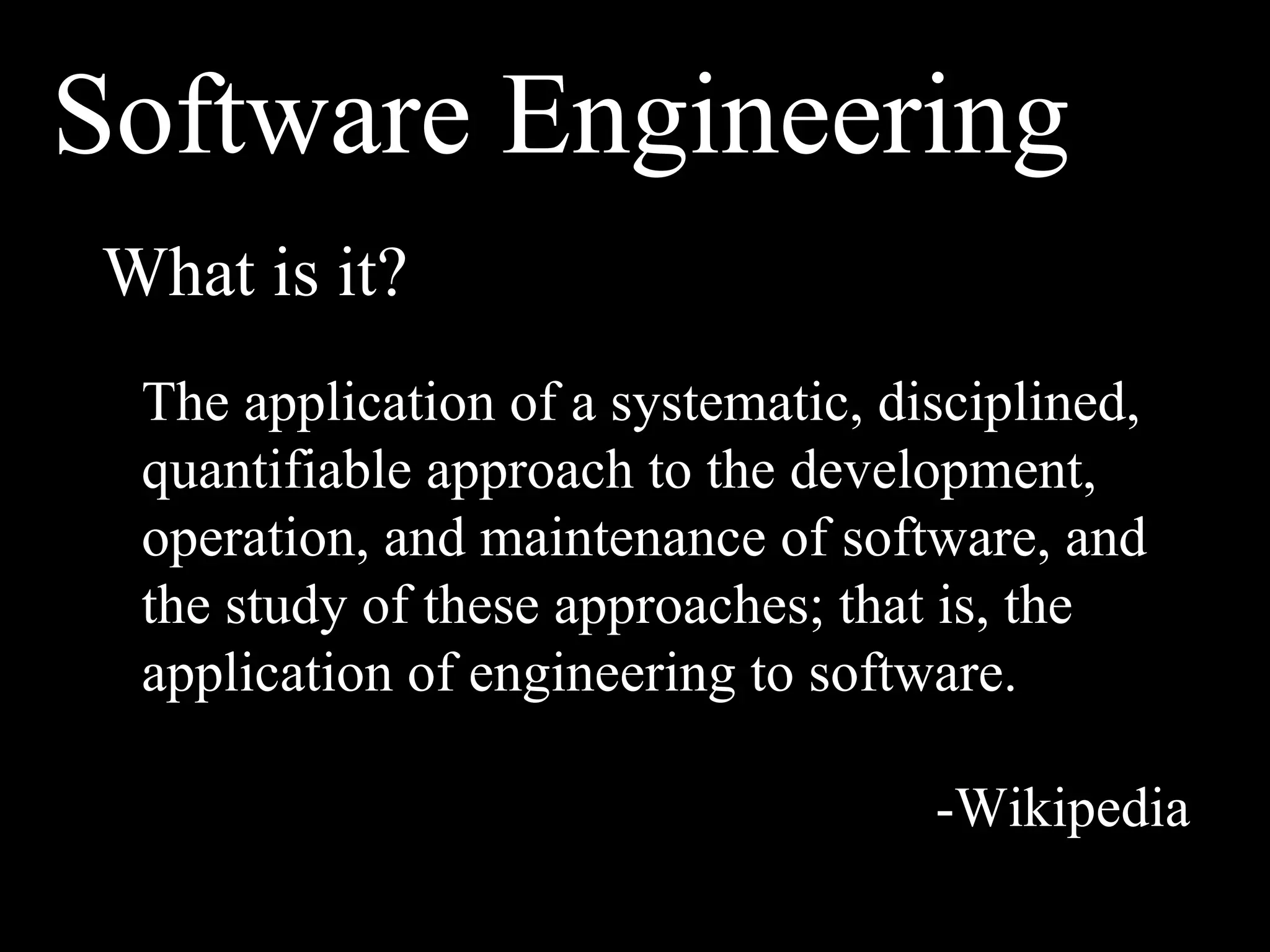
What is it?
 The application of a systematic, disciplined,
 quantifiable approach to the development,
 operation, and maintenance of software, and
 the study of these approaches; that is, the
 application of engineering to software.

                                    -Wikipedia
Software Engineering
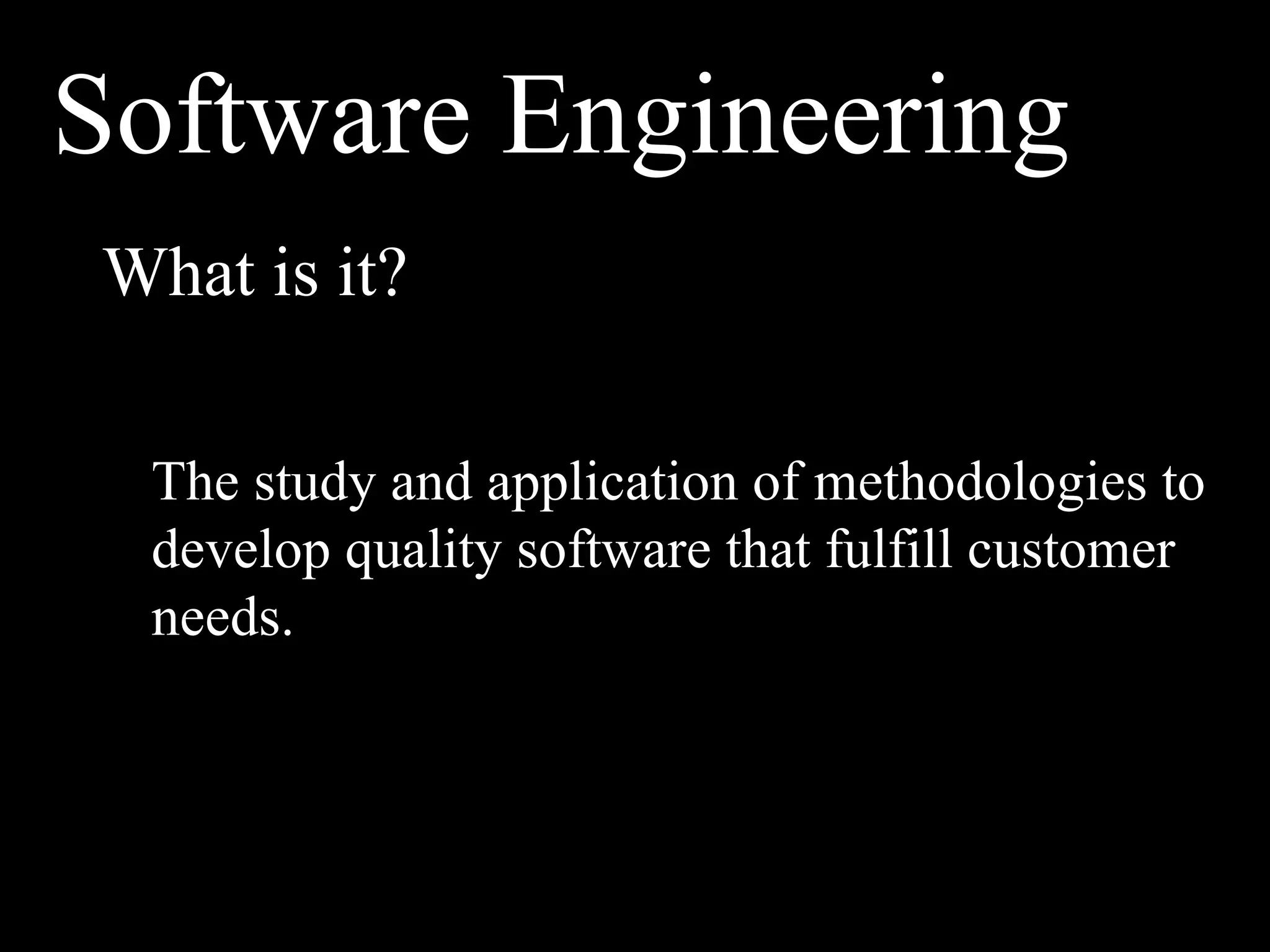
What is it?

 The study and application of methodologies to
 develop quality software that fulfill customer
 needs.
Software Engineering
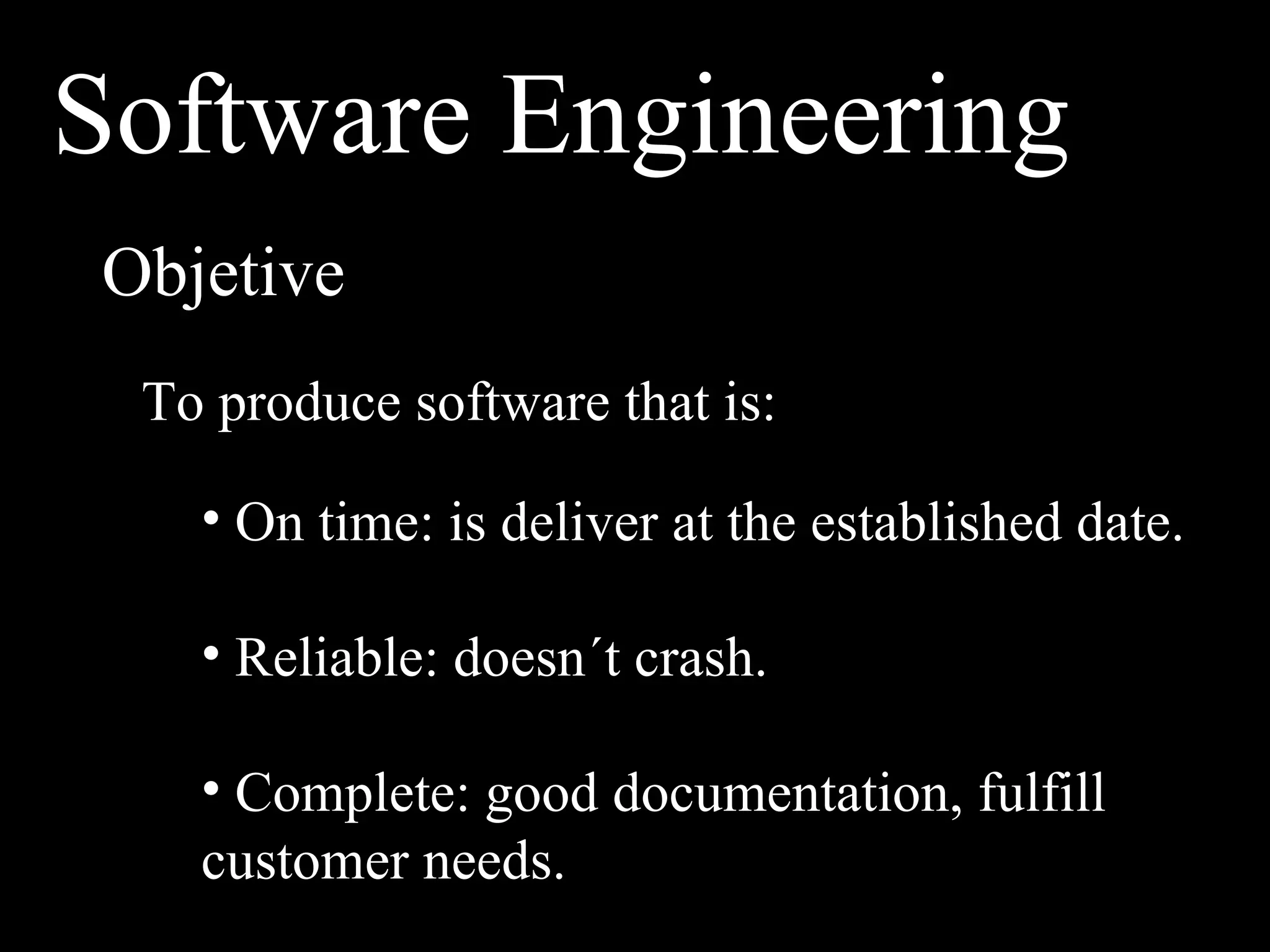
Objetive
 To produce software that is:

   • On time: is deliver at the established date.

   • Reliable: doesn´t crash.

   • Complete: good documentation, fulfill
   customer needs.
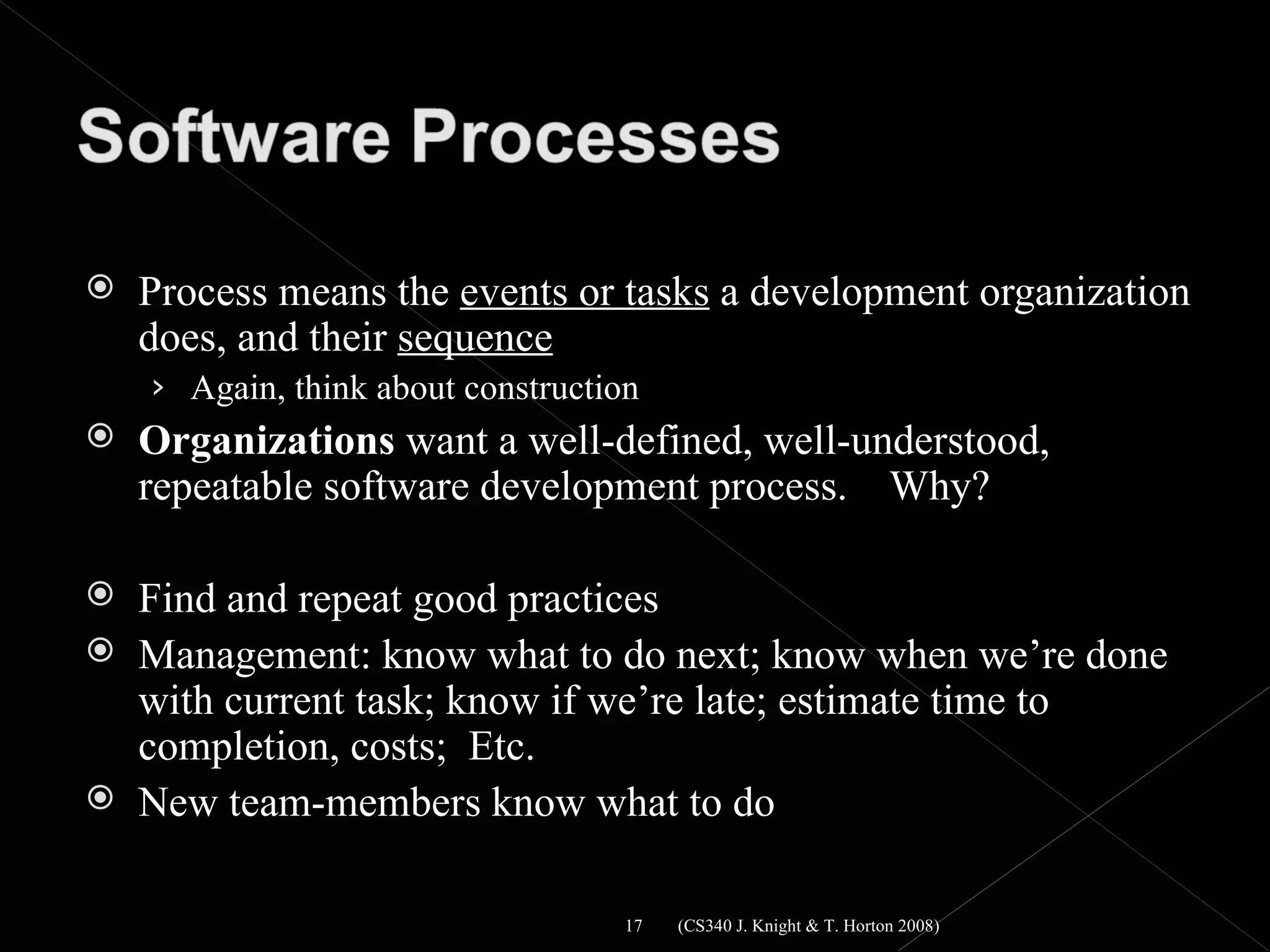
   Process means the events or tasks a development organization
    does, and their sequence
    › Again, think about construction
   Organizations want a well-defined, well-understood,
    repeatable software development process. Why?

   Find and repeat good practices
   Management: know what to do next; know when we’re done
    with current task; know if we’re late; estimate time to
    completion, costs; Etc.
   New team-members know what to do

                                    17   (CS340 J. Knight & T. Horton 2008)
 Major Task Identification
 Sequencing
 General model to be tailored
   There are general principles about:
    › What we do at various stages of SW development
    › How to inject quality into SW
    › How to avoid early problems that cause huge
      problems later
    › Recognize that SE is not just writing code
   No matter what process you end up doing,
    these general principles are the most important
    “take-away” from this material
                             19   (CS340 J. Knight & T. Horton 2008)
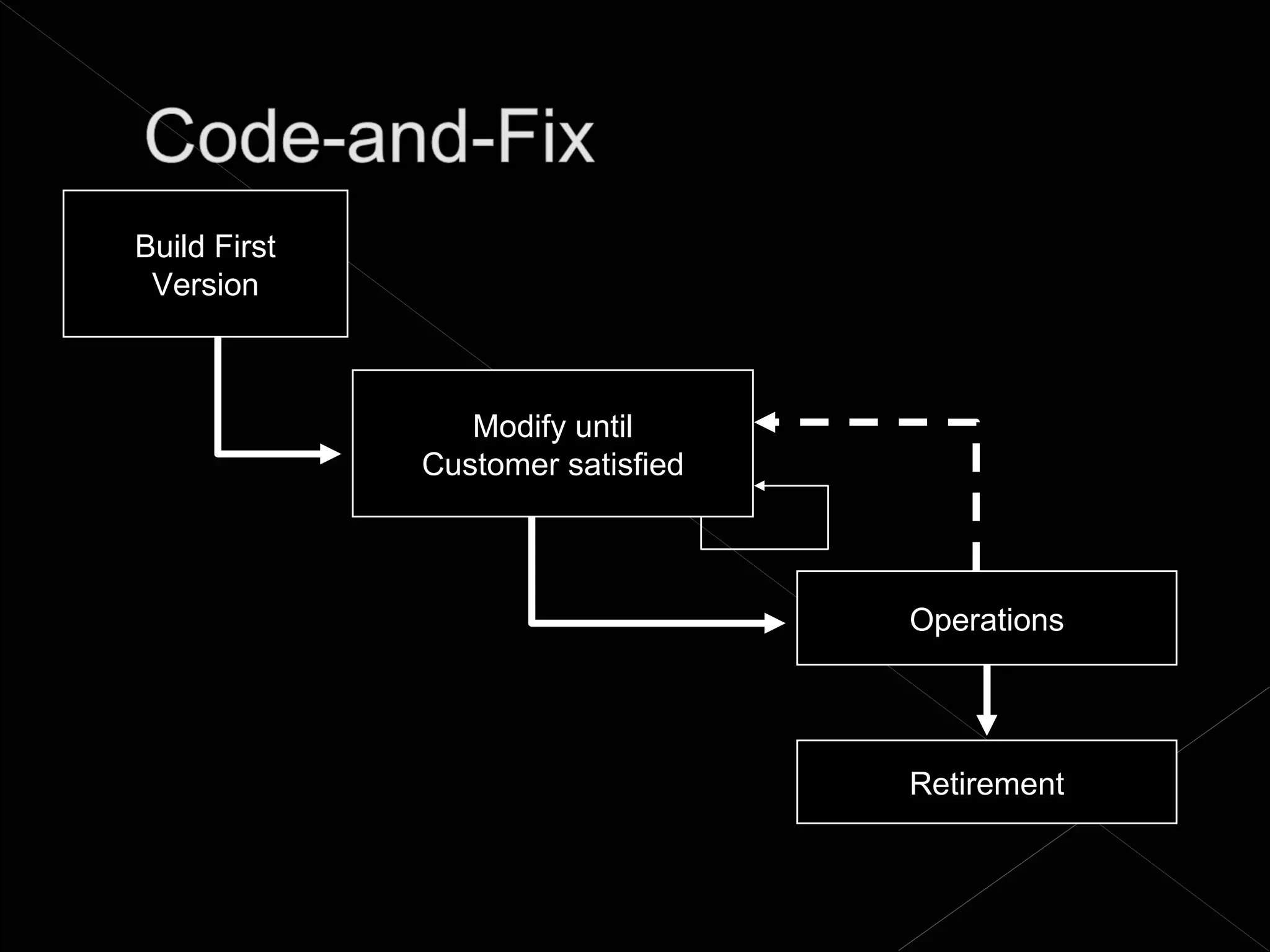
Build First
 Version


                 Modify until
              Customer satisfied


                                   Operations


                                   Retirement
   Really Bad
   Really Common
   Advantages
    › No Overhead
    › No Expertise
   Disadvantages
    › No means of assessing progress
    › Difficult to coordinate multiple programmers
   Useful for “hacking” single-use/personal-use programs:
    start with empty program and debug until it works
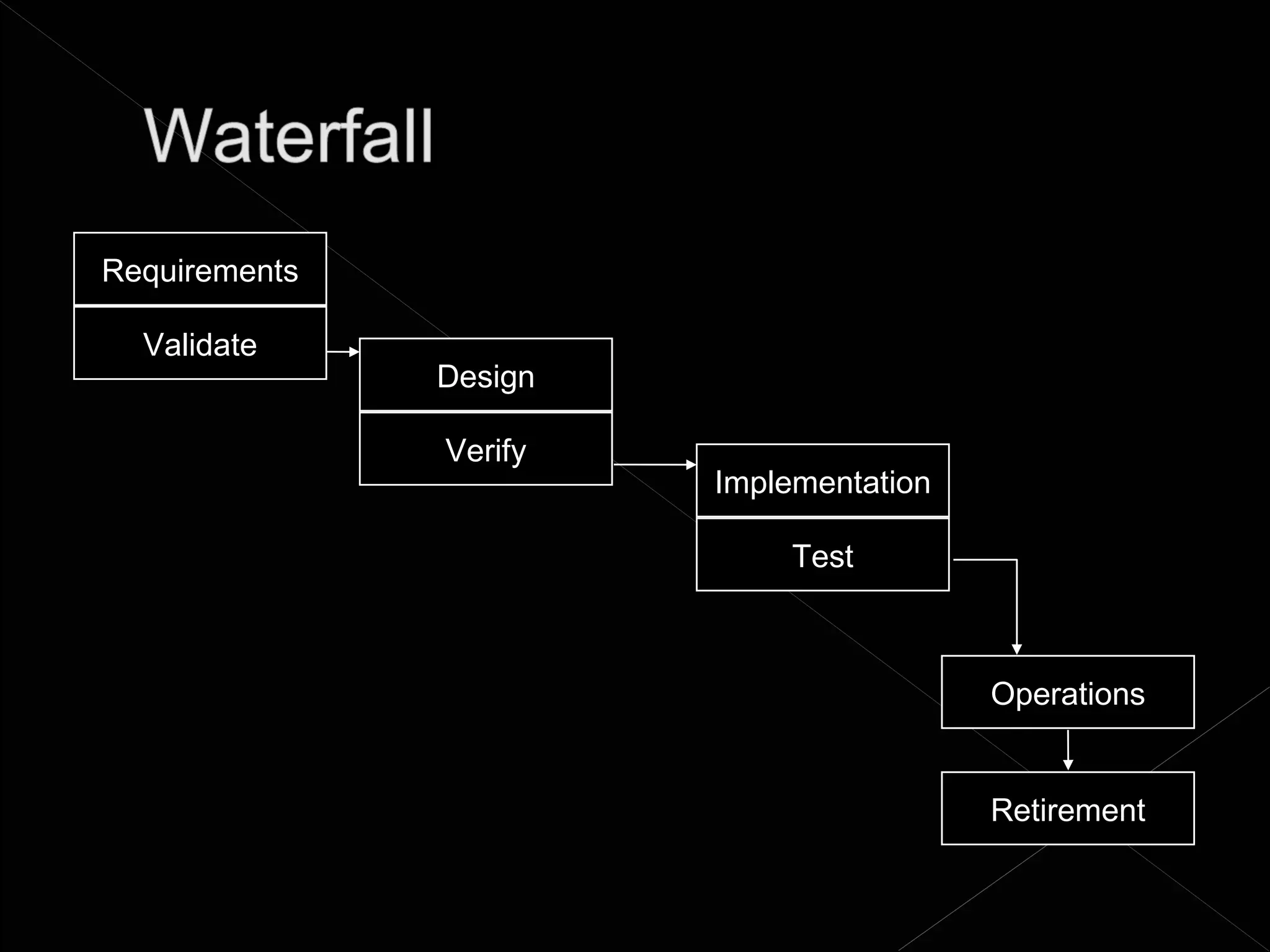
Requirements

  Validate
               Design

               Verify
                        Implementation

                             Test


                                         Operations


                                         Retirement
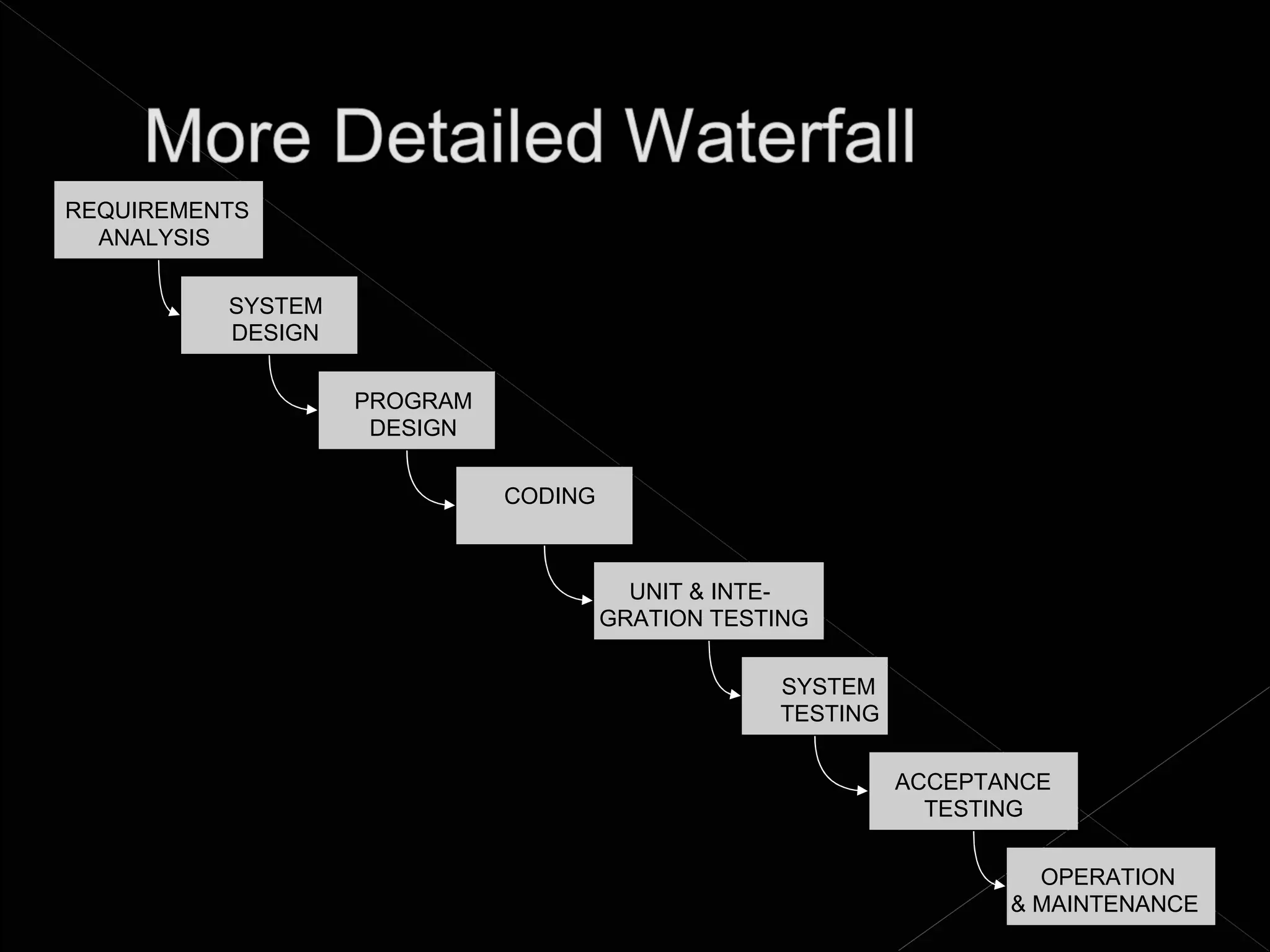
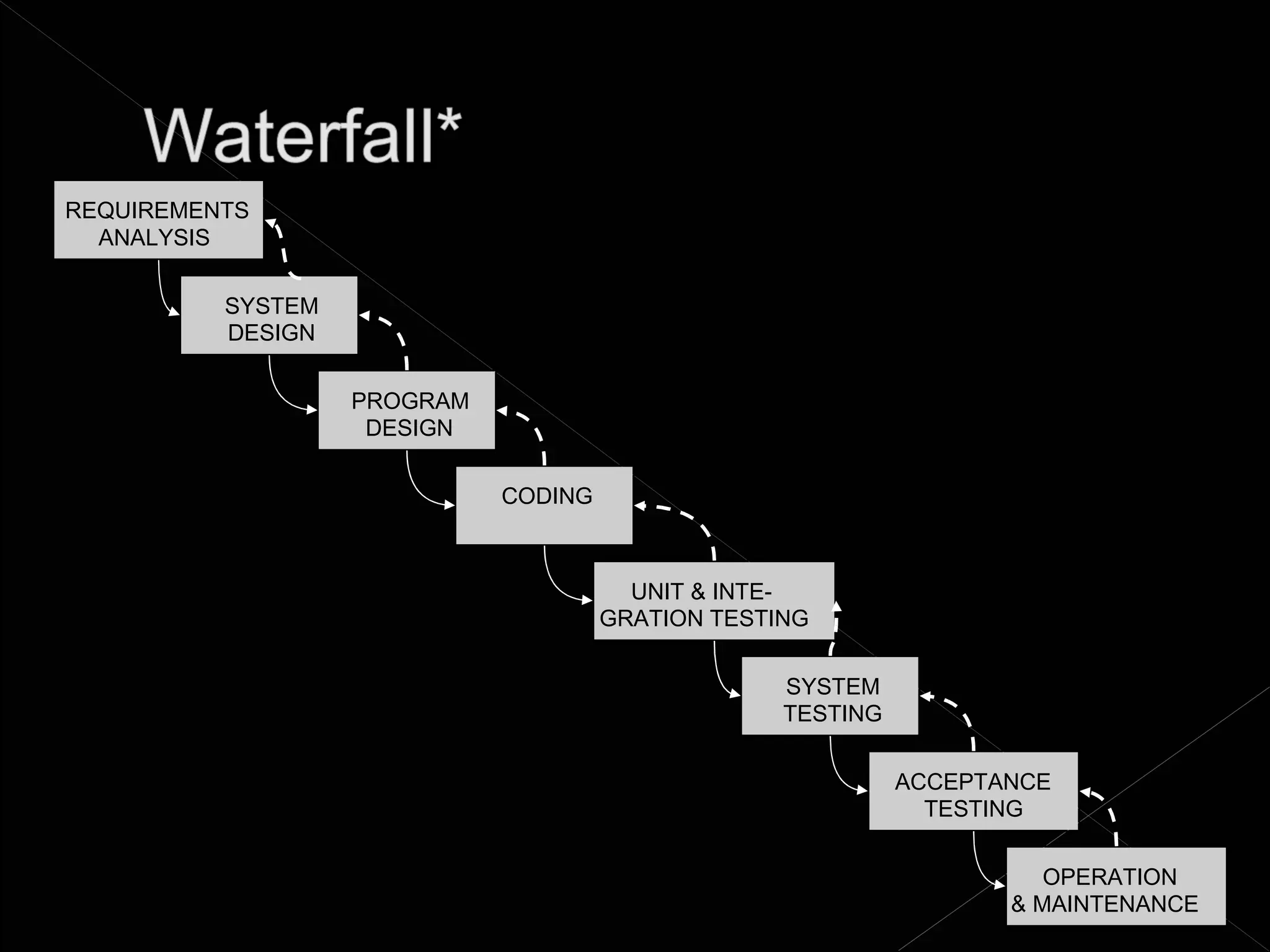
REQUIREMENTS
  ANALYSIS

          SYSTEM
          DESIGN

                   PROGRAM
                    DESIGN

                             CODING


                                        UNIT & INTE-
                                      GRATION TESTING

                                                  SYSTEM
                                                  TESTING

                                                            ACCEPTANCE
                                                              TESTING

                                                                     OPERATION
                                                                   & MAINTENANCE
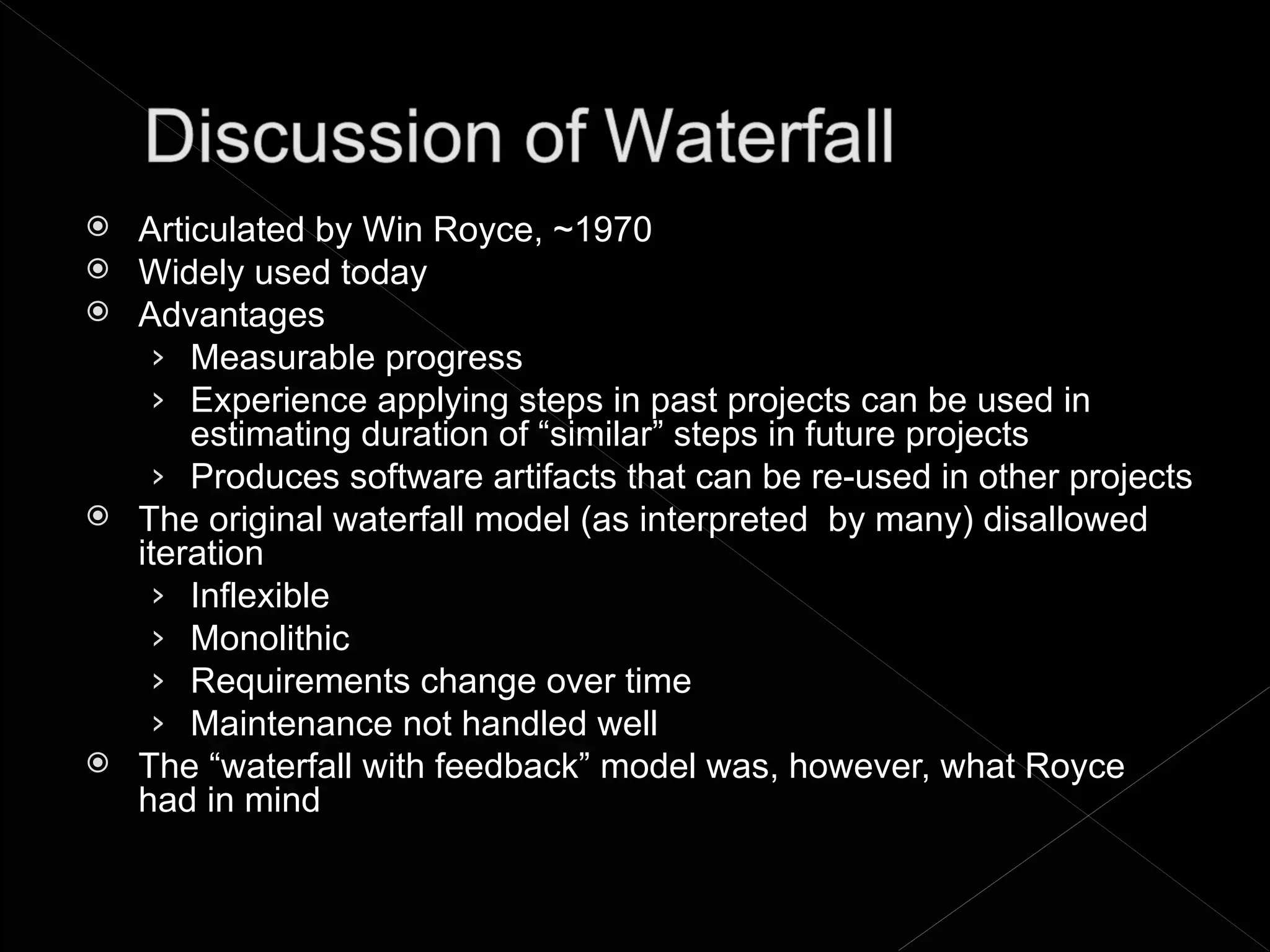
   Articulated by Win Royce, ~1970
   Widely used today
   Advantages
     › Measurable progress
     › Experience applying steps in past projects can be used in
        estimating duration of “similar” steps in future projects
     › Produces software artifacts that can be re-used in other projects
   The original waterfall model (as interpreted by many) disallowed
    iteration
     › Inflexible
     › Monolithic
     › Requirements change over time
     › Maintenance not handled well
   The “waterfall with feedback” model was, however, what Royce
    had in mind
REQUIREMENTS
  ANALYSIS

          SYSTEM
          DESIGN

                   PROGRAM
                    DESIGN

                             CODING


                                        UNIT & INTE-
                                      GRATION TESTING

                                                   SYSTEM
                                                   TESTING

                                                             ACCEPTANCE
                                                               TESTING

                                                                       OPERATION
                                                                    & MAINTENANCE
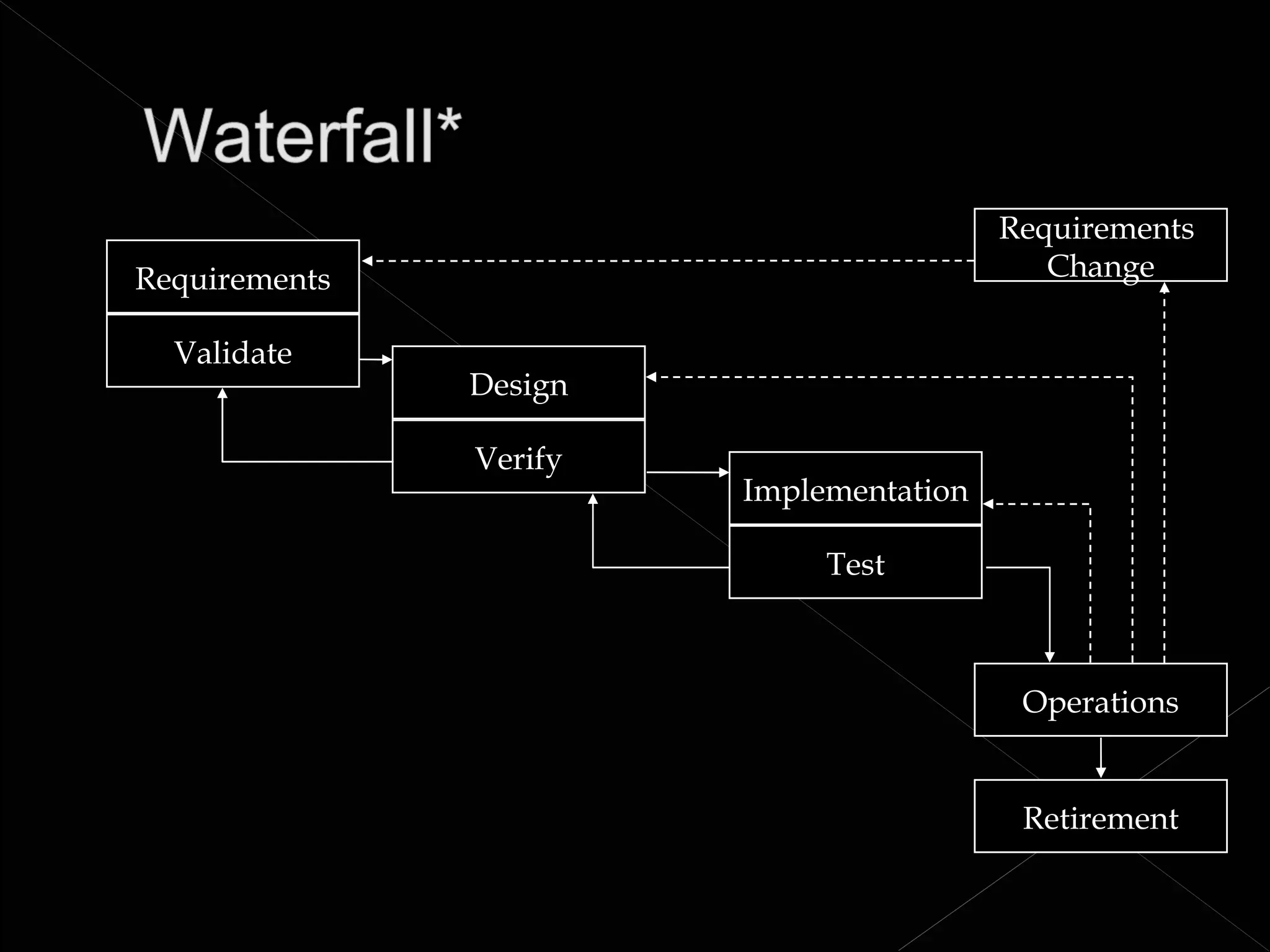
Requirements
Requirements                                Change

  Validate
               Design

               Verify
                        Implementation

                             Test


                                          Operations


                                          Retirement
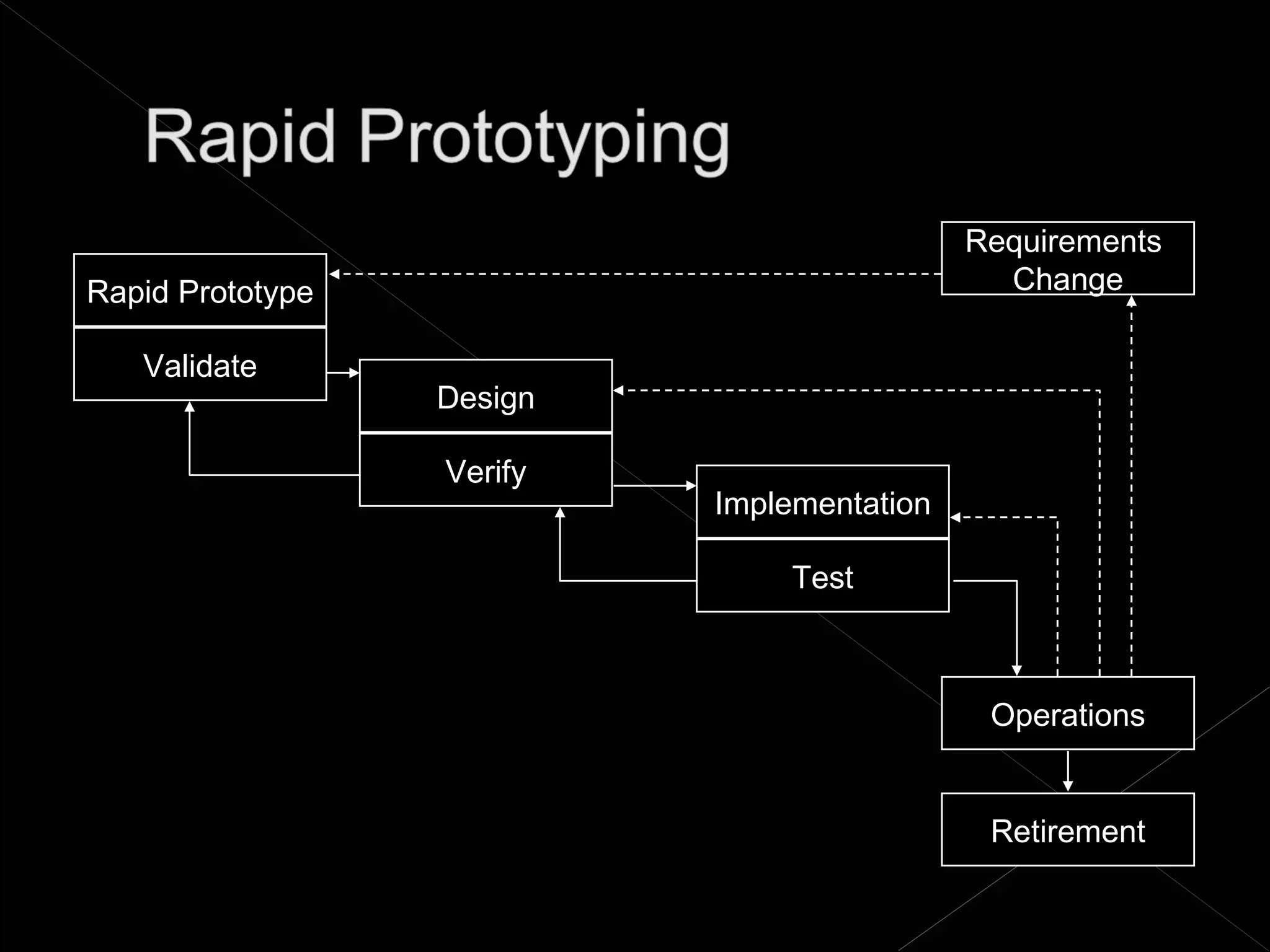
Requirements
Rapid Prototype                               Change

   Validate
                  Design

                  Verify
                           Implementation

                                Test


                                             Operations


                                             Retirement
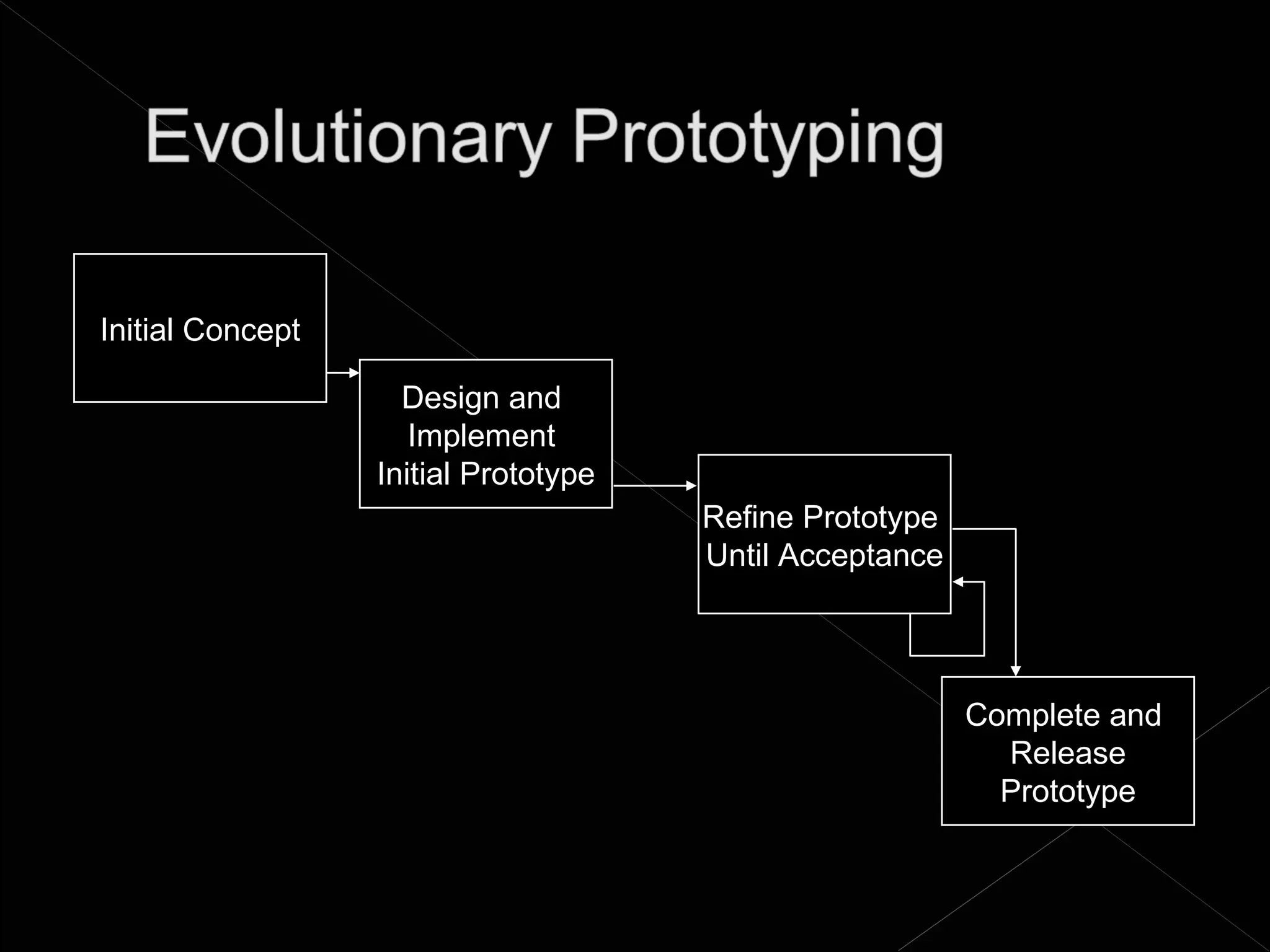
Initial Concept

                    Design and
                     Implement
                  Initial Prototype
                                      Refine Prototype
                                      Until Acceptance


                                                         Complete and
                                                           Release
                                                           Prototype
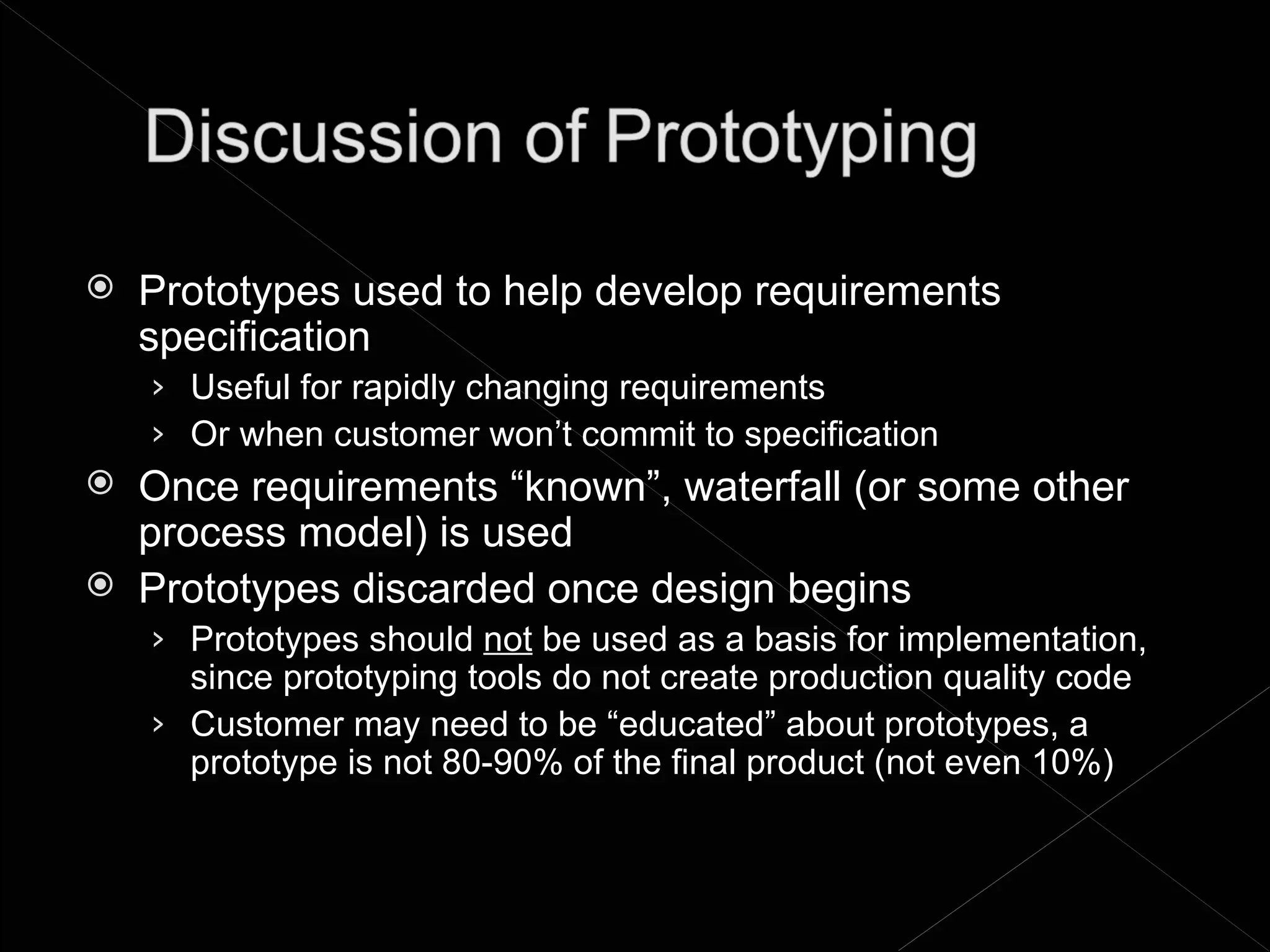
   Prototypes used to help develop requirements
    specification
    › Useful for rapidly changing requirements
    › Or when customer won’t commit to specification
   Once requirements “known”, waterfall (or some other
    process model) is used
   Prototypes discarded once design begins
    › Prototypes should not be used as a basis for implementation,
      since prototyping tools do not create production quality code
    › Customer may need to be “educated” about prototypes, a
      prototype is not 80-90% of the final product (not even 10%)
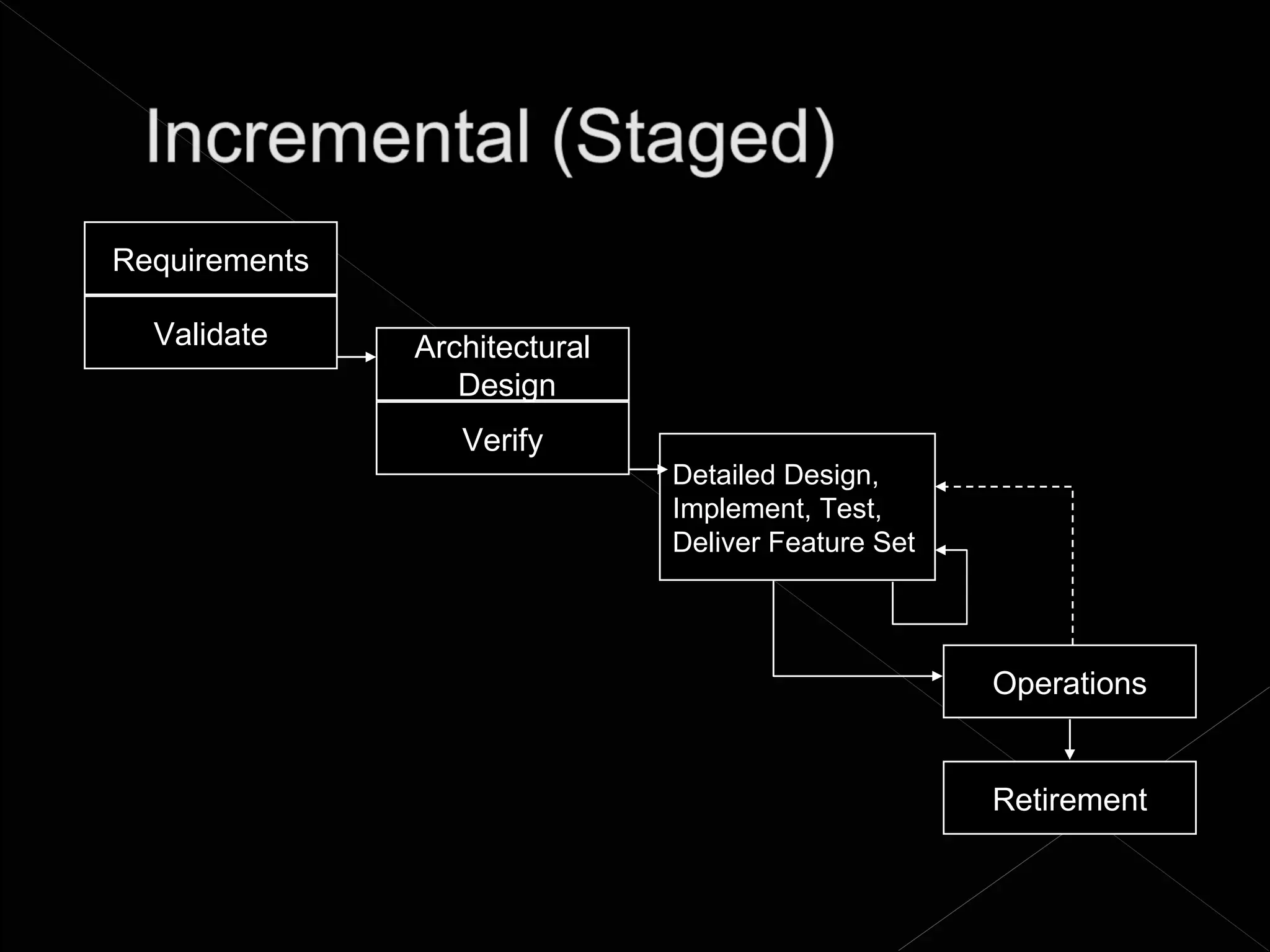
Requirements

  Validate     Architectural
                  Design
                  Verify
                               Detailed Design,
                               Implement, Test,
                               Deliver Feature Set


                                                     Operations


                                                     Retirement
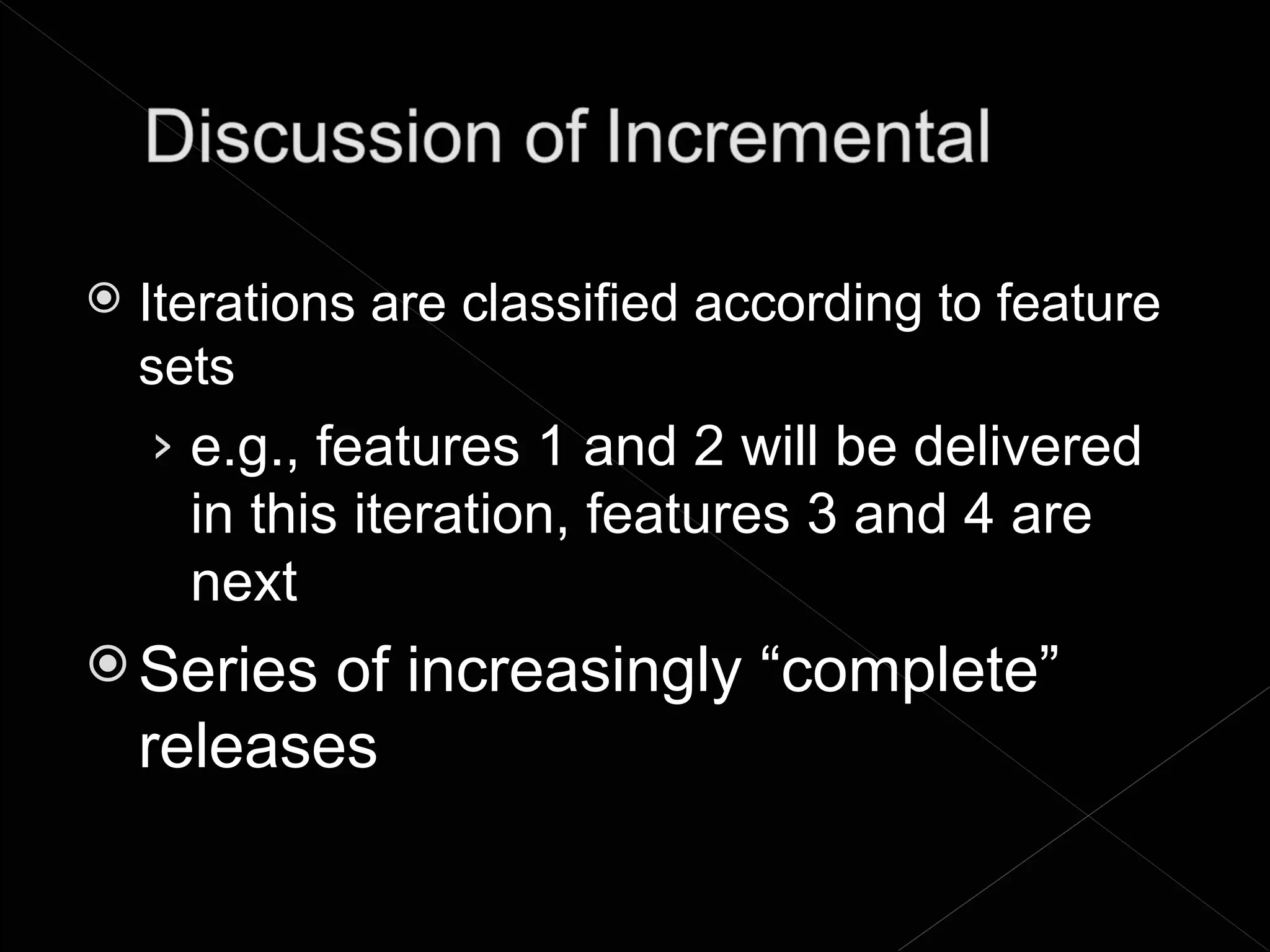
   Iterations are classified according to feature
    sets
    › e.g., features 1 and 2 will be delivered
      in this iteration, features 3 and 4 are
      next
 Series   of increasingly “complete”
    releases
DETERMINE GOALS,                                                                                                                            EVALUATE ALTERNATIVES
ALTERNATIVES,                                                                                                                               AND RISKS
CONSTRAINTS                                                     traints        4                           Risk analysis 4
                                                           Cons


                                                                        traints     3                  Risk analysis 3
                                      4                            Cons
                                 s
                          t   ive
                        na
                  lt er                                                           traints   2    Risk analysis 2
              A                                   es
                                                       3                     Cons
                                            a tiv
                                          rn
                                     Alte                           es
                                                                         2
                                                                           Co
                                                              tiv
                                                            na                ns         Risk analysis 1
                                                       er                        tra                                Proto -      Proto -   Proto -
                                                   Alt                Alte
                                                                          rna        int
                                                                             tive s            Prototype            type 2       type 3    type 4
       Budget 4           Budget 3               Budget            Budget          s 1                          1
                                                                                1           1
                                                              2
                                                           start     Requirements,               Concept of                                Detailed


                                                                                                                                sig re
                                                                                                                     e nts


                                                                                                                              de ftwa
                                                                                                                                            design
                                                                     life-cycle plan             operation         ar me


                                                                                                                                   n
                                                                                                                ftw ire


                                                                                                                               So
                                                  De
                        Int                          vel
                                                        op                                                    So qu
                            e
                       an grat                       pla men                                            d       re
                                                                                                    date   ts
                         dt     i
                             es on
                                                         n   t                                  Vali iremen                          Code
                               tp                                                                requ                  ,
                                  lan                                                                             dated ign
                                                                                                             Vali des
                                                                                                                fied
                                                                                                            veri            Unit test

PLAN                                                                                                                System                            DEVELOP AND TEST
                                                                                                                     test
                                                                                                  Acceptance
                                                                    Implementation
                                                                                                     test
                                                                         plan
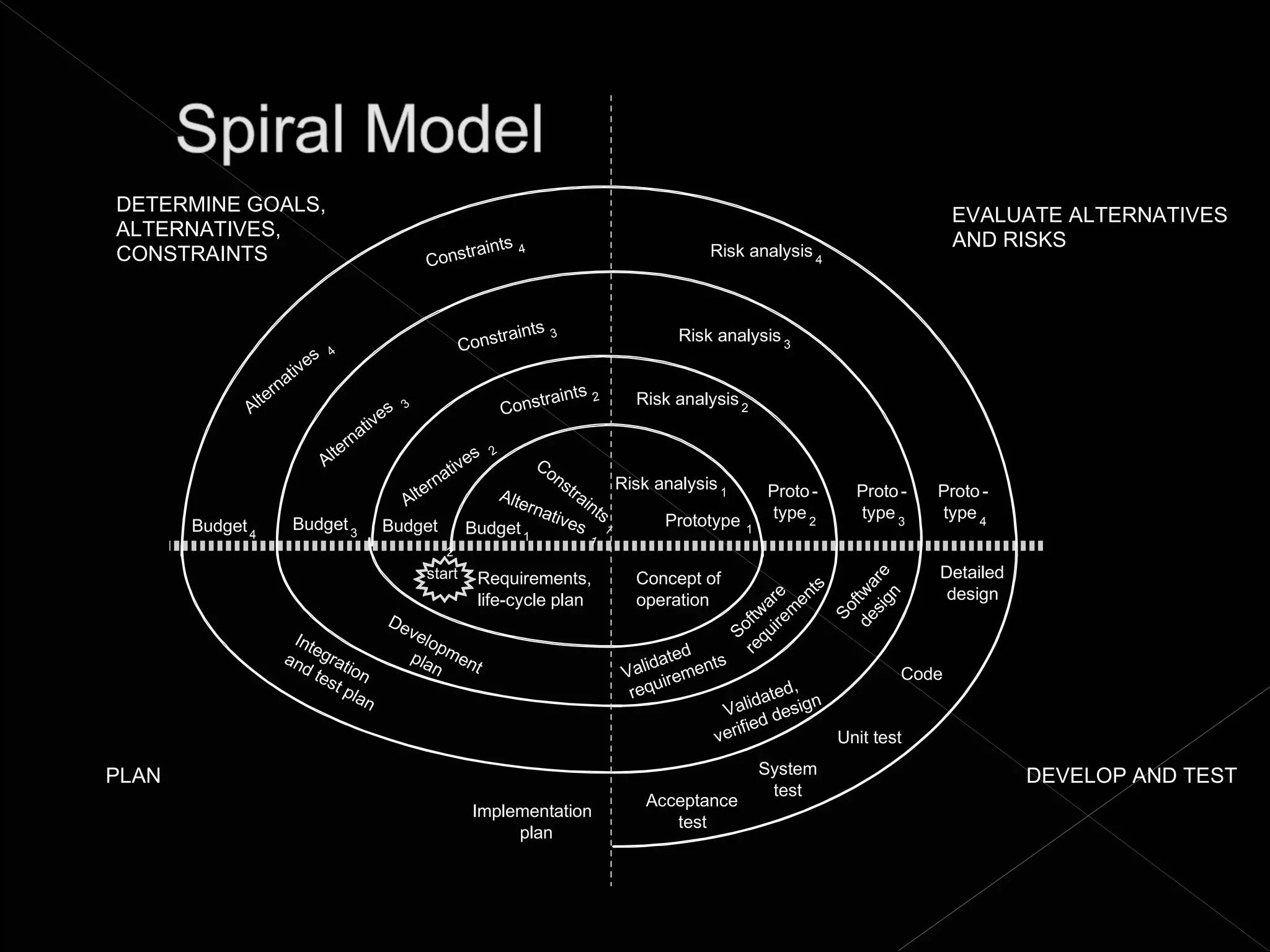
   Proposed by Barry Boehm, ~1986
   Similar to Incremental Model, but each iteration
    is driven by “risk management” and/or customer
    feedback
       Determine objectives and current status
       Identify risks and priorities
       Next iteration addresses (current) highest risk and/
        or highest priority items
       Repeat

Chapter 1 ASE Slides ppt

  • 2.
    Importance of software Software can have a huge impact in any aspect of society.
  • 3.
    Where can youfind software?
  • 4.
  • 5.
  • 6.
  • 7.
    Conclusion Software is Almost Everywhere.
  • 8.
  • 9.
    Common issues •Thefinal Software doesn´t fulfill the needs of the customer. •Hard to extend and improve: if you want to add a functionality later is mission impossible. •Bad documentation. •Bad quality: frequent errors, hard to use, ... •More time and costs than expected
  • 11.
  • 12.
    Conclusion Programming is NOTenough! It is not enough to do your best: you must Know what to do, and THEN do your best. -- W. Edwards Deming
  • 13.
  • 14.
    Software Engineering What isit? The application of a systematic, disciplined, quantifiable approach to the development, operation, and maintenance of software, and the study of these approaches; that is, the application of engineering to software. -Wikipedia
  • 15.
    Software Engineering What isit? The study and application of methodologies to develop quality software that fulfill customer needs.
  • 16.
    Software Engineering Objetive Toproduce software that is: • On time: is deliver at the established date. • Reliable: doesn´t crash. • Complete: good documentation, fulfill customer needs.
  • 17.
    Process means the events or tasks a development organization does, and their sequence › Again, think about construction  Organizations want a well-defined, well-understood, repeatable software development process. Why?  Find and repeat good practices  Management: know what to do next; know when we’re done with current task; know if we’re late; estimate time to completion, costs; Etc.  New team-members know what to do 17 (CS340 J. Knight & T. Horton 2008)
  • 18.
     Major TaskIdentification  Sequencing  General model to be tailored
  • 19.
    There are general principles about: › What we do at various stages of SW development › How to inject quality into SW › How to avoid early problems that cause huge problems later › Recognize that SE is not just writing code  No matter what process you end up doing, these general principles are the most important “take-away” from this material 19 (CS340 J. Knight & T. Horton 2008)
  • 20.
    Build First Version Modify until Customer satisfied Operations Retirement
  • 21.
    Really Bad  Really Common  Advantages › No Overhead › No Expertise  Disadvantages › No means of assessing progress › Difficult to coordinate multiple programmers  Useful for “hacking” single-use/personal-use programs: start with empty program and debug until it works
  • 22.
    Requirements Validate Design Verify Implementation Test Operations Retirement
  • 23.
    REQUIREMENTS ANALYSIS SYSTEM DESIGN PROGRAM DESIGN CODING UNIT & INTE- GRATION TESTING SYSTEM TESTING ACCEPTANCE TESTING OPERATION & MAINTENANCE
  • 24.
    Articulated by Win Royce, ~1970  Widely used today  Advantages › Measurable progress › Experience applying steps in past projects can be used in estimating duration of “similar” steps in future projects › Produces software artifacts that can be re-used in other projects  The original waterfall model (as interpreted by many) disallowed iteration › Inflexible › Monolithic › Requirements change over time › Maintenance not handled well  The “waterfall with feedback” model was, however, what Royce had in mind
  • 25.
    REQUIREMENTS ANALYSIS SYSTEM DESIGN PROGRAM DESIGN CODING UNIT & INTE- GRATION TESTING SYSTEM TESTING ACCEPTANCE TESTING OPERATION & MAINTENANCE
  • 26.
    Requirements Requirements Change Validate Design Verify Implementation Test Operations Retirement
  • 27.
    Requirements Rapid Prototype Change Validate Design Verify Implementation Test Operations Retirement
  • 28.
    Initial Concept Design and Implement Initial Prototype Refine Prototype Until Acceptance Complete and Release Prototype
  • 29.
    Prototypes used to help develop requirements specification › Useful for rapidly changing requirements › Or when customer won’t commit to specification  Once requirements “known”, waterfall (or some other process model) is used  Prototypes discarded once design begins › Prototypes should not be used as a basis for implementation, since prototyping tools do not create production quality code › Customer may need to be “educated” about prototypes, a prototype is not 80-90% of the final product (not even 10%)
  • 30.
    Requirements Validate Architectural Design Verify Detailed Design, Implement, Test, Deliver Feature Set Operations Retirement
  • 31.
    Iterations are classified according to feature sets › e.g., features 1 and 2 will be delivered in this iteration, features 3 and 4 are next  Series of increasingly “complete” releases
  • 32.
    DETERMINE GOALS, EVALUATE ALTERNATIVES ALTERNATIVES, AND RISKS CONSTRAINTS traints 4 Risk analysis 4 Cons traints 3 Risk analysis 3 4 Cons s t ive na lt er traints 2 Risk analysis 2 A es 3 Cons a tiv rn Alte es 2 Co tiv na ns Risk analysis 1 er tra Proto - Proto - Proto - Alt Alte rna int tive s Prototype type 2 type 3 type 4 Budget 4 Budget 3 Budget Budget s 1 1 1 1 2 start Requirements, Concept of Detailed sig re e nts de ftwa design life-cycle plan operation ar me n ftw ire So De Int vel op So qu e an grat pla men d re date ts dt i es on n t Vali iremen Code tp requ , lan dated ign Vali des fied veri Unit test PLAN System DEVELOP AND TEST test Acceptance Implementation test plan
  • 33.
    Proposed by Barry Boehm, ~1986  Similar to Incremental Model, but each iteration is driven by “risk management” and/or customer feedback  Determine objectives and current status  Identify risks and priorities  Next iteration addresses (current) highest risk and/ or highest priority items  Repeat

Editor's Notes

  • #11 i. The final Software doesn´t fit the needs of the customer ii. Hard to extend and improve: if you want to add a functionality later is mission impossible Bad documentation, bad software design iii. Bad quality: frequent errors, hard to use... iv. More time and costs than expected
  • #12 Coming back to the Chaos Report 2006, the thing that doesn’t change significantly over all those years is percentage of projects with time or budget overrun. It still oscillates around 50%
  • #15 In simple terms, is the study and application of methodologies to develop quality software that fulfill customer needs.
  • #16 In simple terms, is the study and application of methodologies to develop quality software that fulfill customer needs.
  • #17 On time: deliver at the established date Reliable: doesn´t crash often, etc Complete: good documentation, fulfill customer needs
  • #24 [Royce 1970] - DoD contracts PROS: Focuses attention Easy to explain to customers Intermediate products are made explicit CONS: Does not really reflect how software is produced Imposes PM structure - no explanation of how artifact from one stage is transformed in the next Failure to treat software as problem-solving process
  • #26 [Royce 1970] - DoD contracts PROS: Focuses attention Easy to explain to customers Intermediate products are made explicit CONS: Does not really reflect how software is produced Imposes PM structure - no explanation of how artifact from one stage is transformed in the next Failure to treat software as problem-solving process
  • #33 [Boehm 88] Viewed in light of risks involved Combine development with risk MGT