



Michael Häusler
ResearchGate
EVERYDAY FLINK
• Big data use cases at ResearchGate
• Frameworks
• Maintainability
• Performance
• Having fun
TOPICS
BIG DATA PROCESSING
AT RESEARCHGATE
Early 2011
First Hadoop Use Case
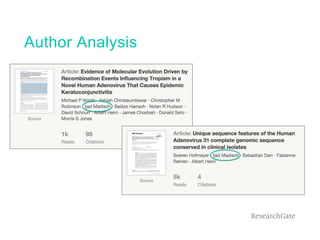
Author Analysis
Author Analysis
Author Analysis
Author Analysis
First version – processes enriching live database
Runtime – few weeks
Author Analysis
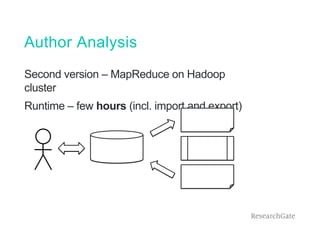
Second version – MapReduce on Hadoop
cluster
Runtime – few hours (incl. import and export)
Author Analysis
• Major effort – many things to consider
• Smarter algorithms – better clustering
• Efficiency – better runtime complexity
• Distributed computing
• Integration
Author Analysis
• One decision was easy due to limited choice:
Frameworks
• Mainly MapReduce
• Hadoop for special use cases
HIVE
Everyone knows SQL
Hadoop for everyone
Hive
• „Realtime“ ResearchGate is mostly NoSQL
• Hive brought back analytical SQL
Immense growth on the Hadoop cluster:
• Users
• Data
• Jobs
Thinking about Frameworks
MapReduce
• General purpose language
• Very low level
• Not for everyone
Hive
• Domain specific language
• Very high level
• Not for every use case
Having fun with Hadoop?
Frameworkitis is the disease that a framework
wants to do too much for you or it does it in a
way that you don't want but you can't change it.
Erich Gamma
Having fun with Hadoop?
Simple things should be simple,
complex things should be possible.
Alan Kay
Evaluating Frameworks
Mid 2013
How to Evaluate a Framework?
Obvious criteria
• Features
• Performance & Scalability
• Robustness & Stability
• Maturity & Community
Not so obvious
• Is it fun to solve simple, everyday problems?
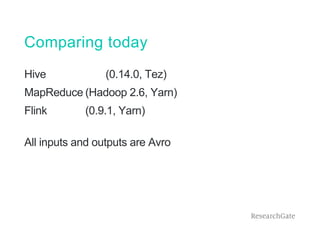
Comparing today
Hive (0.14.0, Tez)
MapReduce (Hadoop 2.6, Yarn)
Flink (0.9.1, Yarn)
All inputs and outputs are Avro
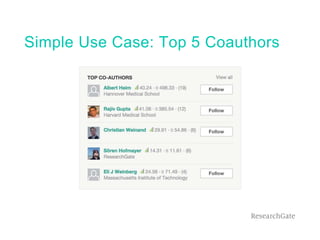
Simple Use Case: Top 5 Coauthors
publication = {
"publicationUid": 7,
"title": "Foo",
"authorships": [
{
"authorUid": 23,
"authorName": "Jane"
},
{
"authorUid": 25,
"authorName": "John"
}
]
}
authorAccountMapping = {
"authorUid": 23,
"accountId": 42
}
(7, 23)
(7, 25)
(7, "AC:42")
(7, "AU:25")
topCoauthorStats = {
"authorKey": "AC:42",
"topCoauthors": [
{
"coauthorKey": "AU:23",
"coauthorCount": 1
}
]
}
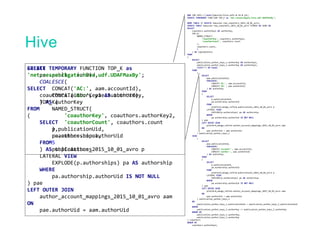
Hive
ADD JAR hdfs:///user/haeusler/hive-udfs-0.19.0.jar;
CREATE TEMPORARY FUNCTION TOP_K as 'net.researchgate.hive.udf.UDAFMaxBy';
DROP TABLE IF EXISTS haeusler.top_coauthors_2015_10_01_avro;
CREATE TABLE haeusler.top_coauthors_2015_10_01_avro STORED AS AVRO AS
SELECT
coauthors.authorKey1 AS authorKey,
TOP_K(
NAMED_STRUCT(
'coauthorKey', coauthors.authorKey2,
'coauthorCount', coauthors.count
),
coauthors.count,
5
) AS topCoAuthors
FROM
(
SELECT
publication_author_keys_1.authorKey AS authorKey1,
publication_author_keys_2.authorKey AS authorKey2,
COUNT(*) AS count
FROM
(
SELECT
pae.publicationUid,
COALESCE(
CONCAT('AC:', aam.accountId),
CONCAT('AU:', pae.authorUid)
) AS authorKey
FROM
(
SELECT
p.publicationUid,
pa.authorship.authorUid
FROM
platform_mongo_refind.publications_2015_10_01_avro p
LATERAL VIEW
EXPLODE(p.authorships) pa AS authorship
WHERE
pa.authorship.authorUid IS NOT NULL
) pae
LEFT OUTER JOIN
platform_mongo_refind.author_account_mappings_2015_10_01_avro aam
ON
pae.authorUid = aam.authorUid
) publication_author_keys_1
JOIN
(
SELECT
pae.publicationUid,
COALESCE(
CONCAT('account:', aam.accountId),
CONCAT('author:', pae.authorUid)
) AS authorKey
FROM
(
SELECT
p.publicationUid,
pa.authorship.authorUid
FROM
platform_mongo_refind.publications_2015_10_01_avro p
LATERAL VIEW
EXPLODE(p.authorships) pa AS authorship
WHERE
pa.authorship.authorUid IS NOT NULL
) pae
LEFT OUTER JOIN
platform_mongo_refind.author_account_mappings_2015_10_01_avro aam
ON
pae.authorUid = aam.authorUid
) publication_author_keys_2
ON
publication_author_keys_1.publicationUid = publication_author_keys_2.publicationUid
WHERE
publication_author_keys_1.authorKey <> publication_author_keys_2.authorKey
GROUP BY
publication_author_keys_1.authorKey,
publication_author_keys_2.authorKey
) coauthors
GROUP BY
coauthors.authorKey1;
SELECT
pae.publicationUid,
COALESCE(
CONCAT('AC:', aam.accountId),
CONCAT('AU:', pae.authorUid)
) AS authorKey
FROM
(
SELECT
p.publicationUid,
pa.authorship.authorUid
FROM
publications_2015_10_01_avro p
LATERAL VIEW
EXPLODE(p.authorships) pa AS authorship
WHERE
pa.authorship.authorUid IS NOT NULL
) pae
LEFT OUTER JOIN
author_account_mappings_2015_10_01_avro aam
ON
pae.authorUid = aam.authorUid
CREATE TEMPORARY FUNCTION TOP_K as
'net.researchgate.hive.udf.UDAFMaxBy';
SELECT
coauthors.authorKey1 AS authorKey,
TOP_K(
NAMED_STRUCT(
'coauthorKey', coauthors.authorKey2,
'coauthorCount', coauthors.count
),
coauthors.count,
5
) AS topCoAuthors
Hive
package net.researchgate.authorstats.hive;
import org.apache.commons.logging.Log;
import org.apache.commons.logging.LogFactory;
import org.apache.hadoop.hive.ql.exec.Description;
import org.apache.hadoop.hive.ql.exec.UDFArgumentTypeException;
import org.apache.hadoop.hive.ql.metadata.HiveException;
import org.apache.hadoop.hive.ql.parse.SemanticException;
import org.apache.hadoop.hive.ql.udf.generic.AbstractGenericUDAFResolver;
import org.apache.hadoop.hive.ql.udf.generic.GenericUDAFEvaluator;
import org.apache.hadoop.hive.serde2.objectinspector.ObjectInspector;
import org.apache.hadoop.hive.serde2.objectinspector.ObjectInspectorFactory;
import org.apache.hadoop.hive.serde2.objectinspector.ObjectInspectorUtils;
import org.apache.hadoop.hive.serde2.objectinspector.PrimitiveObjectInspector;
import org.apache.hadoop.hive.serde2.objectinspector.StandardListObjectInspector;
import org.apache.hadoop.hive.serde2.objectinspector.StandardStructObjectInspector;
import org.apache.hadoop.hive.serde2.objectinspector.primitive.PrimitiveObjectInspectorFactory;
import org.apache.hadoop.hive.serde2.objectinspector.primitive.WritableConstantIntObjectInspector;
import org.apache.hadoop.hive.serde2.typeinfo.PrimitiveTypeInfo;
import org.apache.hadoop.hive.serde2.typeinfo.TypeInfo;
import org.apache.hadoop.io.IntWritable;
import java.util.ArrayList;
import java.util.Arrays;
import java.util.Comparator;
import java.util.List;
import java.util.PriorityQueue;
/**
* Returns top n values sorted by keys.
* <p/>
* The output is an array of values
*/
@Description(name = "top_k",
value = "_FUNC_(value, key, n) - Returns the top n values with the maximum keys",
extended = "Example:n"
+ "> SELECT top_k(value, key, 3) FROM src;n"
+ "[3, 2, 1]n"
+ "The return value is an array of values which correspond to the maximum keys"
)
public class UDAFTopK extends AbstractGenericUDAFResolver {
// class static variables
static final Log LOG = LogFactory.getLog(UDAFTopK.class.getName());
private static void ensurePrimitive(int paramIndex, TypeInfo parameter) throws UDFArgumentTypeException {
if (parameter.getCategory() != ObjectInspector.Category.PRIMITIVE) {
throw new UDFArgumentTypeException(paramIndex, "Only primitive type arguments are accepted but "
+ parameter.getTypeName() + " was passed as parameter " + Integer.toString(paramIndex + 1) + ".");
}
}
private static void ensureInt(int paramIndex, TypeInfo parameter) throws UDFArgumentTypeException {
ensurePrimitive(paramIndex, parameter);
PrimitiveTypeInfo pti = (PrimitiveTypeInfo) parameter;
switch (pti.getPrimitiveCategory()) {
case INT:
return;
default:
throw new IllegalStateException("Unhandled primitive");
}
}
private static void ensureNumberOfArguments(int n, TypeInfo[] parameters) throws SemanticException {
if (parameters.length != n) {
throw new UDFArgumentTypeException(parameters.length - 1, "Please specify exactly " + Integer.toString(n) + " arguments.");
}
}
@Override
public GenericUDAFEvaluator getEvaluator(TypeInfo[] parameters) throws SemanticException {
ensureNumberOfArguments(3, parameters);
//argument 0 can be any
ensurePrimitive(1, parameters[1]);
ensureInt(2, parameters[2]);
return new TopKUDAFEvaluator();
}
public static class TopKUDAFEvaluator extends GenericUDAFEvaluator {
static final Log LOG = LogFactory.getLog(TopKUDAFEvaluator.class.getName());
public static class IntermObjectInspector {
public StandardStructObjectInspector topSoi;
public PrimitiveObjectInspector noi;
public StandardListObjectInspector loi;
public StandardStructObjectInspector soi;
public ObjectInspector oiValue;
public PrimitiveObjectInspector oiKey;
public IntermObjectInspector(StandardStructObjectInspector topSoi) throws HiveException {
this.topSoi = topSoi;
this.noi = (PrimitiveObjectInspector) topSoi.getStructFieldRef("n").getFieldObjectInspector();
this.loi = (StandardListObjectInspector) topSoi.getStructFieldRef("data").getFieldObjectInspector();
soi = (StandardStructObjectInspector) loi.getListElementObjectInspector();
oiValue = soi.getStructFieldRef("value").getFieldObjectInspector();
oiKey = (PrimitiveObjectInspector) soi.getStructFieldRef("key").getFieldObjectInspector();
}
}
private transient ObjectInspector oiValue;
private transient PrimitiveObjectInspector oiKey;
private transient IntermObjectInspector ioi;
private transient int topN;
/**
* PARTIAL1: from original data to partial aggregation data:
* iterate() and terminatePartial() will be called.
* <p/>
* <p/>
* PARTIAL2: from partial aggregation data to partial aggregation data:
* merge() and terminatePartial() will be called.
* <p/>
* FINAL: from partial aggregation to full aggregation:
* merge() and terminate() will be called.
* <p/>
* <p/>
* COMPLETE: from original data directly to full aggregation:
* iterate() and terminate() will be called.
*/
private static StandardStructObjectInspector getTerminatePartialOutputType(ObjectInspector oiValueMaybeLazy, PrimitiveObjectInspector oiKeyMaybeLazy) throws HiveException {
StandardListObjectInspector loi = ObjectInspectorFactory.getStandardListObjectInspector(getTerminatePartialOutputElementType(oiValueMaybeLazy, oiKeyMaybeLazy));
PrimitiveObjectInspector oiN = PrimitiveObjectInspectorFactory.writableIntObjectInspector;
ArrayList<ObjectInspector> foi = new ArrayList<ObjectInspector>();
foi.add(oiN);
foi.add(loi);
ArrayList<String> fnames = new ArrayList<String>();
fnames.add("n");
fnames.add("data");
return ObjectInspectorFactory.getStandardStructObjectInspector(fnames, foi);
}
private static StandardStructObjectInspector getTerminatePartialOutputElementType(ObjectInspector oiValueMaybeLazy, PrimitiveObjectInspector oiKeyMaybeLazy) throws HiveException {
ObjectInspector oiValue = TypeUtils.makeStrict(oiValueMaybeLazy);
PrimitiveObjectInspector oiKey = TypeUtils.primitiveMakeStrict(oiKeyMaybeLazy);
ArrayList<ObjectInspector> foi = new ArrayList<ObjectInspector>();
foi.add(oiValue);
foi.add(oiKey);
ArrayList<String> fnames = new ArrayList<String>();
fnames.add("value");
fnames.add("key");
return ObjectInspectorFactory.getStandardStructObjectInspector(fnames, foi);
}
private static StandardListObjectInspector getCompleteOutputType(IntermObjectInspector ioi) {
return ObjectInspectorFactory.getStandardListObjectInspector(ioi.oiValue);
}
private static int getTopNValue(PrimitiveObjectInspector parameter) throws HiveException {
if (parameter instanceof WritableConstantIntObjectInspector) {
WritableConstantIntObjectInspector nvOI = (WritableConstantIntObjectInspector) parameter;
int numTop = nvOI.getWritableConstantValue().get();
return numTop;
} else {
throw new HiveException("The third parameter: number of max values returned must be a constant int but the parameter was of type " + parameter.getClass().getName());
}
}
@Override
public ObjectInspector init(Mode m, ObjectInspector[] parameters) throws HiveException {
super.init(m, parameters);
if (m == Mode.PARTIAL1) {
//for iterate
assert (parameters.length == 3);
oiValue = parameters[0];
oiKey = (PrimitiveObjectInspector) parameters[1];
topN = getTopNValue((PrimitiveObjectInspector) parameters[2]);
//create type R = list(struct(keyType,valueType))
ioi = new IntermObjectInspector(getTerminatePartialOutputType(oiValue, oiKey));
//for terminate partial
return ioi.topSoi;//call this type R
} else if (m == Mode.PARTIAL2) {
ioi = new IntermObjectInspector((StandardStructObjectInspector) parameters[0]); //type R (see above)
//for merge and terminate partial
return ioi.topSoi;//type R
} else if (m == Mode.COMPLETE) {
assert (parameters.length == 3);
//for iterate
oiValue = parameters[0];
oiKey = (PrimitiveObjectInspector) parameters[1];
topN = getTopNValue((PrimitiveObjectInspector) parameters[2]);
ioi = new IntermObjectInspector(getTerminatePartialOutputType(oiValue, oiKey));//type R (see above)
//for terminate
return getCompleteOutputType(ioi);
} else if (m == Mode.FINAL) {
//for merge
ioi = new IntermObjectInspector((StandardStructObjectInspector) parameters[0]); //type R (see above)
//for terminate
//type O = list(valueType)
return getCompleteOutputType(ioi);
}
throw new IllegalStateException("Unknown mode");
}
@Override
public Object terminatePartial(AggregationBuffer agg) throws HiveException {
StdAgg stdAgg = (StdAgg) agg;
return stdAgg.serialize(ioi);
}
@Override
public Object terminate(AggregationBuffer agg) throws HiveException {
StdAgg stdAgg = (StdAgg) agg;
if (stdAgg == null) {
return null;
}
return stdAgg.terminate(ioi.oiKey);
}
@Override
public void merge(AggregationBuffer agg, Object partial) throws HiveException {
if (partial == null) {
return;
}
StdAgg stdAgg = (StdAgg) agg;
stdAgg.merge(ioi, partial);
}
@Override
public void iterate(AggregationBuffer agg, Object[] parameters) throws HiveException {
assert (parameters.length == 3);
if (parameters[0] == null || parameters[1] == null || parameters[2] == null) {
return;
}
StdAgg stdAgg = (StdAgg) agg;
stdAgg.setTopN(topN);
stdAgg.add(parameters, oiValue, oiKey, ioi);
}
// Aggregation buffer definition and manipulation methods
@AggregationType(estimable = false)
static class StdAgg extends AbstractAggregationBuffer {
public static class KeyValuePair {
public Object key;
public Object value;
public KeyValuePair(Object key, Object value) {
this.key = key;
this.value = value;
}
}
public static class KeyValueComparator implements Comparator<KeyValuePair> {
public PrimitiveObjectInspector getKeyObjectInspector() {
return keyObjectInspector;
}
public void setKeyObjectInspector(PrimitiveObjectInspector keyObjectInspector) {
this.keyObjectInspector = keyObjectInspector;
}
PrimitiveObjectInspector keyObjectInspector;
@Override
public int compare(KeyValuePair o1, KeyValuePair o2) {
if (keyObjectInspector == null) {
throw new IllegalStateException("Key object inspector has to be initialized.");
}
//the heap will store the min element on top
return ObjectInspectorUtils.compare(o1.key, keyObjectInspector, o2.key, keyObjectInspector);
}
}
public PriorityQueue<KeyValuePair> queue;
int topN;
public void setTopN(int topN) {
this.topN = topN;
}
public int getTopN() {
return topN;
}
public void reset() {
queue = new PriorityQueue<KeyValuePair>(10, new KeyValueComparator());
}
public void add(Object[] parameters, ObjectInspector oiValue, PrimitiveObjectInspector oiKey, IntermObjectInspector ioi) {
assert (parameters.length == 3);
Object paramValue = parameters[0];
Object paramKey = parameters[1];
if (paramValue == null || paramKey == null) {
return;
}
Object stdValue = ObjectInspectorUtils.copyToStandardObject(paramValue, oiValue, ObjectInspectorUtils.ObjectInspectorCopyOption.WRITABLE);
Object stdKey = ObjectInspectorUtils.copyToStandardObject(paramKey, oiKey, ObjectInspectorUtils.ObjectInspectorCopyOption.WRITABLE);
addToQueue(stdKey, stdValue, ioi.oiKey);
}
public void addToQueue(Object key, Object value, PrimitiveObjectInspector oiKey) {
final PrimitiveObjectInspector keyObjectInspector = oiKey;
KeyValueComparator comparator = ((KeyValueComparator) queue.comparator());
comparator.setKeyObjectInspector(keyObjectInspector);
queue.add(new KeyValuePair(key, value));
if (queue.size() > topN) {
queue.remove();
}
comparator.setKeyObjectInspector(null);
}
private KeyValuePair[] copyQueueToArray() {
int n = queue.size();
KeyValuePair[] buffer = new KeyValuePair[n];
int i = 0;
for (KeyValuePair pair : queue) {
buffer[i] = pair;
i++;
}
return buffer;
}
public List<Object> terminate(final PrimitiveObjectInspector keyObjectInspector) {
KeyValuePair[] buffer = copyQueueToArray();
Arrays.sort(buffer, new Comparator<KeyValuePair>() {
public int compare(KeyValuePair o1, KeyValuePair o2) {
return ObjectInspectorUtils.compare(o2.key, keyObjectInspector, o1.key, keyObjectInspector);
}
});
//copy the values to ArrayList
ArrayList<Object> result = new ArrayList<Object>();
for (int j = 0; j < buffer.length; j++) {
result.add(buffer[j].value);
}
return result;
}
public Object serialize(IntermObjectInspector ioi) {
StandardStructObjectInspector topLevelSoi = ioi.topSoi;
Object topLevelObj = topLevelSoi.create();
StandardListObjectInspector loi = ioi.loi;
StandardStructObjectInspector soi = ioi.soi;
int n = queue.size();
Object loiObj = loi.create(n);
int i = 0;
for (KeyValuePair pair : queue) {
Object soiObj = soi.create();
soi.setStructFieldData(soiObj, soi.getStructFieldRef("value"), pair.value);
soi.setStructFieldData(soiObj, soi.getStructFieldRef("key"), pair.key);
loi.set(loiObj, i, soiObj);
i += 1;
}
topLevelSoi.setStructFieldData(topLevelObj, topLevelSoi.getStructFieldRef("n"), new IntWritable(topN));
topLevelSoi.setStructFieldData(topLevelObj, topLevelSoi.getStructFieldRef("data"), loiObj);
return topLevelObj;
}
public void merge(IntermObjectInspector ioi, Object partial) {
List<Object> nestedValues = ioi.topSoi.getStructFieldsDataAsList(partial);
topN = (Integer) (ioi.noi.getPrimitiveJavaObject(nestedValues.get(0)));
StandardListObjectInspector loi = ioi.loi;
StandardStructObjectInspector soi = ioi.soi;
PrimitiveObjectInspector oiKey = ioi.oiKey;
Object data = nestedValues.get(1);
int n = loi.getListLength(data);
int i = 0;
while (i < n) {
Object sValue = loi.getListElement(data, i);
List<Object> innerValues = soi.getStructFieldsDataAsList(sValue);
Object primValue = innerValues.get(0);
Object primKey = innerValues.get(1);
addToQueue(primKey, primValue, oiKey);
i += 1;
}
}
}
;
@Override
public AggregationBuffer getNewAggregationBuffer() throws HiveException {
StdAgg result = new StdAgg();
reset(result);
return result;
}
@Override
public void reset(AggregationBuffer agg) throws HiveException {
StdAgg stdAgg = (StdAgg) agg;
stdAgg.reset();
}
}
}
@Override
public ObjectInspector init(Mode m, ObjectInspector[] parameters) throws HiveException {
super.init(m, parameters);
if (m == Mode.PARTIAL1) {
//for iterate
assert (parameters.length == 3);
oiValue = parameters[0];
oiKey = (PrimitiveObjectInspector) parameters[1];
topN = getTopNValue((PrimitiveObjectInspector) parameters[2]);
//create type R = list(struct(keyType,valueType))
ioi = new IntermObjectInspector(getTerminatePartialOutputType(oiValue, oiKey));
//for terminate partial
return ioi.topSoi;//call this type R
} else if (m == Mode.PARTIAL2) {
ioi = new IntermObjectInspector((StandardStructObjectInspector) parameters[0]);
//type R (see above)
//for merge and terminate partial
return ioi.topSoi;//type R
} else if (m == Mode.COMPLETE) {
assert (parameters.length == 3);
//for iterate
oiValue = parameters[0];
oiKey = (PrimitiveObjectInspector) parameters[1];
topN = getTopNValue((PrimitiveObjectInspector) parameters[2]);
ioi = new IntermObjectInspector(getTerminatePartialOutputType(oiValue,
oiKey));//type R (see above)
//for terminate
return getCompleteOutputType(ioi);
} else if (m == Mode.FINAL) {
//for merge
ioi = new IntermObjectInspector((StandardStructObjectInspector) parameters[0]);
//type R (see above)
//for terminate
//type O = list(valueType)
return getCompleteOutputType(ioi);
}
throw new IllegalStateException("Unknown mode");
}
Hive
• Join and group by are easy
• Common subexpressions are
not optimized
• Dealing with denormalized data
can be tricky
• UDFs are implemented low level
and need to be deployed
• UDAFs (aggregation functions)
require expert knowledge
• Dealing with generic UDFs is no fun
MapReduce
@Override
public int compare(byte[] b1, int s1, int l1, byte[] b2, int s2, int l2) {
return BinaryData.compare(b1, s1, l1, b2, s2, l2, pair);
}
public int compare(AvroKey<Pair<Long,Long>> x, AvroKey<Pair<Long,Long>> y) {
return ReflectData.get().compare(x.datum(), y.datum(), pair);
}
MapReduce
• Pure map and reduce is very restrictive
• Map side joins require knowledge of
distributed cache
• Bot map and reduce side joins require
assumptions about data sizes
• Constant type juggling
• Hard to glue together
• Hard to test
• Implementing secondary sorting in an
AvroMapper is no fun
Flink
public static void buildJob(ExecutionEnvironment env,
DataSet<Publication> publications,
DataSet<AuthorAccountMapping> authorAccountMappings,
OutputFormat<TopCoauthorStats> topCoauthorStats) {
publications.flatMap(new FlatMapFunction<Publication, Tuple2<Long, Long>>() {
@Override
public void flatMap(Publication publication, Collector<Tuple2<Long, Long>> publicationAuthors) throws Exception {
if (publication.getAuthorships() == null) {
return;
}
for (Authorship authorship : publication.getAuthorships()) {
if (authorship.getAuthorUid() == null) {
continue;
}
publicationAuthors.collect(new Tuple2<>(publication.getPublicationUid(), authorship.getAuthorUid()));
}
}
}).coGroup(authorAccountMappings).where(1)
// ...
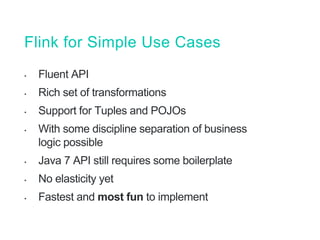
Flink for Simple Use Cases
• Fluent API
• Rich set of transformations
• Support for Tuples and POJOs
• With some discipline separation of business
logic possible
• Java 7 API still requires some boilerplate
• No elasticity yet
• Fastest and most fun to implement
Performance Comparison
0:00:00
0:07:12
0:14:24
0:21:36
0:28:48
0:36:00
50 100
Execution Time
Hive (Tez) MapReduce Flink
Performance and fun – every day
QUESTIONS

Michael Häusler – Everyday flink

  • 1.
  • 2.
    • Big datause cases at ResearchGate • Frameworks • Maintainability • Performance • Having fun TOPICS
  • 6.
    BIG DATA PROCESSING ATRESEARCHGATE Early 2011 First Hadoop Use Case Author Analysis
  • 7.
  • 8.
  • 9.
    Author Analysis First version– processes enriching live database Runtime – few weeks
  • 10.
    Author Analysis Second version– MapReduce on Hadoop cluster Runtime – few hours (incl. import and export)
  • 11.
    Author Analysis • Majoreffort – many things to consider • Smarter algorithms – better clustering • Efficiency – better runtime complexity • Distributed computing • Integration
  • 12.
    Author Analysis • Onedecision was easy due to limited choice: Frameworks • Mainly MapReduce • Hadoop for special use cases
  • 13.
  • 14.
    Hive • „Realtime“ ResearchGateis mostly NoSQL • Hive brought back analytical SQL Immense growth on the Hadoop cluster: • Users • Data • Jobs
  • 15.
    Thinking about Frameworks MapReduce •General purpose language • Very low level • Not for everyone Hive • Domain specific language • Very high level • Not for every use case
  • 16.
    Having fun withHadoop? Frameworkitis is the disease that a framework wants to do too much for you or it does it in a way that you don't want but you can't change it. Erich Gamma
  • 17.
    Having fun withHadoop? Simple things should be simple, complex things should be possible. Alan Kay
  • 18.
  • 19.
    How to Evaluatea Framework? Obvious criteria • Features • Performance & Scalability • Robustness & Stability • Maturity & Community Not so obvious • Is it fun to solve simple, everyday problems?
  • 20.
    Comparing today Hive (0.14.0,Tez) MapReduce (Hadoop 2.6, Yarn) Flink (0.9.1, Yarn) All inputs and outputs are Avro
  • 21.
    Simple Use Case:Top 5 Coauthors
  • 22.
    Simple Use Case:Top 5 Coauthors publication = { "publicationUid": 7, "title": "Foo", "authorships": [ { "authorUid": 23, "authorName": "Jane" }, { "authorUid": 25, "authorName": "John" } ] } authorAccountMapping = { "authorUid": 23, "accountId": 42 } (7, 23) (7, 25) (7, "AC:42") (7, "AU:25") topCoauthorStats = { "authorKey": "AC:42", "topCoauthors": [ { "coauthorKey": "AU:23", "coauthorCount": 1 } ] }
  • 23.
    Hive ADD JAR hdfs:///user/haeusler/hive-udfs-0.19.0.jar; CREATETEMPORARY FUNCTION TOP_K as 'net.researchgate.hive.udf.UDAFMaxBy'; DROP TABLE IF EXISTS haeusler.top_coauthors_2015_10_01_avro; CREATE TABLE haeusler.top_coauthors_2015_10_01_avro STORED AS AVRO AS SELECT coauthors.authorKey1 AS authorKey, TOP_K( NAMED_STRUCT( 'coauthorKey', coauthors.authorKey2, 'coauthorCount', coauthors.count ), coauthors.count, 5 ) AS topCoAuthors FROM ( SELECT publication_author_keys_1.authorKey AS authorKey1, publication_author_keys_2.authorKey AS authorKey2, COUNT(*) AS count FROM ( SELECT pae.publicationUid, COALESCE( CONCAT('AC:', aam.accountId), CONCAT('AU:', pae.authorUid) ) AS authorKey FROM ( SELECT p.publicationUid, pa.authorship.authorUid FROM platform_mongo_refind.publications_2015_10_01_avro p LATERAL VIEW EXPLODE(p.authorships) pa AS authorship WHERE pa.authorship.authorUid IS NOT NULL ) pae LEFT OUTER JOIN platform_mongo_refind.author_account_mappings_2015_10_01_avro aam ON pae.authorUid = aam.authorUid ) publication_author_keys_1 JOIN ( SELECT pae.publicationUid, COALESCE( CONCAT('account:', aam.accountId), CONCAT('author:', pae.authorUid) ) AS authorKey FROM ( SELECT p.publicationUid, pa.authorship.authorUid FROM platform_mongo_refind.publications_2015_10_01_avro p LATERAL VIEW EXPLODE(p.authorships) pa AS authorship WHERE pa.authorship.authorUid IS NOT NULL ) pae LEFT OUTER JOIN platform_mongo_refind.author_account_mappings_2015_10_01_avro aam ON pae.authorUid = aam.authorUid ) publication_author_keys_2 ON publication_author_keys_1.publicationUid = publication_author_keys_2.publicationUid WHERE publication_author_keys_1.authorKey <> publication_author_keys_2.authorKey GROUP BY publication_author_keys_1.authorKey, publication_author_keys_2.authorKey ) coauthors GROUP BY coauthors.authorKey1; SELECT pae.publicationUid, COALESCE( CONCAT('AC:', aam.accountId), CONCAT('AU:', pae.authorUid) ) AS authorKey FROM ( SELECT p.publicationUid, pa.authorship.authorUid FROM publications_2015_10_01_avro p LATERAL VIEW EXPLODE(p.authorships) pa AS authorship WHERE pa.authorship.authorUid IS NOT NULL ) pae LEFT OUTER JOIN author_account_mappings_2015_10_01_avro aam ON pae.authorUid = aam.authorUid CREATE TEMPORARY FUNCTION TOP_K as 'net.researchgate.hive.udf.UDAFMaxBy'; SELECT coauthors.authorKey1 AS authorKey, TOP_K( NAMED_STRUCT( 'coauthorKey', coauthors.authorKey2, 'coauthorCount', coauthors.count ), coauthors.count, 5 ) AS topCoAuthors
  • 24.
    Hive package net.researchgate.authorstats.hive; import org.apache.commons.logging.Log; importorg.apache.commons.logging.LogFactory; import org.apache.hadoop.hive.ql.exec.Description; import org.apache.hadoop.hive.ql.exec.UDFArgumentTypeException; import org.apache.hadoop.hive.ql.metadata.HiveException; import org.apache.hadoop.hive.ql.parse.SemanticException; import org.apache.hadoop.hive.ql.udf.generic.AbstractGenericUDAFResolver; import org.apache.hadoop.hive.ql.udf.generic.GenericUDAFEvaluator; import org.apache.hadoop.hive.serde2.objectinspector.ObjectInspector; import org.apache.hadoop.hive.serde2.objectinspector.ObjectInspectorFactory; import org.apache.hadoop.hive.serde2.objectinspector.ObjectInspectorUtils; import org.apache.hadoop.hive.serde2.objectinspector.PrimitiveObjectInspector; import org.apache.hadoop.hive.serde2.objectinspector.StandardListObjectInspector; import org.apache.hadoop.hive.serde2.objectinspector.StandardStructObjectInspector; import org.apache.hadoop.hive.serde2.objectinspector.primitive.PrimitiveObjectInspectorFactory; import org.apache.hadoop.hive.serde2.objectinspector.primitive.WritableConstantIntObjectInspector; import org.apache.hadoop.hive.serde2.typeinfo.PrimitiveTypeInfo; import org.apache.hadoop.hive.serde2.typeinfo.TypeInfo; import org.apache.hadoop.io.IntWritable; import java.util.ArrayList; import java.util.Arrays; import java.util.Comparator; import java.util.List; import java.util.PriorityQueue; /** * Returns top n values sorted by keys. * <p/> * The output is an array of values */ @Description(name = "top_k", value = "_FUNC_(value, key, n) - Returns the top n values with the maximum keys", extended = "Example:n" + "> SELECT top_k(value, key, 3) FROM src;n" + "[3, 2, 1]n" + "The return value is an array of values which correspond to the maximum keys" ) public class UDAFTopK extends AbstractGenericUDAFResolver { // class static variables static final Log LOG = LogFactory.getLog(UDAFTopK.class.getName()); private static void ensurePrimitive(int paramIndex, TypeInfo parameter) throws UDFArgumentTypeException { if (parameter.getCategory() != ObjectInspector.Category.PRIMITIVE) { throw new UDFArgumentTypeException(paramIndex, "Only primitive type arguments are accepted but " + parameter.getTypeName() + " was passed as parameter " + Integer.toString(paramIndex + 1) + "."); } } private static void ensureInt(int paramIndex, TypeInfo parameter) throws UDFArgumentTypeException { ensurePrimitive(paramIndex, parameter); PrimitiveTypeInfo pti = (PrimitiveTypeInfo) parameter; switch (pti.getPrimitiveCategory()) { case INT: return; default: throw new IllegalStateException("Unhandled primitive"); } } private static void ensureNumberOfArguments(int n, TypeInfo[] parameters) throws SemanticException { if (parameters.length != n) { throw new UDFArgumentTypeException(parameters.length - 1, "Please specify exactly " + Integer.toString(n) + " arguments."); } } @Override public GenericUDAFEvaluator getEvaluator(TypeInfo[] parameters) throws SemanticException { ensureNumberOfArguments(3, parameters); //argument 0 can be any ensurePrimitive(1, parameters[1]); ensureInt(2, parameters[2]); return new TopKUDAFEvaluator(); } public static class TopKUDAFEvaluator extends GenericUDAFEvaluator { static final Log LOG = LogFactory.getLog(TopKUDAFEvaluator.class.getName()); public static class IntermObjectInspector { public StandardStructObjectInspector topSoi; public PrimitiveObjectInspector noi; public StandardListObjectInspector loi; public StandardStructObjectInspector soi; public ObjectInspector oiValue; public PrimitiveObjectInspector oiKey; public IntermObjectInspector(StandardStructObjectInspector topSoi) throws HiveException { this.topSoi = topSoi; this.noi = (PrimitiveObjectInspector) topSoi.getStructFieldRef("n").getFieldObjectInspector(); this.loi = (StandardListObjectInspector) topSoi.getStructFieldRef("data").getFieldObjectInspector(); soi = (StandardStructObjectInspector) loi.getListElementObjectInspector(); oiValue = soi.getStructFieldRef("value").getFieldObjectInspector(); oiKey = (PrimitiveObjectInspector) soi.getStructFieldRef("key").getFieldObjectInspector(); } } private transient ObjectInspector oiValue; private transient PrimitiveObjectInspector oiKey; private transient IntermObjectInspector ioi; private transient int topN; /** * PARTIAL1: from original data to partial aggregation data: * iterate() and terminatePartial() will be called. * <p/> * <p/> * PARTIAL2: from partial aggregation data to partial aggregation data: * merge() and terminatePartial() will be called. * <p/> * FINAL: from partial aggregation to full aggregation: * merge() and terminate() will be called. * <p/> * <p/> * COMPLETE: from original data directly to full aggregation: * iterate() and terminate() will be called. */ private static StandardStructObjectInspector getTerminatePartialOutputType(ObjectInspector oiValueMaybeLazy, PrimitiveObjectInspector oiKeyMaybeLazy) throws HiveException { StandardListObjectInspector loi = ObjectInspectorFactory.getStandardListObjectInspector(getTerminatePartialOutputElementType(oiValueMaybeLazy, oiKeyMaybeLazy)); PrimitiveObjectInspector oiN = PrimitiveObjectInspectorFactory.writableIntObjectInspector; ArrayList<ObjectInspector> foi = new ArrayList<ObjectInspector>(); foi.add(oiN); foi.add(loi); ArrayList<String> fnames = new ArrayList<String>(); fnames.add("n"); fnames.add("data"); return ObjectInspectorFactory.getStandardStructObjectInspector(fnames, foi); } private static StandardStructObjectInspector getTerminatePartialOutputElementType(ObjectInspector oiValueMaybeLazy, PrimitiveObjectInspector oiKeyMaybeLazy) throws HiveException { ObjectInspector oiValue = TypeUtils.makeStrict(oiValueMaybeLazy); PrimitiveObjectInspector oiKey = TypeUtils.primitiveMakeStrict(oiKeyMaybeLazy); ArrayList<ObjectInspector> foi = new ArrayList<ObjectInspector>(); foi.add(oiValue); foi.add(oiKey); ArrayList<String> fnames = new ArrayList<String>(); fnames.add("value"); fnames.add("key"); return ObjectInspectorFactory.getStandardStructObjectInspector(fnames, foi); } private static StandardListObjectInspector getCompleteOutputType(IntermObjectInspector ioi) { return ObjectInspectorFactory.getStandardListObjectInspector(ioi.oiValue); } private static int getTopNValue(PrimitiveObjectInspector parameter) throws HiveException { if (parameter instanceof WritableConstantIntObjectInspector) { WritableConstantIntObjectInspector nvOI = (WritableConstantIntObjectInspector) parameter; int numTop = nvOI.getWritableConstantValue().get(); return numTop; } else { throw new HiveException("The third parameter: number of max values returned must be a constant int but the parameter was of type " + parameter.getClass().getName()); } } @Override public ObjectInspector init(Mode m, ObjectInspector[] parameters) throws HiveException { super.init(m, parameters); if (m == Mode.PARTIAL1) { //for iterate assert (parameters.length == 3); oiValue = parameters[0]; oiKey = (PrimitiveObjectInspector) parameters[1]; topN = getTopNValue((PrimitiveObjectInspector) parameters[2]); //create type R = list(struct(keyType,valueType)) ioi = new IntermObjectInspector(getTerminatePartialOutputType(oiValue, oiKey)); //for terminate partial return ioi.topSoi;//call this type R } else if (m == Mode.PARTIAL2) { ioi = new IntermObjectInspector((StandardStructObjectInspector) parameters[0]); //type R (see above) //for merge and terminate partial return ioi.topSoi;//type R } else if (m == Mode.COMPLETE) { assert (parameters.length == 3); //for iterate oiValue = parameters[0]; oiKey = (PrimitiveObjectInspector) parameters[1]; topN = getTopNValue((PrimitiveObjectInspector) parameters[2]); ioi = new IntermObjectInspector(getTerminatePartialOutputType(oiValue, oiKey));//type R (see above) //for terminate return getCompleteOutputType(ioi); } else if (m == Mode.FINAL) { //for merge ioi = new IntermObjectInspector((StandardStructObjectInspector) parameters[0]); //type R (see above) //for terminate //type O = list(valueType) return getCompleteOutputType(ioi); } throw new IllegalStateException("Unknown mode"); } @Override public Object terminatePartial(AggregationBuffer agg) throws HiveException { StdAgg stdAgg = (StdAgg) agg; return stdAgg.serialize(ioi); } @Override public Object terminate(AggregationBuffer agg) throws HiveException { StdAgg stdAgg = (StdAgg) agg; if (stdAgg == null) { return null; } return stdAgg.terminate(ioi.oiKey); } @Override public void merge(AggregationBuffer agg, Object partial) throws HiveException { if (partial == null) { return; } StdAgg stdAgg = (StdAgg) agg; stdAgg.merge(ioi, partial); } @Override public void iterate(AggregationBuffer agg, Object[] parameters) throws HiveException { assert (parameters.length == 3); if (parameters[0] == null || parameters[1] == null || parameters[2] == null) { return; } StdAgg stdAgg = (StdAgg) agg; stdAgg.setTopN(topN); stdAgg.add(parameters, oiValue, oiKey, ioi); } // Aggregation buffer definition and manipulation methods @AggregationType(estimable = false) static class StdAgg extends AbstractAggregationBuffer { public static class KeyValuePair { public Object key; public Object value; public KeyValuePair(Object key, Object value) { this.key = key; this.value = value; } } public static class KeyValueComparator implements Comparator<KeyValuePair> { public PrimitiveObjectInspector getKeyObjectInspector() { return keyObjectInspector; } public void setKeyObjectInspector(PrimitiveObjectInspector keyObjectInspector) { this.keyObjectInspector = keyObjectInspector; } PrimitiveObjectInspector keyObjectInspector; @Override public int compare(KeyValuePair o1, KeyValuePair o2) { if (keyObjectInspector == null) { throw new IllegalStateException("Key object inspector has to be initialized."); } //the heap will store the min element on top return ObjectInspectorUtils.compare(o1.key, keyObjectInspector, o2.key, keyObjectInspector); } } public PriorityQueue<KeyValuePair> queue; int topN; public void setTopN(int topN) { this.topN = topN; } public int getTopN() { return topN; } public void reset() { queue = new PriorityQueue<KeyValuePair>(10, new KeyValueComparator()); } public void add(Object[] parameters, ObjectInspector oiValue, PrimitiveObjectInspector oiKey, IntermObjectInspector ioi) { assert (parameters.length == 3); Object paramValue = parameters[0]; Object paramKey = parameters[1]; if (paramValue == null || paramKey == null) { return; } Object stdValue = ObjectInspectorUtils.copyToStandardObject(paramValue, oiValue, ObjectInspectorUtils.ObjectInspectorCopyOption.WRITABLE); Object stdKey = ObjectInspectorUtils.copyToStandardObject(paramKey, oiKey, ObjectInspectorUtils.ObjectInspectorCopyOption.WRITABLE); addToQueue(stdKey, stdValue, ioi.oiKey); } public void addToQueue(Object key, Object value, PrimitiveObjectInspector oiKey) { final PrimitiveObjectInspector keyObjectInspector = oiKey; KeyValueComparator comparator = ((KeyValueComparator) queue.comparator()); comparator.setKeyObjectInspector(keyObjectInspector); queue.add(new KeyValuePair(key, value)); if (queue.size() > topN) { queue.remove(); } comparator.setKeyObjectInspector(null); } private KeyValuePair[] copyQueueToArray() { int n = queue.size(); KeyValuePair[] buffer = new KeyValuePair[n]; int i = 0; for (KeyValuePair pair : queue) { buffer[i] = pair; i++; } return buffer; } public List<Object> terminate(final PrimitiveObjectInspector keyObjectInspector) { KeyValuePair[] buffer = copyQueueToArray(); Arrays.sort(buffer, new Comparator<KeyValuePair>() { public int compare(KeyValuePair o1, KeyValuePair o2) { return ObjectInspectorUtils.compare(o2.key, keyObjectInspector, o1.key, keyObjectInspector); } }); //copy the values to ArrayList ArrayList<Object> result = new ArrayList<Object>(); for (int j = 0; j < buffer.length; j++) { result.add(buffer[j].value); } return result; } public Object serialize(IntermObjectInspector ioi) { StandardStructObjectInspector topLevelSoi = ioi.topSoi; Object topLevelObj = topLevelSoi.create(); StandardListObjectInspector loi = ioi.loi; StandardStructObjectInspector soi = ioi.soi; int n = queue.size(); Object loiObj = loi.create(n); int i = 0; for (KeyValuePair pair : queue) { Object soiObj = soi.create(); soi.setStructFieldData(soiObj, soi.getStructFieldRef("value"), pair.value); soi.setStructFieldData(soiObj, soi.getStructFieldRef("key"), pair.key); loi.set(loiObj, i, soiObj); i += 1; } topLevelSoi.setStructFieldData(topLevelObj, topLevelSoi.getStructFieldRef("n"), new IntWritable(topN)); topLevelSoi.setStructFieldData(topLevelObj, topLevelSoi.getStructFieldRef("data"), loiObj); return topLevelObj; } public void merge(IntermObjectInspector ioi, Object partial) { List<Object> nestedValues = ioi.topSoi.getStructFieldsDataAsList(partial); topN = (Integer) (ioi.noi.getPrimitiveJavaObject(nestedValues.get(0))); StandardListObjectInspector loi = ioi.loi; StandardStructObjectInspector soi = ioi.soi; PrimitiveObjectInspector oiKey = ioi.oiKey; Object data = nestedValues.get(1); int n = loi.getListLength(data); int i = 0; while (i < n) { Object sValue = loi.getListElement(data, i); List<Object> innerValues = soi.getStructFieldsDataAsList(sValue); Object primValue = innerValues.get(0); Object primKey = innerValues.get(1); addToQueue(primKey, primValue, oiKey); i += 1; } } } ; @Override public AggregationBuffer getNewAggregationBuffer() throws HiveException { StdAgg result = new StdAgg(); reset(result); return result; } @Override public void reset(AggregationBuffer agg) throws HiveException { StdAgg stdAgg = (StdAgg) agg; stdAgg.reset(); } } } @Override public ObjectInspector init(Mode m, ObjectInspector[] parameters) throws HiveException { super.init(m, parameters); if (m == Mode.PARTIAL1) { //for iterate assert (parameters.length == 3); oiValue = parameters[0]; oiKey = (PrimitiveObjectInspector) parameters[1]; topN = getTopNValue((PrimitiveObjectInspector) parameters[2]); //create type R = list(struct(keyType,valueType)) ioi = new IntermObjectInspector(getTerminatePartialOutputType(oiValue, oiKey)); //for terminate partial return ioi.topSoi;//call this type R } else if (m == Mode.PARTIAL2) { ioi = new IntermObjectInspector((StandardStructObjectInspector) parameters[0]); //type R (see above) //for merge and terminate partial return ioi.topSoi;//type R } else if (m == Mode.COMPLETE) { assert (parameters.length == 3); //for iterate oiValue = parameters[0]; oiKey = (PrimitiveObjectInspector) parameters[1]; topN = getTopNValue((PrimitiveObjectInspector) parameters[2]); ioi = new IntermObjectInspector(getTerminatePartialOutputType(oiValue, oiKey));//type R (see above) //for terminate return getCompleteOutputType(ioi); } else if (m == Mode.FINAL) { //for merge ioi = new IntermObjectInspector((StandardStructObjectInspector) parameters[0]); //type R (see above) //for terminate //type O = list(valueType) return getCompleteOutputType(ioi); } throw new IllegalStateException("Unknown mode"); }
  • 25.
    Hive • Join andgroup by are easy • Common subexpressions are not optimized • Dealing with denormalized data can be tricky • UDFs are implemented low level and need to be deployed • UDAFs (aggregation functions) require expert knowledge • Dealing with generic UDFs is no fun
  • 26.
    MapReduce @Override public int compare(byte[]b1, int s1, int l1, byte[] b2, int s2, int l2) { return BinaryData.compare(b1, s1, l1, b2, s2, l2, pair); } public int compare(AvroKey<Pair<Long,Long>> x, AvroKey<Pair<Long,Long>> y) { return ReflectData.get().compare(x.datum(), y.datum(), pair); }
  • 27.
    MapReduce • Pure mapand reduce is very restrictive • Map side joins require knowledge of distributed cache • Bot map and reduce side joins require assumptions about data sizes • Constant type juggling • Hard to glue together • Hard to test • Implementing secondary sorting in an AvroMapper is no fun
  • 28.
    Flink public static voidbuildJob(ExecutionEnvironment env, DataSet<Publication> publications, DataSet<AuthorAccountMapping> authorAccountMappings, OutputFormat<TopCoauthorStats> topCoauthorStats) { publications.flatMap(new FlatMapFunction<Publication, Tuple2<Long, Long>>() { @Override public void flatMap(Publication publication, Collector<Tuple2<Long, Long>> publicationAuthors) throws Exception { if (publication.getAuthorships() == null) { return; } for (Authorship authorship : publication.getAuthorships()) { if (authorship.getAuthorUid() == null) { continue; } publicationAuthors.collect(new Tuple2<>(publication.getPublicationUid(), authorship.getAuthorUid())); } } }).coGroup(authorAccountMappings).where(1) // ...
  • 29.
    Flink for SimpleUse Cases • Fluent API • Rich set of transformations • Support for Tuples and POJOs • With some discipline separation of business logic possible • Java 7 API still requires some boilerplate • No elasticity yet • Fastest and most fun to implement
  • 30.
    Performance Comparison 0:00:00 0:07:12 0:14:24 0:21:36 0:28:48 0:36:00 50 100 ExecutionTime Hive (Tez) MapReduce Flink Performance and fun – every day
  • 31.

Editor's Notes

  • #16 Both successful, but in different ways
  • #20 Both successful, but in different ways
  • #21 Both successful, but in different ways
  • #22 Both successful, but in different ways
  • #23 Both successful, but in different ways
  • #24 Both successful, but in different ways
  • #25 Both successful, but in different ways
  • #26 Both successful, but in different ways
  • #27 Both successful, but in different ways
  • #28 Both successful, but in different ways
  • #29 Both successful, but in different ways
  • #30 Both successful, but in different ways
  • #31 Both successful, but in different ways