Hive -  Data Warehousing &   Analytics on Hadoop Wednesday, June 10, 2009  Santa Clara Marriott Namit Jain, Zheng Shao Facebook
Agenda Introduction Facebook Usage Hive Progress and Roadmap Open Source Community Facebook
Introduction Facebook
Why Another Data Warehousing System? Data, data and more data ~1TB per day in March 2008  ~10TB per day today Facebook
 
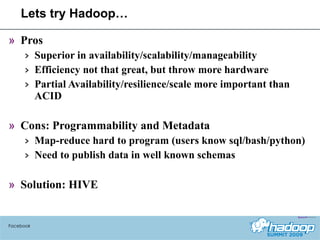
Lets try Hadoop… Pros Superior in availability/scalability/manageability Efficiency not that great, but throw more hardware Partial Availability/resilience/scale more important than ACID Cons: Programmability and Metadata Map-reduce hard to program (users know sql/bash/python) Need to publish data in well known schemas Solution: HIVE Facebook
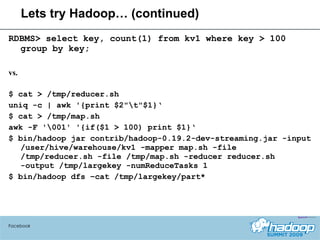
Lets try Hadoop… (continued) RDBMS> select key, count(1) from kv1 where key > 100 group by key; vs. $ cat > /tmp/reducer.sh uniq -c | awk '{print $2"\t"$1}‘ $ cat > /tmp/map.sh awk -F '\001' '{if($1 > 100) print $1}‘ $ bin/hadoop jar contrib/hadoop-0.19.2-dev-streaming.jar -input /user/hive/warehouse/kv1 -mapper map.sh -file /tmp/reducer.sh -file /tmp/map.sh -reducer reducer.sh -output /tmp/largekey -numReduceTasks 1  $ bin/hadoop dfs –cat /tmp/largekey/part* Facebook
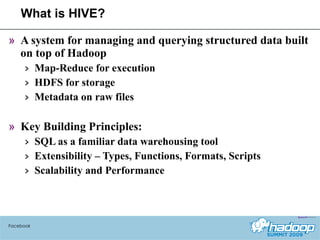
What is HIVE? A system for managing and querying structured data built on top of Hadoop Map-Reduce for execution HDFS for storage Metadata on raw files Key Building Principles: SQL as a familiar data warehousing tool Extensibility – Types, Functions, Formats, Scripts Scalability and Performance Facebook
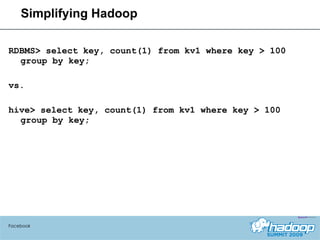
Simplifying Hadoop RDBMS> select key, count(1) from kv1 where key > 100 group by key; vs. hive> select key, count(1) from kv1 where key > 100 group by key; Facebook
Facebook Usage Facebook
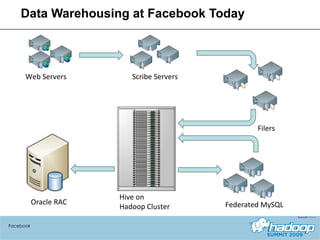
Data Warehousing at Facebook Today Facebook Web Servers Scribe Servers Filers Hive on  Hadoop Cluster Oracle RAC Federated MySQL
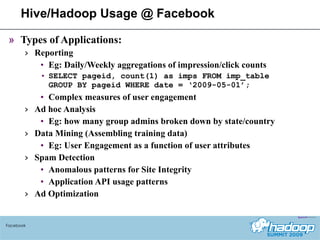
Hive/Hadoop Usage @ Facebook Types of Applications: Reporting  Eg: Daily/Weekly aggregations of impression/click counts SELECT pageid, count(1) as imps FROM imp_table GROUP BY pageid WHERE date = ‘2009-05-01’; Complex measures of user engagement  Ad hoc Analysis Eg: how many group admins broken down by state/country Data Mining (Assembling training data) Eg: User Engagement as a function of user attributes Spam Detection Anomalous patterns for Site Integrity Application API usage patterns Ad Optimization Facebook
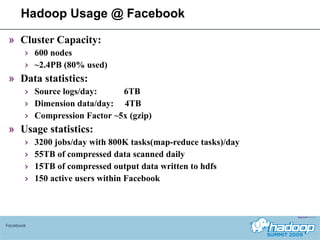
Hadoop Usage @ Facebook Cluster Capacity: 600 nodes ~2.4PB (80% used) Data statistics: Source logs/day:  6TB Dimension data/day:  4TB Compression Factor ~5x (gzip) Usage statistics: 3200 jobs/day with 800K tasks(map-reduce tasks)/day 55TB of compressed data scanned daily 15TB of compressed output data written to hdfs 150 active users within Facebook Facebook
Hive Progress and Roadmap Facebook
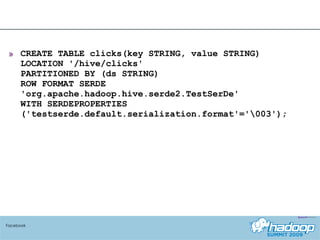
CREATE TABLE clicks(key STRING, value STRING) LOCATION '/hive/clicks' PARTITIONED BY (ds STRING)  ROW FORMAT SERDE 'org.apache.hadoop.hive.serde2.TestSerDe'  WITH SERDEPROPERTIES ('testserde.default.serialization.format'='\003'); Facebook
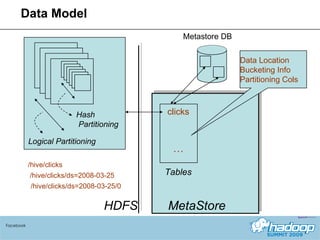
Data Model Facebook Logical Partitioning Hash Partitioning clicks HDFS MetaStore /hive/clicks /hive/clicks/ds=2008-03-25 /hive/clicks/ds=2008-03-25/0 … Tables Metastore DB Data Location Bucketing Info Partitioning Cols
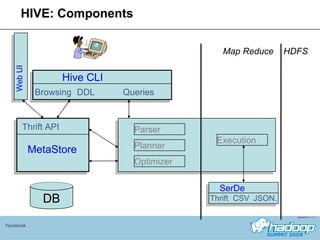
HIVE: Components Facebook HDFS Hive CLI DDL Queries Browsing Map Reduce MetaStore Thrift API SerDe Thrift CSV JSON.. Execution Parser Planner Web UI Optimizer DB
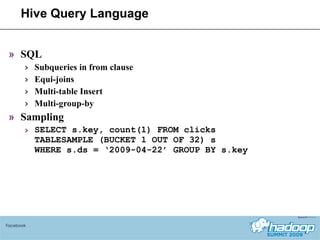
Hive Query Language SQL Subqueries in from clause Equi-joins Multi-table Insert Multi-group-by Sampling SELECT s.key, count(1) FROM clicks TABLESAMPLE (BUCKET 1 OUT OF 32) s  WHERE s.ds = ‘2009-04-22’ GROUP BY s.key Facebook
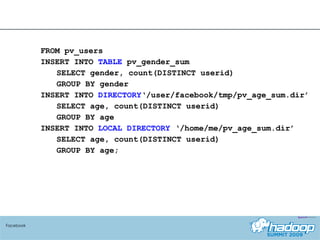
FROM pv_users  INSERT INTO  TABLE  pv_gender_sum  SELECT gender, count(DISTINCT userid)  GROUP BY gender  INSERT INTO  DIRECTORY ‘/user/facebook/tmp/pv_age_sum.dir’  SELECT age, count(DISTINCT userid)  GROUP BY age INSERT INTO  LOCAL DIRECTORY  ‘/home/me/pv_age_sum.dir’ SELECT age, count(DISTINCT userid)  GROUP BY age; Facebook
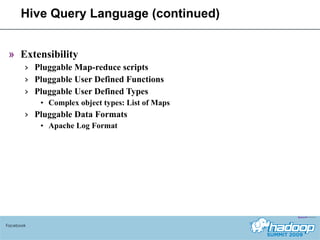
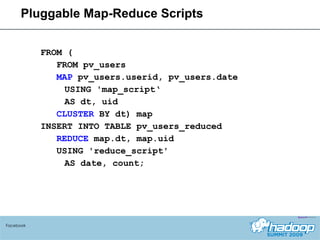
Hive Query Language (continued) Extensibility Pluggable Map-reduce scripts Pluggable User Defined Functions Pluggable User Defined Types Complex object types: List of Maps Pluggable Data Formats Apache Log Format Facebook
FROM (  FROM pv_users  MAP  pv_users.userid, pv_users.date USING 'map_script‘ AS dt, uid CLUSTER  BY dt) map  INSERT INTO TABLE pv_users_reduced  REDUCE  map.dt, map.uid USING 'reduce_script'  AS date, count; Pluggable Map-Reduce Scripts Facebook
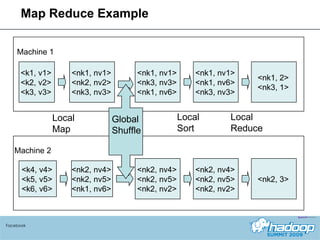
Map Reduce Example Facebook Machine 2 Machine 1 <k1, v1> <k2, v2> <k3, v3> <k4, v4> <k5, v5> <k6, v6> <nk1, nv1> <nk2, nv2> <nk3, nv3> <nk2, nv4> <nk2, nv5> <nk1, nv6> Local Map <nk2, nv4> <nk2, nv5> <nk2, nv2> <nk1, nv1> <nk3, nv3> <nk1, nv6> Global Shuffle <nk1, nv1> <nk1, nv6> <nk3, nv3> <nk2, nv4> <nk2, nv5> <nk2, nv2> Local Sort <nk2, 3> <nk1, 2> <nk3, 1> Local Reduce
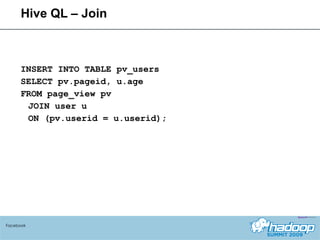
Hive QL – Join INSERT INTO TABLE pv_users SELECT pv.pageid, u.age FROM page_view pv JOIN user u ON (pv.userid = u.userid); Facebook
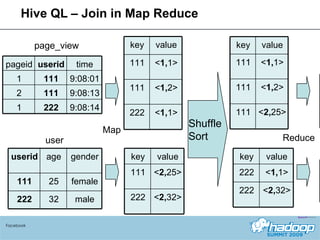
Hive QL – Join in Map Reduce Facebook page_view user pv_users Map Reduce key value 111 < 1, 1> 111 < 1, 2> 222 < 1, 1> pageid userid time 1 111 9:08:01 2 111 9:08:13 1 222 9:08:14 userid age gender 111 25 female 222 32 male key value 111 < 2, 25> 222 < 2, 32> key value 111 < 1, 1> 111 < 1, 2> 111 < 2, 25> key value 222 < 1, 1> 222 < 2, 32> Shuffle Sort Pageid age 1 25 2 25 pageid age 1 32
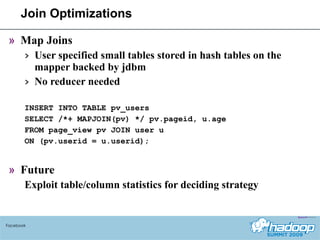
Join Optimizations Map Joins User specified small tables stored in hash tables on the mapper backed by jdbm No reducer needed INSERT INTO TABLE pv_users SELECT /*+ MAPJOIN(pv) */ pv.pageid, u.age FROM page_view pv JOIN user u ON (pv.userid = u.userid); Future Exploit table/column statistics for deciding strategy Facebook
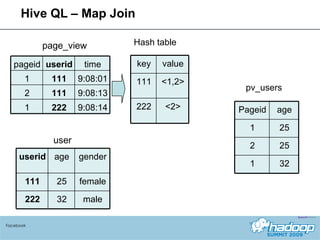
Hive QL – Map Join Facebook page_view user Hash table pv_users key value 111 <1,2> 222 <2> pageid userid time 1 111 9:08:01 2 111 9:08:13 1 222 9:08:14 userid age gender 111 25 female 222 32 male Pageid age 1 25 2 25 1 32
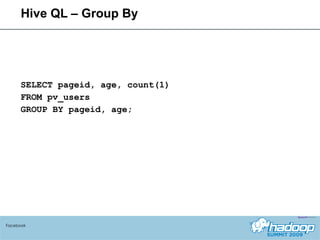
Hive QL – Group By SELECT pageid, age, count(1) FROM pv_users GROUP BY pageid, age; Facebook
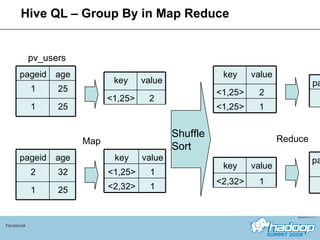
Hive QL – Group By in Map Reduce Facebook pv_users Map Reduce pageid age 1 25 1 25 pageid age count 1 25 3 pageid age 2 32 1 25 key value <1,25> 2 key value <1,25> 1 <2,32> 1 key value <1,25> 2 <1,25> 1 key value <2,32> 1 Shuffle Sort pageid age count 2 32 1
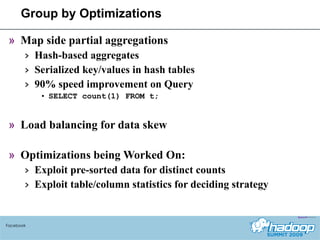
Group by Optimizations Map side partial aggregations Hash-based aggregates Serialized key/values in hash tables 90% speed improvement on Query SELECT count(1) FROM t; Load balancing for data skew Optimizations being Worked On: Exploit pre-sorted data for distinct counts Exploit table/column statistics for deciding strategy Facebook
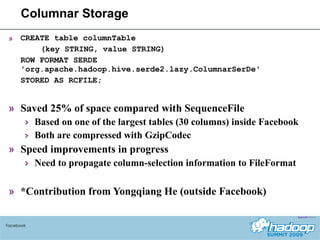
Columnar Storage CREATE table columnTable (key STRING, value STRING) ROW FORMAT SERDE  'org.apache.hadoop.hive.serde2.lazy.ColumnarSerDe' STORED AS RCFILE; Saved 25% of space compared with SequenceFile Based on one of the largest tables (30 columns) inside Facebook Both are compressed with GzipCodec Speed improvements in progress Need to propagate column-selection information to FileFormat *Contribution from Yongqiang He (outside Facebook) Facebook
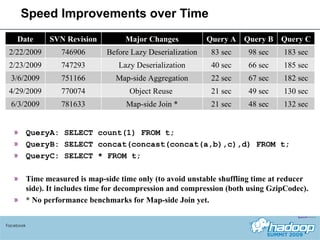
Speed Improvements over Time Facebook QueryA: SELECT count(1) FROM t; QueryB: SELECT concat(concast(concat(a,b),c),d) FROM t; QueryC: SELECT * FROM t; Time measured is map-side time only (to avoid unstable shuffling time at reducer side). It includes time for decompression and compression (both using GzipCodec). * No performance benchmarks for Map-side Join yet. Date SVN Revision Major Changes Query A Query B Query C 2/22/2009 746906 Before Lazy Deserialization 83 sec 98 sec 183 sec 2/23/2009 747293 Lazy Deserialization 40 sec 66 sec 185 sec 3/6/2009 751166 Map-side Aggregation 22 sec 67 sec 182 sec 4/29/2009 770074 Object Reuse  21 sec 49 sec 130 sec 6/3/2009 781633 Map-side Join * 21 sec 48 sec 132 sec
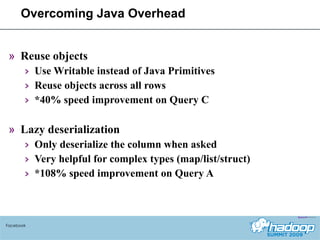
Overcoming Java Overhead Reuse objects Use Writable instead of Java Primitives Reuse objects across all rows *40% speed improvement on Query C Lazy deserialization Only deserialize the column when asked Very helpful for complex types (map/list/struct) *108% speed improvement on Query A Facebook
Generic UDF and UDAF Let UDF and UDAF accept complex-type parameters Integrate UDF and UDAF with Writables public IntWritable evaluate(IntWritable a, IntWritable b) { intWritable.set((int)(a.get() + b.get())); return intWritable; } Facebook
HQL Optimizations Predicate Pushdown Merging n-way join Column Pruning Facebook
Open Source Community Facebook
Open Source Community 21 contributors and growing  6 contributors within Facebook Contributors from: Academia Other web companies Etc.. 7 committers 1 external to Facebook and looking to add more here Facebook
50 jiras fixed in last month 218 jiras still open 125 mails in last month on hive-user@ 600 mails in last month on hive-dev@ Various companies/universities Adknowledge, Admob Berkeley, Chinese Academy of Science Demonstration in VLDB’2009 Facebook
Deployment Options EC2 http://wiki.apache.org/hadoop/Hive/HiveAws/HivingS3nRemotely Cloudera Virtual Machine http://www.cloudera.com/hadoop-training-hive-tutorial Your own cluster http://wiki.apache.org/hadoop/Hive/GettingStarted Hive can directly consume data on hadoop CREATE EXTERNAL TABLE mytable   (key STRING, value STRING) LOCATION '/user/abc/mytable'; Facebook
Future Work Benchmark & Performance Integration with BI tools (through JDBC/ODBC) Indexing More on Hive Roadmap http://wiki.apache.org/hadoop/Hive/Roadmap Machine Learning Integration Real-time Streaming Facebook
Information Available as a sub project in Hadoop http://wiki.apache.org/hadoop/Hive (wiki) http://hadoop.apache.org/hive  (home page) http://svn.apache.org/repos/asf/hadoop/hive  (SVN repo) ##hive (IRC) Works with hadoop-0.17, 0.18, 0.19 Release 0.3 is out and more are coming Mailing Lists:  hive-{user,dev,commits}@hadoop.apache.org  Facebook
Contributors Aaron Newton Ashish Thusoo David Phillips Dhruba Borthakur Edward Capriolo Eric Hwang Hao Liu He Yongqiang Jeff Hammerbacher Johan Oskarsson Josh Ferguson Joydeep Sen Sarma Kim P. Facebook Michi Mutsuzaki Min Zhou Namit Jain Neil Conway Pete Wyckoff Prasad Chakka Raghotham Murthy Richard Lee Shyam Sundar Sarkar Suresh Antony Venky Iyer Zheng Shao
Questions Facebook

Hadoop Summit 2009 Hive

  • 1.
    Hive - Data Warehousing & Analytics on Hadoop Wednesday, June 10, 2009 Santa Clara Marriott Namit Jain, Zheng Shao Facebook
  • 2.
    Agenda Introduction FacebookUsage Hive Progress and Roadmap Open Source Community Facebook
  • 3.
  • 4.
    Why Another DataWarehousing System? Data, data and more data ~1TB per day in March 2008 ~10TB per day today Facebook
  • 5.
  • 6.
    Lets try Hadoop…Pros Superior in availability/scalability/manageability Efficiency not that great, but throw more hardware Partial Availability/resilience/scale more important than ACID Cons: Programmability and Metadata Map-reduce hard to program (users know sql/bash/python) Need to publish data in well known schemas Solution: HIVE Facebook
  • 7.
    Lets try Hadoop…(continued) RDBMS> select key, count(1) from kv1 where key > 100 group by key; vs. $ cat > /tmp/reducer.sh uniq -c | awk '{print $2&quot;\t&quot;$1}‘ $ cat > /tmp/map.sh awk -F '\001' '{if($1 > 100) print $1}‘ $ bin/hadoop jar contrib/hadoop-0.19.2-dev-streaming.jar -input /user/hive/warehouse/kv1 -mapper map.sh -file /tmp/reducer.sh -file /tmp/map.sh -reducer reducer.sh -output /tmp/largekey -numReduceTasks 1 $ bin/hadoop dfs –cat /tmp/largekey/part* Facebook
  • 8.
    What is HIVE?A system for managing and querying structured data built on top of Hadoop Map-Reduce for execution HDFS for storage Metadata on raw files Key Building Principles: SQL as a familiar data warehousing tool Extensibility – Types, Functions, Formats, Scripts Scalability and Performance Facebook
  • 9.
    Simplifying Hadoop RDBMS>select key, count(1) from kv1 where key > 100 group by key; vs. hive> select key, count(1) from kv1 where key > 100 group by key; Facebook
  • 10.
  • 11.
    Data Warehousing atFacebook Today Facebook Web Servers Scribe Servers Filers Hive on Hadoop Cluster Oracle RAC Federated MySQL
  • 12.
    Hive/Hadoop Usage @Facebook Types of Applications: Reporting Eg: Daily/Weekly aggregations of impression/click counts SELECT pageid, count(1) as imps FROM imp_table GROUP BY pageid WHERE date = ‘2009-05-01’; Complex measures of user engagement Ad hoc Analysis Eg: how many group admins broken down by state/country Data Mining (Assembling training data) Eg: User Engagement as a function of user attributes Spam Detection Anomalous patterns for Site Integrity Application API usage patterns Ad Optimization Facebook
  • 13.
    Hadoop Usage @Facebook Cluster Capacity: 600 nodes ~2.4PB (80% used) Data statistics: Source logs/day: 6TB Dimension data/day: 4TB Compression Factor ~5x (gzip) Usage statistics: 3200 jobs/day with 800K tasks(map-reduce tasks)/day 55TB of compressed data scanned daily 15TB of compressed output data written to hdfs 150 active users within Facebook Facebook
  • 14.
    Hive Progress andRoadmap Facebook
  • 15.
    CREATE TABLE clicks(keySTRING, value STRING) LOCATION '/hive/clicks' PARTITIONED BY (ds STRING) ROW FORMAT SERDE 'org.apache.hadoop.hive.serde2.TestSerDe' WITH SERDEPROPERTIES ('testserde.default.serialization.format'='\003'); Facebook
  • 16.
    Data Model FacebookLogical Partitioning Hash Partitioning clicks HDFS MetaStore /hive/clicks /hive/clicks/ds=2008-03-25 /hive/clicks/ds=2008-03-25/0 … Tables Metastore DB Data Location Bucketing Info Partitioning Cols
  • 17.
    HIVE: Components FacebookHDFS Hive CLI DDL Queries Browsing Map Reduce MetaStore Thrift API SerDe Thrift CSV JSON.. Execution Parser Planner Web UI Optimizer DB
  • 18.
    Hive Query LanguageSQL Subqueries in from clause Equi-joins Multi-table Insert Multi-group-by Sampling SELECT s.key, count(1) FROM clicks TABLESAMPLE (BUCKET 1 OUT OF 32) s WHERE s.ds = ‘2009-04-22’ GROUP BY s.key Facebook
  • 19.
    FROM pv_users INSERT INTO TABLE pv_gender_sum SELECT gender, count(DISTINCT userid) GROUP BY gender INSERT INTO DIRECTORY ‘/user/facebook/tmp/pv_age_sum.dir’ SELECT age, count(DISTINCT userid) GROUP BY age INSERT INTO LOCAL DIRECTORY ‘/home/me/pv_age_sum.dir’ SELECT age, count(DISTINCT userid) GROUP BY age; Facebook
  • 20.
    Hive Query Language(continued) Extensibility Pluggable Map-reduce scripts Pluggable User Defined Functions Pluggable User Defined Types Complex object types: List of Maps Pluggable Data Formats Apache Log Format Facebook
  • 21.
    FROM ( FROM pv_users MAP pv_users.userid, pv_users.date USING 'map_script‘ AS dt, uid CLUSTER BY dt) map INSERT INTO TABLE pv_users_reduced REDUCE map.dt, map.uid USING 'reduce_script' AS date, count; Pluggable Map-Reduce Scripts Facebook
  • 22.
    Map Reduce ExampleFacebook Machine 2 Machine 1 <k1, v1> <k2, v2> <k3, v3> <k4, v4> <k5, v5> <k6, v6> <nk1, nv1> <nk2, nv2> <nk3, nv3> <nk2, nv4> <nk2, nv5> <nk1, nv6> Local Map <nk2, nv4> <nk2, nv5> <nk2, nv2> <nk1, nv1> <nk3, nv3> <nk1, nv6> Global Shuffle <nk1, nv1> <nk1, nv6> <nk3, nv3> <nk2, nv4> <nk2, nv5> <nk2, nv2> Local Sort <nk2, 3> <nk1, 2> <nk3, 1> Local Reduce
  • 23.
    Hive QL –Join INSERT INTO TABLE pv_users SELECT pv.pageid, u.age FROM page_view pv JOIN user u ON (pv.userid = u.userid); Facebook
  • 24.
    Hive QL –Join in Map Reduce Facebook page_view user pv_users Map Reduce key value 111 < 1, 1> 111 < 1, 2> 222 < 1, 1> pageid userid time 1 111 9:08:01 2 111 9:08:13 1 222 9:08:14 userid age gender 111 25 female 222 32 male key value 111 < 2, 25> 222 < 2, 32> key value 111 < 1, 1> 111 < 1, 2> 111 < 2, 25> key value 222 < 1, 1> 222 < 2, 32> Shuffle Sort Pageid age 1 25 2 25 pageid age 1 32
  • 25.
    Join Optimizations MapJoins User specified small tables stored in hash tables on the mapper backed by jdbm No reducer needed INSERT INTO TABLE pv_users SELECT /*+ MAPJOIN(pv) */ pv.pageid, u.age FROM page_view pv JOIN user u ON (pv.userid = u.userid); Future Exploit table/column statistics for deciding strategy Facebook
  • 26.
    Hive QL –Map Join Facebook page_view user Hash table pv_users key value 111 <1,2> 222 <2> pageid userid time 1 111 9:08:01 2 111 9:08:13 1 222 9:08:14 userid age gender 111 25 female 222 32 male Pageid age 1 25 2 25 1 32
  • 27.
    Hive QL –Group By SELECT pageid, age, count(1) FROM pv_users GROUP BY pageid, age; Facebook
  • 28.
    Hive QL –Group By in Map Reduce Facebook pv_users Map Reduce pageid age 1 25 1 25 pageid age count 1 25 3 pageid age 2 32 1 25 key value <1,25> 2 key value <1,25> 1 <2,32> 1 key value <1,25> 2 <1,25> 1 key value <2,32> 1 Shuffle Sort pageid age count 2 32 1
  • 29.
    Group by OptimizationsMap side partial aggregations Hash-based aggregates Serialized key/values in hash tables 90% speed improvement on Query SELECT count(1) FROM t; Load balancing for data skew Optimizations being Worked On: Exploit pre-sorted data for distinct counts Exploit table/column statistics for deciding strategy Facebook
  • 30.
    Columnar Storage CREATEtable columnTable (key STRING, value STRING) ROW FORMAT SERDE 'org.apache.hadoop.hive.serde2.lazy.ColumnarSerDe' STORED AS RCFILE; Saved 25% of space compared with SequenceFile Based on one of the largest tables (30 columns) inside Facebook Both are compressed with GzipCodec Speed improvements in progress Need to propagate column-selection information to FileFormat *Contribution from Yongqiang He (outside Facebook) Facebook
  • 31.
    Speed Improvements overTime Facebook QueryA: SELECT count(1) FROM t; QueryB: SELECT concat(concast(concat(a,b),c),d) FROM t; QueryC: SELECT * FROM t; Time measured is map-side time only (to avoid unstable shuffling time at reducer side). It includes time for decompression and compression (both using GzipCodec). * No performance benchmarks for Map-side Join yet. Date SVN Revision Major Changes Query A Query B Query C 2/22/2009 746906 Before Lazy Deserialization 83 sec 98 sec 183 sec 2/23/2009 747293 Lazy Deserialization 40 sec 66 sec 185 sec 3/6/2009 751166 Map-side Aggregation 22 sec 67 sec 182 sec 4/29/2009 770074 Object Reuse 21 sec 49 sec 130 sec 6/3/2009 781633 Map-side Join * 21 sec 48 sec 132 sec
  • 32.
    Overcoming Java OverheadReuse objects Use Writable instead of Java Primitives Reuse objects across all rows *40% speed improvement on Query C Lazy deserialization Only deserialize the column when asked Very helpful for complex types (map/list/struct) *108% speed improvement on Query A Facebook
  • 33.
    Generic UDF andUDAF Let UDF and UDAF accept complex-type parameters Integrate UDF and UDAF with Writables public IntWritable evaluate(IntWritable a, IntWritable b) { intWritable.set((int)(a.get() + b.get())); return intWritable; } Facebook
  • 34.
    HQL Optimizations PredicatePushdown Merging n-way join Column Pruning Facebook
  • 35.
  • 36.
    Open Source Community21 contributors and growing 6 contributors within Facebook Contributors from: Academia Other web companies Etc.. 7 committers 1 external to Facebook and looking to add more here Facebook
  • 37.
    50 jiras fixedin last month 218 jiras still open 125 mails in last month on hive-user@ 600 mails in last month on hive-dev@ Various companies/universities Adknowledge, Admob Berkeley, Chinese Academy of Science Demonstration in VLDB’2009 Facebook
  • 38.
    Deployment Options EC2http://wiki.apache.org/hadoop/Hive/HiveAws/HivingS3nRemotely Cloudera Virtual Machine http://www.cloudera.com/hadoop-training-hive-tutorial Your own cluster http://wiki.apache.org/hadoop/Hive/GettingStarted Hive can directly consume data on hadoop CREATE EXTERNAL TABLE mytable (key STRING, value STRING) LOCATION '/user/abc/mytable'; Facebook
  • 39.
    Future Work Benchmark& Performance Integration with BI tools (through JDBC/ODBC) Indexing More on Hive Roadmap http://wiki.apache.org/hadoop/Hive/Roadmap Machine Learning Integration Real-time Streaming Facebook
  • 40.
    Information Available asa sub project in Hadoop http://wiki.apache.org/hadoop/Hive (wiki) http://hadoop.apache.org/hive (home page) http://svn.apache.org/repos/asf/hadoop/hive (SVN repo) ##hive (IRC) Works with hadoop-0.17, 0.18, 0.19 Release 0.3 is out and more are coming Mailing Lists: hive-{user,dev,commits}@hadoop.apache.org Facebook
  • 41.
    Contributors Aaron NewtonAshish Thusoo David Phillips Dhruba Borthakur Edward Capriolo Eric Hwang Hao Liu He Yongqiang Jeff Hammerbacher Johan Oskarsson Josh Ferguson Joydeep Sen Sarma Kim P. Facebook Michi Mutsuzaki Min Zhou Namit Jain Neil Conway Pete Wyckoff Prasad Chakka Raghotham Murthy Richard Lee Shyam Sundar Sarkar Suresh Antony Venky Iyer Zheng Shao
  • 42.

Editor's Notes

  • #6 What is this? This is huge amount of data. Along with the fast growth of active users on Facebook, the size of our data is exploding. In the last 12 months, the amount of data increased by 500%. These data are very valuable. They can be used to understand the user behavior, measure the impact of a new product, and make data-based decisions. Traditionally people store data in data warehouse solutions on top of Oracle and MySQL. In the recent years, we are also seeing new proprietary solutions like AsterData and Netezza. However, these solutions either do not scale to the amount of data that we have, or they are very inflexible that cannot satisfy our data analysis requirements. In order to provide the capability to analyze the huge amount of data that we have, we started the Hive project. Hive is based on Hadoop but does much more than Hadoop. We will show the details in the following slides. ============