
Methods of inventory valuation
Section 10
Objectives 6 and 7
(a) List methods of inventory valuation
(b) Calculate the value of closing
inventory
(c) Assess the effect of different
methods of inventory valuation on
profit
Methods of inventory valuation
• Reasons for valuing unsold inventory:
• Business owners value unsold stock at the
end of each financial year so that he or she
can calculate the gross profit or loss made on
sales
• The ending inventory figure is needed to
derive the cost of goods sold, as well as the
ending inventory balance to include in a
company's balance sheet.
• Look at the following video explaining
the concept of ending inventory
Calculate Ending Inventory:
Formula & Explanation
Study.com
http://study.com/academy/lesso
n/calculate-ending-inventory-
formula-lesson-quiz.html
Methods of inventory valuation
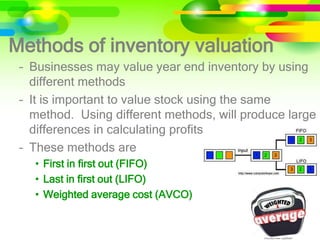
– Businesses may value year end inventory by using
different methods
– It is important to value stock using the same
method. Using different methods, will produce large
differences in calculating profits
– These methods are
• First in first out (FIFO)
• Last in first out (LIFO)
• Weighted average cost (AVCO)
• This method assumes
– that the first goods bought are the first goods to be
sold
– The earliest goods purchased are the first to be
recognised as cost of goods sold
– Ending inventory is calculated on the latest units
purchased
– The latest prices used for the FIFO method gives
the highest valuation of stock and the highest gross
profit
First in first out (FIFO)
• Look at the video on the next slide and watch
FIFO Inventory method
FIFO inventory method
Education Unlocked
https://www.youtube.com/watch?v=Wa83L8TvoaM
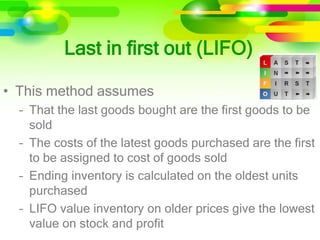
• This method assumes
– That the last goods bought are the first goods to be
sold
– The costs of the latest goods purchased are the first
to be assigned to cost of goods sold
– Ending inventory is calculated on the oldest units
purchased
– LIFO value inventory on older prices give the lowest
value on stock and profit
Last in first out (LIFO)
• Look at the video on the next slide
and watch LIFO inventory method
LIFO Inventory method
Education Unlocked
https://www.youtube.com/watch?v=zLAvpS6o25E
• This method makes no assumption about
the movement of stock.
• It assumes
– That the goods available for sale have the
same average cost per unit
– The goods available for sale is allocated on
the basis of the weighted average unit cost
– The formula used to calculate the unit cost is
• Total value of goods on hand (goods available for
sale) ÷quantity of goods on hand
Weighted average cost (AVCO)
Methods of inventory valuation
• The formula to determine the value
of closing inventory is
Average cost per unit x
remaining units
Methods of inventory valuation
• Look at the video on the next slide
on Average Cost inventory
Average Cost inventory method
Education Unlocked
https://www.youtube.com/watch?v=qAWVVw-dC5A
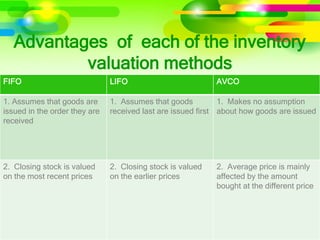
Advantages of each of the inventory
valuation methods
FIFO LIFO AVCO
1. Assumes that goods are
issued in the order they are
received
1. Assumes that goods
received last are issued first
1. Makes no assumption
about how goods are issued
2. Closing stock is valued
on the most recent prices
2. Closing stock is valued
on the earlier prices
2. Average price is mainly
affected by the amount
bought at the different price
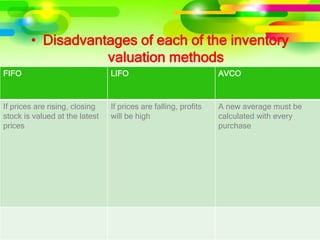
• Disadvantages of each of the inventory
valuation methods
FIFO LIFO AVCO
If prices are rising, closing
stock is valued at the latest
prices
If prices are falling, profits
will be high
A new average must be
calculated with every
purchase

Methods of stock valuation

  • 1.
    Methods of inventoryvaluation Section 10 Objectives 6 and 7 (a) List methods of inventory valuation (b) Calculate the value of closing inventory (c) Assess the effect of different methods of inventory valuation on profit
  • 2.
    Methods of inventoryvaluation • Reasons for valuing unsold inventory: • Business owners value unsold stock at the end of each financial year so that he or she can calculate the gross profit or loss made on sales • The ending inventory figure is needed to derive the cost of goods sold, as well as the ending inventory balance to include in a company's balance sheet.
  • 3.
    • Look atthe following video explaining the concept of ending inventory Calculate Ending Inventory: Formula & Explanation Study.com http://study.com/academy/lesso n/calculate-ending-inventory- formula-lesson-quiz.html
  • 4.
    Methods of inventoryvaluation – Businesses may value year end inventory by using different methods – It is important to value stock using the same method. Using different methods, will produce large differences in calculating profits – These methods are • First in first out (FIFO) • Last in first out (LIFO) • Weighted average cost (AVCO)
  • 5.
    • This methodassumes – that the first goods bought are the first goods to be sold – The earliest goods purchased are the first to be recognised as cost of goods sold – Ending inventory is calculated on the latest units purchased – The latest prices used for the FIFO method gives the highest valuation of stock and the highest gross profit First in first out (FIFO)
  • 6.
    • Look atthe video on the next slide and watch FIFO Inventory method FIFO inventory method Education Unlocked https://www.youtube.com/watch?v=Wa83L8TvoaM
  • 7.
    • This methodassumes – That the last goods bought are the first goods to be sold – The costs of the latest goods purchased are the first to be assigned to cost of goods sold – Ending inventory is calculated on the oldest units purchased – LIFO value inventory on older prices give the lowest value on stock and profit Last in first out (LIFO)
  • 8.
    • Look atthe video on the next slide and watch LIFO inventory method LIFO Inventory method Education Unlocked https://www.youtube.com/watch?v=zLAvpS6o25E
  • 9.
    • This methodmakes no assumption about the movement of stock. • It assumes – That the goods available for sale have the same average cost per unit – The goods available for sale is allocated on the basis of the weighted average unit cost – The formula used to calculate the unit cost is • Total value of goods on hand (goods available for sale) ÷quantity of goods on hand Weighted average cost (AVCO)
  • 10.
    Methods of inventoryvaluation • The formula to determine the value of closing inventory is Average cost per unit x remaining units
  • 11.
    Methods of inventoryvaluation • Look at the video on the next slide on Average Cost inventory Average Cost inventory method Education Unlocked https://www.youtube.com/watch?v=qAWVVw-dC5A
  • 12.
    Advantages of eachof the inventory valuation methods FIFO LIFO AVCO 1. Assumes that goods are issued in the order they are received 1. Assumes that goods received last are issued first 1. Makes no assumption about how goods are issued 2. Closing stock is valued on the most recent prices 2. Closing stock is valued on the earlier prices 2. Average price is mainly affected by the amount bought at the different price
  • 13.
    • Disadvantages ofeach of the inventory valuation methods FIFO LIFO AVCO If prices are rising, closing stock is valued at the latest prices If prices are falling, profits will be high A new average must be calculated with every purchase