
Appropriate profits between
dividends and reserves
Appropriation of profits
Section 9
Objective 8
Appropriation of profits
• The capital of a limited company is made of
different types of shares
• The amount of shares are only increased when
new shares are issued
• Net profit is not transferred to any share capital
accounts in a limited liability company
• The net profit is transferred to an account known
as an appropriation ( also called statement of
retained earnings or statement of owners equity
account)
Appropriation of profits
• The appropriation account is one of the
financial statements of a limited liability
company
• The appropriation account is used for the
allocation of profits and for reserves.
• The remaining profit that is not allocated is
carried forward as a credit balance in the
appropriation account
Appropriation of profits
• The account contains the following key
components
– The profit or loss for the year transferred from the
income statement
– Any profits made in the past which were not
distributed ( known as retained profits or
undistributed profits brought forward)
– Proposed dividends (the amount recommended by
board of directors to be paid to shareholders)
Appropriation of profits
– The transfer of the remaining profits to general
reserve or any other reserve
– The closing balance of profits which have not been
distributed as dividends or set aside as
reserves(called retained profits or undistributed
profits carried forward)
Appropriation of profits
• Corporation tax is the government tax that must
be paid on the profits made by the company
• Proposed dividends are the profits made by the
company which directors recommend to be paid
to shareholders. This amount will be agreed by
shareholders in the next Annual General
Meeting (AGM)
Reserves
• Two major types of reserves used by
companies to set aside funds are
– capital reserves and
– revenue reserves
Capital reserves
• The features of capital reserves are as follows:
– Capital reserves are allocated in the appropriation
account and shown in the balance sheet
– They are a part of the profits of a company which
are set aside for a particular purpose
– Capital reserves are not to be used for dividend
payments
– Capital reserves include
» Share premium
» Replacement of fixed assets
» Plant expansion
» Corporation tax
Revenue Reserves
• The features of revenue reserves are as follows:
– Revenue reserves are amounts set aside annually from
profits for any purpose decided by management
– It is required by law to set aside a revenue reserve
fund
– Disclosure of the fund must be stated in financial
statements
– These reserves can be used for payment of dividends
– Revenue reserves include
» General reserve
» Profit and loss account
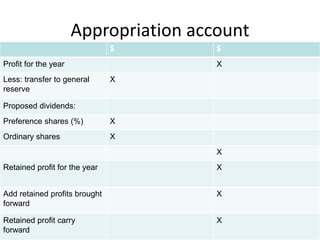
Appropriation account
• The next slide contains an example of
appropriation account and the key components
• To label your appropriation account, the
heading should contain the following
information
»The name of the organisation
»The name of the financial statement
»The date at which it is being prepared
Appropriation account
$ $
Profit for the year X
Less: transfer to general
reserve
X
Proposed dividends:
Preference shares (%) X
Ordinary shares X
X
Retained profit for the year X
Add retained profits brought
forward
X
Retained profit carry
forward
X
Go to the next slide for the review activity
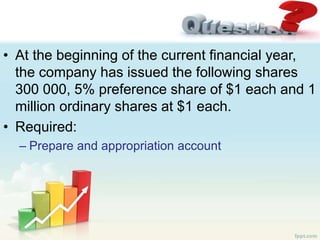
• At the beginning of the current financial year,
the company has issued the following shares
300 000, 5% preference share of $1 each and 1
million ordinary shares at $1 each.
• Required:
– Prepare and appropriation account
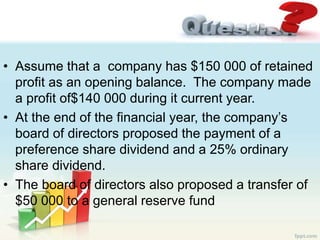
• Assume that a company has $150 000 of retained
profit as an opening balance. The company made
a profit of$140 000 during it current year.
• At the end of the financial year, the company’s
board of directors proposed the payment of a
preference share dividend and a 25% ordinary
share dividend.
• The board of directors also proposed a transfer of
$50 000 to a general reserve fund

Appropriation of profits

  • 1.
    Appropriate profits between dividendsand reserves Appropriation of profits Section 9 Objective 8
  • 2.
  • 3.
    Appropriation of profits •The capital of a limited company is made of different types of shares • The amount of shares are only increased when new shares are issued • Net profit is not transferred to any share capital accounts in a limited liability company • The net profit is transferred to an account known as an appropriation ( also called statement of retained earnings or statement of owners equity account)
  • 4.
    Appropriation of profits •The appropriation account is one of the financial statements of a limited liability company • The appropriation account is used for the allocation of profits and for reserves. • The remaining profit that is not allocated is carried forward as a credit balance in the appropriation account
  • 5.
    Appropriation of profits •The account contains the following key components – The profit or loss for the year transferred from the income statement – Any profits made in the past which were not distributed ( known as retained profits or undistributed profits brought forward) – Proposed dividends (the amount recommended by board of directors to be paid to shareholders)
  • 6.
    Appropriation of profits –The transfer of the remaining profits to general reserve or any other reserve – The closing balance of profits which have not been distributed as dividends or set aside as reserves(called retained profits or undistributed profits carried forward)
  • 7.
  • 8.
    Appropriation of profits •Corporation tax is the government tax that must be paid on the profits made by the company • Proposed dividends are the profits made by the company which directors recommend to be paid to shareholders. This amount will be agreed by shareholders in the next Annual General Meeting (AGM)
  • 9.
    Reserves • Two majortypes of reserves used by companies to set aside funds are – capital reserves and – revenue reserves
  • 10.
    Capital reserves • Thefeatures of capital reserves are as follows: – Capital reserves are allocated in the appropriation account and shown in the balance sheet – They are a part of the profits of a company which are set aside for a particular purpose – Capital reserves are not to be used for dividend payments – Capital reserves include » Share premium » Replacement of fixed assets » Plant expansion » Corporation tax
  • 11.
    Revenue Reserves • Thefeatures of revenue reserves are as follows: – Revenue reserves are amounts set aside annually from profits for any purpose decided by management – It is required by law to set aside a revenue reserve fund – Disclosure of the fund must be stated in financial statements – These reserves can be used for payment of dividends – Revenue reserves include » General reserve » Profit and loss account
  • 12.
    Appropriation account • Thenext slide contains an example of appropriation account and the key components • To label your appropriation account, the heading should contain the following information »The name of the organisation »The name of the financial statement »The date at which it is being prepared
  • 13.
    Appropriation account $ $ Profitfor the year X Less: transfer to general reserve X Proposed dividends: Preference shares (%) X Ordinary shares X X Retained profit for the year X Add retained profits brought forward X Retained profit carry forward X
  • 14.
    Go to thenext slide for the review activity
  • 15.
    • At thebeginning of the current financial year, the company has issued the following shares 300 000, 5% preference share of $1 each and 1 million ordinary shares at $1 each. • Required: – Prepare and appropriation account
  • 16.
    • Assume thata company has $150 000 of retained profit as an opening balance. The company made a profit of$140 000 during it current year. • At the end of the financial year, the company’s board of directors proposed the payment of a preference share dividend and a 25% ordinary share dividend. • The board of directors also proposed a transfer of $50 000 to a general reserve fund