PRESENTATION ON
PRICING
Prepared by:
Rakesh Sharma (CUHP 15 MBA 61)
Saddam Hussain (CUHP 15 MBA 67)
Sumit Behal (CUHP 15 MBA 80)
Vimal Syal (CUHP 15 MBA 86)
Yash Chauhan (CUHP 15 MBA 90)
PRICE HAS MANY NAMES
• Rent
• Fee
• Rate
• Commission
• Assessment
• Tuition
• Fare
• Toll
• Premium
• Retainer
• Bribe
• Salary
• Wage
• Interest
• Tax
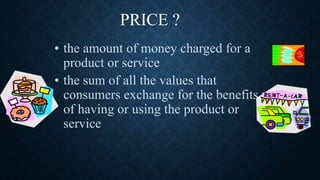
PRICE ?
• the amount of money charged for a
product or service
• the sum of all the values that
consumers exchange for the benefits
of having or using the product or
service
REQUISITE OF GOOD PRICING?
• Must cover the cost of other three elements of marketing mixing i.e
PRODUCT, PLACE, PROMOTION.
• Must generate the reasonable profit.
• Must provide value to the customer.
• Must watch the competitor.
IMPLICATION OF PRICING?
• Major element of consumer decision making processing.
• Decides the growth and survival of company.
• Shape customers perception towards company.
• Send signals about company philosophy.
• Decides the level of competition.
• A powerful marketing instrument.
FACTORS AFFECTING PRICING DECISIONS?
• Price quality relationship.
• The competitive structure of the industry.
• The demand of the product.
• The cost structure.
• The customer expectation.
• The legal constraints.
FACTORS AFFECTING PRICING DECISION? CONTD..
• Economic environment of the market.
• Company objective.
• Competition.
• Negotiating margin with middle man.
• Political pressure.
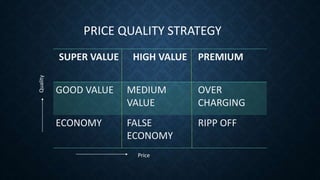
SUPER VALUE HIGH VALUE PREMIUM
GOOD VALUE MEDIUM
VALUE
OVER
CHARGING
ECONOMY FALSE
ECONOMY
RIPP OFF
PRICE QUALITY STRATEGY
Quality
Price
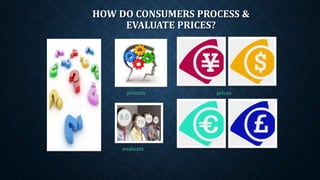
HOW DO CONSUMERS PROCESS &
EVALUATE PRICES?
process
evaluate
prices
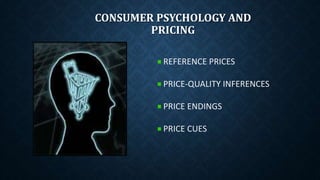
CONSUMER PSYCHOLOGY AND
PRICING
REFERENCE PRICES
PRICE-QUALITY INFERENCES
PRICE ENDINGS
PRICE CUES
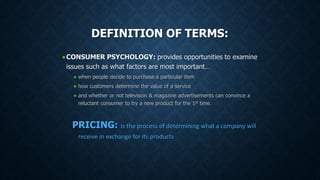
DEFINITION OF TERMS:
CONSUMER PSYCHOLOGY: provides opportunities to examine
issues such as what factors are most important…
when people decide to purchase a particular item
how customers determine the value of a service
and whether or not television & magazine advertisements can convince a
reluctant consumer to try a new product for the 1st time.
PRICING: is the process of determining what a company will
receive in exchange for its products
REFERENCE PRICES…
is a strategy in which a product is sold at a price just
below its main competing brand.
is one component of psychological pricing – sellers
consider the psychology of prices & not simply the
economics.
are prices that buyers carry in their minds and refer to
when looking at a given product.
PRICE CUES
When to use…
Customers purchase item infrequently
Customers are new
Product designs vary over time
Prices vary seasonally
Quality or sizes vary across stores
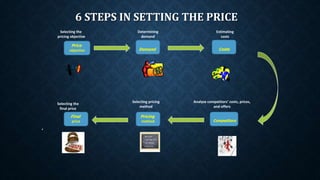
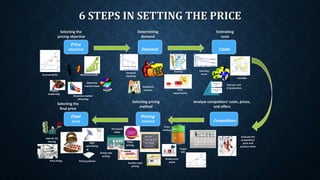
6 STEPS IN SETTING THE PRICE
•
Price
objective
Final
price
Pricing
method Competitors
Demand Costs
Selecting the
pricing objective
Determining
demand
Estimating
costs
Selecting the
final price
Selecting pricing
method
Analyze competitors’ costs, prices,
and offers
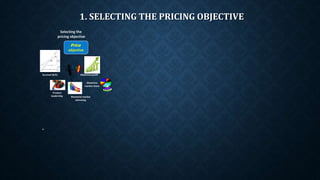
1. SELECTING THE PRICING OBJECTIVE
•
Price
objective
Selecting the
pricing objective
Survival (B/E) Maximize profit
Maximize
market share
Product
leadership Maximize market
skimming
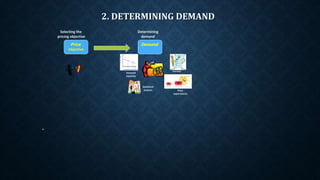
2. DETERMINING DEMAND
•
Price
objective
Demand
Selecting the
pricing objective
Determining
demand
Surveys
Price
experiments
Statistical
analysis
Demand
elasticity
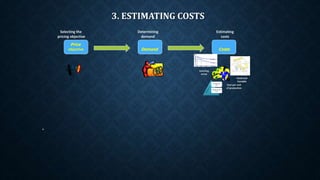
3. ESTIMATING COSTS
•
Price
objective Demand Costs
Selecting the
pricing objective
Determining
demand
Estimating
costs
Fixed and
Variable
Cost per unit
of production
Learning
curve
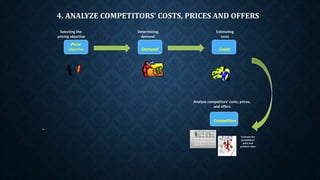
4. ANALYZE COMPETITORS’ COSTS, PRICES AND OFFERS
•
Price
objective
Competitors
Demand Costs
Selecting the
pricing objective
Determining
demand
Estimating
costs
Analyze competitors’ costs, prices,
and offers
Evaluate the
competitors’
price and
product value
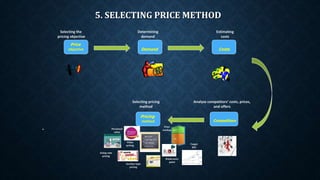
5. SELECTING PRICE METHOD
•
Price
objective
Pricing
method Competitors
Demand Costs
Selecting the
pricing objective
Determining
demand
Estimating
costs
Selecting pricing
method
Analyze competitors’ costs, prices,
and offers
Price
markup
Break-even
point
Target
ROI
Perceived
value
Value
pricing
Going-rate
pricing
Auction-type
pricing
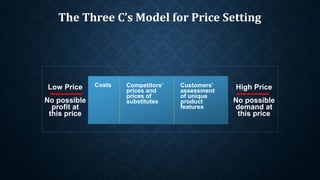
The Three C’s Model for Price Setting
Costs Competitors’
prices and
prices of
substitutes
Customers’
assessment
of unique
product
features
Low Price
No possible
profit at
this price
High Price
No possible
demand at
this price
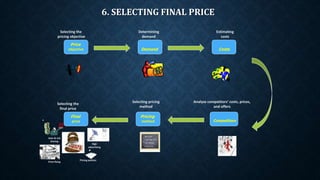
6. SELECTING FINAL PRICE
•
Price
objective
Final
price
Pricing
method Competitors
Demand Costs
Selecting the
pricing objective
Determining
demand
Estimating
costs
Selecting the
final price
Selecting pricing
method
Analyze competitors’ costs, prices,
and offers
High
advertising
Pricing policies
Gain & risk
sharing
Price fixing
6 STEPS IN SETTING THE PRICE
•
Price
objective
Final
price
Pricing
method Competitors
Demand Costs
Selecting the
pricing objective
Determining
demand
Estimating
costs
Survival (B/E) Maximize profit
Maximize
market share
Product
leadership
Maximize market
skimming
Selecting the
final price
Selecting pricing
method
Analyze competitors’ costs, prices,
and offers
Surveys
Price
experiments
Statistical
analysis
Demand
elasticity Fixed and
Variable
Cost per unit
of production
Learning
curve
Evaluate the
competitors’
price and
product value
Price
markup
Break-even
point
Target
ROI
Perceived
value
Value
pricing
Going-rate
pricing
Auction-type
pricing
High
advertising
Pricing policies
Gain & risk
sharing
Price fixing
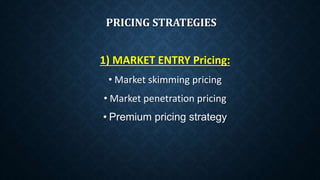
PRICING STRATEGIES
1) MARKET ENTRY Pricing:
• Market skimming pricing
• Market penetration pricing
• Premium pricing strategy
MARKET ENTRY PRICING STRATEGIES
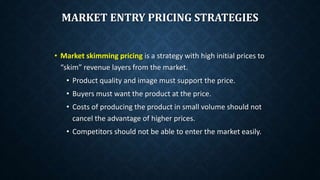
• Market skimming pricing is a strategy with high initial prices to
“skim” revenue layers from the market.
• Product quality and image must support the price.
• Buyers must want the product at the price.
• Costs of producing the product in small volume should not
cancel the advantage of higher prices.
• Competitors should not be able to enter the market easily.
MARKET ENTRY PRICING STRATEGIES
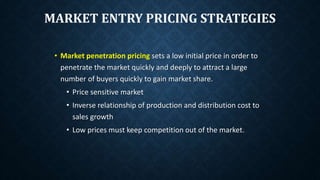
• Market penetration pricing sets a low initial price in order to
penetrate the market quickly and deeply to attract a large
number of buyers quickly to gain market share.
• Price sensitive market
• Inverse relationship of production and distribution cost to
sales growth
• Low prices must keep competition out of the market.
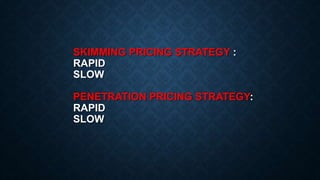
SKIMMING PRICING STRATEGY :
RAPID
SLOW
PENETRATION PRICING STRATEGY:
RAPID
SLOW
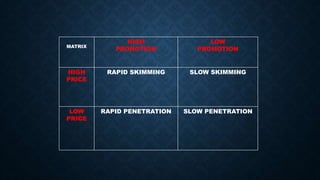
MATRIX
HIGH
PRONOTION
LOW
PROMOTION
HIGH
PRICE
RAPID SKIMMING SLOW SKIMMING
LOW
PRICE
RAPID PENETRATION SLOW PENETRATION
PREMIUM PRICING STRATEGY
• The seller organisation has a superior product in terms of technology
,value ,use reliability and may be branded, may adopt premium pricing
strategy. Here ,the buyers are not sensitive and are willing to pay
higher price for premium product or service.
• The margin of profit on perfumes , skin care product ,premium
branded liquors , cigarettes ,jeans ,ready made garments, fashion
product ,shoes , watches and jewellery etc follow premium pricing
strategy
• .(e.g. apple computers , cell phones , jockey, reebok, levis, rado,titan )
PRODUCT STRATEGIES
2)PRODUCT-MIX Pricing:
• Product line policy
• Optional product pricing
• Captive product pricing
• Product bundle pricing
PRODUCT-MIX PRICING STRATEGIES
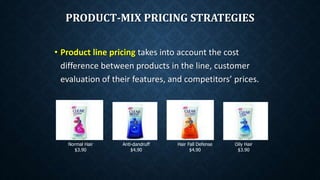
• Product line pricing takes into account the cost
difference between products in the line, customer
evaluation of their features, and competitors’ prices.
Normal Hair
$3.90
Anti-dandruff
$4.90
Hair Fall Defense
$4.90
Oily Hair
$3.90
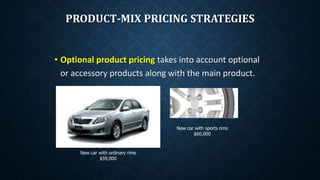
New car with ordinary rims
$59,000
New car with sports rims
$60,000
PRODUCT-MIX PRICING STRATEGIES
• Optional product pricing takes into account optional
or accessory products along with the main product.
PRODUCT-MIX PRICING STRATEGIES
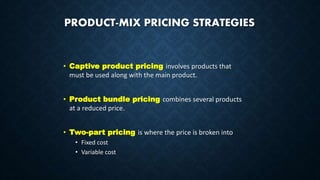
• Captive product pricing involves products that
must be used along with the main product.
• Product bundle pricing combines several products
at a reduced price.
• Two-part pricing is where the price is broken into
• Fixed cost
• Variable cost
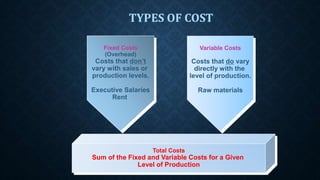
TYPES OF COST
Total Costs
Sum of the Fixed and Variable Costs for a Given
Level of Production
Fixed Costs
(Overhead)
Costs that don’t
vary with sales or
production levels.
Executive Salaries
Rent
Variable Costs
Costs that do vary
directly with the
level of production.
Raw materials
TOTAL COST
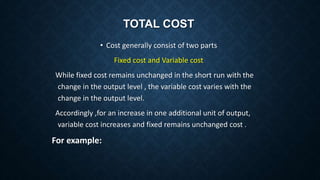
• Cost generally consist of two parts
Fixed cost and Variable cost
While fixed cost remains unchanged in the short run with the
change in the output level , the variable cost varies with the
change in the output level.
Accordingly ,for an increase in one additional unit of output,
variable cost increases and fixed remains unchanged cost .
For example:
TOTAL COST
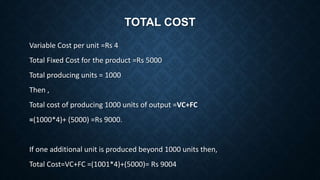
Variable Cost per unit =Rs 4
Total Fixed Cost for the product =Rs 5000
Total producing units = 1000
Then ,
Total cost of producing 1000 units of output =VC+FC
=(1000*4)+ (5000) =Rs 9000.
If one additional unit is produced beyond 1000 units then,
Total Cost=VC+FC =(1001*4)+(5000)= Rs 9004
MARKUP PRICING
• The most elementary pricing method is to add a standard markup to the product’s
cost.
Variable cost per unit =Rs 10
Fixed costs =Rs 300,000
Expected unit sales =Rs 50,000
The manufacturer’s unit cost is given by:
Unit cost = variable cost + fixed cost / unit sales
= 16
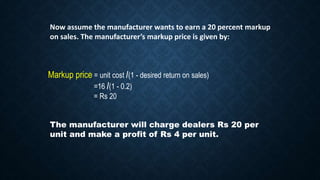
Now assume the manufacturer wants to earn a 20 percent markup
on sales. The manufacturer’s markup price is given by:
Markup price = unit cost /(1 - desired return on sales)
=16 /(1 - 0.2)
= Rs 20
The manufacturer will charge dealers Rs 20 per
unit and make a profit of Rs 4 per unit.
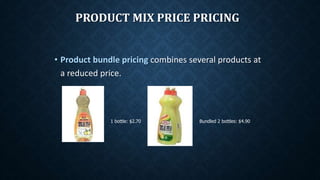
PRODUCT MIX PRICE PRICING
• Product bundle pricing combines several products at
a reduced price.
1 bottle: $2.70 Bundled 2 bottles: $4.90
PRICE STRATEGIES
3)Price Adjustment Strategies
• Discount and allowance pricing
• Promotional pricing
PRICE ADJUSTMENTS STRATEGIES
• Discount and allowance pricing reduces prices to reward customer
responses such as paying early or promoting the product.
• Discounts
• Allowances
PRICE ADJUSTMENTS STRATEGIES
•Discounts
• Cash discount for paying promptly
• Quantity discount for buying in large volume
• Functional (trade) discount for selling, storing,
distribution, and record keeping
•Allowances:
• Trade-in allowance are granted for turning in an old item when
buying a new one.
• Promotional allowance to reward dealers for participating in
advertising or sales support programs.
PRICE ADJUSTMENTS STRATEGIES
• Promotional pricing is when prices are temporarily priced below list price or
cost to increase demand.
• Special event pricing
• Low interest financing
• Warranty and Service contract
• Longer payment terms
PRICE STRATEGIES
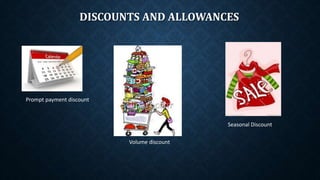
DISCOUNTS AND ALLOWANCES
Prompt payment discount
Volume discount
Seasonal Discount
SPECIAL EVENT PRICING
OTHER PRICING STRATEGIES
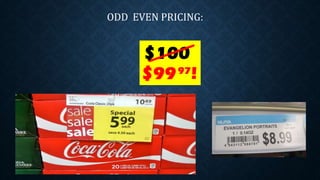
• ODD/EVEN PRICING
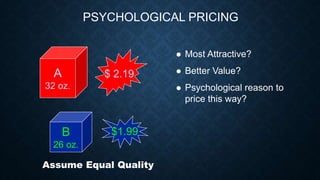
• PSYCHOLOGICAL PRICING
• PRESTIGE PRICING
• GEORAPHICAL PRICING
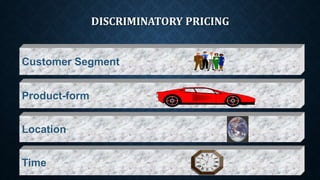
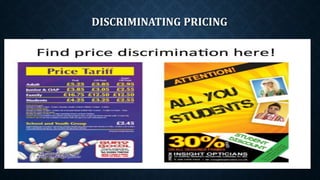
• DISCRIMINATING PRICING
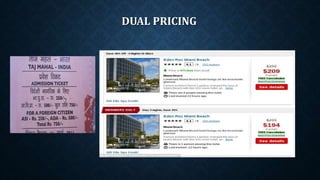
• DUAL PRICING
ODD EVEN PRICING:
PSYCHOLOGICAL PRICING
 Most Attractive?
 Better Value?
 Psychological reason to
price this way?
A
32 oz.
$ 2.19
B
26 oz.
$1.99
Assume Equal Quality
PRESTIGE PRICING
DISCRIMINATORY PRICING
Time
Product-form
Customer Segment
Location
DISCRIMINATING PRICING
DUAL PRICING
EFFECT OF INTERNET ON PRICING
• Internet is changing the habits of the customers due to-
• Price point benefits.
• Internet eased the information research process.
• Provide extensive information about the price, features, quality of the
product.
• Internet is also providing the reviews.
• Internet reduce the middle man cost.
• Weakened loyalty.
• It also offering the cost transparency.
STRATEGIES TO DEAL WITH THESE CHANGES
• Price lining/tiered pricing.
• Smart and dynamic pricing.
• Bundling pricing.
• If these price strategy is not working , offer more values.
PRICING IN MARKETING

PRICING IN MARKETING

  • 1.
    PRESENTATION ON PRICING Prepared by: RakeshSharma (CUHP 15 MBA 61) Saddam Hussain (CUHP 15 MBA 67) Sumit Behal (CUHP 15 MBA 80) Vimal Syal (CUHP 15 MBA 86) Yash Chauhan (CUHP 15 MBA 90)
  • 2.
    PRICE HAS MANYNAMES • Rent • Fee • Rate • Commission • Assessment • Tuition • Fare • Toll • Premium • Retainer • Bribe • Salary • Wage • Interest • Tax
  • 3.
    PRICE ? • theamount of money charged for a product or service • the sum of all the values that consumers exchange for the benefits of having or using the product or service
  • 4.
    REQUISITE OF GOODPRICING? • Must cover the cost of other three elements of marketing mixing i.e PRODUCT, PLACE, PROMOTION. • Must generate the reasonable profit. • Must provide value to the customer. • Must watch the competitor.
  • 5.
    IMPLICATION OF PRICING? •Major element of consumer decision making processing. • Decides the growth and survival of company. • Shape customers perception towards company. • Send signals about company philosophy. • Decides the level of competition. • A powerful marketing instrument.
  • 6.
    FACTORS AFFECTING PRICINGDECISIONS? • Price quality relationship. • The competitive structure of the industry. • The demand of the product. • The cost structure. • The customer expectation. • The legal constraints.
  • 7.
    FACTORS AFFECTING PRICINGDECISION? CONTD.. • Economic environment of the market. • Company objective. • Competition. • Negotiating margin with middle man. • Political pressure.
  • 8.
    SUPER VALUE HIGHVALUE PREMIUM GOOD VALUE MEDIUM VALUE OVER CHARGING ECONOMY FALSE ECONOMY RIPP OFF PRICE QUALITY STRATEGY Quality Price
  • 9.
    HOW DO CONSUMERSPROCESS & EVALUATE PRICES? process evaluate prices
  • 10.
    CONSUMER PSYCHOLOGY AND PRICING REFERENCEPRICES PRICE-QUALITY INFERENCES PRICE ENDINGS PRICE CUES
  • 11.
    DEFINITION OF TERMS: CONSUMERPSYCHOLOGY: provides opportunities to examine issues such as what factors are most important… when people decide to purchase a particular item how customers determine the value of a service and whether or not television & magazine advertisements can convince a reluctant consumer to try a new product for the 1st time. PRICING: is the process of determining what a company will receive in exchange for its products
  • 12.
    REFERENCE PRICES… is astrategy in which a product is sold at a price just below its main competing brand. is one component of psychological pricing – sellers consider the psychology of prices & not simply the economics. are prices that buyers carry in their minds and refer to when looking at a given product.
  • 13.
    PRICE CUES When touse… Customers purchase item infrequently Customers are new Product designs vary over time Prices vary seasonally Quality or sizes vary across stores
  • 14.
    6 STEPS INSETTING THE PRICE • Price objective Final price Pricing method Competitors Demand Costs Selecting the pricing objective Determining demand Estimating costs Selecting the final price Selecting pricing method Analyze competitors’ costs, prices, and offers
  • 15.
    1. SELECTING THEPRICING OBJECTIVE • Price objective Selecting the pricing objective Survival (B/E) Maximize profit Maximize market share Product leadership Maximize market skimming
  • 16.
    2. DETERMINING DEMAND • Price objective Demand Selectingthe pricing objective Determining demand Surveys Price experiments Statistical analysis Demand elasticity
  • 17.
    3. ESTIMATING COSTS • Price objectiveDemand Costs Selecting the pricing objective Determining demand Estimating costs Fixed and Variable Cost per unit of production Learning curve
  • 18.
    4. ANALYZE COMPETITORS’COSTS, PRICES AND OFFERS • Price objective Competitors Demand Costs Selecting the pricing objective Determining demand Estimating costs Analyze competitors’ costs, prices, and offers Evaluate the competitors’ price and product value
  • 19.
    5. SELECTING PRICEMETHOD • Price objective Pricing method Competitors Demand Costs Selecting the pricing objective Determining demand Estimating costs Selecting pricing method Analyze competitors’ costs, prices, and offers Price markup Break-even point Target ROI Perceived value Value pricing Going-rate pricing Auction-type pricing
  • 20.
    The Three C’sModel for Price Setting Costs Competitors’ prices and prices of substitutes Customers’ assessment of unique product features Low Price No possible profit at this price High Price No possible demand at this price
  • 21.
    6. SELECTING FINALPRICE • Price objective Final price Pricing method Competitors Demand Costs Selecting the pricing objective Determining demand Estimating costs Selecting the final price Selecting pricing method Analyze competitors’ costs, prices, and offers High advertising Pricing policies Gain & risk sharing Price fixing
  • 22.
    6 STEPS INSETTING THE PRICE • Price objective Final price Pricing method Competitors Demand Costs Selecting the pricing objective Determining demand Estimating costs Survival (B/E) Maximize profit Maximize market share Product leadership Maximize market skimming Selecting the final price Selecting pricing method Analyze competitors’ costs, prices, and offers Surveys Price experiments Statistical analysis Demand elasticity Fixed and Variable Cost per unit of production Learning curve Evaluate the competitors’ price and product value Price markup Break-even point Target ROI Perceived value Value pricing Going-rate pricing Auction-type pricing High advertising Pricing policies Gain & risk sharing Price fixing
  • 23.
    PRICING STRATEGIES 1) MARKETENTRY Pricing: • Market skimming pricing • Market penetration pricing • Premium pricing strategy
  • 24.
    MARKET ENTRY PRICINGSTRATEGIES • Market skimming pricing is a strategy with high initial prices to “skim” revenue layers from the market. • Product quality and image must support the price. • Buyers must want the product at the price. • Costs of producing the product in small volume should not cancel the advantage of higher prices. • Competitors should not be able to enter the market easily.
  • 25.
    MARKET ENTRY PRICINGSTRATEGIES • Market penetration pricing sets a low initial price in order to penetrate the market quickly and deeply to attract a large number of buyers quickly to gain market share. • Price sensitive market • Inverse relationship of production and distribution cost to sales growth • Low prices must keep competition out of the market.
  • 26.
    SKIMMING PRICING STRATEGY: RAPID SLOW PENETRATION PRICING STRATEGY: RAPID SLOW
  • 27.
    MATRIX HIGH PRONOTION LOW PROMOTION HIGH PRICE RAPID SKIMMING SLOWSKIMMING LOW PRICE RAPID PENETRATION SLOW PENETRATION
  • 28.
    PREMIUM PRICING STRATEGY •The seller organisation has a superior product in terms of technology ,value ,use reliability and may be branded, may adopt premium pricing strategy. Here ,the buyers are not sensitive and are willing to pay higher price for premium product or service. • The margin of profit on perfumes , skin care product ,premium branded liquors , cigarettes ,jeans ,ready made garments, fashion product ,shoes , watches and jewellery etc follow premium pricing strategy • .(e.g. apple computers , cell phones , jockey, reebok, levis, rado,titan )
  • 29.
    PRODUCT STRATEGIES 2)PRODUCT-MIX Pricing: •Product line policy • Optional product pricing • Captive product pricing • Product bundle pricing
  • 30.
    PRODUCT-MIX PRICING STRATEGIES •Product line pricing takes into account the cost difference between products in the line, customer evaluation of their features, and competitors’ prices. Normal Hair $3.90 Anti-dandruff $4.90 Hair Fall Defense $4.90 Oily Hair $3.90
  • 31.
    New car withordinary rims $59,000 New car with sports rims $60,000 PRODUCT-MIX PRICING STRATEGIES • Optional product pricing takes into account optional or accessory products along with the main product.
  • 32.
    PRODUCT-MIX PRICING STRATEGIES •Captive product pricing involves products that must be used along with the main product. • Product bundle pricing combines several products at a reduced price. • Two-part pricing is where the price is broken into • Fixed cost • Variable cost
  • 33.
    TYPES OF COST TotalCosts Sum of the Fixed and Variable Costs for a Given Level of Production Fixed Costs (Overhead) Costs that don’t vary with sales or production levels. Executive Salaries Rent Variable Costs Costs that do vary directly with the level of production. Raw materials
  • 34.
    TOTAL COST • Costgenerally consist of two parts Fixed cost and Variable cost While fixed cost remains unchanged in the short run with the change in the output level , the variable cost varies with the change in the output level. Accordingly ,for an increase in one additional unit of output, variable cost increases and fixed remains unchanged cost . For example:
  • 35.
    TOTAL COST Variable Costper unit =Rs 4 Total Fixed Cost for the product =Rs 5000 Total producing units = 1000 Then , Total cost of producing 1000 units of output =VC+FC =(1000*4)+ (5000) =Rs 9000. If one additional unit is produced beyond 1000 units then, Total Cost=VC+FC =(1001*4)+(5000)= Rs 9004
  • 36.
    MARKUP PRICING • Themost elementary pricing method is to add a standard markup to the product’s cost. Variable cost per unit =Rs 10 Fixed costs =Rs 300,000 Expected unit sales =Rs 50,000 The manufacturer’s unit cost is given by: Unit cost = variable cost + fixed cost / unit sales = 16
  • 37.
    Now assume themanufacturer wants to earn a 20 percent markup on sales. The manufacturer’s markup price is given by: Markup price = unit cost /(1 - desired return on sales) =16 /(1 - 0.2) = Rs 20 The manufacturer will charge dealers Rs 20 per unit and make a profit of Rs 4 per unit.
  • 38.
    PRODUCT MIX PRICEPRICING • Product bundle pricing combines several products at a reduced price. 1 bottle: $2.70 Bundled 2 bottles: $4.90
  • 39.
    PRICE STRATEGIES 3)Price AdjustmentStrategies • Discount and allowance pricing • Promotional pricing
  • 40.
    PRICE ADJUSTMENTS STRATEGIES •Discount and allowance pricing reduces prices to reward customer responses such as paying early or promoting the product. • Discounts • Allowances
  • 41.
    PRICE ADJUSTMENTS STRATEGIES •Discounts •Cash discount for paying promptly • Quantity discount for buying in large volume • Functional (trade) discount for selling, storing, distribution, and record keeping
  • 42.
    •Allowances: • Trade-in allowanceare granted for turning in an old item when buying a new one. • Promotional allowance to reward dealers for participating in advertising or sales support programs. PRICE ADJUSTMENTS STRATEGIES
  • 43.
    • Promotional pricingis when prices are temporarily priced below list price or cost to increase demand. • Special event pricing • Low interest financing • Warranty and Service contract • Longer payment terms PRICE STRATEGIES
  • 44.
    DISCOUNTS AND ALLOWANCES Promptpayment discount Volume discount Seasonal Discount
  • 45.
  • 46.
    OTHER PRICING STRATEGIES •ODD/EVEN PRICING • PSYCHOLOGICAL PRICING • PRESTIGE PRICING • GEORAPHICAL PRICING • DISCRIMINATING PRICING • DUAL PRICING
  • 47.
  • 48.
    PSYCHOLOGICAL PRICING  MostAttractive?  Better Value?  Psychological reason to price this way? A 32 oz. $ 2.19 B 26 oz. $1.99 Assume Equal Quality
  • 49.
  • 50.
  • 51.
  • 52.
  • 53.
    EFFECT OF INTERNETON PRICING • Internet is changing the habits of the customers due to- • Price point benefits. • Internet eased the information research process. • Provide extensive information about the price, features, quality of the product. • Internet is also providing the reviews. • Internet reduce the middle man cost. • Weakened loyalty. • It also offering the cost transparency.
  • 54.
    STRATEGIES TO DEALWITH THESE CHANGES • Price lining/tiered pricing. • Smart and dynamic pricing. • Bundling pricing. • If these price strategy is not working , offer more values.