PRICING
MANAGEMENT MARKETING
Presented by: (Group1)
Akhilesh Sharma
Amit kumar
Ainesh nanda
Ankush Goyal
CONTENT
• Introduction and objective
• Pricing Process
• Pricing methods
• Factors influencing pricing
• Digital pricing
• Pricing to capture value
• Pricing of new product
• Initiating and responding to price change
Pricing
• Process by which business sets the price at which it will sell its products and
services.
• Capturing value : both for company and customers.
• Measure ofValue.
• Important factor for differentiation.
• Only factor in marketing mix that generates revenue.
Pricing Objectives
• Pricing Objectives flow from marketing objectives
• A business will have a number of objectives or a mix in the matter of
pricing.
Objectives Firms seek in Pricing.
• Profit maximization in the short term
• Profit optimization in the long run.
• A minimum return on investment.
• A minimum return on sales income.
• Achieving a particular sales volume.
• Achieving a particular market share.
• Deeper penetration of the market.
• Entering new markets
• Target profit on entire product line, irrespective of profit level
in individual products.
• Keeping competition out or keeping it under check.
• Keeping parity with competition.
• Fast turnaround of stock and early cash recovery.
• Stabilizing the prices and margins in the market.
• Keeping products affordable to customers.
• Providing the products at low prices so as to stimulate
economic development.
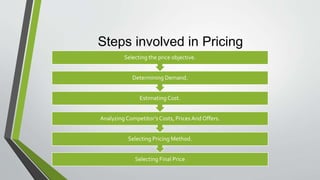
Steps involved in Pricing
Selecting Final Price
Selecting Pricing Method.
Analyzing Competitor’s Costs, PricesAnd Offers.
Estimating Cost.
Determining Demand.
Selecting the price objective.
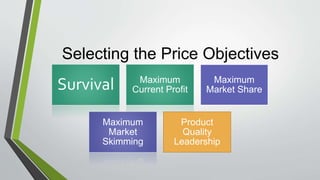
Selecting the Price Objectives
Survival Maximum
Current Profit
Maximum
Market Share
Maximum
Market
Skimming
Product
Quality
Leadership
Maximum Market Share
Some companies believe a
higher sales volume will lead to
lower unit costs and higher long
run profits, so they tend to set
lower prices, assuming that the
market is price sensitive. Also
known as Market Penetration.
• Following conditions favour the market
penetration strategies.
 Market is highly price sensitive.
 Production costs fall with accumulated
production experience.
 Low prices discourage actual and potential
competition.
Maximum Market
Skimming
Companies that unveil new
technologies favour setting
high prices. In this, prices
start high and slowly fall
over a period of time. This
strategy can be fatal if
competitor decides to price
low. Moreover customers
who buy at higher prices
may feel dissatisfied later.
• Skimming Works When:
 Sufficient numbers of customers have high
current demand.
High initial price will not attract competition.
High price communicates the image of the
superior products.
Determining Demand
Each price will lead to a different level of demand and have a different
impact on a company’s marketing objectives. Normally, “Higher the
price, lower the demand”.
Price Sensitivity: Customers are low price sensitive towards the
products they buy infrequently or those which are cheap.
Determining Demand Through Demand Curve by surveys, price
experiments or through statistical analysis.
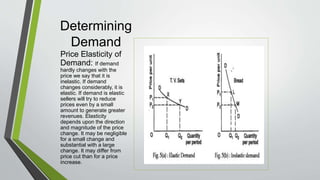
Price Elasticity of Demand
Determining Demand
• Pricing sensitivity can be reduced if:
 Product is more distinctive.
 Buyers are less aware of the substitute.
 Expenditure is smaller part of the buyer’s total income.
 Part of the cost is borne by another party.
 The product is used in conjunction with assets previously bought.
 Product is perceived to be of high quality.
• Estimating demand curve:
 Surveys: These can explore how many units consumers would buy at different proposed
prices. They can be unreliable as customers tend to understate or overstate their purchase
intentions.
 Price Experiments: We can vary the prices of different products in a store or of the same
product in similar territories.
 Statistical analysis of past prices, quantities sold & other factors can reveal their
relationships.
Determining
Demand
Price Elasticity of
Demand: If demand
hardly changes with the
price we say that it is
inelastic. If demand
changes considerably, it is
elastic. If demand is elastic
sellers will try to reduce
prices even by a small
amount to generate greater
revenues. Elasticity
depends upon the direction
and magnitude of the price
change. It may be negligible
for a small change and
substantial with a large
change. It may differ from
price cut than for a price
increase.
Estimating Cost
 Demand sets the ceiling on the price the company can charge for its product. Costs
set the floor.
 A company wants to charge a price that covers its cost of production, distribution and
selling the product, including a fair return for its efforts and risks.
 Types of costs are:
• Fixed Cost: They not vary with production level or sales revenue.
• Variable Cost: Vary directly with the level of production.
• Total Cost: Sum of fixed and variable cost.
• Average Cost: It is total cost divided by production.
Note: To set the costs more accurately manufacturers need to use the activity based costing
instead of standard costing.
Estimating Cost
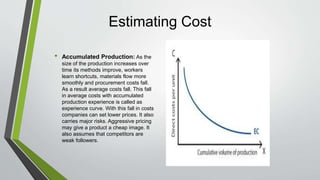
• Accumulated Production: As the
size of the production increases over
time its methods improve, workers
learn shortcuts, materials flow more
smoothly and procurement costs fall.
As a result average costs fall. This fall
in average costs with accumulated
production experience is called as
experience curve. With this fall in costs
companies can set lower prices. It also
carries major risks. Aggressive pricing
may give a product a cheap image. It
also assumes that competitors are
weak followers.
ANALYZING COMPETITOR’S COSTS, PRICES AND
OFFERS.
• Strategies of competitors must be taken into account. If the firm’s offer contains features not offered by the
nearest competitors, it should evaluate their worth to the customer and vice versa.
• Value Priced Competitors: Companies offering the powerful combination of low prices and high quality
are capturing the hearts and wallets of the customers.
• Traditional players feel threatened by the new low cost players.
• New firms rely on serving few consumer segments, providing better delivery and matching low prices with highly
efficient operations.
• Low Cost operations should be set up only if:
a. Existing business will become more competitive.
b. The new business will derive advantages it would not have gained being independent.
Selecting A Pricing Method
• Costs set the floor for pricing.
• Competitors’ pricing and price of substitutes provide an orienting point.
• Customers’ assessment of unique features set the ceiling for pricing.
Based on these three assumptions pricing method is chosen.
• Mark-up Pricing: Standard mark-up is added to product’s cost. Mark-ups are usually higher
on seasonal items, slower moving items, items with high storage and handling costs and
demand inelastic items such as prescription drugs.
• Mark-up ignores current demand, perceived value and competition.
• Mark-up Price = Unit Cost/(1-Desired return on sales)
• Target Return Pricing: Firm determines the price that yields its target return on investment.
• Achieving break even volume is very important.
• TRP ignores price elasticity and competitor’s strategy.
• Ways to lower fixed and variable cost must be implemented.
• Target Return Price = Unit Cost+[(Desired return X Invested Capital)÷Unit
Sales]
Selecting Final Price
• Impact of Other marketing activities: Final price must take into account brand’s quality
and advertising relative to the competition.
• Brands with average quality but high relative advertising budgets could charge
premium prices.
• Brands with high relative quality and high relative advertising obtained the highest
prices.
• Company Pricing Policy: The price must be consistent with company pricing policies.
• Gain & Risk Sharing Prices: Buyers may resist accepting a seller’s proposal because
of high risk involvement. Then the seller has to share the risk with customers.
• Impact of price on parties: While setting up prices distributors and sells must be kept
in mind. If they don’t make enough profit, they may choose not to bring the product to
market. Following questions can help us determine impact on other parties:
a. Will the sales force be willing to sell at these prices?
b. How will competitors react?
c. Will suppliers raise their prices when they see company’s price?
Broad categories of Pricing methods
• Cost based pricing
• Demand based pricing
• Competition oriented pricing
• Product line oriented pricing
• Tender pricing
• Affordability based pricing
• Differentiated pricing
COST BASED PRICING
• Mark up pricing:: Standard mark-up is added to product’s cost. Mark-ups are usually
higher on seasonal items, slower moving items, items with high storage and handling
costs and demand inelastic items such as prescription drugs.
• Mark-up ignores current demand, perceived value and competition.
• Target rate return pricing: Firm determines the price that yields its target return on
investment.
• Achieving break even volume is very important.
• TRP ignores price elasticity and competitor’s strategy.
• Ways to lower fixed and variable cost must be implemented.
• Target Return Price = Unit Cost+[(Desired return X Invested Capital)÷Unit Sales]
• Marginal cost pricing
• Absorption Cost pricing
Demand based Pricing
• Skimming pricing
• ‘What the tariff can bear’ pricing
• Surge pricing
• Premium pricing
• Penetration pricing
• Predatory pricing
Customers’ assessment of unique features set
the ceiling for pricing
• Value Pricing: Companies that adopt this method win loyal customers by offering high quality
at lower prices.
• It is not a matter of lower prices but to make operations more efficient to become low cost
producer.
• EDLP: It stands for “Everyday Low Prices”. Deep discounts are given by sellers perpetually. It
is different from High-Low Pricing as prices are kept low to eliminate wee-to-week price
uncertainty. Walmart is the king of EDLP.
• Used mainly by Retail stores. Constant sales and promotion are costly for sellers and buyers
and EDLP eliminates it.
• Auction Type Pricing: These are popular among firms disposing excessive inventories or
used goods.
i. English Auctions: One seller many buyers.
ii. Dutch Auctions: One buyer many sellers.
iii. Sealed bid auctions: Suppliers submit only one bid and they can’t know other bids. Govt.
Tenders are filled on these basis.
COMPETITION ORIENTED PRICING
• Perceived Value Pricing: Perceived value is made up of a host of inputs, such
as the buyer’s image of product performance, the channel deliverables, the
warranty quality, customer support, supplier’s reputation and esteem.
• Going Rate Pricing: In this firms base their prices on competitors’ prices. In
oligopolistic industries that sell commodities such as steel, paper etc all firms
charge the same price. It is quite popular. It is used where costs are difficult to
measure or competitive response is uncertain. It reflects industry wisdom.
• Premium pricing
• Discount pricing
•Product line oriented pricing
•Tender pricing
•Affordability based pricing
•Differentiated pricing
Factors Influencing Pricing
• Internal Factors
• External Factors
Internal Factors
• Corporate and marketing objectives of the firm
• The image sought by the firm through the pricing
• The characteristics of the product
• The stage of the product in it’s life cycle
• Use pattern and turnaround rate of the product
• Costs of manufacturing and marketing
• Extent of distinctiveness/differentiation of the product
• Interaction of other 3 Ps with pricing
• Whether buyers buy some of the products in combination
External Factors
• Market characteristics ( demand, customer and competition )
• Price elasticity of demand of the product in particular
• Buying behaviour of the customers of the product
• Bargaining power of major customers
• Bargaining power of major suppliers
• Competitors’ pricing strategies
• Government controls/regulation on pricing
• Other relevant legal aspects
• Societal views
• Understanding reached, if any, with competitors
Pricing in a Digital World
• Buyers POV
• Sellers POV
Buyers can
• Get instant price comparisons from thousands of vendors
• Check prices at the point of purchase
• Name their price and have it met
• Get products free
• Negotiate prices in online auctions and exchanges or even in person
Sellers can
• Monitor customer behaviour and tailor offers to individuals
• Give certain customers access to special prices
• Negotiate prices in online auctions and exchanges or even in person
Pricing to capture value
• Price must reflect value
• Customer value has to be the key in pricing
• Essence of pricing to value
• Price=Value>costs(This is what we need)
• Pricing to value is winning approach
• Customer is interested only in the value or worth of the product and is
not bothered about the cost that the marketer has incurred
Approaches in pricing to capture value
• There are many routes to “ pricing to capture value”
• High price is relevant when the value content is correspondingly high,
which the relevant customer segment is willing to pay
• Lower price is relevant when the value content is less
• Challenge the cost Route
• The inflation price point
Pricing of new product
• Firms requirement in pursuing the new product
• The extent of newness and the nature of the product
• Cost data in respect of new products
• Managing price need Organisational Infrastructure
INITIATING PRICE CUTS
• Several circumstances might lead a firm to cut prices like excess plant
capacity
• Possible traps of price cutting strategy
• Low-quality trap
• Fragile-market-share trap
• Shallow-pocket trap
• Price-war trap
INITIATING PRICE INCREASE
• A successful price increase can raise profit considerably.
• Major reasons behind price increase
• Cost Inflation
• Over demand
• Ways to increase price
• Delayed quotation pricing
• Escalator clauses
• Unbundling
• Reduction of discount
ANTICIPATING COMPETITIVE RESPONSE
• Introduction or change to any price can provoke a response from
customers, competitors, distributors, suppliers and even government
• There are several ways to anticipate a competitor’s reaction like-
• Assuming the competitor react in a standard way
• Assuming the competitor treat each price difference or change as a
fresh challenge.
RESPONDINGTO COMPETITOR’S PRICE
CHANGE
• Response of a firm to a competitor’s price change depends on the
situation.
• Companies must analyse following factors and respond accordingly
• Product stage in life cycle
• Product’s importance in the company portfolio
• Competitor’s intention and resources
• Market price and quality sensitivity
• Behaviour of cost with volume
• Company’s alternative opportunities
QUESTIONS!!!
THANKYOU

Pricing

  • 1.
    PRICING MANAGEMENT MARKETING Presented by:(Group1) Akhilesh Sharma Amit kumar Ainesh nanda Ankush Goyal
  • 2.
    CONTENT • Introduction andobjective • Pricing Process • Pricing methods • Factors influencing pricing • Digital pricing • Pricing to capture value • Pricing of new product • Initiating and responding to price change
  • 3.
    Pricing • Process bywhich business sets the price at which it will sell its products and services. • Capturing value : both for company and customers. • Measure ofValue. • Important factor for differentiation. • Only factor in marketing mix that generates revenue.
  • 4.
    Pricing Objectives • PricingObjectives flow from marketing objectives • A business will have a number of objectives or a mix in the matter of pricing.
  • 5.
    Objectives Firms seekin Pricing. • Profit maximization in the short term • Profit optimization in the long run. • A minimum return on investment. • A minimum return on sales income. • Achieving a particular sales volume. • Achieving a particular market share. • Deeper penetration of the market. • Entering new markets
  • 6.
    • Target profiton entire product line, irrespective of profit level in individual products. • Keeping competition out or keeping it under check. • Keeping parity with competition. • Fast turnaround of stock and early cash recovery. • Stabilizing the prices and margins in the market. • Keeping products affordable to customers. • Providing the products at low prices so as to stimulate economic development.
  • 7.
    Steps involved inPricing Selecting Final Price Selecting Pricing Method. Analyzing Competitor’s Costs, PricesAnd Offers. Estimating Cost. Determining Demand. Selecting the price objective.
  • 8.
    Selecting the PriceObjectives Survival Maximum Current Profit Maximum Market Share Maximum Market Skimming Product Quality Leadership
  • 9.
    Maximum Market Share Somecompanies believe a higher sales volume will lead to lower unit costs and higher long run profits, so they tend to set lower prices, assuming that the market is price sensitive. Also known as Market Penetration. • Following conditions favour the market penetration strategies.  Market is highly price sensitive.  Production costs fall with accumulated production experience.  Low prices discourage actual and potential competition.
  • 10.
    Maximum Market Skimming Companies thatunveil new technologies favour setting high prices. In this, prices start high and slowly fall over a period of time. This strategy can be fatal if competitor decides to price low. Moreover customers who buy at higher prices may feel dissatisfied later. • Skimming Works When:  Sufficient numbers of customers have high current demand. High initial price will not attract competition. High price communicates the image of the superior products.
  • 11.
    Determining Demand Each pricewill lead to a different level of demand and have a different impact on a company’s marketing objectives. Normally, “Higher the price, lower the demand”. Price Sensitivity: Customers are low price sensitive towards the products they buy infrequently or those which are cheap. Determining Demand Through Demand Curve by surveys, price experiments or through statistical analysis. Price Elasticity of Demand
  • 12.
    Determining Demand • Pricingsensitivity can be reduced if:  Product is more distinctive.  Buyers are less aware of the substitute.  Expenditure is smaller part of the buyer’s total income.  Expenditure is smaller part of the buyer’s total income.  Part of the cost is borne by another party.  The product is used in conjunction with assets previously bought.  Product is perceived to be of high quality. • Estimating demand curve:  Surveys: These can explore how many units consumers would buy at different proposed prices. They can be unreliable as customers tend to understate or overstate their purchase intentions.  Price Experiments: We can vary the prices of different products in a store or of the same product in similar territories.  Statistical analysis of past prices, quantities sold & other factors can reveal their relationships.
  • 13.
    Determining Demand Price Elasticity of Demand:If demand hardly changes with the price we say that it is inelastic. If demand changes considerably, it is elastic. If demand is elastic sellers will try to reduce prices even by a small amount to generate greater revenues. Elasticity depends upon the direction and magnitude of the price change. It may be negligible for a small change and substantial with a large change. It may differ from price cut than for a price increase.
  • 14.
    Estimating Cost  Demandsets the ceiling on the price the company can charge for its product. Costs set the floor.  A company wants to charge a price that covers its cost of production, distribution and selling the product, including a fair return for its efforts and risks.  Types of costs are: • Fixed Cost: They not vary with production level or sales revenue. • Variable Cost: Vary directly with the level of production. • Total Cost: Sum of fixed and variable cost. • Average Cost: It is total cost divided by production. Note: To set the costs more accurately manufacturers need to use the activity based costing instead of standard costing.
  • 15.
    Estimating Cost • AccumulatedProduction: As the size of the production increases over time its methods improve, workers learn shortcuts, materials flow more smoothly and procurement costs fall. As a result average costs fall. This fall in average costs with accumulated production experience is called as experience curve. With this fall in costs companies can set lower prices. It also carries major risks. Aggressive pricing may give a product a cheap image. It also assumes that competitors are weak followers.
  • 16.
    ANALYZING COMPETITOR’S COSTS,PRICES AND OFFERS. • Strategies of competitors must be taken into account. If the firm’s offer contains features not offered by the nearest competitors, it should evaluate their worth to the customer and vice versa. • Value Priced Competitors: Companies offering the powerful combination of low prices and high quality are capturing the hearts and wallets of the customers. • Traditional players feel threatened by the new low cost players. • New firms rely on serving few consumer segments, providing better delivery and matching low prices with highly efficient operations. • Low Cost operations should be set up only if: a. Existing business will become more competitive. b. The new business will derive advantages it would not have gained being independent.
  • 17.
    Selecting A PricingMethod • Costs set the floor for pricing. • Competitors’ pricing and price of substitutes provide an orienting point. • Customers’ assessment of unique features set the ceiling for pricing. Based on these three assumptions pricing method is chosen. • Mark-up Pricing: Standard mark-up is added to product’s cost. Mark-ups are usually higher on seasonal items, slower moving items, items with high storage and handling costs and demand inelastic items such as prescription drugs. • Mark-up ignores current demand, perceived value and competition. • Mark-up Price = Unit Cost/(1-Desired return on sales) • Target Return Pricing: Firm determines the price that yields its target return on investment. • Achieving break even volume is very important. • TRP ignores price elasticity and competitor’s strategy. • Ways to lower fixed and variable cost must be implemented. • Target Return Price = Unit Cost+[(Desired return X Invested Capital)÷Unit Sales]
  • 18.
    Selecting Final Price •Impact of Other marketing activities: Final price must take into account brand’s quality and advertising relative to the competition. • Brands with average quality but high relative advertising budgets could charge premium prices. • Brands with high relative quality and high relative advertising obtained the highest prices. • Company Pricing Policy: The price must be consistent with company pricing policies. • Gain & Risk Sharing Prices: Buyers may resist accepting a seller’s proposal because of high risk involvement. Then the seller has to share the risk with customers. • Impact of price on parties: While setting up prices distributors and sells must be kept in mind. If they don’t make enough profit, they may choose not to bring the product to market. Following questions can help us determine impact on other parties: a. Will the sales force be willing to sell at these prices? b. How will competitors react? c. Will suppliers raise their prices when they see company’s price?
  • 19.
    Broad categories ofPricing methods • Cost based pricing • Demand based pricing • Competition oriented pricing • Product line oriented pricing • Tender pricing • Affordability based pricing • Differentiated pricing
  • 20.
    COST BASED PRICING •Mark up pricing:: Standard mark-up is added to product’s cost. Mark-ups are usually higher on seasonal items, slower moving items, items with high storage and handling costs and demand inelastic items such as prescription drugs. • Mark-up ignores current demand, perceived value and competition. • Target rate return pricing: Firm determines the price that yields its target return on investment. • Achieving break even volume is very important. • TRP ignores price elasticity and competitor’s strategy. • Ways to lower fixed and variable cost must be implemented. • Target Return Price = Unit Cost+[(Desired return X Invested Capital)÷Unit Sales] • Marginal cost pricing • Absorption Cost pricing
  • 21.
    Demand based Pricing •Skimming pricing • ‘What the tariff can bear’ pricing • Surge pricing • Premium pricing • Penetration pricing • Predatory pricing
  • 22.
    Customers’ assessment ofunique features set the ceiling for pricing • Value Pricing: Companies that adopt this method win loyal customers by offering high quality at lower prices. • It is not a matter of lower prices but to make operations more efficient to become low cost producer. • EDLP: It stands for “Everyday Low Prices”. Deep discounts are given by sellers perpetually. It is different from High-Low Pricing as prices are kept low to eliminate wee-to-week price uncertainty. Walmart is the king of EDLP. • Used mainly by Retail stores. Constant sales and promotion are costly for sellers and buyers and EDLP eliminates it. • Auction Type Pricing: These are popular among firms disposing excessive inventories or used goods. i. English Auctions: One seller many buyers. ii. Dutch Auctions: One buyer many sellers. iii. Sealed bid auctions: Suppliers submit only one bid and they can’t know other bids. Govt. Tenders are filled on these basis.
  • 23.
    COMPETITION ORIENTED PRICING •Perceived Value Pricing: Perceived value is made up of a host of inputs, such as the buyer’s image of product performance, the channel deliverables, the warranty quality, customer support, supplier’s reputation and esteem. • Going Rate Pricing: In this firms base their prices on competitors’ prices. In oligopolistic industries that sell commodities such as steel, paper etc all firms charge the same price. It is quite popular. It is used where costs are difficult to measure or competitive response is uncertain. It reflects industry wisdom. • Premium pricing • Discount pricing
  • 24.
    •Product line orientedpricing •Tender pricing •Affordability based pricing •Differentiated pricing
  • 25.
    Factors Influencing Pricing •Internal Factors • External Factors
  • 26.
    Internal Factors • Corporateand marketing objectives of the firm • The image sought by the firm through the pricing • The characteristics of the product • The stage of the product in it’s life cycle • Use pattern and turnaround rate of the product • Costs of manufacturing and marketing • Extent of distinctiveness/differentiation of the product • Interaction of other 3 Ps with pricing • Whether buyers buy some of the products in combination
  • 27.
    External Factors • Marketcharacteristics ( demand, customer and competition ) • Price elasticity of demand of the product in particular • Buying behaviour of the customers of the product • Bargaining power of major customers • Bargaining power of major suppliers • Competitors’ pricing strategies • Government controls/regulation on pricing • Other relevant legal aspects • Societal views • Understanding reached, if any, with competitors
  • 28.
    Pricing in aDigital World • Buyers POV • Sellers POV
  • 29.
    Buyers can • Getinstant price comparisons from thousands of vendors • Check prices at the point of purchase • Name their price and have it met • Get products free • Negotiate prices in online auctions and exchanges or even in person
  • 30.
    Sellers can • Monitorcustomer behaviour and tailor offers to individuals • Give certain customers access to special prices • Negotiate prices in online auctions and exchanges or even in person
  • 31.
    Pricing to capturevalue • Price must reflect value • Customer value has to be the key in pricing • Essence of pricing to value • Price=Value>costs(This is what we need) • Pricing to value is winning approach • Customer is interested only in the value or worth of the product and is not bothered about the cost that the marketer has incurred
  • 32.
    Approaches in pricingto capture value • There are many routes to “ pricing to capture value” • High price is relevant when the value content is correspondingly high, which the relevant customer segment is willing to pay • Lower price is relevant when the value content is less • Challenge the cost Route • The inflation price point
  • 33.
    Pricing of newproduct • Firms requirement in pursuing the new product • The extent of newness and the nature of the product • Cost data in respect of new products • Managing price need Organisational Infrastructure
  • 34.
    INITIATING PRICE CUTS •Several circumstances might lead a firm to cut prices like excess plant capacity • Possible traps of price cutting strategy • Low-quality trap • Fragile-market-share trap • Shallow-pocket trap • Price-war trap
  • 35.
    INITIATING PRICE INCREASE •A successful price increase can raise profit considerably. • Major reasons behind price increase • Cost Inflation • Over demand • Ways to increase price • Delayed quotation pricing • Escalator clauses • Unbundling • Reduction of discount
  • 36.
    ANTICIPATING COMPETITIVE RESPONSE •Introduction or change to any price can provoke a response from customers, competitors, distributors, suppliers and even government • There are several ways to anticipate a competitor’s reaction like- • Assuming the competitor react in a standard way • Assuming the competitor treat each price difference or change as a fresh challenge.
  • 37.
    RESPONDINGTO COMPETITOR’S PRICE CHANGE •Response of a firm to a competitor’s price change depends on the situation. • Companies must analyse following factors and respond accordingly • Product stage in life cycle • Product’s importance in the company portfolio • Competitor’s intention and resources • Market price and quality sensitivity • Behaviour of cost with volume • Company’s alternative opportunities
  • 38.
  • 39.