 About Us (https://theconstructor.org/about/) |  Contact Us (https://theconstructor.org/contact-us/) |
 Privacy Policy (https://theconstructor.org/privacy-policy/)
 (https://twitter.com/theconstructor2)  (https://www.facebook.com/TheConstructor)
 (https://plus.google.com/+TheconstructorOrg)
Search here ...
Building (https://theconstructor.org/building/) How To Guide (https://theconstructor.org/practical-guide/)
Concrete (https://theconstructor.org/concrete/) Construction (https://theconstructor.org/construction/)
Geotechnical (https://theconstructor.org/geotechnical/) Structural (https://theconstructor.org/structural-engg/)
Dewatering Method Construction Dewatering Excavation Method
And Construction Method Dewatering Pump Dewatering Systems
Ads by Google
(https://theconstructor.org/)
Methods of Dewatering Excavations at Construction Site
Home (https://theconstructor.org) / How To Guide (https://theconstructor.org/practical-guide/) / Work Procedures (https://theconstructor.org/practical-
guide/work-procedure/) / Excavation (https://theconstructor.org/practical-guide/work-procedure/excavation/) / Methods of Dewatering Excavations at
Construction Site
 (https://www.facebook.com/sharer.php?u=https%3A%2F%2Ftheconstructor.org%2Fpractical-guide%2Fmethods-of-dewatering-excavation-construction-site%2F13849%2F)
 (https://twitter.com/intent/tweet?text=Methods of Dewatering Excavations at Construction Site&url=https%3A%2F%2Ftheconstructor.org%2Fpractical-guide%2Fmethods-of-
dewatering-excavation-construction-site%2F13849%2F&via=theconstructor2)

(http
s://p
lus.
goo
gle.
com
/sha
re?
url=
http
s%3
A%
2F
%2
Fthe
con
stru
ctor.
org
%2
Fpr
acti
cal-
guid
 (https://www.linkedin.com/shareArticle?mini=true&url=https%3A%2F%2Ftheconstructor.org%2Fpractical-guide%2Fmethods-of-dewatering-excavation-construction-
site%2F13849%2F&title=Methods of Dewatering Excavations at Construction Site&source=TheConstructor.Org)
 (https://pinterest.com/pin/create/button/?url=https%3A%2F%2Ftheconstructor.org%2Fpractical-guide%2Fmethods-of-dewatering-excavation-construction-
site%2F13849%2F&media=&description=Methods of Dewatering Excavations at Construction Site)
 (whatsapp://send?text=Methods of Dewatering Excavations at Construction Site%20-%20https%3A%2F%2Ftheconstructor.org%2Fpractical-guide%2Fmethods-of-dewatering-
excavation-construction-site%2F13849%2F)
Like 3.2k
Dewatering of excavations are required at construction sites generally for foundation works. Various methods
for dewatering of excavations are described.
(https://www.pushengage.com)GetNotifications
Firm and sound working conditions are indispensable when construction of buildings, powerhouse, dams, and
other structures has to be executed. These structures not only require a dry base for their foundations but also
a good water-table-stability in the girth.
Dewatering of any excavated area is done in order to keep the excavation bottom dry, to prevent the leakage
of water or sand and to avoid upheaval failure. Dewatering could turn out to be a herculean task if one doesn’t
adopt the right method.
The different methods available for dewatering of excavations at constructions sites are not necessarily
interchangeable as each one has a narrow range of applications therefore adopting the right method of
dewatering for a particular ground condition is always a critical and a difficult decision to make.
Minor amount of water can always be pumped out by creating a sump but when other factors like continuous
seepage, excessive smudge come into play one has to resort to a bit of sophistication.
Methods of Dewatering Excavations at Construction Site
There are four important dewatering methods one should be aware of:
Wellpoint method of dewatering,
Eductor wells,
Open sump pumping and
Deep wellpoint method
Wellpoint Method of Dewatering Excavations
1) A series of wells of required depth are created in the vicinity of the excavated area from where the water
has to be pumped out. The wells are arranged either in a line or a rectangular form where the wellpoints are
created at a distance of at least 2m from each other.
2) Riser pipes or dewatering pipes are then installed into those closely spaced wells which on the surface are
connected to a flexible swing pipe which is ultimately appended to a common header pipe that is responsible
for discharging the water away from the site. The purpose of using a flexible swing pipe is just to provide a
clear view of what is being pumped and the purpose of header pipe is to create suction as well as discharge the
water off the working area.
Construction Dewatering
Construction Method
Construction Excavation
Dewatering Systems
Design Method
Ads by Google
(https://www.pushengage.com)GetNotifications
3) One end of the header pipe is connected to a vacuum pump which draws water through notches in the
wellpoint. The water then travels from the wellpoints through the flexible swing pipe into the header pipe to
the pump. It is then discharged away from the site or to other processes to remove unwanted properties such
as contaminants.
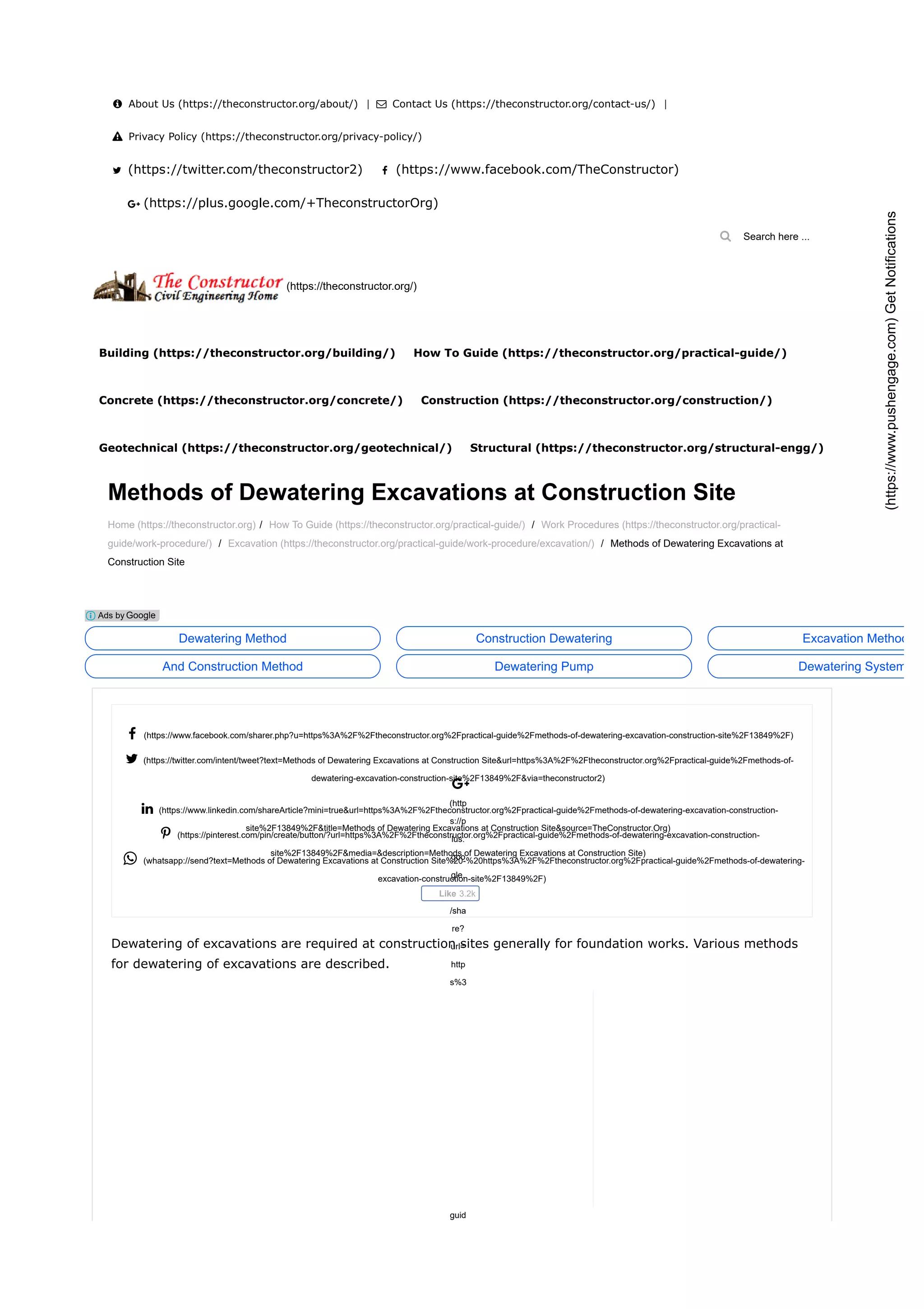
4) The drawdown using this method is restricted to around five to six meters below the wellpoint pump level. If
a deeper drawdown is required, multiple stages of wellpoints must be used.
Fig: Details of Wellpoint Method for Excavation Dewatering
Eductor Wells Method of Dewatering Excavations
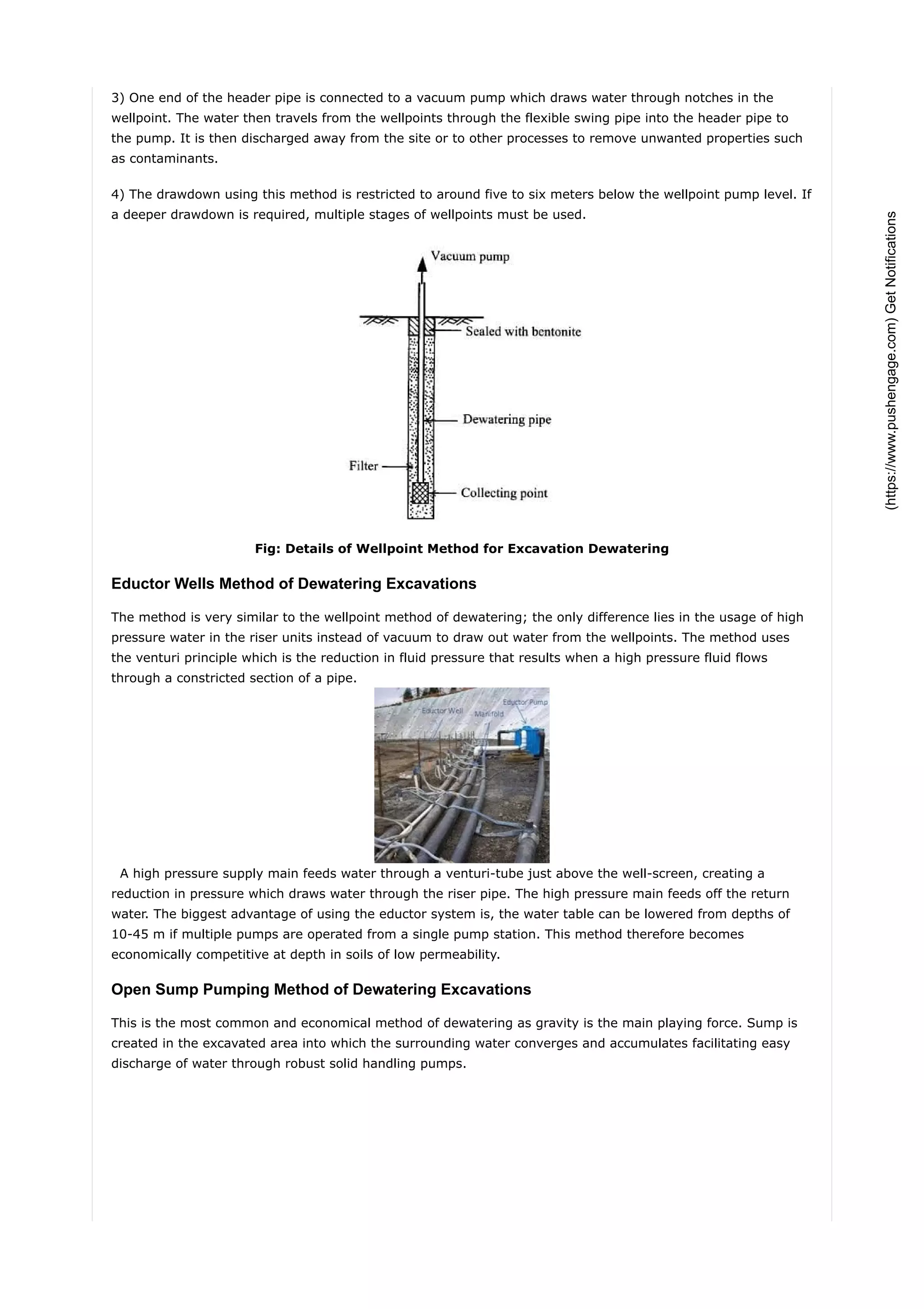
The method is very similar to the wellpoint method of dewatering; the only difference lies in the usage of high
pressure water in the riser units instead of vacuum to draw out water from the wellpoints. The method uses
the venturi principle which is the reduction in fluid pressure that results when a high pressure fluid flows
through a constricted section of a pipe.
A high pressure supply main feeds water through a venturi-tube just above the well-screen, creating a
reduction in pressure which draws water through the riser pipe. The high pressure main feeds off the return
water. The biggest advantage of using the eductor system is, the water table can be lowered from depths of
10-45 m if multiple pumps are operated from a single pump station. This method therefore becomes
economically competitive at depth in soils of low permeability.
Open Sump Pumping Method of Dewatering Excavations
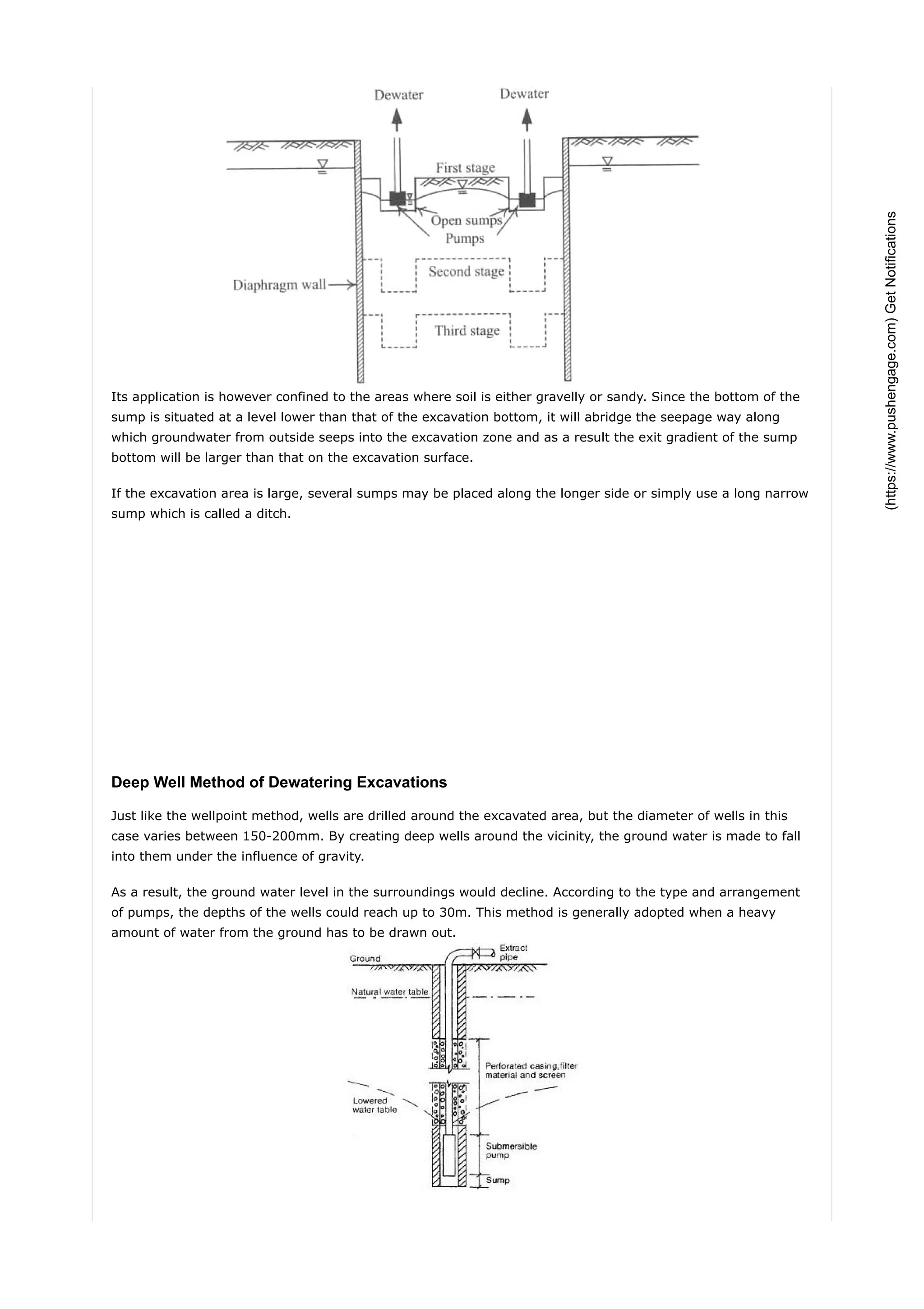
This is the most common and economical method of dewatering as gravity is the main playing force. Sump is
created in the excavated area into which the surrounding water converges and accumulates facilitating easy
discharge of water through robust solid handling pumps.
(https://www.pushengage.com)GetNotifications
Its application is however confined to the areas where soil is either gravelly or sandy. Since the bottom of the
sump is situated at a level lower than that of the excavation bottom, it will abridge the seepage way along
which groundwater from outside seeps into the excavation zone and as a result the exit gradient of the sump
bottom will be larger than that on the excavation surface.
If the excavation area is large, several sumps may be placed along the longer side or simply use a long narrow
sump which is called a ditch.
Deep Well Method of Dewatering Excavations
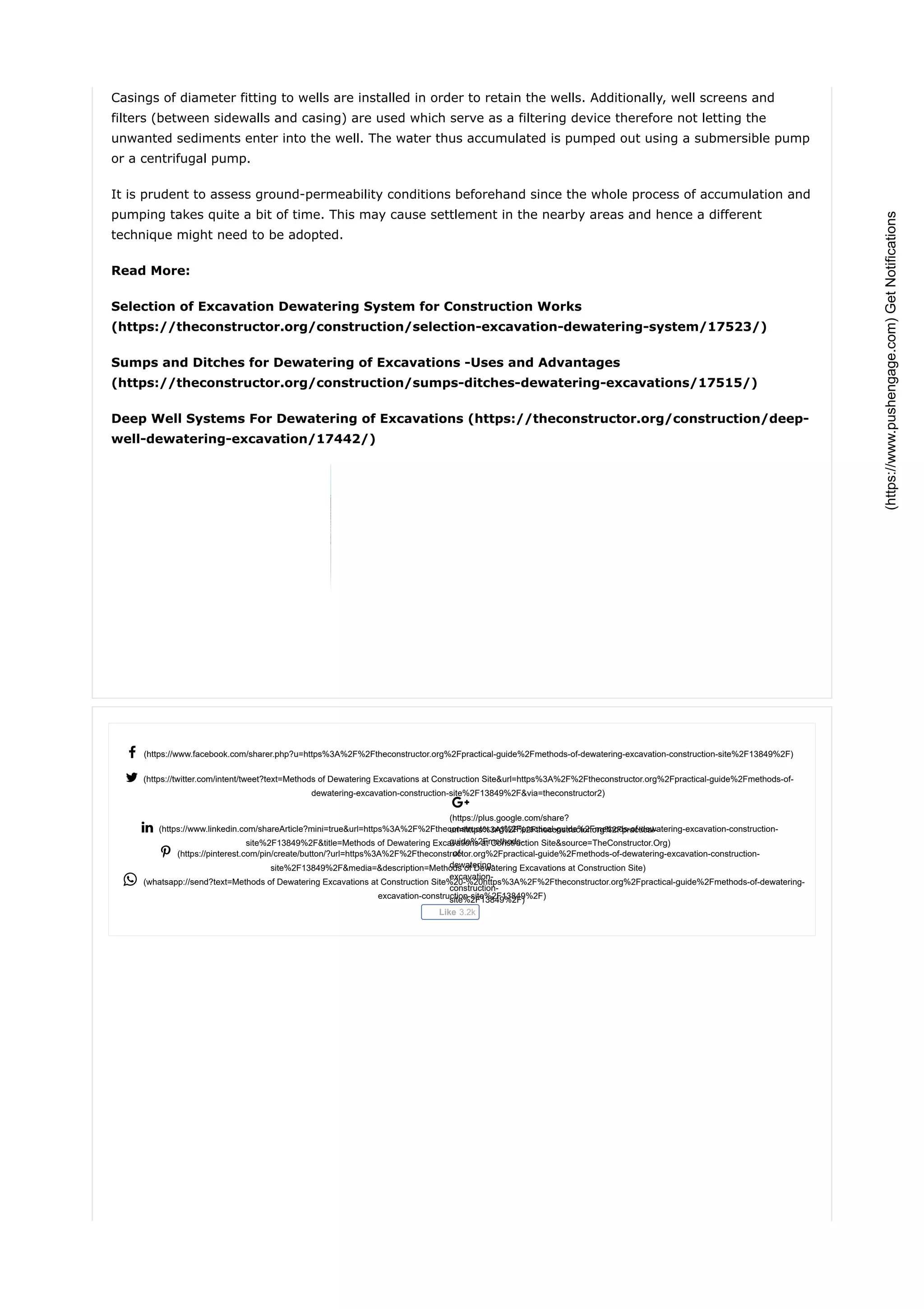
Just like the wellpoint method, wells are drilled around the excavated area, but the diameter of wells in this
case varies between 150-200mm. By creating deep wells around the vicinity, the ground water is made to fall
into them under the influence of gravity.
As a result, the ground water level in the surroundings would decline. According to the type and arrangement
of pumps, the depths of the wells could reach up to 30m. This method is generally adopted when a heavy
amount of water from the ground has to be drawn out.
AquaDam®
20 Years Of Experience With Dewatering
Systems. Call Today.
aquadam.net
(https://www.pushengage.com)GetNotifications
 (https://www.facebook.com/sharer.php?u=https%3A%2F%2Ftheconstructor.org%2Fpractical-guide%2Fmethods-of-dewatering-excavation-construction-site%2F13849%2F)
 (https://twitter.com/intent/tweet?text=Methods of Dewatering Excavations at Construction Site&url=https%3A%2F%2Ftheconstructor.org%2Fpractical-guide%2Fmethods-of-
dewatering-excavation-construction-site%2F13849%2F&via=theconstructor2)

(https://plus.google.com/share?
url=https%3A%2F%2Ftheconstructor.org%2Fpractical-
guide%2Fmethods-
of-
dewatering-
excavation-
construction-
site%2F13849%2F)
 (https://www.linkedin.com/shareArticle?mini=true&url=https%3A%2F%2Ftheconstructor.org%2Fpractical-guide%2Fmethods-of-dewatering-excavation-construction-
site%2F13849%2F&title=Methods of Dewatering Excavations at Construction Site&source=TheConstructor.Org)
 (https://pinterest.com/pin/create/button/?url=https%3A%2F%2Ftheconstructor.org%2Fpractical-guide%2Fmethods-of-dewatering-excavation-construction-
site%2F13849%2F&media=&description=Methods of Dewatering Excavations at Construction Site)
 (whatsapp://send?text=Methods of Dewatering Excavations at Construction Site%20-%20https%3A%2F%2Ftheconstructor.org%2Fpractical-guide%2Fmethods-of-dewatering-
excavation-construction-site%2F13849%2F)
Like 3.2k
Casings of diameter fitting to wells are installed in order to retain the wells. Additionally, well screens and
filters (between sidewalls and casing) are used which serve as a filtering device therefore not letting the
unwanted sediments enter into the well. The water thus accumulated is pumped out using a submersible pump
or a centrifugal pump.
It is prudent to assess ground-permeability conditions beforehand since the whole process of accumulation and
pumping takes quite a bit of time. This may cause settlement in the nearby areas and hence a different
technique might need to be adopted.
Read More:
Selection of Excavation Dewatering System for Construction Works
(https://theconstructor.org/construction/selection-excavation-dewatering-system/17523/)
Sumps and Ditches for Dewatering of Excavations -Uses and Advantages
(https://theconstructor.org/construction/sumps-ditches-dewatering-excavations/17515/)
Deep Well Systems For Dewatering of Excavations (https://theconstructor.org/construction/deep-
well-dewatering-excavation/17442/)
*T&Capply.
Replay
(https://www.pushengage.com)GetNotifications
Subscribe to our updates and get interesting articles to your email inbox
Email *
Subscribe!
Invest in 25 blue-
chips
Ad DSP BlackRock
SETTING OUT A
BUILDING PLAN
ON GROUND
theconstructor.org
Get 100% Safe
Water
Ad www.kent.co.in
Excavation - Civil
Engineering - Page
1 of 1
theconstructor.org
Aluminum Sheet
Ad MINGTAI
Steps in Preparing
Site for
Construction...
theconstructor.org
CONSTRUCTION
ERRORS DURING
CONCRETING AT...
theconstructor.org
RATE ANALYSIS OF
EXCAVATION IN
EARTHWORK
theconstructor.org
Search …
Subscribe to Updates
Popular Articles
(https://theconstructor.org/concrete/compressive-strength-of-concrete-cubes/1561/)
COMPRESSIVE STRENGTH OF CONCRETE
CUBES
(https://theconstructor.org/concrete/compressive-
strength-of-concrete-cubes/1561/)
(https://theconstructor.org/building/formwork-shuttering/types-of-formwork-shuttering/3767/)
TYPES OF FORMWORK (SHUTTERING)
FOR CONCRETE CONSTRUCTION
(https://theconstructor.org/building/formwork-shuttering/types-of-formwork-shuttering/3767/)
(https://theconstructor.org/practical-guide/rate-analysis-for-reinforced-concrete/6954/)
QUANTITY & RATE ANALYSIS FOR
REINFORCED CONCRETE
(https://theconstructor.org/practical-guide/rate-
analysis-for-reinforced-concrete/6954/)
(https://theconstructor.org/practical-guide/quantity-of-cement-sand-calculation-in-mortar/6925/)
QUANTITY OF CEMENT & SAND
CALCULATION IN MORTAR
(https://theconstructor.org/practical-
guide/quantity-of-cement-sand-calculation-in-mortar/6925/)
(https://www.pushengage.com)GetNotifications

Dewatering methods for excavations at construction sites

  • 1.
     About Us(https://theconstructor.org/about/) |  Contact Us (https://theconstructor.org/contact-us/) |  Privacy Policy (https://theconstructor.org/privacy-policy/)  (https://twitter.com/theconstructor2)  (https://www.facebook.com/TheConstructor)  (https://plus.google.com/+TheconstructorOrg) Search here ... Building (https://theconstructor.org/building/) How To Guide (https://theconstructor.org/practical-guide/) Concrete (https://theconstructor.org/concrete/) Construction (https://theconstructor.org/construction/) Geotechnical (https://theconstructor.org/geotechnical/) Structural (https://theconstructor.org/structural-engg/) Dewatering Method Construction Dewatering Excavation Method And Construction Method Dewatering Pump Dewatering Systems Ads by Google (https://theconstructor.org/) Methods of Dewatering Excavations at Construction Site Home (https://theconstructor.org) / How To Guide (https://theconstructor.org/practical-guide/) / Work Procedures (https://theconstructor.org/practical- guide/work-procedure/) / Excavation (https://theconstructor.org/practical-guide/work-procedure/excavation/) / Methods of Dewatering Excavations at Construction Site  (https://www.facebook.com/sharer.php?u=https%3A%2F%2Ftheconstructor.org%2Fpractical-guide%2Fmethods-of-dewatering-excavation-construction-site%2F13849%2F)  (https://twitter.com/intent/tweet?text=Methods of Dewatering Excavations at Construction Site&url=https%3A%2F%2Ftheconstructor.org%2Fpractical-guide%2Fmethods-of- dewatering-excavation-construction-site%2F13849%2F&via=theconstructor2)  (http s://p lus. goo gle. com /sha re? url= http s%3 A% 2F %2 Fthe con stru ctor. org %2 Fpr acti cal- guid  (https://www.linkedin.com/shareArticle?mini=true&url=https%3A%2F%2Ftheconstructor.org%2Fpractical-guide%2Fmethods-of-dewatering-excavation-construction- site%2F13849%2F&title=Methods of Dewatering Excavations at Construction Site&source=TheConstructor.Org)  (https://pinterest.com/pin/create/button/?url=https%3A%2F%2Ftheconstructor.org%2Fpractical-guide%2Fmethods-of-dewatering-excavation-construction- site%2F13849%2F&media=&description=Methods of Dewatering Excavations at Construction Site)  (whatsapp://send?text=Methods of Dewatering Excavations at Construction Site%20-%20https%3A%2F%2Ftheconstructor.org%2Fpractical-guide%2Fmethods-of-dewatering- excavation-construction-site%2F13849%2F) Like 3.2k Dewatering of excavations are required at construction sites generally for foundation works. Various methods for dewatering of excavations are described. (https://www.pushengage.com)GetNotifications
  • 2.
    Firm and soundworking conditions are indispensable when construction of buildings, powerhouse, dams, and other structures has to be executed. These structures not only require a dry base for their foundations but also a good water-table-stability in the girth. Dewatering of any excavated area is done in order to keep the excavation bottom dry, to prevent the leakage of water or sand and to avoid upheaval failure. Dewatering could turn out to be a herculean task if one doesn’t adopt the right method. The different methods available for dewatering of excavations at constructions sites are not necessarily interchangeable as each one has a narrow range of applications therefore adopting the right method of dewatering for a particular ground condition is always a critical and a difficult decision to make. Minor amount of water can always be pumped out by creating a sump but when other factors like continuous seepage, excessive smudge come into play one has to resort to a bit of sophistication. Methods of Dewatering Excavations at Construction Site There are four important dewatering methods one should be aware of: Wellpoint method of dewatering, Eductor wells, Open sump pumping and Deep wellpoint method Wellpoint Method of Dewatering Excavations 1) A series of wells of required depth are created in the vicinity of the excavated area from where the water has to be pumped out. The wells are arranged either in a line or a rectangular form where the wellpoints are created at a distance of at least 2m from each other. 2) Riser pipes or dewatering pipes are then installed into those closely spaced wells which on the surface are connected to a flexible swing pipe which is ultimately appended to a common header pipe that is responsible for discharging the water away from the site. The purpose of using a flexible swing pipe is just to provide a clear view of what is being pumped and the purpose of header pipe is to create suction as well as discharge the water off the working area. Construction Dewatering Construction Method Construction Excavation Dewatering Systems Design Method Ads by Google (https://www.pushengage.com)GetNotifications
  • 3.
    3) One endof the header pipe is connected to a vacuum pump which draws water through notches in the wellpoint. The water then travels from the wellpoints through the flexible swing pipe into the header pipe to the pump. It is then discharged away from the site or to other processes to remove unwanted properties such as contaminants. 4) The drawdown using this method is restricted to around five to six meters below the wellpoint pump level. If a deeper drawdown is required, multiple stages of wellpoints must be used. Fig: Details of Wellpoint Method for Excavation Dewatering Eductor Wells Method of Dewatering Excavations The method is very similar to the wellpoint method of dewatering; the only difference lies in the usage of high pressure water in the riser units instead of vacuum to draw out water from the wellpoints. The method uses the venturi principle which is the reduction in fluid pressure that results when a high pressure fluid flows through a constricted section of a pipe. A high pressure supply main feeds water through a venturi-tube just above the well-screen, creating a reduction in pressure which draws water through the riser pipe. The high pressure main feeds off the return water. The biggest advantage of using the eductor system is, the water table can be lowered from depths of 10-45 m if multiple pumps are operated from a single pump station. This method therefore becomes economically competitive at depth in soils of low permeability. Open Sump Pumping Method of Dewatering Excavations This is the most common and economical method of dewatering as gravity is the main playing force. Sump is created in the excavated area into which the surrounding water converges and accumulates facilitating easy discharge of water through robust solid handling pumps. (https://www.pushengage.com)GetNotifications
  • 4.
    Its application ishowever confined to the areas where soil is either gravelly or sandy. Since the bottom of the sump is situated at a level lower than that of the excavation bottom, it will abridge the seepage way along which groundwater from outside seeps into the excavation zone and as a result the exit gradient of the sump bottom will be larger than that on the excavation surface. If the excavation area is large, several sumps may be placed along the longer side or simply use a long narrow sump which is called a ditch. Deep Well Method of Dewatering Excavations Just like the wellpoint method, wells are drilled around the excavated area, but the diameter of wells in this case varies between 150-200mm. By creating deep wells around the vicinity, the ground water is made to fall into them under the influence of gravity. As a result, the ground water level in the surroundings would decline. According to the type and arrangement of pumps, the depths of the wells could reach up to 30m. This method is generally adopted when a heavy amount of water from the ground has to be drawn out. AquaDam® 20 Years Of Experience With Dewatering Systems. Call Today. aquadam.net (https://www.pushengage.com)GetNotifications
  • 5.
     (https://www.facebook.com/sharer.php?u=https%3A%2F%2Ftheconstructor.org%2Fpractical-guide%2Fmethods-of-dewatering-excavation-construction-site%2F13849%2F)  (https://twitter.com/intent/tweet?text=Methodsof Dewatering Excavations at Construction Site&url=https%3A%2F%2Ftheconstructor.org%2Fpractical-guide%2Fmethods-of- dewatering-excavation-construction-site%2F13849%2F&via=theconstructor2)  (https://plus.google.com/share? url=https%3A%2F%2Ftheconstructor.org%2Fpractical- guide%2Fmethods- of- dewatering- excavation- construction- site%2F13849%2F)  (https://www.linkedin.com/shareArticle?mini=true&url=https%3A%2F%2Ftheconstructor.org%2Fpractical-guide%2Fmethods-of-dewatering-excavation-construction- site%2F13849%2F&title=Methods of Dewatering Excavations at Construction Site&source=TheConstructor.Org)  (https://pinterest.com/pin/create/button/?url=https%3A%2F%2Ftheconstructor.org%2Fpractical-guide%2Fmethods-of-dewatering-excavation-construction- site%2F13849%2F&media=&description=Methods of Dewatering Excavations at Construction Site)  (whatsapp://send?text=Methods of Dewatering Excavations at Construction Site%20-%20https%3A%2F%2Ftheconstructor.org%2Fpractical-guide%2Fmethods-of-dewatering- excavation-construction-site%2F13849%2F) Like 3.2k Casings of diameter fitting to wells are installed in order to retain the wells. Additionally, well screens and filters (between sidewalls and casing) are used which serve as a filtering device therefore not letting the unwanted sediments enter into the well. The water thus accumulated is pumped out using a submersible pump or a centrifugal pump. It is prudent to assess ground-permeability conditions beforehand since the whole process of accumulation and pumping takes quite a bit of time. This may cause settlement in the nearby areas and hence a different technique might need to be adopted. Read More: Selection of Excavation Dewatering System for Construction Works (https://theconstructor.org/construction/selection-excavation-dewatering-system/17523/) Sumps and Ditches for Dewatering of Excavations -Uses and Advantages (https://theconstructor.org/construction/sumps-ditches-dewatering-excavations/17515/) Deep Well Systems For Dewatering of Excavations (https://theconstructor.org/construction/deep- well-dewatering-excavation/17442/) *T&Capply. Replay (https://www.pushengage.com)GetNotifications
  • 6.
    Subscribe to ourupdates and get interesting articles to your email inbox Email * Subscribe! Invest in 25 blue- chips Ad DSP BlackRock SETTING OUT A BUILDING PLAN ON GROUND theconstructor.org Get 100% Safe Water Ad www.kent.co.in Excavation - Civil Engineering - Page 1 of 1 theconstructor.org Aluminum Sheet Ad MINGTAI Steps in Preparing Site for Construction... theconstructor.org CONSTRUCTION ERRORS DURING CONCRETING AT... theconstructor.org RATE ANALYSIS OF EXCAVATION IN EARTHWORK theconstructor.org Search … Subscribe to Updates Popular Articles (https://theconstructor.org/concrete/compressive-strength-of-concrete-cubes/1561/) COMPRESSIVE STRENGTH OF CONCRETE CUBES (https://theconstructor.org/concrete/compressive- strength-of-concrete-cubes/1561/) (https://theconstructor.org/building/formwork-shuttering/types-of-formwork-shuttering/3767/) TYPES OF FORMWORK (SHUTTERING) FOR CONCRETE CONSTRUCTION (https://theconstructor.org/building/formwork-shuttering/types-of-formwork-shuttering/3767/) (https://theconstructor.org/practical-guide/rate-analysis-for-reinforced-concrete/6954/) QUANTITY & RATE ANALYSIS FOR REINFORCED CONCRETE (https://theconstructor.org/practical-guide/rate- analysis-for-reinforced-concrete/6954/) (https://theconstructor.org/practical-guide/quantity-of-cement-sand-calculation-in-mortar/6925/) QUANTITY OF CEMENT & SAND CALCULATION IN MORTAR (https://theconstructor.org/practical- guide/quantity-of-cement-sand-calculation-in-mortar/6925/) (https://www.pushengage.com)GetNotifications