LIFE CYCLE
ASSESSMENT
S.G.Mohanapourani,
2015006028,
III- B.Sc., Horticulture,
HC&RIW, TNAU, Trichy.
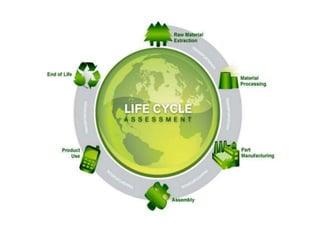
• LCA stands for Life Cycle Assessment.
• It is a technique that tries to identify, measure
and characterize different potential
environmental impacts associated to each one
of the stages of the life cycle of a product
What is LCA?
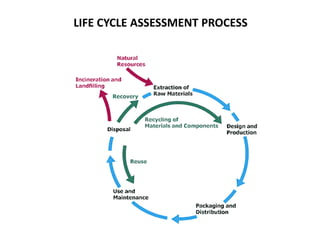
LIFE CYCLE ASSESSMENT PROCESS
What LCA aims at?
• LCA aims to understand the flows of matter and
energy involved in the product, material,
manufacturing process, packaging, etc. and find out
what are the environmentally critical points, and
prevent or remove them using other materials or
systems
TYPES OF LCA
• Cradle-to-Grave
• Cradle-to-Gate
• Cradle-to-Cradle
• Gate-to-Gate
• Wheel-to-Wheel
• Ecology-based
CRADLE-TO-GRAVE
• Cradle-to-grave is the full Life Cycle Assessment from
resource extraction ('cradle') to use phase and
disposal phase ('grave').
CRADLE-TO-GATE
• Cradle-to-gate is an assessment of a partial product
life cycle from resource extraction (cradle) to the
factory gate (i.e., before it is transported to the
consumer)
CRADLE-TO-CRADLE
• Cradle-to-cradle is a specific kind of cradle-to-grave
assessment, where the end-of-life disposal step for
the product is a recycling process.
• It is a method used to minimize the environmental
impact of products by employing sustainable
production, operation, and disposal practices and
aims to incorporate social responsibility into product
development.
GATE-TO-GATE
• Gate-to-gate is a partial LCA looking at only one
value-added process in the entire production chain.
WHEEL-TO-WHEEL
• Well-to-wheel is the specific LCA used for transport
fuels and vehicles.
• The first stage, which incorporates the feedstock or
fuel production and processing and fuel delivery or
energy transmission, and is called the "upstream"
stage.
• The stage that deals with vehicle operation itself is
sometimes called the "downstream“ stage.
ECOLOGY-BASED
• Eco-LCA is a methodology that quantitatively takes
into account regulating and supporting services
during the life cycle of economic goods and products.
• It was designed to provide a guide to wise
management of human activities by understanding
the direct and indirect impacts on ecological
resources and surrounding ecosystems
WHAT CAN BE DONE WITH LCA?
• 1.Product or project development and improvement
• 2.Strategic planning
• 3.Public policy making
• 4.Marketing and eco-declarations
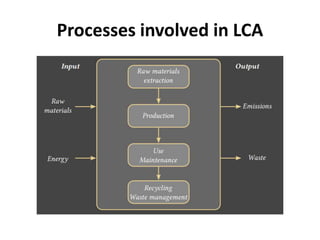
Processes involved in LCA
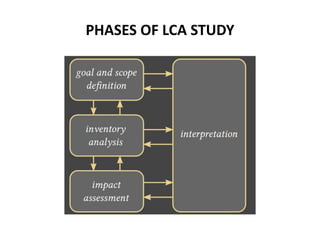
PHASES OF LCA STUDY
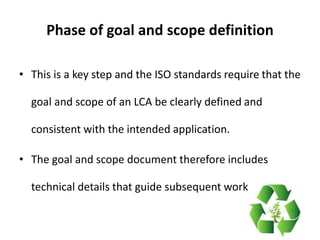
Phase of goal and scope definition
• This is a key step and the ISO standards require that the
goal and scope of an LCA be clearly defined and
consistent with the intended application.
• The goal and scope document therefore includes
technical details that guide subsequent work
Steps involved in Goal and scope
definition
• Product system to study
• The functions of the product system
• The functional unit
• The system limits
• Assumptions
• Limitations
• Data Requirements
Phase of inventory analysis
• Inventory’ literally means listing of products.
• Life Cycle Inventory (LCI) analysis involves creating an
inventory of flows from and to nature for a product
system.
• Inventory flows include inputs of water, energy, and
raw materials, and releases to air, land, and water.
• It also involves data collection and quantification of
needed input/output data.
Phase of impact assessment
• Environmental impact is an alteration of the
initial characteristics of the environment caused
by a project,work or activity.
• It is the set of consequences for human health,
welfare of the flora and fauna and the future
availability of natural resources attributable to
the input or output streams of a system.
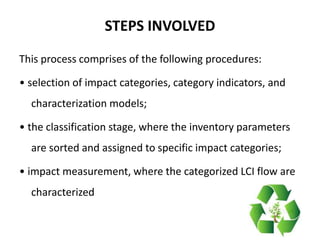
STEPS INVOLVED
This process comprises of the following procedures:
• selection of impact categories, category indicators, and
characterization models;
• the classification stage, where the inventory parameters
are sorted and assigned to specific impact categories;
• impact measurement, where the categorized LCI flow are
characterized
Phase of interpretation
• Life Cycle Interpretation is a systematic technique to
identify, quantify, check, and evaluate information
from the results of the life cycle inventory and/or the
life cycle impact assessment.
• The results from the inventory analysis and impact
assessment are summarized during the
interpretation phase.
• The outcome of the interpretation phase is a set of
conclusions and recommendations for the study.
THANK YOU !

Life cycle assessment

  • 1.
  • 2.
    • LCA standsfor Life Cycle Assessment. • It is a technique that tries to identify, measure and characterize different potential environmental impacts associated to each one of the stages of the life cycle of a product What is LCA?
  • 4.
  • 5.
    What LCA aimsat? • LCA aims to understand the flows of matter and energy involved in the product, material, manufacturing process, packaging, etc. and find out what are the environmentally critical points, and prevent or remove them using other materials or systems
  • 6.
    TYPES OF LCA •Cradle-to-Grave • Cradle-to-Gate • Cradle-to-Cradle • Gate-to-Gate • Wheel-to-Wheel • Ecology-based
  • 7.
    CRADLE-TO-GRAVE • Cradle-to-grave isthe full Life Cycle Assessment from resource extraction ('cradle') to use phase and disposal phase ('grave').
  • 8.
    CRADLE-TO-GATE • Cradle-to-gate isan assessment of a partial product life cycle from resource extraction (cradle) to the factory gate (i.e., before it is transported to the consumer)
  • 9.
    CRADLE-TO-CRADLE • Cradle-to-cradle isa specific kind of cradle-to-grave assessment, where the end-of-life disposal step for the product is a recycling process. • It is a method used to minimize the environmental impact of products by employing sustainable production, operation, and disposal practices and aims to incorporate social responsibility into product development.
  • 10.
    GATE-TO-GATE • Gate-to-gate isa partial LCA looking at only one value-added process in the entire production chain.
  • 11.
    WHEEL-TO-WHEEL • Well-to-wheel isthe specific LCA used for transport fuels and vehicles. • The first stage, which incorporates the feedstock or fuel production and processing and fuel delivery or energy transmission, and is called the "upstream" stage. • The stage that deals with vehicle operation itself is sometimes called the "downstream“ stage.
  • 12.
    ECOLOGY-BASED • Eco-LCA isa methodology that quantitatively takes into account regulating and supporting services during the life cycle of economic goods and products. • It was designed to provide a guide to wise management of human activities by understanding the direct and indirect impacts on ecological resources and surrounding ecosystems
  • 13.
    WHAT CAN BEDONE WITH LCA? • 1.Product or project development and improvement • 2.Strategic planning • 3.Public policy making • 4.Marketing and eco-declarations
  • 14.
  • 15.
  • 16.
    Phase of goaland scope definition • This is a key step and the ISO standards require that the goal and scope of an LCA be clearly defined and consistent with the intended application. • The goal and scope document therefore includes technical details that guide subsequent work
  • 17.
    Steps involved inGoal and scope definition • Product system to study • The functions of the product system • The functional unit • The system limits • Assumptions • Limitations • Data Requirements
  • 18.
    Phase of inventoryanalysis • Inventory’ literally means listing of products. • Life Cycle Inventory (LCI) analysis involves creating an inventory of flows from and to nature for a product system. • Inventory flows include inputs of water, energy, and raw materials, and releases to air, land, and water. • It also involves data collection and quantification of needed input/output data.
  • 19.
    Phase of impactassessment • Environmental impact is an alteration of the initial characteristics of the environment caused by a project,work or activity. • It is the set of consequences for human health, welfare of the flora and fauna and the future availability of natural resources attributable to the input or output streams of a system.
  • 20.
    STEPS INVOLVED This processcomprises of the following procedures: • selection of impact categories, category indicators, and characterization models; • the classification stage, where the inventory parameters are sorted and assigned to specific impact categories; • impact measurement, where the categorized LCI flow are characterized
  • 21.
    Phase of interpretation •Life Cycle Interpretation is a systematic technique to identify, quantify, check, and evaluate information from the results of the life cycle inventory and/or the life cycle impact assessment. • The results from the inventory analysis and impact assessment are summarized during the interpretation phase. • The outcome of the interpretation phase is a set of conclusions and recommendations for the study.
  • 22.