Metamorphic Testing
Metamorphic Testing (MT) is a software testing technique that addresses test oracle problems by
focusing on the relationships between outputs of multiple executions using altered inputs. It is
beneficial when the correct output is unknown or difficult to ascertain, as traditional testing
methods often struggle with complex, non-deterministic, and undecidable problems. MT's core
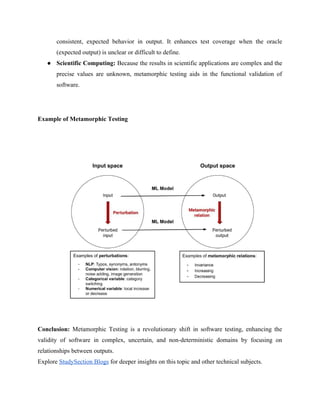
concept is to check if output relations remain invariant under changes in input.
Metamorphic Relations play an important role in Metamorphic Testing. Metamorphic relations
are the properties or relations that must remain consistent between the outputs of multiple
program executions with different inputs. Identifying suitable MRs is essential for the
effectiveness of MT.
Metamorphic Testing Process:
● Identify essential MRs: In the first step, identify the suitable MRs for the software under
test. These relations are identified based on the understanding of the software’s
functionality and domain properties.
● Select the Test Cases: Generate the initial test cases without concerning the exact output.
● Generation of Follow-Up Test Cases: Generate the follow-up test cases based on the
initial test cases. Keep in mind that while generating the new test cases, do not alter the
initial test cases.
● Execution of Test Cases: Execute both the initial and follow-up test cases.
● Verification of MRs: In the final step, check if the MRs hold for the outputs of the initial
and follow-up test cases. If an MR is violated, a defect is likely present.
Applications of Metamorphic Testing:
● Machine Learning and AI: ML systems are based on large input spaces with
probabilistic outcomes from black-box components. Metamorphic testing, a popular
technique, addresses these challenges.
● Web Services and APIs: Metamorphic testing in web services and APIs help identify
hidden defects by generating follow-up test cases based on changes to input and verifying
consistent, expected behavior in output. It enhances test coverage when the oracle
(expected output) is unclear or difficult to define.
● Scientific Computing: Because the results in scientific applications are complex and the
precise values are unknown, metamorphic testing aids in the functional validation of
software.
Example of Metamorphic Testing
Conclusion: Metamorphic Testing is a revolutionary shift in software testing, enhancing the
validity of software in complex, uncertain, and non-deterministic domains by focusing on
relationships between outputs.
Explore StudySection Blogs for deeper insights on this topic and other technical subjects.

Enhancing Software Reliability through Metamorphic Testing

  • 1.
    Metamorphic Testing Metamorphic Testing(MT) is a software testing technique that addresses test oracle problems by focusing on the relationships between outputs of multiple executions using altered inputs. It is beneficial when the correct output is unknown or difficult to ascertain, as traditional testing methods often struggle with complex, non-deterministic, and undecidable problems. MT's core concept is to check if output relations remain invariant under changes in input. Metamorphic Relations play an important role in Metamorphic Testing. Metamorphic relations are the properties or relations that must remain consistent between the outputs of multiple program executions with different inputs. Identifying suitable MRs is essential for the effectiveness of MT. Metamorphic Testing Process: ● Identify essential MRs: In the first step, identify the suitable MRs for the software under test. These relations are identified based on the understanding of the software’s functionality and domain properties. ● Select the Test Cases: Generate the initial test cases without concerning the exact output. ● Generation of Follow-Up Test Cases: Generate the follow-up test cases based on the initial test cases. Keep in mind that while generating the new test cases, do not alter the initial test cases. ● Execution of Test Cases: Execute both the initial and follow-up test cases. ● Verification of MRs: In the final step, check if the MRs hold for the outputs of the initial and follow-up test cases. If an MR is violated, a defect is likely present. Applications of Metamorphic Testing: ● Machine Learning and AI: ML systems are based on large input spaces with probabilistic outcomes from black-box components. Metamorphic testing, a popular technique, addresses these challenges. ● Web Services and APIs: Metamorphic testing in web services and APIs help identify hidden defects by generating follow-up test cases based on changes to input and verifying
  • 2.
    consistent, expected behaviorin output. It enhances test coverage when the oracle (expected output) is unclear or difficult to define. ● Scientific Computing: Because the results in scientific applications are complex and the precise values are unknown, metamorphic testing aids in the functional validation of software. Example of Metamorphic Testing Conclusion: Metamorphic Testing is a revolutionary shift in software testing, enhancing the validity of software in complex, uncertain, and non-deterministic domains by focusing on relationships between outputs. Explore StudySection Blogs for deeper insights on this topic and other technical subjects.