Security Regression
Addressing Security Regression by Unit Testing
Christopher Grayson
@_lavalamp
Introduction
WHOAMI
3
• ATL
• Web development
• Academic researcher
• Haxin’ all the things
• (but I rlllly like networks)
• Founder
• Red team
@_lavalamp
• Security regression is a huge
problem
• Lots of infrastructure built around
regression testing already
• Let’s leverage all of that existing
infrastructure to improve
application security posture at a
minimal cost to development teams
WHY’S DIS
4
1. Background
2. Dynamic Security Test Generation
3. Non-dynamic Security Test
Generation
4. Conclusion
Agenda
5
Background
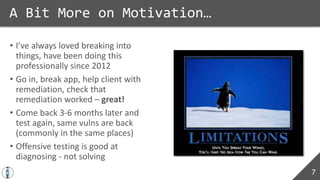
• I’ve always loved breaking into
things, have been doing this
professionally since 2012
• Go in, break app, help client with
remediation, check that
remediation worked – great!
• Come back 3-6 months later and
test again, same vulns are back
(commonly in the same places)
• Offensive testing is good at
diagnosing - not solving
A Bit More on Motivation…
7
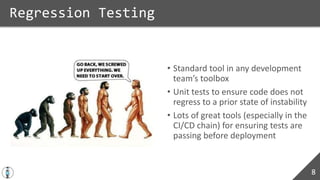
• Standard tool in any development
team’s toolbox
• Unit tests to ensure code does not
regress to a prior state of instability
• Lots of great tools (especially in the
CI/CD chain) for ensuring tests are
passing before deployment
Regression Testing
8
Why not take the problem of security
regression and use all of the tools
already built for regression testing to
improve the security posture of
tested applications?
Putting it All Together
9
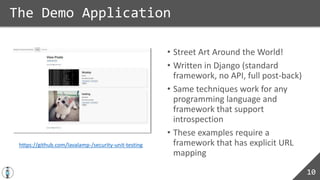
• Street Art Around the World!
• Written in Django (standard
framework, no API, full post-back)
• Same techniques work for any
programming language and
framework that support
introspection
• These examples require a
framework that has explicit URL
mapping
The Demo Application
10
https://github.com/lavalamp-/security-unit-testing
Dynamic Generation
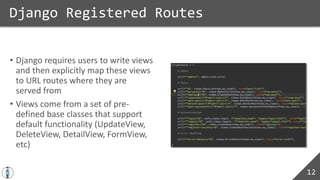
• Django requires users to write views
and then explicitly map these views
to URL routes where they are
served from
• Views come from a set of pre-
defined base classes that support
default functionality (UpdateView,
DeleteView, DetailView, FormView,
etc)
Django Registered Routes
12
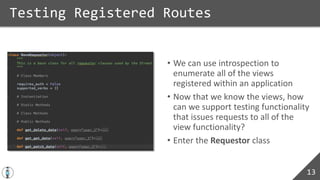
• We can use introspection to
enumerate all of the views
registered within an application
• Now that we know the views, how
can we support testing functionality
that issues requests to all of the
view functionality?
• Enter the Requestor class
Testing Registered Routes
13
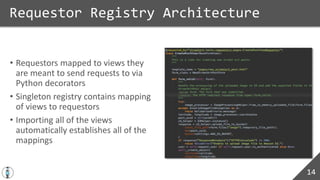
• Requestors mapped to views they
are meant to send requests to via
Python decorators
• Singleton registry contains mapping
of views to requestors
• Importing all of the views
automatically establishes all of the
mappings
Requestor Registry Architecture
14
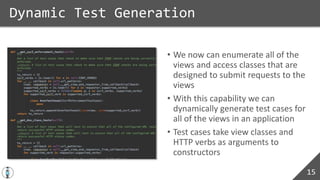
• We now can enumerate all of the
views and access classes that are
designed to submit requests to the
views
• With this capability we can
dynamically generate test cases for
all of the views in an application
• Test cases take view classes and
HTTP verbs as arguments to
constructors
Dynamic Test Generation
15
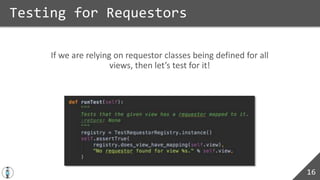
If we are relying on requestor classes being defined for all
views, then let’s test for it!
Testing for Requestors
16
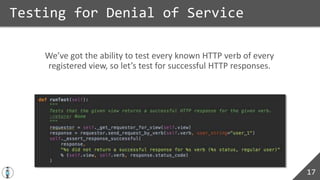
We’ve got the ability to test every known HTTP verb of every
registered view, so let’s test for successful HTTP responses.
Testing for Denial of Service
17
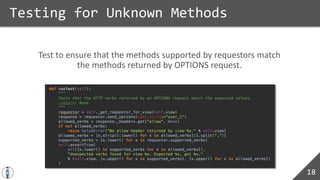
Test to ensure that the methods supported by requestors match
the methods returned by OPTIONS request.
Testing for Unknown Methods
18
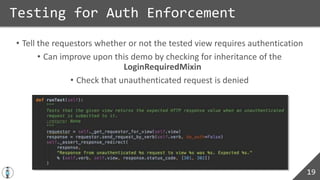
• Tell the requestors whether or not the tested view requires authentication
• Can improve upon this demo by checking for inheritance of the
LoginRequiredMixin
• Check that unauthenticated request is denied
Testing for Auth Enforcement
19
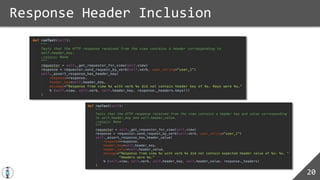
Response Header Inclusion
20
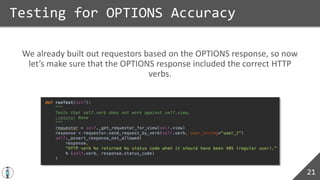
We already built out requestors based on the OPTIONS response, so now
let’s make sure that the OPTIONS response included the correct HTTP
verbs.
Testing for OPTIONS Accuracy
21
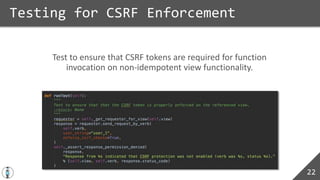
Test to ensure that CSRF tokens are required for function
invocation on non-idempotent view functionality.
Testing for CSRF Enforcement
22
• We now have guarantees that
• Our app contains no hidden
functionality
• All of our views are working as
intended given expected input
• Authentication is being properly
enforced
• Security headers are present
• CSRF is properly protected against
What Have We Gained?
23
• Those guarantees are great and all,
but can’t we just write individual
unit tests to test for them?
• In a development team we have
multiple people contributing code
all the time
• Through dynamic generation, these
tests will automatically be applied
to all new views, providing the
same guarantees to code that
hasn’t even been written yet
Why Dynamic Generation?
24
• Other things that we could write
dynamic tests for
• Rate-limiting
• Fuzzing of all input values to
POST/PUT/PATCH/DELETE
(introspection into forms used to
power the views)
• Proper updating, creation, and
deletion of new models based on
input data
Where Can We Go?
25
Testing Other Vulns
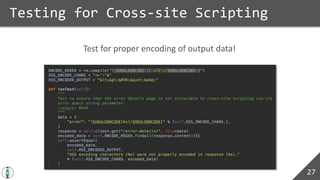
Test for proper encoding of output data!
Testing for Cross-site Scripting
27
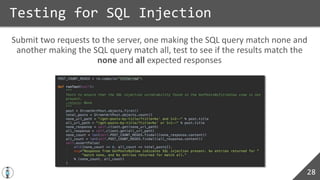
Submit two requests to the server, one making the SQL query match none and
another making the SQL query match all, test to see if the results match the
none and all expected responses
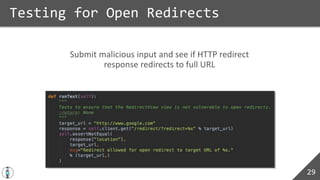
Testing for SQL Injection
28
Submit malicious input and see if HTTP redirect
response redirects to full URL
Testing for Open Redirects
29
Conclusion
• Initial overhead is greater than
writing individual unit tests, but
new views added to the application
also benefit from the tests
• Provide us with strong guarantees
about known application
functionality and basic HTTP-based
security controls
Benefits of Dynamic Generation
31
• Security guarantees now enforced
by CI/CD integration
• Test Driven Development? Great –
have your security testers write
failing unit tests that you then
incorporate into your test suite
• A new interface for how security
and development teams can work
together in harmony
Benefits of Sec. Unit Testing
32
• Security regression is a big problem
• We can use the development paradigm of regression testing to address
security regression
• Dynamic test generation can take us a long way
• Individual tests for individual cases further augment dynamic test generation
capabilities
Recap
33
• Security Unit Testing Project
https://github.com/lavalamp-/security-unit-testing
• Lavalamp’s Personal Blog
https://l.avala.mp/
• Django Web Framework
https://www.djangoproject.com/
Resources
34
THANK YOU!
@_lavalamp
chris [AT] websight [DOT] io
github.com/lavalamp-

Addressing Security Regression Through Unit Testing

  • 1.
    Security Regression Addressing SecurityRegression by Unit Testing Christopher Grayson @_lavalamp
  • 2.
  • 3.
    WHOAMI 3 • ATL • Webdevelopment • Academic researcher • Haxin’ all the things • (but I rlllly like networks) • Founder • Red team @_lavalamp
  • 4.
    • Security regressionis a huge problem • Lots of infrastructure built around regression testing already • Let’s leverage all of that existing infrastructure to improve application security posture at a minimal cost to development teams WHY’S DIS 4
  • 5.
    1. Background 2. DynamicSecurity Test Generation 3. Non-dynamic Security Test Generation 4. Conclusion Agenda 5
  • 6.
  • 7.
    • I’ve alwaysloved breaking into things, have been doing this professionally since 2012 • Go in, break app, help client with remediation, check that remediation worked – great! • Come back 3-6 months later and test again, same vulns are back (commonly in the same places) • Offensive testing is good at diagnosing - not solving A Bit More on Motivation… 7
  • 8.
    • Standard toolin any development team’s toolbox • Unit tests to ensure code does not regress to a prior state of instability • Lots of great tools (especially in the CI/CD chain) for ensuring tests are passing before deployment Regression Testing 8
  • 9.
    Why not takethe problem of security regression and use all of the tools already built for regression testing to improve the security posture of tested applications? Putting it All Together 9
  • 10.
    • Street ArtAround the World! • Written in Django (standard framework, no API, full post-back) • Same techniques work for any programming language and framework that support introspection • These examples require a framework that has explicit URL mapping The Demo Application 10 https://github.com/lavalamp-/security-unit-testing
  • 11.
  • 12.
    • Django requiresusers to write views and then explicitly map these views to URL routes where they are served from • Views come from a set of pre- defined base classes that support default functionality (UpdateView, DeleteView, DetailView, FormView, etc) Django Registered Routes 12
  • 13.
    • We canuse introspection to enumerate all of the views registered within an application • Now that we know the views, how can we support testing functionality that issues requests to all of the view functionality? • Enter the Requestor class Testing Registered Routes 13
  • 14.
    • Requestors mappedto views they are meant to send requests to via Python decorators • Singleton registry contains mapping of views to requestors • Importing all of the views automatically establishes all of the mappings Requestor Registry Architecture 14
  • 15.
    • We nowcan enumerate all of the views and access classes that are designed to submit requests to the views • With this capability we can dynamically generate test cases for all of the views in an application • Test cases take view classes and HTTP verbs as arguments to constructors Dynamic Test Generation 15
  • 16.
    If we arerelying on requestor classes being defined for all views, then let’s test for it! Testing for Requestors 16
  • 17.
    We’ve got theability to test every known HTTP verb of every registered view, so let’s test for successful HTTP responses. Testing for Denial of Service 17
  • 18.
    Test to ensurethat the methods supported by requestors match the methods returned by OPTIONS request. Testing for Unknown Methods 18
  • 19.
    • Tell therequestors whether or not the tested view requires authentication • Can improve upon this demo by checking for inheritance of the LoginRequiredMixin • Check that unauthenticated request is denied Testing for Auth Enforcement 19
  • 20.
  • 21.
    We already builtout requestors based on the OPTIONS response, so now let’s make sure that the OPTIONS response included the correct HTTP verbs. Testing for OPTIONS Accuracy 21
  • 22.
    Test to ensurethat CSRF tokens are required for function invocation on non-idempotent view functionality. Testing for CSRF Enforcement 22
  • 23.
    • We nowhave guarantees that • Our app contains no hidden functionality • All of our views are working as intended given expected input • Authentication is being properly enforced • Security headers are present • CSRF is properly protected against What Have We Gained? 23
  • 24.
    • Those guaranteesare great and all, but can’t we just write individual unit tests to test for them? • In a development team we have multiple people contributing code all the time • Through dynamic generation, these tests will automatically be applied to all new views, providing the same guarantees to code that hasn’t even been written yet Why Dynamic Generation? 24
  • 25.
    • Other thingsthat we could write dynamic tests for • Rate-limiting • Fuzzing of all input values to POST/PUT/PATCH/DELETE (introspection into forms used to power the views) • Proper updating, creation, and deletion of new models based on input data Where Can We Go? 25
  • 26.
  • 27.
    Test for properencoding of output data! Testing for Cross-site Scripting 27
  • 28.
    Submit two requeststo the server, one making the SQL query match none and another making the SQL query match all, test to see if the results match the none and all expected responses Testing for SQL Injection 28
  • 29.
    Submit malicious inputand see if HTTP redirect response redirects to full URL Testing for Open Redirects 29
  • 30.
  • 31.
    • Initial overheadis greater than writing individual unit tests, but new views added to the application also benefit from the tests • Provide us with strong guarantees about known application functionality and basic HTTP-based security controls Benefits of Dynamic Generation 31
  • 32.
    • Security guaranteesnow enforced by CI/CD integration • Test Driven Development? Great – have your security testers write failing unit tests that you then incorporate into your test suite • A new interface for how security and development teams can work together in harmony Benefits of Sec. Unit Testing 32
  • 33.
    • Security regressionis a big problem • We can use the development paradigm of regression testing to address security regression • Dynamic test generation can take us a long way • Individual tests for individual cases further augment dynamic test generation capabilities Recap 33
  • 34.
    • Security UnitTesting Project https://github.com/lavalamp-/security-unit-testing • Lavalamp’s Personal Blog https://l.avala.mp/ • Django Web Framework https://www.djangoproject.com/ Resources 34
  • 35.
    THANK YOU! @_lavalamp chris [AT]websight [DOT] io github.com/lavalamp-

Editor's Notes

  • #14 Show an example of a View (CreatePostView) Show the base requestor class (BaseRequestor) Show an implementation of a requestor class (CreatePostViewRequestor)
  • #15 Checkout HEAD of master branch (git checkout master) Show the registry class (TestRequestorRegistry) Show the decorator (requested_by in tests/registry.py) Show the add_mapping method in TestRequestorRegistry Show the implementation of requested_by (CreatePostView) Run the following code to show the mapping: python manage.py shell -c "from sectesting import urls; from streetart.tests import TestRequestorRegistry; registry = TestRequestorRegistry.instance(); registry.print_mappings()"
  • #16 Checkout HEAD of master branch (git checkout master) Show contents of build_suite method in StreetArtTestRunner Show contents of __get_requestor_class_tests in StreetArtTestRunner Show contents of url_patterns property in StreetArtTestRunner Point out the anonymous subclassing thing
  • #17 Ensure that TEST_FOR_REQUESTOR_CLASSES is the only True value in settings Check out tag v0.1 (git checkout tags/v0.1) Show contents of ViewHasRequestorTestCase Show contents of __get_requestor_class_tests in StreetArtTestRunner Comment out a requested_by on one of the views Run tests and show failing (python manage.py test) Uncomment out requested_by Run tests and show all passing
  • #18 Ensure that TEST_FOR_DENIAL_OF_SERVICE is the only True value in settings Check out tag v0.1 (git checkout tags/v0.1) Show contents of RegularViewRequestIsSuccessfulTestCase Show contents of ____get_dos_class_tests in StreetArtTestRunner Add raise PermissionDenied to EditPostView GET Run tests and show failing (python manage.py test) Remove the PermissionDenied raise Run tests and show passing (python manage.py test)
  • #19 Ensure that TEST_FOR_UNKNOWN_METHODS is the only True value in settings Check out tag v0.1 (git checkout tags/v0.1) Show contents of RegularUnknownMethodsTestCase Run tests and show failing (python manage.py test) Checkout the next tag (git checkout tags/v0.2) Show contents of DeletePostViewRequestor with new verbs Run tests and show passing (python manage.py test) Unknown functionality is a constant problem with web apps (especially in frameworks that provide significant amounts of functionality out of the box)
  • #20 Ensure that TEST_FOR_AUTHENTICATION_ENFORCEMENT is the only True value in settings Check out tag v0.3 (git checkout tags/v0.3) Show contents of AuthenticationEnforcementTestCase Run tests and show failing (python manage.py test) Checkout the next tag (git checkout tags/v0.4) Show contents of MyPostsListView with new auth check Run tests and show passing (python manage.py test)
  • #21 Ensure that TEST_FOR_RESPONSE_HEADERS is the only True value in settings Check out tag v0.5 (git checkout tags/v0.5) Ensure that streetart.middleware.SecurityHeadersMiddleware is commented out in settings.py Show contents of HeaderKeyExistsTestCase and HeaderValueAccurateTestCase Run tests and show failing (python manage.py test) Checkout the next tag (git checkout tags/v0.6) Uncomment streetart.middleware.SecurityHeadersMiddleware in settings.py Run tests and show passing (python manage.py test)
  • #22 Ensure that TEST_FOR_OPTIONS_ACCURACYis the only True value in settings Check out tag v0.9 (git checkout tags/v0.9) Show contents of RegularVerbNotSupportedTestCase and AdminVerbNotSupportedTestCase Show contents of MyPostsListView trace method Run tests and show failing (python manage.py test) Checkout the next tag (git checkout tags/v0.10) Show contents of MyPostsListView Run tests and show passing (python manage.py test)
  • #23 Ensure that TEST_FOR_CSRF_ENFORCEMENT is the only True value in settings Check out tag v0.11 (git checkout tags/v0.11) Show contents of CsrfEnforcementTestCase Show contents of CreatePostView with reference to csrf_exempt Run tests and show failing (python manage.py test) Checkout the next tag (git checkout tags/v0.12) Show contents of CreatePostView with no reference to csrf_exempt Run tests and show passing (python manage.py test) Just because CSRF values are present doesn’t mean they are properly enforced
  • #25 Ensure that all test cases are enabled Check out tag v0.15 (git checkout tags/v0.15) Show contents of NewCreatePostView Run tests and show failing (python manage.py test) Talk about how author neglected to add requestor Checkout the next tag (git checkout tags/v0.16) Show that requestor has been added to NewCreatePostView Run tests and show failing (python manage.py test)
  • #28 Check out tag v0.13 (git checkout tags/v0.13) Show contents of ErrorDetailsXSSTestCase Show contents of error_details.html and point out |safe pipe Run tests and show failing (python manage.py test) Checkout the next tag (git checkout tags/v0.14) Show contents of error_details.html and point out lack of pipe Run tests and show failing (python manage.py test)
  • #29 Check out tag v0.19 (git checkout tags/v0.19) Show contents of SQLInjectionGetPostsByViewTestCase Show contents of GetPostsByTitleView Run tests and show failing (python manage.py test) Checkout the next tag (git checkout tags/v0.20) Show contents of GetPostsByTitleView and point out parameter binding Run tests and show failing (python manage.py test)
  • #30 Check out tag v0.21 (git checkout tags/v0.21) Show contents of RedirectViewTestCase Show contents of RedirectView Run tests and show failing (python manage.py test) Checkout the next tag (git checkout tags/v0.21) Show contents of RedirectView and point out parameter sanitization Run tests and show failing (python manage.py test)