RDF and the Semantic WebRDF and the Semantic Web
Joanna PszenicynJoanna Pszenicyn
What we already know
● RDF is a resource description that computers
can “understand”
● RDF uses XML
● Like XML, it is a metalanguage
(defines syntax only, not semantics)
● RDF & OWL (Web Ontology Language)
are building blocks for the Semantic Web
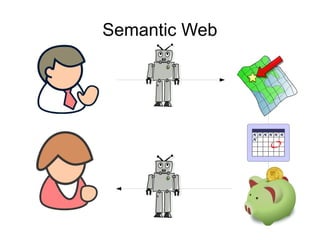
Semantic Web
Semantic Web
“The Semantic Web is a mesh of information
linked up in such a way as to be easily
processable by machines, on a global scale.
You can think of it as being an efficient way of
representing data on the WWW, or as a globally
linked database.”
Sean Palmer, The Semantic Web: an Introduction
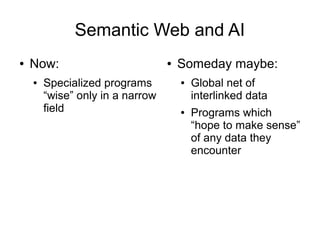
Semantic Web and AI
● Now:
● Specialized programs
“wise” only in a narrow
field
● Someday maybe:
● Global net of
interlinked data
● Programs which
“hope to make sense”
of any data they
encounter
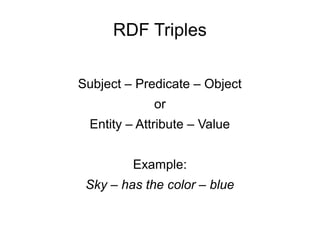
RDF Triples
Subject – Predicate – Object
or
Entity – Attribute – Value
Example:
Sky – has the color – blue
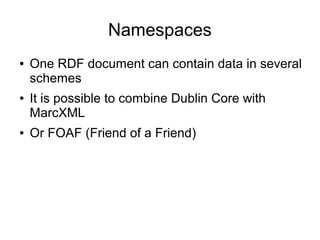
Namespaces
● One RDF document can contain data in several
schemes
● It is possible to combine Dublin Core with
MarcXML
● Or FOAF (Friend of a Friend)
Examples
● VIAF – Virtual Authority File:
http://viaf.org/
● LoC Linked Data Service:
http://id.loc.gov/
Pros & Cons
Pros: Anything that facilitates the interchange
of metadata is a good thing. RDF is a flexible
and extensible framework that could potentially
be used in a wide variety of applications. It
facilitates interoperability between Web-based
applications involving the exchange of
machine-readable information.
Pros & Cons
Cons: Some have described the syntax as
clunky, and physically ugly to look at. There is
relatively limited tool support at this time,
compared to what is available for, say, plain
vanilla XML. At least one XML guru feels that the
level of abstraction is so high that RDF is all but
unusable by the vast majority of developers. (See
"RDF and other monkey wrenches" by Sean
McGrath, http://www.itworld.com/nl/ebiz%5fent/03182003.)
Kennedy, Shirl. 2004. RDF. Computers in Libraries
Bibliography
Berners-Lee, Tim; James Hendler, and Ora Lassila. 2001.
The Semantic Web. Scientific American 2001 (5).
Gradmann, Stefan. 2005. rdfs:frbr--Towards an Implementation 
Model for Library Catalogs Using Semantic Web Technology.
Cataloging & Classification Quarterly. 2005, Vol. 39 Issue 3/4, p. 63–
75.
Jul, Erik. MARC and Mark-Up. Cataloging & Classification Quarterly.
2003, Vol. 36 Issue 3/4, p.141.
Kennedy, Shirl. 2004. RDF. Computers in Libraries, 2004, Vol. 24,
Issue 2.
McGrath, Sean. 2003. RDF and other monkey wrenches. ITworld.
Available at:
http://www.itworld.com/nl/ebiz_ent/03182003
Singer, Ross. Linked Library Data Now! Journal of Electronic
Resources Librarianship. 2009, Vol. 21, Issue 2, p. 114–126.
Thank YouThank You
For Your AttentionFor Your Attention
Joanna PszenicynJoanna Pszenicyn
j.pszenicyn@student.uw.edu.plj.pszenicyn@student.uw.edu.pl

RDF and the Semantic Web -- Joanna Pszenicyn

  • 1.
    RDF and theSemantic WebRDF and the Semantic Web Joanna PszenicynJoanna Pszenicyn
  • 2.
    What we alreadyknow ● RDF is a resource description that computers can “understand” ● RDF uses XML ● Like XML, it is a metalanguage (defines syntax only, not semantics) ● RDF & OWL (Web Ontology Language) are building blocks for the Semantic Web
  • 3.
  • 4.
    Semantic Web “The SemanticWeb is a mesh of information linked up in such a way as to be easily processable by machines, on a global scale. You can think of it as being an efficient way of representing data on the WWW, or as a globally linked database.” Sean Palmer, The Semantic Web: an Introduction
  • 5.
    Semantic Web andAI ● Now: ● Specialized programs “wise” only in a narrow field ● Someday maybe: ● Global net of interlinked data ● Programs which “hope to make sense” of any data they encounter
  • 6.
    RDF Triples Subject –Predicate – Object or Entity – Attribute – Value Example: Sky – has the color – blue
  • 7.
    Namespaces ● One RDFdocument can contain data in several schemes ● It is possible to combine Dublin Core with MarcXML ● Or FOAF (Friend of a Friend)
  • 8.
    Examples ● VIAF –Virtual Authority File: http://viaf.org/ ● LoC Linked Data Service: http://id.loc.gov/
  • 9.
    Pros & Cons Pros:Anything that facilitates the interchange of metadata is a good thing. RDF is a flexible and extensible framework that could potentially be used in a wide variety of applications. It facilitates interoperability between Web-based applications involving the exchange of machine-readable information.
  • 10.
    Pros & Cons Cons:Some have described the syntax as clunky, and physically ugly to look at. There is relatively limited tool support at this time, compared to what is available for, say, plain vanilla XML. At least one XML guru feels that the level of abstraction is so high that RDF is all but unusable by the vast majority of developers. (See "RDF and other monkey wrenches" by Sean McGrath, http://www.itworld.com/nl/ebiz%5fent/03182003.) Kennedy, Shirl. 2004. RDF. Computers in Libraries
  • 11.
    Bibliography Berners-Lee, Tim; JamesHendler, and Ora Lassila. 2001. The Semantic Web. Scientific American 2001 (5). Gradmann, Stefan. 2005. rdfs:frbr--Towards an Implementation  Model for Library Catalogs Using Semantic Web Technology. Cataloging & Classification Quarterly. 2005, Vol. 39 Issue 3/4, p. 63– 75. Jul, Erik. MARC and Mark-Up. Cataloging & Classification Quarterly. 2003, Vol. 36 Issue 3/4, p.141. Kennedy, Shirl. 2004. RDF. Computers in Libraries, 2004, Vol. 24, Issue 2. McGrath, Sean. 2003. RDF and other monkey wrenches. ITworld. Available at: http://www.itworld.com/nl/ebiz_ent/03182003 Singer, Ross. Linked Library Data Now! Journal of Electronic Resources Librarianship. 2009, Vol. 21, Issue 2, p. 114–126.
  • 12.