Richard Sapon-White
     March 11, 2013
Scheme:

A set of metadata elements and the rules for their
 use that have been defined for a particular
 purpose


                                                     2
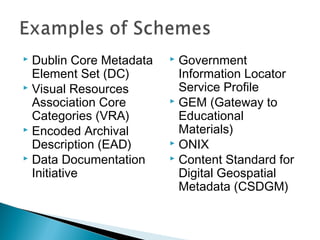
 Dublin Core Metadata    Government
  Element Set (DC)         Information Locator
 Visual Resources         Service Profile
  Association Core        GEM (Gateway to
  Categories (VRA)         Educational
 Encoded Archival         Materials)
  Description (EAD)       ONIX
 Data Documentation      Content Standard for
  Initiative               Digital Geospatial
                           Metadata (CSDGM)


                                                  3
 Semantics – meanings of metadata elements
 Content rules – selection and representation of

  metadata element content
 Syntax – encoding of elements


                                                    4
 AACR2 specifies element names and definitions
  (e.g., author, other title information, publisher)
  [semantics]
 AACR2 also specifies content rules (e.g.,

  selection and representation of author names)
 ISBD and MARC specify syntax

    ◦ 245 $a Title : $b other title information / $c author.


                                                               5
   Some schemes can accommodate multiple
    content standards
    Examples:
       DC + DACS + LCSH
       DC + AACR2 + LCSH
       MARC + AACR2 + MeSH
 Documenting the creation, version, and reuse of
  information resources
 Organization and description
 Validation – documenting the authoritativeness or

  trustworthiness of the information resource
 Search and retrieval
 Utilization and preservation
 Accessioning and deaccessioning
   Is metadata always digital?
    ◦ No. Metadata can also exists in paper form.
   Is metadata always descriptive?
    ◦ No. Metadata can also record the creation,
      management, preservation, and history of an
      information resource.
   True or False: Metadata for a given information resource can
    come from many sources.
    ◦ True.
   True or False: Metadata accrues during the life of a digital
    object.
    ◦ True.
   True or False: Metadata is not data and data is not metadata.
    ◦ False. “The distinctions between what constitutes data
      and what constitutes metadata can often be very fluid.”
 Increased accessibility
 Retention of context

 Expanding use

 Learning metadata

 System development and enhancement

 Multiversioning

 Legal issues

 Preservation and persistence
   High quality descriptive metadata…
    ◦ Enhances retrieval
    ◦ Enables searching across multiple collections
    ◦ Enables creation of virtual collections
 Especially possible when common elements are
  present in different metadata schemes
 Example: OSU’s conversion of EAD/DACS-based

  finding aids to MARC bibliographic records (M.
  Elwood Smith papers)
  http://oasis.oregonstate.edu/
 Metadata can document the relationships that an
  information resource has with people, places, and
  things, including other information resources
 Example: Archival finding aids can indicate other

  related collections as well as the structure of
  within a collection, providing context for users
 Provides access to the entire universe of users,
  wherever they are
 Enables the manipulation of the information

  resource for users with special needs, different
  language skills, etc.
 Specialized forms of metadata can be used to
  promote learning by students of all ages.
 Example: http://

  www.thegateway.org/browse/20651
 Metadata can document changing uses of
  systems and content
 In turn, can use this feedback to make systems

  development decisions
 Examples: search log data, download counts, etc.
 A digital object may exist in several forms within a
  resource, such a images in thumbnail and full-size
 Metadata enables users and machines to

  distinguish between the multiple versions of a
  resource
   Metadata documents:
    ◦   Licensing
    ◦   Legal rights
    ◦   Reproductions
    ◦   Restrictions on access or use
    ◦   Privacy concerns
   Technical, descriptive, and preservation metadata
    ◦ Document how an information resource was:
      created,
      maintained,
      how it relates to other information objects

Metadata lecture 3, metadata schemes

  • 1.
    Richard Sapon-White March 11, 2013
  • 2.
    Scheme: A set ofmetadata elements and the rules for their use that have been defined for a particular purpose 2
  • 3.
     Dublin CoreMetadata  Government Element Set (DC) Information Locator  Visual Resources Service Profile Association Core  GEM (Gateway to Categories (VRA) Educational  Encoded Archival Materials) Description (EAD)  ONIX  Data Documentation  Content Standard for Initiative Digital Geospatial Metadata (CSDGM) 3
  • 4.
     Semantics –meanings of metadata elements  Content rules – selection and representation of metadata element content  Syntax – encoding of elements 4
  • 5.
     AACR2 specifieselement names and definitions (e.g., author, other title information, publisher) [semantics]  AACR2 also specifies content rules (e.g., selection and representation of author names)  ISBD and MARC specify syntax ◦ 245 $a Title : $b other title information / $c author. 5
  • 6.
    Some schemes can accommodate multiple content standards Examples: DC + DACS + LCSH DC + AACR2 + LCSH MARC + AACR2 + MeSH
  • 7.
     Documenting thecreation, version, and reuse of information resources  Organization and description  Validation – documenting the authoritativeness or trustworthiness of the information resource  Search and retrieval  Utilization and preservation  Accessioning and deaccessioning
  • 8.
    Is metadata always digital? ◦ No. Metadata can also exists in paper form.  Is metadata always descriptive? ◦ No. Metadata can also record the creation, management, preservation, and history of an information resource.  True or False: Metadata for a given information resource can come from many sources. ◦ True.
  • 9.
    True or False: Metadata accrues during the life of a digital object. ◦ True.  True or False: Metadata is not data and data is not metadata. ◦ False. “The distinctions between what constitutes data and what constitutes metadata can often be very fluid.”
  • 10.
     Increased accessibility Retention of context  Expanding use  Learning metadata  System development and enhancement  Multiversioning  Legal issues  Preservation and persistence
  • 11.
    High quality descriptive metadata… ◦ Enhances retrieval ◦ Enables searching across multiple collections ◦ Enables creation of virtual collections  Especially possible when common elements are present in different metadata schemes  Example: OSU’s conversion of EAD/DACS-based finding aids to MARC bibliographic records (M. Elwood Smith papers) http://oasis.oregonstate.edu/
  • 12.
     Metadata candocument the relationships that an information resource has with people, places, and things, including other information resources  Example: Archival finding aids can indicate other related collections as well as the structure of within a collection, providing context for users
  • 13.
     Provides accessto the entire universe of users, wherever they are  Enables the manipulation of the information resource for users with special needs, different language skills, etc.
  • 14.
     Specialized formsof metadata can be used to promote learning by students of all ages.  Example: http:// www.thegateway.org/browse/20651
  • 15.
     Metadata candocument changing uses of systems and content  In turn, can use this feedback to make systems development decisions  Examples: search log data, download counts, etc.
  • 16.
     A digitalobject may exist in several forms within a resource, such a images in thumbnail and full-size  Metadata enables users and machines to distinguish between the multiple versions of a resource
  • 17.
    Metadata documents: ◦ Licensing ◦ Legal rights ◦ Reproductions ◦ Restrictions on access or use ◦ Privacy concerns
  • 18.
    Technical, descriptive, and preservation metadata ◦ Document how an information resource was:  created,  maintained,  how it relates to other information objects

Editor's Notes

  • #3 Starting point is really the “particular purpose”. After reading slide: Do you know of any metadata schemes?