Deriving an Emergent Relational Schema
from RDF Data
Minh-Duc Pham Linnea Passing Orri Erling Peter Boncz
duc@cwi.nl linnea.passing@tum.de oerling@openlinksw.com boncz@cwi.nl
 Bad query plans
 Low storage locality
 Lack of user schema insight
Main Problems in RDF Data Management [1]
[1] Minh-Duc Pham, Boncz P.A., " Self-organizing Structured RDF in MonetDB ," PhD Symposium, ICDE, 2013
RDF de-emphasizes the need for a schema
and the notion of structure in the data
Emergent Schema
Emergent schema = “rough” schema to which the majority of triples conforms
Recognize:
 Classes (Characteristic Sets - CS’s ) – recognize “classes” of often co-occurring properties
 Relationships (CS) – recognize often-occurring references between such classes
+ give logical names to these
<http://www.w3.org/1999/02/22-rdf-syntax-ns#type>
<http://rdfs.org/sioc/ns#num_replies>
<http://purl.org/dc/terms/title>
<http://rdfs.org/sioc/ns#has_creator>
<http://purl.org/dc/terms/date>
<http://purl.org/dc/terms/created>
<http://purl.org/rss/1.0/modules/content/encoded>
<http://www.w3.org/1999/02/22-rdf-syntax-ns#type>
<http://xmlns.com/foaf/0.1/name>
<http://xmlns.com/foaf/0.1/page>
<has_creator>
“Book”
Recovering the Emergent Schema of RDF data
“Author”
inproc1
creator
inproceeding
author4
inproc2
type
inproceeding
author2
“BBB”
inproc3
inproceeding
author3
“CCC”
conf1
conf2
Conference
“conference1”
“2010”
webpage1
ID type creator title partOf
inproc1 inproceeding {author3,
author4}
“AAA” conf1
inproc2 inproceeding author2 “BBB” conf1
inproc3 inproceeding author3 “CCC” conf2
ID type title issued
conf1 Conference “conference1” 2010
conf2 Proceedings “conference2” 2011
Foreign Key Relationship
Irregularity
conf2
“content.php”
“Table Cont.”
“index.php”
“index.php”
“content.php”
Original RDF graph Self-organizing RDF representation
Example of structure recognized from RDF graph
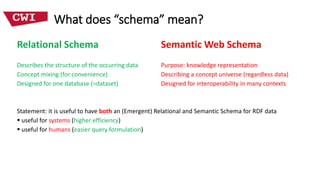
Relational Schema Semantic Web Schema
Describes the structure of the occurring data Purpose: knowledge representation
Concept mixing (for convenience) Describing a concept universe (regardless data)
Designed for one database (=dataset) Designed for interoperability in many contexts
Statement: it is useful to have both an (Emergent) Relational and Semantic Schema for RDF data
 useful for systems (higher efficiency)
 useful for humans (easier query formulation)
What does “schema” mean?
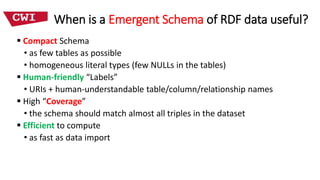
 Compact Schema
• as few tables as possible
• homogeneous literal types (few NULLs in the tables)
 Human-friendly “Labels”
• URIs + human-understandable table/column/relationship names
 High “Coverage”
• the schema should match almost all triples in the dataset
 Efficient to compute
• as fast as data import
When is a Emergent Schema of RDF data useful?
Basic CS
discovery
Characteristic Sets in some well-known RDF datasets
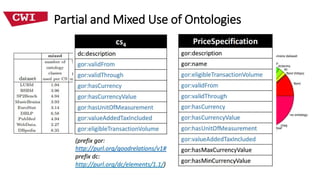
Partial and Mixed Use of Ontologies
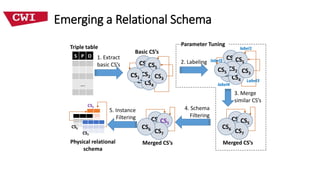
Emerging a Relational Schema
CS2
CS2
S P O
...
1. Extract
basic CS’s
4. Schema
Filtering
Triple table
3. Merge
similar CS’s
5. Instance
Filtering
Physical relational
schema
Basic CS’s
CS4
CS0CS5
CS2 CS3
CS1
label1
label4
label5
Label3
CS4
CS0CS5
CS2 CS3
CS5
Merged CS’s
CS0CS5
CS7
CS6
CS6
CS7
CS5
Merged CS’s
CS0CS5
CS7
CS6
2. Labeling
Parameter Tuning
Results: compact schemas with high coverage
Results: understandable labels & performance
Likert Score: 1=bad ….. 5=excellent
Deriving an Emergent Relational Schema from RDF Data

Deriving an Emergent Relational Schema from RDF Data

  • 1.
    Deriving an EmergentRelational Schema from RDF Data Minh-Duc Pham Linnea Passing Orri Erling Peter Boncz duc@cwi.nl linnea.passing@tum.de oerling@openlinksw.com boncz@cwi.nl
  • 2.
     Bad queryplans  Low storage locality  Lack of user schema insight Main Problems in RDF Data Management [1] [1] Minh-Duc Pham, Boncz P.A., " Self-organizing Structured RDF in MonetDB ," PhD Symposium, ICDE, 2013 RDF de-emphasizes the need for a schema and the notion of structure in the data Emergent Schema
  • 3.
    Emergent schema =“rough” schema to which the majority of triples conforms Recognize:  Classes (Characteristic Sets - CS’s ) – recognize “classes” of often co-occurring properties  Relationships (CS) – recognize often-occurring references between such classes + give logical names to these <http://www.w3.org/1999/02/22-rdf-syntax-ns#type> <http://rdfs.org/sioc/ns#num_replies> <http://purl.org/dc/terms/title> <http://rdfs.org/sioc/ns#has_creator> <http://purl.org/dc/terms/date> <http://purl.org/dc/terms/created> <http://purl.org/rss/1.0/modules/content/encoded> <http://www.w3.org/1999/02/22-rdf-syntax-ns#type> <http://xmlns.com/foaf/0.1/name> <http://xmlns.com/foaf/0.1/page> <has_creator> “Book” Recovering the Emergent Schema of RDF data “Author”
  • 4.
    inproc1 creator inproceeding author4 inproc2 type inproceeding author2 “BBB” inproc3 inproceeding author3 “CCC” conf1 conf2 Conference “conference1” “2010” webpage1 ID type creatortitle partOf inproc1 inproceeding {author3, author4} “AAA” conf1 inproc2 inproceeding author2 “BBB” conf1 inproc3 inproceeding author3 “CCC” conf2 ID type title issued conf1 Conference “conference1” 2010 conf2 Proceedings “conference2” 2011 Foreign Key Relationship Irregularity conf2 “content.php” “Table Cont.” “index.php” “index.php” “content.php” Original RDF graph Self-organizing RDF representation Example of structure recognized from RDF graph
  • 5.
    Relational Schema SemanticWeb Schema Describes the structure of the occurring data Purpose: knowledge representation Concept mixing (for convenience) Describing a concept universe (regardless data) Designed for one database (=dataset) Designed for interoperability in many contexts Statement: it is useful to have both an (Emergent) Relational and Semantic Schema for RDF data  useful for systems (higher efficiency)  useful for humans (easier query formulation) What does “schema” mean?
  • 6.
     Compact Schema •as few tables as possible • homogeneous literal types (few NULLs in the tables)  Human-friendly “Labels” • URIs + human-understandable table/column/relationship names  High “Coverage” • the schema should match almost all triples in the dataset  Efficient to compute • as fast as data import When is a Emergent Schema of RDF data useful?
  • 7.
  • 8.
    Characteristic Sets insome well-known RDF datasets
  • 9.
    Partial and MixedUse of Ontologies
  • 10.
    Emerging a RelationalSchema CS2 CS2 S P O ... 1. Extract basic CS’s 4. Schema Filtering Triple table 3. Merge similar CS’s 5. Instance Filtering Physical relational schema Basic CS’s CS4 CS0CS5 CS2 CS3 CS1 label1 label4 label5 Label3 CS4 CS0CS5 CS2 CS3 CS5 Merged CS’s CS0CS5 CS7 CS6 CS6 CS7 CS5 Merged CS’s CS0CS5 CS7 CS6 2. Labeling Parameter Tuning
  • 11.
    Results: compact schemaswith high coverage
  • 12.
    Results: understandable labels& performance Likert Score: 1=bad ….. 5=excellent