An Introduction to Linked Data
        and Microdata
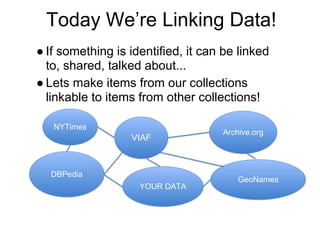
Today We’re Linking Data!
● If something is identified, it can be linked
  to, shared, talked about...
● Lets make items from our collections
  linkable to items from other collections!

   NYTimes
                                    Archive.org
                  VIAF


  DBPedia
                                        GeoNames
                    YOUR DATA
The goal of Linked Data is
to enable people to share
structured (information) on
the Web as easily as they
share documents today.
Bizer/Cyganiak/Heath Linked Data Tutorial, linkeddata.org
Adrian Stevensen, UK Web Archives
Linked Data Design Issues

  ● URIs
  ● LD Design Issues
  ● Triples


http://www.w3.org/DesignIssues/LinkedData.
“The Graph” as an
  Organizational Data Model


Linked Data includes a paradigm shift from the relational or
hierarchical means of modelling data to a graph based model…
Resource Description Format (RDF)
● RDF = defined statements comprising a
  subject, a predicate (property), and an
  object. These statements are called
  “Triples”.
Triples for Humans
● Triples are statements that describe
  relationships or links between things
   ○


  The New York   dc:publisher
     Times       Is a Publisher of   News Articles


    Dave           (foaf:member)      The Dave
   Matthews        Is Member of       Matthews
                                        Band
Triples for Machines
Triples can be serialized in many different
ways including
 ●   Resource Description Format
 ●   RDF/XML
 ●   RDFa
 ●   N3
 ●   Turtle
 ●   etc.
but they all describe things in the
<subject><predicate><object> format

Description Formats must be consistent and
Assigning Meaning to Your Data
RDF doesn't offer any means to record semantics or meaning.
LOD vocabularies and ontologies provide a framework for
determining how we organize information and how we agree on
predicates…

 ● RDF Schema (RDFS)
 ● Ontologies: FOAF, VIAF, OWL (Web Ontology Language), etc.
 ● Schema.org/Microdata/RDFa 1.1
Machine Access/Querying Your Data
SPARQL –provides a formal language with which to
ask meaning-driven questions of RDF data sets
Attribution and CC License
  ● Sections of this presentation adapted from materials
    created by other participants in the LOD-LAM
    Community
  ● This presentation available under creative commons
    Non Commercial-Share Alike:
http://creativecommons.org/licenses/by-nc/2.0/

An Introduction to Linked Data and Microdata

  • 1.
    An Introduction toLinked Data and Microdata
  • 2.
    Today We’re LinkingData! ● If something is identified, it can be linked to, shared, talked about... ● Lets make items from our collections linkable to items from other collections! NYTimes Archive.org VIAF DBPedia GeoNames YOUR DATA
  • 3.
    The goal ofLinked Data is to enable people to share structured (information) on the Web as easily as they share documents today. Bizer/Cyganiak/Heath Linked Data Tutorial, linkeddata.org Adrian Stevensen, UK Web Archives
  • 4.
    Linked Data DesignIssues ● URIs ● LD Design Issues ● Triples http://www.w3.org/DesignIssues/LinkedData.
  • 5.
    “The Graph” asan Organizational Data Model Linked Data includes a paradigm shift from the relational or hierarchical means of modelling data to a graph based model…
  • 6.
    Resource Description Format(RDF) ● RDF = defined statements comprising a subject, a predicate (property), and an object. These statements are called “Triples”.
  • 7.
    Triples for Humans ●Triples are statements that describe relationships or links between things ○ The New York dc:publisher Times Is a Publisher of News Articles Dave (foaf:member) The Dave Matthews Is Member of Matthews Band
  • 8.
    Triples for Machines Triplescan be serialized in many different ways including ● Resource Description Format ● RDF/XML ● RDFa ● N3 ● Turtle ● etc. but they all describe things in the <subject><predicate><object> format Description Formats must be consistent and
  • 9.
    Assigning Meaning toYour Data RDF doesn't offer any means to record semantics or meaning. LOD vocabularies and ontologies provide a framework for determining how we organize information and how we agree on predicates… ● RDF Schema (RDFS) ● Ontologies: FOAF, VIAF, OWL (Web Ontology Language), etc. ● Schema.org/Microdata/RDFa 1.1
  • 10.
    Machine Access/Querying YourData SPARQL –provides a formal language with which to ask meaning-driven questions of RDF data sets
  • 11.
    Attribution and CCLicense ● Sections of this presentation adapted from materials created by other participants in the LOD-LAM Community ● This presentation available under creative commons Non Commercial-Share Alike: http://creativecommons.org/licenses/by-nc/2.0/