A pragmatic glossary of Semantic Technology termsAll rights reserved by ©www.tenforce.comTerminology
LODLinked Open DataAn initiative to open up your data, publish them according to semantic web standards and link them to other sources. This leads to a web of data, as compared to the current web of documents. The semantic web is actually a virtual database, no longer a virtual library...
LOD2An FP7-project to develop the infrastructure that is needed to build LOD, or the data web. Kicked-off in September 2010, for 4 years.Check the status of the project at lod2.eu
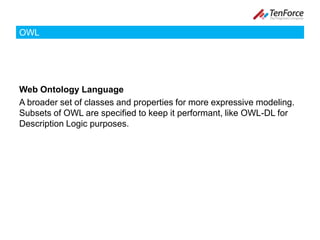
OWLWeb Ontology LanguageA broader set of classes and properties for more expressive modeling. Subsets of OWL are specified to keep it performant, like OWL-DL for Description Logic purposes.
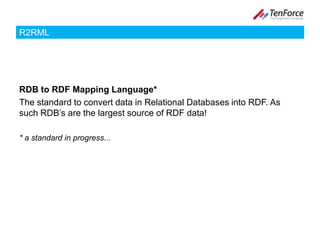
R2RMLRDB to RDF Mapping Language*The standard to convert data in Relational Databases into RDF. As such RDB’s are the largest source of RDF data!* a standard in progress...
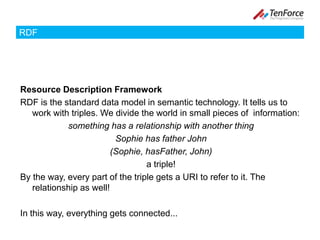
RDFResource Description FrameworkRDF is the standard datamodel in semantic technology. It tells us to work with triples. We divide the world in small pieces of  information:something has a relationship with another thingSophie has father John(Sophie, hasFather, John)a triple!By the way, every part of the triple gets a URI to refer to it. The relationship as well!In this way, everything gets connected...
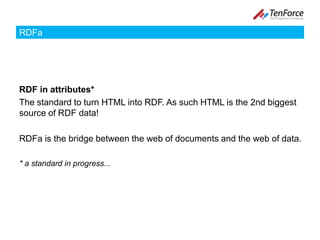
RDFaRDF in attributes*The standard to turn HTML into RDF. As such HTML is the 2nd biggest source of RDF data! RDFa is the bridge between the web of documents and the web of data.* a standard in progress...
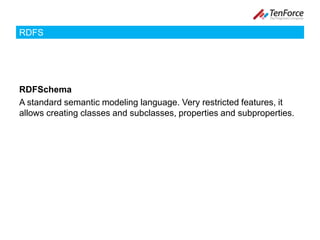
RDFSRDFSchemaA standard semantic modeling language. Very restricted features, it allows creating classes and subclasses, properties and subproperties.
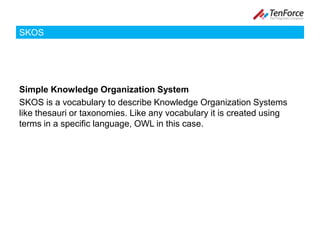
SKOSSimple Knowledge Organization SystemSKOS is a vocabulary to describe Knowledge Organization Systems like thesauri or taxonomies. Like any vocabulary it is created using terms in a specific language, OWL in this case.
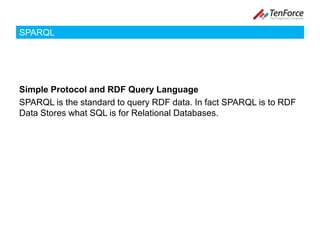
SPARQLSimple Protocol and RDF Query LanguageSPARQL is the standard to query RDF data. In fact SPARQL is to RDF Data Stores what SQL is for Relational Databases.
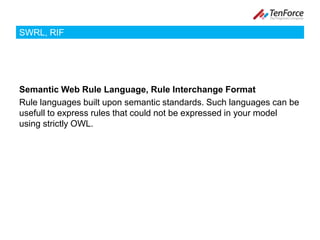
SWRL, RIFSemantic Web Rule Language, Rule Interchange FormatRule languages built upon semantic standards. Such languages can be usefull to express rules that could not be expressed in your model using strictly OWL.
URIUniform Resource IdentifierURI’s are used to identify the smallest pieces of information that we want to refer to.[ URI’s were created in the early 90’s as a way to express names and addresses of objects on the world wide web. On the semantic web we recycle this standard].12
ontology“theory about the nature of being”Literally ‘ontology’ means the study of being. It is a common term in filosophy and psychology since centuries. In a semantic technology context ‘ontology’ refers to the model typically used to capture the meaning of data. It is a representation of the knowledge domain you’re working in. Can be expressed in SKOS, OWL or RDFS.

Services semantic technology_terminology

  • 1.
    A pragmatic glossaryof Semantic Technology termsAll rights reserved by ©www.tenforce.comTerminology
  • 2.
    LODLinked Open DataAninitiative to open up your data, publish them according to semantic web standards and link them to other sources. This leads to a web of data, as compared to the current web of documents. The semantic web is actually a virtual database, no longer a virtual library...
  • 3.
    LOD2An FP7-project todevelop the infrastructure that is needed to build LOD, or the data web. Kicked-off in September 2010, for 4 years.Check the status of the project at lod2.eu
  • 4.
    OWLWeb Ontology LanguageAbroader set of classes and properties for more expressive modeling. Subsets of OWL are specified to keep it performant, like OWL-DL for Description Logic purposes.
  • 5.
    R2RMLRDB to RDFMapping Language*The standard to convert data in Relational Databases into RDF. As such RDB’s are the largest source of RDF data!* a standard in progress...
  • 6.
    RDFResource Description FrameworkRDFis the standard datamodel in semantic technology. It tells us to work with triples. We divide the world in small pieces of information:something has a relationship with another thingSophie has father John(Sophie, hasFather, John)a triple!By the way, every part of the triple gets a URI to refer to it. The relationship as well!In this way, everything gets connected...
  • 7.
    RDFaRDF in attributes*Thestandard to turn HTML into RDF. As such HTML is the 2nd biggest source of RDF data! RDFa is the bridge between the web of documents and the web of data.* a standard in progress...
  • 8.
    RDFSRDFSchemaA standard semanticmodeling language. Very restricted features, it allows creating classes and subclasses, properties and subproperties.
  • 9.
    SKOSSimple Knowledge OrganizationSystemSKOS is a vocabulary to describe Knowledge Organization Systems like thesauri or taxonomies. Like any vocabulary it is created using terms in a specific language, OWL in this case.
  • 10.
    SPARQLSimple Protocol andRDF Query LanguageSPARQL is the standard to query RDF data. In fact SPARQL is to RDF Data Stores what SQL is for Relational Databases.
  • 11.
    SWRL, RIFSemantic WebRule Language, Rule Interchange FormatRule languages built upon semantic standards. Such languages can be usefull to express rules that could not be expressed in your model using strictly OWL.
  • 12.
    URIUniform Resource IdentifierURI’sare used to identify the smallest pieces of information that we want to refer to.[ URI’s were created in the early 90’s as a way to express names and addresses of objects on the world wide web. On the semantic web we recycle this standard].12
  • 13.
    ontology“theory about thenature of being”Literally ‘ontology’ means the study of being. It is a common term in filosophy and psychology since centuries. In a semantic technology context ‘ontology’ refers to the model typically used to capture the meaning of data. It is a representation of the knowledge domain you’re working in. Can be expressed in SKOS, OWL or RDFS.