Cryptographic Hash Functions
01204427
June 2012
Topics
 Overview of Cryptography Hash Function
 Usages
 Properties
 Hashing Function Structure
 Attack on Hash Function
 The Road to new Secure Hash Standard
3
Hash Function
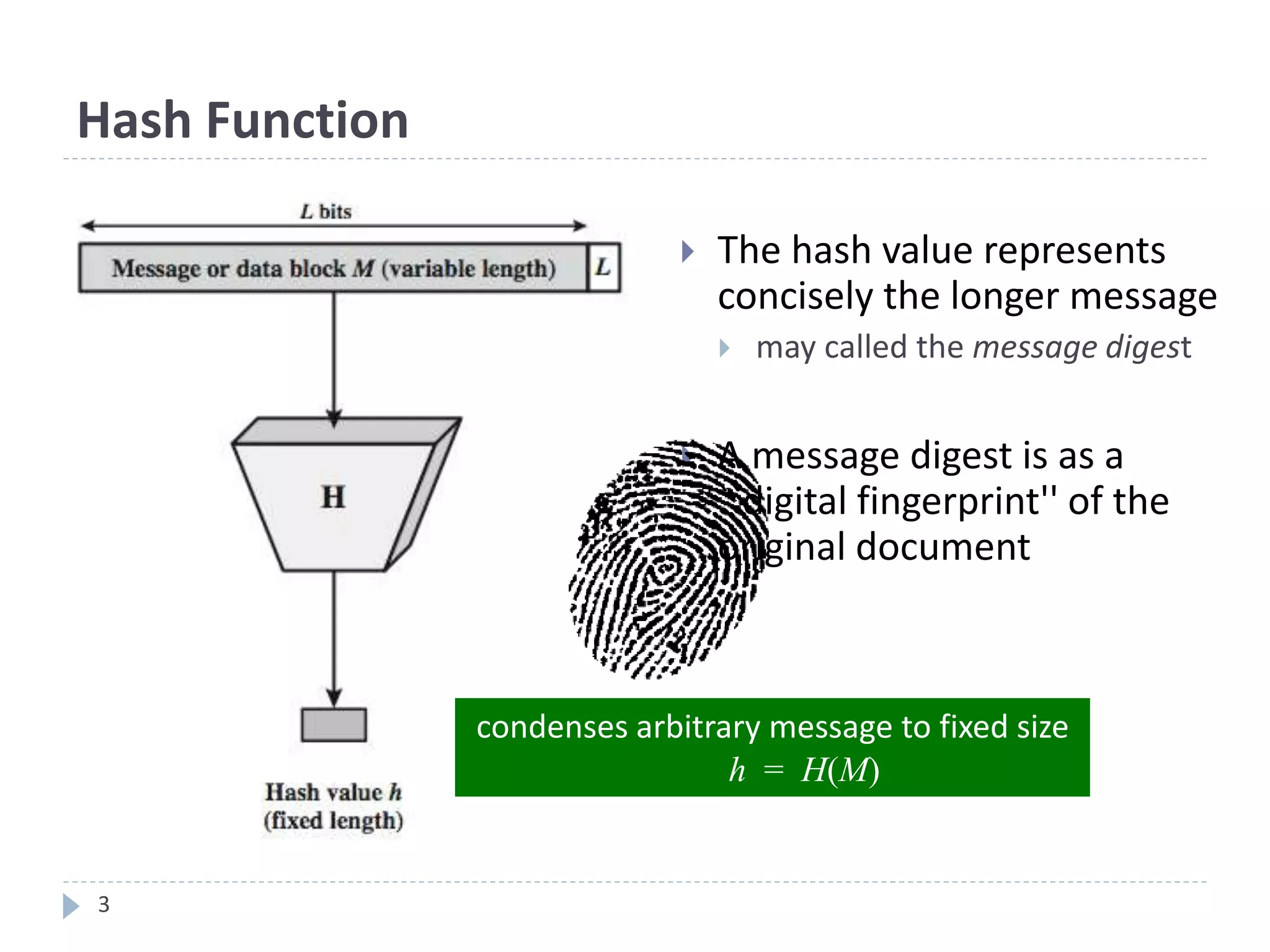
 The hash value represents
concisely the longer message
 may called the message digest
 A message digest is as a
``digital fingerprint'' of the
original document
condenses arbitrary message to fixed size
h = H(M)
Chewing functions
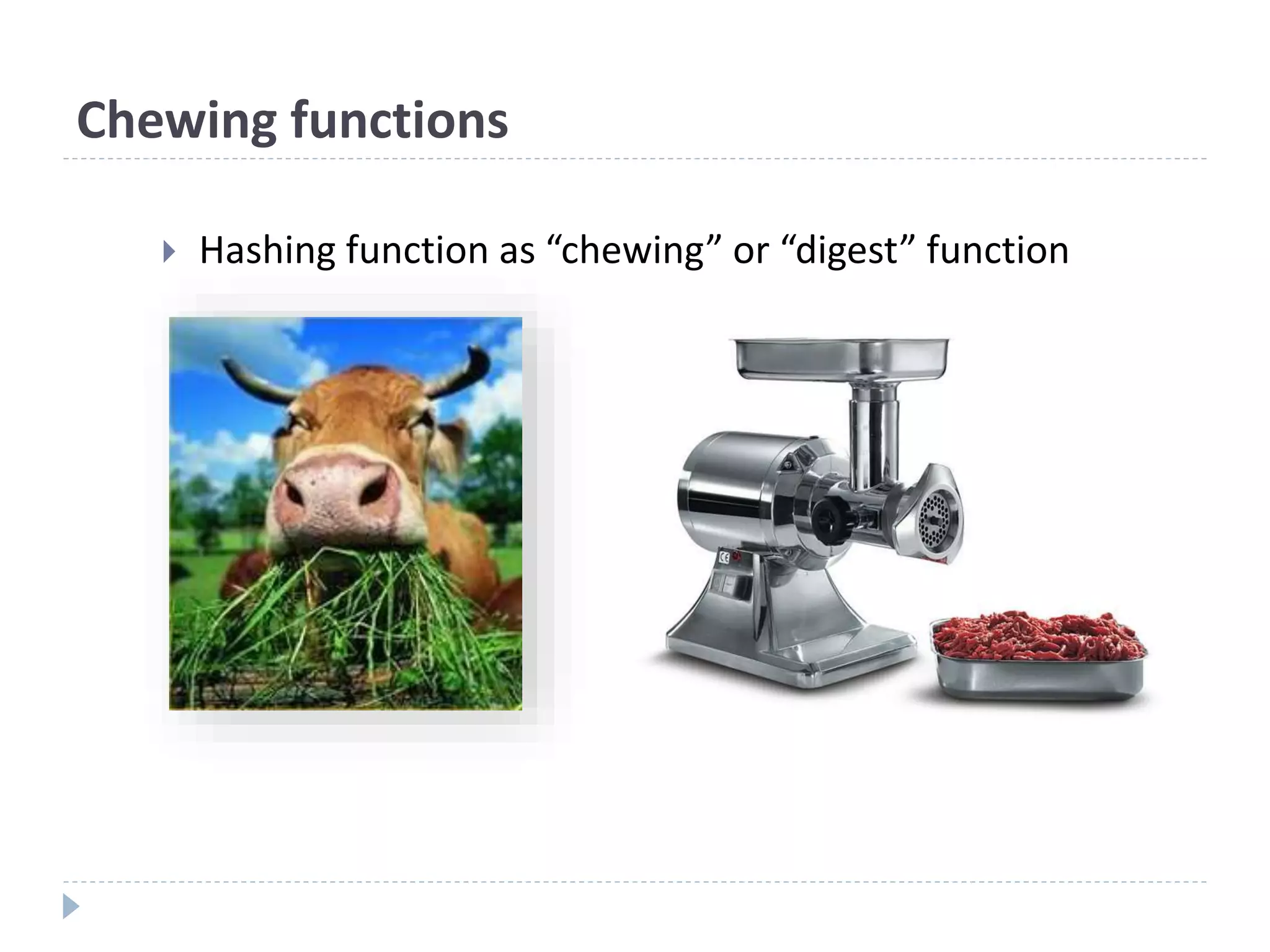
 Hashing function as “chewing” or “digest” function
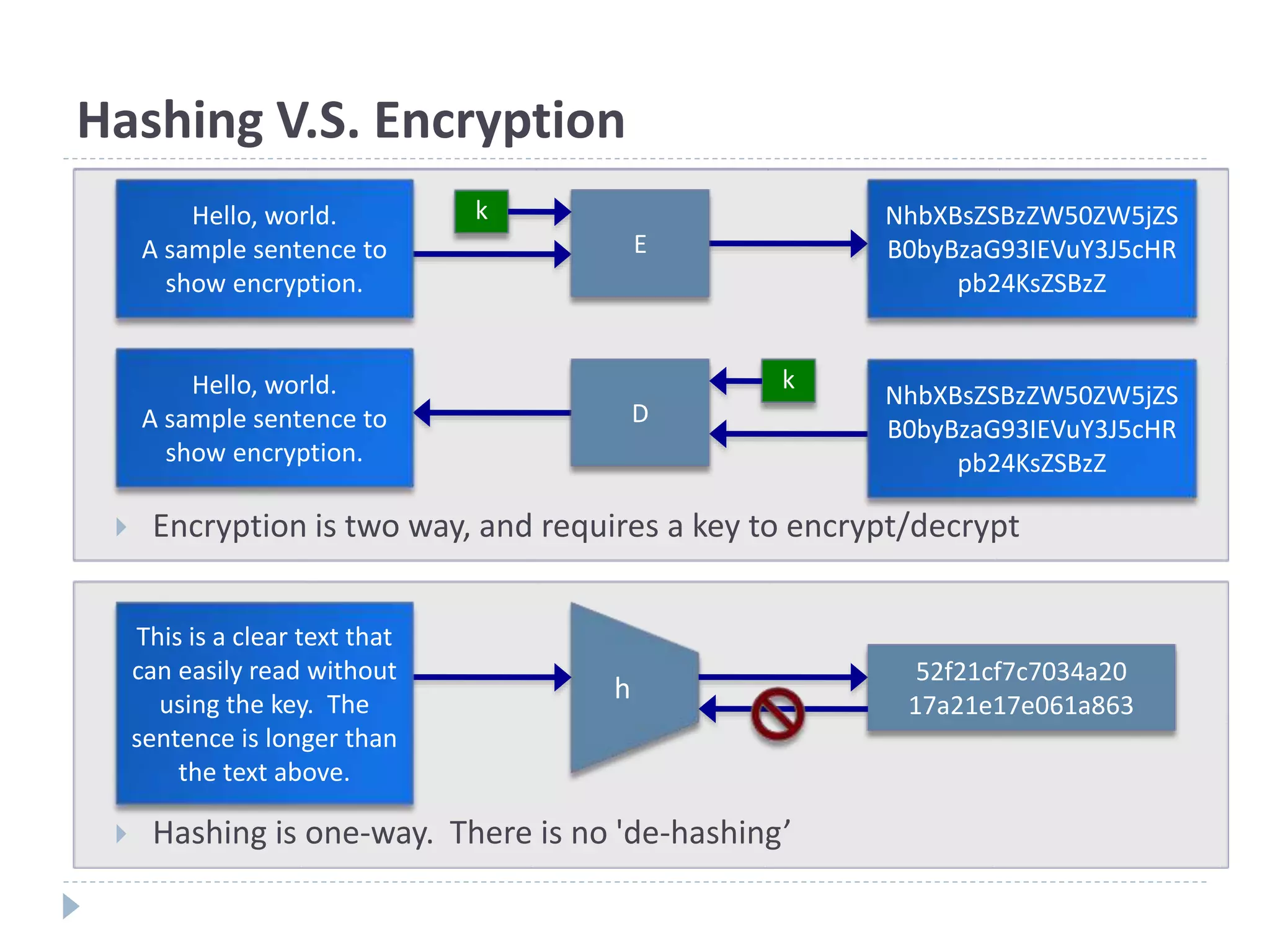
Hashing V.S. Encryption
 Hashing is one-way. There is no 'de-hashing’
Hello, world.
A sample sentence to
show encryption.
E
NhbXBsZSBzZW50ZW5jZS
B0byBzaG93IEVuY3J5cHR
pb24KsZSBzZ
k
Hello, world.
A sample sentence to
show encryption.
D
NhbXBsZSBzZW50ZW5jZS
B0byBzaG93IEVuY3J5cHR
pb24KsZSBzZ
k
 Encryption is two way, and requires a key to encrypt/decrypt
h
52f21cf7c7034a20
17a21e17e061a863
This is a clear text that
can easily read without
using the key. The
sentence is longer than
the text above.
Motivation for Hash Algorithms
 Intuition
 Limitation on non-cryptographic checksum
 Very possible to construct a message that matches the
checksum
 Goal
 Design a code where the original message can not be inferred
based on its checksum
 such that an accidental or intentional change to the message
will change the hash value
Hash Function Applications
 Used Alone
 Fingerprint -- file integrity verification, public key fingerprint
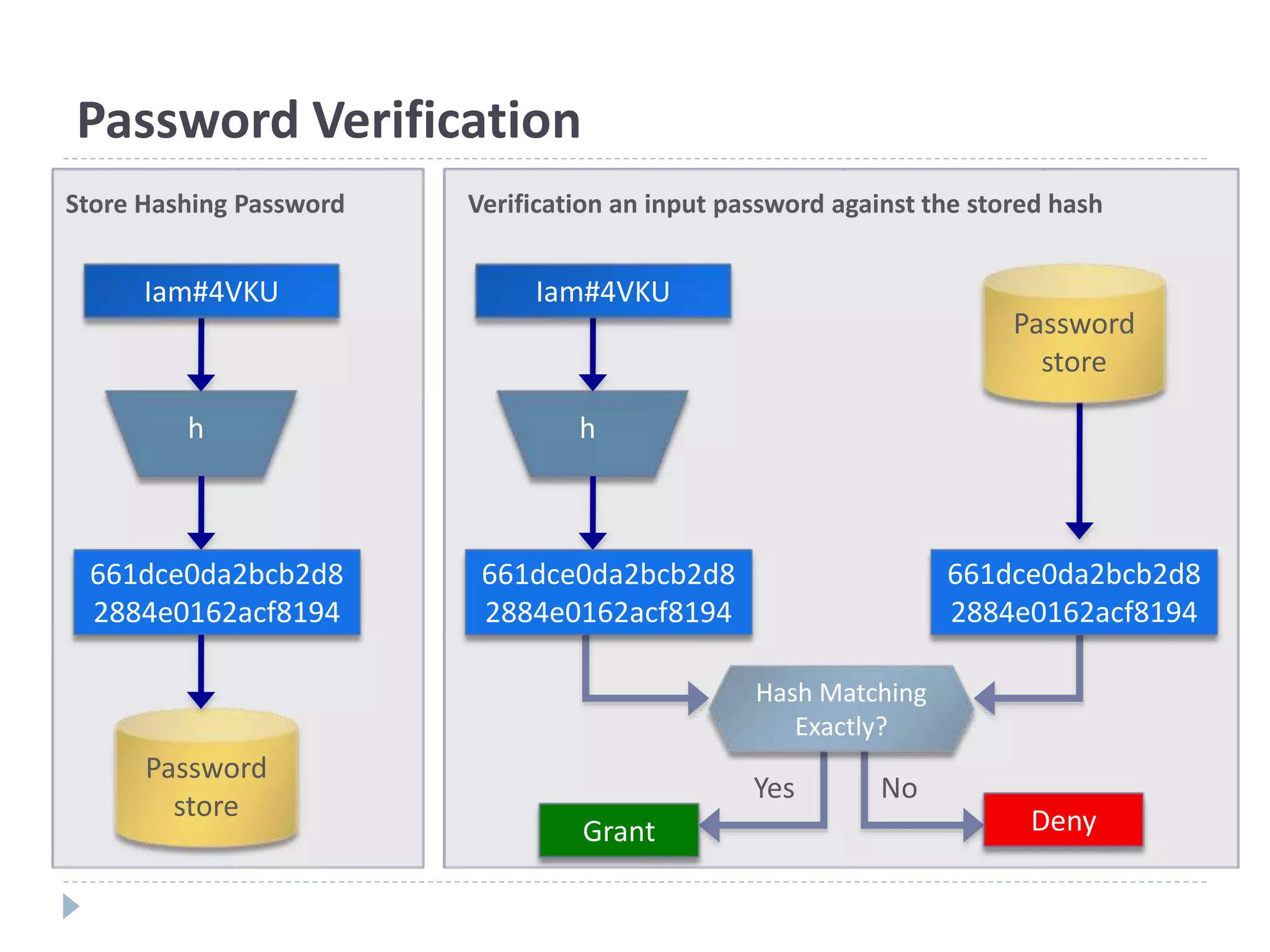
 Password storage (one-way encryption)
 Combined with encryption functions
 Hash based Message Authentication Code (HMAC)
 protects both a message's integrity and confideltaility
 Digital signature
 Ensuring Non-repudiation
 Encrypt hash with private (signing) key and verify with public
(verification) key
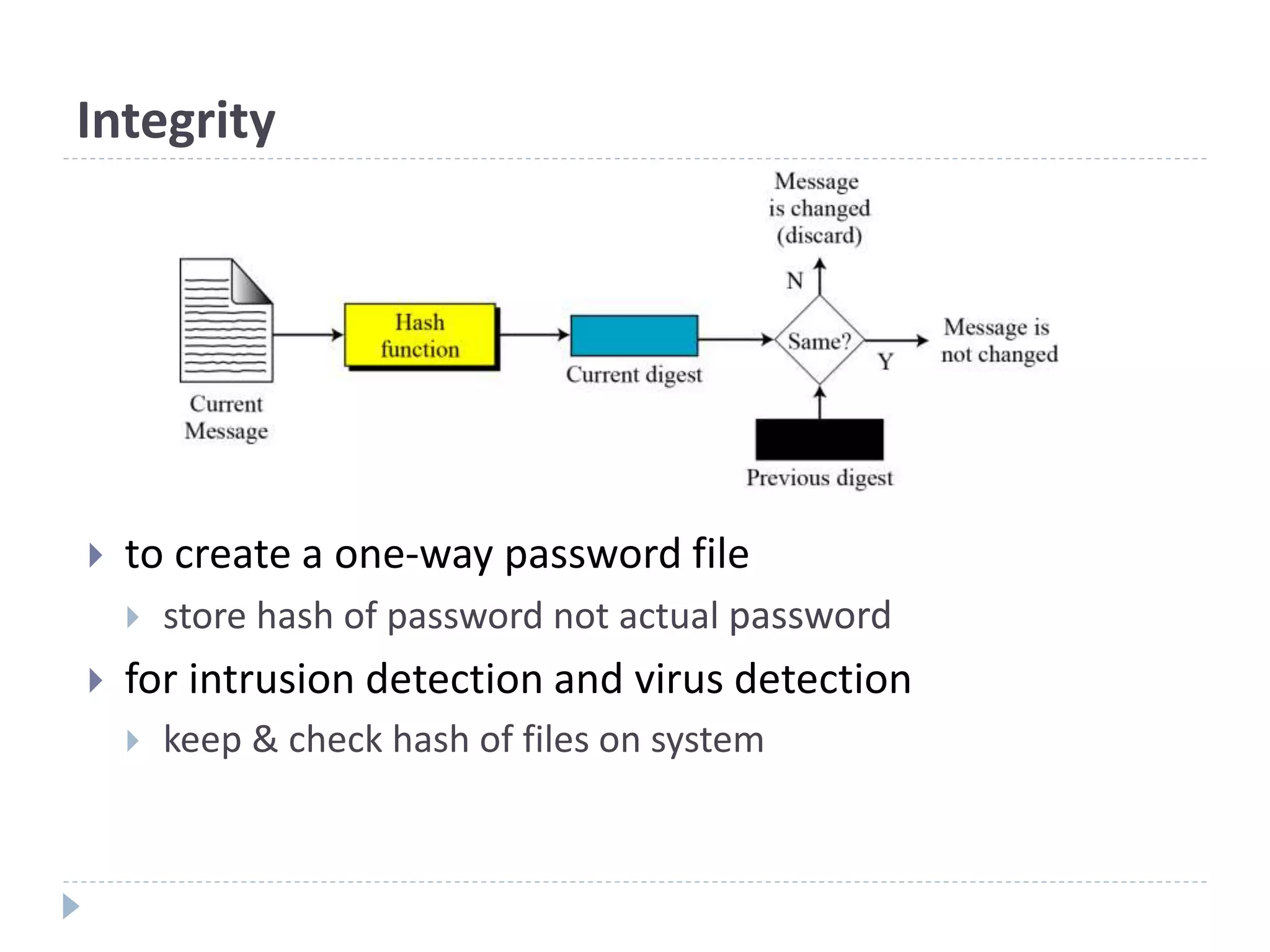
Integrity
 to create a one-way password file
 store hash of password not actual password
 for intrusion detection and virus detection
 keep & check hash of files on system
Password Verification
Iam#4VKU
h
661dce0da2bcb2d8
2884e0162acf8194
Password
store
Store Hashing Password
Iam#4VKU
h
661dce0da2bcb2d8
2884e0162acf8194
661dce0da2bcb2d8
2884e0162acf8194
Password
store
Hash Matching
Exactly?
Grant Deny
Yes No
Verification an input password against the stored hash
Topics
 Overview of Cryptography Hash Function
 Usages
 Properties
 Hashing Function Structure
 Attack on Hash Function
 The Road to new Secure Hash Standard
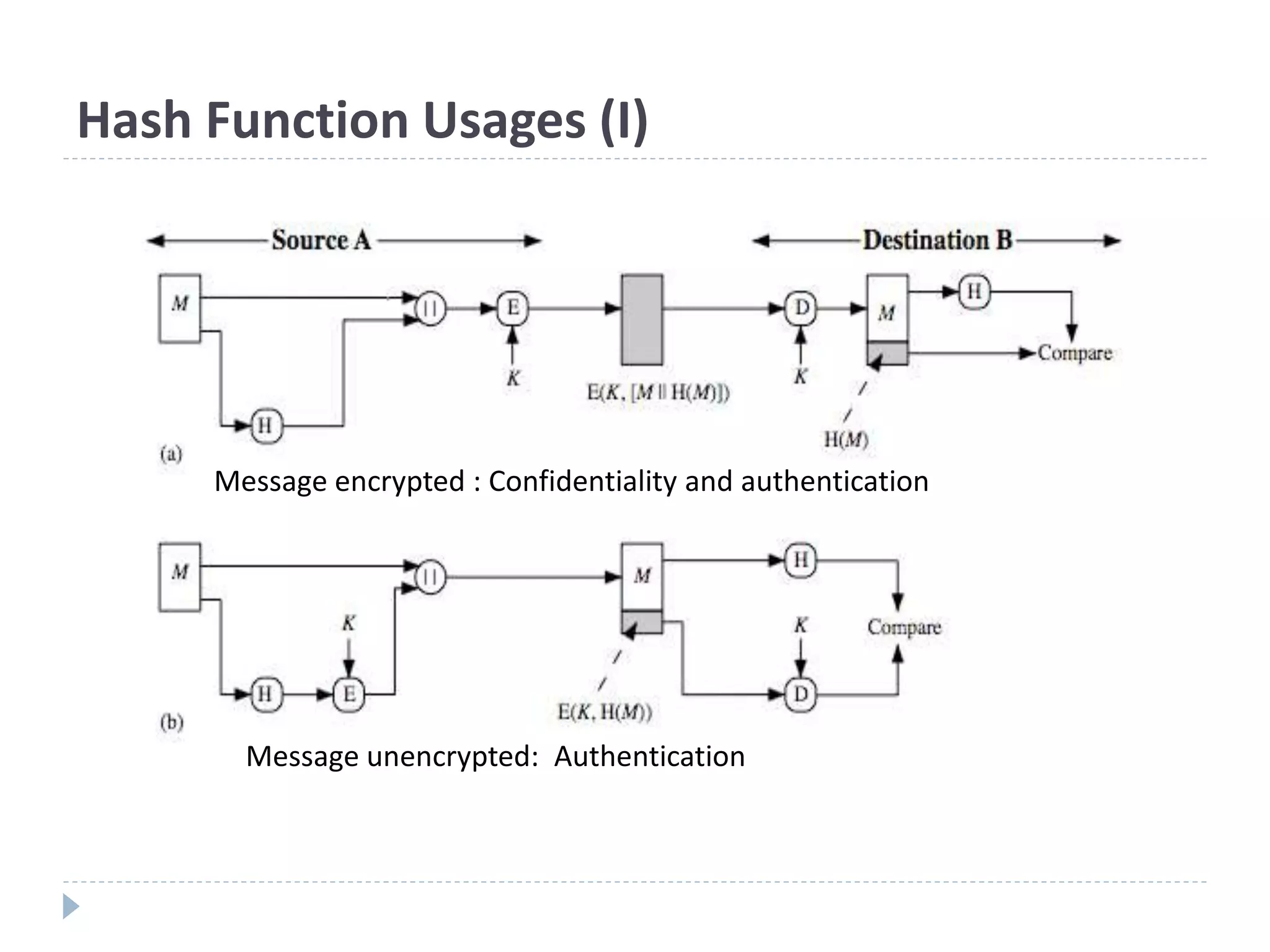
Hash Function Usages (I)
Message encrypted : Confidentiality and authentication
Message unencrypted: Authentication
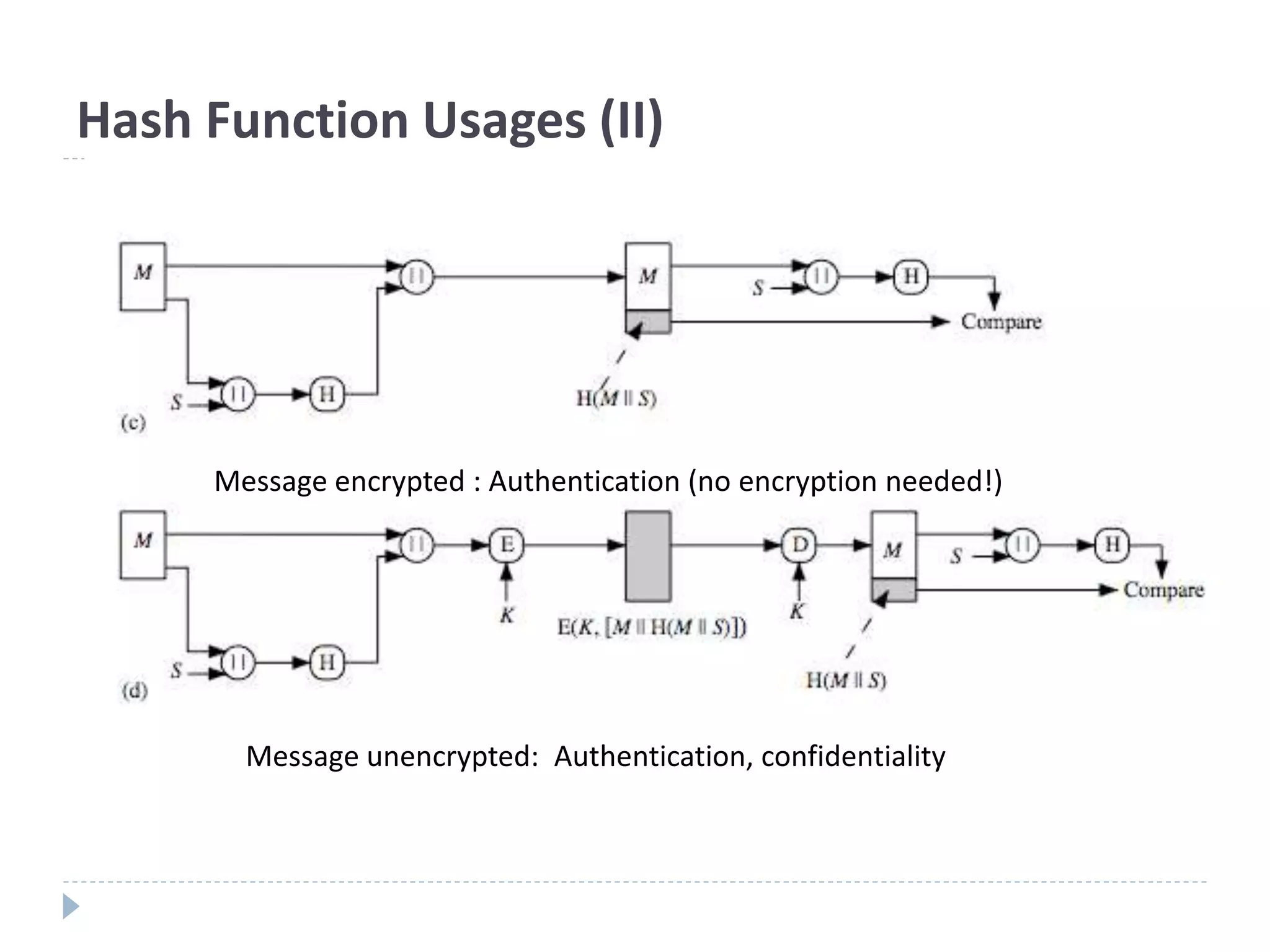
Hash Function Usages (II)
Message encrypted : Authentication (no encryption needed!)
Message unencrypted: Authentication, confidentiality
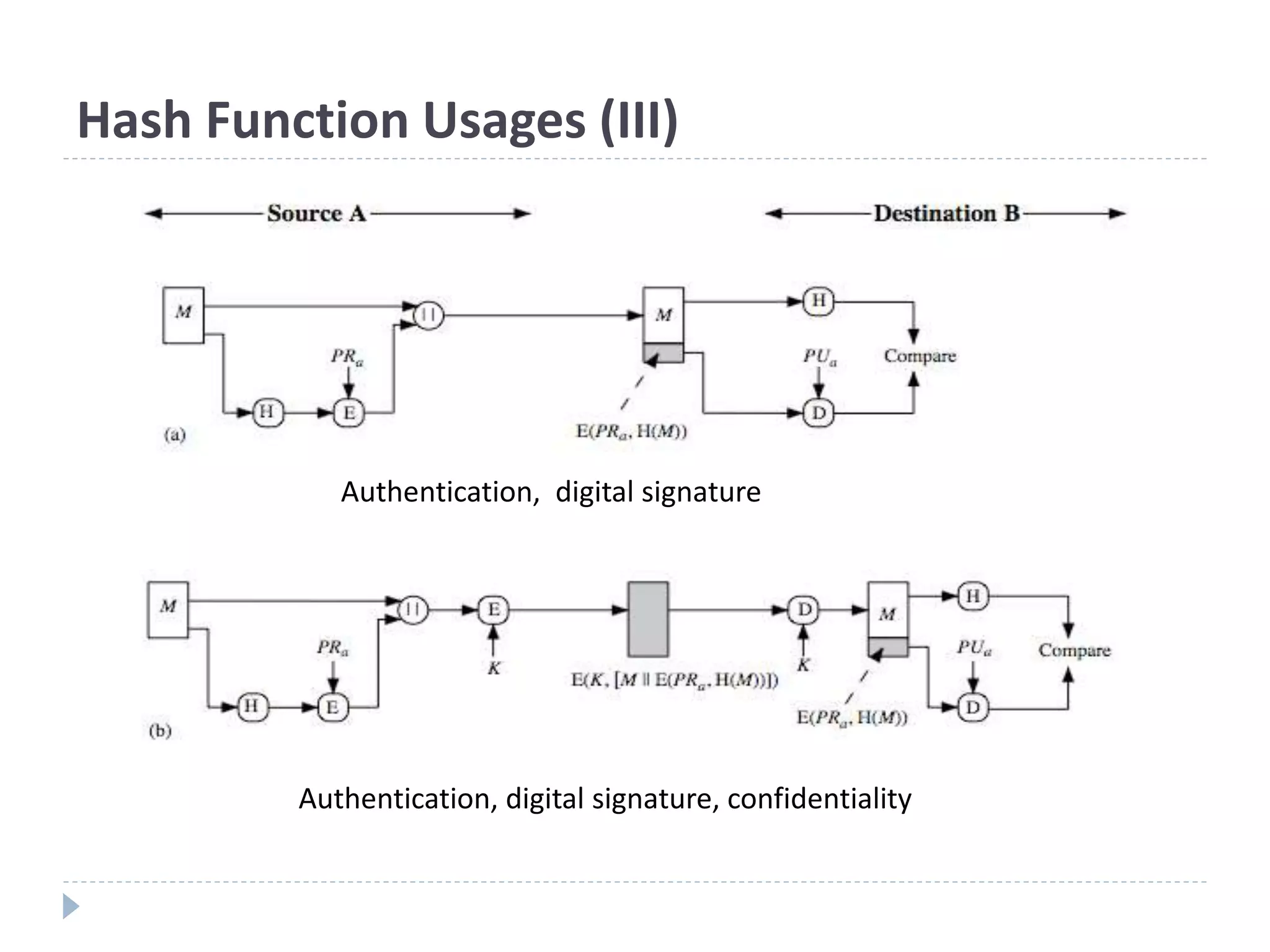
Hash Function Usages (III)
Authentication, digital signature
Authentication, digital signature, confidentiality
Topics
 Overview of Cryptography Hash Function
 Usages
 Properties
 Hashing Function Structure
 Attack on Hash Function
 The Road to new Secure Hash Standard
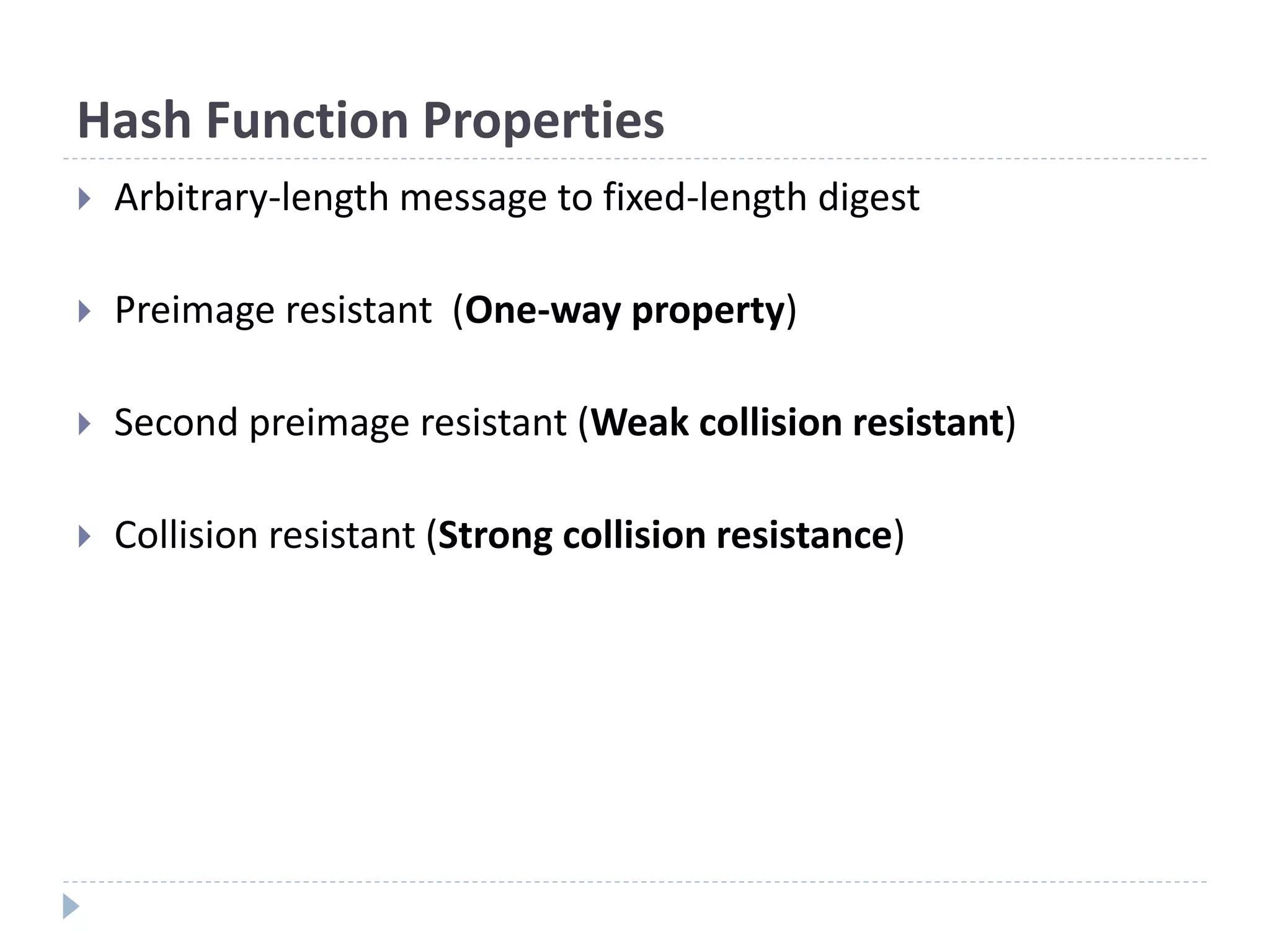
Hash Function Properties
 Arbitrary-length message to fixed-length digest
 Preimage resistant (One-way property)
 Second preimage resistant (Weak collision resistant)
 Collision resistant (Strong collision resistance)
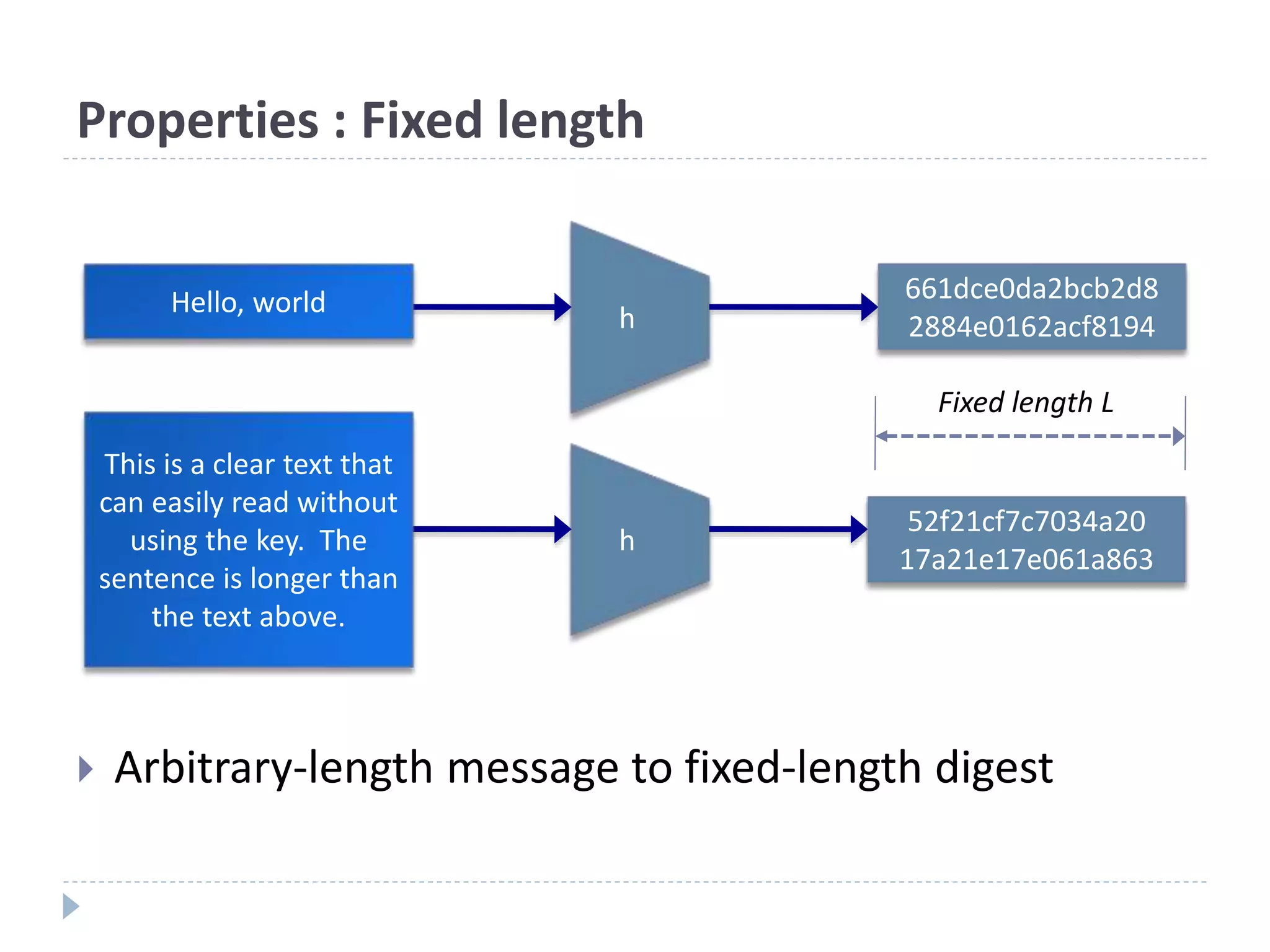
Properties : Fixed length
 Arbitrary-length message to fixed-length digest
h
h
Hello, world
This is a clear text that
can easily read without
using the key. The
sentence is longer than
the text above.
52f21cf7c7034a20
17a21e17e061a863
Fixed length L
661dce0da2bcb2d8
2884e0162acf8194
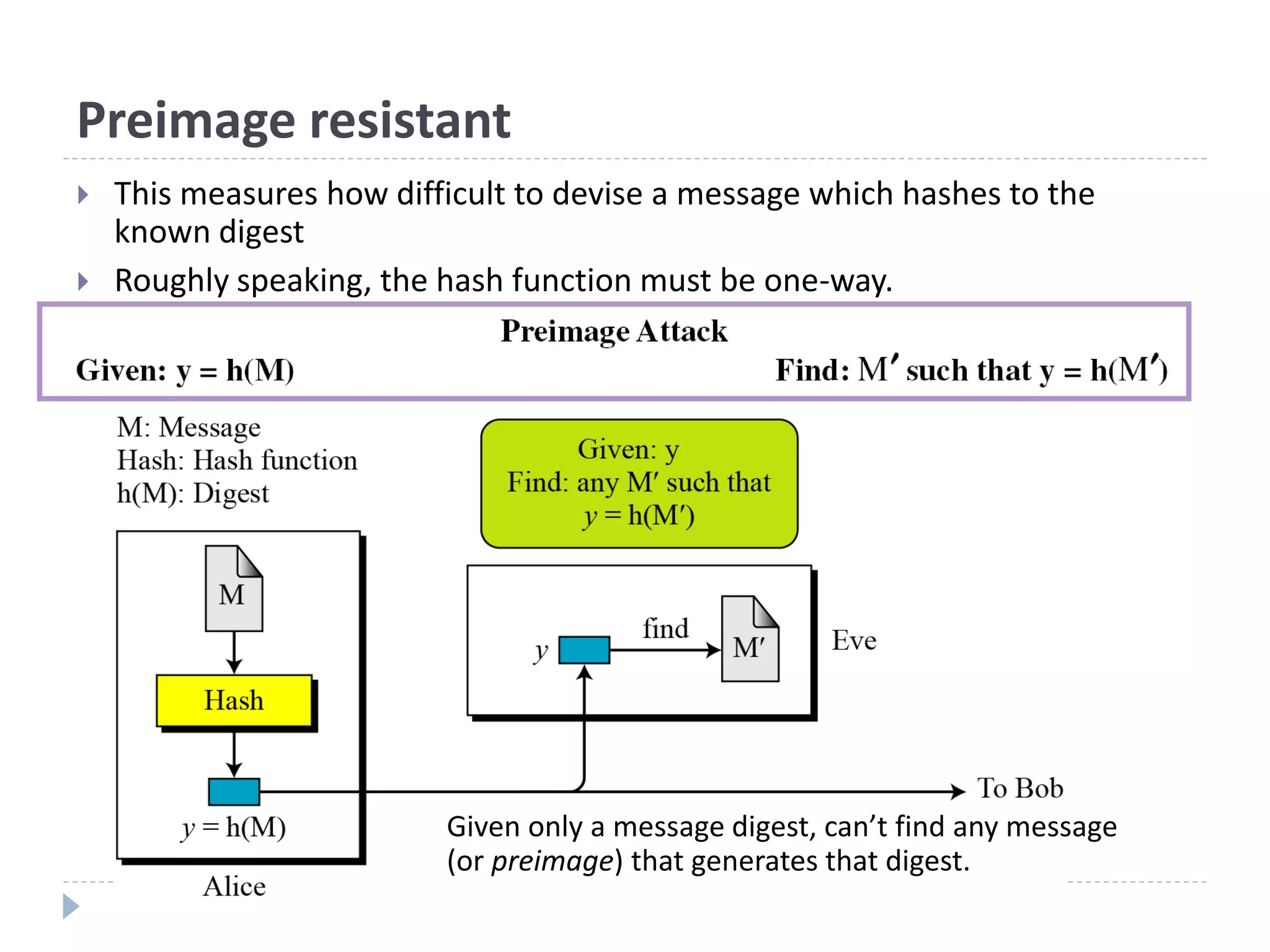
Preimage resistant
 This measures how difficult to devise a message which hashes to the
known digest
 Roughly speaking, the hash function must be one-way.
Given only a message digest, can’t find any message
(or preimage) that generates that digest.
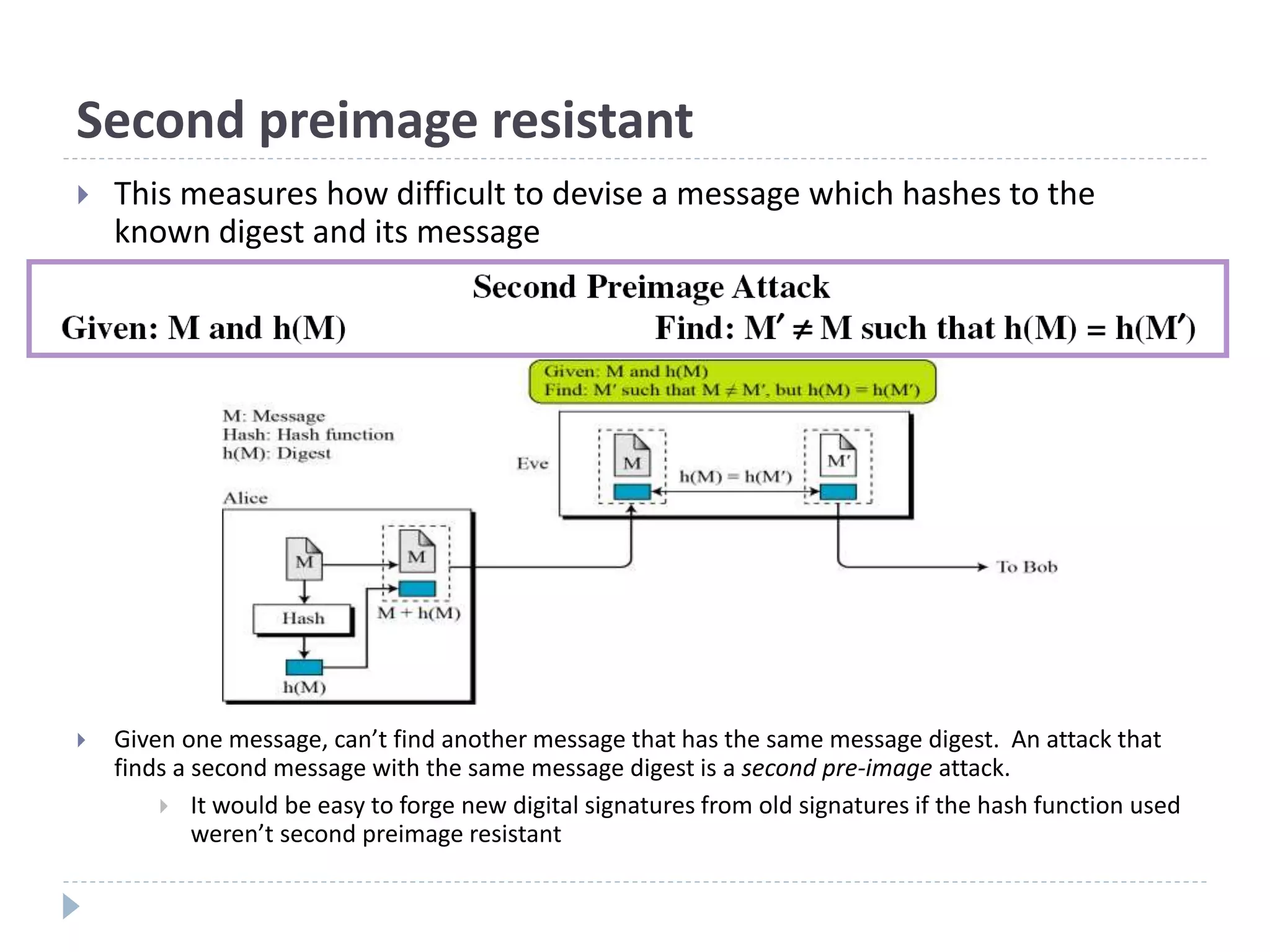
Second preimage resistant
 Given one message, can’t find another message that has the same message digest. An attack that
finds a second message with the same message digest is a second pre-image attack.
 It would be easy to forge new digital signatures from old signatures if the hash function used
weren’t second preimage resistant
 This measures how difficult to devise a message which hashes to the
known digest and its message
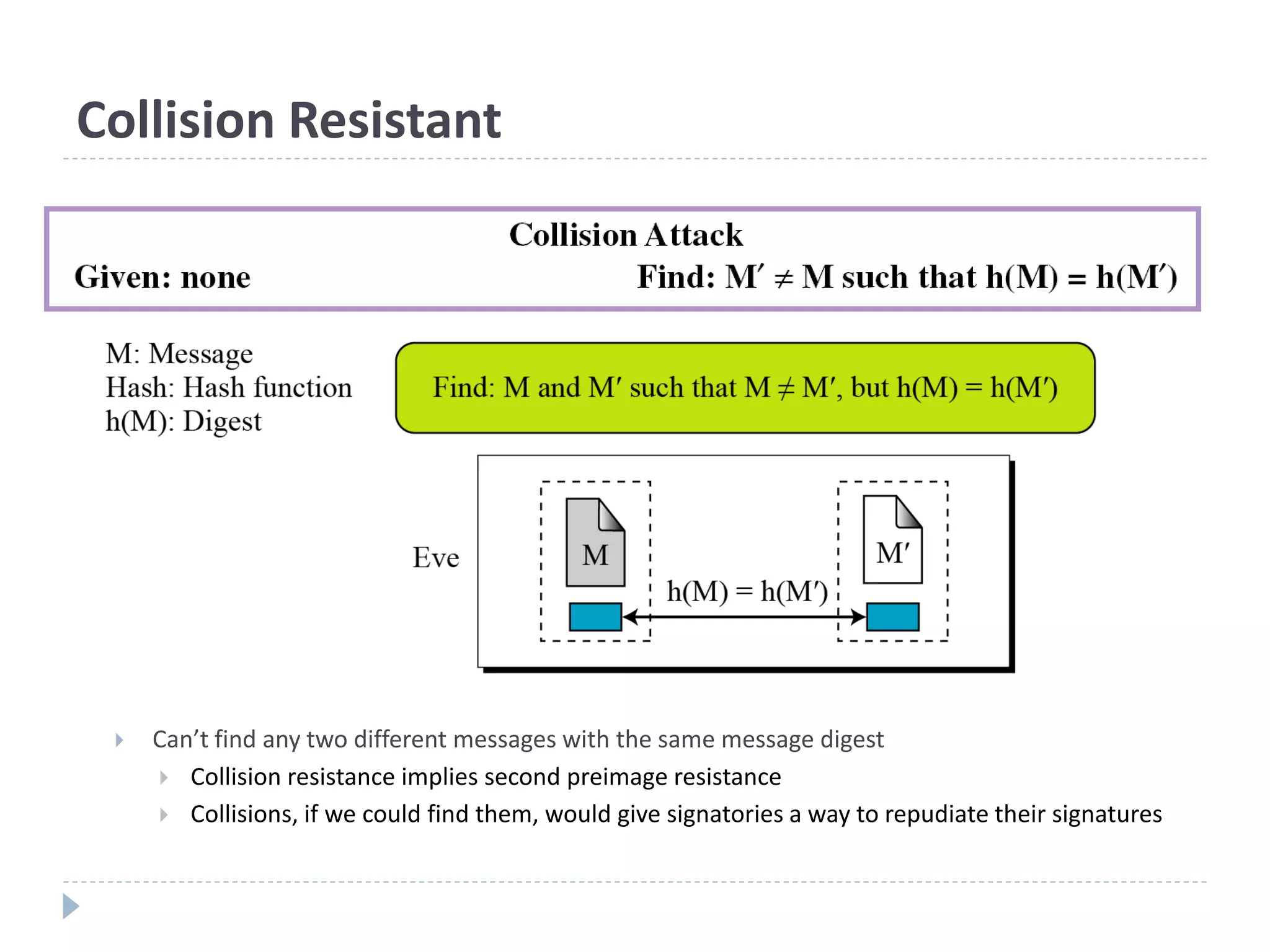
Collision Resistant
 Can’t find any two different messages with the same message digest
 Collision resistance implies second preimage resistance
 Collisions, if we could find them, would give signatories a way to repudiate their signatures
Topics
 Overview of Cryptography Hash Function
 Usages
 Properties
 Hashing Function Structure
 Attack on Hash Function
 The Road to new Secure Hash Standard
Two Group of Compression Functions
 The compression function is made from scratch
 Message Digest
 A symmetric-key block cipher serves as a compression
function
 Whirlpool
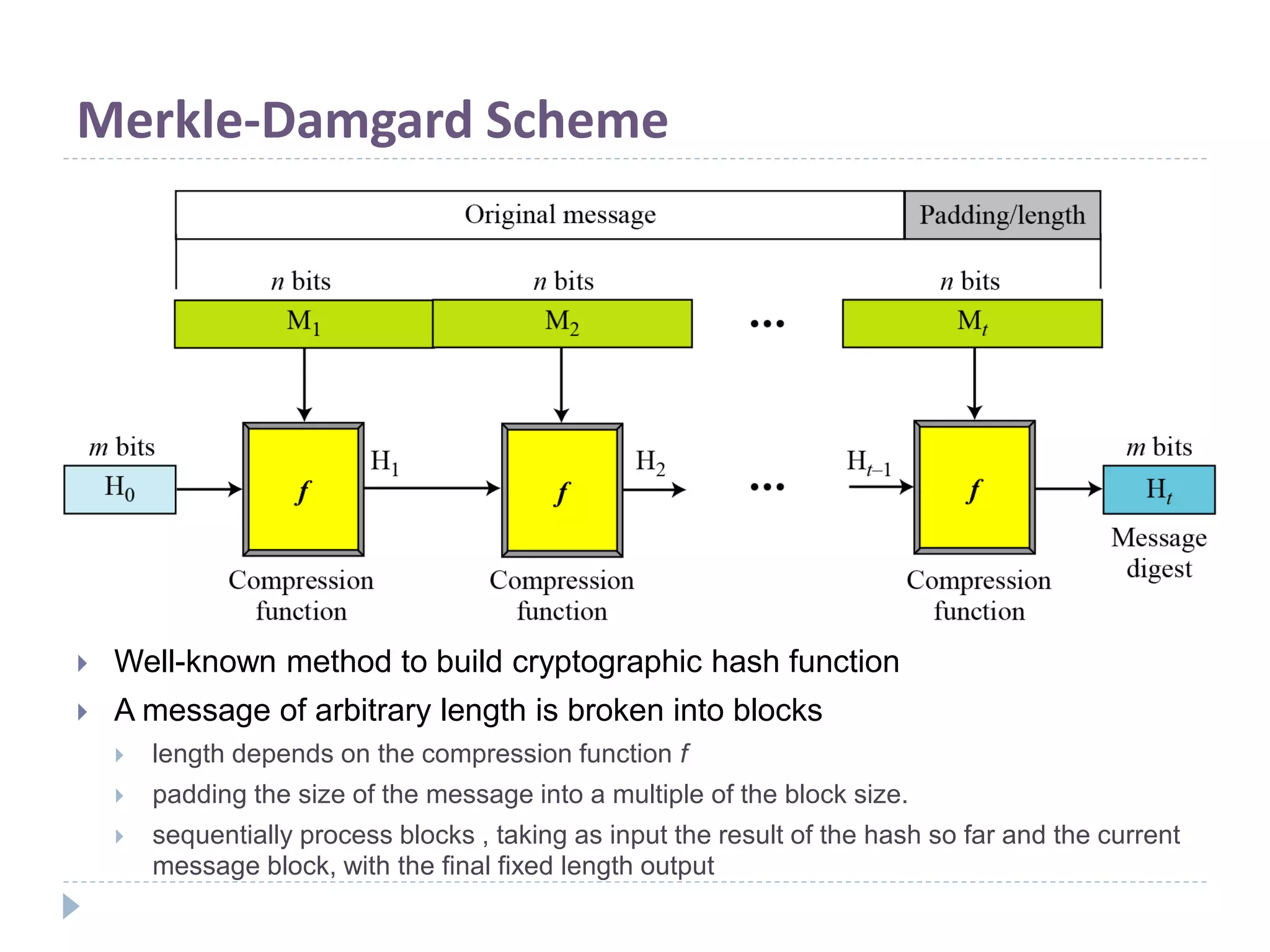
Merkle-Damgard Scheme
 Well-known method to build cryptographic hash function
 A message of arbitrary length is broken into blocks
 length depends on the compression function f
 padding the size of the message into a multiple of the block size.
 sequentially process blocks , taking as input the result of the hash so far and the current
message block, with the final fixed length output
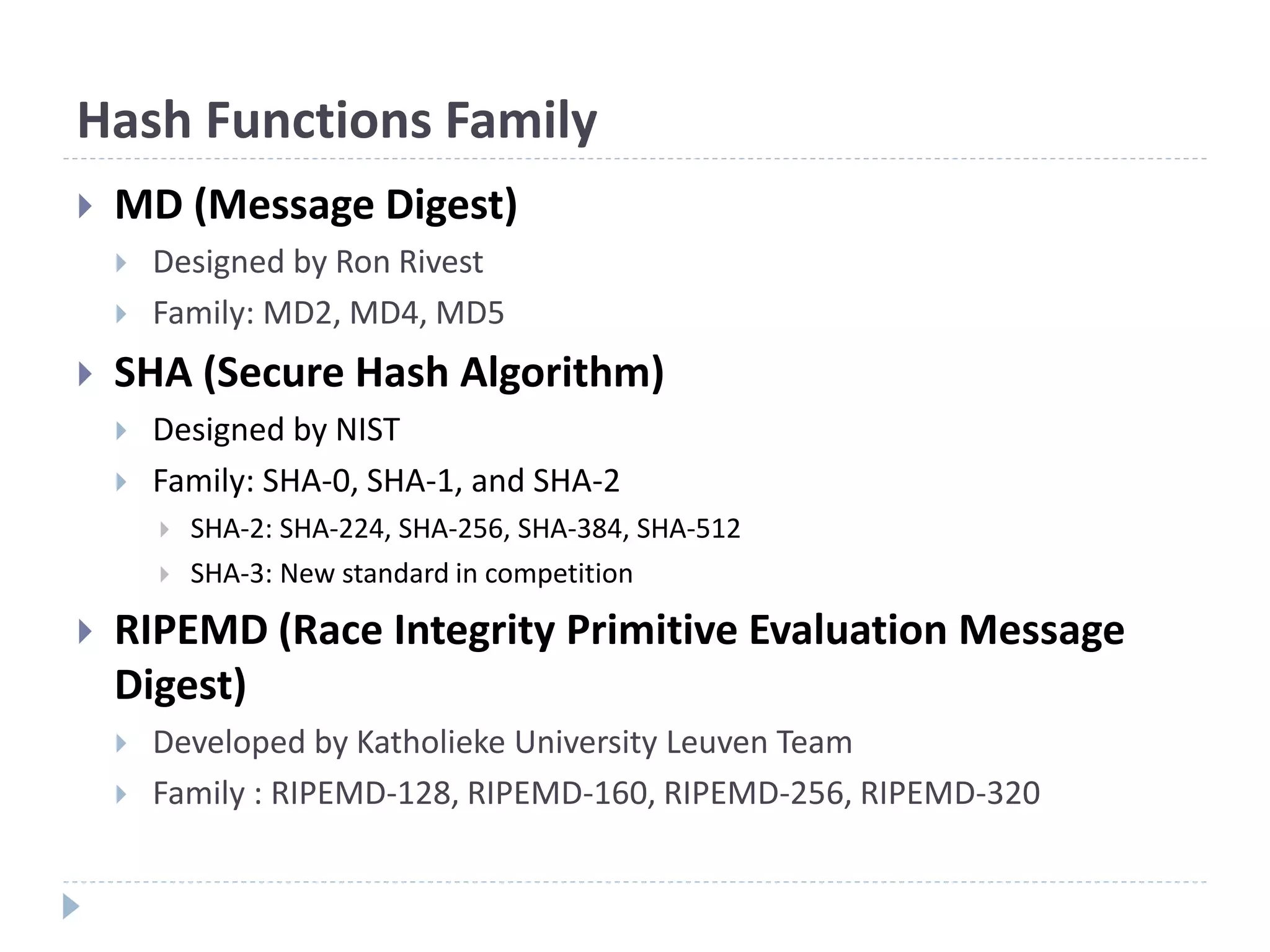
Hash Functions Family
 MD (Message Digest)
 Designed by Ron Rivest
 Family: MD2, MD4, MD5
 SHA (Secure Hash Algorithm)
 Designed by NIST
 Family: SHA-0, SHA-1, and SHA-2
 SHA-2: SHA-224, SHA-256, SHA-384, SHA-512
 SHA-3: New standard in competition
 RIPEMD (Race Integrity Primitive Evaluation Message
Digest)
 Developed by Katholieke University Leuven Team
 Family : RIPEMD-128, RIPEMD-160, RIPEMD-256, RIPEMD-320
24
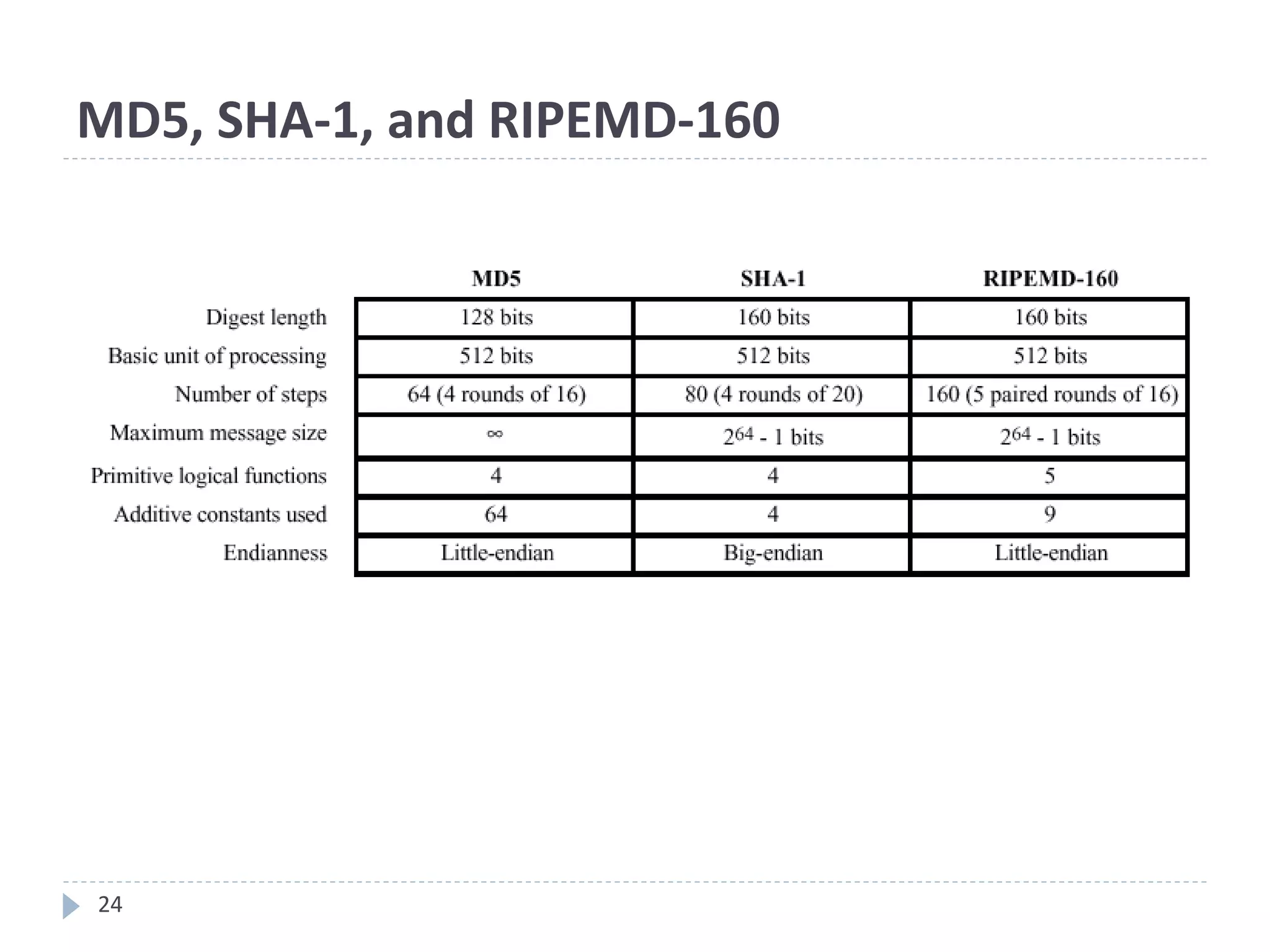
MD5, SHA-1, and RIPEMD-160
MD2, MD4 and MD5
 Family of one-way hash functions by Ronald Rivest
 All produces 128 bits hash value
 MD2: 1989
 Optimized for 8 bit computer
 Collision found in 1995
 MD4: 1990
 Full round collision attack found in 1995
 MD5: 1992
 Specified as Internet standard in RFC 1321
 since 1997 it was theoretically not so hard to create a collision
 Practical Collision MD5 has been broken since 2004
 CA attack published in 2007
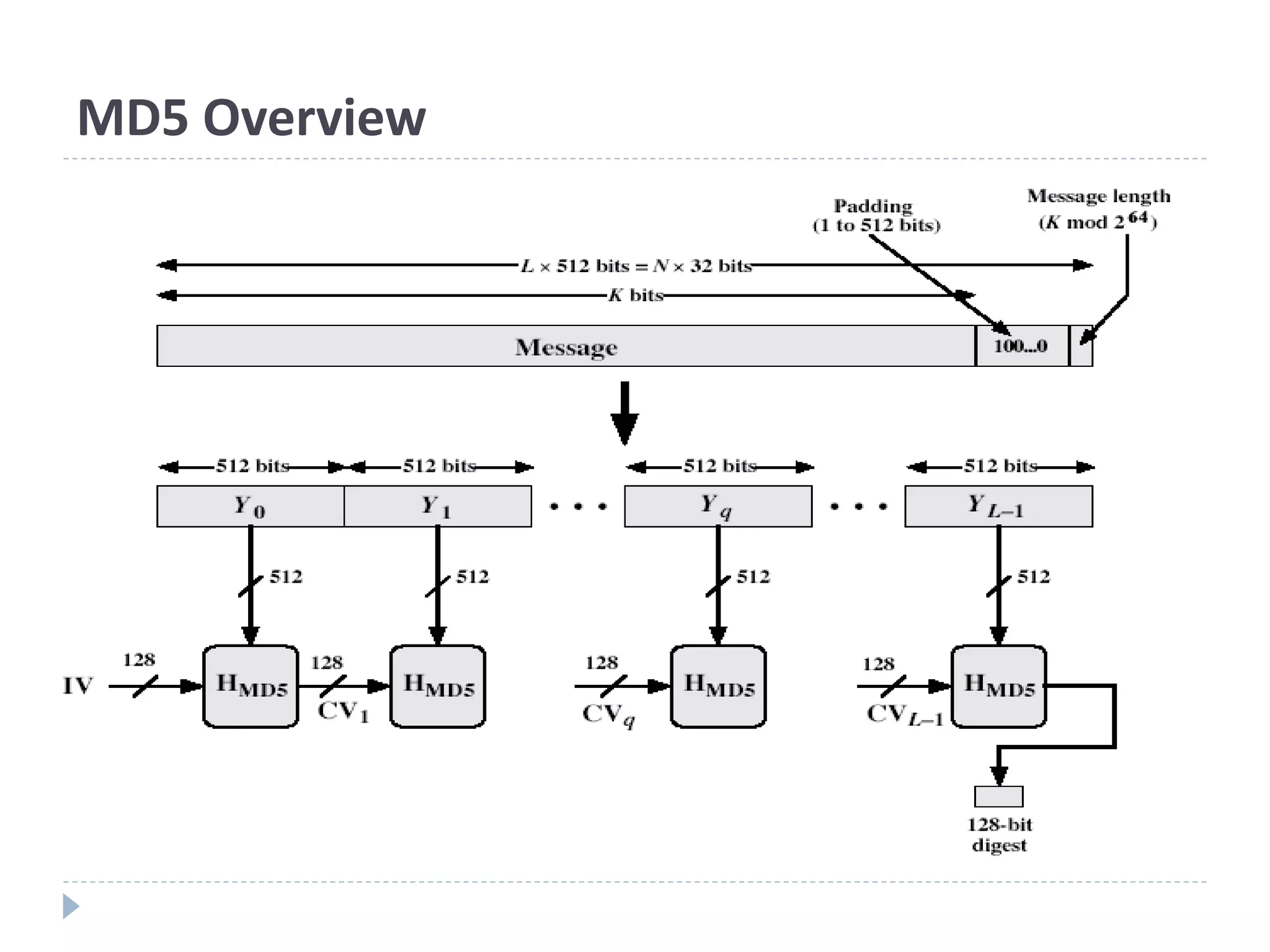
MD5 Overview
Topics
 Overview of Cryptography Hash Function
 Usages
 Properties
 Hashing Function Structure
 MD5
 SHA
 Attack on Hash Function
 The Road to new Secure Hash Standard
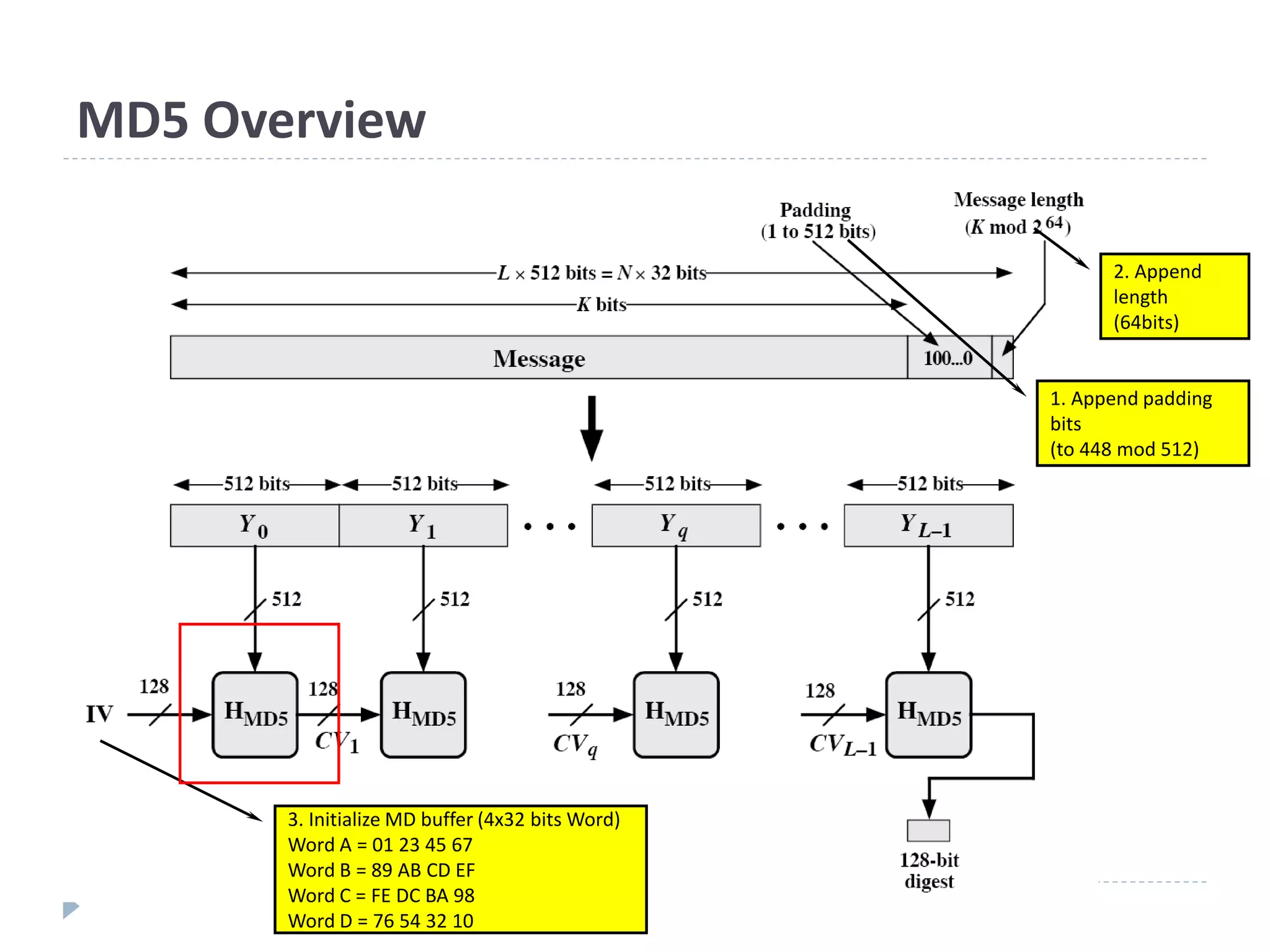
MD5 Overview
1. Append padding
bits
(to 448 mod 512)
2. Append
length
(64bits)
3. Initialize MD buffer (4x32 bits Word)
Word A = 01 23 45 67
Word B = 89 AB CD EF
Word C = FE DC BA 98
Word D = 76 54 32 10
Hash Algorithm Design – MD5
16 steps
Constructed from sine function
X[k] = M [q*16+k] (32 bit)
The ith 32-bit word in matrix T, constructed from the sine function
M [q*16+k] = the kth 32-bit word from the qth 512-bit block of the msg
Single step
Topics
 Overview of Cryptography Hash Function
 Usages
 Properties
 Hashing Function Structure
 MD5
 SHA
 Attack on Hash Function
 The Road to new Secure Hash Standard
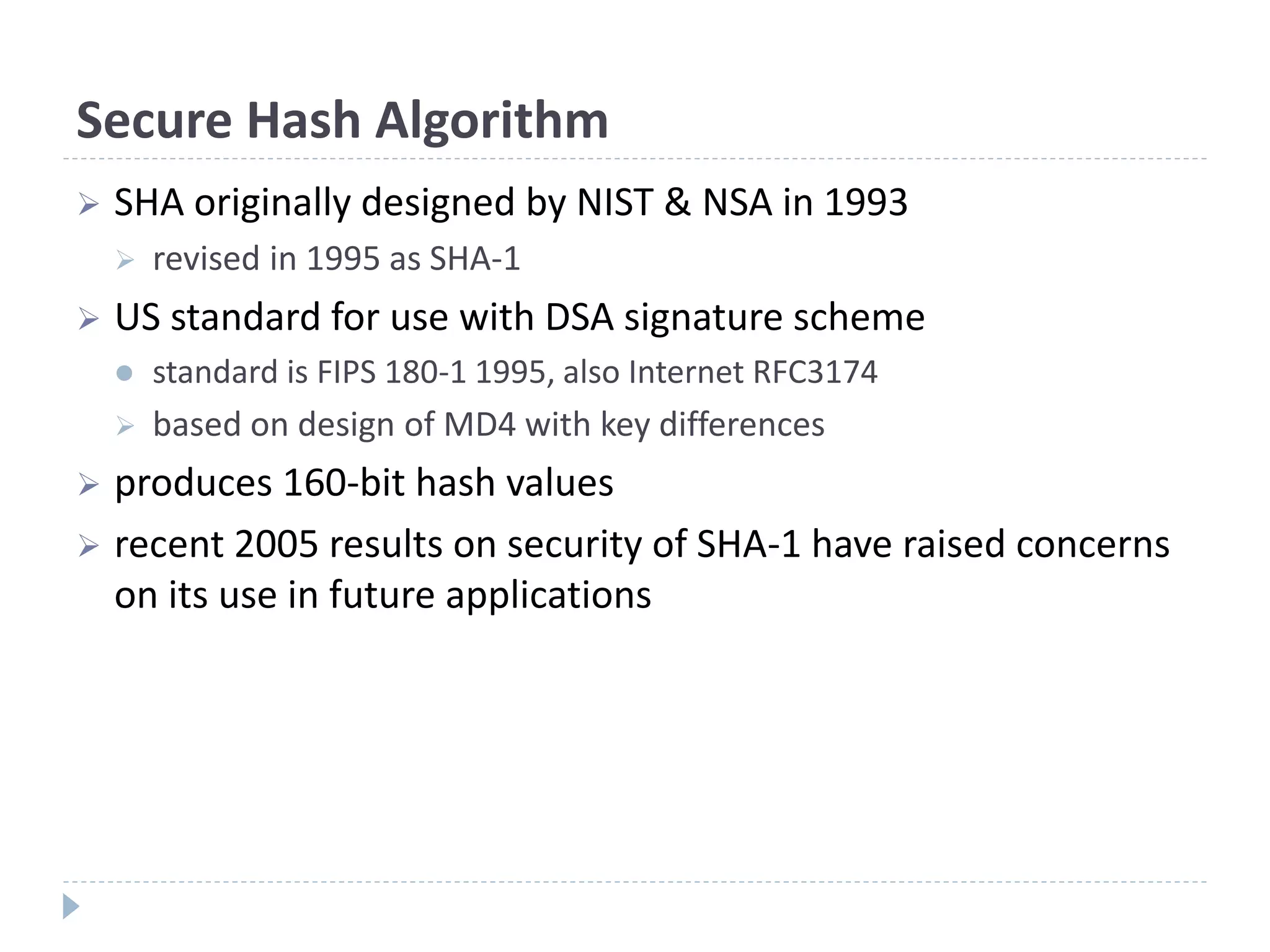
Secure Hash Algorithm
 SHA originally designed by NIST & NSA in 1993
 revised in 1995 as SHA-1
 US standard for use with DSA signature scheme
 standard is FIPS 180-1 1995, also Internet RFC3174
 based on design of MD4 with key differences
 produces 160-bit hash values
 recent 2005 results on security of SHA-1 have raised concerns
on its use in future applications
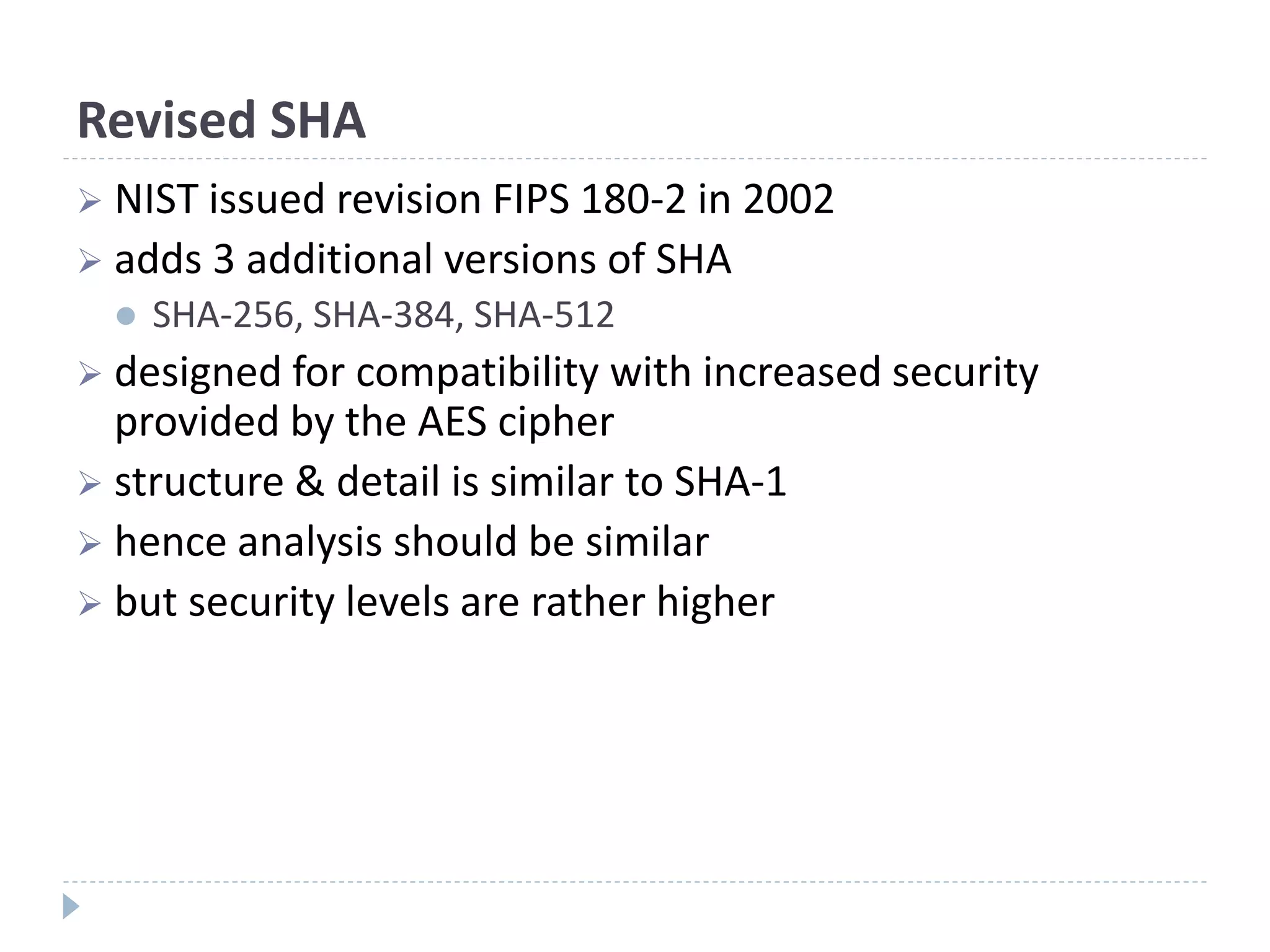
Revised SHA
 NIST issued revision FIPS 180-2 in 2002
 adds 3 additional versions of SHA
 SHA-256, SHA-384, SHA-512
 designed for compatibility with increased security
provided by the AES cipher
 structure & detail is similar to SHA-1
 hence analysis should be similar
 but security levels are rather higher
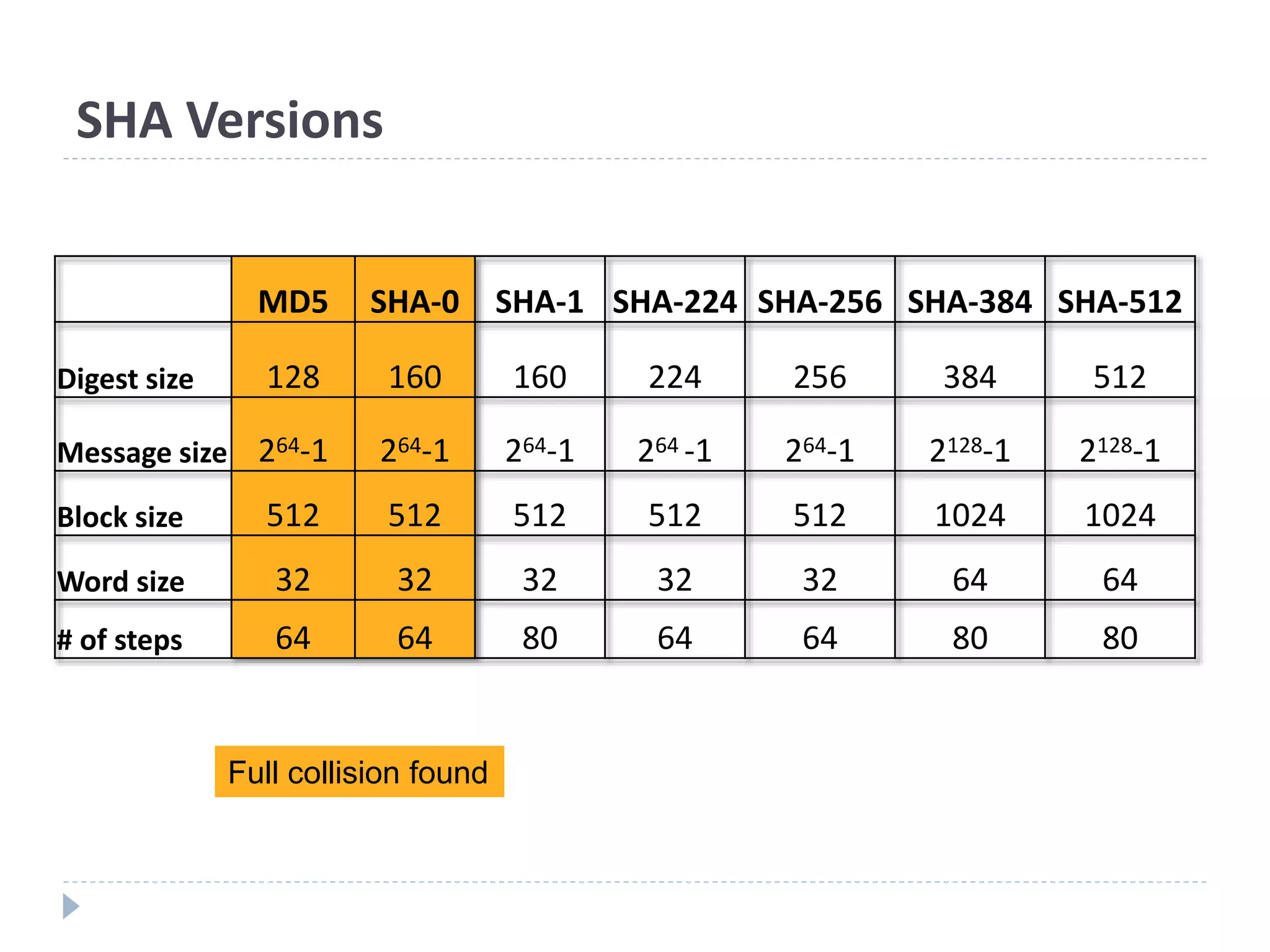
SHA Versions
MD5 SHA-0 SHA-1 SHA-224 SHA-256 SHA-384 SHA-512
Digest size 128 160 160 224 256 384 512
Message size 264-1 264-1 264-1 264 -1 264-1 2128-1 2128-1
Block size 512 512 512 512 512 1024 1024
Word size 32 32 32 32 32 64 64
# of steps 64 64 80 64 64 80 80
Full collision found
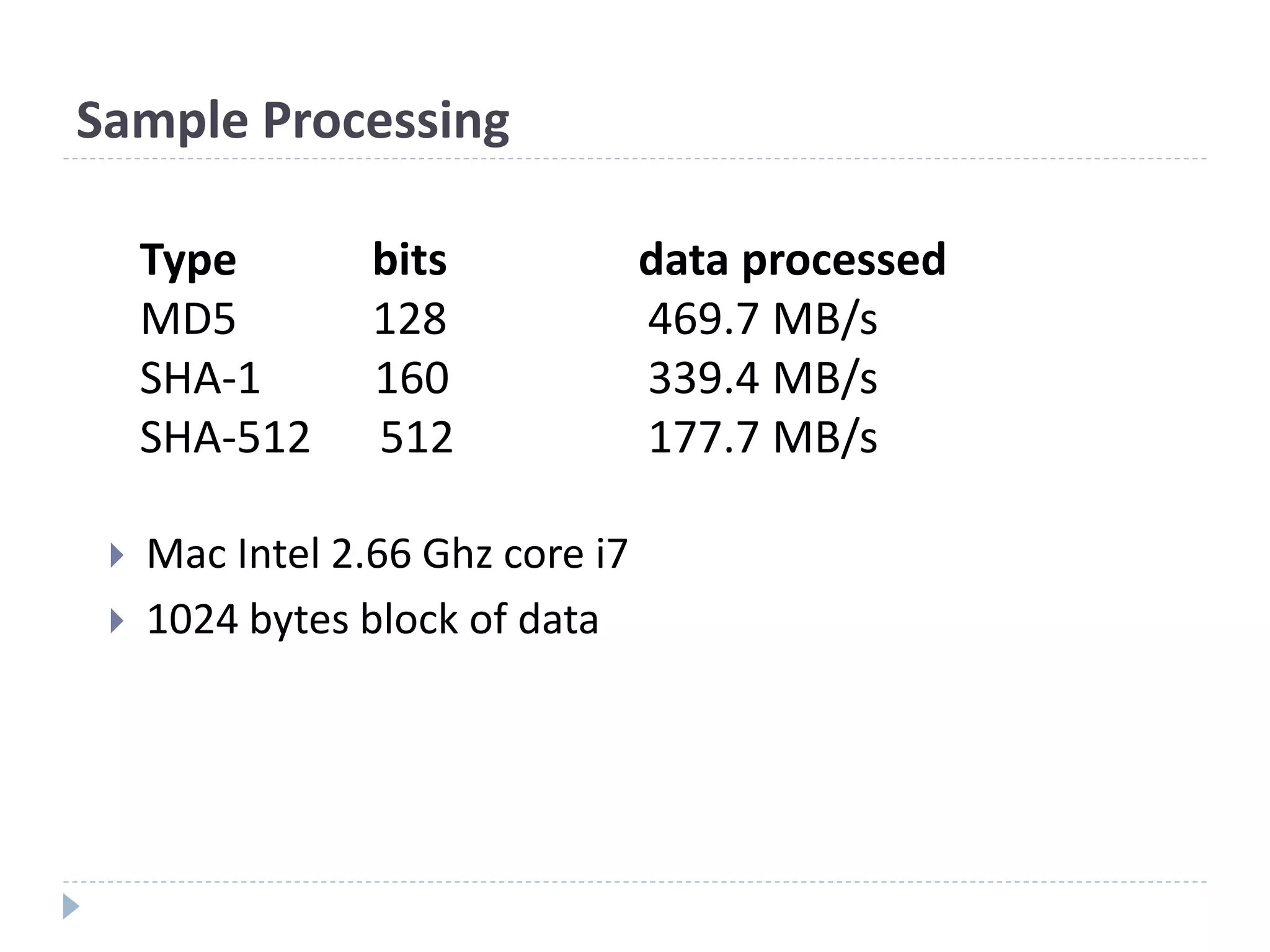
Sample Processing
 Mac Intel 2.66 Ghz core i7
 1024 bytes block of data
Type bits data processed
MD5 128 469.7 MB/s
SHA-1 160 339.4 MB/s
SHA-512 512 177.7 MB/s
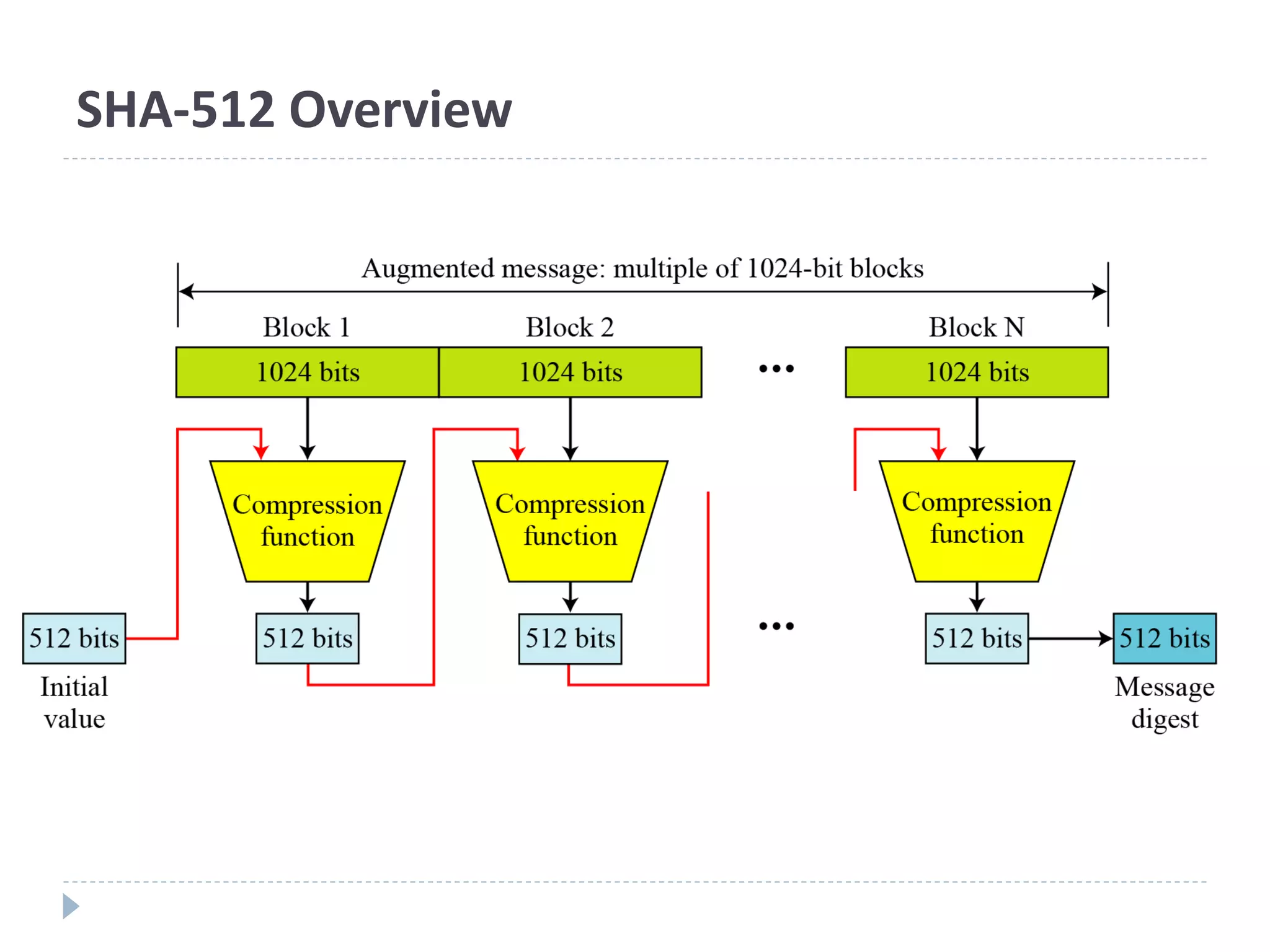
SHA-512 Overview
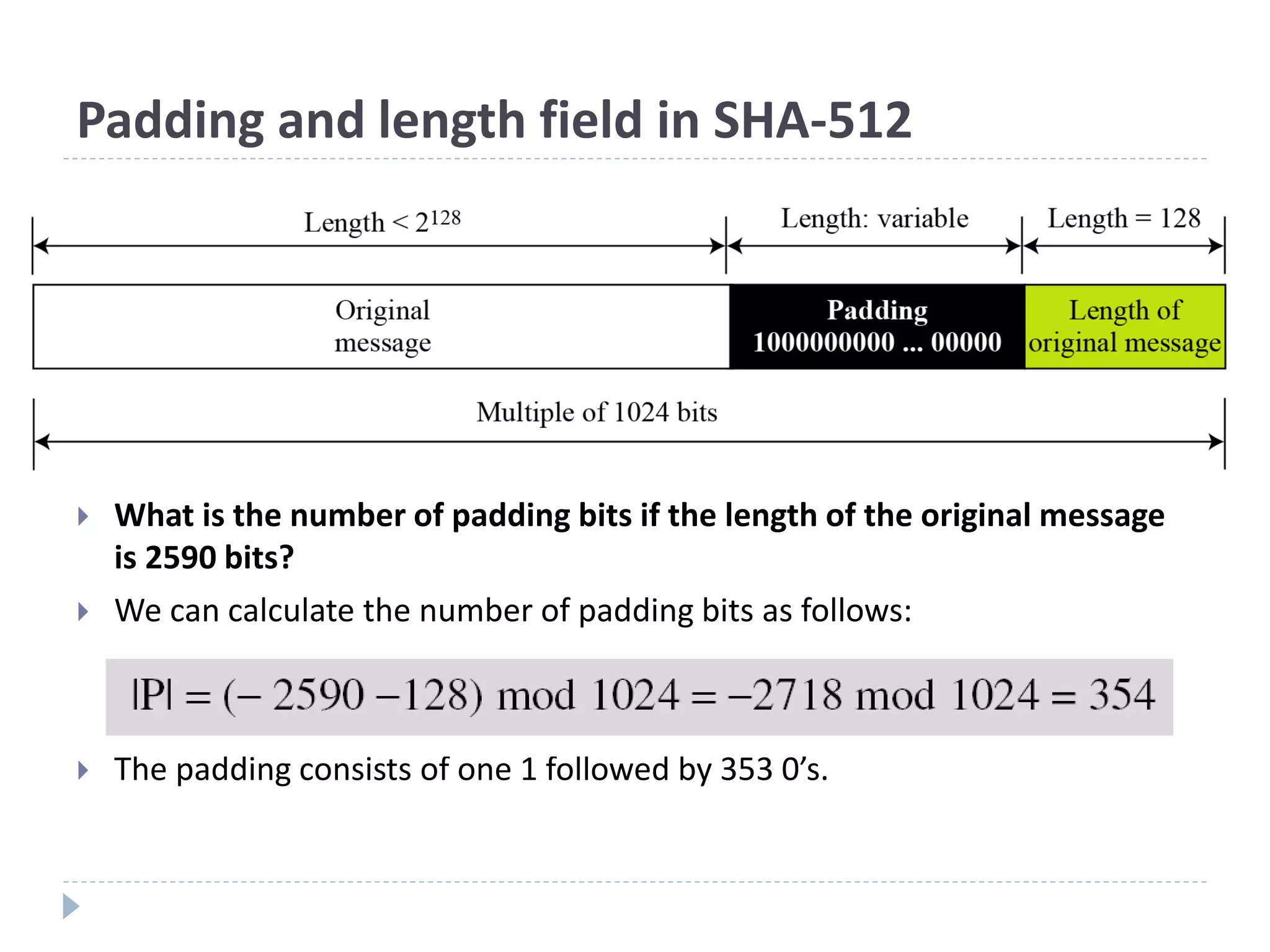
Padding and length field in SHA-512
 What is the number of padding bits if the length of the original message
is 2590 bits?
 We can calculate the number of padding bits as follows:
 The padding consists of one 1 followed by 353 0’s.
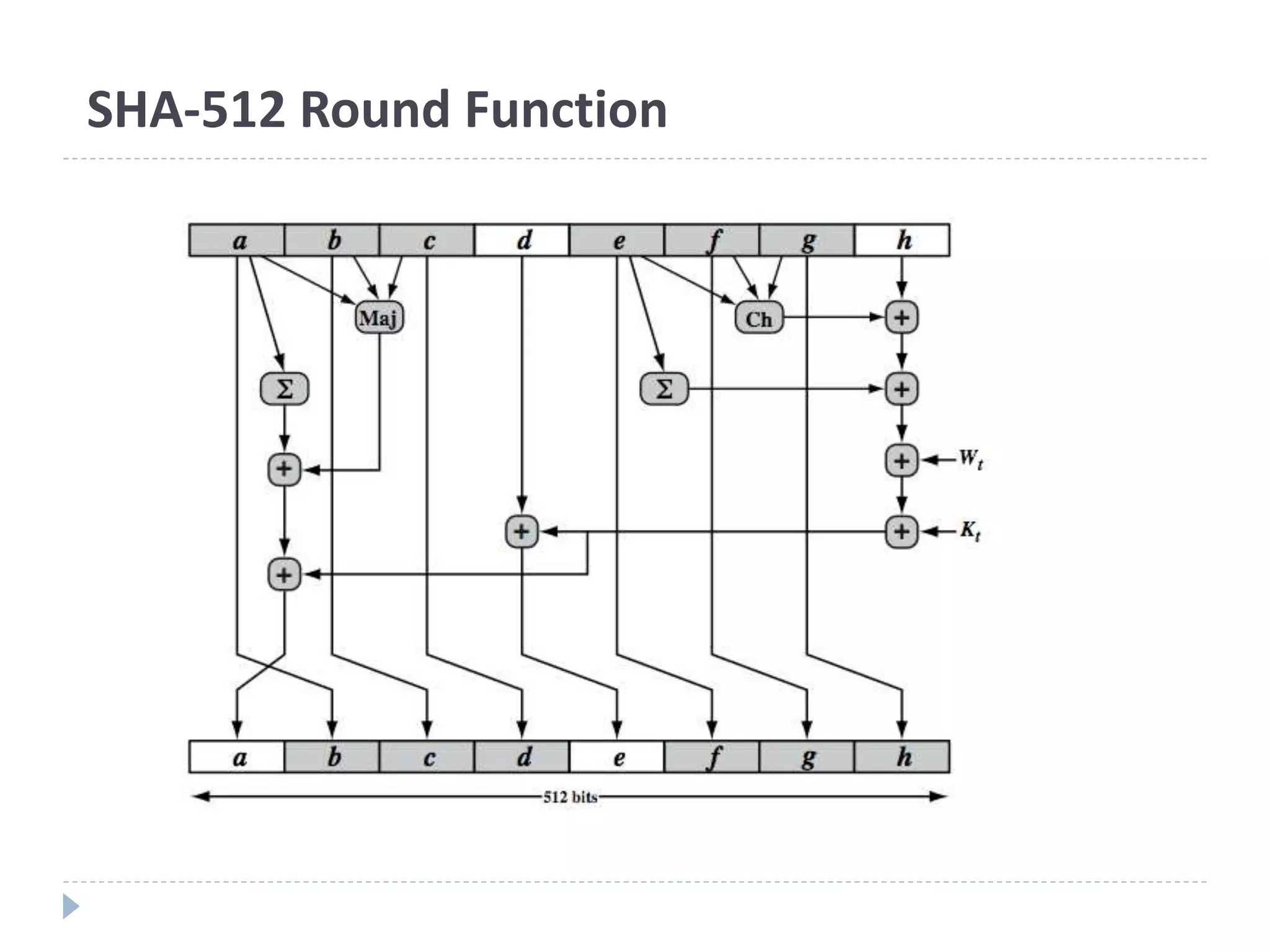
SHA-512 Round Function
Topics
 Overview of Cryptography Hash Function
 Usages
 Properties
 Hashing Function Structure
 MD5
 SHA
 Attack on Hash Function
 The Road to new Secure Hash Standard
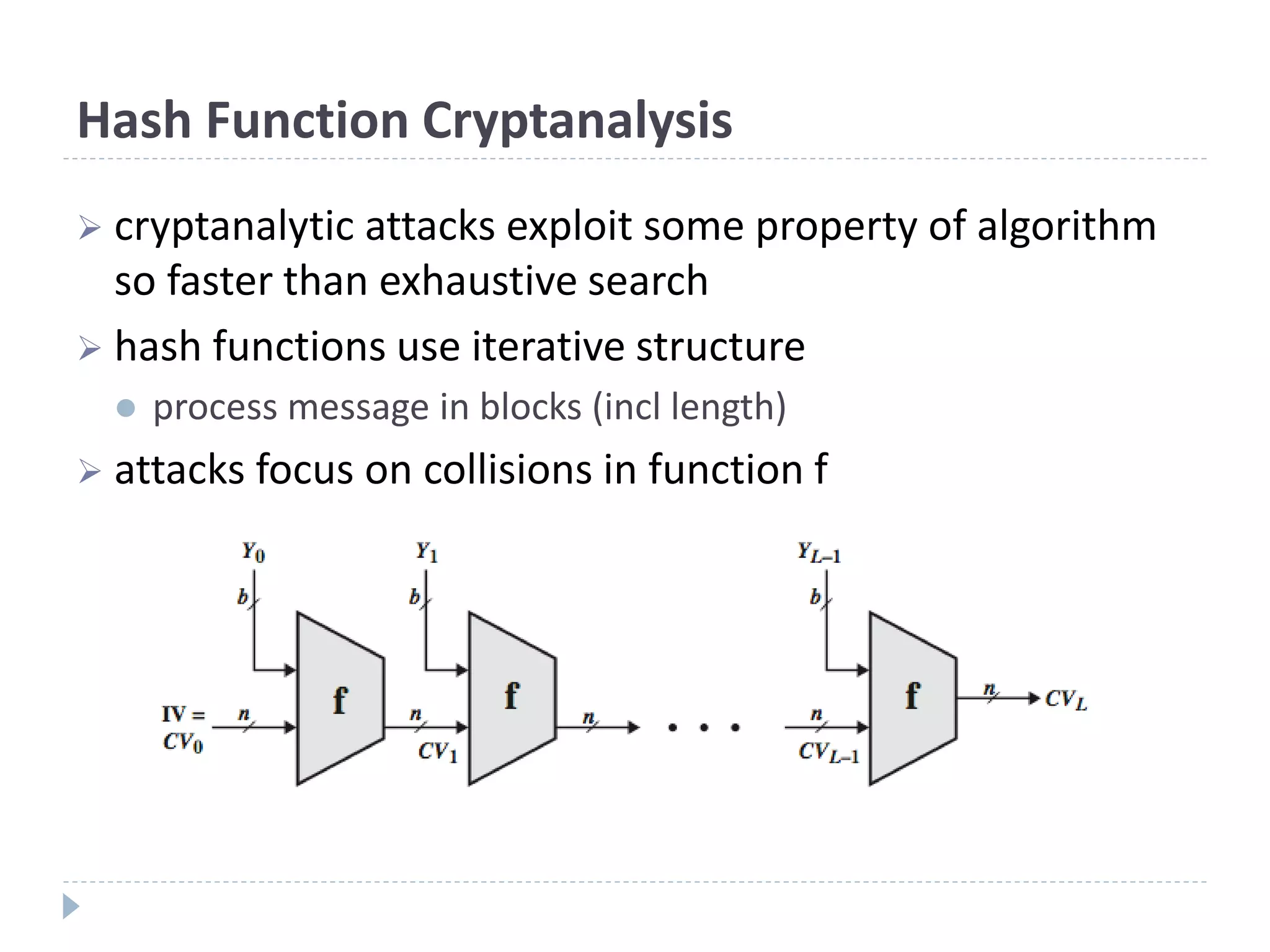
Hash Function Cryptanalysis
 cryptanalytic attacks exploit some property of algorithm
so faster than exhaustive search
 hash functions use iterative structure
 process message in blocks (incl length)
 attacks focus on collisions in function f
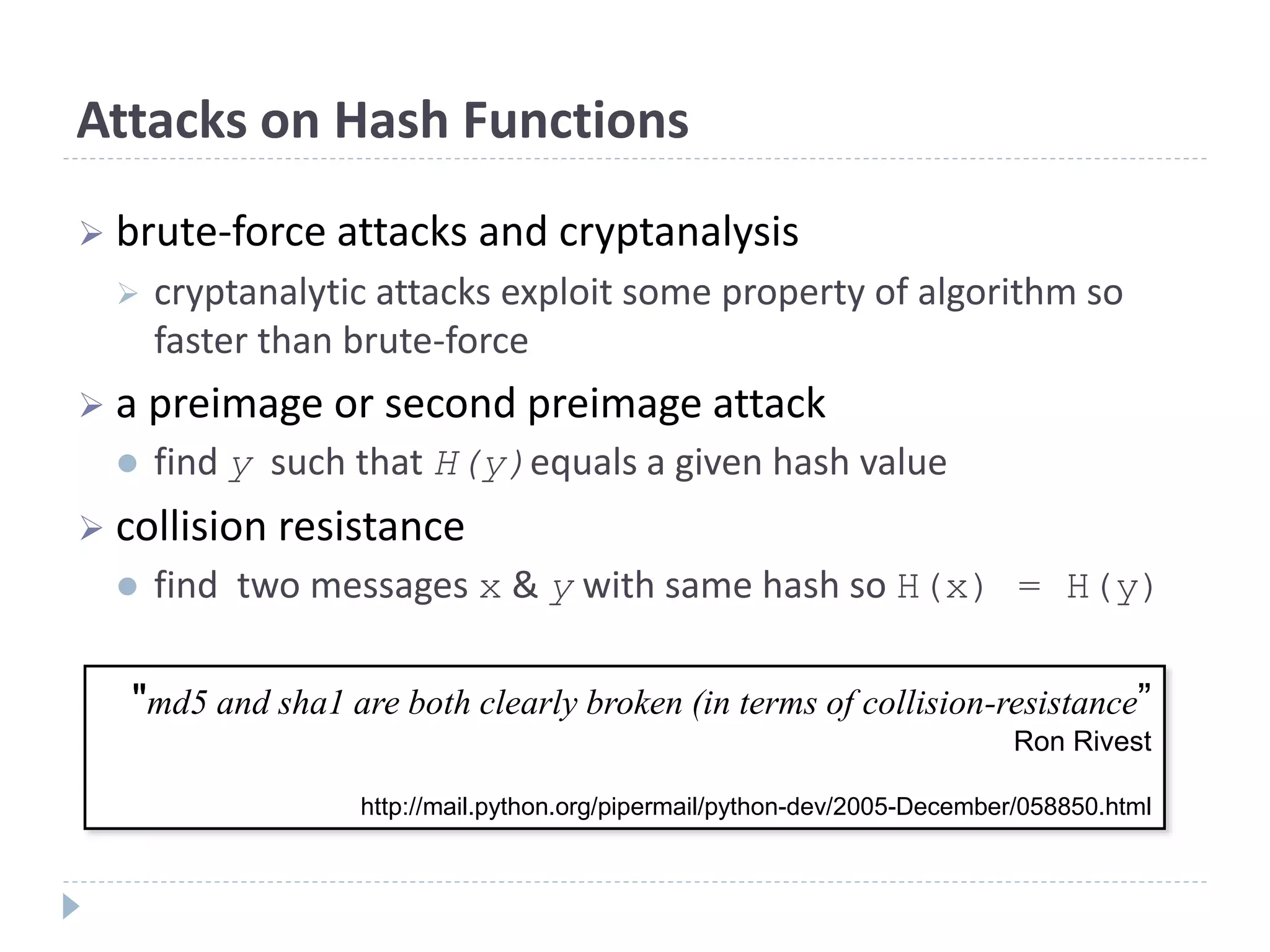
Attacks on Hash Functions
 brute-force attacks and cryptanalysis
 cryptanalytic attacks exploit some property of algorithm so
faster than brute-force
 a preimage or second preimage attack
 find y such that H(y)equals a given hash value
 collision resistance
 find two messages x & y with same hash so H(x) = H(y)
"md5 and sha1 are both clearly broken (in terms of collision-resistance”
Ron Rivest
http://mail.python.org/pipermail/python-dev/2005-December/058850.html
Topics
 Overview of Cryptography Hash Function
 Usages
 Properties
 Hashing Function Structure
 MD5
 SHA
 Attack on Hash Function
 The Road to new Secure Hash Standard
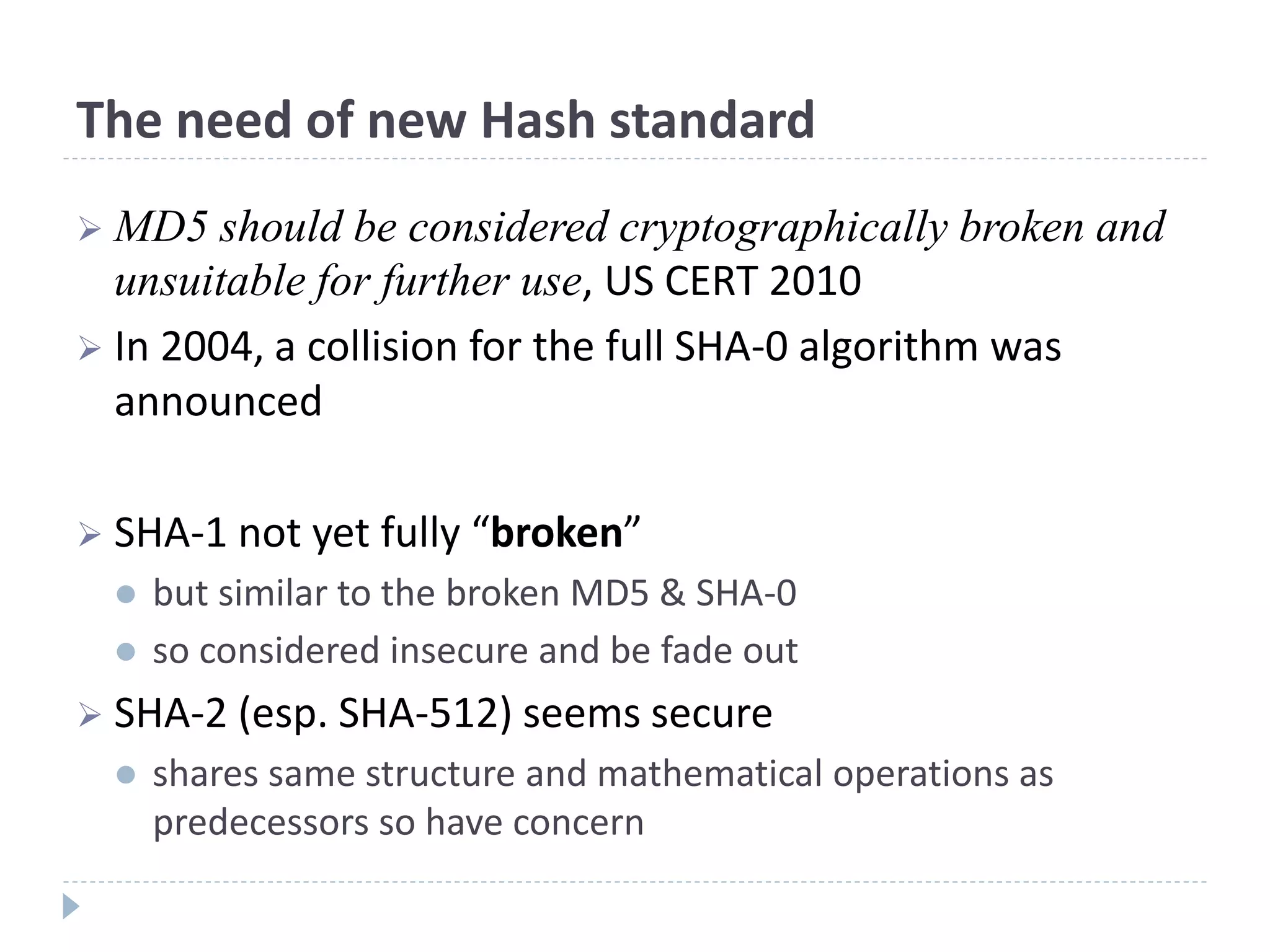
The need of new Hash standard
 MD5 should be considered cryptographically broken and
unsuitable for further use, US CERT 2010
 In 2004, a collision for the full SHA-0 algorithm was
announced
 SHA-1 not yet fully “broken”
 but similar to the broken MD5 & SHA-0
 so considered insecure and be fade out
 SHA-2 (esp. SHA-512) seems secure
 shares same structure and mathematical operations as
predecessors so have concern
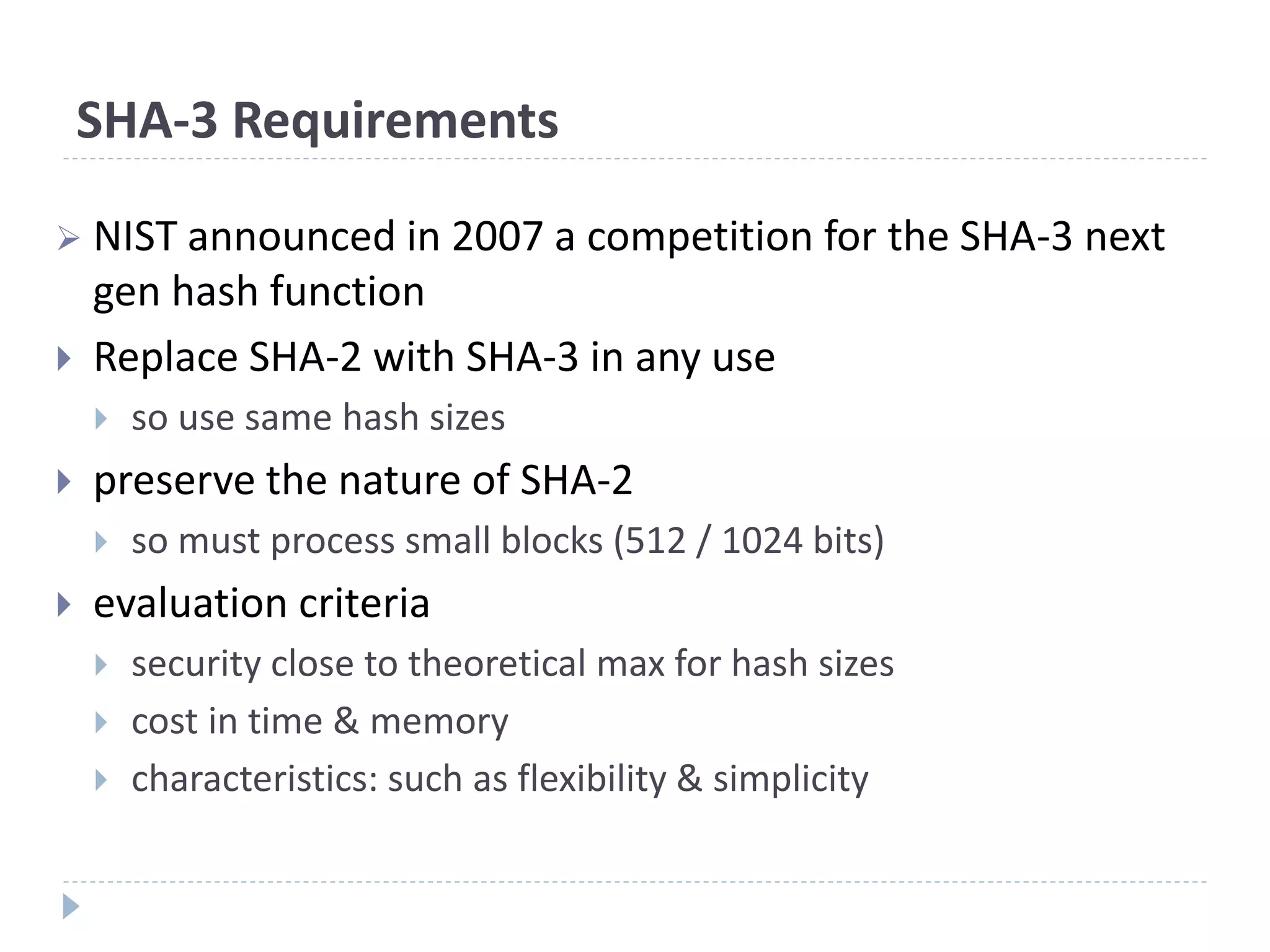
SHA-3 Requirements
 NIST announced in 2007 a competition for the SHA-3 next
gen hash function
 Replace SHA-2 with SHA-3 in any use
 so use same hash sizes
 preserve the nature of SHA-2
 so must process small blocks (512 / 1024 bits)
 evaluation criteria
 security close to theoretical max for hash sizes
 cost in time & memory
 characteristics: such as flexibility & simplicity
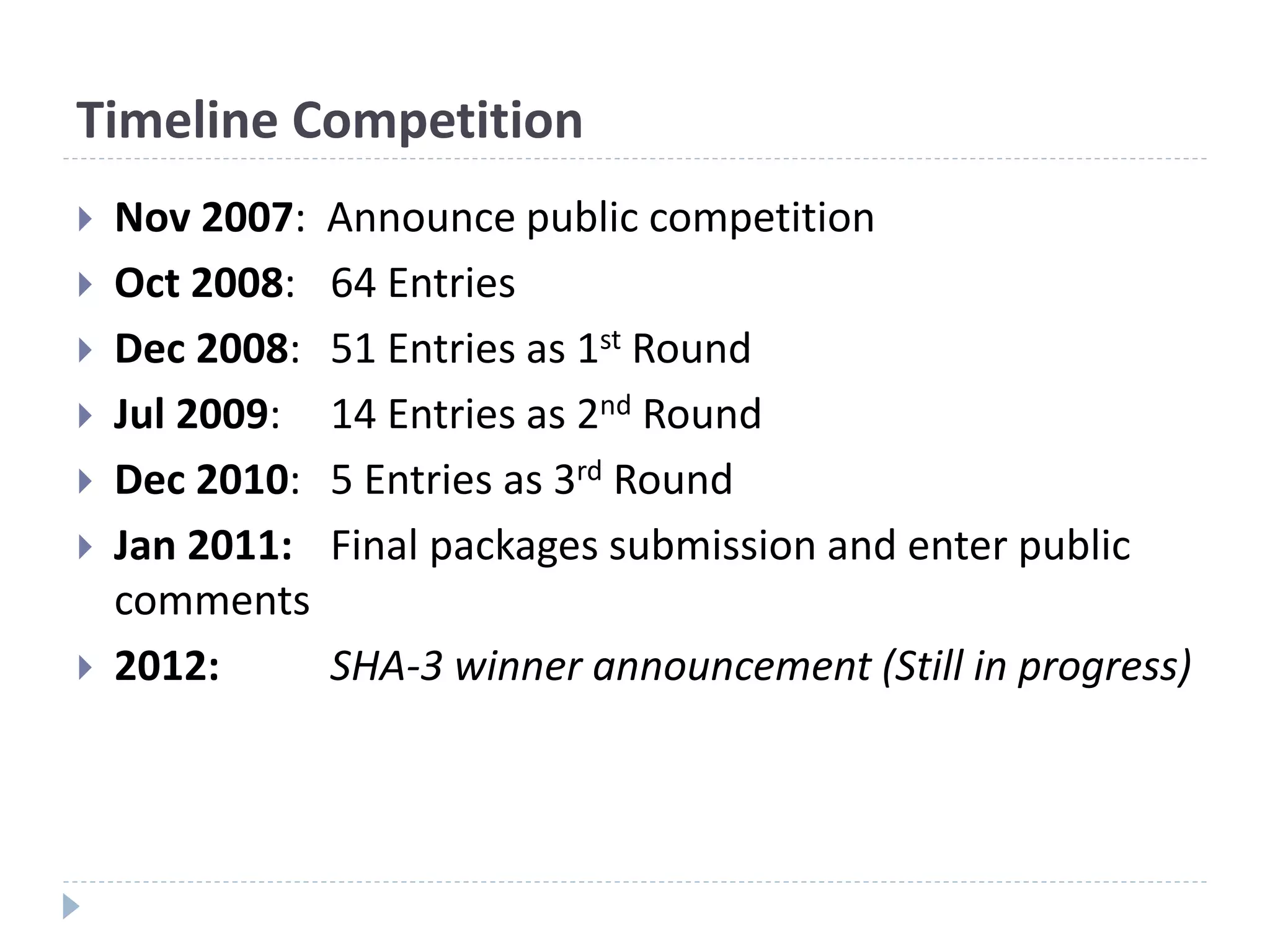
Timeline Competition
 Nov 2007: Announce public competition
 Oct 2008: 64 Entries
 Dec 2008: 51 Entries as 1st Round
 Jul 2009: 14 Entries as 2nd Round
 Dec 2010: 5 Entries as 3rd Round
 Jan 2011: Final packages submission and enter public
comments
 2012: SHA-3 winner announcement (Still in progress)
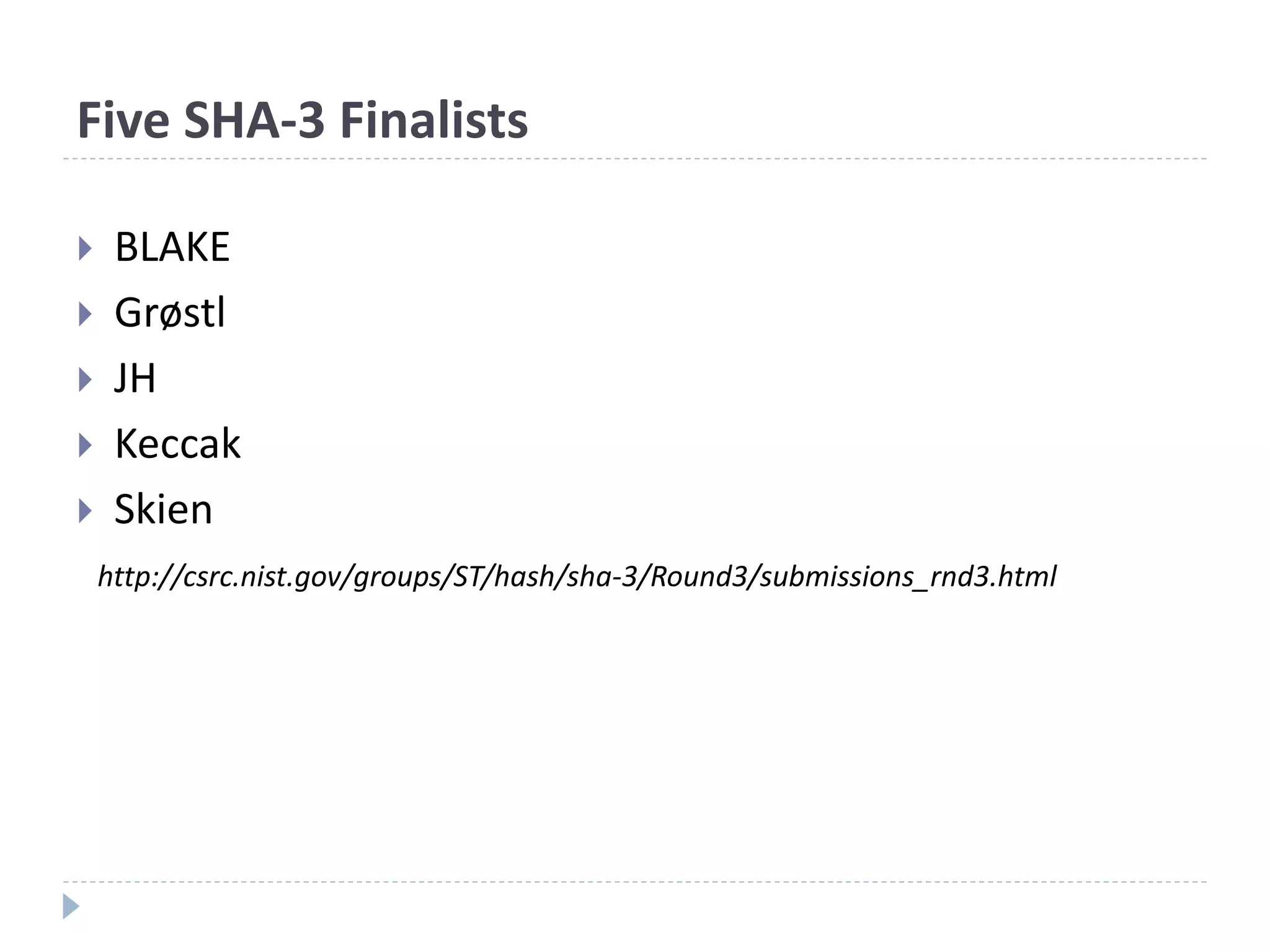
Five SHA-3 Finalists
 BLAKE
 Grøstl
 JH
 Keccak
 Skien
http://csrc.nist.gov/groups/ST/hash/sha-3/Round3/submissions_rnd3.html
Summary
 Hash functions are keyless
 Applications for digital signatures and in message authentication codes
 The three security requirements for hash functions are
 one-wayness, second preimage resistance and collision resistance
 MD5 and SHA-0 is insecure
 Serious security weaknesses have been found in SHA-1
 should be phased out
 SHA-2 appears to be secure
 May use SHA-512 and use the first 256 bytes
 The ongoing SHA-3 competition will result in new standardized
hash functions in a next year

01204427-Hash_Crypto (1).ppt

  • 1.
  • 2.
    Topics  Overview ofCryptography Hash Function  Usages  Properties  Hashing Function Structure  Attack on Hash Function  The Road to new Secure Hash Standard
  • 3.
    3 Hash Function  Thehash value represents concisely the longer message  may called the message digest  A message digest is as a ``digital fingerprint'' of the original document condenses arbitrary message to fixed size h = H(M)
  • 4.
    Chewing functions  Hashingfunction as “chewing” or “digest” function
  • 5.
    Hashing V.S. Encryption Hashing is one-way. There is no 'de-hashing’ Hello, world. A sample sentence to show encryption. E NhbXBsZSBzZW50ZW5jZS B0byBzaG93IEVuY3J5cHR pb24KsZSBzZ k Hello, world. A sample sentence to show encryption. D NhbXBsZSBzZW50ZW5jZS B0byBzaG93IEVuY3J5cHR pb24KsZSBzZ k  Encryption is two way, and requires a key to encrypt/decrypt h 52f21cf7c7034a20 17a21e17e061a863 This is a clear text that can easily read without using the key. The sentence is longer than the text above.
  • 6.
    Motivation for HashAlgorithms  Intuition  Limitation on non-cryptographic checksum  Very possible to construct a message that matches the checksum  Goal  Design a code where the original message can not be inferred based on its checksum  such that an accidental or intentional change to the message will change the hash value
  • 7.
    Hash Function Applications Used Alone  Fingerprint -- file integrity verification, public key fingerprint  Password storage (one-way encryption)  Combined with encryption functions  Hash based Message Authentication Code (HMAC)  protects both a message's integrity and confideltaility  Digital signature  Ensuring Non-repudiation  Encrypt hash with private (signing) key and verify with public (verification) key
  • 8.
    Integrity  to createa one-way password file  store hash of password not actual password  for intrusion detection and virus detection  keep & check hash of files on system
  • 9.
    Password Verification Iam#4VKU h 661dce0da2bcb2d8 2884e0162acf8194 Password store Store HashingPassword Iam#4VKU h 661dce0da2bcb2d8 2884e0162acf8194 661dce0da2bcb2d8 2884e0162acf8194 Password store Hash Matching Exactly? Grant Deny Yes No Verification an input password against the stored hash
  • 10.
    Topics  Overview ofCryptography Hash Function  Usages  Properties  Hashing Function Structure  Attack on Hash Function  The Road to new Secure Hash Standard
  • 11.
    Hash Function Usages(I) Message encrypted : Confidentiality and authentication Message unencrypted: Authentication
  • 12.
    Hash Function Usages(II) Message encrypted : Authentication (no encryption needed!) Message unencrypted: Authentication, confidentiality
  • 13.
    Hash Function Usages(III) Authentication, digital signature Authentication, digital signature, confidentiality
  • 14.
    Topics  Overview ofCryptography Hash Function  Usages  Properties  Hashing Function Structure  Attack on Hash Function  The Road to new Secure Hash Standard
  • 15.
    Hash Function Properties Arbitrary-length message to fixed-length digest  Preimage resistant (One-way property)  Second preimage resistant (Weak collision resistant)  Collision resistant (Strong collision resistance)
  • 16.
    Properties : Fixedlength  Arbitrary-length message to fixed-length digest h h Hello, world This is a clear text that can easily read without using the key. The sentence is longer than the text above. 52f21cf7c7034a20 17a21e17e061a863 Fixed length L 661dce0da2bcb2d8 2884e0162acf8194
  • 17.
    Preimage resistant  Thismeasures how difficult to devise a message which hashes to the known digest  Roughly speaking, the hash function must be one-way. Given only a message digest, can’t find any message (or preimage) that generates that digest.
  • 18.
    Second preimage resistant Given one message, can’t find another message that has the same message digest. An attack that finds a second message with the same message digest is a second pre-image attack.  It would be easy to forge new digital signatures from old signatures if the hash function used weren’t second preimage resistant  This measures how difficult to devise a message which hashes to the known digest and its message
  • 19.
    Collision Resistant  Can’tfind any two different messages with the same message digest  Collision resistance implies second preimage resistance  Collisions, if we could find them, would give signatories a way to repudiate their signatures
  • 20.
    Topics  Overview ofCryptography Hash Function  Usages  Properties  Hashing Function Structure  Attack on Hash Function  The Road to new Secure Hash Standard
  • 21.
    Two Group ofCompression Functions  The compression function is made from scratch  Message Digest  A symmetric-key block cipher serves as a compression function  Whirlpool
  • 22.
    Merkle-Damgard Scheme  Well-knownmethod to build cryptographic hash function  A message of arbitrary length is broken into blocks  length depends on the compression function f  padding the size of the message into a multiple of the block size.  sequentially process blocks , taking as input the result of the hash so far and the current message block, with the final fixed length output
  • 23.
    Hash Functions Family MD (Message Digest)  Designed by Ron Rivest  Family: MD2, MD4, MD5  SHA (Secure Hash Algorithm)  Designed by NIST  Family: SHA-0, SHA-1, and SHA-2  SHA-2: SHA-224, SHA-256, SHA-384, SHA-512  SHA-3: New standard in competition  RIPEMD (Race Integrity Primitive Evaluation Message Digest)  Developed by Katholieke University Leuven Team  Family : RIPEMD-128, RIPEMD-160, RIPEMD-256, RIPEMD-320
  • 24.
  • 25.
    MD2, MD4 andMD5  Family of one-way hash functions by Ronald Rivest  All produces 128 bits hash value  MD2: 1989  Optimized for 8 bit computer  Collision found in 1995  MD4: 1990  Full round collision attack found in 1995  MD5: 1992  Specified as Internet standard in RFC 1321  since 1997 it was theoretically not so hard to create a collision  Practical Collision MD5 has been broken since 2004  CA attack published in 2007
  • 26.
  • 27.
    Topics  Overview ofCryptography Hash Function  Usages  Properties  Hashing Function Structure  MD5  SHA  Attack on Hash Function  The Road to new Secure Hash Standard
  • 28.
    MD5 Overview 1. Appendpadding bits (to 448 mod 512) 2. Append length (64bits) 3. Initialize MD buffer (4x32 bits Word) Word A = 01 23 45 67 Word B = 89 AB CD EF Word C = FE DC BA 98 Word D = 76 54 32 10
  • 29.
    Hash Algorithm Design– MD5 16 steps Constructed from sine function X[k] = M [q*16+k] (32 bit)
  • 30.
    The ith 32-bitword in matrix T, constructed from the sine function M [q*16+k] = the kth 32-bit word from the qth 512-bit block of the msg Single step
  • 31.
    Topics  Overview ofCryptography Hash Function  Usages  Properties  Hashing Function Structure  MD5  SHA  Attack on Hash Function  The Road to new Secure Hash Standard
  • 32.
    Secure Hash Algorithm SHA originally designed by NIST & NSA in 1993  revised in 1995 as SHA-1  US standard for use with DSA signature scheme  standard is FIPS 180-1 1995, also Internet RFC3174  based on design of MD4 with key differences  produces 160-bit hash values  recent 2005 results on security of SHA-1 have raised concerns on its use in future applications
  • 33.
    Revised SHA  NISTissued revision FIPS 180-2 in 2002  adds 3 additional versions of SHA  SHA-256, SHA-384, SHA-512  designed for compatibility with increased security provided by the AES cipher  structure & detail is similar to SHA-1  hence analysis should be similar  but security levels are rather higher
  • 34.
    SHA Versions MD5 SHA-0SHA-1 SHA-224 SHA-256 SHA-384 SHA-512 Digest size 128 160 160 224 256 384 512 Message size 264-1 264-1 264-1 264 -1 264-1 2128-1 2128-1 Block size 512 512 512 512 512 1024 1024 Word size 32 32 32 32 32 64 64 # of steps 64 64 80 64 64 80 80 Full collision found
  • 35.
    Sample Processing  MacIntel 2.66 Ghz core i7  1024 bytes block of data Type bits data processed MD5 128 469.7 MB/s SHA-1 160 339.4 MB/s SHA-512 512 177.7 MB/s
  • 36.
  • 37.
    Padding and lengthfield in SHA-512  What is the number of padding bits if the length of the original message is 2590 bits?  We can calculate the number of padding bits as follows:  The padding consists of one 1 followed by 353 0’s.
  • 38.
  • 39.
    Topics  Overview ofCryptography Hash Function  Usages  Properties  Hashing Function Structure  MD5  SHA  Attack on Hash Function  The Road to new Secure Hash Standard
  • 40.
    Hash Function Cryptanalysis cryptanalytic attacks exploit some property of algorithm so faster than exhaustive search  hash functions use iterative structure  process message in blocks (incl length)  attacks focus on collisions in function f
  • 41.
    Attacks on HashFunctions  brute-force attacks and cryptanalysis  cryptanalytic attacks exploit some property of algorithm so faster than brute-force  a preimage or second preimage attack  find y such that H(y)equals a given hash value  collision resistance  find two messages x & y with same hash so H(x) = H(y) "md5 and sha1 are both clearly broken (in terms of collision-resistance” Ron Rivest http://mail.python.org/pipermail/python-dev/2005-December/058850.html
  • 42.
    Topics  Overview ofCryptography Hash Function  Usages  Properties  Hashing Function Structure  MD5  SHA  Attack on Hash Function  The Road to new Secure Hash Standard
  • 43.
    The need ofnew Hash standard  MD5 should be considered cryptographically broken and unsuitable for further use, US CERT 2010  In 2004, a collision for the full SHA-0 algorithm was announced  SHA-1 not yet fully “broken”  but similar to the broken MD5 & SHA-0  so considered insecure and be fade out  SHA-2 (esp. SHA-512) seems secure  shares same structure and mathematical operations as predecessors so have concern
  • 44.
    SHA-3 Requirements  NISTannounced in 2007 a competition for the SHA-3 next gen hash function  Replace SHA-2 with SHA-3 in any use  so use same hash sizes  preserve the nature of SHA-2  so must process small blocks (512 / 1024 bits)  evaluation criteria  security close to theoretical max for hash sizes  cost in time & memory  characteristics: such as flexibility & simplicity
  • 45.
    Timeline Competition  Nov2007: Announce public competition  Oct 2008: 64 Entries  Dec 2008: 51 Entries as 1st Round  Jul 2009: 14 Entries as 2nd Round  Dec 2010: 5 Entries as 3rd Round  Jan 2011: Final packages submission and enter public comments  2012: SHA-3 winner announcement (Still in progress)
  • 46.
    Five SHA-3 Finalists BLAKE  Grøstl  JH  Keccak  Skien http://csrc.nist.gov/groups/ST/hash/sha-3/Round3/submissions_rnd3.html
  • 47.
    Summary  Hash functionsare keyless  Applications for digital signatures and in message authentication codes  The three security requirements for hash functions are  one-wayness, second preimage resistance and collision resistance  MD5 and SHA-0 is insecure  Serious security weaknesses have been found in SHA-1  should be phased out  SHA-2 appears to be secure  May use SHA-512 and use the first 256 bytes  The ongoing SHA-3 competition will result in new standardized hash functions in a next year