




HASH FUNCTION
BY
STALIN RIJAL
DATE : 5-MAY-2018
CONTENT :
 HASH FUNCTION
 MD5
 ONE WAY SIGNATURE
HASH FUNCTION :
 A hash function is any function that can be used to map data of
arbitrary size to data of fixed size.
 The values returned by a hash function are called hash values,
hash codes, digests, or simply hashes.
 A hash value is a numeric value of a fixed length that uniquely
identifies data.
 There are different hash functions MD4,MD5,SHA,SHS,etc,.
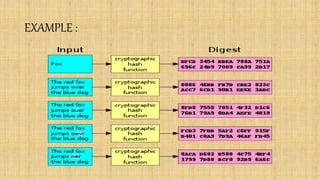
EXAMPLE :
PROPERTIES :
 The hash size is always fixed i.e. output of hash has fixed size.
 Hash function is non reversible i.e. mathematically it cant be
reversed.
 Hash results cant collide. Means if I have two different inputs the
output cant be same.
 If we change even one bit of the string(or input) from right of left
entire hash should change.
 deterministic so the same message always results in the same hash.
MD5 (MESSAGE DIGEST 5) :
 It takes as input a message of arbitrary length and produces
as output a 128 bit “fingerprint” or “message digest” of the
input.
 The MD5 algorithm is intended for digital signature applications,
where a large file must be “compressed” in secure manner before
being encrypted with private-key under a public-key.
 MD5 is used to store hash passwords and verify when user login.
 An intruder can see the hashes of passwords, even if he accessed
the password.
DRAWBACKS :
 In 1993 a hash collision was found in MD5 compression function.
 In 2009 a preimage attack against MD5 was published that breaks
MD5’s preimage resistance.
 In 2012, the most infamous attack happened by the Flame Malware.
The CMU software Engineering Instute considers MD5
“cryptographically broken and unsuitable for further use”.
ONE WAY SIGNATURE :
 Method of generating chain of signature on the same message
by different users.
 Each signature acts as a link of chain and any link can be
added easily to the chain.
 Computationally infeasible to remove any intermediate link
from chain without removing all the links.
 They are similar to proxy signature.
 They are completely non interactive and stateless.
Hash Function
Hash Function

Hash Function

  • 1.
  • 2.
    CONTENT :  HASHFUNCTION  MD5  ONE WAY SIGNATURE
  • 3.
    HASH FUNCTION : A hash function is any function that can be used to map data of arbitrary size to data of fixed size.  The values returned by a hash function are called hash values, hash codes, digests, or simply hashes.  A hash value is a numeric value of a fixed length that uniquely identifies data.  There are different hash functions MD4,MD5,SHA,SHS,etc,.
  • 4.
  • 5.
    PROPERTIES :  Thehash size is always fixed i.e. output of hash has fixed size.  Hash function is non reversible i.e. mathematically it cant be reversed.  Hash results cant collide. Means if I have two different inputs the output cant be same.  If we change even one bit of the string(or input) from right of left entire hash should change.  deterministic so the same message always results in the same hash.
  • 6.
    MD5 (MESSAGE DIGEST5) :  It takes as input a message of arbitrary length and produces as output a 128 bit “fingerprint” or “message digest” of the input.  The MD5 algorithm is intended for digital signature applications, where a large file must be “compressed” in secure manner before being encrypted with private-key under a public-key.  MD5 is used to store hash passwords and verify when user login.  An intruder can see the hashes of passwords, even if he accessed the password.
  • 7.
    DRAWBACKS :  In1993 a hash collision was found in MD5 compression function.  In 2009 a preimage attack against MD5 was published that breaks MD5’s preimage resistance.  In 2012, the most infamous attack happened by the Flame Malware. The CMU software Engineering Instute considers MD5 “cryptographically broken and unsuitable for further use”.
  • 8.
    ONE WAY SIGNATURE:  Method of generating chain of signature on the same message by different users.  Each signature acts as a link of chain and any link can be added easily to the chain.  Computationally infeasible to remove any intermediate link from chain without removing all the links.  They are similar to proxy signature.  They are completely non interactive and stateless.