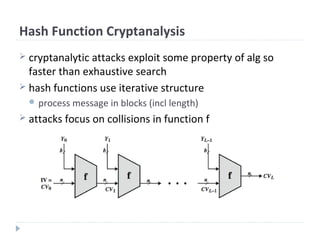
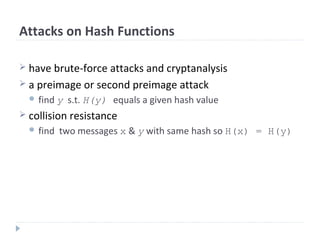
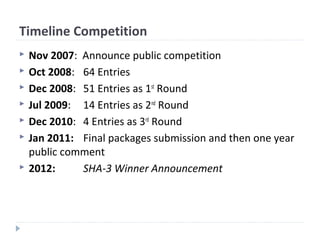
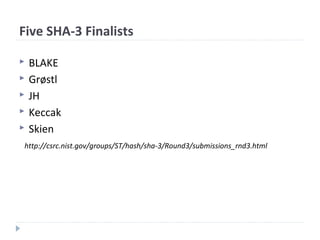
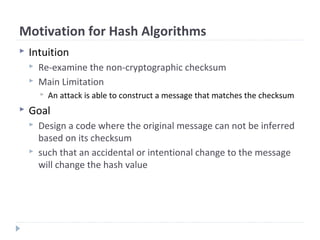
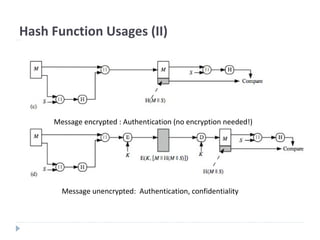
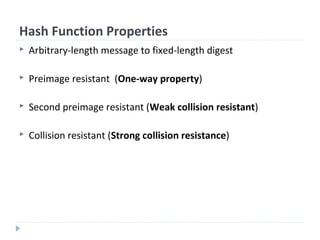
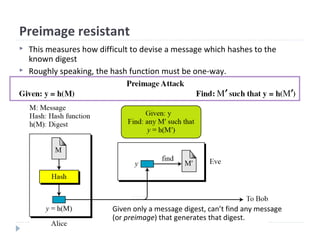
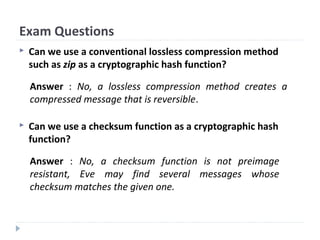
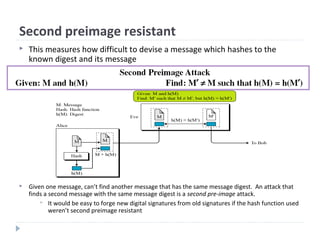
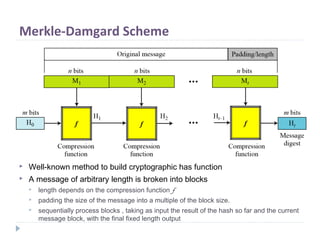
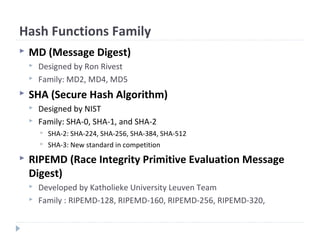
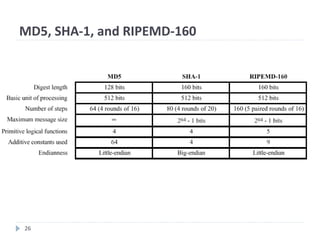
The document discusses cryptographic hash functions, including an overview of their usage, properties, structures, attacks, and the development of standards. Hash functions take an arbitrary-length message and generate a fixed-length digest. They are used for applications like file integrity verification, password storage, and digital signatures. Key properties include producing the same hash for identical messages, and being preimage and collision resistant. Common hash functions are based on the Merkle-Damgard structure and use compression functions. Attacks like birthday attacks aim to find collisions by processing many messages. Due to attacks on MD5 and concerns about SHA-1, NIST is developing a new secure hash standard called SHA-3.










![Hash Algorithm Design – MD5
16 steps
Constructed from sine function
X[k] = M [q*16+k] (32 bit)](https://image.slidesharecdn.com/oks4ygn4seersvk0x1vo-signature-e6fcfd5a192390df9100ea3587becb4b56983dc3733d111cb0f898469f53c17e-poli-160425171239/85/Hash-crypto-31-320.jpg)
![The ith 32-bit word in matrix T, constructed from the sine function
M [q*16+k] = the kth 32-bit word from the qth 512-bit block of the msg
Single step](https://image.slidesharecdn.com/oks4ygn4seersvk0x1vo-signature-e6fcfd5a192390df9100ea3587becb4b56983dc3733d111cb0f898469f53c17e-poli-160425171239/85/Hash-crypto-32-320.jpg)