MESSAGEPresented by Aswathy Chandrakumar
Lalitha M
 Meaning
 Dimensions of Message
 Characteristics of a good
message
 Message treatment strategies
and effectiveness
 Distortion of Message
A message is the facts, feelings, impressions,
attitude, information etc., that a communicator
wishes his audience to receive, understand,
accept and act upon.
Information which is relevant to a particular set
of audience constitute the message, otherwise
for them this is noise.
A good message should clearly state what to
do, how to do, when to do and what would be
the result.
The message must be motivating.
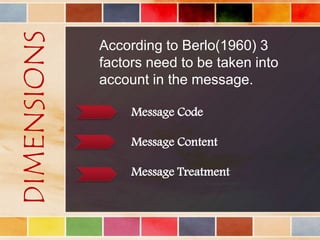
DIMENSIONS According to Berlo(1960) 3
factors need to be taken into
account in the message.
Message Code
Message Content
Message Treatment
MESSAGE CODE
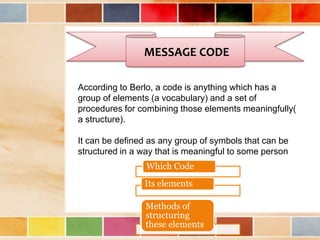
According to Berlo, a code is anything which has a
group of elements (a vocabulary) and a set of
procedures for combining those elements meaningfully(
a structure).
It can be defined as any group of symbols that can be
structured in a way that is meaningful to some person
Which Code
Its elements
Methods of
structuring
these elements
MESSAGE CONTENT
Content is the material in the
message selected by the
source to express his
purpose.
It has both elements and
structure.
MESSAGE TREATMENT
Decisions made by the communication
source in selecting and arranging both
code and content in order to achieve
comprehension on the part of
receivers.
Decisions made by source on how to
deliver his message
CHARACTERISTICS OF A
GOOD MESSAGE
In line with the objective to be
attained
Clearly understood by the
audience
In line with the mental, social,
economic and physical
capabilities of the audience.
LEAGANS
VIEWS
Significant- economically,
socially, or aesthetically to
the needs, interests and
values of the audience.
Specific
Simply stated- covering few
pertinent points at a time.
Accurate-scientifically
sound, factual and
current.
Timely
Supported by factual
material covering both
sides of the argument.
Appropriate to the channel
selected.
Appealing and attractive to the
audience- having utility and
immediate use.
Applicable- can apply
recommendation to one’s own
particular situation.
Adequate- combining principles
and practices in effective
proportion.
Manageable- can be handled by
the communicator and within the
limits of time and resources.
MESSAGE
TREATMENT
AND
EFFECTIVENESS
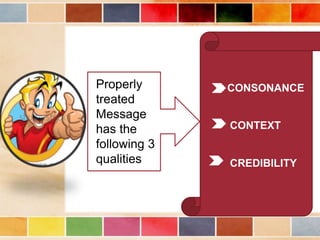
Properly
treated
Message
has the
following 3
qualities
CONSONANCE
CONTEXT
CREDIBILITY
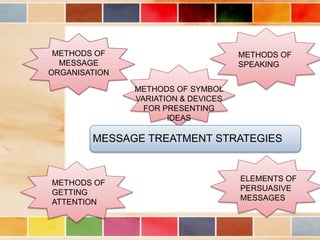
MESSAGE TREATMENT STRATEGIES
METHODS OF
MESSAGE
ORGANISATION
METHODS OF
GETTING
ATTENTION
METHODS OF
SPEAKING
ELEMENTS OF
PERSUASIVE
MESSAGES
METHODS OF SYMBOL
VARIATION & DEVICES
FOR PRESENTING
IDEAS
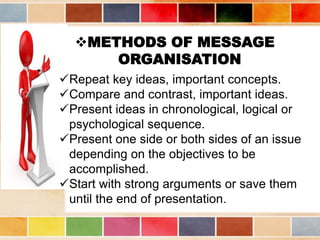
METHODS OF MESSAGE
ORGANISATION
Repeat key ideas, important concepts.
Compare and contrast, important ideas.
Present ideas in chronological, logical or
psychological sequence.
Present one side or both sides of an issue
depending on the objectives to be
accomplished.
Start with strong arguments or save them
until the end of presentation.
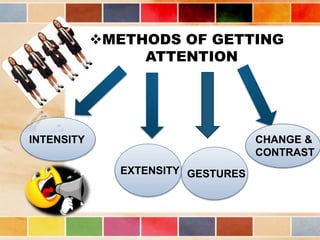
METHODS OF GETTING
ATTENTION
INTENSITY
EXTENSITY GESTURES
CHANGE &
CONTRAST
METHODS OF SPEAKING
Few ideas at a time
Be yourself
Do not read your speech
Know the audience
Keep the communication
interesting
Avoid Condemning
ELEMENTS OF PERSUASIVE
MESSAGES
According to Burgoon and Burgoon(1975), general
rules for preparing a persuasive message-
 Evidence is effective only if receiver was
previously not aware of it
 Credibility of Communicator
 Evidence must be presented well
 If audience is in initial agreement with the
message, one-sided message may suffice.
Otherwise two- sided message.
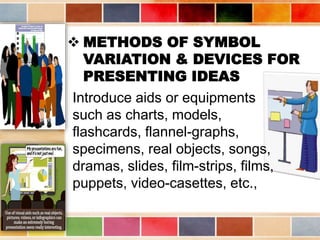
 METHODS OF SYMBOL
VARIATION & DEVICES FOR
PRESENTING IDEAS
Introduce aids or equipments
such as charts, models,
flashcards, flannel-graphs,
specimens, real objects, songs,
dramas, slides, film-strips, films,
puppets, video-casettes, etc.,
MESSAGE
EFFICIENCY
The Relative utility of the message to the
receiver together with the relative ease or
difficulty of the receiver’s comprehension
of the message may be considered.
Efficiency of any message is thus
encounter- specific.
In another study, it was found that a
simple message is better understood and
retained longer.
MESSAGE DISTORTION
According to Kirk (1953), distortion of
information may be of three fundamentally
different kinds.
1.SYSTEMATIC OR STRETCH
DISTORTION
2.FOG DISTORTION
3.MIRAGE DISTORTION
SYSTEMATIC DISTORTION
 No information is lost
 Changed or recorded in a
systematic way
 Useful for extension workers
for effective treatment of the
message.
FOG DISTORTION
Information is lost,
masked or fogged over
because of the inability
of the communicator to
encode or the inability
of the receiver to
decode the message
with complete fidelity.
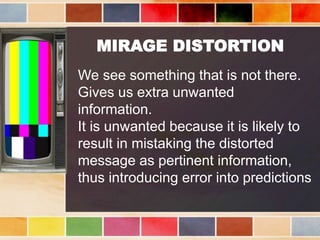
MIRAGE DISTORTION
We see something that is not there.
Gives us extra unwanted
information.
It is unwanted because it is likely to
result in mistaking the distorted
message as pertinent information,
thus introducing error into predictions
REFERENCES :
1. Anoop Singh Sandhu;Textbook on
Agricultural Communication:Process and
Methods
2. G.L.Ray;Extension Communication and
management
3. www.google.com
Message

Message

  • 1.
    MESSAGEPresented by AswathyChandrakumar Lalitha M
  • 2.
     Meaning  Dimensionsof Message  Characteristics of a good message  Message treatment strategies and effectiveness  Distortion of Message
  • 3.
    A message isthe facts, feelings, impressions, attitude, information etc., that a communicator wishes his audience to receive, understand, accept and act upon. Information which is relevant to a particular set of audience constitute the message, otherwise for them this is noise. A good message should clearly state what to do, how to do, when to do and what would be the result. The message must be motivating.
  • 4.
    DIMENSIONS According toBerlo(1960) 3 factors need to be taken into account in the message. Message Code Message Content Message Treatment
  • 5.
    MESSAGE CODE According toBerlo, a code is anything which has a group of elements (a vocabulary) and a set of procedures for combining those elements meaningfully( a structure). It can be defined as any group of symbols that can be structured in a way that is meaningful to some person Which Code Its elements Methods of structuring these elements
  • 6.
    MESSAGE CONTENT Content isthe material in the message selected by the source to express his purpose. It has both elements and structure.
  • 7.
    MESSAGE TREATMENT Decisions madeby the communication source in selecting and arranging both code and content in order to achieve comprehension on the part of receivers. Decisions made by source on how to deliver his message
  • 8.
  • 9.
    In line withthe objective to be attained Clearly understood by the audience In line with the mental, social, economic and physical capabilities of the audience. LEAGANS VIEWS
  • 10.
    Significant- economically, socially, oraesthetically to the needs, interests and values of the audience. Specific Simply stated- covering few pertinent points at a time.
  • 11.
    Accurate-scientifically sound, factual and current. Timely Supportedby factual material covering both sides of the argument.
  • 12.
    Appropriate to thechannel selected. Appealing and attractive to the audience- having utility and immediate use. Applicable- can apply recommendation to one’s own particular situation.
  • 13.
    Adequate- combining principles andpractices in effective proportion. Manageable- can be handled by the communicator and within the limits of time and resources.
  • 14.
  • 15.
  • 16.
    MESSAGE TREATMENT STRATEGIES METHODSOF MESSAGE ORGANISATION METHODS OF GETTING ATTENTION METHODS OF SPEAKING ELEMENTS OF PERSUASIVE MESSAGES METHODS OF SYMBOL VARIATION & DEVICES FOR PRESENTING IDEAS
  • 17.
    METHODS OF MESSAGE ORGANISATION Repeatkey ideas, important concepts. Compare and contrast, important ideas. Present ideas in chronological, logical or psychological sequence. Present one side or both sides of an issue depending on the objectives to be accomplished. Start with strong arguments or save them until the end of presentation.
  • 18.
  • 19.
    METHODS OF SPEAKING Fewideas at a time Be yourself Do not read your speech Know the audience Keep the communication interesting Avoid Condemning
  • 20.
    ELEMENTS OF PERSUASIVE MESSAGES Accordingto Burgoon and Burgoon(1975), general rules for preparing a persuasive message-  Evidence is effective only if receiver was previously not aware of it  Credibility of Communicator  Evidence must be presented well  If audience is in initial agreement with the message, one-sided message may suffice. Otherwise two- sided message.
  • 21.
     METHODS OFSYMBOL VARIATION & DEVICES FOR PRESENTING IDEAS Introduce aids or equipments such as charts, models, flashcards, flannel-graphs, specimens, real objects, songs, dramas, slides, film-strips, films, puppets, video-casettes, etc.,
  • 22.
  • 23.
    The Relative utilityof the message to the receiver together with the relative ease or difficulty of the receiver’s comprehension of the message may be considered. Efficiency of any message is thus encounter- specific. In another study, it was found that a simple message is better understood and retained longer.
  • 24.
  • 25.
    According to Kirk(1953), distortion of information may be of three fundamentally different kinds. 1.SYSTEMATIC OR STRETCH DISTORTION 2.FOG DISTORTION 3.MIRAGE DISTORTION
  • 26.
    SYSTEMATIC DISTORTION  Noinformation is lost  Changed or recorded in a systematic way  Useful for extension workers for effective treatment of the message.
  • 27.
    FOG DISTORTION Information islost, masked or fogged over because of the inability of the communicator to encode or the inability of the receiver to decode the message with complete fidelity.
  • 28.
    MIRAGE DISTORTION We seesomething that is not there. Gives us extra unwanted information. It is unwanted because it is likely to result in mistaking the distorted message as pertinent information, thus introducing error into predictions
  • 29.
    REFERENCES : 1. AnoopSingh Sandhu;Textbook on Agricultural Communication:Process and Methods 2. G.L.Ray;Extension Communication and management 3. www.google.com