
WHITE PAPER ON COMMUNICATION AND PRESENTATION SKILLS


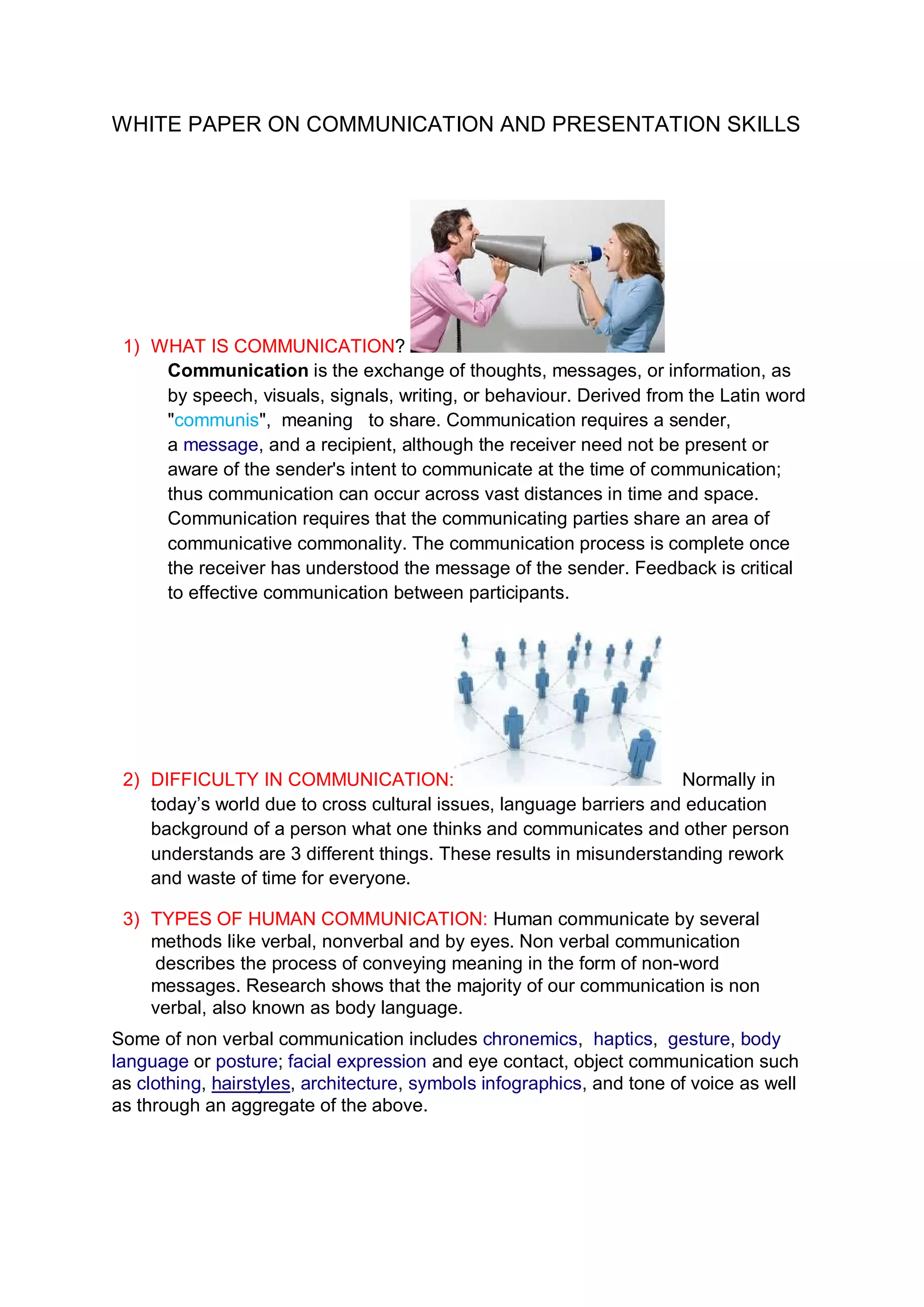
 1) WHAT IS COMMUNICATION?
     Communication is the exchange of thoughts, messages, or information, as
     by speech, visuals, signals, writing, or behaviour. Derived from the Latin word
     "communis", meaning to share. Communication requires a sender,
     a message, and a recipient, although the receiver need not be present or
     aware of the sender's intent to communicate at the time of communication;
     thus communication can occur across vast distances in time and space.
     Communication requires that the communicating parties share an area of
     communicative commonality. The communication process is complete once
     the receiver has understood the message of the sender. Feedback is critical
     to effective communication between participants.


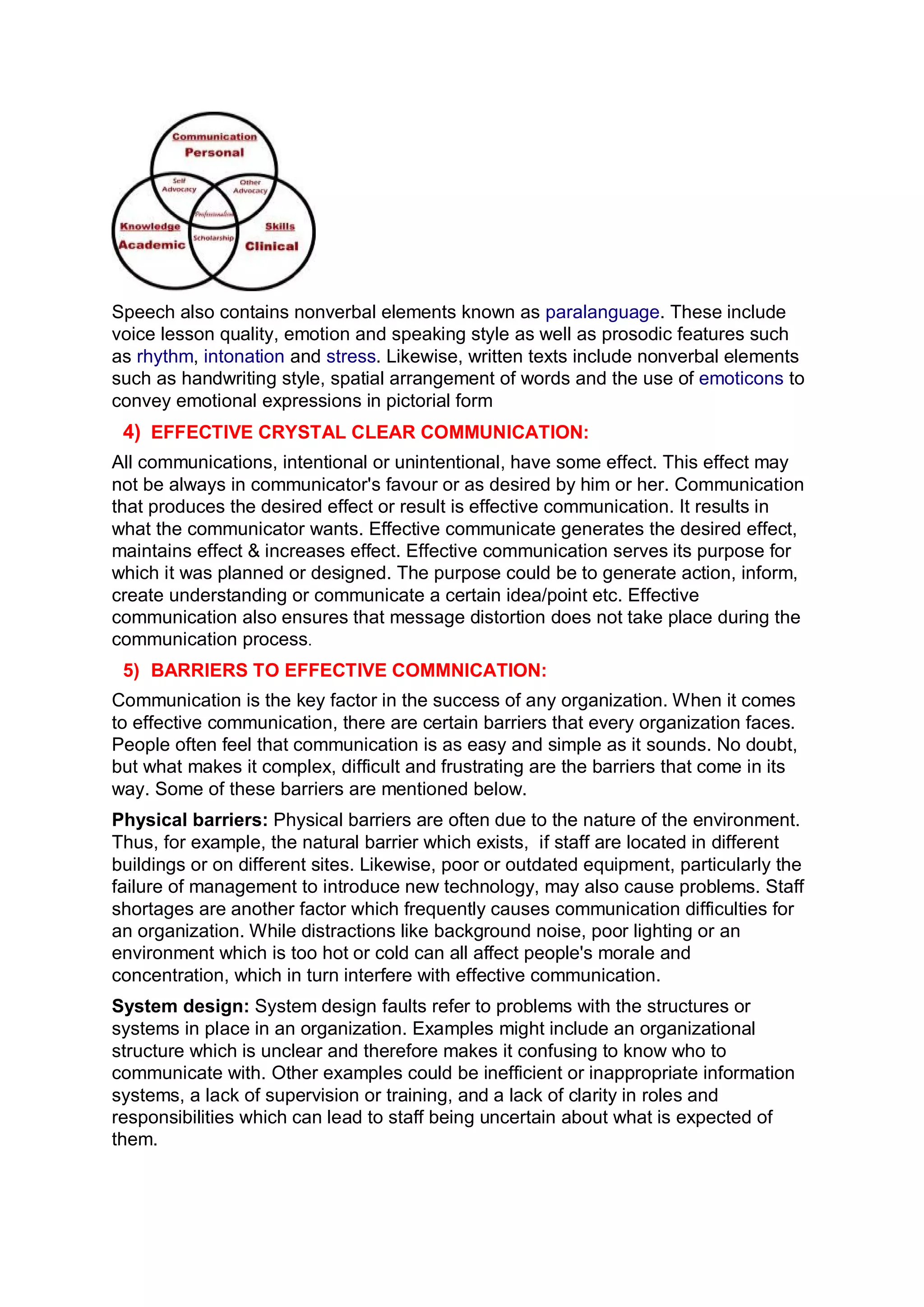
 2) DIFFICULTY IN COMMUNICATION:                                     Normally in
    today’s world due to cross cultural issues, language barriers and education
    background of a person what one thinks and communicates and other person
    understands are 3 different things. These results in misunderstanding rework
    and waste of time for everyone.

 3) TYPES OF HUMAN COMMUNICATION: Human communicate by several
    methods like verbal, nonverbal and by eyes. Non verbal communication
    describes the process of conveying meaning in the form of non-word
    messages. Research shows that the majority of our communication is non
    verbal, also known as body language.
Some of non verbal communication includes chronemics, haptics, gesture, body
language or posture; facial expression and eye contact, object communication such
as clothing, hairstyles, architecture, symbols infographics, and tone of voice as well
as through an aggregate of the above.
Speech also contains nonverbal elements known as paralanguage. These include
voice lesson quality, emotion and speaking style as well as prosodic features such
as rhythm, intonation and stress. Likewise, written texts include nonverbal elements
such as handwriting style, spatial arrangement of words and the use of emoticons to
convey emotional expressions in pictorial form
 4) EFFECTIVE CRYSTAL CLEAR COMMUNICATION:
All communications, intentional or unintentional, have some effect. This effect may
not be always in communicator's favour or as desired by him or her. Communication
that produces the desired effect or result is effective communication. It results in
what the communicator wants. Effective communicate generates the desired effect,
maintains effect & increases effect. Effective communication serves its purpose for
which it was planned or designed. The purpose could be to generate action, inform,
create understanding or communicate a certain idea/point etc. Effective
communication also ensures that message distortion does not take place during the
communication process.
 5) BARRIERS TO EFFECTIVE COMMNICATION:
Communication is the key factor in the success of any organization. When it comes
to effective communication, there are certain barriers that every organization faces.
People often feel that communication is as easy and simple as it sounds. No doubt,
but what makes it complex, difficult and frustrating are the barriers that come in its
way. Some of these barriers are mentioned below.
Physical barriers: Physical barriers are often due to the nature of the environment.
Thus, for example, the natural barrier which exists, if staff are located in different
buildings or on different sites. Likewise, poor or outdated equipment, particularly the
failure of management to introduce new technology, may also cause problems. Staff
shortages are another factor which frequently causes communication difficulties for
an organization. While distractions like background noise, poor lighting or an
environment which is too hot or cold can all affect people's morale and
concentration, which in turn interfere with effective communication.
System design: System design faults refer to problems with the structures or
systems in place in an organization. Examples might include an organizational
structure which is unclear and therefore makes it confusing to know who to
communicate with. Other examples could be inefficient or inappropriate information
systems, a lack of supervision or training, and a lack of clarity in roles and
responsibilities which can lead to staff being uncertain about what is expected of
them.
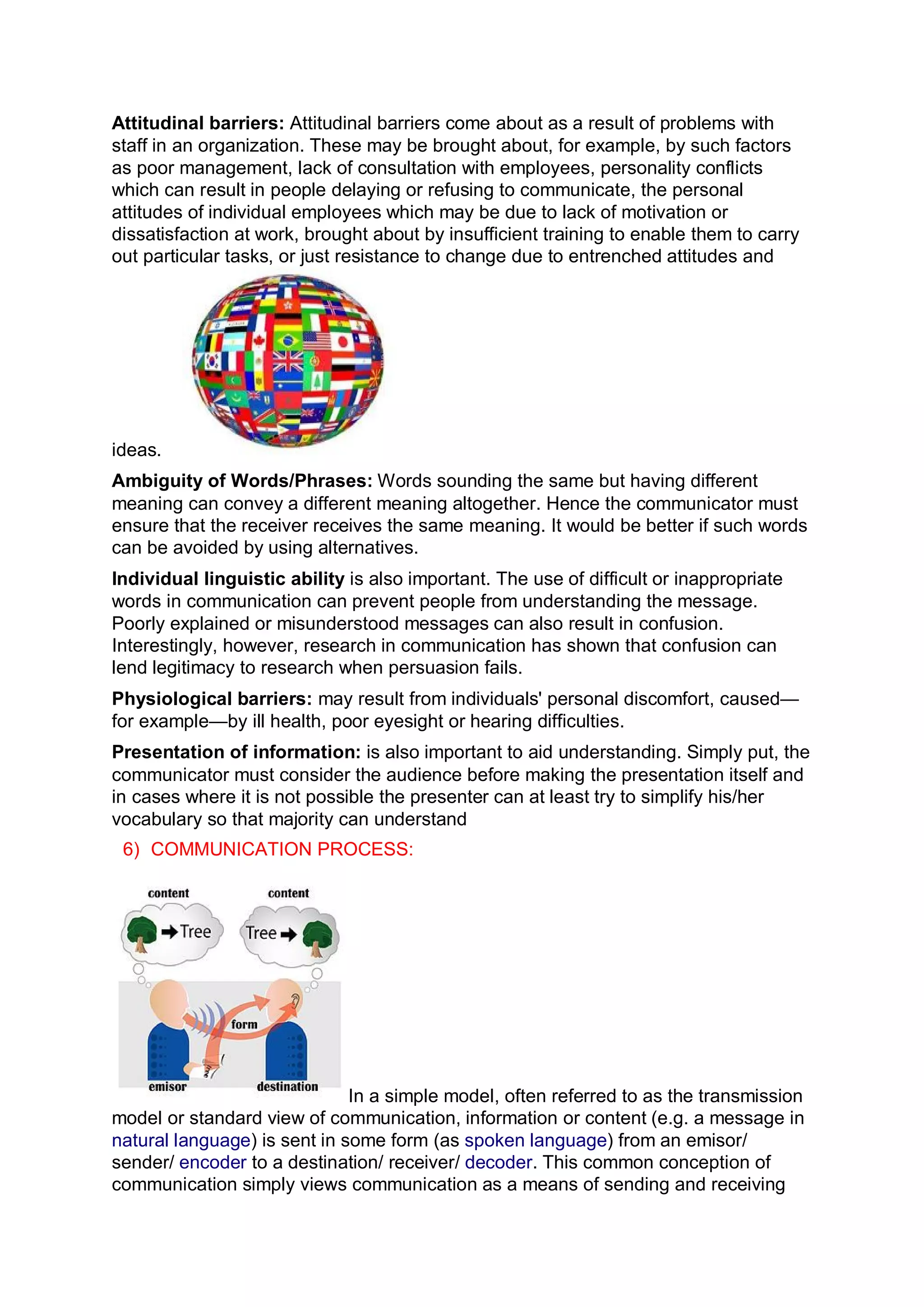
Attitudinal barriers: Attitudinal barriers come about as a result of problems with
staff in an organization. These may be brought about, for example, by such factors
as poor management, lack of consultation with employees, personality conflicts
which can result in people delaying or refusing to communicate, the personal
attitudes of individual employees which may be due to lack of motivation or
dissatisfaction at work, brought about by insufficient training to enable them to carry
out particular tasks, or just resistance to change due to entrenched attitudes and


ideas.
Ambiguity of Words/Phrases: Words sounding the same but having different
meaning can convey a different meaning altogether. Hence the communicator must
ensure that the receiver receives the same meaning. It would be better if such words
can be avoided by using alternatives.
Individual linguistic ability is also important. The use of difficult or inappropriate
words in communication can prevent people from understanding the message.
Poorly explained or misunderstood messages can also result in confusion.
Interestingly, however, research in communication has shown that confusion can
lend legitimacy to research when persuasion fails.
Physiological barriers: may result from individuals' personal discomfort, caused—
for example—by ill health, poor eyesight or hearing difficulties.
Presentation of information: is also important to aid understanding. Simply put, the
communicator must consider the audience before making the presentation itself and
in cases where it is not possible the presenter can at least try to simplify his/her
vocabulary so that majority can understand
 6) COMMUNICATION PROCESS:


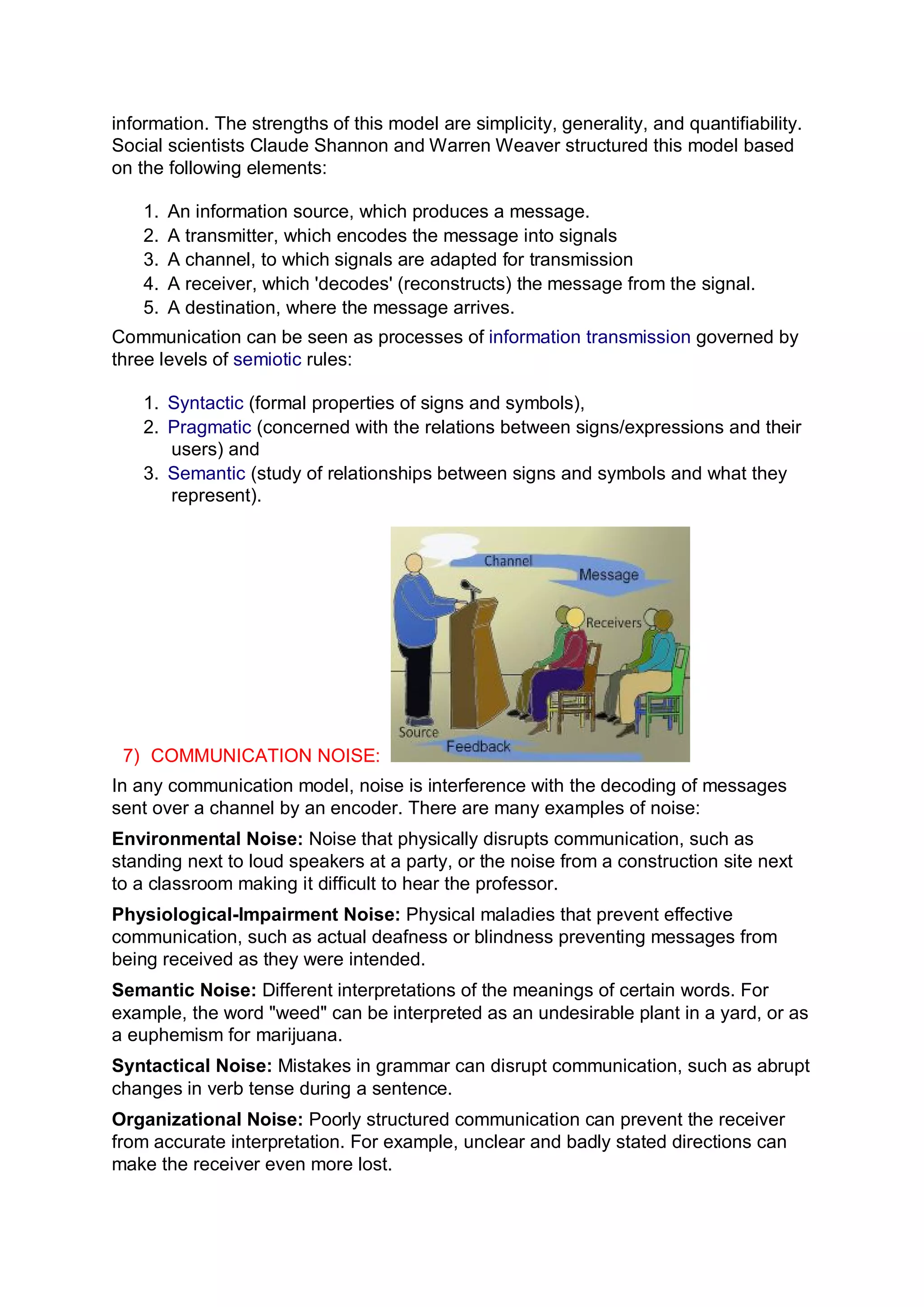
                              In a simple model, often referred to as the transmission
model or standard view of communication, information or content (e.g. a message in
natural language) is sent in some form (as spoken language) from an emisor/
sender/ encoder to a destination/ receiver/ decoder. This common conception of
communication simply views communication as a means of sending and receiving
information. The strengths of this model are simplicity, generality, and quantifiability.
Social scientists Claude Shannon and Warren Weaver structured this model based
on the following elements:

    1.   An information source, which produces a message.
    2.   A transmitter, which encodes the message into signals
    3.   A channel, to which signals are adapted for transmission
    4.   A receiver, which 'decodes' (reconstructs) the message from the signal.
    5.   A destination, where the message arrives.
Communication can be seen as processes of information transmission governed by
three levels of semiotic rules:

    1. Syntactic (formal properties of signs and symbols),
    2. Pragmatic (concerned with the relations between signs/expressions and their
       users) and
    3. Semantic (study of relationships between signs and symbols and what they
       represent).


 7) COMMUNICATION NOISE:
In any communication model, noise is interference with the decoding of messages
sent over a channel by an encoder. There are many examples of noise:
Environmental Noise: Noise that physically disrupts communication, such as
standing next to loud speakers at a party, or the noise from a construction site next
to a classroom making it difficult to hear the professor.
Physiological-Impairment Noise: Physical maladies that prevent effective
communication, such as actual deafness or blindness preventing messages from
being received as they were intended.
Semantic Noise: Different interpretations of the meanings of certain words. For
example, the word "weed" can be interpreted as an undesirable plant in a yard, or as
a euphemism for marijuana.
Syntactical Noise: Mistakes in grammar can disrupt communication, such as abrupt
changes in verb tense during a sentence.
Organizational Noise: Poorly structured communication can prevent the receiver
from accurate interpretation. For example, unclear and badly stated directions can
make the receiver even more lost.
Cultural Noise: Stereotypical assumptions can cause misunderstandings, such as
unintentionally offending a non-Christian person by wishing them a "Merry
Christmas".
Psychological Noise: Certain attitudes can also make communication difficult. For
instance, great anger or sadness may cause someone to lose focus on the present
moment.


How can we help?


                        UTOPIA conducts EFFECTIVE COMMUNICATION COURSE
with certification which is a 2 days program from 9.30am to 6.00pm in which all
aspects of Communication skills as below are covered. It can also be broken into 3
hours very alternate days for 2 months for those people whose basic English is not
up to mark and it will include grammar, phonetics, intonations etc.


       WHAT WILL YOU LEARN :

   ·   Dos & Don’ts in Communication
   ·   Making effective presentation
   ·   Using powerful words in English language
   ·   Words to be avoided
   ·   Written Email communication
   ·   Handling group psychology by building rapport
   ·   Tips on equipment required for audio-visual presentation
   ·   Language patterns in our daily life using Neuro Linguistic Programming (NLP)
       in communication
   ·   Personal Grooming
   ·   Body Language
   ·   Etiquette and Good manners
   ·   Video recording of participants performance before participating and after
       participating in the workshop for review purpose……MUCH MORE
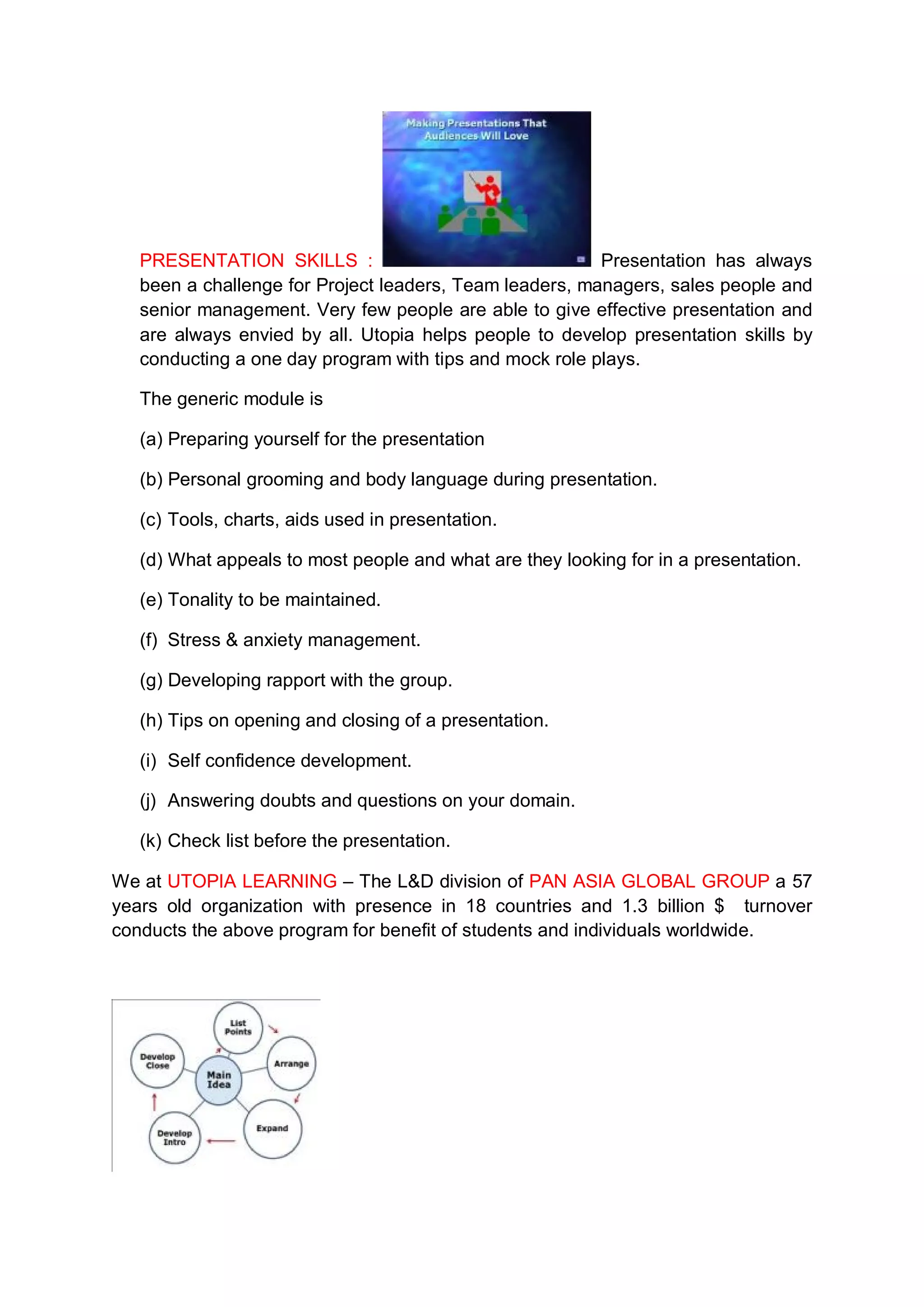
PRESENTATION SKILLS :                                 Presentation has always
   been a challenge for Project leaders, Team leaders, managers, sales people and
   senior management. Very few people are able to give effective presentation and
   are always envied by all. Utopia helps people to develop presentation skills by
   conducting a one day program with tips and mock role plays.

   The generic module is

   (a) Preparing yourself for the presentation

   (b) Personal grooming and body language during presentation.

   (c) Tools, charts, aids used in presentation.

   (d) What appeals to most people and what are they looking for in a presentation.

   (e) Tonality to be maintained.

   (f) Stress & anxiety management.

   (g) Developing rapport with the group.

   (h) Tips on opening and closing of a presentation.

   (i) Self confidence development.

   (j) Answering doubts and questions on your domain.

   (k) Check list before the presentation.

We at UTOPIA LEARNING – The L&D division of PAN ASIA GLOBAL GROUP a 57
years old organization with presence in 18 countries and 1.3 billion $ turnover
conducts the above program for benefit of students and individuals worldwide.
AND COST?


                                No, it is an investment on yourself because knowledge
    is one thing no one can steal from you rest everything money, car, property, etc
    will either be stolen or fire will devour it or government will take it. If one has
    knowledge everything can be regained back “Nehi Gyanenum Sadrisham” –
    Nothing is above knowledge. All our programs investment is affordable and
    nominal.


WHAT ELSE DO WE GET?

Students get a detailed manual, CD’s and host of internet links to do more research
and enhance their knowledge. The training is completely technique oriented, simple
to follow and immediately to put into practice.

WHAT IS SO UNIQUE ABOUT THE COURSE? The uniqueness of this course is
that it is value for money and by using advance tools like NLP, video recording and
role plays the student gets guaranteed results and able to substantially improve their
communication to enhance their careers, job/visa interview, presentation skills.


WHAT IS THE CERTIFICATION?

    All students get a certification of a public limited company which is ISO 9001
    ,ISO 19011 & ISO 27001 certified & DUNS registered after a simple objective
    type 2 hour exam/ viva which will also help them in getting a job or enhance
    their careers.
WHO CONDUCTS THIS PROGRAM?

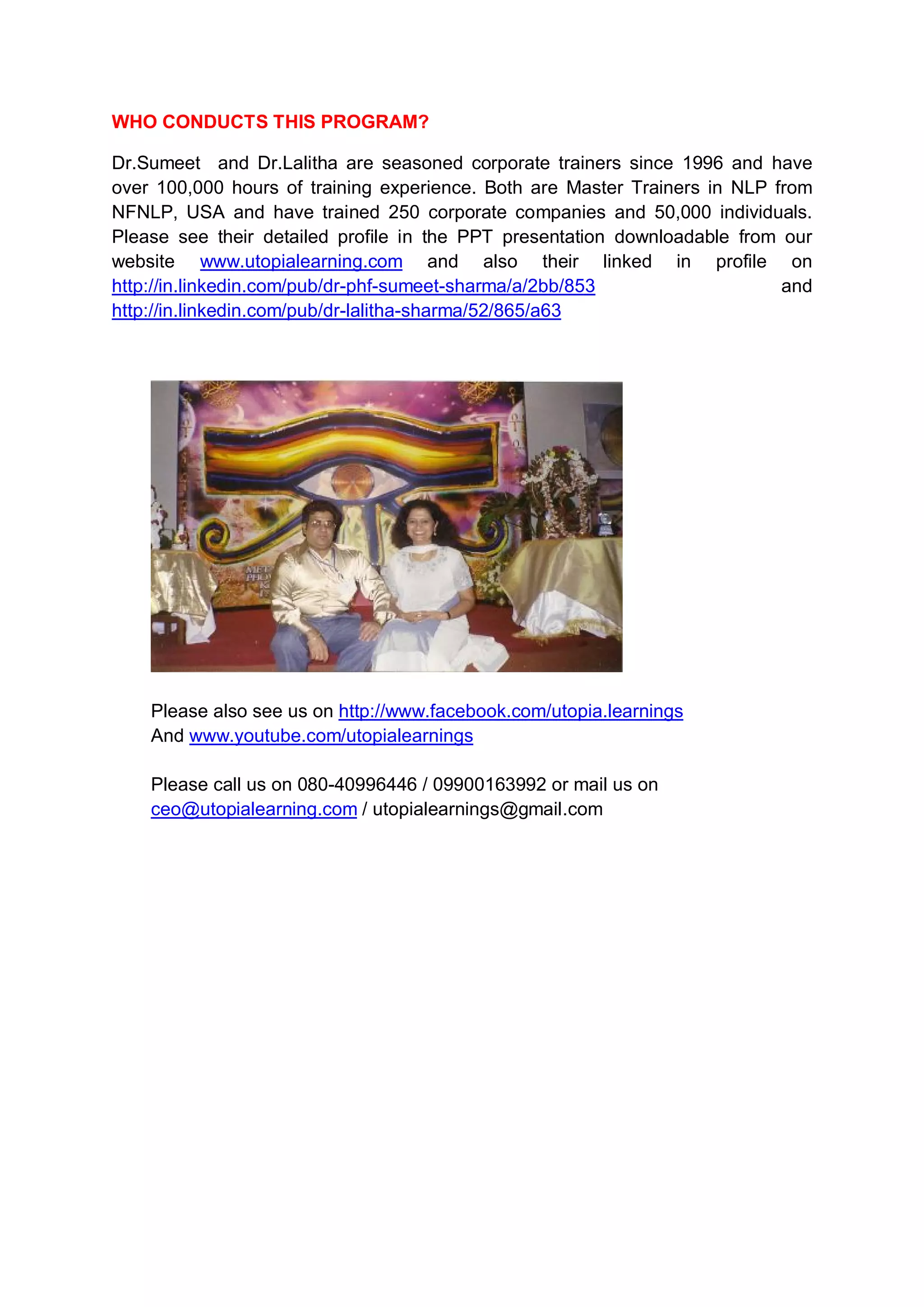
Dr.Sumeet and Dr.Lalitha are seasoned corporate trainers since 1996 and have
over 100,000 hours of training experience. Both are Master Trainers in NLP from
NFNLP, USA and have trained 250 corporate companies and 50,000 individuals.
Please see their detailed profile in the PPT presentation downloadable from our
website www.utopialearning.com and also their linked in profile on
http://in.linkedin.com/pub/dr-phf-sumeet-sharma/a/2bb/853                   and
http://in.linkedin.com/pub/dr-lalitha-sharma/52/865/a63


    Please also see us on http://www.facebook.com/utopia.learnings
    And www.youtube.com/utopialearnings

    Please call us on 080-40996446 / 09900163992 or mail us on
    ceo@utopialearning.com / utopialearnings@gmail.com
White paper on communication and presentation skills

White paper on communication and presentation skills

  • 1.
    WHITE PAPER ONCOMMUNICATION AND PRESENTATION SKILLS 1) WHAT IS COMMUNICATION? Communication is the exchange of thoughts, messages, or information, as by speech, visuals, signals, writing, or behaviour. Derived from the Latin word "communis", meaning to share. Communication requires a sender, a message, and a recipient, although the receiver need not be present or aware of the sender's intent to communicate at the time of communication; thus communication can occur across vast distances in time and space. Communication requires that the communicating parties share an area of communicative commonality. The communication process is complete once the receiver has understood the message of the sender. Feedback is critical to effective communication between participants. 2) DIFFICULTY IN COMMUNICATION: Normally in today’s world due to cross cultural issues, language barriers and education background of a person what one thinks and communicates and other person understands are 3 different things. These results in misunderstanding rework and waste of time for everyone. 3) TYPES OF HUMAN COMMUNICATION: Human communicate by several methods like verbal, nonverbal and by eyes. Non verbal communication describes the process of conveying meaning in the form of non-word messages. Research shows that the majority of our communication is non verbal, also known as body language. Some of non verbal communication includes chronemics, haptics, gesture, body language or posture; facial expression and eye contact, object communication such as clothing, hairstyles, architecture, symbols infographics, and tone of voice as well as through an aggregate of the above.
  • 2.
    Speech also containsnonverbal elements known as paralanguage. These include voice lesson quality, emotion and speaking style as well as prosodic features such as rhythm, intonation and stress. Likewise, written texts include nonverbal elements such as handwriting style, spatial arrangement of words and the use of emoticons to convey emotional expressions in pictorial form 4) EFFECTIVE CRYSTAL CLEAR COMMUNICATION: All communications, intentional or unintentional, have some effect. This effect may not be always in communicator's favour or as desired by him or her. Communication that produces the desired effect or result is effective communication. It results in what the communicator wants. Effective communicate generates the desired effect, maintains effect & increases effect. Effective communication serves its purpose for which it was planned or designed. The purpose could be to generate action, inform, create understanding or communicate a certain idea/point etc. Effective communication also ensures that message distortion does not take place during the communication process. 5) BARRIERS TO EFFECTIVE COMMNICATION: Communication is the key factor in the success of any organization. When it comes to effective communication, there are certain barriers that every organization faces. People often feel that communication is as easy and simple as it sounds. No doubt, but what makes it complex, difficult and frustrating are the barriers that come in its way. Some of these barriers are mentioned below. Physical barriers: Physical barriers are often due to the nature of the environment. Thus, for example, the natural barrier which exists, if staff are located in different buildings or on different sites. Likewise, poor or outdated equipment, particularly the failure of management to introduce new technology, may also cause problems. Staff shortages are another factor which frequently causes communication difficulties for an organization. While distractions like background noise, poor lighting or an environment which is too hot or cold can all affect people's morale and concentration, which in turn interfere with effective communication. System design: System design faults refer to problems with the structures or systems in place in an organization. Examples might include an organizational structure which is unclear and therefore makes it confusing to know who to communicate with. Other examples could be inefficient or inappropriate information systems, a lack of supervision or training, and a lack of clarity in roles and responsibilities which can lead to staff being uncertain about what is expected of them.
  • 3.
    Attitudinal barriers: Attitudinalbarriers come about as a result of problems with staff in an organization. These may be brought about, for example, by such factors as poor management, lack of consultation with employees, personality conflicts which can result in people delaying or refusing to communicate, the personal attitudes of individual employees which may be due to lack of motivation or dissatisfaction at work, brought about by insufficient training to enable them to carry out particular tasks, or just resistance to change due to entrenched attitudes and ideas. Ambiguity of Words/Phrases: Words sounding the same but having different meaning can convey a different meaning altogether. Hence the communicator must ensure that the receiver receives the same meaning. It would be better if such words can be avoided by using alternatives. Individual linguistic ability is also important. The use of difficult or inappropriate words in communication can prevent people from understanding the message. Poorly explained or misunderstood messages can also result in confusion. Interestingly, however, research in communication has shown that confusion can lend legitimacy to research when persuasion fails. Physiological barriers: may result from individuals' personal discomfort, caused— for example—by ill health, poor eyesight or hearing difficulties. Presentation of information: is also important to aid understanding. Simply put, the communicator must consider the audience before making the presentation itself and in cases where it is not possible the presenter can at least try to simplify his/her vocabulary so that majority can understand 6) COMMUNICATION PROCESS: In a simple model, often referred to as the transmission model or standard view of communication, information or content (e.g. a message in natural language) is sent in some form (as spoken language) from an emisor/ sender/ encoder to a destination/ receiver/ decoder. This common conception of communication simply views communication as a means of sending and receiving
  • 4.
    information. The strengthsof this model are simplicity, generality, and quantifiability. Social scientists Claude Shannon and Warren Weaver structured this model based on the following elements: 1. An information source, which produces a message. 2. A transmitter, which encodes the message into signals 3. A channel, to which signals are adapted for transmission 4. A receiver, which 'decodes' (reconstructs) the message from the signal. 5. A destination, where the message arrives. Communication can be seen as processes of information transmission governed by three levels of semiotic rules: 1. Syntactic (formal properties of signs and symbols), 2. Pragmatic (concerned with the relations between signs/expressions and their users) and 3. Semantic (study of relationships between signs and symbols and what they represent). 7) COMMUNICATION NOISE: In any communication model, noise is interference with the decoding of messages sent over a channel by an encoder. There are many examples of noise: Environmental Noise: Noise that physically disrupts communication, such as standing next to loud speakers at a party, or the noise from a construction site next to a classroom making it difficult to hear the professor. Physiological-Impairment Noise: Physical maladies that prevent effective communication, such as actual deafness or blindness preventing messages from being received as they were intended. Semantic Noise: Different interpretations of the meanings of certain words. For example, the word "weed" can be interpreted as an undesirable plant in a yard, or as a euphemism for marijuana. Syntactical Noise: Mistakes in grammar can disrupt communication, such as abrupt changes in verb tense during a sentence. Organizational Noise: Poorly structured communication can prevent the receiver from accurate interpretation. For example, unclear and badly stated directions can make the receiver even more lost.
  • 5.
    Cultural Noise: Stereotypicalassumptions can cause misunderstandings, such as unintentionally offending a non-Christian person by wishing them a "Merry Christmas". Psychological Noise: Certain attitudes can also make communication difficult. For instance, great anger or sadness may cause someone to lose focus on the present moment. How can we help? UTOPIA conducts EFFECTIVE COMMUNICATION COURSE with certification which is a 2 days program from 9.30am to 6.00pm in which all aspects of Communication skills as below are covered. It can also be broken into 3 hours very alternate days for 2 months for those people whose basic English is not up to mark and it will include grammar, phonetics, intonations etc. WHAT WILL YOU LEARN : · Dos & Don’ts in Communication · Making effective presentation · Using powerful words in English language · Words to be avoided · Written Email communication · Handling group psychology by building rapport · Tips on equipment required for audio-visual presentation · Language patterns in our daily life using Neuro Linguistic Programming (NLP) in communication · Personal Grooming · Body Language · Etiquette and Good manners · Video recording of participants performance before participating and after participating in the workshop for review purpose……MUCH MORE
  • 6.
    PRESENTATION SKILLS : Presentation has always been a challenge for Project leaders, Team leaders, managers, sales people and senior management. Very few people are able to give effective presentation and are always envied by all. Utopia helps people to develop presentation skills by conducting a one day program with tips and mock role plays. The generic module is (a) Preparing yourself for the presentation (b) Personal grooming and body language during presentation. (c) Tools, charts, aids used in presentation. (d) What appeals to most people and what are they looking for in a presentation. (e) Tonality to be maintained. (f) Stress & anxiety management. (g) Developing rapport with the group. (h) Tips on opening and closing of a presentation. (i) Self confidence development. (j) Answering doubts and questions on your domain. (k) Check list before the presentation. We at UTOPIA LEARNING – The L&D division of PAN ASIA GLOBAL GROUP a 57 years old organization with presence in 18 countries and 1.3 billion $ turnover conducts the above program for benefit of students and individuals worldwide.
  • 7.
    AND COST? No, it is an investment on yourself because knowledge is one thing no one can steal from you rest everything money, car, property, etc will either be stolen or fire will devour it or government will take it. If one has knowledge everything can be regained back “Nehi Gyanenum Sadrisham” – Nothing is above knowledge. All our programs investment is affordable and nominal. WHAT ELSE DO WE GET? Students get a detailed manual, CD’s and host of internet links to do more research and enhance their knowledge. The training is completely technique oriented, simple to follow and immediately to put into practice. WHAT IS SO UNIQUE ABOUT THE COURSE? The uniqueness of this course is that it is value for money and by using advance tools like NLP, video recording and role plays the student gets guaranteed results and able to substantially improve their communication to enhance their careers, job/visa interview, presentation skills. WHAT IS THE CERTIFICATION? All students get a certification of a public limited company which is ISO 9001 ,ISO 19011 & ISO 27001 certified & DUNS registered after a simple objective type 2 hour exam/ viva which will also help them in getting a job or enhance their careers.
  • 8.
    WHO CONDUCTS THISPROGRAM? Dr.Sumeet and Dr.Lalitha are seasoned corporate trainers since 1996 and have over 100,000 hours of training experience. Both are Master Trainers in NLP from NFNLP, USA and have trained 250 corporate companies and 50,000 individuals. Please see their detailed profile in the PPT presentation downloadable from our website www.utopialearning.com and also their linked in profile on http://in.linkedin.com/pub/dr-phf-sumeet-sharma/a/2bb/853 and http://in.linkedin.com/pub/dr-lalitha-sharma/52/865/a63 Please also see us on http://www.facebook.com/utopia.learnings And www.youtube.com/utopialearnings Please call us on 080-40996446 / 09900163992 or mail us on ceo@utopialearning.com / utopialearnings@gmail.com