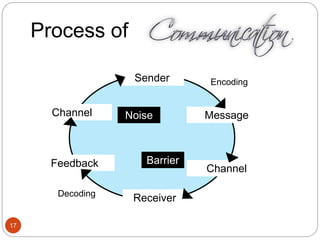
Sender
Channel
Receiver
Feedback
Channel
Encoding
Decoding
Message
Noise
Barrier
Process of
17
KEY TERMS IN THE
COMMUNICATION PROCESS
3
 Understanding several key terms is important in order to
follow the models.
 These terms are:
 Sender
 Encoding
 Decoding
 Message
 Channel
 Receiver
 Noise
SENDER
4
 Initiates communication.
 Is the person who is sending the message.
 To communicate effectively, the sender must use
effective verbal as well as nonverbal techniques.
 Speaking or writing clearly, organizing your points to
make them easy to follow and understand,
maintaining eye contact, using proper grammar and
giving accurate information are all essential in the
effectiveness of your message.
 The sender should have some understanding of who
the receiver is in order to modify the message to
make it more relevant.
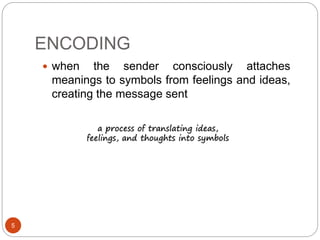
ENCODING
5
 when the sender consciously attaches
meanings to symbols from feelings and ideas,
creating the message sent
a process of translating ideas,
feelings, and thoughts into symbols
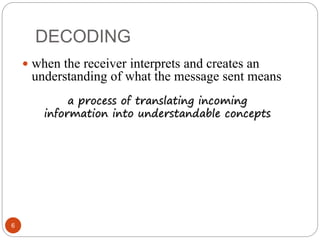
DECODING
6
 when the receiver interprets and creates an
understanding of what the message sent means
a process of translating incoming
information into understandable concepts
MESSAGE
7
 Most crucial element of effective communication.
 Comes in many different forms, such as an oral
presentation, a written document, an advertisement
or just a comment.
 It is a “signal or combination of signals that serves
as a stimulus for a receiver” .
 Can be either a sign or a symbol.
 A sign, on one hand, is a natural, universally
understood phenomenon such as thunder (which
follows the occurrence of lightning) and smoke
(which suggests that a fire is also present).
MESSAGE
8
 A symbol, on the other hand, exists by human
convention.
 The object commonly called a stop “sign” — because
it has been created by people to convey a message,
and because it is not natural and universally
understood — is an example of a symbol
 The message isn't necessarily what the sender
intends it to be.
 Rather, the message is what the receiver perceives
the message to be.
 As a result, the sender must not only compose the
message carefully, but also evaluate the ways in
CHANNEL
9
 The message travels from one point to another
via a channel of communication.
 The channel sits between the sender and
receiver.
 Channels include spoken word to radio,
television, an Internet site or something written,
like a book, letter or magazine.
CHANNEL
10
 Every channel of communication has its
advantages and disadvantages.
 E.g., one disadvantage of the written word, on a
computer screen or in a book, is that the receiver
cannot evaluate the tone of the message.
 For this reason, effective communicators word
written communications clearly so they don't rely
on a specific tone of voice to convey the
message accurately.
 The advantages of television as a channel for
communication include its expansive reach to a
wide audience and the sender's ability to further
manipulate the message using editing and
RECEIVER
11
 The party to whom the sender transmits the
message.
 Can be one person or an entire audience of people.
 The best way to receive a message is to listen
carefully, sitting up straight and making eye contact.
 Don’t get distracted or try to do something else while
you're listening.
RECEIVER
12
 The individual/s to whom the message is directed
 Once the message is received and examined the
stimulus is sent to the brain for interpreting, in order
to assign type of meaning to it.
 The receiver interprets the symbols sent by the
sender ,translating the message to their own set of
experiences in order to make symbols meaningful.
 Nodding and smiling as you listen to the sender
speak demonstrate that you understand the
message
FEEDBACK
13
 The last element of effective communication,
feedback, describes the receiver's response or
reaction to the sender's message.
 Feedback is that reaction I just mentioned.
 It can be a verbal or nonverbal reaction or
response.
FEEDBACK
14
 It can be external feedback (something we see)
or internal feedback (something we can’t see).
 The receiver can transmit feedback through
asking questions, making comments or just
supporting the message that was delivered.
 Feedback helps the sender to determine how the
receiver interpreted the message and how it can
be improved.
 Feedback can be positive or negative
THANK YOU

process of communication.ppt

  • 2.
  • 3.
    KEY TERMS INTHE COMMUNICATION PROCESS 3  Understanding several key terms is important in order to follow the models.  These terms are:  Sender  Encoding  Decoding  Message  Channel  Receiver  Noise
  • 4.
    SENDER 4  Initiates communication. Is the person who is sending the message.  To communicate effectively, the sender must use effective verbal as well as nonverbal techniques.  Speaking or writing clearly, organizing your points to make them easy to follow and understand, maintaining eye contact, using proper grammar and giving accurate information are all essential in the effectiveness of your message.  The sender should have some understanding of who the receiver is in order to modify the message to make it more relevant.
  • 5.
    ENCODING 5  when thesender consciously attaches meanings to symbols from feelings and ideas, creating the message sent a process of translating ideas, feelings, and thoughts into symbols
  • 6.
    DECODING 6  when thereceiver interprets and creates an understanding of what the message sent means a process of translating incoming information into understandable concepts
  • 7.
    MESSAGE 7  Most crucialelement of effective communication.  Comes in many different forms, such as an oral presentation, a written document, an advertisement or just a comment.  It is a “signal or combination of signals that serves as a stimulus for a receiver” .  Can be either a sign or a symbol.  A sign, on one hand, is a natural, universally understood phenomenon such as thunder (which follows the occurrence of lightning) and smoke (which suggests that a fire is also present).
  • 8.
    MESSAGE 8  A symbol,on the other hand, exists by human convention.  The object commonly called a stop “sign” — because it has been created by people to convey a message, and because it is not natural and universally understood — is an example of a symbol  The message isn't necessarily what the sender intends it to be.  Rather, the message is what the receiver perceives the message to be.  As a result, the sender must not only compose the message carefully, but also evaluate the ways in
  • 9.
    CHANNEL 9  The messagetravels from one point to another via a channel of communication.  The channel sits between the sender and receiver.  Channels include spoken word to radio, television, an Internet site or something written, like a book, letter or magazine.
  • 10.
    CHANNEL 10  Every channelof communication has its advantages and disadvantages.  E.g., one disadvantage of the written word, on a computer screen or in a book, is that the receiver cannot evaluate the tone of the message.  For this reason, effective communicators word written communications clearly so they don't rely on a specific tone of voice to convey the message accurately.  The advantages of television as a channel for communication include its expansive reach to a wide audience and the sender's ability to further manipulate the message using editing and
  • 11.
    RECEIVER 11  The partyto whom the sender transmits the message.  Can be one person or an entire audience of people.  The best way to receive a message is to listen carefully, sitting up straight and making eye contact.  Don’t get distracted or try to do something else while you're listening.
  • 12.
    RECEIVER 12  The individual/sto whom the message is directed  Once the message is received and examined the stimulus is sent to the brain for interpreting, in order to assign type of meaning to it.  The receiver interprets the symbols sent by the sender ,translating the message to their own set of experiences in order to make symbols meaningful.  Nodding and smiling as you listen to the sender speak demonstrate that you understand the message
  • 13.
    FEEDBACK 13  The lastelement of effective communication, feedback, describes the receiver's response or reaction to the sender's message.  Feedback is that reaction I just mentioned.  It can be a verbal or nonverbal reaction or response.
  • 14.
    FEEDBACK 14  It canbe external feedback (something we see) or internal feedback (something we can’t see).  The receiver can transmit feedback through asking questions, making comments or just supporting the message that was delivered.  Feedback helps the sender to determine how the receiver interpreted the message and how it can be improved.  Feedback can be positive or negative
  • 15.