Mesenteric Cysts
By:
Mohamed Tag El-din Mohamed
Resident of General Surgery
Sohag university hospital
Introduction
A mesenteric cyst is formed of fluid
collection between the 2 layers of
small bowel mesentery
Introduction (conc.)
• Mesenteric cysts can be simple or multiple,
unilocular or multilocular, and they may
contain hemorrhagic, serous, chylous, or
infected fluid.
(Egozi et al, 1997)
Introduction (conc.)
• The fluid is serous in ileal and colonic cysts
and is chylous in jejunal cysts.
• They can range in size from a few millimeters
to 40 cm in diameter.
(Egozi EI et al, 1997)
Incidence
• Mesenteric cyst is one of the rarest abdominal
masses.
• The incidence varies from 1 per 100,000 to 1 per
250,000 admissions
• Approximately one third of cases are diagnosed
before the age of 15.
(Egozi EI et al, 1997)
Types and Etiology
1)False mesenteric cyst:
• Blood cyst due to trauma.
• Tuberculous mesenteric cold
abscess due to caseating
tuberculous mesenteric adentitis.
2) True mesenteric cyst:
• Chylolymphatic cyst “the commonest” due to:
– benign proliferations of ectopic lymphatics . (Bliss DP Jr et
al, 1997)
– Obstructed lymphatic drainage.
• Enterogenous cyst due to:
– failure of the leaves of the mesentery to fuse.
– Sequestrated intestinal epithelium or from duplicated
intestine.
• Treatomatous dermoid cyst
• Hydatid cyst
( kasr el-aini introduction to surgery, 8th edition, 2014)
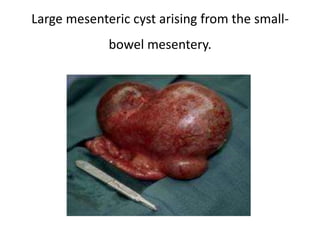
Large mesenteric cyst arising from the small-
bowel mesentery.
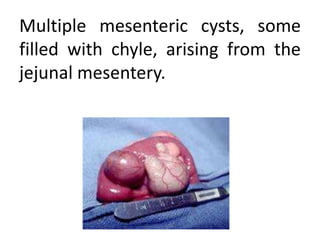
Multiple mesenteric cysts, some
filled with chyle, arising from the
jejunal mesentery.
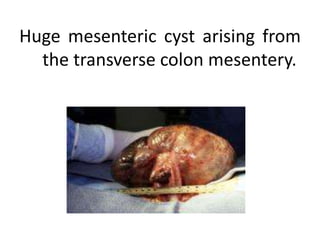
Huge mesenteric cyst arising from
the transverse colon mesentery.
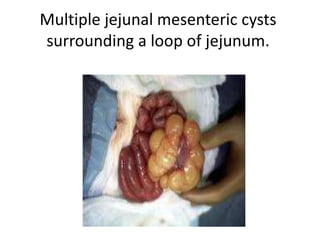
Multiple jejunal mesenteric cysts
surrounding a loop of jejunum.
Presentation
• Mesenteric cysts mostly discovered incidentally
• Symptoms
– Abdominal distention
– vague abdominal pain
– Mass may be palpable .
(Lockhart C et al, 2005)
Presentation(conc.)
• Approximately 10% of patients with mesenteric
cysts present with an acute abdominal
emergency, the most common picture is small-
bowel obstruction, which may be associated
with intestinal volvulus or infarction.
(Kosir MA et al, 1991)
Investigations
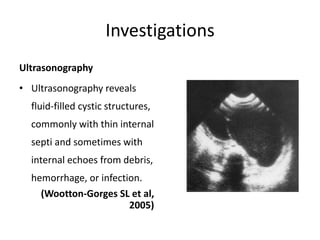
Ultrasonography
• Ultrasonography reveals
fluid-filled cystic structures,
commonly with thin internal
septi and sometimes with
internal echoes from debris,
hemorrhage, or infection.
(Wootton-Gorges SL et al,
2005)
Investigations (conc.)
CT scanning
• Abdominal CT scanning adds minimal
information, onlt ti ensure that cyst not
arising from another organ such as the kidney,
pancreas, or ovary.
(Nakano T et al, 2007)
Investigations (conc.)
Radiography (rare)
• Plain abdominal radiography may reveal a gasless,
homogeneous, water-dense mass that displaces bowel loops
laterally or anteriorly in the presence of a mesenteric cyst.
Fine calcifications can sometimes be observed within the cyst
wall.
(Wootton-Gorges SL et al, 2005)
Treatment
A.Medical Therapy
Anti-tuberculous drugs in case of ceasating
tuberculous mesenteric cysts
Treatment (conc.)
B.Surgical Treatment
1. Enucleation: The preferred treatment of
mesenteric cysts.
(Hebra A et al, 1993)
Treatment (conc.)
2. Excision and intestinal resection:
– is frequently required to ensure that the
remaining bowel is viable.
– Bowel resection may be required in 50-60%
of children with mesenteric cysts, whereas
resection is necessary in about 30% of
adults.
Treatment (conc.)
3. partial excision with marsupialization:
• If enucleation or resection is not possible because of the
size of the cyst or because of its location deep within the
root of the mesentery
• the cyst lining should be sclerosed with 10% glucose
solution, electrocautery, or tincture of iodine to minimize
recurrence.
(Ricketts RR, Pediatric Surgery. 5th ed. 1998)
Treatment (conc.)
4. Current apporaches
• Laparoscopic management: could be used to
localize the cysts, and resection could be
performed through a small laparotomy or via
an extended umbilical incision.
(Bhandarwar AH et al, 2013)
Treatment (conc.)
• Ultrasound-guided drainage has also
reported to be successful.
(Ma A et al, 2012).
Postoperative
• Depend on the intraoperative decision
• If enculation done: the patient is maintained
nothing by mouth (NPO) with intravenous fluids
until bowel function returns(mostly 24 hours).
• If intestinal resection done: follow up until
anastmosis is good.
Follow-up
• Routine postoperative follow-up care 2-3 weeks after
discharge from the hospital is indicated.
• The child's family should be warned about the potential for
intestinal obstruction from adhesions.
• If the patient was treated with marsupialization, closer follow-
up for possible recurrence should be instituted.
• Otherwise, long-term results for simple excision are favorable.
(Chang TS et al, 2011)
Outcome and Prognosis
• Overall results are favorable. The recurrence rate ranges
from 0-13.6%.
• Most recurrences occur in patients with retroperitoneal
cysts or those who had only a partial excision.
• Essentially, no mortality is associated with mesenteric cyst ;
only one pediatric death has been reported since 1950.
(Wong SW et al, 1998)
Future
• With the widespread use of ultrasonography,
mesenteric cysts are being diagnosed earlier, so
intervention during early infancy is indicated to
prevent potential complications such as intestinal
obstruction and volvulus.
(Polat C et al, 2004)
Mesentericcysts

Mesentericcysts

  • 1.
    Mesenteric Cysts By: Mohamed TagEl-din Mohamed Resident of General Surgery Sohag university hospital
  • 2.
    Introduction A mesenteric cystis formed of fluid collection between the 2 layers of small bowel mesentery
  • 3.
    Introduction (conc.) • Mesentericcysts can be simple or multiple, unilocular or multilocular, and they may contain hemorrhagic, serous, chylous, or infected fluid. (Egozi et al, 1997)
  • 4.
    Introduction (conc.) • Thefluid is serous in ileal and colonic cysts and is chylous in jejunal cysts. • They can range in size from a few millimeters to 40 cm in diameter. (Egozi EI et al, 1997)
  • 5.
    Incidence • Mesenteric cystis one of the rarest abdominal masses. • The incidence varies from 1 per 100,000 to 1 per 250,000 admissions • Approximately one third of cases are diagnosed before the age of 15. (Egozi EI et al, 1997)
  • 6.
    Types and Etiology 1)Falsemesenteric cyst: • Blood cyst due to trauma. • Tuberculous mesenteric cold abscess due to caseating tuberculous mesenteric adentitis.
  • 7.
    2) True mesentericcyst: • Chylolymphatic cyst “the commonest” due to: – benign proliferations of ectopic lymphatics . (Bliss DP Jr et al, 1997) – Obstructed lymphatic drainage. • Enterogenous cyst due to: – failure of the leaves of the mesentery to fuse. – Sequestrated intestinal epithelium or from duplicated intestine. • Treatomatous dermoid cyst • Hydatid cyst ( kasr el-aini introduction to surgery, 8th edition, 2014)
  • 8.
    Large mesenteric cystarising from the small- bowel mesentery.
  • 9.
    Multiple mesenteric cysts,some filled with chyle, arising from the jejunal mesentery.
  • 10.
    Huge mesenteric cystarising from the transverse colon mesentery.
  • 11.
    Multiple jejunal mesentericcysts surrounding a loop of jejunum.
  • 12.
    Presentation • Mesenteric cystsmostly discovered incidentally • Symptoms – Abdominal distention – vague abdominal pain – Mass may be palpable . (Lockhart C et al, 2005)
  • 13.
    Presentation(conc.) • Approximately 10%of patients with mesenteric cysts present with an acute abdominal emergency, the most common picture is small- bowel obstruction, which may be associated with intestinal volvulus or infarction. (Kosir MA et al, 1991)
  • 14.
    Investigations Ultrasonography • Ultrasonography reveals fluid-filledcystic structures, commonly with thin internal septi and sometimes with internal echoes from debris, hemorrhage, or infection. (Wootton-Gorges SL et al, 2005)
  • 15.
    Investigations (conc.) CT scanning •Abdominal CT scanning adds minimal information, onlt ti ensure that cyst not arising from another organ such as the kidney, pancreas, or ovary. (Nakano T et al, 2007)
  • 16.
    Investigations (conc.) Radiography (rare) •Plain abdominal radiography may reveal a gasless, homogeneous, water-dense mass that displaces bowel loops laterally or anteriorly in the presence of a mesenteric cyst. Fine calcifications can sometimes be observed within the cyst wall. (Wootton-Gorges SL et al, 2005)
  • 17.
    Treatment A.Medical Therapy Anti-tuberculous drugsin case of ceasating tuberculous mesenteric cysts
  • 18.
    Treatment (conc.) B.Surgical Treatment 1.Enucleation: The preferred treatment of mesenteric cysts. (Hebra A et al, 1993)
  • 19.
    Treatment (conc.) 2. Excisionand intestinal resection: – is frequently required to ensure that the remaining bowel is viable. – Bowel resection may be required in 50-60% of children with mesenteric cysts, whereas resection is necessary in about 30% of adults.
  • 20.
    Treatment (conc.) 3. partialexcision with marsupialization: • If enucleation or resection is not possible because of the size of the cyst or because of its location deep within the root of the mesentery • the cyst lining should be sclerosed with 10% glucose solution, electrocautery, or tincture of iodine to minimize recurrence. (Ricketts RR, Pediatric Surgery. 5th ed. 1998)
  • 21.
    Treatment (conc.) 4. Currentapporaches • Laparoscopic management: could be used to localize the cysts, and resection could be performed through a small laparotomy or via an extended umbilical incision. (Bhandarwar AH et al, 2013)
  • 22.
    Treatment (conc.) • Ultrasound-guideddrainage has also reported to be successful. (Ma A et al, 2012).
  • 23.
    Postoperative • Depend onthe intraoperative decision • If enculation done: the patient is maintained nothing by mouth (NPO) with intravenous fluids until bowel function returns(mostly 24 hours). • If intestinal resection done: follow up until anastmosis is good.
  • 24.
    Follow-up • Routine postoperativefollow-up care 2-3 weeks after discharge from the hospital is indicated. • The child's family should be warned about the potential for intestinal obstruction from adhesions. • If the patient was treated with marsupialization, closer follow- up for possible recurrence should be instituted. • Otherwise, long-term results for simple excision are favorable. (Chang TS et al, 2011)
  • 25.
    Outcome and Prognosis •Overall results are favorable. The recurrence rate ranges from 0-13.6%. • Most recurrences occur in patients with retroperitoneal cysts or those who had only a partial excision. • Essentially, no mortality is associated with mesenteric cyst ; only one pediatric death has been reported since 1950. (Wong SW et al, 1998)
  • 26.
    Future • With thewidespread use of ultrasonography, mesenteric cysts are being diagnosed earlier, so intervention during early infancy is indicated to prevent potential complications such as intestinal obstruction and volvulus. (Polat C et al, 2004)