MERCURY POISONING
Mercury poisoning is a type of metal poisoning due to exposure to mercury.
Mercury is a naturally occurring element. that is found in air, water and soil.
▶It exists in three chemical forms. They each have specific effects on human health.
▶Elemental mercury (metallic)
▶Organic compounds (methylmercury)
▶Inorganic salts
Only metal in liquid state at room temperature.
Toxic to humans in both liquid and vaporized state
EXPOSURE
Aquatic food chain
Fungicides used on seeds
Inhalation ----from working environment
oBurning waste
oBurning coal in power plants
Dentistry---amalgams
Broken fluorescent bulbs& thermometers
SIGN AND SYMPTOMS
Common symptoms of mercury poisoning are peripheral neuropathy, presenting
as paresthesia or itching, burning, pain, or even a sensation that resembles small insects crawling on or
under the skin (formication); skin discoloration (pink cheeks, fingertips and toes); swelling;
and desquamation (shedding or peeling of skin).
Mercury irreversibly inhibits selenium-dependent enzymes and may also inactivate S-adenosyl-
methionine, which is necessary for catecholamine catabolism by catechol-O-methyl transferase. Due to
the body's inability to degrade catecholamines (e.g. adrenaline), a person with mercury poisoning may
experience profuse sweating, tachycardia (persistently faster-than-normal heart beat), increased
salivation, and hypertension (high blood pressure).
Affected children may show red cheeks, nose and lips, loss of hair, teeth, and nails, transient
rashes, hypotonia (muscle weakness), and increased sensitivity to light. Other symptoms may
include kidney dysfunction (e.g. Fanconi syndrome) or neuropsychiatric symptoms such as
emotional lability, memory impairment, or insomnia.
Thus, the clinical presentation may resemble pheochromocytoma or Kawasaki disease. Desquamation
(skin peeling) can occur with severe mercury poisoning acquired by handling elemental mercury
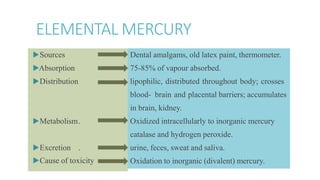
ELEMENTAL MERCURY
▶Sources
▶Absorption
▶Distribution
▶Metabolism.
▶Excretion .
▶Cause of toxicity .
Dental amalgams, old latex paint, thermometer.
75-85% of vapour absorbed.
lipophilic, distributed throughout body; crosses
blood- brain and placental barriers; accumulates
in brain, kidney.
Oxidized intracellularly to inorganic mercury
catalase and hydrogen peroxide.
urine, feces, sweat and saliva.
Oxidation to inorganic (divalent) mercury.
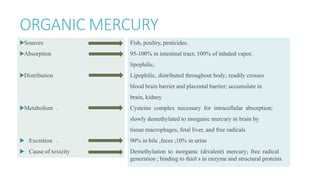
ORGANIC MERCURY
▶Sources
▶Absorption
▶Distribution
▶Metabolism .
▶ Excretion .
▶ Cause of toxicity .
Fish, poultry, pesticides.
95-100% in intestinal tract; 100% of inhaled vapor.
lipophilic,
Lipophilic, distributed throughout body; readily crosses
blood brain barrier and placental barrier; accumulate in
brain, kidney
Cysteine complex necessary for intracellular absorption;
slowly demethylated to inorganic mercury in brain by
tissue macrophages, fetal liver, and free radicals
90% in bile ,feces ;10% in urine
Demethylation to inorganic (divalent) mercury; free radical
generation ; binding to thiol s in enzyme and structural proteins.
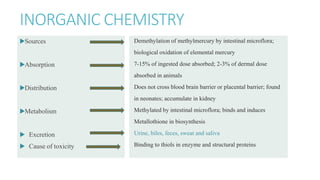
INORGANIC CHEMISTRY
▶Sources
▶Absorption
▶Distribution
▶Metabolism
▶ Excretion
▶ Cause of toxicity .
Demethylation of methylmercury by intestinal microflora;
biological oxidation of elemental mercury
7-15% of ingested dose absorbed; 2-3% of dermal dose
absorbed in animals
Does not cross blood brain barrier or placental barrier; found
in neonates; accumulate in kidney
Methylated by intestinal microflora; binds and induces
Metallothione in biosynthesis
Urine, biles, feces, sweat and saliva
Binding to thiols in enzyme and structural proteins
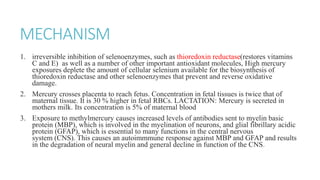
MECHANISM
1. irreversible inhibition of selenoenzymes, such as thioredoxin reductase(restores vitamins
C and E) as well as a number of other important antioxidant molecules, High mercury
exposures deplete the amount of cellular selenium available for the biosynthesis of
thioredoxin reductase and other selenoenzymes that prevent and reverse oxidative
damage.
2. Mercury crosses placenta to reach fetus. Concentration in fetal tissues is twice that of
maternal tissue. It is 30 % higher in fetal RBCs. LACTATION: Mercury is secreted in
mothers milk. Its concentration is 5% of maternal blood
3. Exposure to methylmercury causes increased levels of antibodies sent to myelin basic
protein (MBP), which is involved in the myelination of neurons, and glial fibrillary acidic
protein (GFAP), which is essential to many functions in the central nervous
system (CNS). This causes an autoimmmune response against MBP and GFAP and results
in the degradation of neural myelin and general decline in function of the CNS.
DIAGNOSIS
Diagnosis of elemental or inorganic mercury poisoning involves determining the
history of exposure, physical findings, and an elevated body burden of mercury.
Although whole-blood mercury concentrations are typically less than 6 μg/L, diets
rich in fish can result in blood mercury concentrations higher than 200 μg/L; it is not
that useful to measure these levels for suspected cases of elemental or inorganic
poisoning because of mercury's short half-life in the blood. If the exposure is chronic,
urine levels can be obtained; 24-hour collections are more reliable than spot
collections. It is difficult or impossible to interpret urine samples of people
undergoing chelation therapy, as the therapy itself increases mercury levels in the
samples.
Diagnosis of organic mercury poisoning differs in that whole-blood or hair analysis
is more reliable than urinary mercury levels.
TREATMENT
Diamercaprol----at once
DMSA ---10 mg/kg orally for 5 days then every 12 hrs for 2weeks
UNITHIOL ----Not freely available
Maintain good kidney function.

MERCURY POISONING.pptx

  • 1.
  • 2.
    Mercury poisoning isa type of metal poisoning due to exposure to mercury. Mercury is a naturally occurring element. that is found in air, water and soil. ▶It exists in three chemical forms. They each have specific effects on human health. ▶Elemental mercury (metallic) ▶Organic compounds (methylmercury) ▶Inorganic salts Only metal in liquid state at room temperature. Toxic to humans in both liquid and vaporized state
  • 3.
    EXPOSURE Aquatic food chain Fungicidesused on seeds Inhalation ----from working environment oBurning waste oBurning coal in power plants Dentistry---amalgams Broken fluorescent bulbs& thermometers
  • 4.
    SIGN AND SYMPTOMS Commonsymptoms of mercury poisoning are peripheral neuropathy, presenting as paresthesia or itching, burning, pain, or even a sensation that resembles small insects crawling on or under the skin (formication); skin discoloration (pink cheeks, fingertips and toes); swelling; and desquamation (shedding or peeling of skin). Mercury irreversibly inhibits selenium-dependent enzymes and may also inactivate S-adenosyl- methionine, which is necessary for catecholamine catabolism by catechol-O-methyl transferase. Due to the body's inability to degrade catecholamines (e.g. adrenaline), a person with mercury poisoning may experience profuse sweating, tachycardia (persistently faster-than-normal heart beat), increased salivation, and hypertension (high blood pressure). Affected children may show red cheeks, nose and lips, loss of hair, teeth, and nails, transient rashes, hypotonia (muscle weakness), and increased sensitivity to light. Other symptoms may include kidney dysfunction (e.g. Fanconi syndrome) or neuropsychiatric symptoms such as emotional lability, memory impairment, or insomnia. Thus, the clinical presentation may resemble pheochromocytoma or Kawasaki disease. Desquamation (skin peeling) can occur with severe mercury poisoning acquired by handling elemental mercury
  • 5.
    ELEMENTAL MERCURY ▶Sources ▶Absorption ▶Distribution ▶Metabolism. ▶Excretion . ▶Causeof toxicity . Dental amalgams, old latex paint, thermometer. 75-85% of vapour absorbed. lipophilic, distributed throughout body; crosses blood- brain and placental barriers; accumulates in brain, kidney. Oxidized intracellularly to inorganic mercury catalase and hydrogen peroxide. urine, feces, sweat and saliva. Oxidation to inorganic (divalent) mercury.
  • 6.
    ORGANIC MERCURY ▶Sources ▶Absorption ▶Distribution ▶Metabolism . ▶Excretion . ▶ Cause of toxicity . Fish, poultry, pesticides. 95-100% in intestinal tract; 100% of inhaled vapor. lipophilic, Lipophilic, distributed throughout body; readily crosses blood brain barrier and placental barrier; accumulate in brain, kidney Cysteine complex necessary for intracellular absorption; slowly demethylated to inorganic mercury in brain by tissue macrophages, fetal liver, and free radicals 90% in bile ,feces ;10% in urine Demethylation to inorganic (divalent) mercury; free radical generation ; binding to thiol s in enzyme and structural proteins.
  • 7.
    INORGANIC CHEMISTRY ▶Sources ▶Absorption ▶Distribution ▶Metabolism ▶ Excretion ▶Cause of toxicity . Demethylation of methylmercury by intestinal microflora; biological oxidation of elemental mercury 7-15% of ingested dose absorbed; 2-3% of dermal dose absorbed in animals Does not cross blood brain barrier or placental barrier; found in neonates; accumulate in kidney Methylated by intestinal microflora; binds and induces Metallothione in biosynthesis Urine, biles, feces, sweat and saliva Binding to thiols in enzyme and structural proteins
  • 8.
    MECHANISM 1. irreversible inhibitionof selenoenzymes, such as thioredoxin reductase(restores vitamins C and E) as well as a number of other important antioxidant molecules, High mercury exposures deplete the amount of cellular selenium available for the biosynthesis of thioredoxin reductase and other selenoenzymes that prevent and reverse oxidative damage. 2. Mercury crosses placenta to reach fetus. Concentration in fetal tissues is twice that of maternal tissue. It is 30 % higher in fetal RBCs. LACTATION: Mercury is secreted in mothers milk. Its concentration is 5% of maternal blood 3. Exposure to methylmercury causes increased levels of antibodies sent to myelin basic protein (MBP), which is involved in the myelination of neurons, and glial fibrillary acidic protein (GFAP), which is essential to many functions in the central nervous system (CNS). This causes an autoimmmune response against MBP and GFAP and results in the degradation of neural myelin and general decline in function of the CNS.
  • 9.
    DIAGNOSIS Diagnosis of elementalor inorganic mercury poisoning involves determining the history of exposure, physical findings, and an elevated body burden of mercury. Although whole-blood mercury concentrations are typically less than 6 μg/L, diets rich in fish can result in blood mercury concentrations higher than 200 μg/L; it is not that useful to measure these levels for suspected cases of elemental or inorganic poisoning because of mercury's short half-life in the blood. If the exposure is chronic, urine levels can be obtained; 24-hour collections are more reliable than spot collections. It is difficult or impossible to interpret urine samples of people undergoing chelation therapy, as the therapy itself increases mercury levels in the samples. Diagnosis of organic mercury poisoning differs in that whole-blood or hair analysis is more reliable than urinary mercury levels.
  • 10.
    TREATMENT Diamercaprol----at once DMSA ---10mg/kg orally for 5 days then every 12 hrs for 2weeks UNITHIOL ----Not freely available Maintain good kidney function.