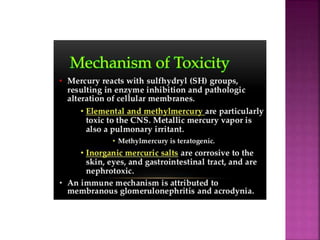
 Mercury affects many systems and organs: nervous,
immune, digestive systems; lungs, kidneys, skin and eyes
 Major threat is an impact on child’s neurodevelopment
following exposure to methylmercury in utero and early in
life
 Currently, of major concern are adverse effects associated
with low level exposure to (methyl)mercury
 Any release of mercury could be converted into
methylmercury
 Mercury methylation in the aquatic environment
 Bio-accumulation of mercury with the highest
concentrations at the top of the food chains
 Mercury exists in various forms: elemental
(or metallic) and inorganic (to which people
may be exposed through their occupation);
and organic (e.g., methylmercury, to which
people may be exposed through their diet)
 The type of mercury concerned;
 the dose;
 the age or developmental stage of the person
exposed (the foetus is most susceptible);
 the duration of exposure;
 the route of exposure (inhalation, ingestion
or dermal contact).
 Generally, two groups are more sensitive to the effects of
mercury. Foetuses are most susceptible to developmental effects
due to mercury. Methylmercury exposure in the womb can result
from a mother's consumption of fish and shellfish. It can
adversely affect a baby's growing brain and nervous system. The
primary health effect of methylmercury is impaired neurological
development. Therefore, cognitive thinking, memory, attention,
language, and fine motor and visual spatial skills may be affected
in children who were exposed to methylmercury as foetuses.
 The second group is people who are regularly exposed (chronic
exposure) to high levels of mercury (such as populations that rely
on subsistence fishing or people who are occupationally
exposed). Among selected subsistence fishing populations,
between 1.5/1000 and 17/1000 children showed cognitive
impairment (mild mental retardation) caused by the consumption
of fish containing mercury. These included populations in Brazil,
Canada, China, Columbia and Greenland.
 Industrial
- Batteries, fungicide
 Seafood consumption
- Mostly methylmercury
1)Elemental
 Liquid metal at room temperature (Think of
the Terminator recongealing)
 14x more dense than water
 Volatile and lipid soluble, therefore rapidly
absorbed through lungs (approximately 70-
80%)
 Oxidized rapidly to inorganic form
 Poorly absorbed from GI tract
 Therefor most ingestions are non-toxic
2) Organic
 Exists in three major forms:
 Long chain
 Short chain
 Aryl
 Long chain and Aryl forms are rapidly converted
to inorganic forms
 Short chain forms are highly lipophilic and cross
the blood-brain barrier and placenta
 Metabolized in the liver to N-acetyl-
homocysteine-methylmercury which undergoes
enterohepatic recirculation
3) Inorganic
 Exists as monovalent and divalent
 Corrosive
 Chronic exposures lead to accumulation in brain
and CNS
 Found in many batteries, little risk of toxicity
from the mercury components s/p ingestion
 Other dangers exist though!!!
 The California Department of Public Health
issued a health alert on May, 2014 noting
mercury poisoning linked to use of skin-
lightening or acne Creams from Mexico[1]
 Clinical presentation highly dependent on
form, concentration and duration of
exposure
 Inhalation of elemental mercury and
ingestion of inorganic can cause acute or
subacute toxicity
 Organic mercury more likely causes chronic
toxicity
Acute Exposure
 Metal fume fever
- Usually self limited course of flu-like illness;
fever, chills, shortness of breath, metallic taste in
throat, lethargy, confusion, vomiting, renal tubular
necrosis
- Rarely may progress to respiratory compromise
and death
 Worse presentation in children
- May develop pneumothorax, pneumomediastinum
and interstitial emphysema
 Small airway obstruction secondary to
desquamation
Chronic Exposure
 Classic Triad:
-Tremor
-Gingivitis/stomatitis
- Hyperexcitable state/emotional lability
 Other findings
 Headache, visual disturbances, peripheral
neuropathy, ataxia
Acute Exposure Chronic Exposure
 Primarily toxic through oral
route
 Causes caustic burns
 Severity dependent on type
[Hg(2)Cl vs Hg(1)Cl] and
concentration of mercurial
salts
 Mercuric forms [Hg(2)]
more toxic
 Other symptoms include
pain, nausea, hematemesis,
hypovolemia, acute tubular
necrosis
 Sequelae include renal
failure
 Chronic exposures usually
secondary to inhalation
exposure
 Symptoms include renal
failure, dementia,
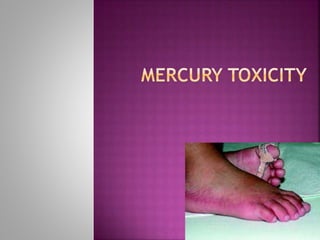
acrodynia
 Acrodynia (AKA pink
disease) = painful
erythema and edema of
hands and feet, rash,
tachycardia, hypertension
and irritability.
 Neuropsychiatric
disturbances
 Acute and chronic exposures present similarly
 Acute presentations usually show signs days to weeks after
exposure
 Neuro symptoms predominate
 Tremor, ataxia, paresthesias, memory difficulties, visual
disturbances, hearing loss
 May also cause thrombocytopenia and agranulocytosis
 Highly fetotoxic
 Easily crosses placenta
 May lead to severe intellectual disability (like those with
Minamata disease), developmental delay, ataxia and seizures in
offspring
 Controversy exists over exposure from regular diet
 Albacore tuna may contain up to 0.34ppm of organic mercury
 Please see Faroe Island and Seychelles studies
 Thimerosal (mercury containing preservative found in many
vaccines) has NOT been linked to developmental delays or autism
 Urine and blood mercury levels
 CBC
 Chem 7 ( Renal profile, glucose, c02)
 Type and screen (GSH)
 Radiographs
 Urine mercury levels (>25μg/L is elevated)
for elemental and organic mercury
 Levels >300μg/L usually symptomatic
 Organic mercury poorly excreted
 Blood levels for organic mercury
 Hair analysis is not sufficient
 ABC's
 Decontaminate
- Of note, mercury can penetrate through
latex and nitrile gloves
Inhalation injuries
 Oxygen
 May require intubation
 ABC
 Removal of contaminated clothing and skin
irrigation
 Do not induce emesis if the compound ingested
is caustic inorganic form
 Gastric lavage is recommended for organic
ingestion, especially if the compound is observed
on the abdominal x ray
 Whole bowel irrigation may be used until rectal
effluent is clear and void of any radiopaque
material
 Use chelating agents if patient is symptomatic or
if increase urine or blood levels
 The choice of chelating agent is dependent of
the type of mercury poisoning.
 Penicillamine 250mg PO QID x 1-2wks
 Avoid in renal failure
 Dimercaprol (BAL) 2.5-5mg IM Q6-12hr
 Day 1: 5 mg/kg deep IM qDay x1 day
 Day 2-11: 2.5 mg/kg deep IM q12-24hr x10 days
 Contraindicated in organic mercury poisoning as
can paradoxically increase mercury levels
 DMSA (succimer) 10mg/kg TID x 5days then
10mg/kg BID x 14days
 Haddad and Winchester's Clinical Management of Poisoning and
Overdose
 Goldfrank's Toxicology
 http://en.wikipedia.org/wiki/Mercury(I)_chloride
 http://en.wikipedia.org/wiki/Minamata_disease
 http://en.wikipedia.org/wiki/1971_Iraq_poison_grain_disaster
 http://www.ehib.org/papers/Health_Alert%20_Mercury_Poisonin
gs_from_Mexican_creams_5_2014.pdf

MERCURY TOXICITY.pptx

  • 2.
     Mercury affectsmany systems and organs: nervous, immune, digestive systems; lungs, kidneys, skin and eyes  Major threat is an impact on child’s neurodevelopment following exposure to methylmercury in utero and early in life  Currently, of major concern are adverse effects associated with low level exposure to (methyl)mercury  Any release of mercury could be converted into methylmercury  Mercury methylation in the aquatic environment  Bio-accumulation of mercury with the highest concentrations at the top of the food chains
  • 3.
     Mercury existsin various forms: elemental (or metallic) and inorganic (to which people may be exposed through their occupation); and organic (e.g., methylmercury, to which people may be exposed through their diet)
  • 4.
     The typeof mercury concerned;  the dose;  the age or developmental stage of the person exposed (the foetus is most susceptible);  the duration of exposure;  the route of exposure (inhalation, ingestion or dermal contact).
  • 5.
     Generally, twogroups are more sensitive to the effects of mercury. Foetuses are most susceptible to developmental effects due to mercury. Methylmercury exposure in the womb can result from a mother's consumption of fish and shellfish. It can adversely affect a baby's growing brain and nervous system. The primary health effect of methylmercury is impaired neurological development. Therefore, cognitive thinking, memory, attention, language, and fine motor and visual spatial skills may be affected in children who were exposed to methylmercury as foetuses.  The second group is people who are regularly exposed (chronic exposure) to high levels of mercury (such as populations that rely on subsistence fishing or people who are occupationally exposed). Among selected subsistence fishing populations, between 1.5/1000 and 17/1000 children showed cognitive impairment (mild mental retardation) caused by the consumption of fish containing mercury. These included populations in Brazil, Canada, China, Columbia and Greenland.
  • 6.
     Industrial - Batteries,fungicide  Seafood consumption - Mostly methylmercury
  • 7.
    1)Elemental  Liquid metalat room temperature (Think of the Terminator recongealing)  14x more dense than water  Volatile and lipid soluble, therefore rapidly absorbed through lungs (approximately 70- 80%)  Oxidized rapidly to inorganic form  Poorly absorbed from GI tract  Therefor most ingestions are non-toxic
  • 8.
    2) Organic  Existsin three major forms:  Long chain  Short chain  Aryl  Long chain and Aryl forms are rapidly converted to inorganic forms  Short chain forms are highly lipophilic and cross the blood-brain barrier and placenta  Metabolized in the liver to N-acetyl- homocysteine-methylmercury which undergoes enterohepatic recirculation
  • 9.
    3) Inorganic  Existsas monovalent and divalent  Corrosive  Chronic exposures lead to accumulation in brain and CNS  Found in many batteries, little risk of toxicity from the mercury components s/p ingestion  Other dangers exist though!!!  The California Department of Public Health issued a health alert on May, 2014 noting mercury poisoning linked to use of skin- lightening or acne Creams from Mexico[1]
  • 10.
     Clinical presentationhighly dependent on form, concentration and duration of exposure  Inhalation of elemental mercury and ingestion of inorganic can cause acute or subacute toxicity  Organic mercury more likely causes chronic toxicity
  • 11.
    Acute Exposure  Metalfume fever - Usually self limited course of flu-like illness; fever, chills, shortness of breath, metallic taste in throat, lethargy, confusion, vomiting, renal tubular necrosis - Rarely may progress to respiratory compromise and death  Worse presentation in children - May develop pneumothorax, pneumomediastinum and interstitial emphysema  Small airway obstruction secondary to desquamation
  • 12.
    Chronic Exposure  ClassicTriad: -Tremor -Gingivitis/stomatitis - Hyperexcitable state/emotional lability  Other findings  Headache, visual disturbances, peripheral neuropathy, ataxia
  • 13.
    Acute Exposure ChronicExposure  Primarily toxic through oral route  Causes caustic burns  Severity dependent on type [Hg(2)Cl vs Hg(1)Cl] and concentration of mercurial salts  Mercuric forms [Hg(2)] more toxic  Other symptoms include pain, nausea, hematemesis, hypovolemia, acute tubular necrosis  Sequelae include renal failure  Chronic exposures usually secondary to inhalation exposure  Symptoms include renal failure, dementia, acrodynia  Acrodynia (AKA pink disease) = painful erythema and edema of hands and feet, rash, tachycardia, hypertension and irritability.  Neuropsychiatric disturbances
  • 14.
     Acute andchronic exposures present similarly  Acute presentations usually show signs days to weeks after exposure  Neuro symptoms predominate  Tremor, ataxia, paresthesias, memory difficulties, visual disturbances, hearing loss  May also cause thrombocytopenia and agranulocytosis  Highly fetotoxic  Easily crosses placenta  May lead to severe intellectual disability (like those with Minamata disease), developmental delay, ataxia and seizures in offspring  Controversy exists over exposure from regular diet  Albacore tuna may contain up to 0.34ppm of organic mercury  Please see Faroe Island and Seychelles studies  Thimerosal (mercury containing preservative found in many vaccines) has NOT been linked to developmental delays or autism
  • 15.
     Urine andblood mercury levels  CBC  Chem 7 ( Renal profile, glucose, c02)  Type and screen (GSH)  Radiographs
  • 16.
     Urine mercurylevels (>25μg/L is elevated) for elemental and organic mercury  Levels >300μg/L usually symptomatic  Organic mercury poorly excreted  Blood levels for organic mercury  Hair analysis is not sufficient
  • 17.
     ABC's  Decontaminate -Of note, mercury can penetrate through latex and nitrile gloves Inhalation injuries  Oxygen  May require intubation
  • 18.
     ABC  Removalof contaminated clothing and skin irrigation  Do not induce emesis if the compound ingested is caustic inorganic form  Gastric lavage is recommended for organic ingestion, especially if the compound is observed on the abdominal x ray  Whole bowel irrigation may be used until rectal effluent is clear and void of any radiopaque material  Use chelating agents if patient is symptomatic or if increase urine or blood levels
  • 19.
     The choiceof chelating agent is dependent of the type of mercury poisoning.  Penicillamine 250mg PO QID x 1-2wks  Avoid in renal failure  Dimercaprol (BAL) 2.5-5mg IM Q6-12hr  Day 1: 5 mg/kg deep IM qDay x1 day  Day 2-11: 2.5 mg/kg deep IM q12-24hr x10 days  Contraindicated in organic mercury poisoning as can paradoxically increase mercury levels  DMSA (succimer) 10mg/kg TID x 5days then 10mg/kg BID x 14days
  • 26.
     Haddad andWinchester's Clinical Management of Poisoning and Overdose  Goldfrank's Toxicology  http://en.wikipedia.org/wiki/Mercury(I)_chloride  http://en.wikipedia.org/wiki/Minamata_disease  http://en.wikipedia.org/wiki/1971_Iraq_poison_grain_disaster  http://www.ehib.org/papers/Health_Alert%20_Mercury_Poisonin gs_from_Mexican_creams_5_2014.pdf