THE MENU
RATIONALE
• Everything starts
with the menu.
• The menu dictates
much about how your
operation will be
organized and
managed, the extent
to which it meet its
goals, and even how
the building itself -
certainly the interior -
should be designed
and constructed.
MENU
• Definition
• Importance
• Ways In Categorizing The Menu
• Menu Pricing Styles
• Menu Types
• Menu Planning
• Menu Balancing
• Menu Design
• Menu Development
• Menu Format
• Menu Cover
• Menu Layout
• Menu Copy
MENU
• Is a list of available
foods offered in any
food service
operation.
IMPORTANCE OF MENU
• For guest, it communicates the operation’s image. It contributes to the over-all
dining experience by helping to set a mood and build interest and excitement.
• For production employees, it dictates what foods must be prepared.
• For service employees, their task is influenced by what items are offered on the
menu.
• For managers, it is the chief-in-house marketing and sales tool.
• it tells what food and beverage items must be purchased and what equipment
must they have to have, the number of employees they need to hire and their skill
level.
WAYS IN
CATEGORIZING
THE MENU
ACCORDING TO MENU
SCHEDULES
(How often they are used)
• FIXED MENUS – a single menu used for several
months or longer.
• CYCLE MENUS – designed to provide variety for
guests who eat frequently or even daily like in
schools, hospitals, and offices.
• Three basic types of menu is designed around the three traditional meal
periods:
BREAKFAST – menus are fairly standard, items are “simple”, “fast”, and
“inexpensive”
LUNCH – it usually features menu items that are easy and quick to make; it is
lighter than dinner menu.
DINNER – is the main meal for most people, it is heavier in character and more
elaborate than those offered at breakfast or lunch.
ACCORDING TO
MENU TYPES
ACCORDING TO MENU PRICING
STYLES
3 Styles of Menu in the Food Service Industry
• A LA CARTE MENU
• SEMI A LA CARTE MENU
• PRIX FIXE MENU
A LA CARTE MENU
• Menu that is priced separately
from appetizers to desserts.
SEMI A LA CARTE MENU
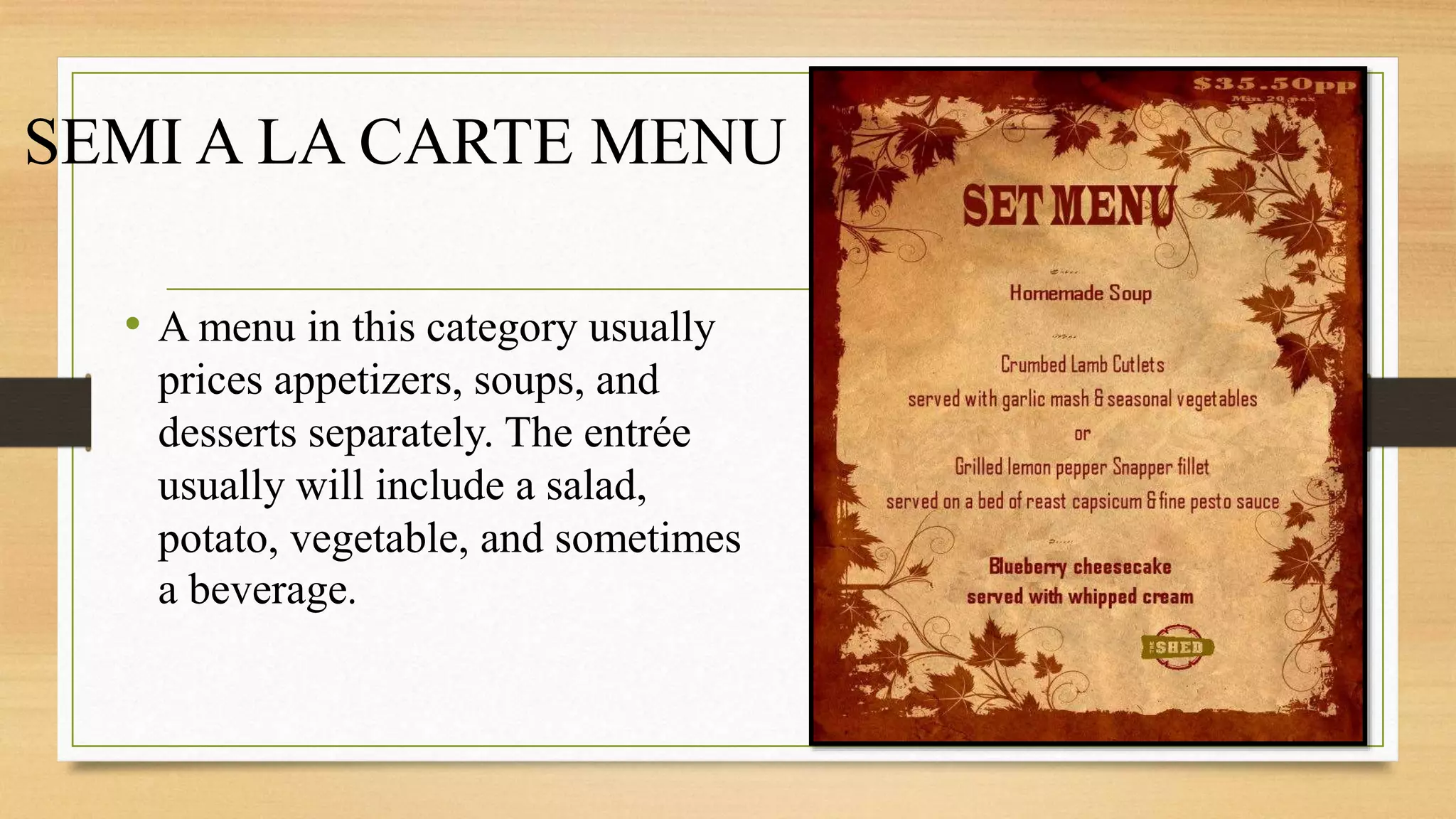
• A menu in this category usually
prices appetizers, soups, and
desserts separately. The entrée
usually will include a salad,
potato, vegetable, and sometimes
a beverage.
PRIX FIXE MENU
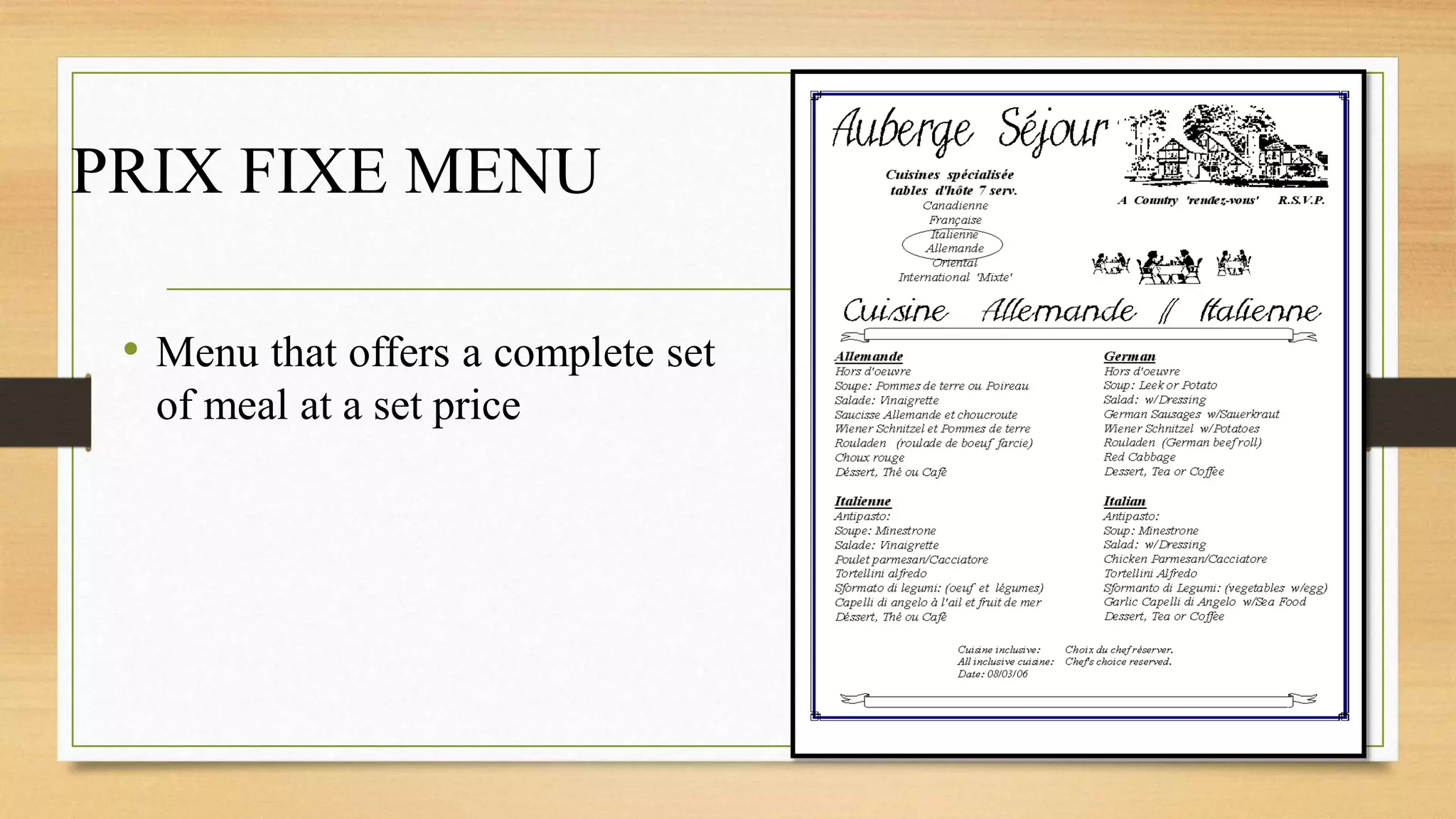
• Menu that offers a complete set
of meal at a set price
MENU OFFERING / SPECIALTY
MENUS:
• Children’s Menu
• Senior Citizen’s Menu
• Alcoholic Beverage
• Dessert
• Room Service
• Take-out
• Country Style / California Menu
• Ethnic
MENU PLANNING
• Consists of selecting new menu items for an
existing menu.
PURPOSE OF MENU PLANNING
-Work will flow more smoothly
-Guests will be served more effectively
-Profit will be greater
2 BASIC RULES IN MENU PLANNING:
1. Knowing your guests
2. Knowing your operation.
5 COMPONENTS OF OPERATION:
1. Theme or Cuisine
2. Equipment
3. Personnel
4. Quality Standards
5. Budget
Categories of Menu Items Listed on the
Menu:
• Appetizers / Soups
• Salads
• Entrees
• Starch Items (Potatoes, Rice, Pasta)
• Vegetables
• Desserts
• Beverages
SELECTING MENU ITEMS:
• SOURCES FOR SELECTING MENU
• Old Menus
• Books
• Trade Magazines
• Cookbooks for the Home Market
• STEPS IN SELECTING MENU ITEMS
• Entrees
• Appetizers / Soups
• Starch Items and vegetables
• Salads
• Desserts
• Beverages
• Business Balance
• Aesthetic Balance
(Artistic)
• Nutritional Balance
MENU BALANCING
MENU DESIGN
Characteristics of a well-designed
menu:
• It complements a restaurant’s over-all theme.
• It blends with the interior design of the
restaurant
• It communicates with the guests
• It helps sell the operation and its menu
items.
MENU COPY
We have three elements of menu copy:
• Headings – includes major heads, subheads, and names of menu
items.
• Descriptive Copy – informs the guests about the menu items
and helps increase sales. The menu items’ main ingredient,
important secondary ingredients and method of preparation.
• Supplemental Merchandising Copy – it includes basic
information: address, telephone number, days and hours of
operation, meals served, reservations and payment policies.
MENU LAYOUT
A rough sketch of how the finished menu will look. It
includes:
• listing menu items in the right sequence,
• placing the menu items’ names and descriptive copy,
• determining the menu format, choosing the right typeface
and the right paper, and integrating artwork into the
menu.
MENU COVER
• A well designed cover communicates the image, style, cuisine and
price range of the operation, it helps set the mood and creates
expectations of the dining experience to come
• It features the restaurant’s name and some basic information, the
cover’s design must be suitable to your operation, the color should
either blend or contrast pleasantly of the color scheme of the
restaurant.
COMMON MENU DESIGN
MISTAKES:• Menu is too small
• Type (font) is too small
• No descriptive copy
• Every item treated the same
• Some of the food and beverages are not listed.
• Clip-on problem
• Blank pages
• Basic information about the property and
policies not included
MENU DEVELOPMENT
• It is a process which involves improvement (or to provide a solution
for) the current menu items performance.
• Factor that contributes to Menu Development
 Menu Knowledge
 Menu Design
MENU FORMAT
• The principal duty of the menu writer is to direct the customer’s
attention to those items that the restaurant operation wants to sell.
• The menu must be designed to increase both sales and profit.
• Menu format discusses ways to attain this goal.
• There are 5 Main Types of Menu Design
1. Single-page
2. Two-panel
3. Letter-fold (Vertical or Horizontal)
4. Three-panel
5. Multi-page
SINGLE – PAGE MENU
• The area immediately above
an imaginary line dividing
the menu in half horizontally
is the focal point of the
menu.
• This area, therefore, should
contain those items that are
most profitable
Sales
Concentration
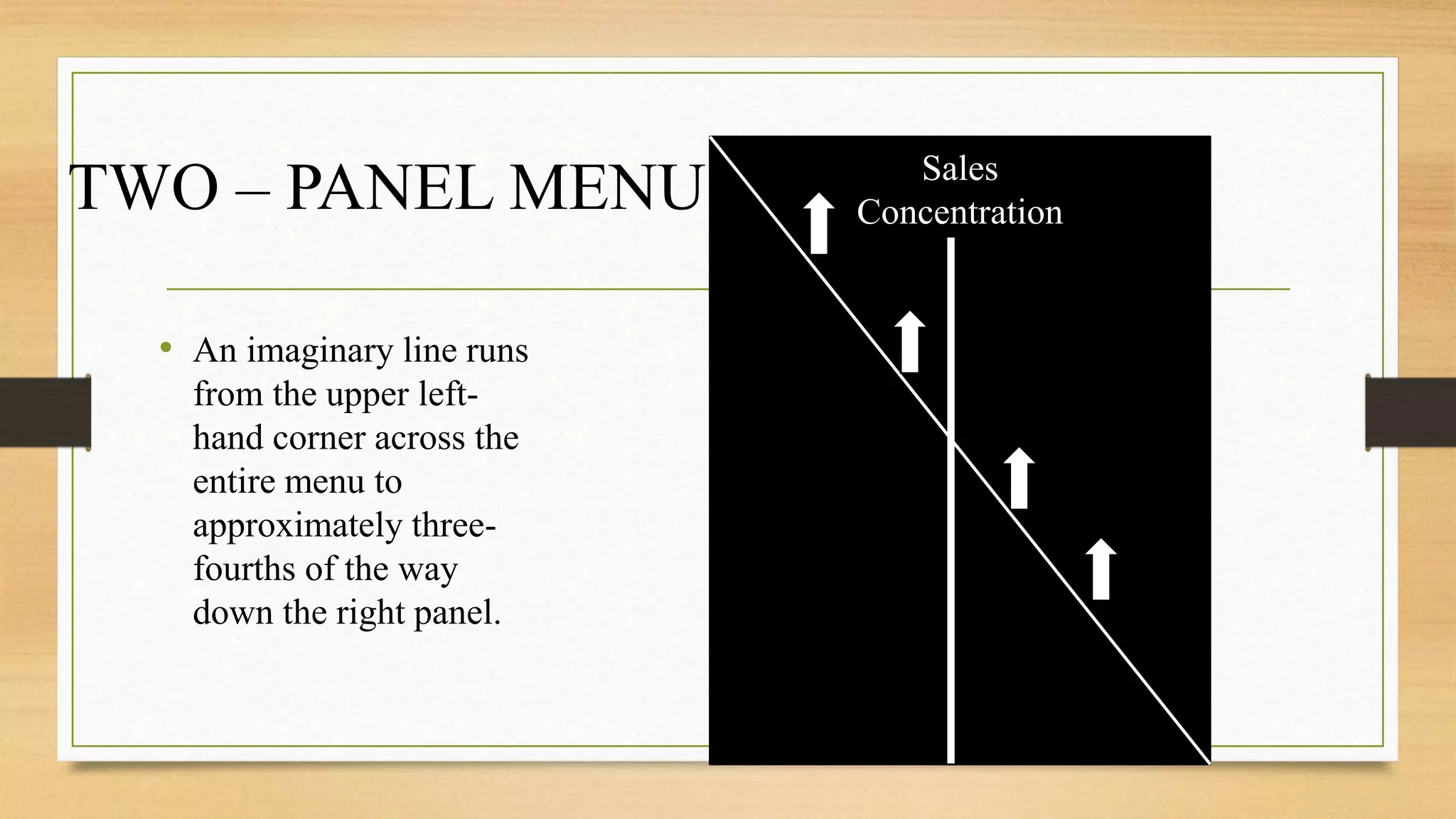
TWO – PANEL MENU
• An imaginary line runs
from the upper left-
hand corner across the
entire menu to
approximately three-
fourths of the way
down the right panel.
Sales
Concentration
LETTER – FOLD (VERTICAL /
HORIZONTAL)
• Is folded horizontally or vertically into three equal parts.
• This design permits you to use six panels—four inside and two outside—for
logo identification, advertisement, institutional copy, and food listings and
descriptions.
• One section of this type of menu can even be used for mailing label so that
the menu can be a promotion piece or a souvenir.
LETTER – FOLD VERTICAL
(House
Drinks
Advertisemen
t
On Back Fold
in Cover)
Sales
Concentration
LETTER – FOLD HORIZONTAL
(House Drink
Advertisement On Back
Fold in Cover)
Sales
Concentration
THREE – PANEL MENU
• Has right and left panels that are folded to meet at the middle of the center
panel.
• The left panel is one-fourth of the menu, the center panel is one-half, and the
right panel is one-fourth.
• With this menu the eye tends to focus in the center.
THREE – PANEL MENU
Three-panel Menu, Showing Eye Movement
UPPER
LEFT
CORNE
R
UPPER
RIGHT
CORNE
R
BOTTO
M
RIGHT
CORNE
R
BOTTO
M LEFT
CORNE
R
FIRST
EYE
FOCUS
Sales
Concentration
MULTI-PAGE MENU
• Is a book style format used by restaurants with extensive menu offerings.
• The multi-page format has some drawbacks that need to be mentioned.
• It requires longer customer decision time and can lower the table turnover rate
in the restaurant.
• Attention can only be drawn to the category of item listed on a single page.
MULTI-PAGE MENU
PAGE
01
PAGE
02
PAGE
03
PAGE
04
Sales
Concentration
MENU KNOWLEDGE
Menu Design and Writing
Menu Rotation and Proper Item Replacement
Menus for Events
Prioritize the Elements of Your Menu
Menus By Season
MENU DESIGN
Characteristics of a well-designed
menu:
• It complements and blend with the interior
design and the restaurant’s over-all theme.
• It communicates with the guests and helps sell
the operation and its menu items.
MENU DESIGN CHANGES AND
DEVELOPMENT
• In Europe, the contemporary menu
first appeared in the second half of
the eighteenth century.
• Pen and paper were the only medium
they used to represent their menu as
well as for the purpose of order
taking
MENU CARD
• Menu Card is the list of
foods and beverage
available in the restaurant
written or printed in a piece
of paper.
MENU DESIGN SOFTWARE
• Is a program designed for the
foodservice establishment to
make the menu look
professional, simple to use,
automate the daily specials,
save time and money, and to
have an effective and efficient
service.
SIGNIFICANCE OF MENU DESIGN
SOFTWARE
• Fast and reliable, it offers the highest-quality menu design services supported with exceptional
personal service.
• A menu design software can increase profits, complement your eatery and provide the image
needed to compete in a very competitive market.
• Menu design will help improve your image. Menu and menu cover graphically communicate the
identity of your restaurant. Its appearance sends subtle signals that can affect how customers
perceive your operation.
• A clean and well-organized menu design can improve your restaurants image by helping
customers feel good about your establishment and how they feel about being there
CONT.
• The driving force behind increased profits is the menu -Restaurant menu design
involves more than just starting with appetizers and ending with desserts.
There's a strategy -- commonly referred to as "menu engineering". A
comprehensive understanding of category placement, arrangement of items
within these categories and the overall design of the menu.
• Increase Return Visits - You can personally design your menu and it is
interesting and easy-to-use -- compelling your customers to relax. It will help
make for an enjoyable dining experience and your customers feeling good
about returning.
I TOUCH DESIGN SOFTWARE
NUTRITION LABELING
• Nutrition Labeling, also called a food label, is a
graphic square placed on a box of prepared
foods that shows the nutritional value of a
consumable product.
• It also gives that value expressed as a
percentage of the daily nutrition values that the
Food and Drug Administration (FDA)
recommends for a healthy diet..
NUTRITIONAL INFORMATION
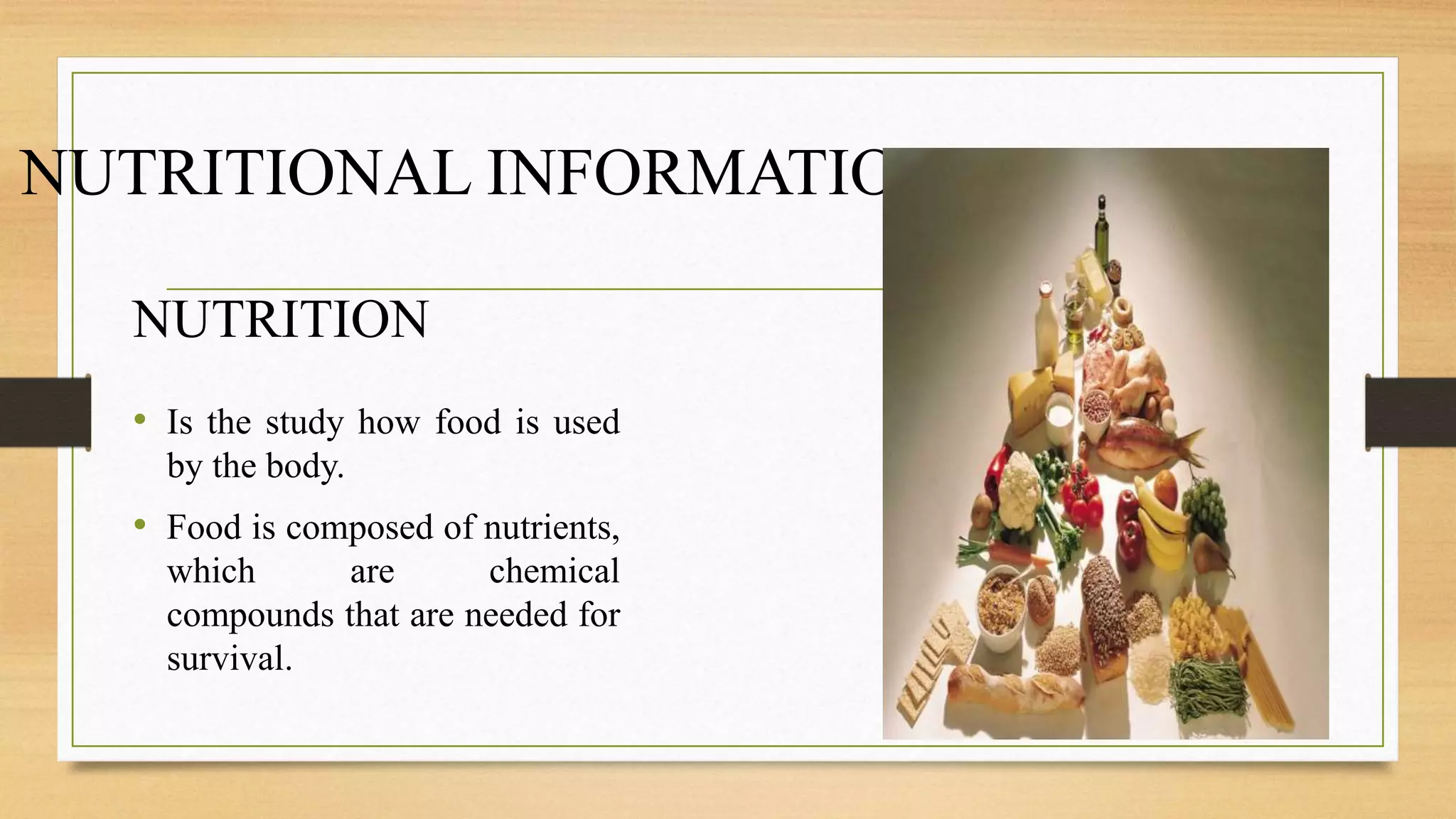
NUTRITION
• Is the study how food is used
by the body.
• Food is composed of nutrients,
which are chemical
compounds that are needed for
survival.
6 MAJOR NUTRIENT GROUPS
1. Protein
2. Carbohydrates
3. Fat
4. Vitamins
5. Minerals
6. Water
PROTEIN
• Provides calories, synthesize new body
tissue during growth, and replace worn-
out cells.
• It also form hormones, enzymes and
antibodies, which are required for
performing numerous bodily processes
and for maintaining immunity to
diseases.
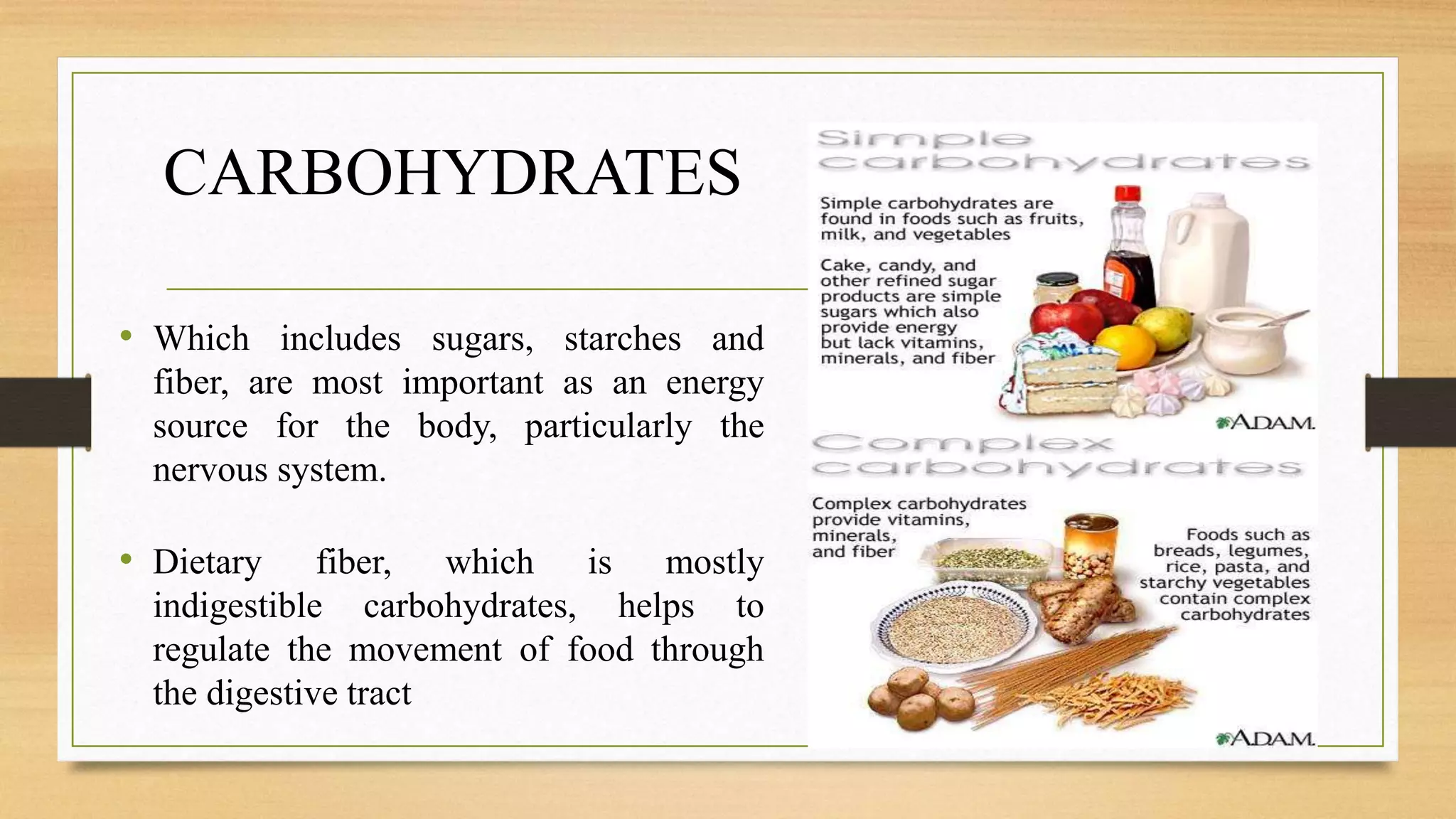
CARBOHYDRATES
• Which includes sugars, starches and
fiber, are most important as an energy
source for the body, particularly the
nervous system.
• Dietary fiber, which is mostly
indigestible carbohydrates, helps to
regulate the movement of food through
the digestive tract
FATS
• Are very concentrated energy source,
providing more than twice the calories as
an equal amount of protein or
carbohydrate.
• 2 Types of Fats
 Saturated
 Unsaturated
SATURATED FATS
• Chemical structure contains
maximum number of hydrogen
atoms.
• These fats are solid and tend to be
found in animal products
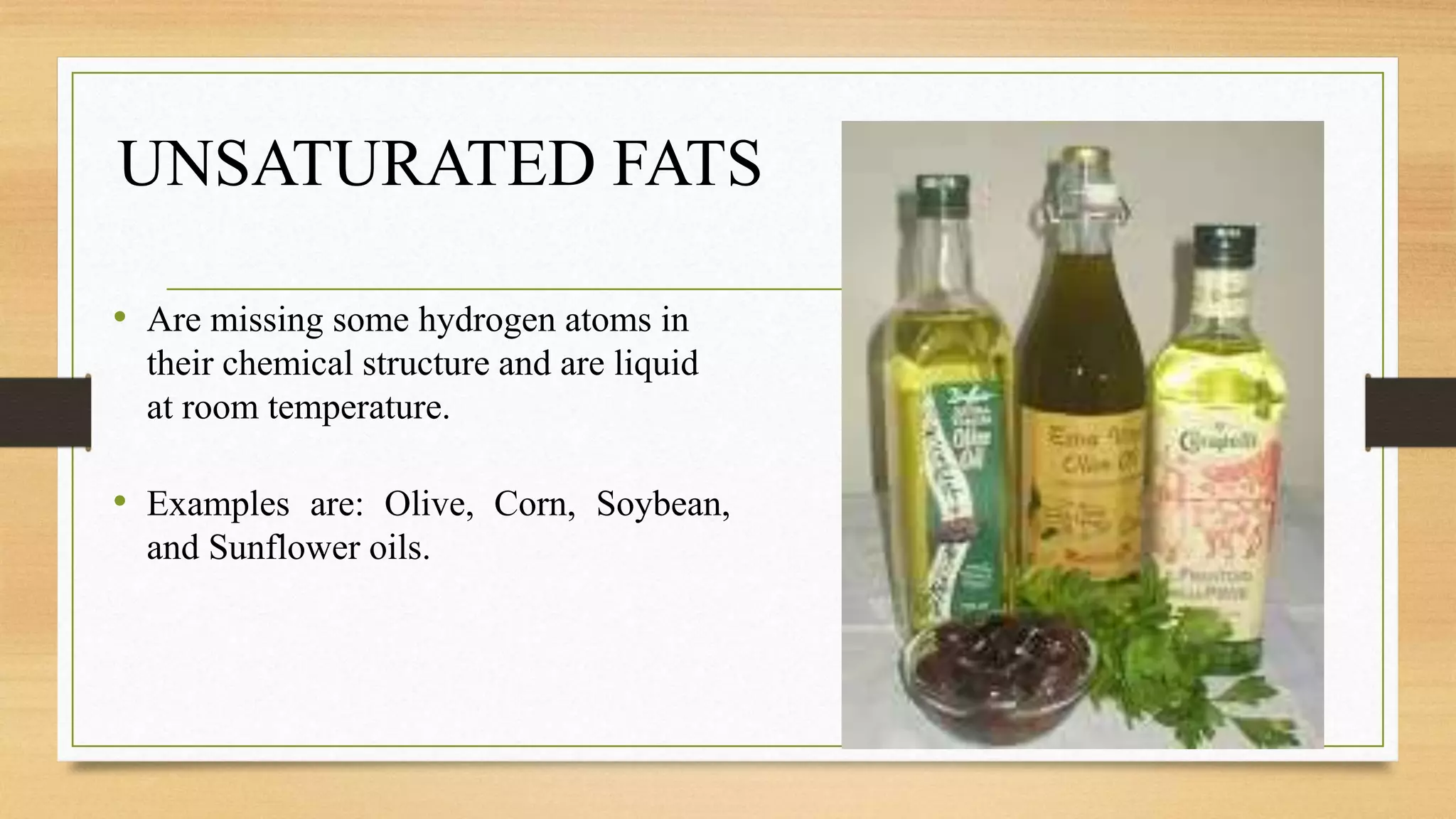
UNSATURATED FATS
• Are missing some hydrogen atoms in
their chemical structure and are liquid
at room temperature.
• Examples are: Olive, Corn, Soybean,
and Sunflower oils.
VITAMINS
• Are chemically compounds that are
involved in various metabolic reactions
in the body.
• They are divided in two groups:
 Fat-Soluble Vitamins: Vitamins A,D,E, and
K.
 Water-Soluble Vitamins: Vitamins B and C
MINERALS
• Are crystalline chemical elements that comprise
about 4 percent of a person’s weight.
• Minerals performs various functions. Calcium,
Phosphorous, sodium potassium, magnesium,
sulfur and chlorine are considered
micronutrients, because they are present in the
body in relatively large amounts
WATER
• Is the most vital nutrient.
• Water dissolves and transports nutrients
into, throughout, and from the body.
• It also regulates body temperature,
lubricate joints, it is also involved in
chemical reactions, and helps cells retain
their shape
NUTRITIONAL IMPLICATIONS FOR
MENU PLANNING
• When planning for the menu for an institutional, industrial or commercial food service operation,
it is beneficial to the clientele to take into consideration their nutrient needs.
• Breakdown and general nutrition information about items found in the menu by informing the
customers about the following:
 Recommended Dietary Allowance
 Nutrition Labeling
 Proper Diet
RDA (Recommended Dietary
Allowance)
• Is the suggested level of daily consumption for protein, 11 vitamins, and 7
minerals.
• RDA is grouped by age and gender; recommendations were also given for
pregnant and lactating females.
• As well as, recommendations for calorie intake and range estimated safe and
adequate levels for additional vitamins and minerals.

MENU

  • 1.
    THE MENU RATIONALE • Everythingstarts with the menu. • The menu dictates much about how your operation will be organized and managed, the extent to which it meet its goals, and even how the building itself - certainly the interior - should be designed and constructed.
  • 2.
    MENU • Definition • Importance •Ways In Categorizing The Menu • Menu Pricing Styles • Menu Types • Menu Planning • Menu Balancing • Menu Design • Menu Development • Menu Format • Menu Cover • Menu Layout • Menu Copy
  • 3.
    MENU • Is alist of available foods offered in any food service operation.
  • 4.
    IMPORTANCE OF MENU •For guest, it communicates the operation’s image. It contributes to the over-all dining experience by helping to set a mood and build interest and excitement. • For production employees, it dictates what foods must be prepared. • For service employees, their task is influenced by what items are offered on the menu. • For managers, it is the chief-in-house marketing and sales tool. • it tells what food and beverage items must be purchased and what equipment must they have to have, the number of employees they need to hire and their skill level.
  • 5.
  • 6.
    ACCORDING TO MENU SCHEDULES (Howoften they are used) • FIXED MENUS – a single menu used for several months or longer. • CYCLE MENUS – designed to provide variety for guests who eat frequently or even daily like in schools, hospitals, and offices.
  • 7.
    • Three basictypes of menu is designed around the three traditional meal periods: BREAKFAST – menus are fairly standard, items are “simple”, “fast”, and “inexpensive” LUNCH – it usually features menu items that are easy and quick to make; it is lighter than dinner menu. DINNER – is the main meal for most people, it is heavier in character and more elaborate than those offered at breakfast or lunch. ACCORDING TO MENU TYPES
  • 8.
    ACCORDING TO MENUPRICING STYLES 3 Styles of Menu in the Food Service Industry • A LA CARTE MENU • SEMI A LA CARTE MENU • PRIX FIXE MENU
  • 9.
    A LA CARTEMENU • Menu that is priced separately from appetizers to desserts.
  • 10.
    SEMI A LACARTE MENU • A menu in this category usually prices appetizers, soups, and desserts separately. The entrée usually will include a salad, potato, vegetable, and sometimes a beverage.
  • 11.
    PRIX FIXE MENU •Menu that offers a complete set of meal at a set price
  • 12.
    MENU OFFERING /SPECIALTY MENUS: • Children’s Menu • Senior Citizen’s Menu • Alcoholic Beverage • Dessert • Room Service • Take-out • Country Style / California Menu • Ethnic
  • 13.
    MENU PLANNING • Consistsof selecting new menu items for an existing menu. PURPOSE OF MENU PLANNING -Work will flow more smoothly -Guests will be served more effectively -Profit will be greater
  • 14.
    2 BASIC RULESIN MENU PLANNING: 1. Knowing your guests 2. Knowing your operation. 5 COMPONENTS OF OPERATION: 1. Theme or Cuisine 2. Equipment 3. Personnel 4. Quality Standards 5. Budget
  • 16.
    Categories of MenuItems Listed on the Menu: • Appetizers / Soups • Salads • Entrees • Starch Items (Potatoes, Rice, Pasta) • Vegetables • Desserts • Beverages
  • 17.
    SELECTING MENU ITEMS: •SOURCES FOR SELECTING MENU • Old Menus • Books • Trade Magazines • Cookbooks for the Home Market • STEPS IN SELECTING MENU ITEMS • Entrees • Appetizers / Soups • Starch Items and vegetables • Salads • Desserts • Beverages
  • 18.
    • Business Balance •Aesthetic Balance (Artistic) • Nutritional Balance MENU BALANCING
  • 19.
    MENU DESIGN Characteristics ofa well-designed menu: • It complements a restaurant’s over-all theme. • It blends with the interior design of the restaurant • It communicates with the guests • It helps sell the operation and its menu items.
  • 20.
    MENU COPY We havethree elements of menu copy: • Headings – includes major heads, subheads, and names of menu items. • Descriptive Copy – informs the guests about the menu items and helps increase sales. The menu items’ main ingredient, important secondary ingredients and method of preparation. • Supplemental Merchandising Copy – it includes basic information: address, telephone number, days and hours of operation, meals served, reservations and payment policies.
  • 21.
    MENU LAYOUT A roughsketch of how the finished menu will look. It includes: • listing menu items in the right sequence, • placing the menu items’ names and descriptive copy, • determining the menu format, choosing the right typeface and the right paper, and integrating artwork into the menu.
  • 22.
    MENU COVER • Awell designed cover communicates the image, style, cuisine and price range of the operation, it helps set the mood and creates expectations of the dining experience to come • It features the restaurant’s name and some basic information, the cover’s design must be suitable to your operation, the color should either blend or contrast pleasantly of the color scheme of the restaurant.
  • 23.
    COMMON MENU DESIGN MISTAKES:•Menu is too small • Type (font) is too small • No descriptive copy • Every item treated the same • Some of the food and beverages are not listed. • Clip-on problem • Blank pages • Basic information about the property and policies not included
  • 24.
    MENU DEVELOPMENT • Itis a process which involves improvement (or to provide a solution for) the current menu items performance. • Factor that contributes to Menu Development  Menu Knowledge  Menu Design
  • 25.
    MENU FORMAT • Theprincipal duty of the menu writer is to direct the customer’s attention to those items that the restaurant operation wants to sell. • The menu must be designed to increase both sales and profit. • Menu format discusses ways to attain this goal. • There are 5 Main Types of Menu Design 1. Single-page 2. Two-panel 3. Letter-fold (Vertical or Horizontal) 4. Three-panel 5. Multi-page
  • 26.
    SINGLE – PAGEMENU • The area immediately above an imaginary line dividing the menu in half horizontally is the focal point of the menu. • This area, therefore, should contain those items that are most profitable Sales Concentration
  • 27.
    TWO – PANELMENU • An imaginary line runs from the upper left- hand corner across the entire menu to approximately three- fourths of the way down the right panel. Sales Concentration
  • 28.
    LETTER – FOLD(VERTICAL / HORIZONTAL) • Is folded horizontally or vertically into three equal parts. • This design permits you to use six panels—four inside and two outside—for logo identification, advertisement, institutional copy, and food listings and descriptions. • One section of this type of menu can even be used for mailing label so that the menu can be a promotion piece or a souvenir.
  • 29.
    LETTER – FOLDVERTICAL (House Drinks Advertisemen t On Back Fold in Cover) Sales Concentration
  • 30.
    LETTER – FOLDHORIZONTAL (House Drink Advertisement On Back Fold in Cover) Sales Concentration
  • 31.
    THREE – PANELMENU • Has right and left panels that are folded to meet at the middle of the center panel. • The left panel is one-fourth of the menu, the center panel is one-half, and the right panel is one-fourth. • With this menu the eye tends to focus in the center.
  • 32.
    THREE – PANELMENU Three-panel Menu, Showing Eye Movement UPPER LEFT CORNE R UPPER RIGHT CORNE R BOTTO M RIGHT CORNE R BOTTO M LEFT CORNE R FIRST EYE FOCUS Sales Concentration
  • 33.
    MULTI-PAGE MENU • Isa book style format used by restaurants with extensive menu offerings. • The multi-page format has some drawbacks that need to be mentioned. • It requires longer customer decision time and can lower the table turnover rate in the restaurant. • Attention can only be drawn to the category of item listed on a single page.
  • 34.
  • 35.
    MENU KNOWLEDGE Menu Designand Writing Menu Rotation and Proper Item Replacement Menus for Events Prioritize the Elements of Your Menu Menus By Season
  • 36.
    MENU DESIGN Characteristics ofa well-designed menu: • It complements and blend with the interior design and the restaurant’s over-all theme. • It communicates with the guests and helps sell the operation and its menu items.
  • 37.
    MENU DESIGN CHANGESAND DEVELOPMENT • In Europe, the contemporary menu first appeared in the second half of the eighteenth century. • Pen and paper were the only medium they used to represent their menu as well as for the purpose of order taking
  • 38.
    MENU CARD • MenuCard is the list of foods and beverage available in the restaurant written or printed in a piece of paper.
  • 39.
    MENU DESIGN SOFTWARE •Is a program designed for the foodservice establishment to make the menu look professional, simple to use, automate the daily specials, save time and money, and to have an effective and efficient service.
  • 40.
    SIGNIFICANCE OF MENUDESIGN SOFTWARE • Fast and reliable, it offers the highest-quality menu design services supported with exceptional personal service. • A menu design software can increase profits, complement your eatery and provide the image needed to compete in a very competitive market. • Menu design will help improve your image. Menu and menu cover graphically communicate the identity of your restaurant. Its appearance sends subtle signals that can affect how customers perceive your operation. • A clean and well-organized menu design can improve your restaurants image by helping customers feel good about your establishment and how they feel about being there
  • 41.
    CONT. • The drivingforce behind increased profits is the menu -Restaurant menu design involves more than just starting with appetizers and ending with desserts. There's a strategy -- commonly referred to as "menu engineering". A comprehensive understanding of category placement, arrangement of items within these categories and the overall design of the menu. • Increase Return Visits - You can personally design your menu and it is interesting and easy-to-use -- compelling your customers to relax. It will help make for an enjoyable dining experience and your customers feeling good about returning.
  • 42.
  • 43.
    NUTRITION LABELING • NutritionLabeling, also called a food label, is a graphic square placed on a box of prepared foods that shows the nutritional value of a consumable product. • It also gives that value expressed as a percentage of the daily nutrition values that the Food and Drug Administration (FDA) recommends for a healthy diet..
  • 44.
    NUTRITIONAL INFORMATION NUTRITION • Isthe study how food is used by the body. • Food is composed of nutrients, which are chemical compounds that are needed for survival.
  • 45.
    6 MAJOR NUTRIENTGROUPS 1. Protein 2. Carbohydrates 3. Fat 4. Vitamins 5. Minerals 6. Water
  • 46.
    PROTEIN • Provides calories,synthesize new body tissue during growth, and replace worn- out cells. • It also form hormones, enzymes and antibodies, which are required for performing numerous bodily processes and for maintaining immunity to diseases.
  • 47.
    CARBOHYDRATES • Which includessugars, starches and fiber, are most important as an energy source for the body, particularly the nervous system. • Dietary fiber, which is mostly indigestible carbohydrates, helps to regulate the movement of food through the digestive tract
  • 48.
    FATS • Are veryconcentrated energy source, providing more than twice the calories as an equal amount of protein or carbohydrate. • 2 Types of Fats  Saturated  Unsaturated
  • 49.
    SATURATED FATS • Chemicalstructure contains maximum number of hydrogen atoms. • These fats are solid and tend to be found in animal products
  • 50.
    UNSATURATED FATS • Aremissing some hydrogen atoms in their chemical structure and are liquid at room temperature. • Examples are: Olive, Corn, Soybean, and Sunflower oils.
  • 51.
    VITAMINS • Are chemicallycompounds that are involved in various metabolic reactions in the body. • They are divided in two groups:  Fat-Soluble Vitamins: Vitamins A,D,E, and K.  Water-Soluble Vitamins: Vitamins B and C
  • 52.
    MINERALS • Are crystallinechemical elements that comprise about 4 percent of a person’s weight. • Minerals performs various functions. Calcium, Phosphorous, sodium potassium, magnesium, sulfur and chlorine are considered micronutrients, because they are present in the body in relatively large amounts
  • 53.
    WATER • Is themost vital nutrient. • Water dissolves and transports nutrients into, throughout, and from the body. • It also regulates body temperature, lubricate joints, it is also involved in chemical reactions, and helps cells retain their shape
  • 54.
    NUTRITIONAL IMPLICATIONS FOR MENUPLANNING • When planning for the menu for an institutional, industrial or commercial food service operation, it is beneficial to the clientele to take into consideration their nutrient needs. • Breakdown and general nutrition information about items found in the menu by informing the customers about the following:  Recommended Dietary Allowance  Nutrition Labeling  Proper Diet
  • 55.
    RDA (Recommended Dietary Allowance) •Is the suggested level of daily consumption for protein, 11 vitamins, and 7 minerals. • RDA is grouped by age and gender; recommendations were also given for pregnant and lactating females. • As well as, recommendations for calorie intake and range estimated safe and adequate levels for additional vitamins and minerals.