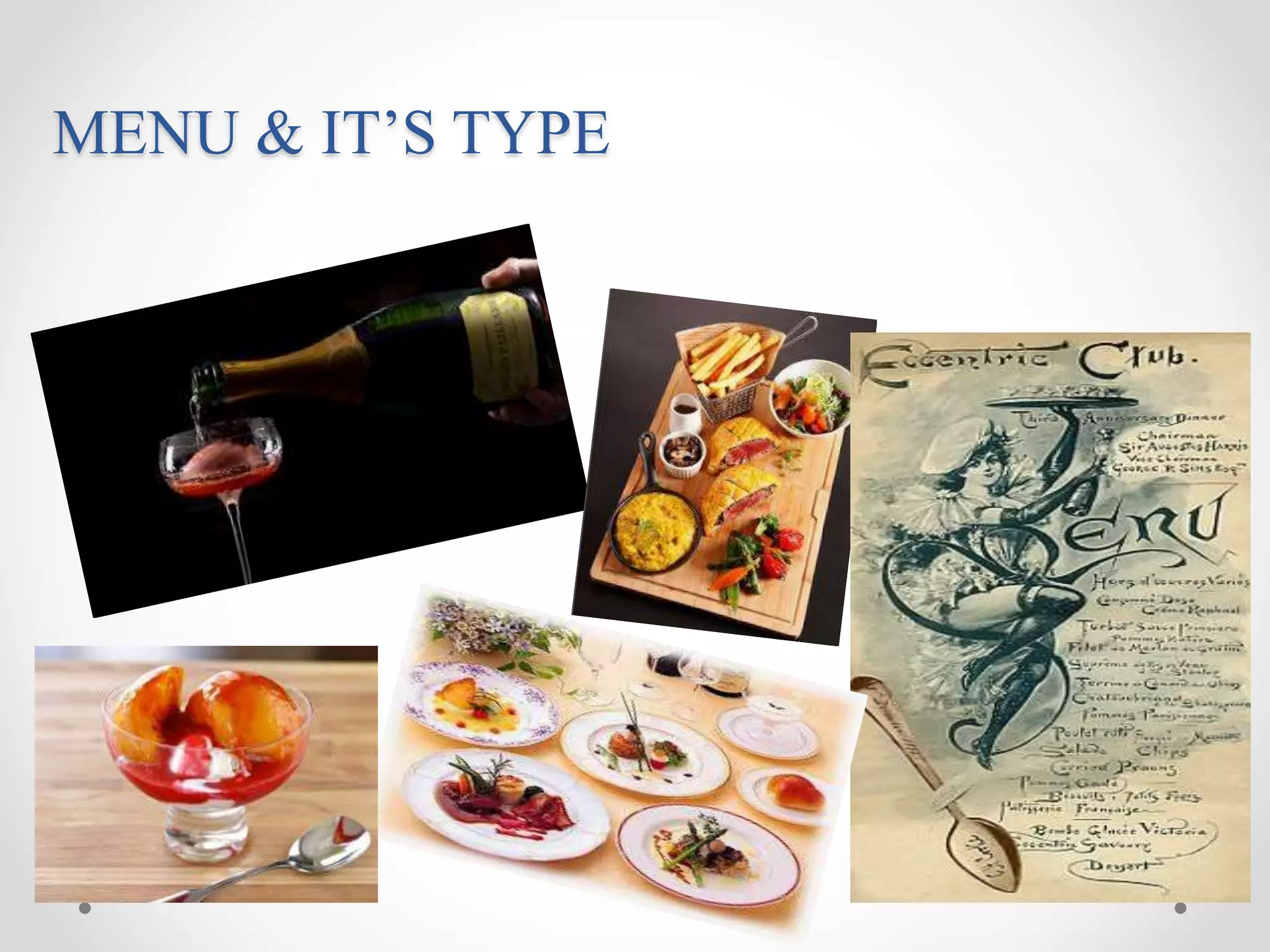

MENU & IT’S TYPE
• History, Origin of Menu and it’s definition
• Types of Menu
• Difference between various Menu
• Function of Menu
• Menu Planning aspects
Lesson Plan
Here we will discuss:
Learning outcome
After completing this module you will be able to
• Explain the origin of word “Menu”
• Various types of Menu with its advantages and disadvantages
• Elaborate Menu in other forms
• Function of Menu
• Plan the Menu for any Outlet.
HISTORY AND ORIGIN OF MENU
For the answer it is necessary to travel back almost a millennium, to the
Chinese Song Dynasty(the only region of the world at the time where
paper was abundant)
At that time, merchants used to gathered together in the cities and were
often too tired to work their way through the prolific menus of various
regions by the time came to their evening meal.
Because of the prolific menu or the large variation found in Chinese
cuisine from different regions, the restaurants could no longer cater to
the local palates, thus it give rise to the first menu.
HISTORY AND ORIGIN OF MENU
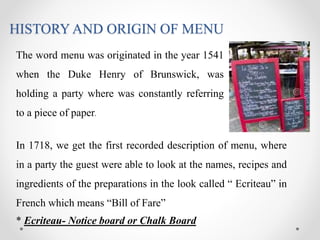
The word menu was originated in the year 1541
when the Duke Henry of Brunswick, was
holding a party where was constantly referring
to a piece of paper.
In 1718, we get the first recorded description of menu, where
in a party the guest were able to look at the names, recipes and
ingredients of the preparations in the look called “ Ecriteau” in
French which means “Bill of Fare”
* Ecriteau- Notice board or Chalk Board
HISTORY AND ORIGIN OF MENU
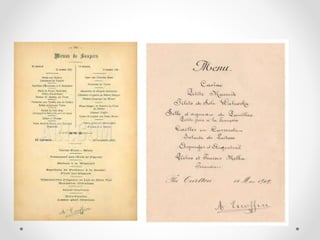
The earliest European menus, several of which survive from 1751
onwards, appear to have been for the relatively intimate and
informal soupers intimes ("intimate suppers") given by King Louis
XV of France at the Château de Choisy for between 31 and 36
guests. Several seem to have been placed on the table, listing four
courses, each with several dishes, plus dessert.
HISTORY AND ORIGIN OF MENU
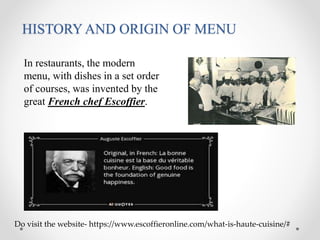
In restaurants, the modern
menu, with dishes in a set order
of courses, was invented by the
great French chef Escoffier.
Do visit the website- https://www.escoffieronline.com/what-is-haute-cuisine/#
Define Menu
• The word menu was French in origin, from the Latin
'minutus', meaning something small. The French used this
term to mean a list of items, including food.
• So, we can say that Menu is a list of items served by a
particular in a food and beverage outlets is called as menu.
What is Menu Card?
• A menu represents the range of food and beverage items
offered in a restaurant. When the menu is represented on a
card, it is referred to as the Menu Card.
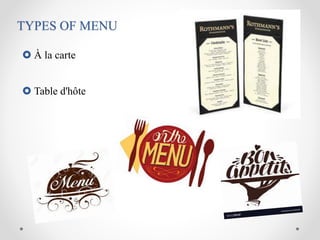
TYPES OF MENU
 À la carte
 Table d'hôte
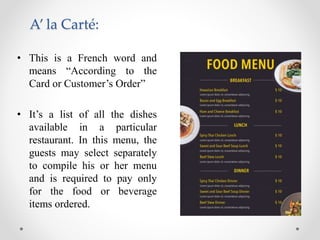
A’ la Carté:
• This is a French word and
means “According to the
Card or Customer’s Order”
• It’s a list of all the dishes
available in a particular
restaurant. In this menu, the
guests may select separately
to compile his or her menu
and is required to pay only
for the food or beverage
items ordered.
Special characteristic features are: -
• Extensive choice in food and beverages within each
course and in categories.
• Each dish is priced separately
• Dishes are cooked as per the order.
• Each dish ordered has a waiting time.
• Customers are billed as per their order.
• Every dish has a short description underneath to explain
the dish.
• Dishes are semi-prepared beforehand and finished off at
the time of their order.
• This type of menu is available in all types of food and
beverage outlets except for banquets, flight catering,
institutional catering and welfare catering.
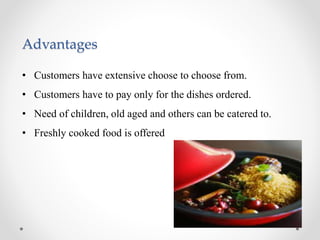
Advantages
• Customers have extensive choose to choose from.
• Customers have to pay only for the dishes ordered.
• Need of children, old aged and others can be catered to.
• Freshly cooked food is offered.
Disadvantages
 Needs more kitchen space, kitchen and service equipment.
 More Mise-en-place is required to be done.
 Requires more kitchen staff.
 Work load of the kitchen and service staff is not evenly
distributed.
 More food wastage is there.
 Food Cost cannot be controlled, as the customer’s preferences
cannot be predicted.
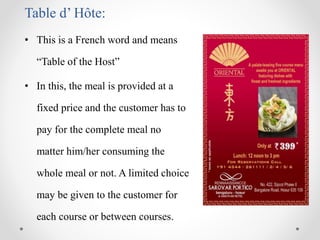
Table d’ Hôte:
• This is a French word and means
“Table of the Host”
• In this, the meal is provided at a
fixed price and the customer has to
pay for the complete meal no
matter him/her consuming the
whole meal or not. A limited choice
may be given to the customer for
each course or between courses.
Special characteristic features are
• Set number of courses.
• Limited choice within each course or amongst courses.
• Set price for all courses.
• Food prepared beforehand and available at a set time.
Advantages
• Less kitchen space is required
• Limited kitchen and service equipment are required.
• Less Mise – en – place is required to be done.
• Less labor is required, as the numbers of dishes are limited.
• Less food storage space required.
• Food wastage is minimal.
• Food Cost easier to control.
Disadvantages: -
• Choice for the customer is limited.
• Fixed amount has to be paid irrespective of the dishes
consumed.
• Need of children, old aged and others cannot be
catered to.
This type of menu (Table d’ Hôte) is available
• Banquets
• Restaurants where buffet lunch and dinner is available.
• Guest houses
• Flight catering
• Institutional catering such as mess
• Welfare catering.
• “Combo Meals” in fast food outlets.
• “Thali Meals’” in Indian restaurants.
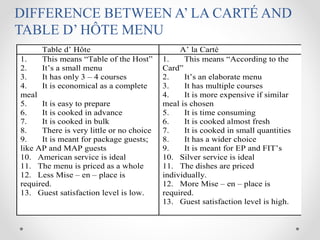
DIFFERENCE BETWEEN A’ LA CARTÉ AND
TABLE D’ HÔTE MENU
Table d’ Hôte A’ la Carté
1. This means “Table of the Host”
2. It’s a small menu
3. It has only 3 – 4 courses
4. It is economical as a complete
meal
5. It is easy to prepare
6. It is cooked in advance
7. It is cooked in bulk
8. There is very little or no choice
9. It is meant for package guests;
like AP and MAP guests
10. American service is ideal
11. The menu is priced as a whole
12. Less Mise – en – place is
required.
13. Guest satisfaction level is low.
1. This means “According to the
Card”
2. It’s an elaborate menu
3. It has multiple courses
4. It is more expensive if similar
meal is chosen
5. It is time consuming
6. It is cooked almost fresh
7. It is cooked in small quantities
8. It has a wider choice
9. It is meant for EP and FIT’s
10. Silver service is ideal
11. The dishes are priced
individually.
12. More Mise – en – place is
required.
13. Guest satisfaction level is high.
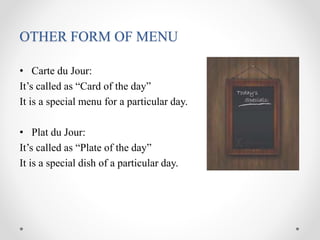
OTHER FORM OF MENU
• Carte du Jour:
It’s called as “Card of the day”
It is a special menu for a particular day.
• Plat du Jour:
It’s called as “Plate of the day”
It is a special dish of a particular day.
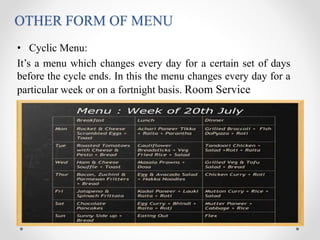
OTHER FORM OF MENU
• Cyclic Menu:
It’s a menu which changes every day for a certain set of days
before the cycle ends. In this the menu changes every day for a
particular week or on a fortnight basis. Room Service
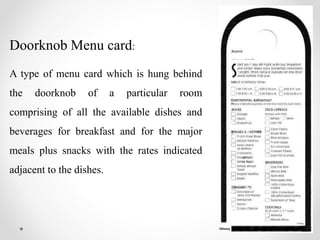
Doorknob Menu card:
A type of menu card which is hung behind
the doorknob of a particular room
comprising of all the available dishes and
beverages for breakfast and for the major
meals plus snacks with the rates indicated
adjacent to the dishes.
OTHER FORM OF MENU
• PRICE- Table d’ Hôte and A’ la Carté
• MEAL FIXED- Cyclic Menu, Fixed Menu
• SECHEDULE(TIME)- Breakfast Menu, Lunch Menu,
Dinner Menu, Snacks Menu
• SPECIAL MENU- Children Menu, Pool side Menu, Diet
Menu.
FUNCTION OF MENU
• Basis of Operations- Basis of all activities that are
carried out in the F&B outlets.
• Communication Device- Provide information about
the Food & Beverages.(Description and Price)
• Effective Sales Tool- Describing the Food &
Beverage products in appetizing way.
• Image Builder-Make you different from others.
Learn By
Doing
Just imagine you have to plan the
Menu for
• New Outlet
• Existing Outlets
POINTS TO BE CONSIDERED WHILE
PLANNING A MENU
• Competition
• Policy of the establishment
• Customer
• Operational aspect
• Gastronomic standpoint
• Nutritional aspect
• Government regulation
POINTS TO BE CONSIDERED WHILE
PLANNING A MENU
• Competition
Hours of operation
Cuisine offered
Menu choice available
Type of customer
Menu pricing
Portion size of the dish
POINTS TO BE CONSIDERED WHILE
PLANNING A MENU
• Policy of the establishment
ROI
Operations Hours
Type of operations
What to serve
Production Process
Use of Convenience Products
Style of Service
POINTS TO BE CONSIDERED WHILE
PLANNING A MENU
• Customer
Eating Habit
Age
Budget of the customer
Time Available
POINTS TO BE CONSIDERED WHILE
PLANNING A MENU
• Operational Aspect
Area Available
Place of Consumption
Skill level of staff
Equipment Available
Ingredients Available
Number of Covers
Ease of Maintaining Consistency
POINTS TO BE CONSIDERED WHILE
PLANNING A MENU
• Gastronomic Standpoint
Color
Texture
Flavor and Aroma
Sauces
Garnish
Cooking Methods
Foundation Ingredient
POINTS TO BE CONSIDERED WHILE
PLANNING A MENU
• Nutritional Aspects
Balance Diet
• Government Regulations
Food Safety and Standards Authority of India (FSSAI) is the
apex food regulator.
Federation of Hotel and Restaurant Associations of India
(FHRAI)
Taxation- GST
Take Away
So far we have studied the following –
• Origin and history of Menu
• Definition of Menu and its type
• Characteristics with advantages and disadvantages of Menu
• Difference between the Menus
• Menu planning
Menu & its type

Menu & its type

  • 1.
  • 2.
    • History, Originof Menu and it’s definition • Types of Menu • Difference between various Menu • Function of Menu • Menu Planning aspects Lesson Plan Here we will discuss:
  • 3.
    Learning outcome After completingthis module you will be able to • Explain the origin of word “Menu” • Various types of Menu with its advantages and disadvantages • Elaborate Menu in other forms • Function of Menu • Plan the Menu for any Outlet.
  • 4.
    HISTORY AND ORIGINOF MENU For the answer it is necessary to travel back almost a millennium, to the Chinese Song Dynasty(the only region of the world at the time where paper was abundant) At that time, merchants used to gathered together in the cities and were often too tired to work their way through the prolific menus of various regions by the time came to their evening meal. Because of the prolific menu or the large variation found in Chinese cuisine from different regions, the restaurants could no longer cater to the local palates, thus it give rise to the first menu.
  • 5.
    HISTORY AND ORIGINOF MENU The word menu was originated in the year 1541 when the Duke Henry of Brunswick, was holding a party where was constantly referring to a piece of paper. In 1718, we get the first recorded description of menu, where in a party the guest were able to look at the names, recipes and ingredients of the preparations in the look called “ Ecriteau” in French which means “Bill of Fare” * Ecriteau- Notice board or Chalk Board
  • 6.
    HISTORY AND ORIGINOF MENU The earliest European menus, several of which survive from 1751 onwards, appear to have been for the relatively intimate and informal soupers intimes ("intimate suppers") given by King Louis XV of France at the Château de Choisy for between 31 and 36 guests. Several seem to have been placed on the table, listing four courses, each with several dishes, plus dessert.
  • 7.
    HISTORY AND ORIGINOF MENU In restaurants, the modern menu, with dishes in a set order of courses, was invented by the great French chef Escoffier. Do visit the website- https://www.escoffieronline.com/what-is-haute-cuisine/#
  • 9.
    Define Menu • Theword menu was French in origin, from the Latin 'minutus', meaning something small. The French used this term to mean a list of items, including food. • So, we can say that Menu is a list of items served by a particular in a food and beverage outlets is called as menu. What is Menu Card? • A menu represents the range of food and beverage items offered in a restaurant. When the menu is represented on a card, it is referred to as the Menu Card.
  • 10.
    TYPES OF MENU À la carte  Table d'hôte
  • 11.
    A’ la Carté: •This is a French word and means “According to the Card or Customer’s Order” • It’s a list of all the dishes available in a particular restaurant. In this menu, the guests may select separately to compile his or her menu and is required to pay only for the food or beverage items ordered.
  • 12.
    Special characteristic featuresare: - • Extensive choice in food and beverages within each course and in categories. • Each dish is priced separately • Dishes are cooked as per the order. • Each dish ordered has a waiting time. • Customers are billed as per their order. • Every dish has a short description underneath to explain the dish. • Dishes are semi-prepared beforehand and finished off at the time of their order. • This type of menu is available in all types of food and beverage outlets except for banquets, flight catering, institutional catering and welfare catering.
  • 13.
    Advantages • Customers haveextensive choose to choose from. • Customers have to pay only for the dishes ordered. • Need of children, old aged and others can be catered to. • Freshly cooked food is offered.
  • 14.
    Disadvantages  Needs morekitchen space, kitchen and service equipment.  More Mise-en-place is required to be done.  Requires more kitchen staff.  Work load of the kitchen and service staff is not evenly distributed.  More food wastage is there.  Food Cost cannot be controlled, as the customer’s preferences cannot be predicted.
  • 15.
    Table d’ Hôte: •This is a French word and means “Table of the Host” • In this, the meal is provided at a fixed price and the customer has to pay for the complete meal no matter him/her consuming the whole meal or not. A limited choice may be given to the customer for each course or between courses.
  • 16.
    Special characteristic featuresare • Set number of courses. • Limited choice within each course or amongst courses. • Set price for all courses. • Food prepared beforehand and available at a set time.
  • 17.
    Advantages • Less kitchenspace is required • Limited kitchen and service equipment are required. • Less Mise – en – place is required to be done. • Less labor is required, as the numbers of dishes are limited. • Less food storage space required. • Food wastage is minimal. • Food Cost easier to control.
  • 18.
    Disadvantages: - • Choicefor the customer is limited. • Fixed amount has to be paid irrespective of the dishes consumed. • Need of children, old aged and others cannot be catered to.
  • 19.
    This type ofmenu (Table d’ Hôte) is available • Banquets • Restaurants where buffet lunch and dinner is available. • Guest houses • Flight catering • Institutional catering such as mess • Welfare catering. • “Combo Meals” in fast food outlets. • “Thali Meals’” in Indian restaurants.
  • 20.
    DIFFERENCE BETWEEN A’LA CARTÉ AND TABLE D’ HÔTE MENU Table d’ Hôte A’ la Carté 1. This means “Table of the Host” 2. It’s a small menu 3. It has only 3 – 4 courses 4. It is economical as a complete meal 5. It is easy to prepare 6. It is cooked in advance 7. It is cooked in bulk 8. There is very little or no choice 9. It is meant for package guests; like AP and MAP guests 10. American service is ideal 11. The menu is priced as a whole 12. Less Mise – en – place is required. 13. Guest satisfaction level is low. 1. This means “According to the Card” 2. It’s an elaborate menu 3. It has multiple courses 4. It is more expensive if similar meal is chosen 5. It is time consuming 6. It is cooked almost fresh 7. It is cooked in small quantities 8. It has a wider choice 9. It is meant for EP and FIT’s 10. Silver service is ideal 11. The dishes are priced individually. 12. More Mise – en – place is required. 13. Guest satisfaction level is high.
  • 21.
    OTHER FORM OFMENU • Carte du Jour: It’s called as “Card of the day” It is a special menu for a particular day. • Plat du Jour: It’s called as “Plate of the day” It is a special dish of a particular day.
  • 22.
    OTHER FORM OFMENU • Cyclic Menu: It’s a menu which changes every day for a certain set of days before the cycle ends. In this the menu changes every day for a particular week or on a fortnight basis. Room Service
  • 23.
    Doorknob Menu card: Atype of menu card which is hung behind the doorknob of a particular room comprising of all the available dishes and beverages for breakfast and for the major meals plus snacks with the rates indicated adjacent to the dishes.
  • 24.
    OTHER FORM OFMENU • PRICE- Table d’ Hôte and A’ la Carté • MEAL FIXED- Cyclic Menu, Fixed Menu • SECHEDULE(TIME)- Breakfast Menu, Lunch Menu, Dinner Menu, Snacks Menu • SPECIAL MENU- Children Menu, Pool side Menu, Diet Menu.
  • 25.
    FUNCTION OF MENU •Basis of Operations- Basis of all activities that are carried out in the F&B outlets. • Communication Device- Provide information about the Food & Beverages.(Description and Price) • Effective Sales Tool- Describing the Food & Beverage products in appetizing way. • Image Builder-Make you different from others.
  • 26.
    Learn By Doing Just imagineyou have to plan the Menu for • New Outlet • Existing Outlets
  • 27.
    POINTS TO BECONSIDERED WHILE PLANNING A MENU • Competition • Policy of the establishment • Customer • Operational aspect • Gastronomic standpoint • Nutritional aspect • Government regulation
  • 28.
    POINTS TO BECONSIDERED WHILE PLANNING A MENU • Competition Hours of operation Cuisine offered Menu choice available Type of customer Menu pricing Portion size of the dish
  • 29.
    POINTS TO BECONSIDERED WHILE PLANNING A MENU • Policy of the establishment ROI Operations Hours Type of operations What to serve Production Process Use of Convenience Products Style of Service
  • 30.
    POINTS TO BECONSIDERED WHILE PLANNING A MENU • Customer Eating Habit Age Budget of the customer Time Available
  • 31.
    POINTS TO BECONSIDERED WHILE PLANNING A MENU • Operational Aspect Area Available Place of Consumption Skill level of staff Equipment Available Ingredients Available Number of Covers Ease of Maintaining Consistency
  • 32.
    POINTS TO BECONSIDERED WHILE PLANNING A MENU • Gastronomic Standpoint Color Texture Flavor and Aroma Sauces Garnish Cooking Methods Foundation Ingredient
  • 33.
    POINTS TO BECONSIDERED WHILE PLANNING A MENU • Nutritional Aspects Balance Diet • Government Regulations Food Safety and Standards Authority of India (FSSAI) is the apex food regulator. Federation of Hotel and Restaurant Associations of India (FHRAI) Taxation- GST
  • 34.
    Take Away So farwe have studied the following – • Origin and history of Menu • Definition of Menu and its type • Characteristics with advantages and disadvantages of Menu • Difference between the Menus • Menu planning