A Culinary Perspective  on  Menu Development Presented by  Charlie Baggs President   & Executive   Chef Charlie Baggs, Inc. [email_address] www.charliebaggsinc.com Skip Julius   CEC, CRC, CCS Product Development Leader Gordon Food Service [email_address]   www.gfs.com
Presentation at a Glance Consumer insights Increased ingredient cost Look at the menu Rising cost strategy How to capture customers interest Tracking trends Menu engineering Concepting and menu descriptions Pleasure principles
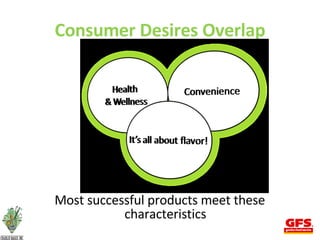
Consumer Desires Overlap Most successful products meet these characteristics
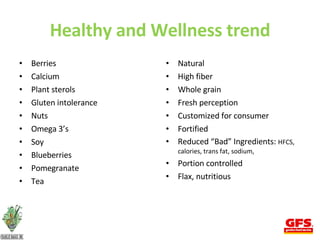
Healthy and Wellness trend Berries Calcium Plant sterols Gluten intolerance  Nuts Omega 3’s Soy Blueberries Pomegranate Tea Natural High fiber  Whole grain Fresh perception Customized for consumer Fortified Reduced “Bad” Ingredients:  HFCS, calories, trans fat, sodium,  Portion controlled  Flax, nutritious
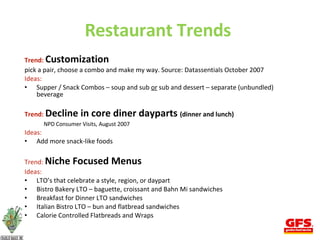
Restaurant Trends  Trend:  Customization  pick a pair, choose a combo and make my way. Source: Datassentials October 2007 Ideas:  Supper / Snack Combos – soup and sub  or  sub and dessert – separate (unbundled) beverage  Trend:  Decline in core diner dayparts  (dinner and lunch)  NPD Consumer Visits, August 2007 Ideas:  Add more snack-like foods Trend:  Niche Focused Menus Ideas:  LTO’s that celebrate a style, region, or daypart Bistro Bakery LTO – baguette, croissant and Bahn Mi sandwiches  Breakfast for Dinner LTO sandwiches  Italian Bistro LTO – bun and flatbread sandwiches  Calorie Controlled Flatbreads and Wraps
Restaurant Trends Trend:  Upgraded offers for kids Ideas:  Make kid size Signature dishes Fruits – fresh whole fruit, or cut fruit or cocktail available as side or dessert options or vegetable sticks with dressing cup or pack  Nutritional information posted for children’s menus citing accordance with acceptable standard of childhood nutrition, and awareness of childhood obesity concerns. Trend:  Restaurants and environmental responsibility  Ideas:  Waste reduction theme posters in store, sustainable paper sourced products Segregated waste recycling waste containers Trend:   Marketing lunch menu specials for workers  Ideas:  Offer “buy two get a percent off” deals.  Offer daily weekday lunch special subs & combos Offer frequent diner cards to local work places
Food Trends Overview
Consumers Want Choices Convenience: Dine in, dine at home, or dine on-the-go Cupholder Cuisine: Demands food that travels well The Rise of Breakfast Customization of Menu Items Choice of Portion Sizes Miniaturization of Treats/Indulgences Choice of Sides New Beverage Options Bold New Flavors Ethnic - Authenticity a must Premiumization vs. Basic
“ Green” is “IN” Grass Fed Hormone Free Cage Free Ethical Fair Trade Clean Foods Carbon Footprint Energy Efficient Eco-Friendly Free Range Recyclable Sustainable Traceable Vegetarian/Vegan Locally Grown Natural Organic Humanely Raised Rainforest Alliance Whole Foods
Food Trends Trend:  Familiar with a Twist Ideas:  Take signature ideas and offer LTO variations Trend:  Moving to smaller portions Ideas:  Half portion sandwiches, salads, entrees Differentiate by focusing on quality – unique sauces, premium proteins and exquisite breads.
Food Trends Trend:  Fruit & Savory (sweet & savory) Ideas:  Savory proteins accented by sharp, sweet fruit flavors - traditional or exotic (mango was 1 st ) Fruit salsas or sweet glazes can be small in quantity applied but still provide significant identifiable flavor and texture Trend:  Shrimp has greatest seafood share on restaurant menus. Ideas:  Add shrimp to your sandwiches, soups, salads
Consumer Trends Overview
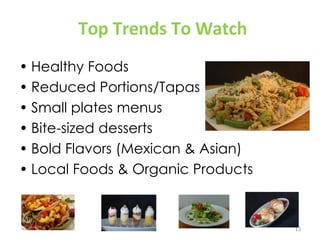
Top Trends To Watch Healthy Foods Reduced Portions/Tapas Small plates menus Bite-sized desserts Bold Flavors (Mexican & Asian) Local Foods & Organic Products
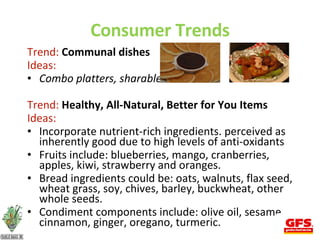
Consumer Trends Trend:  Communal dishes Ideas:  Combo platters, sharable Trend:  Healthy, All-Natural, Better for You Items Ideas:  Incorporate nutrient-rich ingredients. perceived as inherently good due to high levels of anti-oxidants Fruits include: blueberries, mango, cranberries, apples, kiwi, strawberry and oranges. Bread ingredients could be: oats, walnuts, flax seed, wheat grass, soy, chives, barley, buckwheat, other whole seeds. Condiment components include: olive oil, sesame, cinnamon, ginger, oregano, turmeric.
Customization Offer sauce accompaniment Offer portion size alternatives Hot or cold serving option Kid or adult packaging choice Packaged for ‘the office’ or immediate consumption
Increased Ingredient Cost Example:  “ The Clorox Story” Early in the 20 th  century  hypochlorite  became very scarce and cost increased due to supply and demand.
Your Menu is  the Lifeblood of your Business. Don’t Take it for Granted!     Capture customers' interest Encourage repeat visits  Review the menu now  Profitability Operational constraints Labor capabilities Current trends Seasonal menu options It can help to work with an outside/objective source
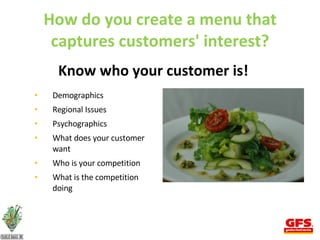
How do you create a menu that captures customers' interest? Demographics Regional Issues Psychographics What does your customer want Who is your competition What is the competition doing Know who your customer is!
Understanding the Menu
Menu Strategies And Practices The Menu is the #1 Merchandising Tool Rounding Theory Eye Gaze Patterns Shading, Boxing, Angled Specials, Top & Bottom of a List Price to the Consumer, Not to Formula Branding drives Image and Value
Rounding Theory Under $5.00, guests only recognize price increments of 25¢  Above $5.00, guests only recognize price increments of 50¢ and 95¢. Over $10.00, the incremental price point is $1.00. Common pricing strategy  -  a $2.54 food cost and a 33% cost percentage target should be priced at $7.62.
Rounding Theory  cont. Manager lowers pricing to $7.75 from $7.95 In a year, most restaurants will serve in excess of 100,000 customers. An extra 20¢ on just half of those customers (in pure profit) would put an extra $10,000 to the bottom line. Restaurant only makes $50,000, so this is a 20% increase. Fact Based Selling!
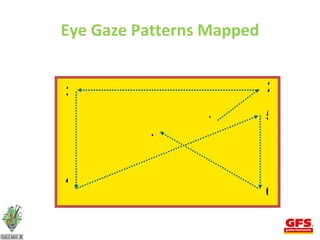
Eye Gaze Patterns Customers don’t read menus. Customers scan menus The eyes follow a predictable path Strategically place high-profit items Customer spends less than 45 seconds scanning the menu .
Eye Gaze Patterns Mapped 3 4 7 2 1 5 6
Shading, Boxing, Angled Specials,  Top & Bottom Of Lists You can expect a minimum 20% increase  At the top or bottom of a list. When you shade or box. Patrons only scan menus. Eye gaze motion will be drawn to variations in text, layout or format Combine shading, boxing and special with other forms of merchandising
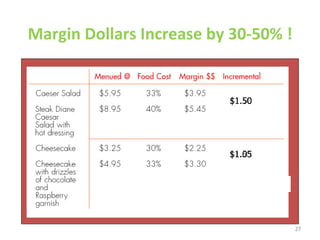
Price to the Consumer,  Not to Formula Formula pricing is lazy. A formula price leaves Money on the table.  Customers have limited knowledge of raw costs.  Set price points based on the value perception of the guest and what the market will bear. Use  coffee as your example … Fact Based Selling!
Margin Dollars Increase by 30-50% ! $1.50 $1.05
Where to get Trends NRA The Food Institute CIA Food Navigator Technomic Google Datamonitor Mintel Datassentials NPD Publications (Trade & Consumer)
But…what are the real trends?   How to filter out the “noise”
Flavor Trends
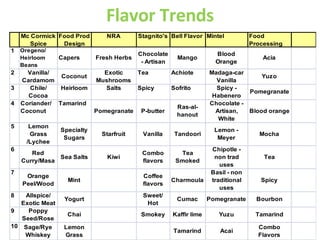
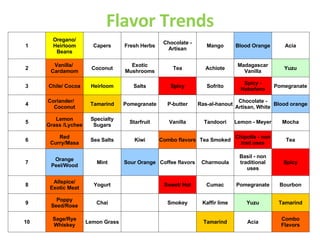
Flavor Trends 1 Oregano/ Heirloom Beans Capers Fresh Herbs Chocolate - Artisan Mango Blood Orange Acia 2 Vanilla/  Cardamom Coconut Exotic Mushrooms Tea Achiote Madagascar Vanilla Yuzu 3 Chile/ Cocoa Heirloom Salts Spicy Sofrito Spicy - Habañero Pomegranate 4 Coriander/  Coconut Tamarind Pomegranate P-butter Ras-al-hanout Chocolate - Artisan, White Blood orange 5 Lemon Grass /Lychee Specialty Sugars Starfruit Vanilla Tandoori Lemon - Meyer Mocha 6 Red Curry/Masa Sea Salts Kiwi Combo flavors Tea Smoked Chipotle - non trad uses Tea 7 Orange Peel/Wood Mint Sour Orange Coffee flavors Charmoula Basil - non traditional uses Spicy 8 Allspice/ Exotic Meat Yogurt   Sweet/ Hot Cumac Pomegranate Bourbon 9 Poppy Seed/Rose Chai   Smokey Kaffir lime Yuzu Tamarind 10 Sage/Rye Whiskey Lemon Grass     Tamarind Acia Combo Flavors
Macro Trends
Macro Trends
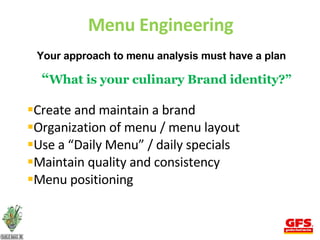
Menu Engineering Your approach to menu analysis must have a plan “ What is your culinary Brand identity?” Create and maintain a brand Organization of menu / menu layout Use a “Daily Menu” / daily specials Maintain quality and consistency Menu positioning
Engineering Menu Profit Real Time Pricing Set menu item performance levels -Don’t become emotionally attached -If items don’t perform or contribute: 86 ‘em SKU Utilization- Get Creative Specials – your best friend (BFF) -Steer customers to higher margin items
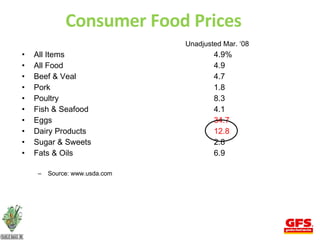
Consumer Food Prices  Unadjusted Mar. ‘08  All Items    4.9% All Food    4.9 Beef & Veal      4.7 Pork      1.8 Poultry    8.3 Fish & Seafood    4.1 Eggs    34.7 Dairy Products    12.8 Sugar & Sweets    2.8 Fats & Oils  6.9 Source: www.usda.com
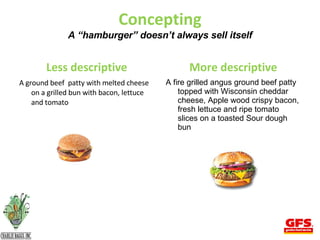
Concepting A “hamburger” doesn’t always sell itself Less descriptive A ground beef  patty with melted cheese on a grilled bun with bacon, lettuce and tomato More descriptive A fire grilled angus ground beef patty topped with Wisconsin cheddar cheese, Apple wood crispy bacon, fresh lettuce and ripe tomato slices on a toasted Sour dough bun
Menu Descriptions Include ingredients:  spring onions, portabella mushrooms, etc. Add terms to make ingredients  alive :  caramelized, sautéed, basted, glazed, crispy, chunky, rich Describe colors/temperatures/sensations :  chilled, cool, refreshing, soothing, blush, rosy, vibrant green
Concepting  Action Words Flavors  (zesty, tangy, salty, etc…) Cooking Methods  (roasted, fried, caramelization, etc…) Textures  (soft, crispy, chewy, etc…) Shape & Size  (chopped, julienne, minced, etc…) Cooking Action  (drizzled, shaved, stuffed, etc…)
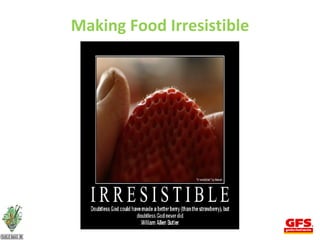
Making Food Irresistible
Great Food Gives Great Pleasure Food and beverage is one of three essential human needs for basic survival Yet, aside from love, nothing else evokes as much pleasure and passion as food! We Choose the Food That Gives Us The Most Pleasure!!!!!
Why it Works Understanding Why Food Tastes So Good…or Doesn’t PLEASURE
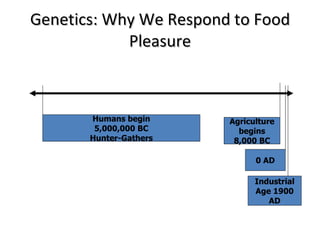
Genetics: Why We Respond to Food Pleasure Humans begin 5,000,000 BC Hunter-Gathers Agriculture begins 8,000 BC 0 AD Industrial Age 1900 AD
Genetics: Why We Respond  to Food Pleasure 4.998 % of human history is as hunter gathers Natural selection results in our genes being predisposed as hunter gathers The brain and body have 5 million years of developing mechanisms that respond to pleasure stimulus: it’s how we survived this long!
Food Pleasure Equation When you have a food choice the brain calculates how much pleasure will be generated during the eating and digestion of any food.  EXPECTATIONS! Goal of the brain, gut and fat cell is to maximize the pleasure extracted from the environment in both food sensation and macronutrient content
Pleasure Rule  #1  Taste Hedonics Salt, Sugar, MSG, 5’ Nucleotides  in solution  yield most pleasure Glutamates = Umami (MSG is but one) Umami signals presence of protein Salt + Glutamates = powerful hedonics Emulsions –  Salt-fat: butter, salad dressings, mayo Sugar-fat: chocolate, ice cream, cream
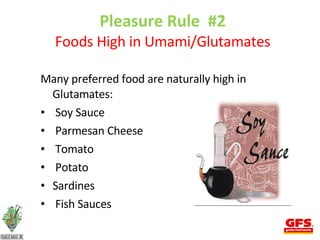
Pleasure Rule  #2 Foods High in Umami/Glutamates Many preferred food are naturally high in Glutamates: Soy Sauce Parmesan Cheese Tomato Potato Sardines Fish Sauces
Pleasure Rule  #3 Taste Hedonics Salivation Response We prefer foods that are moist or evoke saliva Saliva is critical for solute contact with taste buds (no taste, no pleasure) Saliva fosters food lubrication, enhances the eating experience Why is there salt on crackers? Add salt  and  fat (think potato chips) = perfect “salivation” food
Pleasure Rule  #4 Balance the BASICS™ Balance Acid Sweet Intended flavor and texture Color Salt
Pleasure Rule  #5 Texture About Texture The brain has more difficulty “reading” a flavor when a food has more texture The brain reads temp first, then texture and finally flavor Foods like ice cream, foie gras and risotto are sensed as richer and more sensual
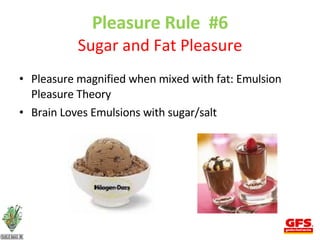
Pleasure Rule  #6 Sugar and Fat Pleasure Pleasure magnified when mixed with fat: Emulsion Pleasure Theory Brain Loves Emulsions with sugar/salt
To Summarize Your menu is the most important thing you have.  Never take it for granted!
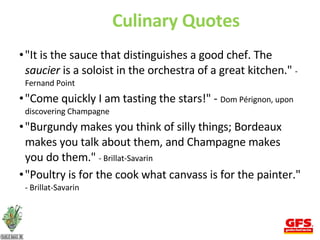
Culinary Quotes "It is the sauce that distinguishes a good chef. The  saucier  is a soloist in the orchestra of a great kitchen."  - Fernand Point "Come quickly I am tasting the stars!" -  Dom Pérignon, upon discovering Champagne  "Burgundy makes you think of silly things; Bordeaux makes you talk about them, and Champagne makes you do them."  - Brillat-Savarin  "Poultry is for the cook what canvass is for the painter."  - Brillat-Savarin

A Culinary Perspective on Menu Development

  • 1.
    A Culinary Perspective on Menu Development Presented by Charlie Baggs President & Executive Chef Charlie Baggs, Inc. [email_address] www.charliebaggsinc.com Skip Julius CEC, CRC, CCS Product Development Leader Gordon Food Service [email_address] www.gfs.com
  • 2.
    Presentation at aGlance Consumer insights Increased ingredient cost Look at the menu Rising cost strategy How to capture customers interest Tracking trends Menu engineering Concepting and menu descriptions Pleasure principles
  • 3.
    Consumer Desires OverlapMost successful products meet these characteristics
  • 4.
    Healthy and Wellnesstrend Berries Calcium Plant sterols Gluten intolerance Nuts Omega 3’s Soy Blueberries Pomegranate Tea Natural High fiber Whole grain Fresh perception Customized for consumer Fortified Reduced “Bad” Ingredients: HFCS, calories, trans fat, sodium, Portion controlled Flax, nutritious
  • 5.
    Restaurant Trends Trend: Customization pick a pair, choose a combo and make my way. Source: Datassentials October 2007 Ideas: Supper / Snack Combos – soup and sub or sub and dessert – separate (unbundled) beverage Trend: Decline in core diner dayparts (dinner and lunch) NPD Consumer Visits, August 2007 Ideas: Add more snack-like foods Trend: Niche Focused Menus Ideas: LTO’s that celebrate a style, region, or daypart Bistro Bakery LTO – baguette, croissant and Bahn Mi sandwiches Breakfast for Dinner LTO sandwiches Italian Bistro LTO – bun and flatbread sandwiches Calorie Controlled Flatbreads and Wraps
  • 6.
    Restaurant Trends Trend: Upgraded offers for kids Ideas: Make kid size Signature dishes Fruits – fresh whole fruit, or cut fruit or cocktail available as side or dessert options or vegetable sticks with dressing cup or pack Nutritional information posted for children’s menus citing accordance with acceptable standard of childhood nutrition, and awareness of childhood obesity concerns. Trend: Restaurants and environmental responsibility Ideas: Waste reduction theme posters in store, sustainable paper sourced products Segregated waste recycling waste containers Trend: Marketing lunch menu specials for workers Ideas: Offer “buy two get a percent off” deals. Offer daily weekday lunch special subs & combos Offer frequent diner cards to local work places
  • 7.
  • 8.
    Consumers Want ChoicesConvenience: Dine in, dine at home, or dine on-the-go Cupholder Cuisine: Demands food that travels well The Rise of Breakfast Customization of Menu Items Choice of Portion Sizes Miniaturization of Treats/Indulgences Choice of Sides New Beverage Options Bold New Flavors Ethnic - Authenticity a must Premiumization vs. Basic
  • 9.
    “ Green” is“IN” Grass Fed Hormone Free Cage Free Ethical Fair Trade Clean Foods Carbon Footprint Energy Efficient Eco-Friendly Free Range Recyclable Sustainable Traceable Vegetarian/Vegan Locally Grown Natural Organic Humanely Raised Rainforest Alliance Whole Foods
  • 10.
    Food Trends Trend: Familiar with a Twist Ideas: Take signature ideas and offer LTO variations Trend: Moving to smaller portions Ideas: Half portion sandwiches, salads, entrees Differentiate by focusing on quality – unique sauces, premium proteins and exquisite breads.
  • 11.
    Food Trends Trend: Fruit & Savory (sweet & savory) Ideas: Savory proteins accented by sharp, sweet fruit flavors - traditional or exotic (mango was 1 st ) Fruit salsas or sweet glazes can be small in quantity applied but still provide significant identifiable flavor and texture Trend: Shrimp has greatest seafood share on restaurant menus. Ideas: Add shrimp to your sandwiches, soups, salads
  • 12.
  • 13.
    Top Trends ToWatch Healthy Foods Reduced Portions/Tapas Small plates menus Bite-sized desserts Bold Flavors (Mexican & Asian) Local Foods & Organic Products
  • 14.
    Consumer Trends Trend: Communal dishes Ideas: Combo platters, sharable Trend: Healthy, All-Natural, Better for You Items Ideas: Incorporate nutrient-rich ingredients. perceived as inherently good due to high levels of anti-oxidants Fruits include: blueberries, mango, cranberries, apples, kiwi, strawberry and oranges. Bread ingredients could be: oats, walnuts, flax seed, wheat grass, soy, chives, barley, buckwheat, other whole seeds. Condiment components include: olive oil, sesame, cinnamon, ginger, oregano, turmeric.
  • 15.
    Customization Offer sauceaccompaniment Offer portion size alternatives Hot or cold serving option Kid or adult packaging choice Packaged for ‘the office’ or immediate consumption
  • 16.
    Increased Ingredient CostExample: “ The Clorox Story” Early in the 20 th century hypochlorite became very scarce and cost increased due to supply and demand.
  • 17.
    Your Menu is the Lifeblood of your Business. Don’t Take it for Granted!     Capture customers' interest Encourage repeat visits Review the menu now Profitability Operational constraints Labor capabilities Current trends Seasonal menu options It can help to work with an outside/objective source
  • 18.
    How do youcreate a menu that captures customers' interest? Demographics Regional Issues Psychographics What does your customer want Who is your competition What is the competition doing Know who your customer is!
  • 19.
  • 20.
    Menu Strategies AndPractices The Menu is the #1 Merchandising Tool Rounding Theory Eye Gaze Patterns Shading, Boxing, Angled Specials, Top & Bottom of a List Price to the Consumer, Not to Formula Branding drives Image and Value
  • 21.
    Rounding Theory Under$5.00, guests only recognize price increments of 25¢ Above $5.00, guests only recognize price increments of 50¢ and 95¢. Over $10.00, the incremental price point is $1.00. Common pricing strategy - a $2.54 food cost and a 33% cost percentage target should be priced at $7.62.
  • 22.
    Rounding Theory cont. Manager lowers pricing to $7.75 from $7.95 In a year, most restaurants will serve in excess of 100,000 customers. An extra 20¢ on just half of those customers (in pure profit) would put an extra $10,000 to the bottom line. Restaurant only makes $50,000, so this is a 20% increase. Fact Based Selling!
  • 23.
    Eye Gaze PatternsCustomers don’t read menus. Customers scan menus The eyes follow a predictable path Strategically place high-profit items Customer spends less than 45 seconds scanning the menu .
  • 24.
    Eye Gaze PatternsMapped 3 4 7 2 1 5 6
  • 25.
    Shading, Boxing, AngledSpecials, Top & Bottom Of Lists You can expect a minimum 20% increase At the top or bottom of a list. When you shade or box. Patrons only scan menus. Eye gaze motion will be drawn to variations in text, layout or format Combine shading, boxing and special with other forms of merchandising
  • 26.
    Price to theConsumer, Not to Formula Formula pricing is lazy. A formula price leaves Money on the table. Customers have limited knowledge of raw costs. Set price points based on the value perception of the guest and what the market will bear. Use coffee as your example … Fact Based Selling!
  • 27.
    Margin Dollars Increaseby 30-50% ! $1.50 $1.05
  • 28.
    Where to getTrends NRA The Food Institute CIA Food Navigator Technomic Google Datamonitor Mintel Datassentials NPD Publications (Trade & Consumer)
  • 29.
    But…what are thereal trends? How to filter out the “noise”
  • 30.
  • 31.
    Flavor Trends 1Oregano/ Heirloom Beans Capers Fresh Herbs Chocolate - Artisan Mango Blood Orange Acia 2 Vanilla/ Cardamom Coconut Exotic Mushrooms Tea Achiote Madagascar Vanilla Yuzu 3 Chile/ Cocoa Heirloom Salts Spicy Sofrito Spicy - Habañero Pomegranate 4 Coriander/ Coconut Tamarind Pomegranate P-butter Ras-al-hanout Chocolate - Artisan, White Blood orange 5 Lemon Grass /Lychee Specialty Sugars Starfruit Vanilla Tandoori Lemon - Meyer Mocha 6 Red Curry/Masa Sea Salts Kiwi Combo flavors Tea Smoked Chipotle - non trad uses Tea 7 Orange Peel/Wood Mint Sour Orange Coffee flavors Charmoula Basil - non traditional uses Spicy 8 Allspice/ Exotic Meat Yogurt   Sweet/ Hot Cumac Pomegranate Bourbon 9 Poppy Seed/Rose Chai   Smokey Kaffir lime Yuzu Tamarind 10 Sage/Rye Whiskey Lemon Grass     Tamarind Acia Combo Flavors
  • 32.
  • 33.
  • 34.
    Menu Engineering Yourapproach to menu analysis must have a plan “ What is your culinary Brand identity?” Create and maintain a brand Organization of menu / menu layout Use a “Daily Menu” / daily specials Maintain quality and consistency Menu positioning
  • 35.
    Engineering Menu ProfitReal Time Pricing Set menu item performance levels -Don’t become emotionally attached -If items don’t perform or contribute: 86 ‘em SKU Utilization- Get Creative Specials – your best friend (BFF) -Steer customers to higher margin items
  • 36.
    Consumer Food Prices Unadjusted Mar. ‘08 All Items 4.9% All Food 4.9 Beef & Veal 4.7 Pork 1.8 Poultry 8.3 Fish & Seafood 4.1 Eggs 34.7 Dairy Products 12.8 Sugar & Sweets 2.8 Fats & Oils 6.9 Source: www.usda.com
  • 37.
    Concepting A “hamburger”doesn’t always sell itself Less descriptive A ground beef patty with melted cheese on a grilled bun with bacon, lettuce and tomato More descriptive A fire grilled angus ground beef patty topped with Wisconsin cheddar cheese, Apple wood crispy bacon, fresh lettuce and ripe tomato slices on a toasted Sour dough bun
  • 38.
    Menu Descriptions Includeingredients: spring onions, portabella mushrooms, etc. Add terms to make ingredients alive :  caramelized, sautéed, basted, glazed, crispy, chunky, rich Describe colors/temperatures/sensations :  chilled, cool, refreshing, soothing, blush, rosy, vibrant green
  • 39.
    Concepting ActionWords Flavors (zesty, tangy, salty, etc…) Cooking Methods (roasted, fried, caramelization, etc…) Textures (soft, crispy, chewy, etc…) Shape & Size (chopped, julienne, minced, etc…) Cooking Action (drizzled, shaved, stuffed, etc…)
  • 40.
  • 41.
    Great Food GivesGreat Pleasure Food and beverage is one of three essential human needs for basic survival Yet, aside from love, nothing else evokes as much pleasure and passion as food! We Choose the Food That Gives Us The Most Pleasure!!!!!
  • 42.
    Why it WorksUnderstanding Why Food Tastes So Good…or Doesn’t PLEASURE
  • 43.
    Genetics: Why WeRespond to Food Pleasure Humans begin 5,000,000 BC Hunter-Gathers Agriculture begins 8,000 BC 0 AD Industrial Age 1900 AD
  • 44.
    Genetics: Why WeRespond to Food Pleasure 4.998 % of human history is as hunter gathers Natural selection results in our genes being predisposed as hunter gathers The brain and body have 5 million years of developing mechanisms that respond to pleasure stimulus: it’s how we survived this long!
  • 45.
    Food Pleasure EquationWhen you have a food choice the brain calculates how much pleasure will be generated during the eating and digestion of any food. EXPECTATIONS! Goal of the brain, gut and fat cell is to maximize the pleasure extracted from the environment in both food sensation and macronutrient content
  • 46.
    Pleasure Rule #1 Taste Hedonics Salt, Sugar, MSG, 5’ Nucleotides in solution yield most pleasure Glutamates = Umami (MSG is but one) Umami signals presence of protein Salt + Glutamates = powerful hedonics Emulsions – Salt-fat: butter, salad dressings, mayo Sugar-fat: chocolate, ice cream, cream
  • 47.
    Pleasure Rule #2 Foods High in Umami/Glutamates Many preferred food are naturally high in Glutamates: Soy Sauce Parmesan Cheese Tomato Potato Sardines Fish Sauces
  • 48.
    Pleasure Rule #3 Taste Hedonics Salivation Response We prefer foods that are moist or evoke saliva Saliva is critical for solute contact with taste buds (no taste, no pleasure) Saliva fosters food lubrication, enhances the eating experience Why is there salt on crackers? Add salt and fat (think potato chips) = perfect “salivation” food
  • 49.
    Pleasure Rule #4 Balance the BASICS™ Balance Acid Sweet Intended flavor and texture Color Salt
  • 50.
    Pleasure Rule #5 Texture About Texture The brain has more difficulty “reading” a flavor when a food has more texture The brain reads temp first, then texture and finally flavor Foods like ice cream, foie gras and risotto are sensed as richer and more sensual
  • 51.
    Pleasure Rule #6 Sugar and Fat Pleasure Pleasure magnified when mixed with fat: Emulsion Pleasure Theory Brain Loves Emulsions with sugar/salt
  • 52.
    To Summarize Yourmenu is the most important thing you have. Never take it for granted!
  • 53.
    Culinary Quotes "Itis the sauce that distinguishes a good chef. The saucier is a soloist in the orchestra of a great kitchen." - Fernand Point "Come quickly I am tasting the stars!" - Dom Pérignon, upon discovering Champagne "Burgundy makes you think of silly things; Bordeaux makes you talk about them, and Champagne makes you do them." - Brillat-Savarin "Poultry is for the cook what canvass is for the painter." - Brillat-Savarin