M Naveen Kumar
MENU PLANNING
Menu
Menu ……………
1. A list of prepared foods
2. The list of food available or to be served in a
restaurant or at a meal
3. Any list or set of items from which to choose.
Types of Menu
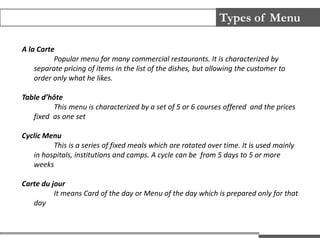
A la Carte
Popular menu for many commercial restaurants. It is characterized by
separate pricing of items in the list of the dishes, but allowing the customer to
order only what he likes.
Table d’hôte
This menu is characterized by a set of 5 or 6 courses offered and the prices
fixed as one set
Cyclic Menu
This is a series of fixed meals which are rotated over time. It is used mainly
in hospitals, institutions and camps. A cycle can be from 5 days to 5 or more
weeks
Carte du jour
It means Card of the day or Menu of the day which is prepared only for that
day
Types of Menu
A la Carte
Types of Menu
Table d’hôte
Types of Menu
Cyclic Menu
Types of Menu
Carte du jour
Importance of Menu Planning
1. Determines the people needed for the operation
2. Determines the performance of the business
3. Determines the ideas to develop the restaurant theme, décor and feel
4. Determines the type of menu you are going to offer the guest, whether it is
individual or pre fix
5. Determines the level of service, style and target customers
6. Determines the profitability in terms of the guest feasibility, comfortably in
reading and understanding the menu
7. Determines the concept of food
Restaurant Menu is a very powerful brand statement
YOU are what you are going to serve
Importance of Menu Planning
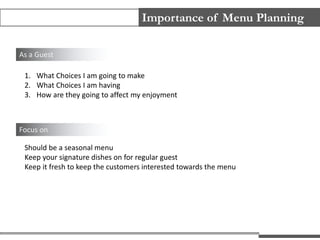
1. What Choices I am going to make
2. What Choices I am having
3. How are they going to affect my enjoyment
Should be a seasonal menu
Keep your signature dishes on for regular guest
Keep it fresh to keep the customers interested towards the menu
As a Guest
Focus on
Principles of Menu Planning
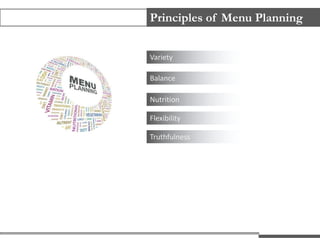
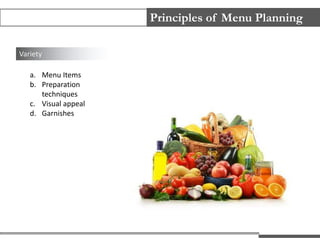
Variety
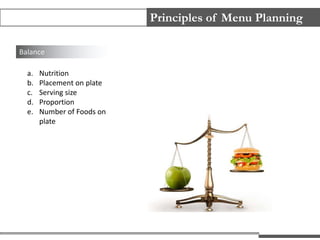
Balance
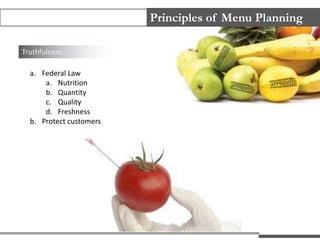
Truthfulness
Nutrition
Flexibility
Principles of Menu Planning
a. Menu Items
b. Preparation
techniques
c. Visual appeal
d. Garnishes
Variety
Principles of Menu Planning
a. Nutrition
b. Placement on plate
c. Serving size
d. Proportion
e. Number of Foods on
plate
Balance
Principles of Menu Planning
a. Low fat diets
b. Gluten free
c. Vegan
d. Allergies
Nutrition
Principles of Menu Planning
a. Seasonal foods
b. Target Customers
Flexibility
Principles of Menu Planning
a. Federal Law
a. Nutrition
b. Quantity
c. Quality
d. Freshness
b. Protect customers
Truthfulness
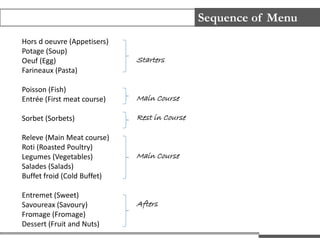
Sequence of Menu
Hors d oeuvre (Appetisers)
Potage (Soup)
Oeuf (Egg)
Farineaux (Pasta)
Poisson (Fish)
Entrée (First meat course)
Sorbet (Sorbets)
Releve (Main Meat course)
Roti (Roasted Poultry)
Legumes (Vegetables)
Salades (Salads)
Buffet froid (Cold Buffet)
Entremet (Sweet)
Savoureax (Savoury)
Fromage (Fromage)
Dessert (Fruit and Nuts)
Starters
Main Course
Rest in Course
Main Course
Afters
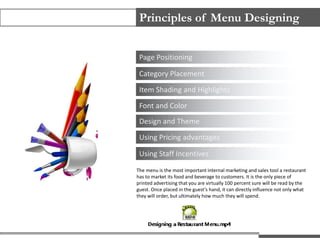
Principles of Menu Designing
Page Positioning
Category Placement
Item Shading and Highlights
Using Pricing advantages
Using Staff Incentives
The menu is the most important internal marketing and sales tool a restaurant
has to market its food and beverage to customers. It is the only piece of
printed advertising that you are virtually 100 percent sure will be read by the
guest. Once placed in the guest’s hand, it can directly influence not only what
they will order, but ultimately how much they will spend.
Font and Color
Design and Theme
Rules for Menu writing
1. To avoid repetition each dish should be different in
composition
2. Composition of individual dishes must be excellent. This
should be well cooked, tastefully dressed
3. Mode of cooking should be different so that each one is
distinct from the other bearing no relation in appearance
of all the dishes
4. Various types of sauces in the preparation and as
accompaniment used must be distinctly in color, taste
and flavor
5. When 2 or more types of fish are to be served, first
should be boiled or poached and the second fried /
grilled / broiled
6. The entrée should always be classified so that light dishes
such as quick croquette are served first and meat cutlets
steaks are served later
7. Too dark meat or too white meat must not allow each
other
8. If there are two soups one should be clear an other
cream

Menu planning by M.Naveen Kumar

  • 1.
  • 2.
    Menu Menu …………… 1. Alist of prepared foods 2. The list of food available or to be served in a restaurant or at a meal 3. Any list or set of items from which to choose.
  • 3.
    Types of Menu Ala Carte Popular menu for many commercial restaurants. It is characterized by separate pricing of items in the list of the dishes, but allowing the customer to order only what he likes. Table d’hôte This menu is characterized by a set of 5 or 6 courses offered and the prices fixed as one set Cyclic Menu This is a series of fixed meals which are rotated over time. It is used mainly in hospitals, institutions and camps. A cycle can be from 5 days to 5 or more weeks Carte du jour It means Card of the day or Menu of the day which is prepared only for that day
  • 4.
  • 5.
  • 6.
  • 7.
  • 8.
    Importance of MenuPlanning 1. Determines the people needed for the operation 2. Determines the performance of the business 3. Determines the ideas to develop the restaurant theme, décor and feel 4. Determines the type of menu you are going to offer the guest, whether it is individual or pre fix 5. Determines the level of service, style and target customers 6. Determines the profitability in terms of the guest feasibility, comfortably in reading and understanding the menu 7. Determines the concept of food Restaurant Menu is a very powerful brand statement YOU are what you are going to serve
  • 9.
    Importance of MenuPlanning 1. What Choices I am going to make 2. What Choices I am having 3. How are they going to affect my enjoyment Should be a seasonal menu Keep your signature dishes on for regular guest Keep it fresh to keep the customers interested towards the menu As a Guest Focus on
  • 10.
    Principles of MenuPlanning Variety Balance Truthfulness Nutrition Flexibility
  • 11.
    Principles of MenuPlanning a. Menu Items b. Preparation techniques c. Visual appeal d. Garnishes Variety
  • 12.
    Principles of MenuPlanning a. Nutrition b. Placement on plate c. Serving size d. Proportion e. Number of Foods on plate Balance
  • 13.
    Principles of MenuPlanning a. Low fat diets b. Gluten free c. Vegan d. Allergies Nutrition
  • 14.
    Principles of MenuPlanning a. Seasonal foods b. Target Customers Flexibility
  • 15.
    Principles of MenuPlanning a. Federal Law a. Nutrition b. Quantity c. Quality d. Freshness b. Protect customers Truthfulness
  • 16.
    Sequence of Menu Horsd oeuvre (Appetisers) Potage (Soup) Oeuf (Egg) Farineaux (Pasta) Poisson (Fish) Entrée (First meat course) Sorbet (Sorbets) Releve (Main Meat course) Roti (Roasted Poultry) Legumes (Vegetables) Salades (Salads) Buffet froid (Cold Buffet) Entremet (Sweet) Savoureax (Savoury) Fromage (Fromage) Dessert (Fruit and Nuts) Starters Main Course Rest in Course Main Course Afters
  • 17.
    Principles of MenuDesigning Page Positioning Category Placement Item Shading and Highlights Using Pricing advantages Using Staff Incentives The menu is the most important internal marketing and sales tool a restaurant has to market its food and beverage to customers. It is the only piece of printed advertising that you are virtually 100 percent sure will be read by the guest. Once placed in the guest’s hand, it can directly influence not only what they will order, but ultimately how much they will spend. Font and Color Design and Theme
  • 18.
    Rules for Menuwriting 1. To avoid repetition each dish should be different in composition 2. Composition of individual dishes must be excellent. This should be well cooked, tastefully dressed 3. Mode of cooking should be different so that each one is distinct from the other bearing no relation in appearance of all the dishes 4. Various types of sauces in the preparation and as accompaniment used must be distinctly in color, taste and flavor 5. When 2 or more types of fish are to be served, first should be boiled or poached and the second fried / grilled / broiled 6. The entrée should always be classified so that light dishes such as quick croquette are served first and meat cutlets steaks are served later 7. Too dark meat or too white meat must not allow each other 8. If there are two soups one should be clear an other cream