

What is the difference between
coaching and mentoring?
A business presentation from Pathway
Qualified to deliver
• Pathway group are accredited with ILM
Awarding body to deliver the ILM Level 3
certificate in Coaching and Mentoring
qualification.
• We work with a number of businesses to train
their staff to deliver coaching in the workplace
Talk to one of our business advisors on 0121 707 0550
Coaching is fundamentally…
• Short-term
• Task oriented
• A coach focuses on professional development
around tangible skills or knowledge areas
• The relationship between the coach and the
coachee is not essential – just the coach’s
credentials
Talk to one of our business advisors on 0121 707 0550
Mentoring is fundamentally…
• Long-term
• Relationship oriented
• A mentor focuses on the transformation and management of the
individual, including both professional and personal life
• It is not essential for a mentor to understand
the facets of each task
• They are not teaching, but facilitating
Talk to one of our business advisors on 0121 707 0550
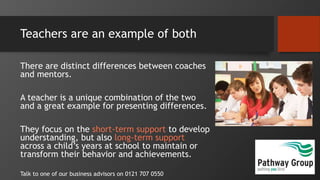
Teachers are an example of both
There are distinct differences between coaches
and mentors.
A teacher is a unique combination of the two
and a great example for presenting differences.
They focus on the short-term support to develop
understanding, but also long-term support
across a child’s years at school to maintain or
transform their behavior and achievements.
Talk to one of our business advisors on 0121 707 0550
The Fundamental Differences
Of which we count six…
What its driving force is - coaching
• The driving force of coaching is the
need to acquire knowledge and improve
ROI for the individual
• Once this had been delivered, the
coaching can stop.
Talk to one of our business advisors on 0121 707 0550
1
What its driving force is - mentoring
• Mentoring is driven by a desire to develop for the
future
• It is harder to quantify, and as it is focused on
relationships, difficult to measure
• Observing change requires a long time – an
immediate ROI or similar cannot drive mentoring
Talk to one of our business advisors on 0121 707 0550
1
The distance between management - coaching
• As the purpose of the coach is to improve the
skillset or knowledge of the individual,
management need to understand the effect
coaching is having
• It is necessary for a coach to feed back to
management about progress – and by extension
the coach’s value
Talk to one of our business advisors on 0121 707 0550
2
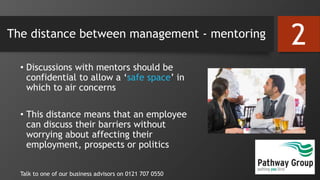
The distance between management - mentoring
• Discussions with mentors should be
confidential to allow a ‘safe space’ in
which to air concerns
• This distance means that an employee
can discuss their barriers without
worrying about affecting their
employment, prospects or politics
Talk to one of our business advisors on 0121 707 0550
2
It’s about money - coaching
• Ultimately, a coach has the incentive of a reward
• External coaches are paid for their services, and
may need referrals for more work
• Internal coaches may be rewarded with an
increase in responsibility (and pay), or put them
closer to a promotion. They will see a benefit to
their immediate workflow with a coached team.
Talk to one of our business advisors on 0121 707 0550
3
It’s not about money - mentoring
• A mentor is never paid for mentoring
• Losing this connection means that the mentor
does the work with definite intentions that
money won’t touch
• Their performance is not linked, and this
delivers an objectivity that is lost with coaching
Talk to one of our business advisors on 0121 707 0550
3
Idea focused - coaching
• A coach should be well informed on what they are
coaching, and will come with the intention of
spreading that knowledge
• They do not need consideration for how the idea
ties in to the business – only that the individuals
can achieve it
• Coaching can be used as a ‘quick-fix’ if remedial
learning is required or a job is on the line
Talk to one of our business advisors on 0121 707 0550
4
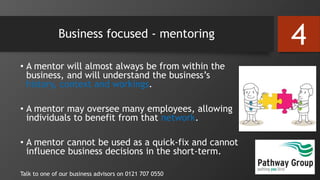
Business focused - mentoring
• A mentor will almost always be from within the
business, and will understand the business’s
history, context and workings.
• A mentor may oversee many employees, allowing
individuals to benefit from that network.
• A mentor cannot be used as a quick-fix and cannot
influence business decisions in the short-term.
Talk to one of our business advisors on 0121 707 0550
4
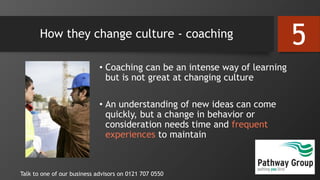
How they change culture - coaching
• Coaching can be an intense way of learning
but is not great at changing culture
• An understanding of new ideas can come
quickly, but a change in behavior or
consideration needs time and frequent
experiences to maintain
Talk to one of our business advisors on 0121 707 0550
5
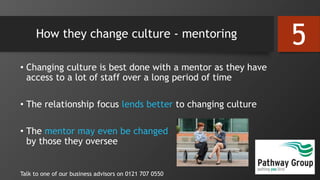
How they change culture - mentoring
• Changing culture is best done with a mentor as they have
access to a lot of staff over a long period of time
• The relationship focus lends better to changing culture
• The mentor may even be changed
by those they oversee
Talk to one of our business advisors on 0121 707 0550
5
Coaching is one-way
• The focus is on developing the client
i.e the skills of the person being
coached – the majority of the learning
should be with the coached.
• The pathway of learning should be
one-directional, and can be done with
larger groups taught by an individual –
like a teacher in a classroom
Talk to one of our business advisors on 0121 707 0550
6
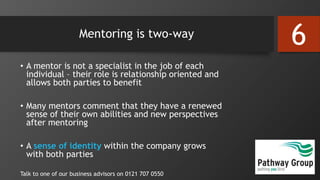
Mentoring is two-way
• A mentor is not a specialist in the job of each
individual – their role is relationship oriented and
allows both parties to benefit
• Many mentors comment that they have a renewed
sense of their own abilities and new perspectives
after mentoring
• A sense of identity within the company grows
with both parties
Talk to one of our business advisors on 0121 707 0550
6
The benefits of internal coaching
• Training to coach your colleagues
means your staff can develop the
skill of coaching from you
• A developing culture of coaching
means staff can benefit from
having to teach aspects of their
job – often improving their own
understanding of it
Talk to one of our business advisors on 0121 707 0550
Qualified to deliver
• Pathway group are accredited with ILM
Awarding body to deliver the ILM Level 3
certificate in Coaching and Mentoring
qualification.
• We work with a number of businesses to train
their staff to deliver coaching in the workplace
• This qualification can be funded via Advanced
Learning Loans system in England which is run
by the Student Loans Company for individuals
wishing to fund their own learning
Talk to one of our business advisors on 0121 707 0550
Make the most out of your staff with workplace coaching.
Why not contact one of our business advisors?
0121 707 0550
http://www.pathwaygroup.co.uk/
www.facebook.com/pathwaygroup
www.twitter.com/pathwaygroup
www.linkedin.com/company/pathwaygroup
Interested in our qualification?

What is the difference between coaching and mentoring?

  • 1.
    What is thedifference between coaching and mentoring? A business presentation from Pathway
  • 2.
    Qualified to deliver •Pathway group are accredited with ILM Awarding body to deliver the ILM Level 3 certificate in Coaching and Mentoring qualification. • We work with a number of businesses to train their staff to deliver coaching in the workplace Talk to one of our business advisors on 0121 707 0550
  • 3.
    Coaching is fundamentally… •Short-term • Task oriented • A coach focuses on professional development around tangible skills or knowledge areas • The relationship between the coach and the coachee is not essential – just the coach’s credentials Talk to one of our business advisors on 0121 707 0550
  • 4.
    Mentoring is fundamentally… •Long-term • Relationship oriented • A mentor focuses on the transformation and management of the individual, including both professional and personal life • It is not essential for a mentor to understand the facets of each task • They are not teaching, but facilitating Talk to one of our business advisors on 0121 707 0550
  • 5.
    Teachers are anexample of both There are distinct differences between coaches and mentors. A teacher is a unique combination of the two and a great example for presenting differences. They focus on the short-term support to develop understanding, but also long-term support across a child’s years at school to maintain or transform their behavior and achievements. Talk to one of our business advisors on 0121 707 0550
  • 6.
    The Fundamental Differences Ofwhich we count six…
  • 7.
    What its drivingforce is - coaching • The driving force of coaching is the need to acquire knowledge and improve ROI for the individual • Once this had been delivered, the coaching can stop. Talk to one of our business advisors on 0121 707 0550 1
  • 8.
    What its drivingforce is - mentoring • Mentoring is driven by a desire to develop for the future • It is harder to quantify, and as it is focused on relationships, difficult to measure • Observing change requires a long time – an immediate ROI or similar cannot drive mentoring Talk to one of our business advisors on 0121 707 0550 1
  • 9.
    The distance betweenmanagement - coaching • As the purpose of the coach is to improve the skillset or knowledge of the individual, management need to understand the effect coaching is having • It is necessary for a coach to feed back to management about progress – and by extension the coach’s value Talk to one of our business advisors on 0121 707 0550 2
  • 10.
    The distance betweenmanagement - mentoring • Discussions with mentors should be confidential to allow a ‘safe space’ in which to air concerns • This distance means that an employee can discuss their barriers without worrying about affecting their employment, prospects or politics Talk to one of our business advisors on 0121 707 0550 2
  • 11.
    It’s about money- coaching • Ultimately, a coach has the incentive of a reward • External coaches are paid for their services, and may need referrals for more work • Internal coaches may be rewarded with an increase in responsibility (and pay), or put them closer to a promotion. They will see a benefit to their immediate workflow with a coached team. Talk to one of our business advisors on 0121 707 0550 3
  • 12.
    It’s not aboutmoney - mentoring • A mentor is never paid for mentoring • Losing this connection means that the mentor does the work with definite intentions that money won’t touch • Their performance is not linked, and this delivers an objectivity that is lost with coaching Talk to one of our business advisors on 0121 707 0550 3
  • 13.
    Idea focused -coaching • A coach should be well informed on what they are coaching, and will come with the intention of spreading that knowledge • They do not need consideration for how the idea ties in to the business – only that the individuals can achieve it • Coaching can be used as a ‘quick-fix’ if remedial learning is required or a job is on the line Talk to one of our business advisors on 0121 707 0550 4
  • 14.
    Business focused -mentoring • A mentor will almost always be from within the business, and will understand the business’s history, context and workings. • A mentor may oversee many employees, allowing individuals to benefit from that network. • A mentor cannot be used as a quick-fix and cannot influence business decisions in the short-term. Talk to one of our business advisors on 0121 707 0550 4
  • 15.
    How they changeculture - coaching • Coaching can be an intense way of learning but is not great at changing culture • An understanding of new ideas can come quickly, but a change in behavior or consideration needs time and frequent experiences to maintain Talk to one of our business advisors on 0121 707 0550 5
  • 16.
    How they changeculture - mentoring • Changing culture is best done with a mentor as they have access to a lot of staff over a long period of time • The relationship focus lends better to changing culture • The mentor may even be changed by those they oversee Talk to one of our business advisors on 0121 707 0550 5
  • 17.
    Coaching is one-way •The focus is on developing the client i.e the skills of the person being coached – the majority of the learning should be with the coached. • The pathway of learning should be one-directional, and can be done with larger groups taught by an individual – like a teacher in a classroom Talk to one of our business advisors on 0121 707 0550 6
  • 18.
    Mentoring is two-way •A mentor is not a specialist in the job of each individual – their role is relationship oriented and allows both parties to benefit • Many mentors comment that they have a renewed sense of their own abilities and new perspectives after mentoring • A sense of identity within the company grows with both parties Talk to one of our business advisors on 0121 707 0550 6
  • 19.
    The benefits ofinternal coaching • Training to coach your colleagues means your staff can develop the skill of coaching from you • A developing culture of coaching means staff can benefit from having to teach aspects of their job – often improving their own understanding of it Talk to one of our business advisors on 0121 707 0550
  • 20.
    Qualified to deliver •Pathway group are accredited with ILM Awarding body to deliver the ILM Level 3 certificate in Coaching and Mentoring qualification. • We work with a number of businesses to train their staff to deliver coaching in the workplace • This qualification can be funded via Advanced Learning Loans system in England which is run by the Student Loans Company for individuals wishing to fund their own learning Talk to one of our business advisors on 0121 707 0550
  • 21.
    Make the mostout of your staff with workplace coaching. Why not contact one of our business advisors? 0121 707 0550 http://www.pathwaygroup.co.uk/ www.facebook.com/pathwaygroup www.twitter.com/pathwaygroup www.linkedin.com/company/pathwaygroup Interested in our qualification?