The Range, Purpose & Techniques
              for
Career Management and Guidance
               in
         the Workplace

           Presentation by
             Ann Sullivan


      Saturday 5th December 2009
Career v Career Management?
Lifelong, self-monitored process of career planning that
involves choosing and setting personal goals, and formulating
strategies for achieving them.
(Business Dictionary.com)

“Can be defined as the sequence of jobs that a person has
during his or her working life”
(King, Z 2004 Career Management, CIPD)

Handling different aspects of a career activity successfully,
usually in the form of meeting pre-established activity
objectives. Career management usually refers to
maintenance of all aspects of the career planning and
development processes.
(Eresumes.com/eglossary- http://www.eresumes.com/eglossary.html)

“We need to redefine it as the individual’s lifelong
progression in learning and in work.”
(Tony Watts, 1998 Reshaping Career Development for the 21st century)

“An individual's "course or progress through life (or a distinct
portion of life)“
(Oxford English Dictionary)

“A blend of formal and informal activities that should be
pursued throughout one’s working life”
(Greenhaus, JH & Callanan, C (1994) Career Manaagement)
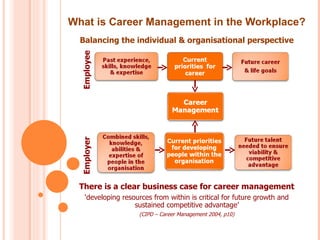
What is Career Management in the Workplace?
  Balancing the individual & organisational perspective


  Employee
  Employer


  There is a clear business case for career management
    ‘developing resources from within is critical for future growth and
                    sustained competitive advantage’
                     (CIPD – Career Management 2004, p10)
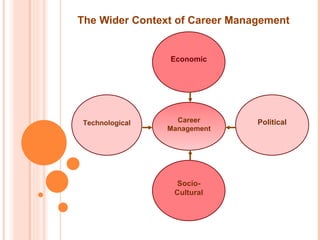
The Wider Context of Career Management


                Economic


Technological     Career        Political
                Management


                  Socio-
                 Cultural
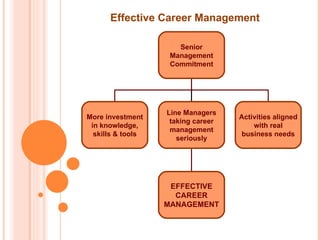
Effective Career Management

                      Senior
                    Management
                    Commitment


                   Line Managers
More investment                     Activities aligned
                    taking career
 in knowledge,                          with real
                    management
  skills & tools                     business needs
                      seriously


                    EFFECTIVE
                     CAREER
                   MANAGEMENT
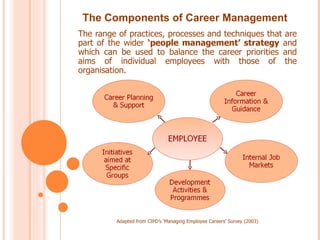
The Components of Career Management
The range of practices, processes and techniques that are
part of the wider ‘people management’ strategy and
which can be used to balance the career priorities and
aims of individual employees with those of the
organisation.


          Adapted from CIPD’s ‘Managing Employee Careers’ Survey (2003)
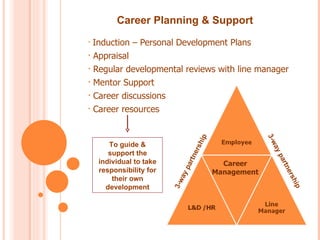
Career Planning & Support
• Induction – Personal Development Plans
• Appraisal

• Regular developmental reviews with line manager

• Mentor Support

• Career discussions

• Career resources


                                        hip


                                                           3-w
       To guide &


                                    ers


                                                              ay
       support the


                                 rtn


                                                              pa
    individual to take                          Career


                                                                rtn
                               pa
    responsibility for                        Management


                                                                   ers
        their own           ay
                         3-w


                                                                       hip
      development
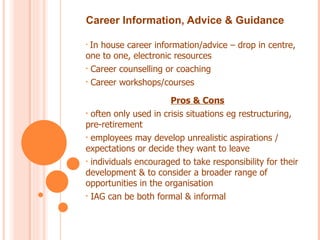
Career Information, Advice & Guidance

• In house career information/advice – drop in centre,
one to one, electronic resources
• Career counselling or coaching

• Career workshops/courses


                       Pros & Cons
• often only used in crisis situations eg restructuring,
pre-retirement
• employees may develop unrealistic aspirations /
expectations or decide they want to leave
• individuals encouraged to take responsibility for their
development & to consider a broader range of
opportunities in the organisation
• IAG can be both formal & informal
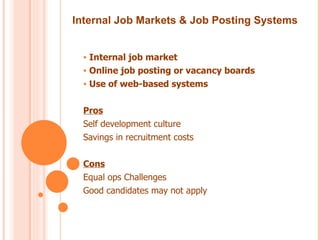
Internal Job Markets & Job Posting Systems


  • Internal job market
  • Online job posting or vacancy boards
  • Use of web-based systems


  Pros
  Self development culture
  Savings in recruitment costs


  Cons
  Equal ops Challenges
  Good candidates may not apply
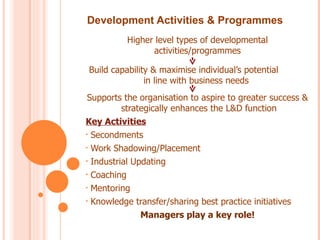
Development Activities & Programmes
          Higher level types of developmental
                activities/programmes

Build capability & maximise individual’s potential
               in line with business needs
 Supports the organisation to aspire to greater success &
          strategically enhances the L&D function
Key Activities
• Secondments

• Work Shadowing/Placement

• Industrial Updating

• Coaching

• Mentoring

• Knowledge transfer/sharing best practice initiatives

               Managers play a key role!
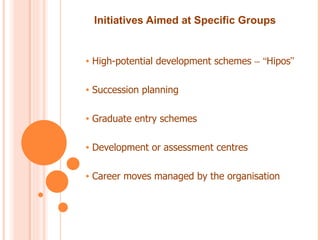
Initiatives Aimed at Specific Groups


•   High-potential development schemes – “Hipos”

•   Succession planning

•   Graduate entry schemes

•   Development or assessment centres

•   Career moves managed by the organisation
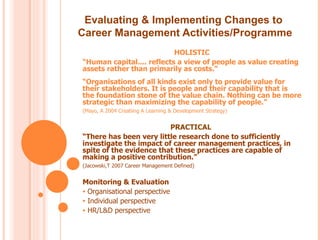
Evaluating & Implementing Changes to
Career Management Activities/Programme
                           HOLISTIC
“Human capital.... reflects a view of people as value creating
assets rather than primarily as costs.”
“Organisations of all kinds exist only to provide value for
their stakeholders. It is people and their capability that is
the foundation stone of the value chain. Nothing can be more
strategic than maximizing the capability of people.”
(Mayo, A 2004 Creatiing A Learning & Development Strategy)


                         PRACTICAL
“There has been very little research done to sufficiently
investigate the impact of career management practices, in
spite of the evidence that these practices are capable of
making a positive contribution.”
(Jacowski,T 2007 Career Management Defined)


Monitoring & Evaluation
• Organisational perspective
• Individual perspective
• HR/L&D perspective
Career Management v Talent Management
 Career Management
 • Ideally ‘holistic,’ all embracing and a key component of the
 HR strategy

 Talent Management
 • Depends on the perception of ‘talent’

 • Tends to have a narrower focus than career management &
 is just one aspect of HR strategy
 • A talent management strategy is more often focused on
 particular groups of staff and specifics such as succession
 planning and potential high flyers, talent pools

 The Future....
 A forward thinking approach may be to focus on the
 knowledge, skills & ‘talents’ of the whole organisation to
 develop the widest possible pool of talent
    “Releasing talent for business benefit requires organisations to
     understand individuals in their totality as much as it requires
      identifying potential successors for business critical roles”
            (Mce J, 2008 Talent Management: What Does It Really Mean?)
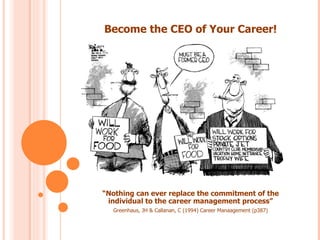
Become the CEO of Your Career!


“Nothing can ever replace the commitment of the
 individual to the career management process”
  Greenhaus, JH & Callanan, C (1994) Career Manaagement (p387)

Career & Talent Management

  • 1.
    The Range, Purpose& Techniques for Career Management and Guidance in the Workplace Presentation by Ann Sullivan Saturday 5th December 2009
  • 2.
    Career v CareerManagement? Lifelong, self-monitored process of career planning that involves choosing and setting personal goals, and formulating strategies for achieving them. (Business Dictionary.com) “Can be defined as the sequence of jobs that a person has during his or her working life” (King, Z 2004 Career Management, CIPD) Handling different aspects of a career activity successfully, usually in the form of meeting pre-established activity objectives. Career management usually refers to maintenance of all aspects of the career planning and development processes. (Eresumes.com/eglossary- http://www.eresumes.com/eglossary.html) “We need to redefine it as the individual’s lifelong progression in learning and in work.” (Tony Watts, 1998 Reshaping Career Development for the 21st century) “An individual's "course or progress through life (or a distinct portion of life)“ (Oxford English Dictionary) “A blend of formal and informal activities that should be pursued throughout one’s working life” (Greenhaus, JH & Callanan, C (1994) Career Manaagement)
  • 3.
    What is CareerManagement in the Workplace? Balancing the individual & organisational perspective Employee Employer There is a clear business case for career management ‘developing resources from within is critical for future growth and sustained competitive advantage’ (CIPD – Career Management 2004, p10)
  • 4.
    The Wider Contextof Career Management Economic Technological Career Political Management Socio- Cultural
  • 5.
    Effective Career Management Senior Management Commitment Line Managers More investment Activities aligned taking career in knowledge, with real management skills & tools business needs seriously EFFECTIVE CAREER MANAGEMENT
  • 6.
    The Components ofCareer Management The range of practices, processes and techniques that are part of the wider ‘people management’ strategy and which can be used to balance the career priorities and aims of individual employees with those of the organisation. Adapted from CIPD’s ‘Managing Employee Careers’ Survey (2003)
  • 7.
    Career Planning &Support • Induction – Personal Development Plans • Appraisal • Regular developmental reviews with line manager • Mentor Support • Career discussions • Career resources hip 3-w To guide & ers ay support the rtn pa individual to take Career rtn pa responsibility for Management ers their own ay 3-w hip development
  • 8.
    Career Information, Advice& Guidance • In house career information/advice – drop in centre, one to one, electronic resources • Career counselling or coaching • Career workshops/courses Pros & Cons • often only used in crisis situations eg restructuring, pre-retirement • employees may develop unrealistic aspirations / expectations or decide they want to leave • individuals encouraged to take responsibility for their development & to consider a broader range of opportunities in the organisation • IAG can be both formal & informal
  • 9.
    Internal Job Markets& Job Posting Systems • Internal job market • Online job posting or vacancy boards • Use of web-based systems Pros Self development culture Savings in recruitment costs Cons Equal ops Challenges Good candidates may not apply
  • 10.
    Development Activities &Programmes Higher level types of developmental activities/programmes Build capability & maximise individual’s potential in line with business needs Supports the organisation to aspire to greater success & strategically enhances the L&D function Key Activities • Secondments • Work Shadowing/Placement • Industrial Updating • Coaching • Mentoring • Knowledge transfer/sharing best practice initiatives Managers play a key role!
  • 11.
    Initiatives Aimed atSpecific Groups • High-potential development schemes – “Hipos” • Succession planning • Graduate entry schemes • Development or assessment centres • Career moves managed by the organisation
  • 12.
    Evaluating & ImplementingChanges to Career Management Activities/Programme HOLISTIC “Human capital.... reflects a view of people as value creating assets rather than primarily as costs.” “Organisations of all kinds exist only to provide value for their stakeholders. It is people and their capability that is the foundation stone of the value chain. Nothing can be more strategic than maximizing the capability of people.” (Mayo, A 2004 Creatiing A Learning & Development Strategy) PRACTICAL “There has been very little research done to sufficiently investigate the impact of career management practices, in spite of the evidence that these practices are capable of making a positive contribution.” (Jacowski,T 2007 Career Management Defined) Monitoring & Evaluation • Organisational perspective • Individual perspective • HR/L&D perspective
  • 13.
    Career Management vTalent Management Career Management • Ideally ‘holistic,’ all embracing and a key component of the HR strategy Talent Management • Depends on the perception of ‘talent’ • Tends to have a narrower focus than career management & is just one aspect of HR strategy • A talent management strategy is more often focused on particular groups of staff and specifics such as succession planning and potential high flyers, talent pools The Future.... A forward thinking approach may be to focus on the knowledge, skills & ‘talents’ of the whole organisation to develop the widest possible pool of talent “Releasing talent for business benefit requires organisations to understand individuals in their totality as much as it requires identifying potential successors for business critical roles” (Mce J, 2008 Talent Management: What Does It Really Mean?)
  • 14.
    Become the CEOof Your Career! “Nothing can ever replace the commitment of the individual to the career management process” Greenhaus, JH & Callanan, C (1994) Career Manaagement (p387)

Editor's Notes

  • #7 “ The growth of such systems has been strongly encouraged by the voluntary Investors in People programme, in which employers can be kitemarked if they meet certain specifications – including opportunities for development reviews” (Tony Watts, 1998)
  • #9 Handouts: Eli Lilly Case Study & NBP examples, Career Planning Sheet
  • #11 Refer to CIPD 2009 survey key findings re-uptake of activities
  • #14 “ All of us do not have equal talents, but all of us should have an equal opportunity to develop our talents.” ( John F. Kennedy )