CHAPTER 2
PSYCHIATRIC EVALUATION
Comprises of two sections
1. Histories:
• The patient’s description of how symptoms of
the current episode have evolved
• A review of past episodes and treatments
• A description of current and past medical
conditions
• A summary of family members' psychiatric
problems and treatments
• The patient's interpersonal and adaptive
functioning over time.
2. The Mental Status Examination:
• Systematic review of:
• Behavior
• Emotions
• Thinking (Cognitive functioning)
• Cross-sectional
Psychiatric History
IDENTIFICATION:
• Establishes the basic demographics of the patient
It includes:
• Name, Age, Sex, Address, Education, Marital Status
• Previous psychiatric admissions
• Living circumstances
• Source and reasons for referral
• Source of information and its reliability
Psychiatric History
CHIEF COMPLAINT:
• A verbatim recording of the patient's reason for seeking
treatment or evaluation.
• even apparently implausible or nonsensical verbatim conveys
valuable information
Examples:
• “I am thinking to kill myself”
• “I am not sick, it is my wife who is sick!”
• “the patient is mute”
Psychiatric History
HISTORY OF PRESENT ILLNESS
• A chronological description of how symptoms in the current
episode have unfolded over time.
• Onset of symptoms
• Progression over time
• Characterization of symptoms
• Aggravating and ameliorating factors
• What triggered the current episode?
• Effect of symptoms on functioning
Psychiatric History
• Treatments sought and its effects on the
symptoms
• Adherence to treatments
• Use of psychoactive substances
RISK OF DANGER TO SELF AND OTHERS!
CORROBORATE THE HISTORY
Psychiatric History
PAST PSYCHIATRIC HISTORY:
• Description previous episodes
• Attention to first episode
• Clear delineation of longitudinal course
• Previous medications: dose, duration, efficacy and
side effects
• Previous suicide attempts and aggressive
behavior
• Alcohol and other substance abuse
PAST MEDICAL HISTORY:
• Major illnesses and Surgeries
• Trauma, seizures, neurological illness…
• May be significant life events
• May precipitate psychiatric disorder
• Medical illnesses and their treatment may
cause psychiatric symptoms
• Hypoglycemia  anxiety, panic
• Importance in choosing psychotropic drugs
Psychiatric History
FAMILY HISTORY:
• Why do we need family history of psychiatric problems?
Treatments?
• Family pedigree
• Suicide, antisocial or aggressive behavior, alcohol or other
psychoactive substance abuse?
• Who is available to support the patient?
• Who is exacerbating symptoms?
Personal History
• Helps to understand the patient as a
person
• It is usually divided into:
• Perinatal
• Infancy & Early childhood
• Middle childhood
• Puberty & Adolescence
• Adulthood
Personal History
Perinatal
• Pregnancy and delivery
• Maternal emotional and physical state at
the time of the patient's birth
• Maternal alcohol or substance abuse
during her pregnancy
Personal History
Early Childhood
• Infant and mother relationship
• Problems with feeding and sleep
• Significant milestones
• Standing/walking
• First words/two-word sentences
• Bowel and bladder control
• Unusual behaviors (e.g., head-banging,
rocking)
Personal History
Middle Childhood:
• Discipline & punishments
• Early school experiences
• Tolerance to separation
• Earliest friendships
• Temperament
• Learning disabilities
• Aggression, phobias, bed-wetting, etc.
• Major illnesses
Psychiatric History
Puberty & Adolescence:
• Age of menarche, the circumstance of its onset,
and preparations (females)
• Early experiences in relationship and any confusion
or discomfort in relationships.
• Experimentation with drugs (alcohol, illicit drugs…)
• Early adulthood: development of career goals,
undertaking advanced education, starting a first
job, entering the military, and establishing a
partnership (including marriage)
Adulthood:
• Qualitative descriptions of current interpersonal
relationships
• Summary of the jobs held, the length of time in each, and
the reasons for leaving.
• Explore possible discrepancy between aspiration and
achievement.
• Interference of psychiatric illness with the capacity for
sustained productive work.
• Financial status and living arrangements
• Premorbid personality (traits)
• How do you describe yourselves as a person?
• How do you think others describe you as a person?
• Military History: behavior problems, premature discharge,
etc
• Forensic History: legal difficulties, imprisonment
Mental State Examination
• Analogous to the physical examination in physical medicine.
• It is the description of the patient’s appearance speech, actions
and thoughts during the interview.
• Unlike the history, mental status can change from time to time.
• Most of the MSE is observational and can be made in the
course taking the history.
• Record what is observed than what is inferred (Observed data
are always more reliable than inferred data)
Mental State Examination
General Description:
APPEARANCE: overall physical impression as reflected by posture,
gait, clothing, and grooming
Is the patient overdressed or underdressed? Is the patient
wearing excessive, garish make-up? Is the patient disheveled,
unkempt, or poorly groomed?
EYE CONTACT: the degree of eye contact the patient is making
during the interview. It could be described as good (adequate),
poor (inadequate), or “patient avoids eye contact”
Mental State Examination
BEHAVIOR and PSYCHOMOTOR ACTIVITY: refers to the
quantitative and qualitative aspects of the patient’s motor
behavior
E.g. Psychomotor agitation Vs retardation; wringing of hands,
mannerisms, echopraxia, negativism, etc
ATTITUDE: the patient’s attitude towards the examiner. Is the
patient cooperative, oppositional, or hostile? Other
descriptions include: friendly, over-familiar, defensive, guarded,
suspicious, contemptuous, perplexed, indifferent, interested
etc.
Mental State Examination
Mood and Affect
MOOD: pervasive and sustained emotional state as described by
the patient (Subjective)
• Mood is recorded in verbatim “I feel cheerful”, “I am feeling
anxious”, “I feel good/ normal”
AFFECT: the patient’s present emotional expression inferred
during the interview
• Intensity & range: normal, constricted, blunted, or flat.
• Quality: smiling, anxious, tearful, angry, etc
• Stability: stable, labile
• Appropriateness:- assessed in the context of the subject the
patient is discussing
Mental State Examination
Speech: describes the physical production of speech, not the
ideas being conveyed.
• Quantity: scanty, talkative, copious, mute
• Rate: rapid, slow, pressured, hesitant, normal rate
• Spontaneity: spontaneous Vs non-spontaneous
• Volume: low, high/ loud
• Quality: prosodic, monotonous, slurred etc…
Mental State Examination
Thought
THOUGHT FORM (PROCESS): refers to the way in which ideas are
linked, not the ideas themselves.
• Normally thoughts are logically associated and goal directed.
• No thought disorder is pathognomonic for a particular disorder.
• Examples: flight of ideas, derailment,circumstantiality…
Mental State Examination
THOUGHT CONTENT: refers to what a person is actually thinking
about: ideas, beliefs, obsessions
• Delusions are fixed, false beliefs that rigidly held regardless of
evidence to the contrary and are not shared by others.
• Ideas of reference: beliefs that everyday neutral occurrences
carry specific, unique, and personal significance
• Suicidal ideas and ideas of hurting someone else should be
inquired and recorded
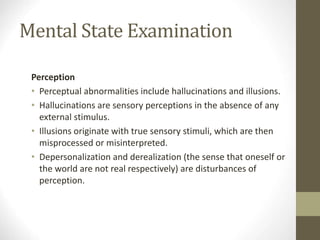
Mental State Examination
Perception
• Perceptual abnormalities include hallucinations and illusions.
• Hallucinations are sensory perceptions in the absence of any
external stimulus.
• Illusions originate with true sensory stimuli, which are then
misprocessed or misinterpreted.
• Depersonalization and derealization (the sense that oneself or
the world are not real respectively) are disturbances of
perception.
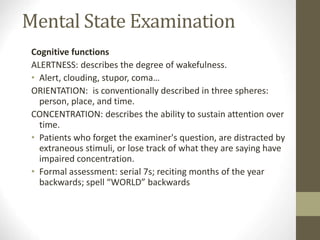
Mental State Examination
Cognitive functions
ALERTNESS: describes the degree of wakefulness.
• Alert, clouding, stupor, coma…
ORIENTATION: is conventionally described in three spheres:
person, place, and time.
CONCENTRATION: describes the ability to sustain attention over
time.
• Patients who forget the examiner's question, are distracted by
extraneous stimuli, or lose track of what they are saying have
impaired concentration.
• Formal assessment: serial 7s; reciting months of the year
backwards; spell “WORLD” backwards
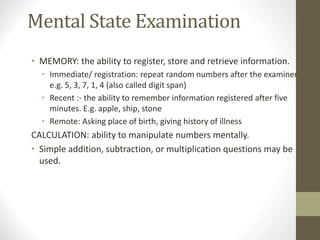
Mental State Examination
• MEMORY: the ability to register, store and retrieve information.
• Immediate/ registration: repeat random numbers after the examiner
e.g. 5, 3, 7, 1, 4 (also called digit span)
• Recent :- the ability to remember information registered after five
minutes. E.g. apple, ship, stone
• Remote: Asking place of birth, giving history of illness
CALCULATION: ability to manipulate numbers mentally.
• Simple addition, subtraction, or multiplication questions may be
used.
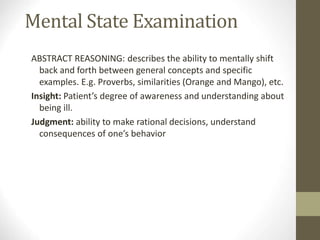
Mental State Examination
ABSTRACT REASONING: describes the ability to mentally shift
back and forth between general concepts and specific
examples. E.g. Proverbs, similarities (Orange and Mango), etc.
Insight: Patient’s degree of awareness and understanding about
being ill.
Judgment: ability to make rational decisions, understand
consequences of one’s behavior
Physical Examination
• Vital signs
• Complete physical examination for inpatients and patients
with medical complaints
• Neurologic examination
DSM Multiaxial Diagnosis
• The diagnostic & statistical manual system DSM – American
psychiatric association
• DSM-I 1952 . DSM-III-R
• DSM-II 1968 . DSM-IV 1994
• DSM-III 1979 . DSM IV-TR 2000 & DSM 5: 2013
DSM Multiaxial Diagnosis
• Assessment on several axes, each refers to a different domain
of information – five axes
• Comprehensive & systematic evaluation
• Biopsychosocial model
Cont…
• Axis I- clinical disorder
• Axis II- personality disorder & mental retardation
• 17 major classes & more than 300 specific disorders
• Axis III- general medical condition
Cont…
• Axis IV psychosocial condition
• Significantly contribute to the development or exacerbation of
the current disorder
• Positive/ negative
• Important in formulating treatment plan
• Attempt to remove stressor
• Help the patient cope with them
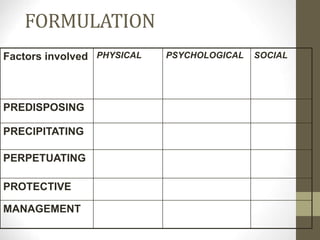
Formulation
• Describes what, how and why the patient developed the
illness at this time
• Directs how the patient can be helped
• Offers a general impression on the patient’s prognosis.
ETIOLOGY OF MENTAL DISORDERS
• Unknown or incompletely understood.
• Caused by a combination and interaction of several factors.
• Causes are remote in time.
• Single cause may lead to several effect.
• Complex and ambiguous.
• The Bio-Psycho-Social model is so far the most plausible
approach to the problem
Classification of causes
• A single disease may result from several causes
and scheme for understanding the illness.
• Predisposing factors are those that render the
personality susceptible or vulnerable and are
present over a long period of time.
• Precipitating factors are events that precede
clinical onset.
• Perpetuating factors are factors that prolong
the course of a disorder after it has been
provoked.
PREDISPOSING FACTORS
1. Genetics:-
E.g. schizophrenia, Bipolar Disorder,
dementia
2. Age:-
E.g. Adolescence, middle life, old age
Physical, psychological and social factor early in life
and premorbid personality is important.
PRECIPITATING FACTORS
1. Environment:- Emotional as well as physical milieu
• Family interactions (engagement, marriage, separation, death,
becoming a parent)
• Other interpersonal relationship (Difficulties with friends or
neighbors)
• Living circumstances (immigration)
• Financial affairs (inadequate finances)
PRECIPITATING FACTORS
• Legal affairs (Being arrested or sued)
• Occupation – stress related to job (e.g. conflict
with a superior)
2.Physical illness
• Personal (pain, discomfort)
• Financial (cost of treatment)
• Emotional (feeling of depression)
• Body image (breast amputation)
Perpetuating factors
• Secondary demoralization and withdrawal from social
activities.
• Substance use/abuse
• Non-adherence with treatment
• Ongoing psychosocial stressors
• Lack of social support (supportive network)
FORMULATION
Factors involved PHYSICAL PSYCHOLOGICAL SOCIAL
PREDISPOSING
PRECIPITATING
PERPETUATING
PROTECTIVE
MANAGEMENT

CHAPTER 2 PSYCHIATRIC EVALUATION.pptx

  • 1.
  • 2.
    Comprises of twosections 1. Histories: • The patient’s description of how symptoms of the current episode have evolved • A review of past episodes and treatments • A description of current and past medical conditions • A summary of family members' psychiatric problems and treatments • The patient's interpersonal and adaptive functioning over time.
  • 3.
    2. The MentalStatus Examination: • Systematic review of: • Behavior • Emotions • Thinking (Cognitive functioning) • Cross-sectional
  • 4.
    Psychiatric History IDENTIFICATION: • Establishesthe basic demographics of the patient It includes: • Name, Age, Sex, Address, Education, Marital Status • Previous psychiatric admissions • Living circumstances • Source and reasons for referral • Source of information and its reliability
  • 5.
    Psychiatric History CHIEF COMPLAINT: •A verbatim recording of the patient's reason for seeking treatment or evaluation. • even apparently implausible or nonsensical verbatim conveys valuable information Examples: • “I am thinking to kill myself” • “I am not sick, it is my wife who is sick!” • “the patient is mute”
  • 6.
    Psychiatric History HISTORY OFPRESENT ILLNESS • A chronological description of how symptoms in the current episode have unfolded over time. • Onset of symptoms • Progression over time • Characterization of symptoms • Aggravating and ameliorating factors • What triggered the current episode? • Effect of symptoms on functioning
  • 7.
    Psychiatric History • Treatmentssought and its effects on the symptoms • Adherence to treatments • Use of psychoactive substances RISK OF DANGER TO SELF AND OTHERS! CORROBORATE THE HISTORY
  • 8.
    Psychiatric History PAST PSYCHIATRICHISTORY: • Description previous episodes • Attention to first episode • Clear delineation of longitudinal course • Previous medications: dose, duration, efficacy and side effects • Previous suicide attempts and aggressive behavior • Alcohol and other substance abuse
  • 9.
    PAST MEDICAL HISTORY: •Major illnesses and Surgeries • Trauma, seizures, neurological illness… • May be significant life events • May precipitate psychiatric disorder • Medical illnesses and their treatment may cause psychiatric symptoms • Hypoglycemia  anxiety, panic • Importance in choosing psychotropic drugs
  • 10.
    Psychiatric History FAMILY HISTORY: •Why do we need family history of psychiatric problems? Treatments? • Family pedigree • Suicide, antisocial or aggressive behavior, alcohol or other psychoactive substance abuse? • Who is available to support the patient? • Who is exacerbating symptoms?
  • 11.
    Personal History • Helpsto understand the patient as a person • It is usually divided into: • Perinatal • Infancy & Early childhood • Middle childhood • Puberty & Adolescence • Adulthood
  • 12.
    Personal History Perinatal • Pregnancyand delivery • Maternal emotional and physical state at the time of the patient's birth • Maternal alcohol or substance abuse during her pregnancy
  • 13.
    Personal History Early Childhood •Infant and mother relationship • Problems with feeding and sleep • Significant milestones • Standing/walking • First words/two-word sentences • Bowel and bladder control • Unusual behaviors (e.g., head-banging, rocking)
  • 14.
    Personal History Middle Childhood: •Discipline & punishments • Early school experiences • Tolerance to separation • Earliest friendships • Temperament • Learning disabilities • Aggression, phobias, bed-wetting, etc. • Major illnesses
  • 15.
    Psychiatric History Puberty &Adolescence: • Age of menarche, the circumstance of its onset, and preparations (females) • Early experiences in relationship and any confusion or discomfort in relationships. • Experimentation with drugs (alcohol, illicit drugs…) • Early adulthood: development of career goals, undertaking advanced education, starting a first job, entering the military, and establishing a partnership (including marriage)
  • 16.
    Adulthood: • Qualitative descriptionsof current interpersonal relationships • Summary of the jobs held, the length of time in each, and the reasons for leaving. • Explore possible discrepancy between aspiration and achievement. • Interference of psychiatric illness with the capacity for sustained productive work. • Financial status and living arrangements • Premorbid personality (traits) • How do you describe yourselves as a person? • How do you think others describe you as a person? • Military History: behavior problems, premature discharge, etc • Forensic History: legal difficulties, imprisonment
  • 17.
    Mental State Examination •Analogous to the physical examination in physical medicine. • It is the description of the patient’s appearance speech, actions and thoughts during the interview. • Unlike the history, mental status can change from time to time. • Most of the MSE is observational and can be made in the course taking the history. • Record what is observed than what is inferred (Observed data are always more reliable than inferred data)
  • 18.
    Mental State Examination GeneralDescription: APPEARANCE: overall physical impression as reflected by posture, gait, clothing, and grooming Is the patient overdressed or underdressed? Is the patient wearing excessive, garish make-up? Is the patient disheveled, unkempt, or poorly groomed? EYE CONTACT: the degree of eye contact the patient is making during the interview. It could be described as good (adequate), poor (inadequate), or “patient avoids eye contact”
  • 19.
    Mental State Examination BEHAVIORand PSYCHOMOTOR ACTIVITY: refers to the quantitative and qualitative aspects of the patient’s motor behavior E.g. Psychomotor agitation Vs retardation; wringing of hands, mannerisms, echopraxia, negativism, etc ATTITUDE: the patient’s attitude towards the examiner. Is the patient cooperative, oppositional, or hostile? Other descriptions include: friendly, over-familiar, defensive, guarded, suspicious, contemptuous, perplexed, indifferent, interested etc.
  • 20.
    Mental State Examination Moodand Affect MOOD: pervasive and sustained emotional state as described by the patient (Subjective) • Mood is recorded in verbatim “I feel cheerful”, “I am feeling anxious”, “I feel good/ normal” AFFECT: the patient’s present emotional expression inferred during the interview • Intensity & range: normal, constricted, blunted, or flat. • Quality: smiling, anxious, tearful, angry, etc • Stability: stable, labile • Appropriateness:- assessed in the context of the subject the patient is discussing
  • 21.
    Mental State Examination Speech:describes the physical production of speech, not the ideas being conveyed. • Quantity: scanty, talkative, copious, mute • Rate: rapid, slow, pressured, hesitant, normal rate • Spontaneity: spontaneous Vs non-spontaneous • Volume: low, high/ loud • Quality: prosodic, monotonous, slurred etc…
  • 22.
    Mental State Examination Thought THOUGHTFORM (PROCESS): refers to the way in which ideas are linked, not the ideas themselves. • Normally thoughts are logically associated and goal directed. • No thought disorder is pathognomonic for a particular disorder. • Examples: flight of ideas, derailment,circumstantiality…
  • 23.
    Mental State Examination THOUGHTCONTENT: refers to what a person is actually thinking about: ideas, beliefs, obsessions • Delusions are fixed, false beliefs that rigidly held regardless of evidence to the contrary and are not shared by others. • Ideas of reference: beliefs that everyday neutral occurrences carry specific, unique, and personal significance • Suicidal ideas and ideas of hurting someone else should be inquired and recorded
  • 24.
    Mental State Examination Perception •Perceptual abnormalities include hallucinations and illusions. • Hallucinations are sensory perceptions in the absence of any external stimulus. • Illusions originate with true sensory stimuli, which are then misprocessed or misinterpreted. • Depersonalization and derealization (the sense that oneself or the world are not real respectively) are disturbances of perception.
  • 25.
    Mental State Examination Cognitivefunctions ALERTNESS: describes the degree of wakefulness. • Alert, clouding, stupor, coma… ORIENTATION: is conventionally described in three spheres: person, place, and time. CONCENTRATION: describes the ability to sustain attention over time. • Patients who forget the examiner's question, are distracted by extraneous stimuli, or lose track of what they are saying have impaired concentration. • Formal assessment: serial 7s; reciting months of the year backwards; spell “WORLD” backwards
  • 26.
    Mental State Examination •MEMORY: the ability to register, store and retrieve information. • Immediate/ registration: repeat random numbers after the examiner e.g. 5, 3, 7, 1, 4 (also called digit span) • Recent :- the ability to remember information registered after five minutes. E.g. apple, ship, stone • Remote: Asking place of birth, giving history of illness CALCULATION: ability to manipulate numbers mentally. • Simple addition, subtraction, or multiplication questions may be used.
  • 27.
    Mental State Examination ABSTRACTREASONING: describes the ability to mentally shift back and forth between general concepts and specific examples. E.g. Proverbs, similarities (Orange and Mango), etc. Insight: Patient’s degree of awareness and understanding about being ill. Judgment: ability to make rational decisions, understand consequences of one’s behavior
  • 28.
    Physical Examination • Vitalsigns • Complete physical examination for inpatients and patients with medical complaints • Neurologic examination
  • 29.
    DSM Multiaxial Diagnosis •The diagnostic & statistical manual system DSM – American psychiatric association • DSM-I 1952 . DSM-III-R • DSM-II 1968 . DSM-IV 1994 • DSM-III 1979 . DSM IV-TR 2000 & DSM 5: 2013
  • 30.
    DSM Multiaxial Diagnosis •Assessment on several axes, each refers to a different domain of information – five axes • Comprehensive & systematic evaluation • Biopsychosocial model
  • 31.
    Cont… • Axis I-clinical disorder • Axis II- personality disorder & mental retardation • 17 major classes & more than 300 specific disorders • Axis III- general medical condition
  • 32.
    Cont… • Axis IVpsychosocial condition • Significantly contribute to the development or exacerbation of the current disorder • Positive/ negative • Important in formulating treatment plan • Attempt to remove stressor • Help the patient cope with them
  • 33.
    Formulation • Describes what,how and why the patient developed the illness at this time • Directs how the patient can be helped • Offers a general impression on the patient’s prognosis.
  • 34.
    ETIOLOGY OF MENTALDISORDERS • Unknown or incompletely understood. • Caused by a combination and interaction of several factors. • Causes are remote in time. • Single cause may lead to several effect. • Complex and ambiguous. • The Bio-Psycho-Social model is so far the most plausible approach to the problem
  • 35.
    Classification of causes •A single disease may result from several causes and scheme for understanding the illness. • Predisposing factors are those that render the personality susceptible or vulnerable and are present over a long period of time. • Precipitating factors are events that precede clinical onset. • Perpetuating factors are factors that prolong the course of a disorder after it has been provoked.
  • 36.
    PREDISPOSING FACTORS 1. Genetics:- E.g.schizophrenia, Bipolar Disorder, dementia 2. Age:- E.g. Adolescence, middle life, old age Physical, psychological and social factor early in life and premorbid personality is important.
  • 37.
    PRECIPITATING FACTORS 1. Environment:-Emotional as well as physical milieu • Family interactions (engagement, marriage, separation, death, becoming a parent) • Other interpersonal relationship (Difficulties with friends or neighbors) • Living circumstances (immigration) • Financial affairs (inadequate finances)
  • 38.
    PRECIPITATING FACTORS • Legalaffairs (Being arrested or sued) • Occupation – stress related to job (e.g. conflict with a superior) 2.Physical illness • Personal (pain, discomfort) • Financial (cost of treatment) • Emotional (feeling of depression) • Body image (breast amputation)
  • 39.
    Perpetuating factors • Secondarydemoralization and withdrawal from social activities. • Substance use/abuse • Non-adherence with treatment • Ongoing psychosocial stressors • Lack of social support (supportive network)
  • 40.
    FORMULATION Factors involved PHYSICALPSYCHOLOGICAL SOCIAL PREDISPOSING PRECIPITATING PERPETUATING PROTECTIVE MANAGEMENT